Hybrid Inverter Battery Compatibility: The Truth About LiFePO4 vs AGM vs Tubular
Hybrid inverter battery compatibility explained. Learn how wrong settings destroy batteries and how to configure LiFePO4, AGM, and tubular systems correctly.
Hybrid inverter battery compatibility refers to how well a battery’s voltage, charging requirements, and communication system match the inverter’s control logic.
A Nigerian home runs a hybrid solar system for fourteen months. The battery bank depletes faster every week. By month fourteen, a 10kWh battery delivers three hours of backup instead of ten. The inverter display shows no faults. The solar array is producing normally. The installer checks the wiring and says everything looks correct.
The battery is dying. It has been dying since day one. Not because it was a bad battery. Because the inverter was configured for the wrong battery type, and nobody noticed for over a year.
In Nigeria, most hybrid inverter battery failures are not caused by bad batteries. They are caused by wrong compatibility and wrong configuration.
Your battery choice determines whether you use 100% or less than 50% of what you paid for in a hybrid inverter. A hybrid inverter paired with the wrong battery is a sophisticated and expensive controller managing a dumb device blindly.
Are hybrid inverters compatible with all battery types?
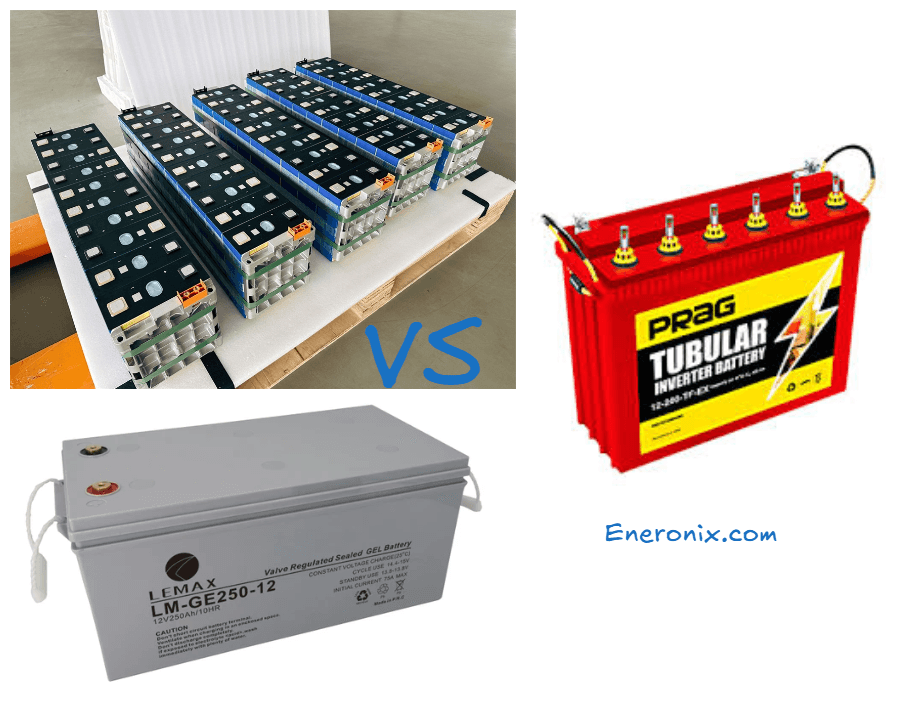
Yes, hybrid inverters can work with LiFePO4, AGM, and tubular batteries. True compatibility depends on charge profile and BMS communication, not just voltage. LiFePO4 offers full compatibility with closed-loop control. AGM and tubular operate with significant limitations and require precise manual configuration to avoid long-term damage.
The Three Levels of hybrid inverter battery Compatibility
Most buyers check one thing when pairing a battery with a hybrid inverter: voltage. The battery is 48V. The inverter is 48V. They match. Done.
That is Level 1. It is the least important level for long-term performance. The batteries that fail in 14 months passed Level 1 perfectly.
There are three levels of compatibility. All three must be satisfied. The first is the only one most people check. The second and third are where batteries are silently destroyed.
Level 1: Voltage Compatibility
The battery nominal voltage must fall within the inverter’s DC input range. A 48V hybrid inverter requires a 48V battery bank: four 12V batteries in series, or a single 48V LiFePO4 pack configured as 16 cells in series. Both LiFePO4 and lead-acid 48V banks fall within a typical hybrid inverter’s DC input range of 40V to 60V. Voltage compatibility is necessary but not sufficient.
Level 2: Charge Profile Compatibility
Every battery chemistry has a specific electrochemical requirement for how it should be charged. The inverter’s charging algorithm must match that requirement precisely. A mismatch does not cause immediate failure. It causes slow, progressive degradation that is invisible until the battery has lost 30 to 50% of its original capacity.
LiFePO4 requires: CC-CV profile (constant current to full charge voltage, then taper). No float stage. Once full, the battery rests at open-circuit voltage. Holding LiFePO4 at high voltage after full charge accelerates calendar aging.
Lead-acid (AGM and tubular) requires: 3-stage profile (bulk, absorption, float). Absorption holds bulk voltage for 2 to 4 hours. Float then holds a lower voltage indefinitely to counteract self-discharge and prevent sulphation.
These are fundamentally different charging behaviours. An inverter configured for LiFePO4 applied to lead-acid removes the float stage the battery depends on. An inverter configured for lead-acid applied to LiFePO4 damages cells by applying float voltage the battery must never receive.
Level 3: BMS Communication Compatibility
This level applies only to LiFePO4. It determines whether a lithium battery system lasts 3 years or 12 years.
A LiFePO4 battery contains a BMS that monitors individual cell voltages, temperatures, and current in real time. In a properly configured hybrid system, the BMS communicates directly with the hybrid inverter using CAN bus or RS485. Through this link, the BMS sends three dynamic signals to the inverter every second:
CVL (Charge Voltage Limit): the maximum voltage the inverter may apply at this exact moment
CCL (Charge Current Limit): the maximum current the inverter may push into the battery at this exact moment
DCL (Discharge Current Limit): the maximum current the battery will allow the inverter to draw at this exact moment
These three numbers change dynamically as the battery’s SOC, temperature, and cell balance change. Without this communication link, the inverter manages LiFePO4 using the same blind voltage-curve approach it uses for lead-acid. The battery appears to charge and discharge normally. But the inverter cannot see what is happening inside the cells.
What this means in practice: A LiFePO4 battery managed without BMS communication looks healthy for 12 to 18 months. Then capacity suddenly collapses as the accumulated cell damage becomes impossible to ignore.
The Master hybrid inverter battery compatibility Comparison Table
Before the electrochemistry, this table answers the question most buyers actually have in 30 seconds.
Feature
LiFePO4
AGM
Tubular
BMS communication
Yes (CAN or RS485)
No
No
Charging type
CC-CV, no float
3-stage (bulk, absorption, float)
3-stage + periodic equalization
Float stage required
No (harmful)
Yes (mandatory)
Yes (mandatory)
Maintenance required
None
None
Yes (water topping every 2 to 3 months)
Usable DoD
80%
50%
50%
Realistic lifespan in Nigeria
8 to 12 years
2 to 4 years
2 to 4 years
Temperature sensitivity
Low
High
High
Open or closed loop
Closed loop
Open loop
Open loop
Typical failure mode
BMS comms loss, float damage
Overcharge gassing, capacity fade
Sulphation from missed equalization, electrolyte loss
Compatible with full hybrid features
Yes (90 to 100%)
Partial (60 to 70%)
Partial (40 to 50%)
The last row is the one that matters most. Every feature that makes a hybrid inverter worth its price (BMS-managed charge optimisation, accurate SOC, TOU scheduling based on real battery state, dynamic current limiting) requires a LiFePO4 battery with active BMS communication. AGM and tubular unlock some of these features partially. Most of them not at all. A hybrid inverter with a tubular battery bank is using 40 to 50% of its capability. The other 50 to 60% is paid for and sitting idle.
What Happens When You Mismatch (The Electrochemistry)
This is the section most Nigerian solar articles skip entirely. They say use the right settings without explaining what the wrong settings actually do to a battery at the electrochemical level. That omission is why the same failures repeat across thousands of Nigerian installations every year.
Case 1: AGM Connected to an Inverter Configured for LiFePO4
A hybrid inverter configured for LiFePO4 at 48V applies: bulk/charge voltage 58.4V, brief absorption at 58.4V, float disabled or set to 53.6V, equalization never.
An AGM battery at 48V nominal requires: bulk 57.6V, absorption 57.6V held for 2 hours, float 54.0V applied continuously, equalization disabled.
The 58.4V bulk is 0.8V above AGM maximum. For a sealed AGM battery that cannot vent, this causes internal gas pressure to build on every charge cycle. AGM pressure relief valves rated at 0.15 to 0.35 bar vent irreversibly under repeated overpressure, losing electrolyte moisture that cannot be replaced.
More critically, the float stage is disabled or set to 53.6V instead of 54.0V. Without a float voltage to compensate for self-discharge, the battery slowly drops below 50% SOC between charge cycles. Below 50% SOC, lead sulphate crystals begin forming on the negative plates. Over weeks, these crystals harden and become electrochemically irreversible.
Result: Progressive sulphation and electrolyte loss. Capacity loss of 30 to 40% within 12 to 18 months. The battery reads normal voltage but delivers reduced Ah.
Case 2: LiFePO4 Connected to an Inverter Configured for Tubular Lead-Acid
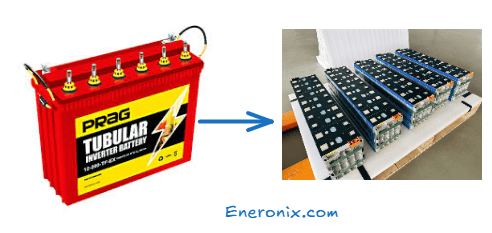
This is the most common and most destructive mismatch in Nigeria. It happens every time a home replaces a failed tubular bank with LiFePO4 and nobody reconfigures the inverter.
A hybrid inverter configured for tubular at 48V applies: bulk 57.6V, absorption 57.6V held for 3 hours, float 54.4V applied continuously and indefinitely, equalization 60.0V to 62.0V periodically every 30 to 90 days.
A LiFePO4 battery at 48V nominal requires: maximum charge voltage 58.4V (absolute cell limit 3.65V x 16 cells), float disabled entirely, equalization never under any circumstances.
The float voltage of 54.4V keeps LiFePO4 cells at approximately 93 to 96% SOC indefinitely. Research on LiFePO4 cell degradation shows that cells held continuously above 95% SOC degrade 3 to 5 times faster than cells cycled between 20% and 80% SOC.
When the automatic equalization fires at 60.0V to 62.0V, individual cells are pushed to 3.75V to 3.875V. The LiFePO4 cell maximum is 3.65V. Above 3.65V, lithium ions plate out as metallic lithium on the anode rather than intercalating into the graphite. This is called lithium plating. It is irreversible. Each plating event permanently reduces the cell’s capacity and internal resistance.
Result: Accelerated calendar aging from continuous float overvoltage. Irreversible lithium plating from equalization events. A 10kWh LiFePO4 battery rated for 6,000 cycles is typically destroyed within 18 to 36 months in this configuration.
Case 3: Tubular Connected to an Inverter Configured for LiFePO4
With LiFePO4 settings applied to tubular: float is disabled or set to 53.6V instead of the required 54.4V, equalization is never applied, absorption is cut short.
Without adequate float voltage, tubular batteries self-discharge between charge cycles. Without periodic equalization at 60V+, sulphate crystals accumulate on the negative plates progressively. Without a proper 3-hour absorption stage, the battery never fully charges. It cycles between 70% and 95% SOC rather than 20% and 100%. This partial state of charge cycling is the leading cause of premature tubular battery failure.
Result: Chronic partial state of charge. Progressive sulphation on negative plates. A battery rated at 1,500 cycles delivers 600 to 800 cycles before capacity falls below 70% of original. Expected lifespan of 5 to 7 years shortens to 2 to 3 years.
The Tubular Battery Reality in Nigeria
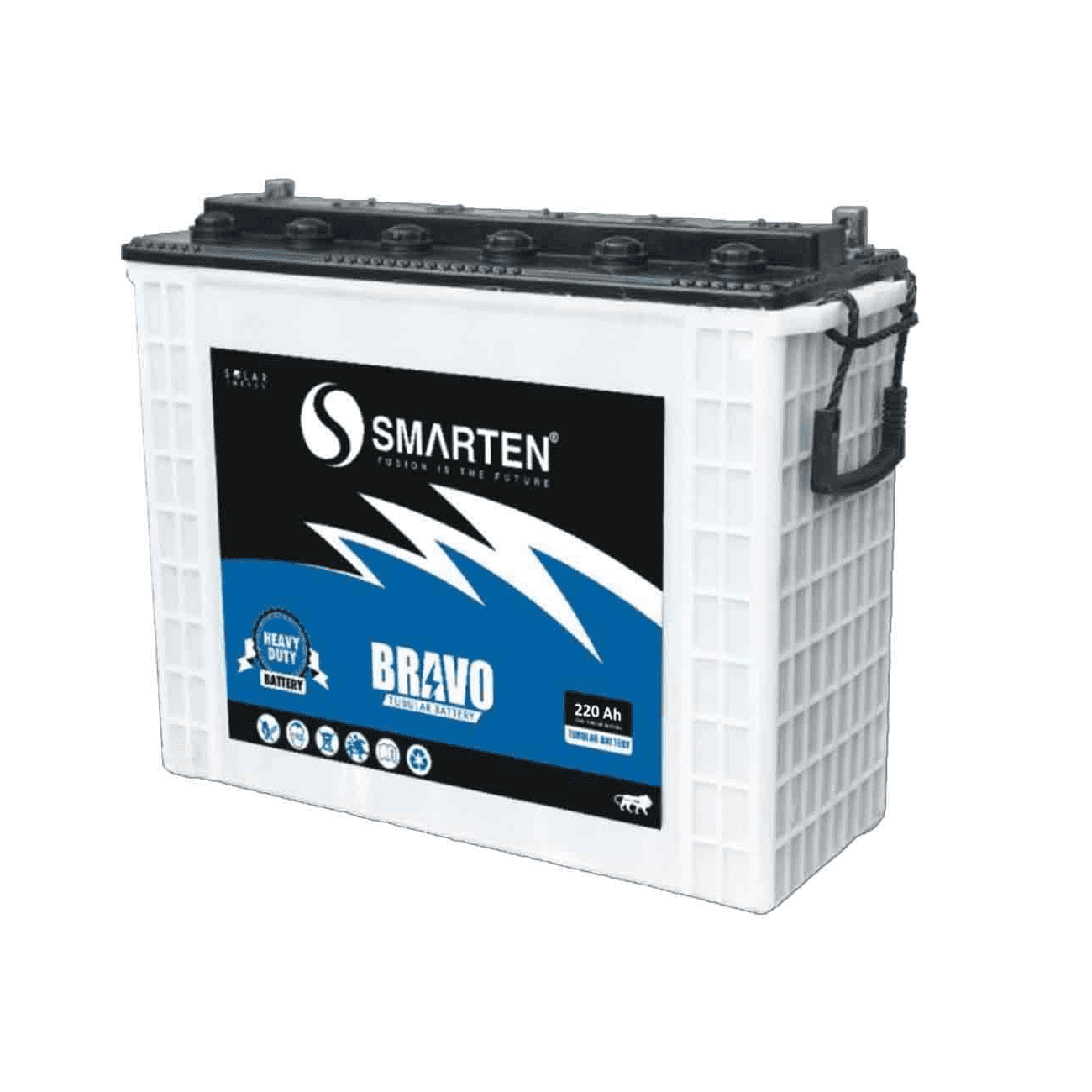
Tubular batteries are the most common battery type in Nigerian homes. They are familiar, widely available, cheaper per kWh than LiFePO4, and deeply embedded in the market. The honest answer to whether they work with a hybrid inverter is yes, with conditions that most buyers are not told.
The Open-Loop Problem
Tubular batteries have no BMS and no communication port. The hybrid inverter cannot receive CVL, CCL, or DCL signals. It manages the battery entirely in open-loop mode: measuring terminal voltage and estimating SOC from a fixed voltage-SOC curve.
Lead-acid battery voltage under load is a highly unreliable SOC indicator. A tubular battery at 60% SOC discharging at 50A may read the same terminal voltage as a battery at 40% SOC at rest. The inverter cannot distinguish these states.
In simple terms: the hybrid inverter thinks it knows what your tubular battery is doing. It does not.
This is why Nigerian homes with tubular batteries on hybrid inverters regularly experience inverter displays showing 70% battery when the bank is actually at 40%, grid switching on prematurely when battery still has capacity, and unexpected deep discharge events that accelerate sulphation.
Our article on SOC drift in lithium battery systems explains this problem in detail. For tubular batteries, the same drift occurs but cannot be corrected because there is no BMS to provide a real SOC reference.
The Temperature Problem
A well-established principle in battery engineering: lead-acid battery lifespan halves for every 8 degrees C rise above 25 degrees C.
A quality tubular battery rated for 1,500 cycles at 25 degrees C:
At 33 degrees C (mild Nigerian ambient): approximately 750 cycles
At 37 degrees C (typical Lagos plant room): approximately 530 cycles
At 40 degrees C (sealed plant room, harmattan): less than 400 cycles
A tubular battery rated for 1,500 cycles can realistically deliver less than 400 cycles in Nigerian heat conditions without strict maintenance. That is a lifespan of just over one year at one cycle per day.
A LiFePO4 battery at the same ambient temperature loses significantly less capacity per degree. Its thermal degradation coefficient is approximately 0.3 to 0.5% per degree above 25 degrees C, compared to lead-acid’s effective 50% per 8 degrees C. In a 40 degree C Nigerian plant room, LiFePO4 delivers 93 to 96% of its rated cycle life. Tubular delivers less than 30%.
The Financial Consequence
A tubular battery bank replaced every 2 years over a 10-year system life costs N700,000 to N1,300,000 in replacements alone, not counting installation labour each time. A single LiFePO4 bank correctly configured lasts the same 10 years with zero replacement cost. The LiFePO4 premium pays for itself in the first replacement cycle.
The Maintenance Problem
Tubular batteries require electrolyte topping with distilled water every 2 to 3 months in Nigerian heat. Most Nigerian homeowners do not do this. The electrolyte level drops, plates are exposed above the electrolyte surface, and the exposed active material dries and falls off the plates. A bank neglected for 6 months loses 20 to 30% of its capacity permanently.
In simple terms: a hybrid inverter with tubular batteries is a N500,000 to N1,500,000 control system managing a battery that the control system cannot see, cannot communicate with, and cannot protect from its own environment.
AGM vs Tubular on a Hybrid Inverter
When a buyer has decided to use lead-acid on a hybrid inverter, the next question is whether AGM or tubular is the better choice. The answer hinges on one issue: equalization.
Tubular batteries require periodic equalization at 60V to 62V (48V system) for 2 to 3 hours every 30 to 90 days. It breaks down hardened sulphate crystals, balances cell electrolyte concentrations, and removes stratification. Without equalization, tubular capacity falls 5 to 10% per year from progressive sulphation.
AGM batteries cannot accept equalization. They are sealed. Gas generated during equalization cannot escape. Internal pressure builds until the pressure relief valve opens, releasing electrolyte moisture that cannot be replaced. Equalization destroys AGM batteries.
Most Nigerian hybrid inverters (Deye, Growatt, Felicity) do not have automated equalization schedulers. The equalization that tubular requires must be performed manually every 1 to 3 months. Most Nigerian homeowners and many installers do not do this.
For a hybrid system where regular maintenance cannot be guaranteed: AGM is the better lead-acid choice. It is more forgiving of open-loop management limitations. Tubular is the better choice only if the owner commits to monthly equalization and quarterly water topping. This is a real operational discipline, not a setting.
The Correct Configuration for Each Battery Type
LiFePO4 on a 48V Hybrid Inverter
Parameter
Setting
Battery type
LiFePO4 or Lithium
Bulk/charge voltage limit
58.4V
Absorption voltage
58.4V (brief CV taper)
Float voltage
Disabled or 53.6V
Discharge cut-off
44.0V to 46.4V
Equalization
Never
BMS communication
CAN or RS485, verify active
Max charge current
Per BMS CCL signal
AGM on a 48V Hybrid Inverter
Parameter
Setting
Battery type
AGM or Sealed Lead-Acid
Bulk charge voltage
57.6V
Absorption voltage
57.6V, hold 2 hours
Float voltage
54.0V
Discharge cut-off
46.4V (50% DoD)
Equalization
Disabled
BMS communication
None (open-loop)
Max charge current
0.2C of Ah rating
Tubular on a 48V Hybrid Inverter
Parameter
Setting
Battery type
Flooded or Tubular
Bulk charge voltage
57.6V
Absorption voltage
57.6V, hold 3 hours
Float voltage
54.4V
Discharge cut-off
46.4V (50% DoD)
Equalization
Manual, 60V for 2 to 3 hours, every 60 days
BMS communication
None (open-loop)
Max charge current
0.25C of Ah rating
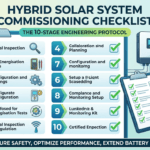
Before You Turn the System On: Commissioning Checklist
1. Battery type setting in the inverter matches the actual battery chemistry installed
2. Charge voltage limit does not exceed the battery manufacturer’s maximum charge voltage
3. Discharge cut-off voltage matches the battery’s minimum operating voltage
4. Equalization is disabled for LiFePO4 and AGM; scheduled manually for tubular
5. For LiFePO4: BMS communication is active and the inverter display shows BMS-sourced SOC, not voltage-estimated SOC
Point 5 is the one most Nigerian installers skip. On the inverter display, if the SOC reading changes in smooth percentage increments (60%, 61%, 62%), it is likely voltage-estimated. If it updates in real time with load changes and reflects actual cell state, BMS communication is active. Verify this before the installer leaves.
The Upgrade Scenario: Moving From Tubular to LiFePO4
This is the most dangerous scenario in the Nigerian solar market. It happens every day. And it destroys more LiFePO4 batteries than any other single cause.
Here is the exact failure sequence:
A home runs four 12V tubular batteries on a hybrid inverter for two years. The bank fails. The owner upgrades to a 10kWh LiFePO4 pack. The installer arrives. Disconnects the old bank. Connects the new LiFePO4. Verifies voltage (48V, correct). Turns the system on.
Nobody opens the inverter settings menu. The inverter is still configured for tubular. Float: 54.4V. Equalization: automatic every 60 days. Absorption: 57.6V held 3 hours.
Month 3: equalization fires for the first time at 60V+. Cells are pushed to 3.75V. Lithium plating begins. The owner sees nothing on the display.
Month 18: the 10kWh battery delivers 5.5kWh. Warranty claim is voided. The battery was operated outside its specified parameters. The owner loses N1.65 million to N2.65 million.
The three steps required at battery replacement:
Step 1: Before connecting the new battery, open the inverter settings and change battery type from Tubular to LiFePO4
Step 2: Verify charge voltage limit is set to 58.4V (not 57.6V from the old tubular setting)
Step 3: Disable equalization completely. Verify it is off, not just set to a long interval
These three steps take less than five minutes. Skipping them costs N1.65 million to N2.65 million and two years.
Full closed-loop management, accurate SOC, TOU precision
90 to 100%
Existing tubular, still functional
Continue with tubular, configure correctly
Replacement cost not yet justified
40 to 50%
Existing tubular bank failing
LiFePO4
Reconfigure inverter at replacement, start correctly
90 to 100%
Existing AGM, still functional
Continue with AGM, configure correctly
AGM is better lead-acid for hybrid than tubular
60 to 70%
Budget constrained, cannot afford LiFePO4 now
AGM as interim
Lower maintenance than tubular, better float compatibility
60 to 70%
Long-term system planning
LiFePO4 only
Battery replacement savings alone justify premium within first cycle
90 to 100%
LiFePO4 is not the best battery for a hybrid system because it is trendy or expensive. It is the best battery because it is the only chemistry that was designed to communicate with the inverter in real time. That communication is what the hybrid inverter was built around. Every other chemistry leaves the inverter managing blindly.
AGM delivers 60 to 70% of hybrid capability. Tubular delivers 40 to 50%. Both are valid interim choices for specific scenarios. Neither is a long-term optimal choice for a hybrid system.
Are hybrid inverters compatible with all battery types?
Yes. Hybrid inverters can work with LiFePO4, AGM, and tubular batteries. True compatibility depends on charge profile and BMS communication, not just voltage. LiFePO4 offers full compatibility with closed-loop BMS control. AGM and tubular operate with limitations and require precise manual configuration to avoid long-term damage.
Can I use tubular batteries with a Deye or Growatt hybrid inverter?
Yes, with conditions. Set the battery type to Flooded or Tubular. Set absorption to 57.6V held for 3 hours. Set float to 54.4V. Perform manual equalization at 60V for 2 to 3 hours every 60 days. Accept that SOC accuracy will be poor because tubular batteries cannot communicate with the inverter.
What happens if I connect LiFePO4 to a lead-acid inverter profile?
Float voltage is applied continuously at 54.4V, holding LiFePO4 cells at 93 to 96% SOC indefinitely, accelerating calendar aging by 3 to 5 times. Periodic equalization fires at 60V to 62V, pushing individual cells above their 3.65V maximum and causing irreversible lithium plating. A battery rated for 6,000 cycles is typically destroyed within 18 to 36 months.
What is the difference between CAN and RS485 for battery communication?
CAN bus operates at 500 kbits/s and is more noise-resistant over longer cable runs. Used by Victron, Pylontech, and BYD. RS485 operates at 115 kbits/s and is more widely supported by mid-range brands including Growatt and most Deye models. Both transmit CVL, CCL, and DCL signals from the BMS to the inverter. The inverter and battery BMS must use the same protocol.
Can I mix AGM and LiFePO4 batteries on the same hybrid inverter?
No. Mixing battery chemistries is unsafe and leads to uneven charging and accelerated degradation. AGM requires a float voltage of 54.0V. LiFePO4 must never receive float voltage. The inverter can only apply one charge profile at a time.
What settings should I use for tubular batteries on a 48V hybrid system?
Battery type: Flooded or Tubular. Bulk charge: 57.6V. Absorption: 57.6V held for 3 hours. Float: 54.4V. Discharge cut-off: 46.4V. Equalization: manual at 60V for 2 to 3 hours every 60 days. Max charge current: 0.25C of Ah rating. Equalization must never be applied to LiFePO4 or AGM.
How do I know if my BMS communication is working correctly?
On the inverter display, navigate to the battery information screen. If BMS communication is active, you will see real-time cell voltages, BMS-reported temperature, and SOC directly from the BMS. If the screen shows only terminal voltage and voltage-estimated SOC in smooth fixed increments, BMS communication is not active. Do not close the installation until this is confirmed.
Which battery lasts longer on a hybrid inverter?
LiFePO4 in correctly configured closed-loop operation: 8 to 12 years at 80% DoD in Nigerian conditions. AGM in correctly configured open-loop operation: 2 to 4 years at 50% DoD. Tubular in correctly configured open-loop operation with regular equalization and maintenance: 3 to 5 years at 50% DoD, reducing to 1 to 2 years without maintenance at Nigerian ambient temperatures.
Why does my hybrid inverter show the wrong battery percentage?
Three causes. First: BMS communication is not active and the inverter is estimating SOC from voltage curves, which are unreliable under load. Second: the battery type setting does not match the actual battery installed. Third: the battery has degraded and its actual capacity no longer matches the inverter’s internal model. Our article on inverter battery percentage wrong covers the full diagnostic process.
Conclusion
Hybrid inverter battery compatibility is not about whether the battery physically connects and the system turns on. Every battery type will turn on. The question is what the inverter does to the battery every hour of every day for the next 10 years.
LiFePO4 is the only battery chemistry that was designed to work with the control logic of a hybrid inverter. The BMS communication link, the dynamic current limits, the absence of float, the SOC accuracy: all of these require a battery that can talk to the inverter. Lead-acid batteries cannot do that. They are managed blindly, with less precision, at a chemistry that degrades faster in Nigerian heat conditions.
AGM and tubular are valid interim choices for specific scenarios. They work. But they unlock 40 to 70% of what you paid for in a hybrid inverter, not 100%.
The single most important action: if you are replacing a tubular or AGM bank with LiFePO4, change the inverter battery type setting before connecting the new battery. Not after. Before. That five-minute configuration change is the difference between a 10-year battery and an 18-month one.
I am Engr. Ubokobong Ekpenyong, a solar specialist and lithium battery systems engineer with over five years of hands-on experience designing, assembling, and commissioning off-grid solar and energy storage systems. My work focuses on lithium battery pack architecture, BMS configuration, and system reliability in off-grid and high-demand environments.
Contains information related to marketing campaigns of the user. These are shared with Google AdWords / Google Ads when the Google Ads and Google Analytics accounts are linked together.
90 days
__utma
ID used to identify users and sessions
2 years after last activity
__utmt
Used to monitor number of Google Analytics server requests
10 minutes
__utmb
Used to distinguish new sessions and visits. This cookie is set when the GA.js javascript library is loaded and there is no existing __utmb cookie. The cookie is updated every time data is sent to the Google Analytics server.
30 minutes after last activity
__utmc
Used only with old Urchin versions of Google Analytics and not with GA.js. Was used to distinguish between new sessions and visits at the end of a session.
End of session (browser)
__utmz
Contains information about the traffic source or campaign that directed user to the website. The cookie is set when the GA.js javascript is loaded and updated when data is sent to the Google Anaytics server
6 months after last activity
__utmv
Contains custom information set by the web developer via the _setCustomVar method in Google Analytics. This cookie is updated every time new data is sent to the Google Analytics server.
2 years after last activity
__utmx
Used to determine whether a user is included in an A / B or Multivariate test.
18 months
_ga
ID used to identify users
2 years
_gali
Used by Google Analytics to determine which links on a page are being clicked
30 seconds
_ga_
ID used to identify users
2 years
_gid
ID used to identify users for 24 hours after last activity
24 hours
_gat
Used to monitor number of Google Analytics server requests when using Google Tag Manager
1 minute
You can find more information in our Cookie Policy and .