
If you are in Germany or the United States, this question barely comes up. Their grid is stable for 22 to 24 hours a day, so an on-grid system makes complete economic sense. But you are probably reading this from Nigeria, where the grid delivers 8 to 14 hours of supply on a good day and nothing at all on a bad one.
which is better on-grid or hybrid solar system?
That context changes everything.
This article gives you the full technical and financial comparison of on-grid vs hybrid solar systems specifically for Nigerian conditions. By the end, you will know exactly which system makes sense for your situation, why the cheaper option is not always the better option, and what questions to ask before you spend a single naira on solar.
What Is an On-Grid (Grid-Tied) Solar System?
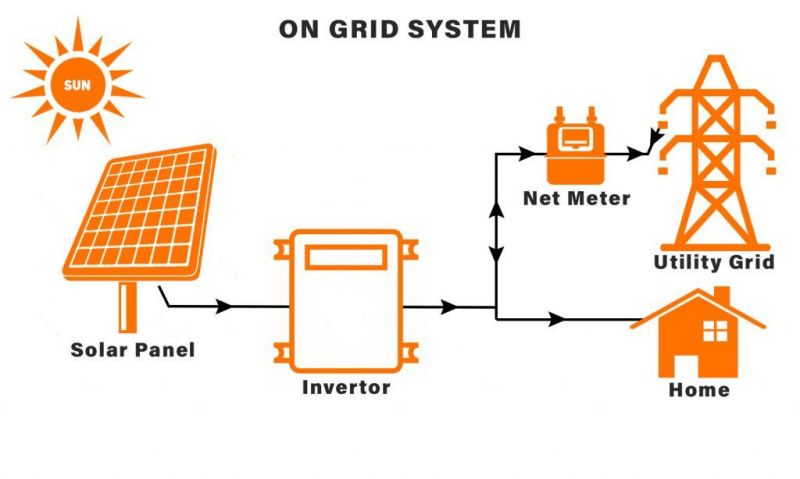
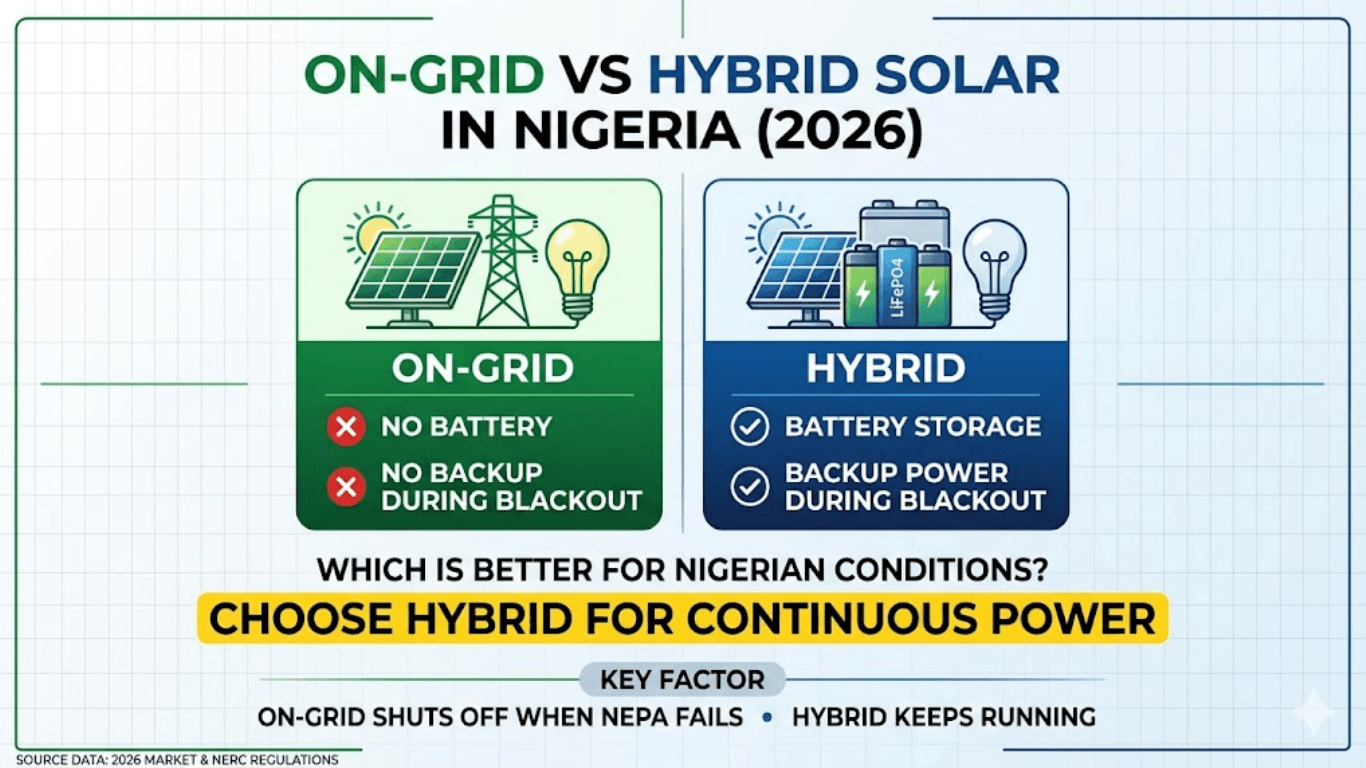
An on-grid system, also called a grid-tied system, connects your solar panels directly to the national grid through a grid-tied inverter. There is no battery. During the day, solar powers your loads. If your panels produce more than you are consuming, the excess flows into the grid. At night, you draw from the grid normally.
This system was designed for one specific environment: a stable grid with net metering available. Net metering means the electricity you push into the grid earns you credits that offset your bill.
Key characteristics of an on-grid system:
- No battery storage
- No backup capability during power cuts
- Lowest upfront cost of any solar system type
- Depends entirely on the grid being live at all times
- Maximum solar export potential when net metering exists
The on-grid system is technically simple and highly efficient. There is no battery charging or discharging loss. Every watt your panels produce goes directly to your loads or the grid. But that simplicity comes with a hard limitation that most Nigerian buyers do not fully understand before they purchase.
Why On-Grid Shuts Down When NEPA Goes: The Anti-Islanding Problem
This is the most important technical fact in this entire comparison, and most sales agents in Nigeria never explain it properly.
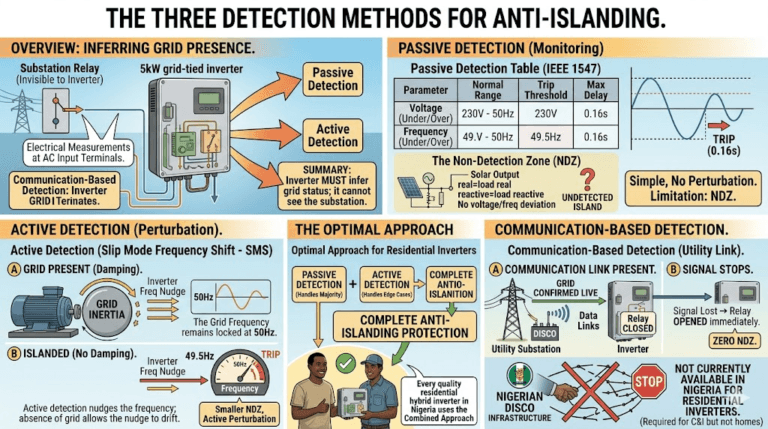
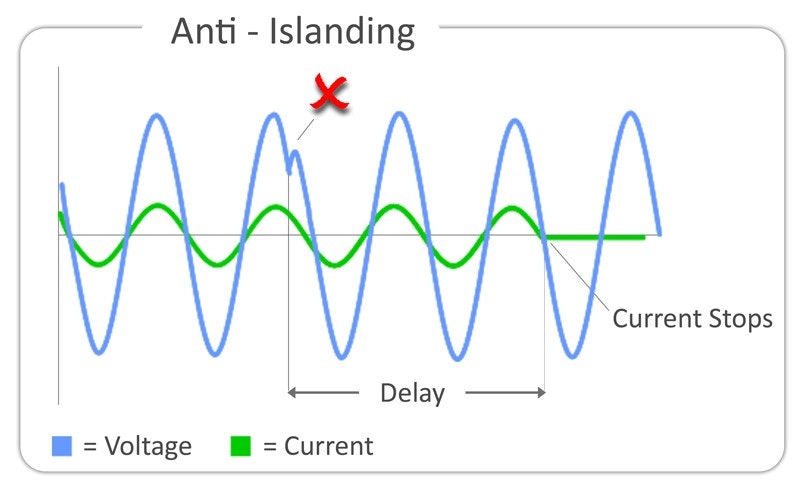
Every grid-tied inverter in the world must comply with what engineers call anti-islanding protection. When the grid goes down, the inverter must shut itself off within seconds. It is a mandatory safety requirement that prevents your solar system from back-feeding electricity into a grid that utility workers may be physically handling.
Here is what that means in practice: your solar panels are sitting in full afternoon sun, producing maximum power. NEPA trips. Within 20 milliseconds, your grid-tied inverter detects the loss of grid voltage and shuts down completely. Your house goes dark. The panels are still producing, the sun is still shining, but the inverter is locked out.
This is not a malfunction. It is exactly how the system is designed to work.
In a country where the grid fails 8 to 14 hours every single day, an on-grid system is effectively a system that is unavailable for 8 to 14 hours every day. You are paying for solar and only getting value from it during the hours when NEPA is live and the sun is also producing. That window is often smaller than buyers expect.
If you want to understand the full diagnostic picture of solar charging failures, our guide on why your solar panel is not charging your battery covers the interaction between inverter behavior, MPPT settings, and grid conditions in detail.
What Is a Hybrid Solar System?
A hybrid solar system combines solar panels, a battery bank, and a hybrid inverter that can manage multiple power sources simultaneously: solar, battery, and grid (or generator).
Unlike a grid-tied inverter, a hybrid inverter has an internal grid relay. When the grid goes down, the relay opens in 10 to 20 milliseconds and the system transitions into island mode, continuing to power your loads from solar and battery storage without any interruption you would notice.
This is the core structural difference. A hybrid system does not need the grid to be alive in order to keep running.
Key capabilities of a hybrid system:
- Continuous backup during grid outages
- Battery storage for use at night or during outages
- Time-of-use management: charge cheap, discharge during peak or outage
- Generator integration with AC input current limiting
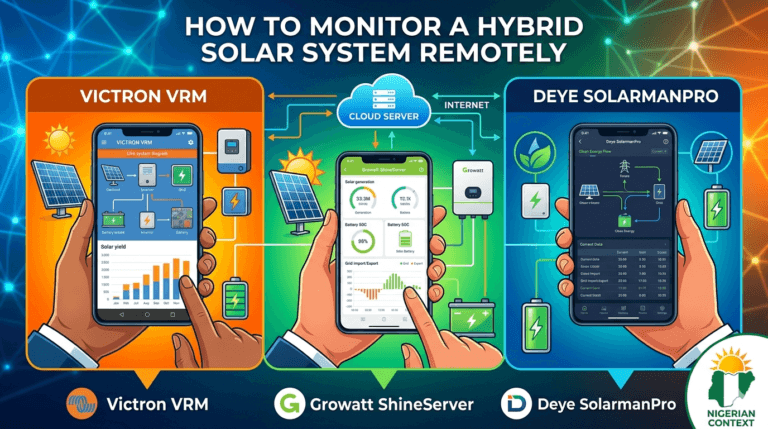
- Remote monitoring through apps like SolarmanPV or GoodWe
For a complete breakdown of how hybrid systems work, including DC coupling vs AC coupling and component selection, see our complete hybrid solar system design guide.
The Net Metering Situation in Nigeria Right Now
One of the few scenarios where on-grid becomes financially attractive is when net metering is available. Net metering lets you sell excess solar energy back to the grid and earn bill credits. This is how on-grid owners in stable-grid countries recover their investment quickly.
In Nigeria, NERC released Draft Net Billing Regulations in March 2026 under the Electricity Act 2023. This is a real regulatory step forward. But there is a critical detail buried in the draft: the proposed minimum installed capacity for participation is 50kWp.
Most residential solar installations in Nigeria sit between 3kWp and 15kWp. A family home with a 5kW inverter and 10 panels is nowhere near 50kWp. Under the current draft framework, virtually every residential solar owner in Nigeria would be disqualified from participating in net billing.
This means the financial case for residential on-grid solar in Nigeria currently rests on one thing only: self-consumption of solar energy during the hours when NEPA supply and solar production overlap. In locations where NEPA runs mostly during daylight hours, there is some value in this. In locations where NEPA runs mostly at night, an on-grid system produces almost no financial benefit.
Until the net billing framework is finalised and the minimum capacity threshold is addressed, on-grid remains financially weak at residential scale in Nigeria.
Grid Instability and Inverter Damage
There is a third problem with on-grid systems in Nigeria that goes beyond backup power: grid power quality.
Nigerian grid supply frequently experiences voltage surges, brownouts, and frequency excursions that fall outside the acceptable operating range of grid-tied inverters. When an on-grid inverter detects out-of-range grid conditions, it trips offline and waits for stable conditions before reconnecting.
In areas with poor power quality, this can happen multiple times per hour. Each trip-and-reconnect cycle reduces your effective solar yield and accelerates wear on the inverter components over time.
A hybrid system handles this differently. The hybrid inverter uses its battery and internal relay to isolate your loads from the raw grid supply. Your sensitive electronics see a clean, regulated output even when the grid is delivering dirty power. This is particularly important for protecting equipment like computers, medical devices, refrigerators with inverter compressors, and variable-speed motors.
On-Grid vs Hybrid
Most articles on this topic give you vague percentage savings. Here are actual naira figures for a 5kVA scale system suitable for a Nigerian 3-bedroom home in 2026.
On-Grid System (5kW)
| Component | Approximate Cost |
| 5kW string inverter | N250,000 to N400,000 |
| 10 x 500Wp solar panels | N600,000 to N900,000 |
| Mounting, cables, protection | N150,000 to N200,000 |
| Total | N1,000,000 to N1,500,000 |
| Backup during NEPA outage | Zero |
| Benefit in Nigeria | Daytime bill reduction only |
Hybrid System (5kVA with 10kWh LiFePO4)
| Component | Approximate Cost |
| Hybrid inverter (Deye, Growatt, Victron) | N400,000 to N700,000 |
| 10 x 500Wp solar panels | N600,000 to N900,000 |
| 10kWh LiFePO4 battery | N2,000,000 to N2,500,000 |
| BMS, cabling, protection | N200,000 to N300,000 |
| Total | N3,200,000 to N4,400,000 |
| Backup during NEPA outage | 10 to 12 hours on essential loads |
| Benefit in Nigeria | Full backup + bill reduction + TOU capability |
The on-grid system is N2,200,000 to N2,900,000 cheaper upfront. That gap is real and significant. But cost comparison without context is misleading.
The correct question is not “which costs less” but “what does each naira I spend actually buy me in Nigerian conditions?”
If you want to understand the battery cost side in detail, our guide on how many tubular batteries equal a 10kWh lithium battery explains why LiFePO4 is the better long-term value despite higher upfront cost, using real depth-of-discharge and cycle life calculations.
The 10-Year Cost of Ownership Changes the Picture
The upfront cost gap between on-grid and hybrid narrows dramatically over a 10-year ownership period when you account for what the hybrid system replaces.
Most Nigerian homes running a generator spend between N3,000,000 and N5,000,000 per year on fuel and maintenance alone. We documented this in detail in our analysis of off-grid solar vs generator costs in Nigeria, where a typical household running a 3kVA generator consumes over N5 million in fuel per year at current petrol prices.
A properly sized hybrid system eliminates most of that generator running time. The battery handles overnight loads. Solar handles daytime loads. The generator becomes a rarely-used backup rather than a daily appliance.
Over 10 years, the N2.5 million extra you spent on the hybrid system versus on-grid is recovered multiple times over from generator fuel savings alone, before you even account for the business productivity value of never losing power.
For those planning to build out a system over time, our off-grid solar system expansion guide covers how to scale arrays, battery banks, and inverter capacity as your budget grows.
When On-Grid Is Actually the Right Choice
I would be dishonest if I declared hybrid as always the better answer. There are three specific Nigerian scenarios where on-grid makes legitimate sense.
1. Large commercial or industrial sites with dedicated feeders.
Some commercial and industrial customers in Nigeria receive power from dedicated feeders with supply quality and duration well above the residential average. If your site receives 20 or more hours of stable power per day with consistent voltage, an on-grid system can deliver meaningful bill reduction while a separate UPS handles critical loads during the rare outages.
2. Businesses that already have generators and only want to cut fuel bills.
Some businesses have no need for a second backup system. They want to reduce generator fuel consumption during daylight hours. An on-grid system connected to the generator’s AC output during business hours can harvest solar to offset generator load, reducing fuel consumption without replacing the generator.
3. When budget absolutely cannot accommodate a battery right now.
An on-grid system is a real step toward solar even when hybrid is out of financial reach. The critical thing is to install it with future expansion in mind: size the panel array for eventual battery addition, use a mounting system that accommodates more panels, and choose an inverter brand that has a compatible battery-ready upgrade path.
If you are evaluating all three system architectures together, our comparison of off-grid vs hybrid vs grid-tied solar systems gives you the full side-by-side breakdown including which architecture suits each Nigerian use case.
The One Question That Decides Everything
All the technical detail in this article leads to one practical question you need to answer honestly before buying either system:
How many hours of NEPA supply do you receive per day, and what do you lose when the grid fails?
If your answer is: “We receive 20 or more hours of stable NEPA and we just want to reduce our electricity bill,” on-grid may be appropriate for your situation.
If your answer is: “We receive 6 to 14 hours of NEPA and we lose business productivity, food spoils in the fridge, medical equipment cannot run, or children cannot study at night,” hybrid is your system.
For the vast majority of Nigerian homes and small businesses, the honest answer is the second one. The verdict follows directly from that answer.
which is better on-grid or hybrid solar system in Nigeria
For the typical Nigerian residential or small business customer, the hybrid solar system is the better choice. Not because it costs less, but because it actually solves the problem.
The on-grid system is a good system designed for a context that does not match Nigerian grid reality. It was built for a world where the grid is reliable, net metering pays you fairly, and power cuts are rare events. That is not Nigeria in 2026.
The hybrid system costs more upfront, but it delivers backup power, battery storage, generator integration, and protection from grid power quality problems. When you account for generator savings over 5 to 10 years, the total cost of ownership often makes hybrid the cheaper option in the long run.
The emerging NERC net billing framework is worth watching. If it is finalised with a lower minimum capacity threshold, on-grid becomes more attractive at residential scale because export credits would start to make financial sense. Until that happens, hybrid remains the stronger investment for most Nigerian buyers.
For a complete guide to the disadvantages you should know before committing to any hybrid system, read our article on the real disadvantages of a hybrid solar system that most solar salespeople will not tell you about.
Frequently Asked Questions
Can I convert my on-grid system to hybrid later?
Yes, but it depends on your inverter brand and model. Some grid-tied inverters can be paired with a separate hybrid inverter or battery inverter added in AC coupling configuration. Others require complete replacement of the inverter unit. Before buying an on-grid system, confirm with your installer whether the specific inverter model supports future battery integration and what that upgrade path looks like in terms of cost.
Does a hybrid system work without solar panels?
Yes. A hybrid inverter can charge its battery from the grid during cheap tariff periods or when NEPA supply is available and then discharge the battery to power your loads during outages or peak-rate periods. However, without solar panels you lose the free energy generation that makes the system financially strong. Most installations include both panels and batteries from the start.
What happens to a hybrid system when the battery is fully discharged?
When the battery reaches its low-voltage cutoff (set by the BMS), the system switches to grid supply if available, or to generator if one is connected and configured. The inverter does not leave your loads unpowered as long as an alternative source is available. This is why proper BMS settings matter enormously. Our guide on lithium battery problems and how to prevent failure explains how incorrect BMS configuration causes unexpected shutdowns that look like battery failure but are actually setting errors.
Is an on-grid system better for the environment?
Both systems generate clean solar energy. The on-grid system has no battery, which means no battery manufacturing footprint. However, if the alternative to on-grid is a diesel generator running 8 to 14 hours per day, the hybrid system that replaces that generator eliminates a far larger carbon footprint than the battery production adds. In the Nigerian context, hybrid is likely the more environmentally responsible choice for most households.
What inverter brands are recommended for hybrid systems in Nigeria?
Deye and Growatt are the most widely installed hybrid inverter brands in Nigeria as of 2026, with good spare parts availability and local technical support. Victron Energy is the preferred choice for high-reliability applications and complex system designs, though at a higher price point. Solark is gaining ground in the commercial segment. Brand reputation matters less than installer competence and proper system commissioning. For guidance on how inverter voltage architecture affects efficiency, see our comparison of high voltage vs low voltage inverters.
How long will a 10kWh hybrid battery last overnight?
This depends entirely on your load profile. A home running a refrigerator (150W), four LED bulbs (40W total), a standing fan (75W), a TV (80W), phone chargers (50W), and a router (20W) is drawing roughly 415W continuously. At that load, a 10kWh battery using the 80/20 rule for lithium batteries (which limits usable capacity to 80% to protect cycle life) gives you 8kWh of usable energy, lasting approximately 19 hours. Running an air conditioner changes the calculation entirely. Always size your battery to your real load, not your ideal load.
Will on-grid solar qualify for NERC net billing when the framework is finalised?
Under the March 2026 draft framework, the minimum capacity threshold is 50kWp. Residential installations below that threshold would not qualify. This may change before the final regulation is published. Businesses and industries considering on-grid installations at 50kWp and above should monitor the NERC regulatory process closely, as net billing would significantly improve the return on investment for large-scale grid-tied systems.
External Resources
- NERC Draft Net Billing Regulations 2026 – Nigerian Electricity Regulatory Commission
- IEA Energy Access Outlook – Nigeria – International Energy Agency data on Nigerian grid access
- Solar Energy Industries Association: Anti-Islanding Explained – Technical background on anti-islanding protection requirements

I am Engr. Ubokobong Ekpenyong, a solar specialist and lithium battery systems engineer with over five years of hands-on experience designing, assembling, and commissioning off-grid solar and energy storage systems. My work focuses on lithium battery pack architecture, BMS configuration, and system reliability in off-grid and high-demand environments.