
Most Nigerians buying a solar system ask the wrong question.
They ask: Hybrid Solar System vs Off-Grid which is better?
The right question is: how many hours of NEPA supply does your location receive per day?
That single number determines the correct system. Everything else follows from it.
If your answer is zero, or close to zero, off-grid is the right architecture. You have no grid to use as a backup, so paying for a hybrid inverter’s grid management capabilities is paying for a feature you cannot use.
If your answer is 4 to 18 hours per day, which covers the vast majority of Nigerian urban and peri-urban locations, hybrid wins. Not marginally. Decisively. On total system cost, battery bank size, generator dependency, expandability, and long-term maintenance cost.
This article proves that with real naira numbers, full cost tables, and a direct verdict for every Nigerian location type.
The Architectural Difference in Plain Terms
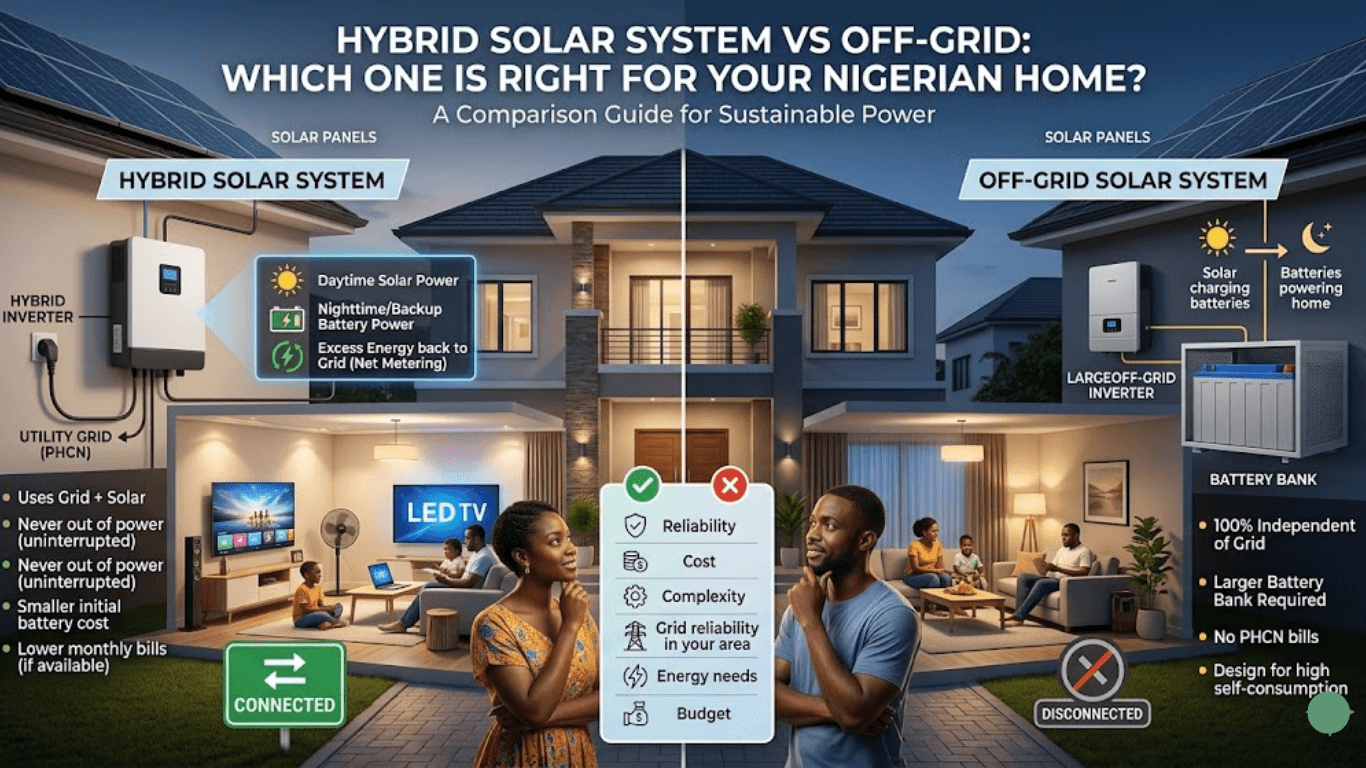
Every other difference between hybrid and off-grid flows from one thing: whether the system has a grid connection or not.
Off-grid architecture:
No grid connection. Solar panels charge the battery. The battery powers your loads. When solar is insufficient, a generator charges the battery. The system is entirely self-contained. The consequence: the battery must be large enough to cover your loads for 3 to 5 consecutive days with minimal solar input. There is no other recharge source. The battery bank is not just storage. It is the entire safety margin of the system.
Hybrid architecture:
Grid connected. Solar charges the battery and powers loads. The battery covers overnight and blackout periods. When the battery reaches its low SOC threshold, the grid takes over. The generator is optional backup for extreme scenarios only.
The consequence:
the battery only needs to cover 1 to 2 days of autonomy. The grid handles extended cloudy periods. The battery bank is sized for the most common scenario, not the worst-case scenario.
This single architectural difference cascades into every cost and design decision that follows.
For a full explanation of what the hybrid architecture does and how all three sources are managed simultaneously, read our article on what a hybrid solar system is and our complete hybrid solar system design guide.
The Battery Sizing Gap and What It Costs in Naira

This is the number most installers never show you side by side. It is the most important number in this comparison.
Off-Grid Battery Sizing for a 5kWh Daily Essential Load in Lagos
Lagos wet season PSH averages 3.0 to 3.5 hours in July, the worst solar month. A correctly designed Lagos off-grid system needs 5 days of autonomy to survive consecutive wet season cloud events without a generator running every night.
Required battery capacity = Daily load x Days of autonomy / DoD = 5kWh x 5 / 0.8 = 31.25kWh
Hybrid Battery Sizing for the Same 5kWh Daily Essential Load
With the grid available as backup for extended low-solar periods, 1.5 days of autonomy is sufficient for urban Lagos.
Required battery capacity = Daily load x Days of autonomy / DoD = 5kWh x 1.5 / 0.8 = 9.375kWh (round to 10kWh)
The Cost Difference at Current Nigerian LiFePO4 Prices
| Off-Grid | Hybrid | |
| Battery capacity required | 31.25kWh | 10kWh |
| Battery cost (low estimate) | N6,250,000 | N2,000,000 |
| Battery cost (high estimate) | N7,812,500 | N2,500,000 |
| Battery cost difference | N4,250,000 to N5,312,500 |
The hybrid system saves N4.25 million to N5.3 million on battery cost alone for the same 5kWh daily load in Lagos.
The hybrid inverter costs N450,000 to N680,000. The off-grid inverter plus separate MPPT costs N800,000 to N1,250,000. The hybrid inverter is actually cheaper on hardware too.
The net saving from choosing hybrid over off-grid in Lagos is N4.5 million to N5.8 million on the initial system cost, for identical load coverage.
Use our LiFePO4 battery bank calculator to run this calculation for your specific load and location. Use our battery bank sizing guide for the full methodology including autonomy targeting.
The Generator Problem in Off-Grid Systems
Here is the fact most off-grid system salespeople do not put in their proposals: every serious off-grid installation in Nigeria needs a generator.
Not as a rare emergency backup. As a routine operational tool.
Southern Nigeria’s wet season is brutal on solar production. Lagos in July averages 3.0 to 3.5 PSH. Port Harcourt in July averages 2.5 to 3.0 PSH. During a severe wet season overcast event lasting 4 to 6 consecutive days, even a correctly sized 5-day autonomy battery will deplete if loads are not dramatically curtailed.
What Generator Dependency Costs a Nigerian Household Annually

| Cost Item | Annual Cost Range |
| Generator purchase (amortised over 4 years) | N87,500 to N175,000 |
| Fuel (10h/day, 2 to 2.5L/h at N1,000/L) | N7,300,000 to N9,125,000 |
| Service every 3 months | N60,000 to N100,000 |
| Annual total generator cost | N7,447,500 to N9,400,000 |
A hybrid system eliminates this dependency for most Nigerian homes. The grid handles the wet season recharge. The generator becomes a tertiary backup that runs perhaps 10 to 20 days per year in extreme scenarios, not 365 days per year as a routine recharge source.
The fuel cost saving alone pays for the hybrid system within 4 to 8 months.
For the full generator cost breakdown and how it compares to solar in Nigeria, read our article on off-grid solar vs generator in Nigeria. For correctly sizing a generator for solar system integration, read our generator sizing guide.
The Inverter Architecture Difference
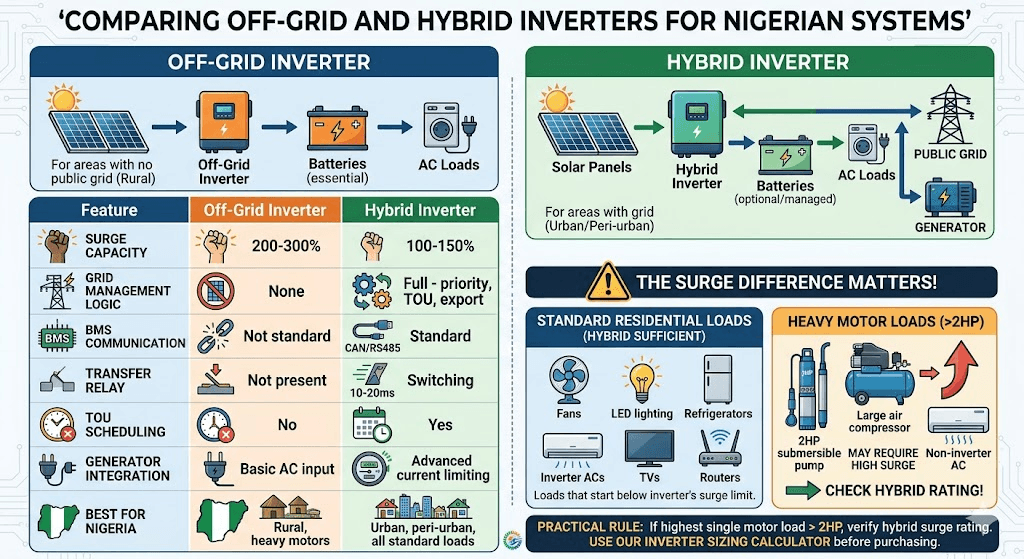
The inverters in hybrid and off-grid systems are different devices designed for different purposes. Understanding the differences helps you know when each is the right choice.
| Feature | Off-Grid Inverter | Hybrid Inverter |
| Surge capacity | 200 to 300% of continuous rating | 100 to 150% of continuous rating |
| Grid management logic | None | Full (priority, TOU, export) |
| BMS communication | Not standard | CAN or RS485 standard |
| Transfer relay | Not present | 10 to 20ms switching |
| TOU scheduling | No | Yes |
| Generator integration | Basic AC input | Advanced with current limiting |
| Best for Nigeria | Rural, no grid, heavy motors | Urban, peri-urban, all standard loads |
The surge difference matters only for heavy motor loads. A 2HP+ submersible pump, large air compressor, or non-inverter AC above 2HP may require startup surge beyond a hybrid inverter’s rating. For all standard Nigerian residential loads (fans, LED lighting, refrigerators, inverter ACs, TVs, routers), the hybrid’s surge capacity is sufficient.
The practical rule: if your highest single motor load exceeds 2HP and must start under full load, verify the hybrid inverter’s surge rating. Use our inverter sizing calculator to check this before purchasing.
For a detailed guide to selecting the right off-grid inverter, read our article on how to select an off-grid inverter. For MPPT selection in off-grid systems, read our MPPT charge controller selection guide.
Complete Cost Comparison in Nigerian Naira
Full system cost for a 5kWh daily essential load in Lagos, sized correctly for each architecture.
Off-Grid System (5kWh Daily Load, 5-Day Autonomy, Lagos)
| Component | Specification | Cost Range |
| Off-grid inverter | Victron Multiplus 48/5000 | N600,000 to N900,000 |
| MPPT charge controller | Victron SmartSolar 150/70 | N200,000 to N350,000 |
| Solar panels | 12 x 500Wp (6kWp) | N720,000 to N1,080,000 |
| LiFePO4 battery bank | 31kWh (48V 620Ah) | N6,200,000 to N7,750,000 |
| Generator | 3.5kVA quality unit | N350,000 to N600,000 |
| Wiring, protection, installation | Full BOS + labour | N300,000 to N500,000 |
| Total | N8,370,000 to N11,180,000 |
Hybrid System (5kWh Daily Load, 1.5-Day Autonomy, Lagos)

| Component | Specification | Cost Range |
| Hybrid inverter | Deye 5kVA 48V | N450,000 to N680,000 |
| Solar panels | 8 x 500Wp (4kWp) | N920,000 to N1,440,000 |
| LiFePO4 battery bank | 10kWh (48V 200Ah) | N1,650,000 to N2,650,000 |
| Wiring, protection, installation | Full BOS + labour | N250,000 to N400,000 |
| Total | N3,270,000 to N5,170,000 |
10-Year Total Cost of Ownership for Hybrid Solar System vs Off-Grid
| Off-Grid | Hybrid | Saving with Hybrid | |
| Total upfront cost | N8.4m to N11.2m | N3.3m to N5.2m | N5.1m to N6.0m |
| Generator required | Yes | No | N350,000 to N700,000 |
| Annual fuel cost | N7.3m to N9.1m | Near zero | N7.3m to N9.1m per year |
| Battery bank | 31kWh | 10kWh | N4.3m to N5.3m |
| 10-year total cost | N81m to N102m | N6m to N9m | N75m to N93m |
The 10-year total cost of ownership difference is not a typo. Generator fuel at N1,000 per litre running 10 hours daily for 10 years is N73 million to N91 million in fuel alone. The hybrid system avoids almost all of that.
For the complete 10-year cost analysis, read our article on off-grid solar vs generator in Nigeria. For the full hybrid system price breakdown, read our hybrid solar system price guide.
When Off-Grid Genuinely Wins
This article would be incomplete without an honest account of when off-grid is the correct choice. There are four specific scenarios.
Scenario 1: Zero or Near-Zero Grid Supply
Rural Nigeria, farming communities, remote locations where DISCO infrastructure does not reach. If there is no grid to connect to, a hybrid inverter’s grid management capability is worthless. You are paying N100,000 to N400,000 extra for a feature you cannot use. An off-grid inverter with an external MPPT, correctly sized battery bank, and generator backup is the right architecture.
Scenario 2: Deliberate Energy Independence
Some buyers specifically want no grid dependency as a matter of principle. They distrust the DISCO infrastructure near their location, want predictable energy costs regardless of tariff changes, or have experienced enough grid instability to make complete autonomy worth the extra investment. Off-grid delivers that autonomy. A hybrid system with an undersized battery in a location with sudden prolonged grid failure will deplete. An off-grid system with a correctly sized battery bank does not have this failure mode.
Scenario 3: Highly Unstable Grid Voltage
Some Nigerian feeders supply voltage that fluctuates between 140V and 260V. A hybrid inverter connecting to such a supply trips its AC input protection repeatedly. When the AC input trips, the system runs as off-grid anyway. In this scenario, a dedicated off-grid inverter handles the situation more cleanly because it simply ignores the grid entirely.
If your DISCO supply is below 180V or above 260V for more than 30% of supply hours, verify your hybrid inverter’s AC input voltage tolerance before purchasing. Most hybrid inverters accept 170V to 280V. Some have tighter tolerances.
Scenario 4: Heavy Industrial Motor Loads

Locations with 3HP+ submersible pumps, large industrial compressors, or heavy CNC machinery require surge capacity that most hybrid inverters in the 5 to 10kVA range cannot reliably deliver. An off-grid inverter in this application offers 200 to 300% surge capacity that handles these loads without tripping.
Expandability: The Hidden Advantage Hybrid Has Over Off-Grid
Hybrid expansion: add more panels within the MPPT’s current and voltage limits. Add a second battery in parallel within the BMS and inverter communication limits. Both additions are straightforward. The grid provides a safety net during the expansion period.
Off-grid expansion: adding new batteries to an existing bank is complicated by cell age mismatch. A new 200Ah battery connected in parallel with a 3-year-old 200Ah battery creates an imbalanced bank. The new battery charges faster and accepts a disproportionate share of the charge current. The old battery appears weaker and gets pushed into premature failure. The correct approach for off-grid expansion is to replace the entire battery bank simultaneously, which is a much larger capital expense.
Our article on off-grid solar system expansion covers this constraint in detail and explains the correct methodology for expanding existing off-grid battery banks.
The Decision Framework
Use this table to determine the right system for your location.
| Location Type | DISCO Supply Hours | Recommended System |
| Urban Lagos, Abuja, PH (estate) | 8 to 14 hours | Hybrid |
| Urban Lagos, Abuja, PH (poor feeder) | 4 to 8 hours | Hybrid |
| Peri-urban (outskirts, developing areas) | 2 to 6 hours | Hybrid |
| Semi-rural (occasional DISCO) | 1 to 3 hours | Hybrid with generator input configured |
| Rural (no DISCO) | 0 hours | Off-grid |
| Industrial (heavy motor loads) | Any | Verify hybrid surge rating first |
| For urban and peri-urban Nigeria: hybrid is the correct system in almost every scenario. For rural Nigeria with zero grid supply: off-grid is the only viable option. The numbers make the decision. |
For a comparison of all three solar architectures including grid-tied, read our article on off-grid vs hybrid vs grid-tied solar. For the specific comparison of hybrid against on-grid systems, read our article on on-grid vs hybrid solar system in Nigeria.
Frequently Asked Questions
What is the difference between a hybrid and off-grid solar system?
The fundamental difference is the grid connection. An off-grid system has no connection to the DISCO network. It runs entirely on solar and battery, with a generator as backup. A hybrid system stays connected to the grid and uses it as a backup recharge source. This means a hybrid system needs a much smaller battery bank (1 to 2 days autonomy versus 3 to 5 days for off-grid), does not need a generator for routine operation, and costs significantly less in total for any location with partial DISCO supply.
Which is cheaper, hybrid or off-grid?
For any Nigerian location with 4 or more hours of DISCO supply per day, hybrid is cheaper in total system cost. The battery bank for a correctly designed Lagos off-grid system costs N6.2 million to N7.75 million. The battery bank for an equivalent hybrid system costs N1.65 million to N2.65 million. The saving of N4.3 million to N5.3 million on battery cost alone makes hybrid cheaper overall despite the higher inverter cost. Off-grid is only cheaper in locations with zero grid supply.
Can a hybrid system work like an off-grid system?
Yes. When NEPA supply is absent, a hybrid system operates in island mode exactly like an off-grid system. The battery and solar power your loads with no grid involvement. The difference is that a hybrid system has a smaller battery bank sized for typical NEPA absence (1 to 2 days), not worst-case extended absence (3 to 5 days). If NEPA is absent for longer than the battery autonomy, the hybrid system will deplete and you will need a generator just like an off-grid system.
Do I still need a generator with a hybrid system in Nigeria?
For most urban Nigerian homes, no. The grid handles extended low-solar periods. A generator is only necessary if NEPA and solar are simultaneously insufficient for longer than your battery autonomy (typically 12 to 14 hours). Keep an existing generator as a tertiary backup but plan to run it perhaps 10 to 20 days per year, not every day.
Which is better for Lagos, hybrid or off-grid?
Hybrid. For Lagos specifically, the wet season battery sizing requirement for off-grid (5 days autonomy, approximately 31kWh for a 5kWh daily load) makes off-grid significantly more expensive than hybrid. Lagos has enough DISCO supply (8 to 14 hours per day in most estates) to make the hybrid grid backup highly effective. The battery saving alone is N4.3 million to N5.3 million. For Lagos, hybrid is the financially rational choice in almost every residential and small commercial scenario.
What happens to a hybrid system when NEPA supply stops completely?
The system enters island mode and operates exactly like an off-grid system. Battery and solar power your loads. This continues until the battery reaches its low SOC threshold (typically 20% SOC). At that point, if NEPA has not returned and solar is not producing, the system will require a generator connected to the hybrid inverter’s AC input port to recharge the battery and sustain the system.
Can I convert my off-grid system to hybrid later?
Not without replacing the inverter. An off-grid inverter cannot be converted to a hybrid inverter through firmware or configuration changes. They are fundamentally different hardware. To convert to hybrid, you replace the off-grid inverter with a hybrid inverter. The battery bank, solar panels, and BOS components can be reused if they are compatible with the new inverter’s specifications.
Conclusion
The hybrid vs off-grid debate in Nigeria is not a close contest for most buyers.
For any location with 4 or more hours of DISCO supply per day, hybrid wins on total system cost (N5 million to N6 million cheaper), battery size (31kWh vs 10kWh for the same load), generator dependency (eliminated vs mandatory), and 10-year cost of ownership (N6 million to N9 million vs N81 million to N102 million including generator fuel).
Off-grid wins in exactly one common Nigerian scenario: zero grid supply. Rural locations without DISCO coverage need off-grid. That is not a compromise. It is the correct architecture for that situation.
For everyone else: size your load, calculate your battery for 1.5 days of autonomy, and build a hybrid system. The battery cost saving alone pays for the hybrid inverter premium many times over.
| The numbers make the decision for you. Run both battery calculations. The difference in naira is the answer. |
| Size both systems yourself before speaking to any installer Step 1: Complete your load audit. Use our load audit guide and off-grid solar system sizing calculator. Step 2: Calculate battery size for both architectures. Use our LiFePO4 battery bank calculator. Run it twice: once at 5-day autonomy (off-grid) and once at 1.5-day autonomy (hybrid). The cost difference makes the decision for you. Step 3: Verify your inverter sizing. Use our inverter sizing calculator to confirm the right capacity for your peak load, surge requirement, and temperature-derated output. |

I am Engr. Ubokobong Ekpenyong, a solar specialist and lithium battery systems engineer with over five years of hands-on experience designing, assembling, and commissioning off-grid solar and energy storage systems. My work focuses on lithium battery pack architecture, BMS configuration, and system reliability in off-grid and high-demand environments.