
Hybrid is the most abused word in the Nigerian solar market.
Walk into any solar shop in Lagos, Port Harcourt, or Abuja and point at almost any inverter on the shelf. The salesperson will call it hybrid. It is probably not.
The word has been stretched so far that it now means almost nothing. Buyers spend N800,000 to N2,000,000 on systems they think are hybrid and discover six months later that their system cannot do half of what they expected.
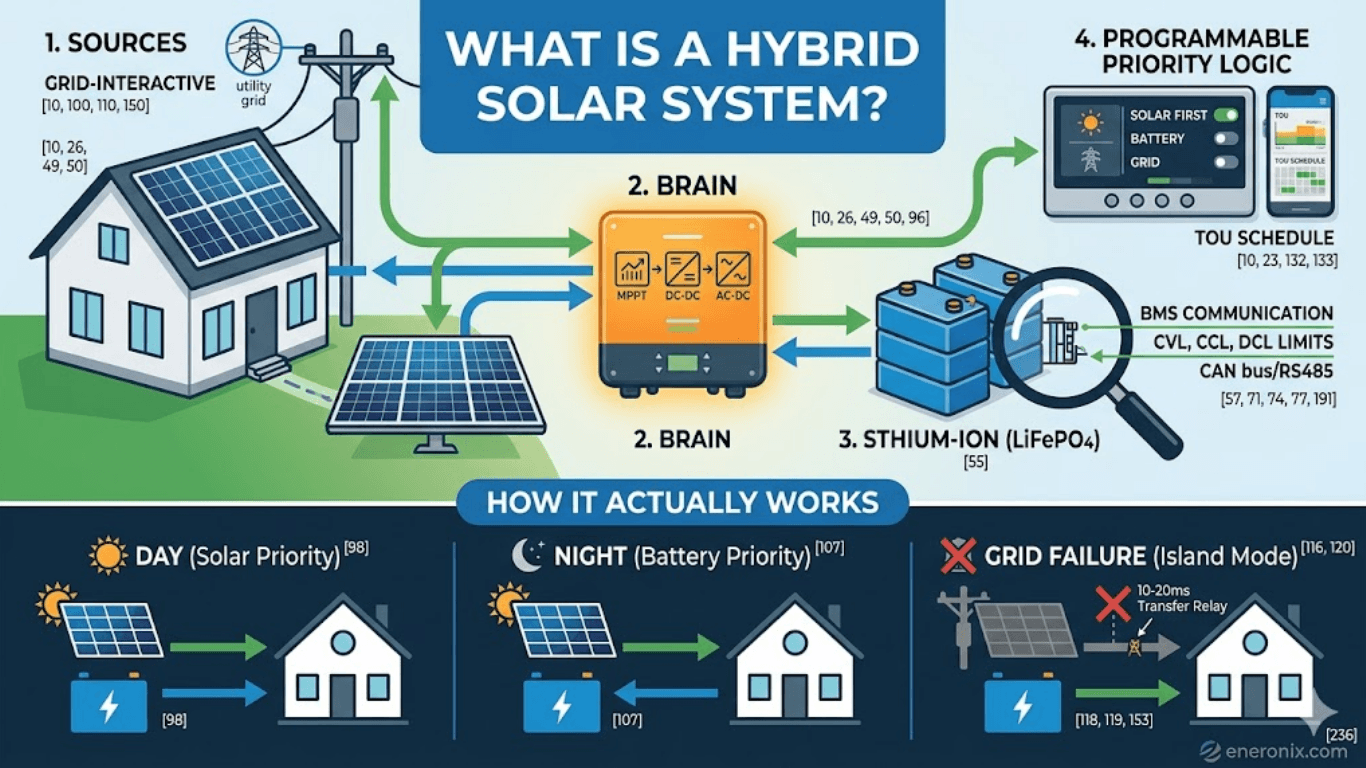
| A hybrid solar system is a grid-interactive energy storage system in which a single hybrid inverter simultaneously manages three power sources: a solar array, a battery bank, and the utility grid, using programmable priority logic. |
Every word in that definition is doing work. We will unpack each one through this article.
By the end, you will know exactly what a hybrid solar system is, how it works second by second, what the five components actually do, why most systems sold as hybrid in Nigeria are not, and whether this system is the right fit for your home or business.
What Is a Hybrid Solar System?
Most articles define a hybrid solar system like this: solar panels, plus a battery, plus a connection to the grid.
That is a parts list. It tells you what is in the box. It does not tell you what the system does or why it is different from anything else.
Here is the problem with the parts-list definition. A basic inverter-charger has solar panels, a battery, and a grid connection. By the parts-list definition, it is hybrid. But it is not. It has no grid management logic. It cannot export power. It cannot schedule grid charging. It cannot simultaneously draw from solar, battery, and grid to power your loads. It just switches between them one at a time.
The difference is not the parts. The difference is the behaviour.
A hybrid solar system simultaneously manages three power sources. Not sequentially. Not one at a time. All three at once, every few milliseconds, based on your configured priority settings.
Here is what that looks like in practice. It is 2pm. Solar is producing 3kW. Your loads are drawing 2kW. Your battery is at 70% SOC. The grid is available. In that single moment, your hybrid inverter is doing all of this at once:
- Directing 2kW of solar to your loads
- Directing the remaining 1kW of solar to charge the battery
- Monitoring grid voltage and frequency for stability
- Communicating with the BMS to verify battery charge acceptance rate
- Tracking the solar array’s maximum power point as a passing cloud changes irradiance
A basic inverter-charger cannot do any of that simultaneously. It picks one source, powers your loads from it, and waits.
That simultaneous multi-source management, governed by programmable priority logic, is what makes a system genuinely hybrid. Not the parts. The behaviour.
The Five Components and What Each One Actually Does
1. Solar Panels
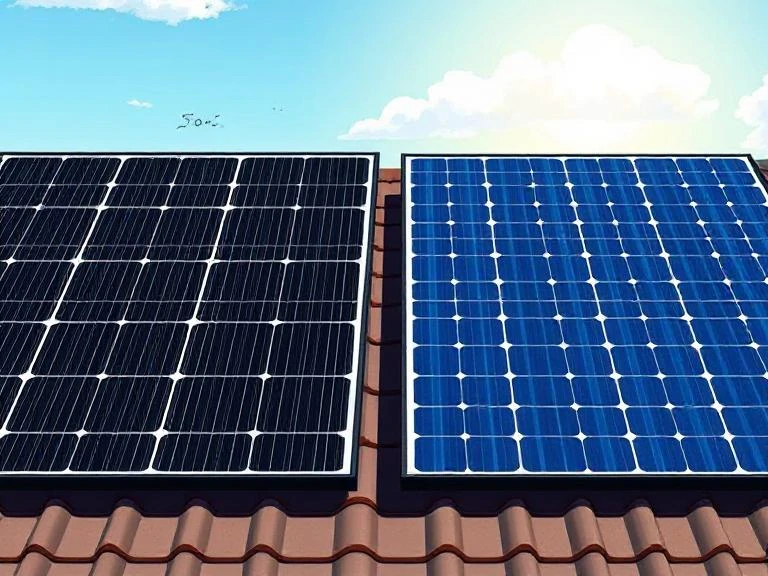
Solar panels convert sunlight into direct current (DC) electricity through the photovoltaic effect. Photons from sunlight strike silicon cells in the panel and knock electrons loose. That flow of electrons is DC electricity.
The amount of power a panel produces at any moment depends on three things: irradiance (how much sunlight is hitting the panel), cell temperature (panels produce less power as they heat up), and shading (even partial shading of one cell reduces output of the entire string).
In a hybrid system, the solar array is the primary energy source. It powers your loads first. Whatever is left over charges the battery. The array size must be calculated to cover both jobs, not just your loads. Most Nigerian installers size the array only for loads and leave the battery chronically undercharged.
For everything on how to size your solar array correctly, read our solar array sizing guide.
2. The Hybrid Inverter

A hybrid inverter contains four distinct functional blocks inside one enclosure. Understanding them is what separates a buyer who makes a good decision from one who gets sold the wrong product.
| Block 1: The MPPT charge controller Continuously adjusts the electrical load on the solar array to keep it operating at its maximum power point. A good MPPT extracts 20 to 30% more energy from the same panels compared to a fixed-voltage system. Block 2: The bidirectional DC-DC converter Manages the flow of DC power between the battery and the rest of the system. In charging mode it steps down voltage to the battery. In discharge mode it steps up battery voltage to the DC bus. Bidirectional means power flows in both directions. Block 3: The bidirectional AC-DC inverter Converts DC electricity from the solar array and battery into AC electricity for loads and the grid. Also converts AC from the grid back into DC to charge the battery. This is the block that makes grid charging possible. Block 4: The grid relay and transfer switch Physically connects and disconnects your system from the NEPA line. Opens in 10 to 20 milliseconds when the grid fails. Reconnects when grid stability is verified after power returns. |
All four blocks are coordinated by a microprocessor running control algorithms that execute every few milliseconds. That microprocessor is the actual brain of the system.
3. The Battery Bank
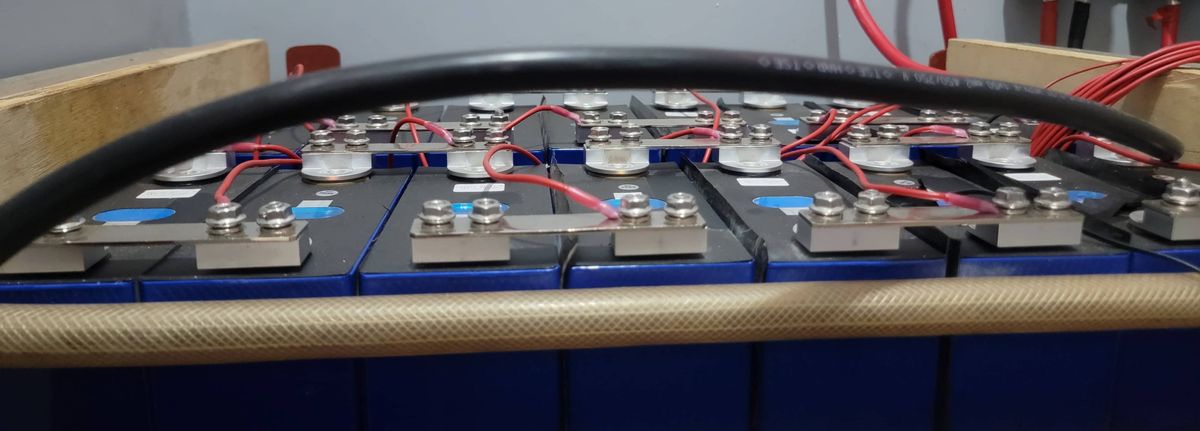
The battery bank stores energy when solar is producing more than your loads need. It delivers energy when solar is not producing: at night, during cloudy periods, and during NEPA blackouts.
For a hybrid system, the only serious battery choice is LiFePO4 (lithium iron phosphate). This is not a preference. It is a technical requirement.
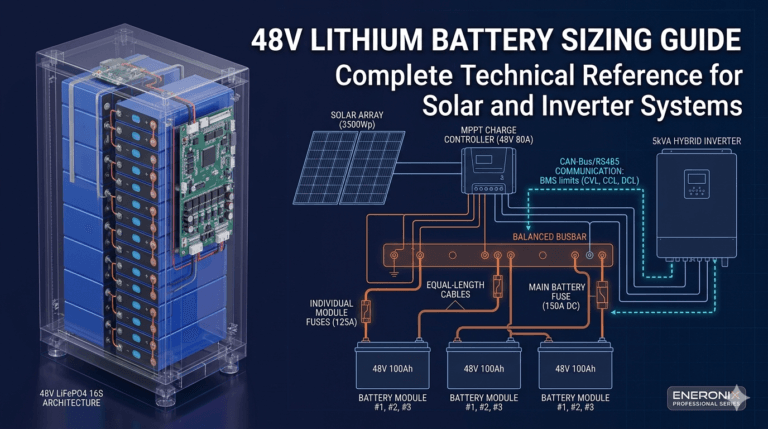
Hybrid inverters with BMS communication manage the battery through real-time signals: CVL (charge voltage limit), CCL (charge current limit), and DCL (discharge current limit). The BMS sends these signals to the inverter every second. The inverter adjusts its behaviour accordingly. Lead-acid batteries have no BMS. The inverter cannot communicate with them. It manages them using voltage curves alone, which are unreliable under.
Learn more about BMS communication
Additionally, lead-acid batteries require a float charge stage that LiFePO4 batteries must never receive. A hybrid inverter configured for LiFePO4 will not apply float voltage. Put a lead-acid bank on that inverter and it will sulfate within months.
LiFePO4 also delivers 80% usable capacity versus 50% for lead-acid. It lasts 3,000 to 6,000 cycles versus 800 to 1,200 for tubular lead-acid. And it requires zero maintenance.
For a detailed breakdown of LiFePO4 performance in solar systems, read our lithium battery basics guide.
4. The BMS
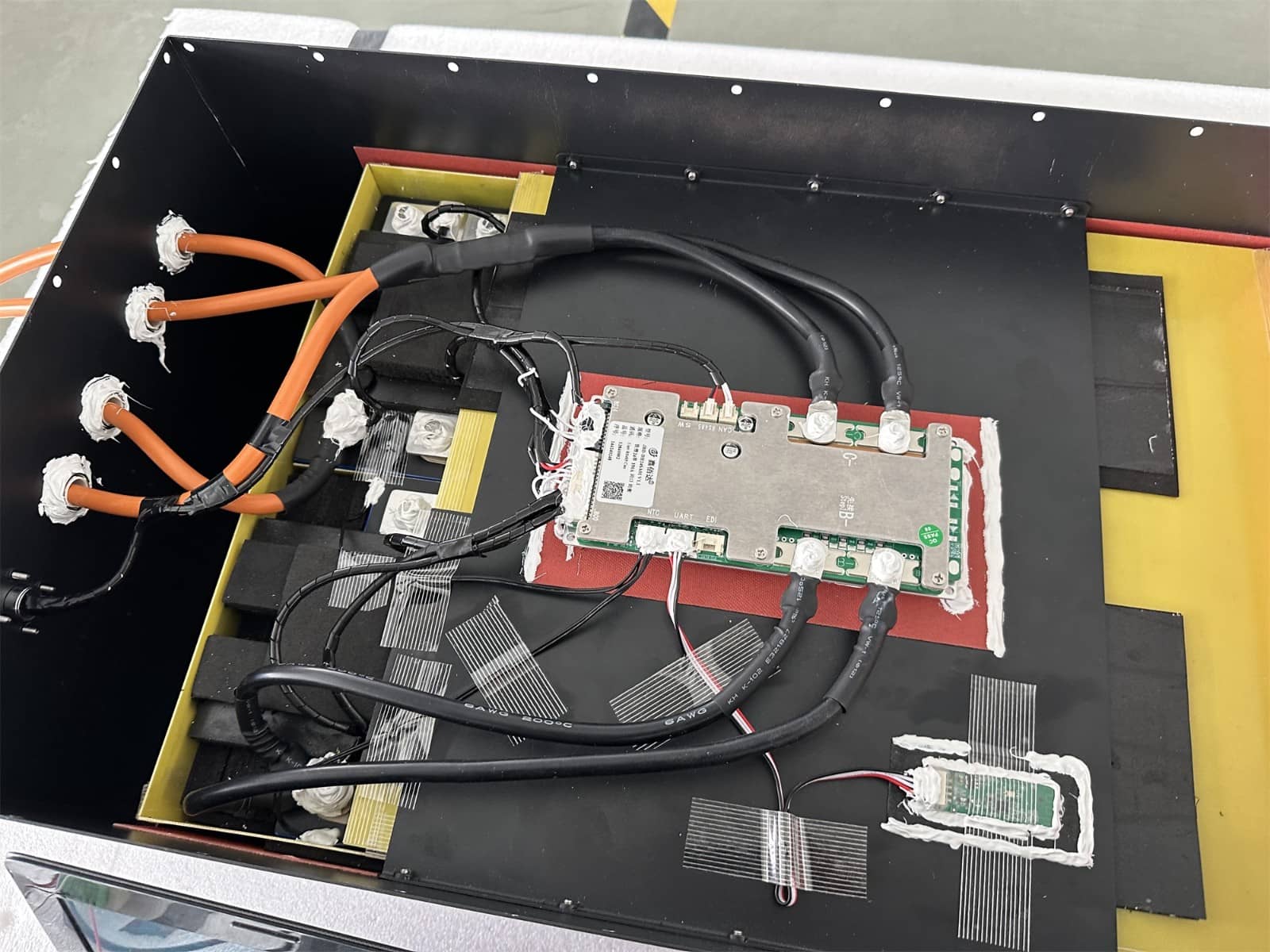
image source: LiFePO4 Battery Shop
The Battery Management System is the electronics embedded in or attached to your battery bank. It monitors individual cell voltages, temperatures, and currents. It protects the battery from overcharge, over-discharge, overcurrent, and thermal events.
In a hybrid system, the BMS does something beyond protection. It communicates with the hybrid inverter in real time, sending three critical signals:
- CVL (charge voltage limit): The maximum voltage the inverter may apply to the battery right now
- CCL (charge current limit): The maximum current the inverter may push into the battery right now
- DCL (discharge current limit): The maximum current the battery will allow the inverter to draw right now
These three numbers change dynamically as the battery’s SOC, temperature, and cell balance change. The inverter reads them every second and adjusts its operation accordingly.
This communication happens over one of two protocols: CAN bus (faster, more noise-resistant, used by premium brands like Victron, Pylontech, and BYD) or RS485 (slower but more widely supported, used by Growatt and most mid-range brands).
The BMS and the hybrid inverter must speak the same protocol. If they do not, the inverter manages the battery blind, using voltage curves alone. This is the hidden cause of most unexplained battery failures in Nigerian hybrid systems. The installation looks correct. The wiring is right. But no one configured the communication protocol, and the battery is being quietly damaged every day.
To understand how these communication signals work in depth, read our guide on CVL, CCL, and DCL dynamic battery limits and our article on inverter-battery communication protocols.
5. Protection Devices
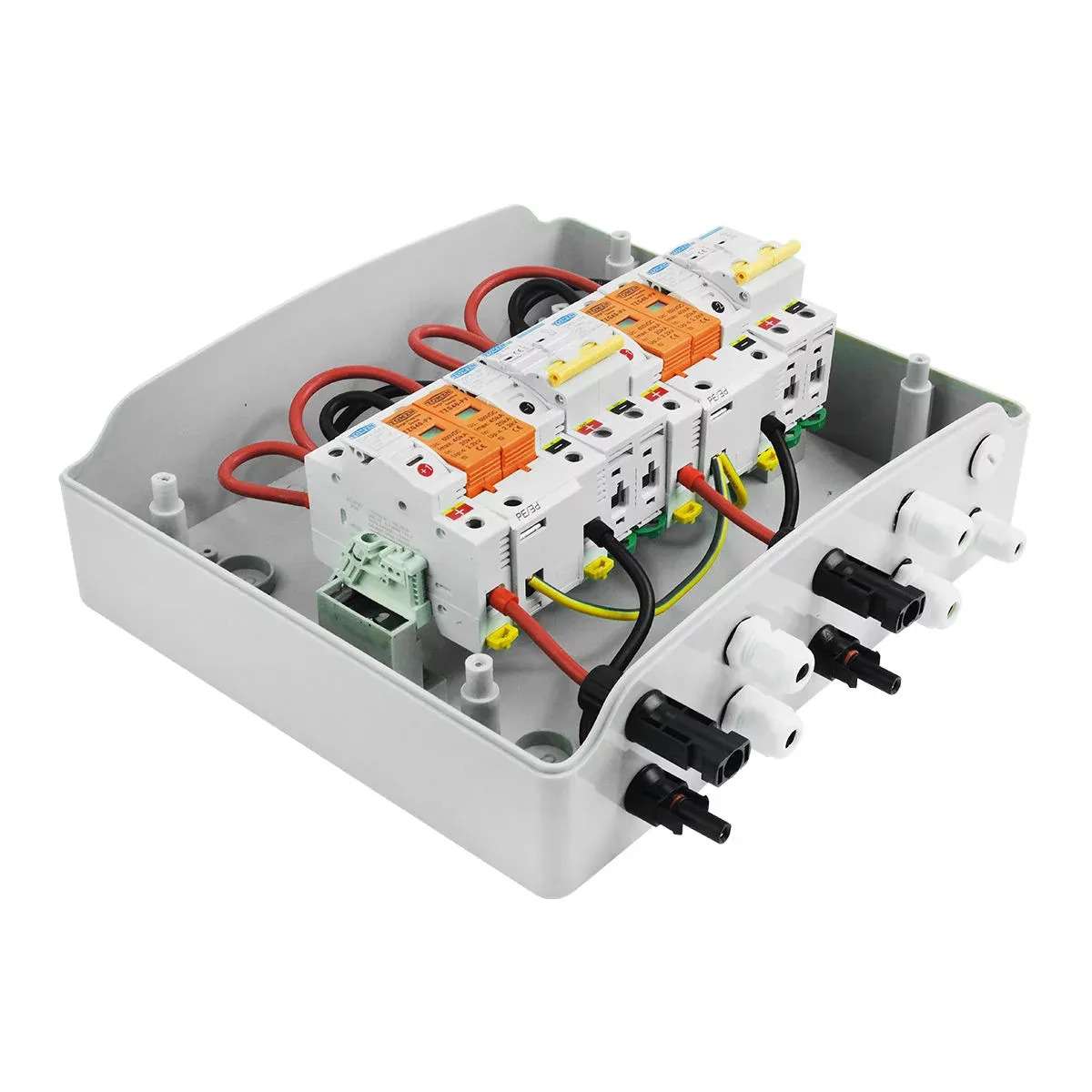
This is the layer most Nigerian hybrid installations are missing at least one element of. Protection devices are not optional add-ons. They are the difference between a system that lasts 12 years and one that needs a N450,000 inverter replacement after the first harmattan season.
- DC surge protection device (SPD): Installed between the solar array and the inverter’s MPPT input. It absorbs voltage transients from lightning strikes and switching surges. A N15,000 SPD prevents a N450,000 inverter replacement.
- AC SPD on the grid input: Absorbs voltage spikes coming in from the NEPA line. NEPA supply in Nigeria regularly carries transients from switching operations and load shedding events.
- DC isolator: A manually operated switch that allows the solar array to be safely disconnected from the inverter for maintenance without live cables remaining energised.
- AC breakers and RCBOs: One RCBO per output circuit. Not one breaker for the entire inverter output. A fault on one circuit should not kill the entire system.
- DC fuse between battery and inverter: Rated for the battery’s maximum discharge current. Installed within 300mm of the battery terminals.
Use our cable and electrical calculator to size every protection device correctly for your system voltage and current ratings.
How a Hybrid Solar System Works: Step by Step
The hybrid inverter runs through a continuous decision loop every few milliseconds. But from the user’s perspective, the system operates in four recognisable states. Here is what is happening in each one.
Step 1: Daytime With Grid Connected (Solar Priority Mode)
The sun is up. Solar is producing. The grid is connected.
The hybrid inverter directs solar power to your loads first. Whatever your loads are drawing comes from solar. The grid stands by but does not contribute.
If solar production exceeds your load demand, the surplus goes to the battery. The MPPT continues tracking the array’s maximum power point while the bidirectional DC-DC converter pushes current into the battery at the rate the BMS allows via CCL.
If solar production exceeds both your load demand and the battery’s charge acceptance rate, the MPPT begins throttling the array. This is called clipping. The array is not broken. The system is protecting the battery from overcharge. In Nigeria, where most DISCOs do not offer residential net metering, clipping is normal and expected once the battery is full.
Step 2: Night With Grid Connected (Battery Priority Mode)
Solar production has stopped. The battery takes over.
The hybrid inverter switches to battery discharge mode. The battery powers your loads through the bidirectional DC-DC converter and the AC-DC inverter stage. The grid is connected but standing by.
The battery discharges until it reaches your configured low SOC threshold. For LiFePO4, this is typically 15 to 20% SOC, corresponding to 80 to 85% depth of discharge. At that point, the inverter switches to grid supply to protect the battery from going deeper.
| The default setting on many inverter brands is 0% SOC. Doing this to a LiFePO4 battery repeatedly destroys it within 18 months. Set it to 20% SOC. Leave it there. |
For everything on the 80/20 rule and why it matters for battery lifespan, read our article on the 80/20 rule for lithium batteries.
Step 3: Grid Failure (Island Mode)
NEPA takes light.
Within milliseconds of detecting the loss of grid voltage, the hybrid inverter opens the grid relay. The NEPA line is physically disconnected from your system. The transfer takes 10 to 20 milliseconds on most quality hybrid inverters, fast enough that your LED lights may flicker once but do not go off.
The inverter then enters island mode. In island mode, the hybrid inverter itself becomes the voltage and frequency reference for your home. It generates the 230V 50Hz AC waveform that your appliances need. The battery powers your loads through this inverter-generated AC supply. If the sun is still up, solar continues charging the battery and contributing to the load simultaneously.
When NEPA restores power, the inverter does not reconnect immediately. It monitors the incoming grid voltage and frequency for 30 to 60 seconds to verify stability. Once the grid is verified stable, the relay closes and the system reconnects seamlessly.
Step 4: Grid Charge Window (TOU Opportunity)
This is the mode most Nigerian hybrid system owners do not know their system can do.
If your DISCO tariff is lower during off-peak hours, typically midnight to 6am, you can configure your hybrid inverter to charge the battery from the grid during that window. During the day, your battery discharges to power your loads. You avoid buying electricity at peak rates. At night, you recharge at off-peak rates.
This is called time-of-use (TOU) arbitrage. Every quality hybrid inverter from Victron, Deye, Growatt, and Solis has a grid charge schedule in its settings. It takes five minutes to configure.
The One Thing That Makes Hybrid Different From Every Other System
Most articles tell you a hybrid system works during blackouts. Almost none of them explain the mechanism that makes this possible, or why every other system fails when the grid goes down.
Why a Grid-Tied System Shuts Down During a Blackout
A grid-tied solar system without a battery shuts down the moment NEPA fails. This is not a design flaw. It is a legal safety requirement.
A grid-tied inverter works by synchronising its output to the grid’s voltage and frequency. It is always pushing power onto the grid. When the grid goes down, linemen from your DISCO go out to repair the fault. If your grid-tied inverter continues feeding power onto the dead line, those linemen can be electrocuted by voltage they cannot see coming.
To prevent this, every grid-tied inverter has an anti-islanding function. It continuously monitors the grid. The moment it detects that the grid has gone down, it shuts itself off. No exceptions.
The result: your solar panels are producing electricity, the sun is shining, and your house is completely dark because the inverter has switched off to protect the linesmen.
This is why grid-tied solar is a poor fit for Nigeria. It is designed for countries where the grid is always on. When the grid goes down for 10 hours a day, a grid-tied system is 10 hours of expensive hardware doing nothing.
How a Hybrid System Stays On: Island Mode
A hybrid system solves this problem with one additional hardware element: the grid relay.
The grid relay is a physical switch inside the hybrid inverter. When the grid is present, this relay is closed and the system is connected to the NEPA line. When the grid fails, the relay opens in 10 to 20 milliseconds and physically disconnects the system from the NEPA line.
Once disconnected, the system is no longer a grid-tied inverter feeding a shared network. It is a standalone power source running only your home. In this state, it is completely safe for linesmen to work on the NEPA network because your system is not connected to it.
The hybrid inverter then generates its own 230V 50Hz AC reference waveform using the battery as its energy source. Your loads run on this inverter-generated waveform as if the grid were still present. Solar continues contributing if the sun is still up.
This state is called island mode. Your home is an island, separated from the grid, self-powered, fully operational.
| The transfer from grid-connected to island mode takes 10 to 20 milliseconds. A full AC cycle at 50Hz takes 20 milliseconds. The transfer happens in less than one cycle. This is why your LED lights flicker at most once, and sensitive electronics like computers continue running without interruption. |
When the grid returns, the inverter monitors the incoming voltage and frequency for 30 to 60 seconds. Only after confirming that the grid is stable does it reconnect. This delay protects your equipment from brownout damage during an unstable grid recovery.
This mechanism is the entire reason hybrid systems are worth the premium over basic inverter-chargers in the Nigerian context. The island mode capability, the fast transfer relay, and the anti-islanding compliance are what you are paying for when you pay for a genuine hybrid inverter.
What a Hybrid Solar System Is NOT
This section could save you more money than any other part of this article.
The Nigerian solar market has a serious labelling problem. The word hybrid is applied to almost any inverter that has both a solar input and a grid connection. Most of those products are not hybrid systems in any meaningful engineering sense.
Here are the four things that are regularly sold as hybrid in Nigeria and are not.
1. A Basic Inverter-Charger With a Solar Input
This is the most common false hybrid in the Nigerian market. It is an off-grid inverter with a solar charge controller built in and an AC input port for grid or generator charging.
What it cannot do: It cannot simultaneously manage all three sources. It switches between them. Solar charges the battery. Or the grid charges the battery. Or the battery powers the loads. One at a time.
What it lacks: No programmable priority logic. No bidirectional AC-DC stage for grid charging at controlled current. No TOU scheduling. No grid export capability. No transfer relay engineered for 10 to 20 millisecond switching.
It is useful. It is not hybrid.
2. A Generator Plus Inverter System
A generator that charges a battery through an inverter-charger is an off-grid backup system with a generator as the charging source. There is no grid connection. There is no grid management. There is no export capability. There is no TOU logic. Calling it hybrid because it has two energy sources is marketing, not engineering.
3. An Automatic Transfer Switch With Solar Panels
Some systems use an ATS to switch between NEPA and a solar inverter. The solar inverter charges the battery and powers loads. When NEPA comes, the ATS switches the home back to NEPA supply.
This is two separate systems managed by a mechanical switch. They do not interact. The solar side does not coordinate with the NEPA side. The NEPA side does not charge the battery. There is no simultaneous three-source management.
4. An Inverter With a Hybrid Label but No BMS Communication Port
A genuine hybrid inverter has a dedicated BMS communication port, usually a CAN bus port or an RS485 port, labelled clearly on the back panel. It is how the inverter talks to the battery in real time.
If an inverter has no BMS communication port, it cannot communicate with a LiFePO4 BMS. It manages the battery blind. This is a fundamental capability gap that disqualifies it as a true hybrid inverter regardless of what the label says.
Four Questions to Ask Before Buying Anything Called Hybrid
Question 1: Does the inverter have a dedicated BMS communication port (CAN or RS485)? If no, it is not a true hybrid inverter.
Question 2: Can it simultaneously draw from solar, battery, and grid to power loads? If the answer is that it switches between them, it is not hybrid.
Question 3: Does it have programmable priority settings for solar, battery, and grid? If it only has one mode, it is not hybrid.
Question 4: Does it have a transfer relay rated for less than 20ms switching? If the salesperson does not know what this means, walk away.
Hybrid vs The Alternatives: What Actually Matters for Nigeria
Here is the comparison that matters for a Nigerian buyer. Built around the actual grid supply situation in Nigerian cities, not a generic global comparison.
| Grid-Tied | Off-Grid | Basic Inverter-Charger | True Hybrid | |
| Works during NEPA blackout | No | Yes | Yes | Yes |
| Battery required | No | Yes | Yes | Yes |
| Battery bank size needed | None | 3 to 5 days | 2 to 3 days | 1 to 2 days |
| Grid management logic | None | None | None | Full |
| TOU scheduling | No | No | No | Yes |
| Generator integration | No | Basic | Basic | Advanced |
| Export to grid | Yes | No | No | Yes (if DISCO allows) |
| Best for Nigeria | Poor fit | Rural only | Common but limited | Best fit for cities |
The key column is battery bank size. This is where the cost difference between off-grid and hybrid becomes concrete.
A 5kWh daily essential load needs roughly 15 to 25kWh of battery for off-grid. A hybrid system needs 10 to 12kWh because the grid covers cloudy-day recharge. At current Nigerian LiFePO4 prices of roughly N200,000 to N250,000 per kWh, that difference is N1,000,000 to N3,250,000 in battery cost alone. The hybrid inverter costs more than a basic inverter-charger, but the battery savings more than compensate.
For a detailed cost comparison with real Nigerian figures, read our guide on off-grid solar vs generator costs in Nigeria and our breakdown of the off-grid vs hybrid vs grid-tied decision.
How Long Does a Hybrid Solar System Last?
A properly designed and correctly configured hybrid solar system lasts 15 to 25 years in Nigerian conditions. But the system is made of components with different lifespans. Understanding each one sets the right expectation.
Component Lifespans
| Component | Expected Lifespan | Key Limiting Factor |
| Solar panels | 20 to 25 years | Output degrades ~0.5% per year |
| Hybrid inverter | 10 to 15 years | Capacitor degradation, ambient temperature |
| LiFePO4 battery bank | 8 to 12 years | Depth of discharge, temperature, charge config |
| BMS | Usually outlasts battery cells | Surge events, water ingress |
| Protection devices | Life of system | SPDs need inspection every 3 to 5 years |
What Kills a Hybrid System Early in Nigeria
Three things consistently destroy hybrid systems before they should fail.
Incorrect battery configuration. Float charging enabled on LiFePO4. Discharge cut-off set to 0% SOC. Battery type set to lead-acid in the inverter settings. Any of these alone can destroy a LiFePO4 bank within 18 months. All three together will do it in less than a year.
Read our articles on why float charging lithium batteries is harmful and why 100% maximum usable capacity is a battery death sentence.
No DC surge protection. Nigeria’s harmattan season brings electrostatic discharge events that regularly exceed the MPPT input voltage rating of hybrid inverters. Without a DC SPD, the first major surge destroys the MPPT. Inverter replacement follows shortly after.
Plant room temperature. A hybrid inverter running at 45 degrees C ambient degrades its internal capacitors 4 to 5 times faster than at 25 degrees C. This is the single most overlooked factor in Nigerian hybrid system longevity. A well-ventilated plant room is not a luxury. It is a maintenance schedule.
For the complete guide to extending your battery system’s life, read our article on how to increase lithium battery lifespan.
Frequently Asked Questions
What is the difference between a hybrid solar system and a normal solar system?
A normal solar system in most Nigerian contexts refers to a basic inverter-charger with solar panels. It switches between solar, battery, and grid one source at a time. A hybrid solar system manages all three simultaneously using programmable priority logic. It has BMS communication, TOU scheduling, transfer relay switching, and full grid management capability. The difference is not cosmetic. It is the difference between a system that optimises energy use intelligently and one that simply switches between sources.
How does a hybrid solar system work step by step?
During the day, solar powers your loads first. Surplus goes to the battery. If surplus exceeds battery charge acceptance, the MPPT throttles the array. At night, the battery powers your loads until it reaches the low SOC threshold (typically 20% for LiFePO4), then the grid takes over. When the grid fails, the transfer relay opens in 10 to 20 milliseconds, the system enters island mode, and the battery plus solar power your home. When the grid returns, the inverter waits 30 to 60 seconds to verify stability before reconnecting.
What are the components of a hybrid solar system?
A hybrid solar system has five core components. Solar panels generate DC electricity. The hybrid inverter manages power flow across all three sources using four internal functional blocks: MPPT, bidirectional DC-DC converter, bidirectional AC-DC inverter, and transfer relay. The LiFePO4 battery bank stores energy. The BMS monitors and communicates battery state to the inverter via CAN or RS485. Protection devices including DC SPD, AC SPD, isolators, and RCBOs protect all components from surges, faults, and overcurrent events.
Is a hybrid solar system better than off-grid?
For most Nigerian homes in cities with partial DISCO supply, yes. A hybrid system needs 1 to 2 days of battery autonomy versus 3 to 5 days for off-grid, because the grid handles extended cloudy periods. This difference translates to N1,000,000 to N3,250,000 in battery cost savings. The hybrid inverter costs more, but the overall system cost is lower and the performance is better for urban Nigerian conditions. Off-grid is the better choice only for locations with zero grid supply.
What is the lifespan of a hybrid solar system?
Panels last 20 to 25 years. The hybrid inverter lasts 10 to 15 years in a properly ventilated installation. A LiFePO4 battery bank lasts 8 to 12 years at 80% depth of discharge. The full system life when all components are correctly sized and maintained is 15 to 20 years. The most common reason systems fail early is incorrect battery configuration, missing surge protection, and excessive plant room temperature.
Can a hybrid solar system work without NEPA?
Yes. When the grid is absent the hybrid system operates in island mode, powered by the battery and solar array. It does not need the grid to function. The grid is a backup source, not a requirement. This is the critical difference from a grid-tied system which cannot operate without the grid. For homes and businesses in areas with very poor or zero DISCO supply, a hybrid system still functions as a complete off-grid system until DISCO supply improves.
What makes a hybrid solar system different from a basic inverter in Nigeria?
Four capabilities that a basic inverter does not have. First, simultaneous three-source management: a hybrid manages solar, battery, and grid all at once, a basic inverter switches between them. Second, BMS communication: a hybrid talks to the battery BMS every second to optimise charging and protect the cells, a basic inverter manages the battery blind. Third, programmable priority logic: a hybrid can be configured for solar-first, battery-first, or grid-first depending on your needs and tariff schedule. Fourth, fast transfer relay: a hybrid switches to island mode in 10 to 20 milliseconds, a basic inverter-charger typically takes 20 to 60 milliseconds.
Conclusion
A hybrid solar system is not defined by what it contains. It is defined by what it does.
The simultaneous management of three power sources, the programmable priority logic, the BMS communication, the fast transfer relay, and the island mode capability are what make a system genuinely hybrid. Remove any of these and you have a different product, regardless of what the label says.
In the Nigerian context, where grid supply is partial, unreliable, and increasingly expensive, a properly designed hybrid system is the most intelligent energy architecture available. It uses the grid intelligently when it is present. It runs independently when it is not. It charges the battery at the right time, at the right rate, and at the right depth. It does all of this automatically, based on parameters you set once during commissioning.
The full engineering guide for designing, sizing, and commissioning a hybrid system for Nigerian conditions is in our Complete Hybrid Solar System Design Guide. Start there if you are planning a new installation.
| Plan your system before speaking to any installer Use our off-grid solar system sizing calculator to establish your load and battery baseline. Then use our inverter sizing calculator to verify any inverter you are quoted is actually sized for your real load, including surge and temperature derating. |

I am Engr. Ubokobong Ekpenyong, a solar specialist and lithium battery systems engineer with over five years of hands-on experience designing, assembling, and commissioning off-grid solar and energy storage systems. My work focuses on lithium battery pack architecture, BMS configuration, and system reliability in off-grid and high-demand environments.