
Every article on this topic lists the same five things. Backup power. Lower electricity bills. Energy independence. Scalability. Environmental benefits. These are real. But they are surface level.
The advantages that actually separate a hybrid solar system from an off-grid system, a generator, or a basic inverter-charger go much deeper. This article quantifies where possible, explains the mechanism behind each advantage, and anchors every benefit to the Nigerian energy reality.
Vague claims like “reduces your electricity bill” help no one. You will find real numbers here.
What are the advantages of hybrid solar system?
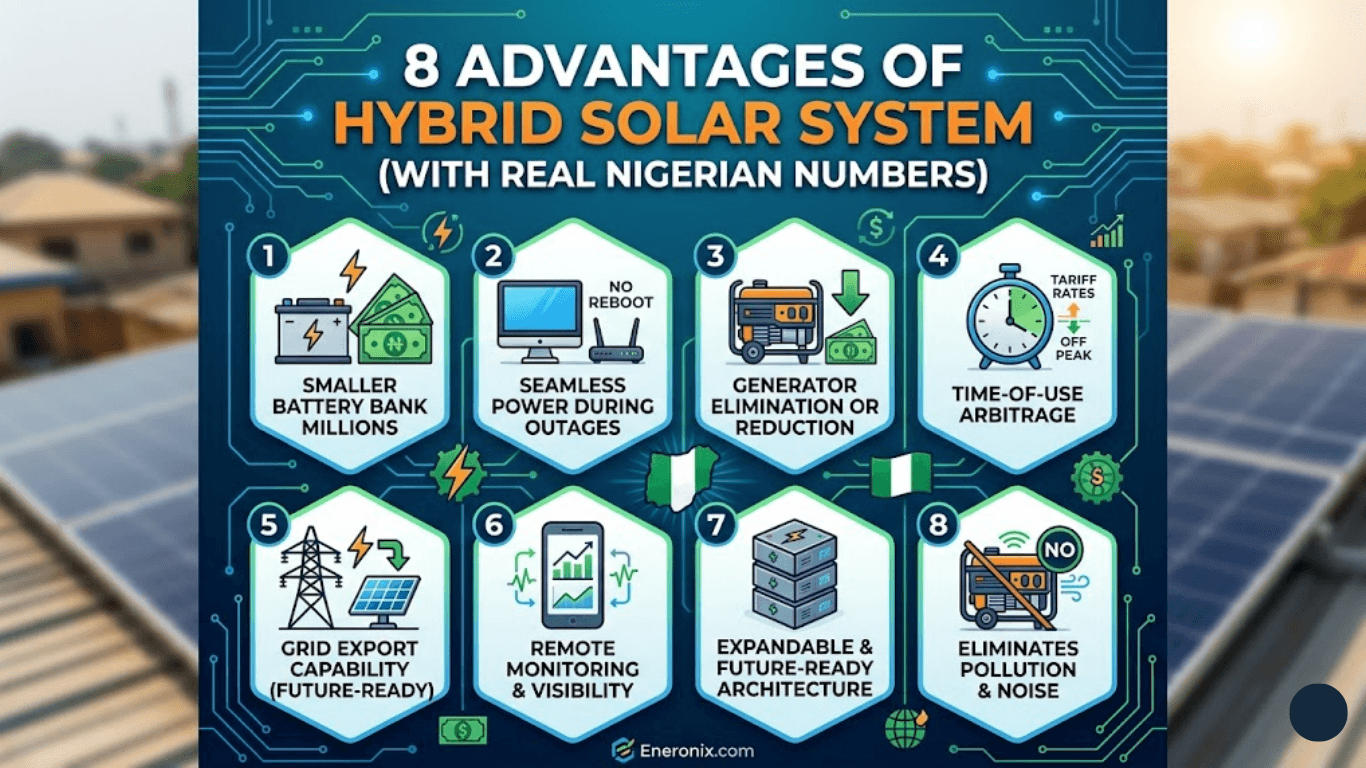
A hybrid solar system offers three major advantages: a smaller battery requirement, seamless power backup within 10–20 milliseconds, and significant cost savings by reducing generator usage. It combines solar panels, battery storage, and grid supply to deliver reliable and efficient power in regions with unstable electricity like Nigeria.
Advantage 1: A Smaller Battery Bank Saves You Millions

This is the most financially significant advantage of a hybrid solar system. Most articles skip it entirely or mention it in one sentence.
An off-grid system must carry the full load alone. That means the battery bank must provide 3 to 5 days of autonomy with no other source of power. A hybrid system uses the grid as a tertiary backup. The battery only needs to cover 1 to 2 days of essential load.
Here is what that difference looks like in naira.
Take a home with a 5kWh daily essential load. An off-grid system needs 25kWh to 37.5kWh of usable battery capacity for 3 to 5 days of autonomy. A hybrid system needs 5kWh to 10kWh for 1 to 2 days. The difference is roughly 22 to 25kWh of battery capacity you simply do not need to buy.
At current Nigerian LiFePO4 battery prices of N200,000 to N250,000 per kWh, that battery saving alone comes to N4.4 million to N6.25 million.
Battery Size and Cost Comparison
| System Type | Required Autonomy | Battery Size Needed | Estimated Cost (₦200k–₦250k/kWh) | Financial Impact |
|---|---|---|---|---|
| Off-Grid System | 3–5 days | 25–37.5 kWh | ₦5M – ₦9.3M | Very high upfront cost |
| Hybrid System | 1–2 days | 5–10 kWh | ₦1M – ₦2.5M | Significantly lower cost |
| Cost Difference | — | ~22–25 kWh saved | ₦4.4M – ₦6.25M saved | Major financial advantage |
Generator Cost Comparison
| Power Source | Daily Runtime | Daily Cost | Annual Cost |
|---|---|---|---|
| Generator Only | ~10 hours/day | ₦19,000 – ₦31,500 | ₦5M+ |
| Hybrid System | ~10 hours/month | Negligible | Massive savings |
The battery saving on a correctly sized hybrid system is large enough to more than cover the cost premium of a hybrid inverter over a basic off-grid unit. This makes the total hybrid system cost lower than an equivalent off-grid system for any home or business with even partial DISCO supply.
If you want to size your battery bank correctly, use the LiFePO4 Battery Bank Calculator to model both scenarios side by side.
Advantage 2: Truly Seamless Power During NEPA Outages
A hybrid system transfers from grid to battery in 10 to 20 milliseconds. Your computers, routers, medical devices, and LED lighting cannot detect this transfer. There is no reset. There is no reboot. There is no data loss.
This is materially different from a generator backup. A generator takes 15 to 60 seconds to start. It requires manual or automated transfer switching. It produces audible noise and fumes for the entire outage duration.
For a Nigerian business, the value of seamless power continuity is not theoretical. A 2024 RMI report on a real Nigerian commercial and industrial hybrid solar deployment showed a client achieving a 44% reduction in energy costs and 95% power uptime after installing a hybrid solar system. Before that installation, the same business had cut production to one daytime shift to manage diesel costs that had risen 367% over four years.
No amount of generator management achieves 95% uptime at that cost reduction. Only a hybrid system can.
Advantage 3: Generator Elimination or Dramatic Reduction in Running Hours
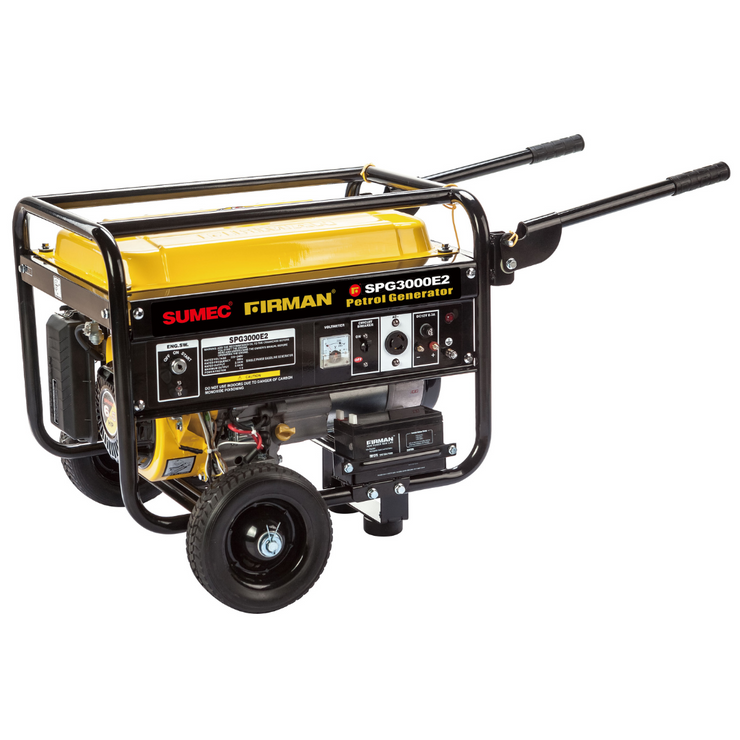
A hybrid system with a correctly sized battery bank can eliminate generator dependency entirely for most Nigerian households. The grid recharges the battery during supply hours. Solar recharges it during daylight. The generator only becomes necessary if both the grid and solar are simultaneously insufficient for multiple consecutive days.
Here is the financial value of eliminating the generator.
A typical Nigerian household runs a 3.5kVA generator for roughly 10 hours per day. At current petrol prices of approximately N950 to N1,050 per litre (as of early 2026), the generator consumes 2 to 3 litres per hour. That is N19,000 to N31,500 per day in fuel alone.
Compounded over a year, a Nigerian home dependent on a generator spends over N5 million on fuel. Our detailed breakdown of off-grid solar vs generator costs in Nigeria shows this clearly. A hybrid system eliminates this expenditure.
The generator does not go away immediately. But it goes from running 10 hours a day to running 10 hours a month or less. That is a transformation in both cost and quality of life.
Advantage 4: Time-of-Use Arbitrage and Intelligent Energy Scheduling
This advantage is available to hybrid system owners today and it will become increasingly valuable as Nigerian tariff structures mature.
A hybrid inverter can be programmed to charge the battery from the grid during off-peak tariff hours, typically midnight to 6am on Nigerian DISCO tariffs, and discharge during peak hours. This is called time-of-use (TOU) arbitrage.
Under the MYTO framework, DISCOs are increasingly moving toward time-differentiated billing. A system owner who configures TOU scheduling correctly pays low off-peak rates to fill their battery at night and avoids high peak rates during the day. Over a month, this produces meaningful tariff savings on top of the solar generation savings.
Quality hybrid inverters from Victron, Deye, Growatt, and Solis all support TOU programming. No other solar system type can do this. An off-grid system has no grid connection to exploit. A basic inverter-charger lacks the intelligence to schedule charging around tariff windows.
Advantage 5: Grid Export Capability as Tariff Policy Matures
NERC released Draft Net Billing Regulations in March 2026. The current proposed minimum capacity of 50kWp excludes most residential installations for now. But the regulatory direction is clear: Nigeria is moving toward a framework where solar system owners can export excess generation and receive credits.
A hybrid system is already built for this. When net metering becomes available at residential scale, a hybrid system owner enables the export function in the inverter settings. That is all. The infrastructure is already there.
An off-grid system cannot export. A basic inverter-charger cannot export. Only a true hybrid system supports bidirectional grid interaction.
The buyers who invest in hybrid today are positioning their energy infrastructure for the tariff regime of the next decade. This is not speculative. The regulation is drafted and in public consultation.
To understand the architecture that makes this possible, see our guide on what a hybrid solar system actually is.
Advantage 6: Remote Monitoring and Real-Time System Visibility
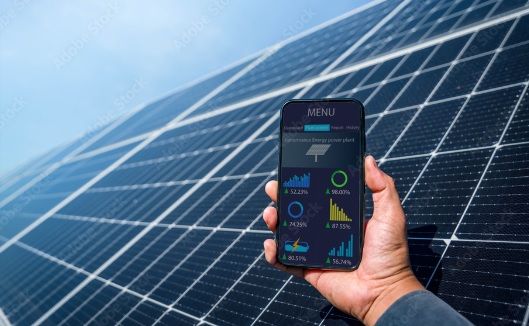
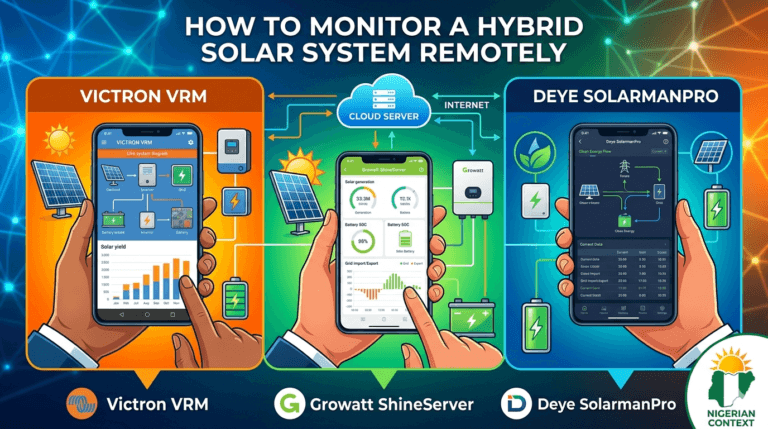
Every quality hybrid inverter comes with a monitoring platform. Victron has VRM. Growatt has ShineServer. Deye and Solis have SolarmanPro and SolisCloud respectively. These platforms show real-time solar generation, battery state of charge, grid import and export, load consumption, and full historical data.
This matters for three practical reasons.
- You can see exactly what your system is doing from your phone at any time. You do not have to be on-site to know if the battery is charging.
- Faults are flagged with error codes before they escalate to component failures. You catch a problem in the data before it becomes a repair bill.
- You can verify that your installer configured the system correctly at commissioning. An incorrect float voltage setting, a wrong battery type selection, or a misconfigured discharge cut-off are visible immediately in the monitoring data.
A basic inverter-charger system typically has no monitoring capability beyond a local display. An off-grid system can get monitoring if a Victron Cerbo GX is added, but that is an additional cost. In a hybrid system, monitoring is built into the architecture from day one.
Advantage 7: Future-Ready and Expandable Architecture
A hybrid system is designed to grow with you. Adding more solar panels to an existing MPPT charge controller, within its voltage and current limits, is a modest cost. Adding more battery capacity, within BMS and inverter communication limits, extends your autonomy.
This modularity means you can start with a 10kWh battery bank today and expand to 20kWh two years later when budget allows. Global lithium battery prices continue to fall. Expanding becomes more affordable every year.
Off-grid systems face a specific problem when expanding battery banks retrospectively: cell age mismatch. Adding new cells to an old bank creates imbalance and can shorten the lifespan of both the old and new cells. Hybrid systems with managed BMS communication handle battery bank expansion more cleanly because the BMS can manage and balance across the expanded bank.
If you are planning an expansion, use the Off-Grid Solar System Sizing Calculator to model your future system size and understand the panel and controller headroom you need from day one.
For a deeper look at what a correctly designed hybrid system looks like at scale, read the Complete Hybrid Solar System Design Guide.
Advantage 8: Elimination of Generator Pollution and Noise
A hybrid system running on solar and battery eliminates generator exhaust fumes from your home or business environment. Petrol generators produce carbon monoxide, nitrogen oxides, and particulate matter. Generator-related carbon monoxide poisoning is a documented cause of death in Nigeria every year. This typically occurs when generators are operated in enclosed or semi-enclosed spaces.
A hybrid system eliminates this health risk for the hours it covers. It also eliminates the noise that has become a defining feature of Nigerian neighbourhoods. The difference in living environment is immediate and significant.
At a larger scale, an RMI analysis of hybrid solar deployments across 20 Nigerian commercial and industrial sites showed an estimated 20,000 metric tonnes of CO2 equivalent reduction combined. The environmental impact at the individual level is modest. At national scale it compounds quickly.
The Honest Summary: These Advantages Are Real But Conditional
Every advantage in this article is genuine. But every one of them is conditional on the same thing: the system being correctly designed and correctly configured.
A hybrid system with BMS communication not configured, float charging enabled on a LiFePO4 battery, and discharge cut-off set at 0% SOC will not deliver most of these advantages. It will fail within 18 months and the owner will blame the technology rather than the installation.
The advantages of a hybrid system are the ceiling of what a correctly designed system achieves. The floor of what a poorly designed system delivers is considerably lower. A competent installation is not optional. It is the difference between the two outcomes.
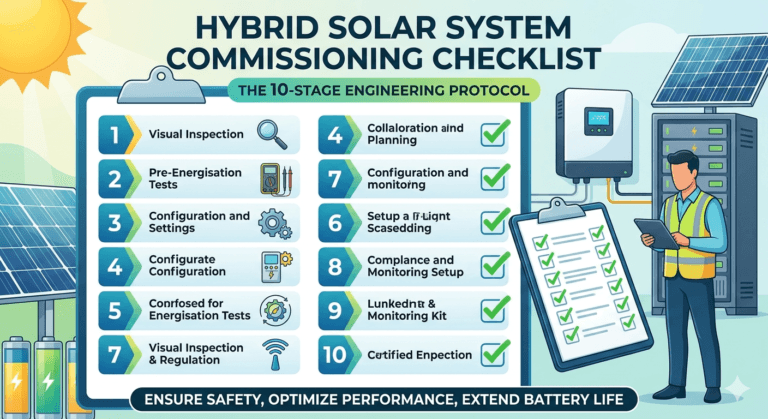
Before you commission any system, use the Off-Grid System Design Checklist to verify every stage from design through installation and commissioning. And if you want to understand what can go wrong, the disadvantages of a hybrid solar system article covers the technical problems most vendors will never tell you about.
Related Reading on Eneronix
- Off-Grid vs Hybrid vs Grid-Tied Solar: Which Architecture Is Right for Your Site?
- Which Is Better: On-Grid or Hybrid Solar System in Nigeria?
- How to Increase Lithium Battery Lifespan: 6 Proven Strategies
- Top 10 Costly Off-Grid Solar Mistakes
- Lithium Battery Basics: Lifespan, Voltage, Charging and Real-World Performance
Frequently Asked Questions

What is the main advantage of a hybrid solar system over an off-grid system?
The main advantage is a smaller battery bank. A hybrid system uses the grid as a backup source, so the battery only needs to cover 1 to 2 days of essential load instead of 3 to 5 days for a fully off-grid system. For a typical Nigerian home, this battery size reduction saves N4 million to N6 million in upfront cost.
Is a hybrid solar system worth it in Nigeria?
Yes, for any location with at least partial DISCO supply. The generator elimination alone, which can save over N5 million per year in fuel, justifies the investment. The seamless transfer during outages, remote monitoring capability, and future export readiness add further value that a generator or basic inverter-charger cannot match.
Can a hybrid solar system work without the grid?
Yes. A hybrid system operates in island mode when the grid is unavailable. It runs on solar and battery exactly like an off-grid system during that period. The grid connection simply provides an additional recharge path and a tertiary backup when both solar and battery are depleted.
What is the transfer time from grid to battery on a hybrid system?
10 to 20 milliseconds on a quality hybrid inverter. This is fast enough that computers, routers, medical devices, and most sensitive electronics cannot detect the transition. There is no reboot, no data loss, and no interruption to running equipment.
Can a hybrid solar system export power to the grid in Nigeria?
Not yet at residential scale. NERC released Draft Net Billing Regulations in March 2026 with a proposed minimum capacity of 50kWp, which currently excludes most homes. However, a hybrid system is already architecturally capable of exporting. When regulations permit it at smaller scales, a hybrid owner enables the function in the inverter settings. No hardware change is required.
What is time-of-use arbitrage and how does it help hybrid system owners?
Time-of-use arbitrage means charging the battery from the grid at low off-peak tariff rates and discharging during high-rate peak hours. This reduces your net electricity spend. It is available on Victron, Deye, Growatt, and Solis inverters through their scheduling or grid-code settings. As Nigerian DISCOs move toward time-differentiated billing under MYTO, this advantage grows more valuable.
How do I know if my hybrid system is configured correctly?
Check the monitoring platform. Victron VRM, SolarmanPro, ShineServer, and SolisCloud all show real-time data including battery SOC, charge and discharge rates, and system events. Specific things to verify: float voltage must be disabled or set correctly for LiFePO4, discharge cut-off must not be set to 0% SOC, and BMS communication must be active with no persistent error codes. The Off-Grid System Design Checklist covers the full commissioning verification process.
How does a hybrid solar system reduce generator running hours?
The battery covers load during NEPA outages. Solar recharges the battery during the day. The grid recharges it when supply is available. The generator is only needed if all three sources are simultaneously insufficient for consecutive days. In practice, most Nigerian households with a correctly sized hybrid system run their generator fewer than 10 hours per month instead of 10 hours per day.
What are the disadvantages of a hybrid solar system?
Higher upfront cost than a basic inverter-charger, more complex configuration, and dependency on correct BMS communication setup are the primary ones. The disadvantages of a hybrid solar system article covers 7 technical problems in detail, including the ones most vendors will not mention.

I am Engr. Ubokobong Ekpenyong, a solar specialist and lithium battery systems engineer with over five years of hands-on experience designing, assembling, and commissioning off-grid solar and energy storage systems. My work focuses on lithium battery pack architecture, BMS configuration, and system reliability in off-grid and high-demand environments.