MPPT vs PWM Charge Controller in Nigeria: Which One Actually Saves You Money?
MPPT vs PWM charge controller in Nigeria explained with real data. See efficiency, costs, and payback in Lagos, Abuja & Kano. Find the best controller for your system.
A plain-English breakdown – with real numbers, Nigerian city data, and naira savings calculations. Whether you are a homeowner, installer, or engineer, this guide will help you pick the right charge controller and stop wasting money on solar energy that never reaches your battery.
QUICK ANSWER Skip If You Just Want the Bottom Line
MPPT wins for most Nigerian homes. For any solar system above 400W on a 12V setup, or any 24V/48V system, MPPT pays for itself in under 18 months through extra energy harvested. PWM is fine only for very small systems under 200W (phone charging, a few LED lights). The ‘30% better’ claim you see in MPPT marketing is for cold climates – in Nigeria’s heat, the real advantage is 10–15%. Still significant, still worth the money.
What Is In This Guide
1. What Is a PWM Charge Controller – and How Does It Work?
2. What Is an MPPT Charge Controller – and How Is It Different?
3. How Nigeria’s Heat Changes the MPPT vs PWM Equation
4. City-by-City Naira Savings: Lagos, Abuja, Kano, and More
5. When PWM Is the Right Choice
6. MPPT and LiFePO4 Batteries – What You Must Know
7. How to Size and Select an MPPT Controller
8. Hybrid Inverters – Do You Still Need a Charge Controller?
9. Installation Tips That Double Your MPPT’s Performance
10. Decision Table: Which Controller for Which System?
11. FAQ – The 15 Most-Asked Questions in Nigeria
The Question Every Nigerian Solar Buyer Gets Wrong
Walk into any solar shop in Lagos or Abuja. Ask about MPPT vs PWM. You will almost certainly hear: 'MPPT is better, but PWM is cheaper. Pick based on your budget.' That answer is not wrong. But it is dangerously incomplete.
What the salesperson does not tell you is that Nigeria’s hot weather shrinks the efficiency gap between the two – and the real decision is about how much naira you extract from every watt of solar panel you buy over the next 10 years.
This guide goes deep. We will explain both technologies in plain English, apply the temperature math to real Nigerian city data, and calculate – in actual watt-hours and naira – exactly when the MPPT price premium pays for itself. If you have ever had a battery that died faster than expected, read our post on the biggest lithium battery problems alongside this one, because the two issues are often connected.
1. What Is a PWM Charge Controller?
The Simple Explanation
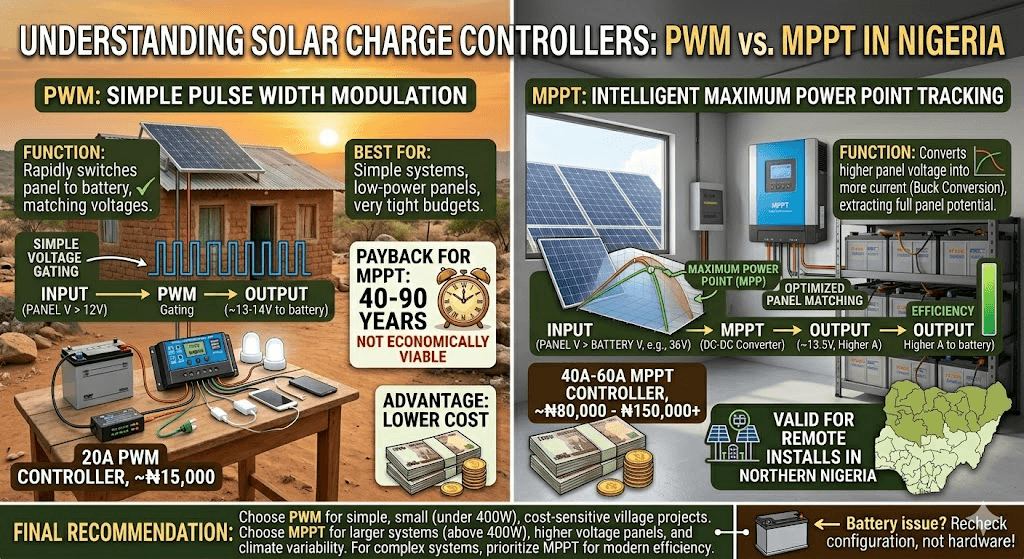
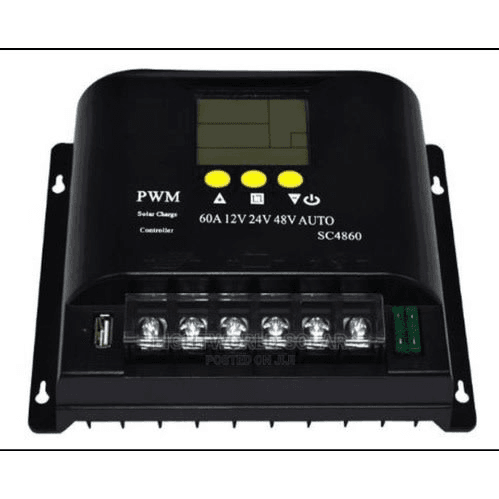
PWM stands for Pulse Width Modulation. Think of it as a very fast on-off switch between your solar panels and your battery. The controller switches the panel connection on and off thousands of times per second. By changing how long each ‘on’ pulse lasts (the duty cycle), it controls how much energy flows into the battery.
When your battery is nearly empty, the switch is almost always ON – full power flowing. As the battery fills up, the pulses get shorter and shorter to avoid overcharging. That is it. Simple, reliable, and cheap.
The Big Problem with PWM
Here is where PWM costs you money. When the switch is ON, it creates a near-direct connection between the panel and the battery. The panel’s voltage gets pulled down – forced to match the battery voltage.
Your solar panel is designed to work best at its Maximum Power Point Voltage (Vmp), which is roughly 17–18V for a standard 12V panel. Your 12V battery charges at about 12.5–14.4V. With PWM, the panel gets dragged down to 12.5–13.5V – and the energy gap between 17V and 13.5V is simply thrown away. Not converted, not stored – gone.
SIMPLE ANALOGY
Imagine your solar panel is a water pipe that naturally flows at full pressure (17V). PWM squeezes a valve to match your battery’s lower pressure (13.5V). The excess water pressure? It just pushes against the valve and gets wasted as heat. MPPT is different – it captures that excess pressure and converts it into more water volume (current) going into your battery.
Energy wasted per hour by PWM (example):
Panel Vmp = 17V, Battery voltage = 13.5V
Voltage wasted = 17 – 13.5 = 3.5V
Loss fraction = 3.5 / 17 = 20.6%
On a 200W panel: ~41W wasted every hour of sunshine
2. What Is an MPPT Charge Controller?
The Simple Explanation
MPPT stands for Maximum Power Point Tracking. Unlike PWM which just switches the panel on and off, an MPPT controller is a smart power converter – it lets the panel operate at its natural best voltage, then steps that voltage down to what the battery needs, converting the excess voltage into extra current.
Think of it as a voltage transformer that works in reverse – stepping down voltage and boosting current, just like a DC-DC converter. The result is that almost all the available power from the panel reaches the battery instead of being thrown away.
How the Tracking Works
The ‘tracking’ part is done by a microchip inside the controller. Every 10–100 milliseconds, it measures the panel’s voltage and current, calculates the power (P = V × I), and makes tiny adjustments to find the exact voltage point where the panel produces the most power. This is called the Perturb-and-Observe algorithm – it gently nudges the operating point back and forth until it finds the peak.
Why does it need to keep tracking? Because the panel’s best operating point changes every time a cloud passes, the temperature changes, or the sun angle shifts. A good MPPT controller responds within milliseconds.
Real Efficiency Numbers
Quality MPPT controllers convert 97–99% of the power they receive from the panels. The losses come from the switching transistors (MOSFETs) and the inductor inside the buck converter. Cheap generic MPPT controllers sold in Ladipo market can drop to 93–96% – still better than PWM, but the gap narrows.
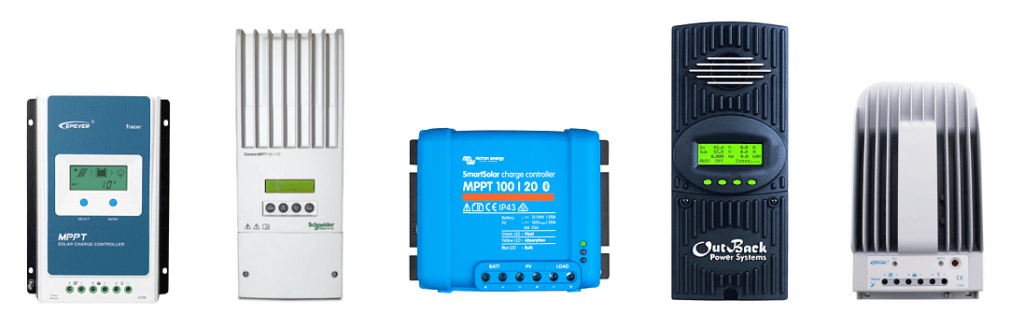
For a full breakdown of MPPT controller brands available in Nigeria, their efficiency ratings, and which ones support LiFePO4 batteries properly, check our MPPT controller sizing guide on Eneronix.
How Nigeria’s Heat Changes Everything
Why ‘Up to 30% Better’ Is Misleading for Nigeria
You have probably read that MPPT controllers harvest 10–30% more energy than PWM. That range is real – but the 30% figure applies to cold European and North American climates. The Global Solar Atlas data for Nigeria tells a different story, and it is important to understand why.
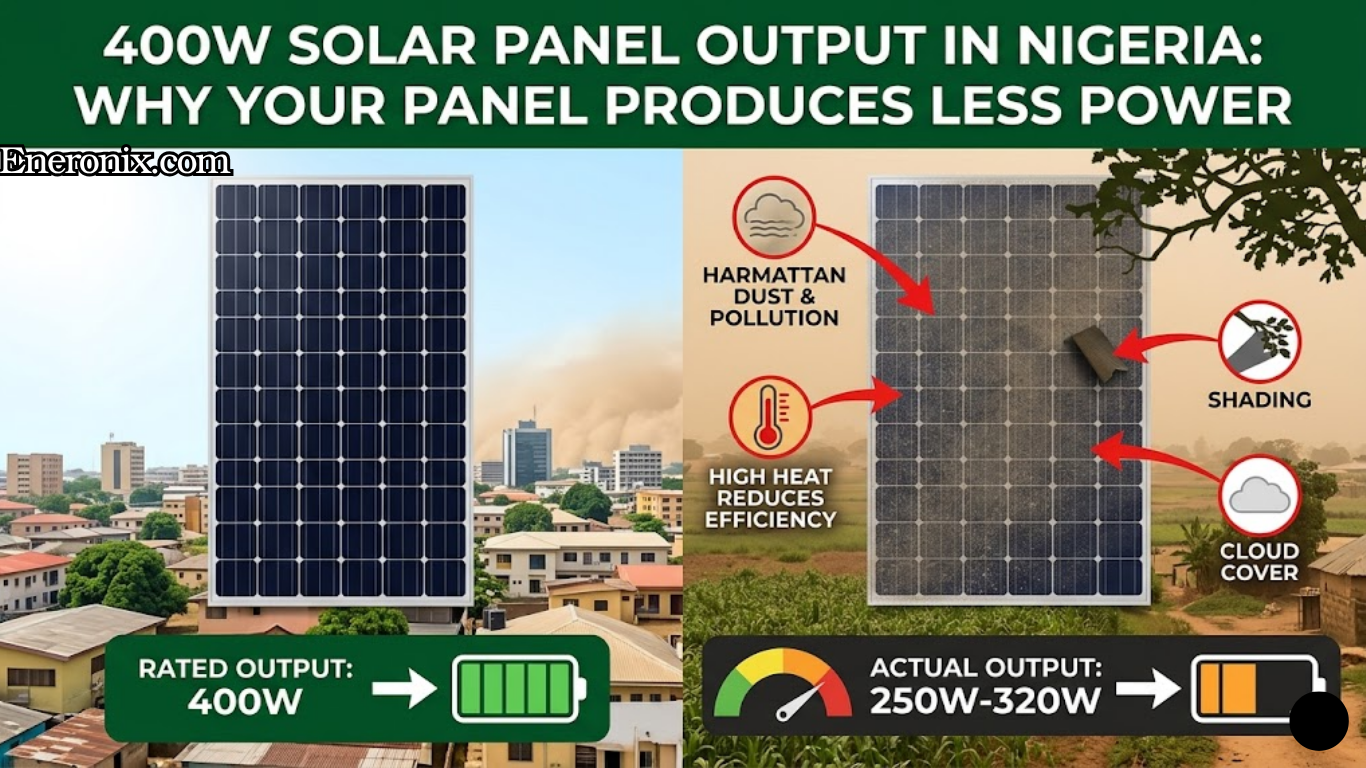
Solar panels are rated at Standard Test Conditions (STC): 25°C cell temperature. In Nigeria, panels on a rooftop commonly reach 55°C to 75°C during peak hours. Here is the key physics: as panel temperature rises, the panel’s maximum power voltage (Vmp) drops. This shrinks the voltage gap between what the panel wants to operate at and what the battery needs – and that gap is exactly what MPPT recovers.
Less voltage gap = less for MPPT to recover = smaller MPPT advantage over PWM. It is still an advantage. Just not 30%.
The Temperature Calculation
The voltage drop per degree of temperature is called the temperature coefficient of Vmp (γ_Vmp). For standard monocrystalline panels it is approximately -0.38% per °C.
How much does Vmp drop in Lagos? (example: 48V system, 4-panel string, Vmp_STC = 72V)
Ambient temperature at 13:00 in Lagos = 34°C
Panel cell temperature (rooftop, still air) = 34 + 25 = 59°C
Voltage headroom MPPT can recover = 62.7 – 54.4 = 8.3V
Recovery fraction = 8.3 / 62.7 = 13.2%
So in Lagos, MPPT recovers about 13.2% more energy than PWM – not 30%. In Abuja and Kano, where it is even hotter, the advantage drops slightly further to 10–12%. But on a 2kWp system charging from 4–6 hours of good sun every day, 10–13% translates into hundreds of kilowatt-hours per year.
WHY THIS MATTERS FOR YOUR PURCHASE DECISION
The 10–13% extra harvest in Nigeria still pays back the MPPT premium in under 18 months on any system above 1kWp – but it also means you should not believe vendors who promise you 30% enaergy gains. If someone is quoting 30% efficiency improvement for MPPT in Nigeria, they are using cold-climate numbers that do not apply here. Read more: Top 10 costly off-grid solar mistakes Nigerians make – many are rooted in wrong efficiency assumptions.
City-by-City Naira Savings: The Real Numbers
Using NASA POWER 22-year average irradiance data and the temperature correction math above, here is how much extra energy MPPT delivers over PWM in Nigeria’s main cities – and how fast it pays back the price difference.
Assumptions: 2,000Wp array installed, 80% system efficiency, ₦100/kWh value of stored energy (diesel equivalent), MPPT premium over comparable PWM controller = ₦37,000.
City
Sun hrs/day
MPPT Advantage
Extra kWh/yr
Extra ₦/yr
MPPT Cost Premium
Payback Time
Lagos
4.5
13.2%
322 kWh
₦32,200
₦37,000
~1.1 years
Port Harcourt
3.8
13.0%
272 kWh
₦27,200
₦37,000
~1.4 years
Abuja
5.8
11.7%
386 kWh
₦38,600
₦37,000
< 1 year
Kano
6.5
10.5%
389 kWh
₦38,900
₦37,000
< 1 year
Ibadan
5.2
12.5%
370 kWh
₦37,000
₦37,000
~1 year
Enugu
4.8
12.8%
349 kWh
₦34,900
₦37,000
~1.1 years
Maiduguri
6.8
10.2%
394 kWh
₦39,400
₦37,000
< 1 year
Peak sun hours from NASA POWER dataset. Extra kWh = 2,000Wp × PSH × 365 × 0.80 × advantage fraction. Naira savings at ₦100/kWh diesel equivalent. Actual results vary with load profile and real irradiance.
10-YEAR PICTURE
In every Nigerian city, the MPPT premium pays back within 14 months. Over 10 years, MPPT generates 3,000–4,000 kWh more energy from the same panels compared to PWM. At ₦100/kWh, that is ₦300,000–400,000 of extra stored energy from a ₦37,000 hardware decision. Related: See why running a generator full-time costs over ₦5 million per year – and why every kWh your MPPT recovers is money you are not spending on fuel.
When PWM Is the Right Choice
We are not here to say MPPT is always better. There are real situations in Nigeria where a good PWM controller is the correct engineering decision, and wasting money on MPPT is the wrong call.
Small Systems Under 200W
If your whole solar setup is one 100W panel charging a 12V battery for a few LED lights and phone chargers – PWM is correct. The extra energy MPPT would recover might be 15–25 Wh per day. At ₦100/kWh, that is about ₦1.50 to ₦2.50 per day. A 30A MPPT controller costs ₦30,000–50,000 more than a comparable PWM. The payback becomes 40–90 years. It simply does not make sense.
Rough threshold: MPPT makes economic sense once your array is bigger than 400W on 12V, 800W on 24V, or 1,600W on 48V.
When Panel Voltage Closely Matches Battery Voltage
If you design the system so the panel’s hot Vmp is only slightly above the battery charging voltage, the voltage gap shrinks and so does the MPPT advantage. This is possible with careful panel selection – but it removes flexibility for system expansion later.
PWM’s Real Advantages
Simpler and easier to repair in the field – fewer components, no complex firmware.
Less internal heat – important in hot Nigerian battery rooms.
Lower standby power draw – 5–15mA vs 20–50mA for MPPT. Matters for systems that sit idle for days.
Lower cost – ₦10,000–20,000 for 20–30A. Important for village electrification and very small budgets.
For remote northern Nigeria installations where local repair is a priority, a quality PWM is a valid choice.
If you are experiencing issues where your system is neither PWM nor MPPT but the battery percentage display seems wrong, read our post on why your inverter battery percentage is wrong – the root cause is often controller misconfiguration, not a hardware fault.
MPPT and LiFePO4 Batteries
Most Nigerian homes are now switching from lead-acid to LiFePO4 lithium batteries. If you have already made that upgrade – or are planning to – the interaction between your charge controller and your battery chemistry is critical. We have a full guide on the best lithium batteries for inverters in Nigeria that covers this from the battery side. Here we cover it from the charge controller side.
The Right Charge Voltage – This Is the Most Common Mistake
A 48V LiFePO4 battery needs to be charged to 58.4V during the absorption phase. Most inverter-chargers and charge controllers shipped to Nigeria have a default lead-acid profile that charges to 56.4V or 57.6V. These defaults are wrong for lithium.
If your MPPT controller charges your LiFePO4 battery to 57.6V instead of 58.4V, your battery will never fully charge. The BMS will keep reporting 85–90% SOC as the maximum. The battery appears defective. The installer may blame the cells. But the cells are fine – the charge voltage is wrong.
Correct charge settings for a 48V LiFePO4 battery bank:
Absorption (Bulk/Boost) voltage: 58.4V
Float voltage: 54.0V (or disable float for LiFePO4)
Low voltage cutoff: 44.0V
Equalization: OFF (never equalize LiFePO4)
CRITICAL WARNING - READ THIS BEFORE CONFIGURING ANY CONTROLLER
The single most common lithium battery failure in Nigeria is wrong charge voltage settings. The installer connects a new LiFePO4 battery, leaves the controller on its default lead-acid profile, and the battery never reaches full charge. Over hundreds of shallow cycles, capacity degrades faster than normal. Always configure your MPPT controller’s absorption voltage to 58.4V for 48V LiFePO4. Not 56.4V. Not 57.6V. 58.4V. If your battery is dying faster than expected, read: Why your battery dies faster than expected – even when it says 100%.
The Summer Dropout Problem
Here is a sizing error that causes mysterious ‘afternoon charging dropout’ in Nigerian systems. As panels get hotter, their Vmp drops. If the panel string Vmp drops BELOW the battery’s charging voltage in the heat of the day, the MPPT controller cannot charge the battery at all.
Check: Does your panel string Vmp stay above 58.4V at maximum panel temperature?
For Kano (T_cell can reach 70°C in the dry season):
Vmp at 70°C = Vmp_STC × [1 – 0.0038 × (70-25)]
= Vmp_STC × [1 – 0.171]
= Vmp_STC × 0.829
Required Vmp_STC > 58.4V / 0.829 = 70.4V minimum
A 2-panel series string (Vmp_STC ≈ 72V) just barely passes.
A single-panel string (Vmp_STC ≈ 36V) will drop out on hot afternoons.
The solution is simple: size your panel string so the cold-STC Vmp is at least 20% above the battery’s maximum charging voltage. This gives you headroom for Nigeria’s heat.
How to Size and Select an MPPT Controller
Calculate Required Controller Current
The MPPT controller current rating must match the actual current your solar array will deliver to the battery at maximum charge. The formula:
→ Specify a 60A controller (never run at 100% capacity continuously)
Check Maximum PV Input Voltage
The controller’s maximum PV voltage must handle the panel string’s open-circuit voltage (Voc) at the coldest possible temperature. In Nigeria, night temperatures can drop to 15–18°C in the harmattan season.
Most MPPT controllers are rated at 25°C ambient. In a Nigerian battery cabinet at 40–45°C, the controller’s output current must be derated. Typical derating: 1% per °C above 25°C.
This means a 40A controller in a hot, enclosed cabinet only delivers 32A. Size up, or ventilate properly. This is one of the 10 most costly off-grid solar mistakes – specifying a controller by its rating without accounting for ambient derating.
Controller Comparison Table
Controllers available in Nigeria with LiFePO4 support:
Brand / Model
Max PV V
Max A
Efficiency
LiFePO4 Profile
Naira Price (est.)
Recommended For
Victron SmartSolar 100/50
100V
50A
98–99%
Yes (custom)
₦120,000+
Premium systems, full LiFePO4 support
Epever Tracer 4215AN
150V
40A
98%
Yes (custom)
₦55,000–75,000
Best mid-range for 2–4kWp
Epever Tracer 6415AN
150V
60A
98%
Yes (custom)
₦80,000–100,000
Mid-range for 4–6kWp systems
Renogy Rover 40A
100V
40A
97%
Yes (preset)
₦50,000–70,000
Good budget option, 2–4kWp
Deye SCC 40A MPPT
100V
40A
97%
Yes (preset)
₦45,000–65,000
Budget, pairs well with Deye inverters
Generic (unbranded)
100V
30A
93–96%
Limited
₦20,000–35,000
Not recommended – avoid
Prices for Lagos/Abuja market, May 2026. 'Custom' LiFePO4 = fully programmable absorption voltage, float voltage, and current cutoff.
'Preset' = fixed lithium profile - verify it matches your specific battery's charge specs before installation.
Hybrid Inverters: Do You Still Need a Charge Controller?
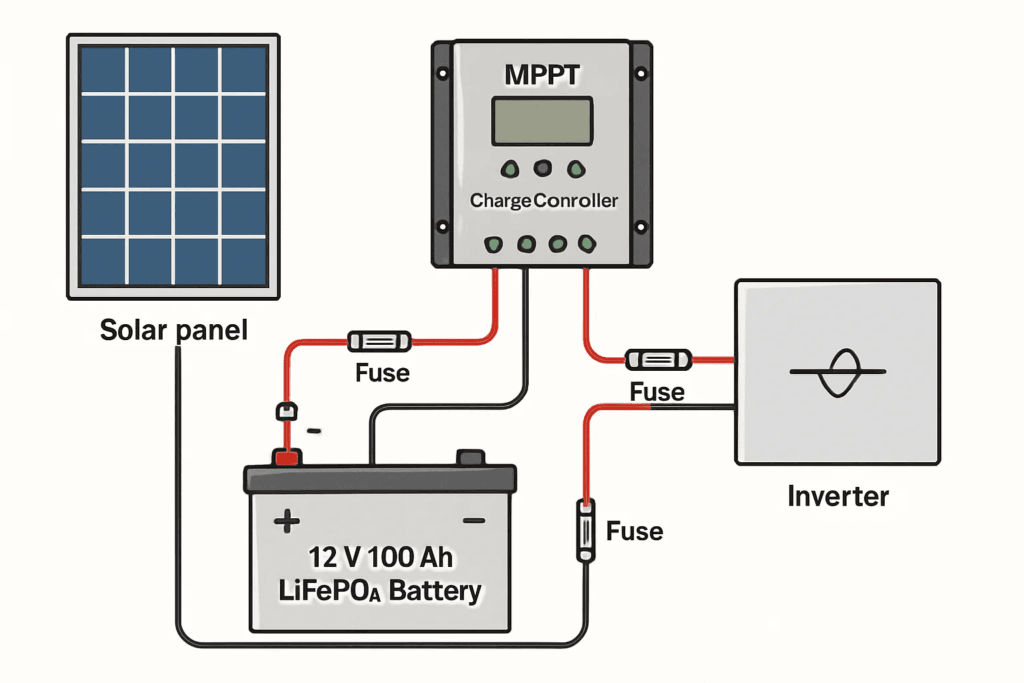
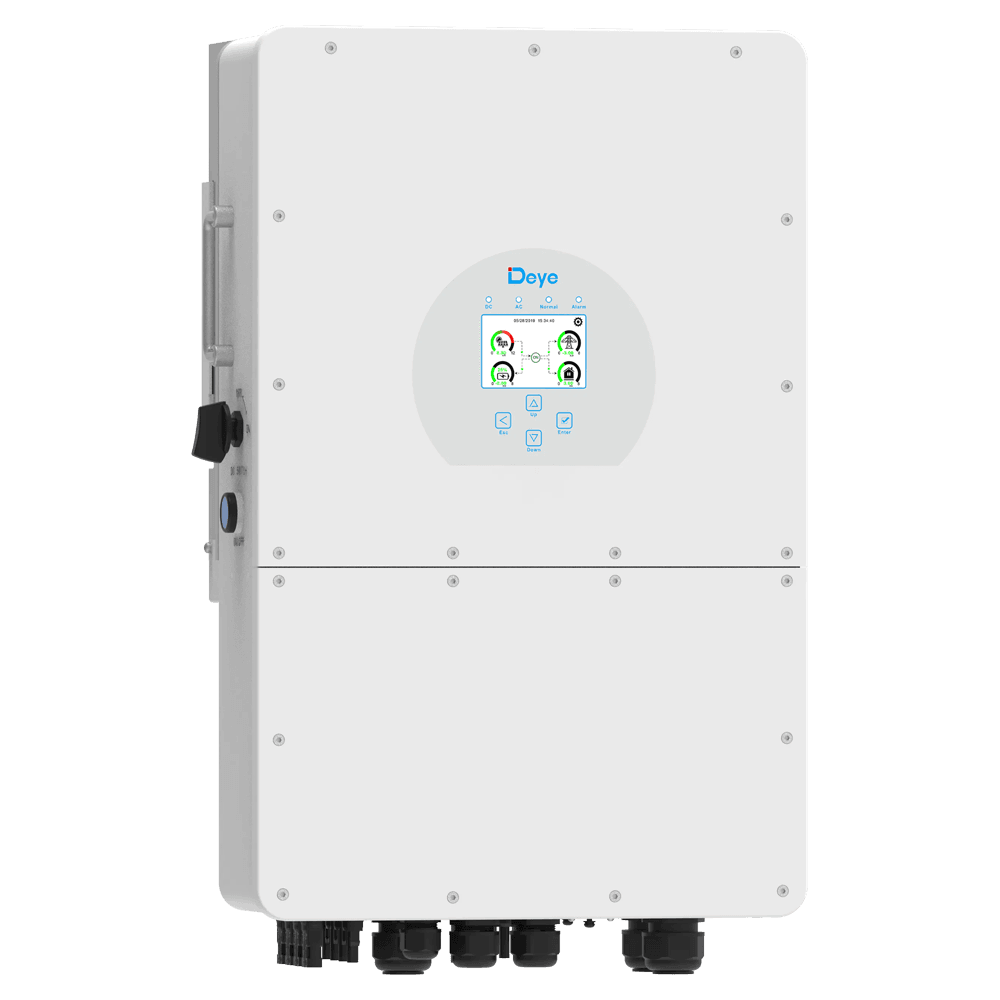
If you have a hybrid inverter like the Deye SUN-5K, Growatt SPF5000, or Victron Multiplus-II with built-in MPPT – you almost certainly do NOT need a separate external charge controller.
Adding an external MPPT controller in parallel with a hybrid inverter’s built-in MPPT is one of the most common wiring mistakes in Nigerian installations. Here is why it causes problems:
The hybrid’s built-in MPPT communicates with its own battery charger circuit, BMS connection, and load management logic. An external controller has no visibility into any of this.
Both controllers will try to charge the battery simultaneously. The BMS may receive conflicting charge current commands and enter a fault state.
The hybrid inverter may lose accurate SOC tracking because it does not account for the extra current coming in from the external controller.
The only valid case for an external controller alongside a hybrid is a very specific DC-coupled design where the external controller charges a separate battery. This requires careful voltage matching and BMS integration. Read our guide on off-grid inverter sizing with a complete worked example for how the built-in MPPT should be configured.
Installation Tips That Double Your MPPT’s Performance
Cable Sizing – The Hidden Efficiency Killer
One of the biggest installation mistakes in Nigeria is undersized PV cable between the panels and the controller. Because MPPT operates at higher panel voltage and lower current than PWM, you might think cable sizing is less important. It is not – and the voltage drop calculation is easy to check.
Voltage drop formula:
V_drop = (2 × cable length in metres × current × 0.0175) / cable area in mm²
Maximum acceptable V_drop = 1% of system voltage = 0.48V (for 48V system)
Example: 10-metre run from rooftop to battery room, 40A current:
With 6mm² cable: V_drop = (2 × 10 × 40 × 0.0175) / 6 = 2.33V ← TOO HIGH
In Nigerian homes where the panel array on the roof may be 15–25 metres from the battery room, undersized cable is one of the most common energy loss points – easily negating 3–5% of the MPPT efficiency advantage you paid for.
Ventilate Your Controller Cabinet
We covered battery thermal management in our guide on lithium battery problems. The same principle applies to the controller. An MPPT controller in a sealed cabinet in a Nigerian home can easily see 45–50°C ambient temperatures. At 45°C, a 40A Epever controller derate to 32A effective output – you lose 20% of your charge capacity to heat without knowing it.
Simple fix: install a thermostatically controlled exhaust fan in the battery/controller cabinet. Set it to activate above 32°C. This single action recovers the derating losses and pays for itself in months.
Orient Your Panels for Morning and Afternoon Balance
Most Nigerian installers default to due-south panel orientation. For grid-tied systems this is optimal. For off-grid battery systems, a slightly west-facing orientation (185–200°) shifts generation into the late afternoon when household loads are higher and the battery needs more charging. This is discussed in detail in our off-grid system sizing guide for commercial buildings, but it applies equally to residential systems.
The Nigerian Decision Table: MPPT or PWM?
Use this table as a quick reference for any new system or upgrade:
Your System Profile
Choose This
Why
Tiny setup: 1 panel ≤100W, 12V, phone/lights only
PWM 10–20A
MPPT payback too long for this size. PWM is right here.
Small home: 200–800W on 12V or 24V
MPPT 20–40A
Payback < 2 years. Extra complexity is worth it.
Medium home/SME: 800W–3kWp on 48V
MPPT 40–60A
Core recommendation for most Nigerian homes. Payback < 1.5 years.
Large home or office: >3kWp on 48V
MPPT 60–100A or use hybrid inverter’s built-in MPPT
High return. Verify it does not conflict with hybrid inverter.
LiFePO4 battery bank, any system size
MPPT with fully programmable LiFePO4 profile
Critical. Must set 58.4V absorption voltage manually.
These are the real questions Nigerians ask in WhatsApp groups, on solar forums, and directly to installers every day. Here are honest, engineering-backed answers.
Q1: Is MPPT always better than PWM in Nigeria?
Not always. For systems under 400W on 12V, PWM is the right economic choice – MPPT payback takes too long at small array sizes. For anything larger – especially 24V and 48V systems – MPPT is almost always the better investment.
Q2: Can I use a PWM charge controller with LiFePO4 batteries?
Yes, but with caution. A PWM controller can charge LiFePO4 if configured with the correct voltage setpoints (58.4V absorption, 54V float for 48V packs). The problem is that most cheap PWM controllers do not have fully programmable voltage profiles. Many have fixed lead-acid presets. If you are using LiFePO4, always verify the controller can be programmed to your battery’s exact charge voltages. See our guide on lithium battery problems for the full list of configuration errors that damage cells.
Q3: How much extra energy does MPPT give me in Lagos every day?
On a 2kWp system in Lagos (4.5 peak sun hours per day), MPPT delivers approximately 0.88 kWh more per day than PWM – that is about 322 kWh per year. In Abuja with more sunshine (5.8 PSH), the daily extra is about 1.06 kWh.
Q4: What is the best MPPT charge controller in Nigeria right now?
For professional 48V LiFePO4 systems: the Epever Tracer 6415AN (60A, 150V) is excellent value at ₦80,000–100,000 and has fully programmable charge parameters. For premium installations, the Victron SmartSolar 100/50 at ₦120,000+ is the benchmark for reliability and remote monitoring. For budget-conscious 24V systems, the Epever Tracer 4215AN at ₦55,000–75,000 is our primary recommendation.
Q5: My panels are already installed with PWM. Should I change to MPPT?
Most likely yes, if your array is larger than 400W. The upgrade cost is the MPPT controller itself (₦50,000–80,000 for a quality unit). You can keep all your existing panels and wiring in most cases. The energy gain will typically pay back the controller cost within 12–18 months in Nigeria.
Q6: Can I use a 12V MPPT controller on a 48V system?
No. The controller must match your battery system voltage. A 12V controller will not regulate properly on a 48V battery bank – it will either fail to charge or blow up. Always match the controller’s rated system voltage to your battery voltage: 12V, 24V, or 48V.
Q7: What happens if my MPPT controller rating is too small for my panels?
The controller will hit its maximum current limit and begin clipping – limiting the charge current even when more is available from the panels. You will notice the system underperforms on clear sunny days but seems normal on cloudy days. The solution is to either increase the controller current rating or reduce the array size. The panels will not be damaged, but you are wasting part of your solar investment.
Q8: Why is my MPPT controller showing less power than my panels are rated for?
Three common reasons in Nigeria: (1) Panel temperature derating – panels in 60°C cells produce 12–15% less than their STC rating. (2) Controller thermal derating – a controller in a hot cabinet derate its output. (3) Panel degradation – panels lose 0.5–1% of rated capacity per year. Taken together, a 2kWp array in Nigeria typically delivers 1,600–1,750W under good real-world conditions, not the full 2,000W.
Q9: Do I need a charge controller if I have a hybrid inverter?
Almost certainly not – your hybrid inverter has a built-in MPPT charge controller. Adding an external controller in parallel creates conflicts, BMS communication problems, and potential overcharge. The only exception is a very specific DC-coupled design. Read our inverter sizing guide for the correct configuration of built-in MPPT.
Q10: Can I connect different sizes of solar panels to one MPPT controller?
You can mix panels on the same MPPT controller if they are in parallel strings (same voltage, different current) – the MPPT will find the best operating point for the combined array. You should not mix panels of different voltages in the same series string, as the weakest panel limits the entire string. If you need to mix different panel types, use separate MPPT inputs if your inverter or controller supports it.
Q11: How many solar panels can one MPPT controller handle?
The controller limits you by two things: maximum PV input voltage and maximum output current. For a 100V/40A controller on a 48V LiFePO4 system: maximum input voltage limits your series string length (typically 2 panels per string for 400W panels), and the 40A output at 54.4V allows a maximum of about 2,176W input. So roughly 5–6 x 400W panels, depending on your string configuration.
Q12: Is MPPT worth it if NEPA power is fairly reliable in my area?
Yes, potentially even more so. If your grid power is reliable, your battery system is used mainly as a backup – meaning you charge less from solar and more from grid. But when you do use solar, you want to extract every available watt-hour efficiently. Also, the more reliable the grid in your area, the longer your battery lifespan (fewer deep cycles), which actually increases the value of every kWh properly charged by MPPT.
Q13: My MPPT controller says ‘PV overvoltage’ – what does that mean?
It means the open-circuit voltage of your panel string exceeds the controller’s maximum PV input rating. This usually happens with newly added panels in the morning when temperature is cool – remember, lower temperature means higher Voc. Common fix: reduce your series string length by one panel, or switch to a controller with a higher maximum PV voltage (e.g., upgrade from 100V to 150V rating).
Q14: Which is safer for my battery – MPPT or PWM?
MPPT is safer for batteries, particularly LiFePO4. Because it can be precisely programmed with the correct voltage setpoints and current limits for lithium chemistry, it gives the BMS more predictable charging conditions. PWM’s pulsed charging is acceptable for lead-acid but can cause slightly elevated cell temperatures in lithium packs during the absorption phase. For more on what actually damages lithium batteries, read Why your battery dies faster than expected.
Q15: Can I use an MPPT controller with a generator?
No – MPPT controllers are designed for DC sources only (solar panels, wind turbines, sometimes hydro). A generator produces AC power. Your hybrid inverter’s charger handles generator input through its AC input terminals, not through the MPPT input. For generator integration with your solar system, read our detailed guide on generator sizing for off-grid solar.
Summary:
In Nigeria’s heat, MPPT harvests 10–15% more energy than PWM – not the 30% you see in international marketing. Still worth it for most systems.
On a 2kWp system in Lagos, that 10–15% = ~322 extra kWh per year = ₦32,200 value at ₦100/kWh diesel equivalent. The MPPT premium (₦37,000) pays back in ~13 months.
For systems under 400W on 12V, PWM is the right economic choice. For everything else in Nigeria, MPPT wins.
If you have a hybrid inverter with built-in MPPT, you do not need an external charge controller – adding one causes BMS conflicts and potentially damages your battery.
Set your MPPT controller absorption voltage to 58.4V for any 48V LiFePO4 battery. Not the lead-acid default of 56.4V or 57.6V.
I am Engr. Ubokobong Ekpenyong, a solar specialist and lithium battery systems engineer with over five years of hands-on experience designing, assembling, and commissioning off-grid solar and energy storage systems. My work focuses on lithium battery pack architecture, BMS configuration, and system reliability in off-grid and high-demand environments.
Contains information related to marketing campaigns of the user. These are shared with Google AdWords / Google Ads when the Google Ads and Google Analytics accounts are linked together.
90 days
__utma
ID used to identify users and sessions
2 years after last activity
__utmt
Used to monitor number of Google Analytics server requests
10 minutes
__utmb
Used to distinguish new sessions and visits. This cookie is set when the GA.js javascript library is loaded and there is no existing __utmb cookie. The cookie is updated every time data is sent to the Google Analytics server.
30 minutes after last activity
__utmc
Used only with old Urchin versions of Google Analytics and not with GA.js. Was used to distinguish between new sessions and visits at the end of a session.
End of session (browser)
__utmz
Contains information about the traffic source or campaign that directed user to the website. The cookie is set when the GA.js javascript is loaded and updated when data is sent to the Google Anaytics server
6 months after last activity
__utmv
Contains custom information set by the web developer via the _setCustomVar method in Google Analytics. This cookie is updated every time new data is sent to the Google Analytics server.
2 years after last activity
__utmx
Used to determine whether a user is included in an A / B or Multivariate test.
18 months
_ga
ID used to identify users
2 years
_gali
Used by Google Analytics to determine which links on a page are being clicked
30 seconds
_ga_
ID used to identify users
2 years
_gid
ID used to identify users for 24 hours after last activity
24 hours
_gat
Used to monitor number of Google Analytics server requests when using Google Tag Manager
1 minute
You can find more information in our Cookie Policy and .