
Best solar panel tilt angle in Nigeria (Quick Answer)
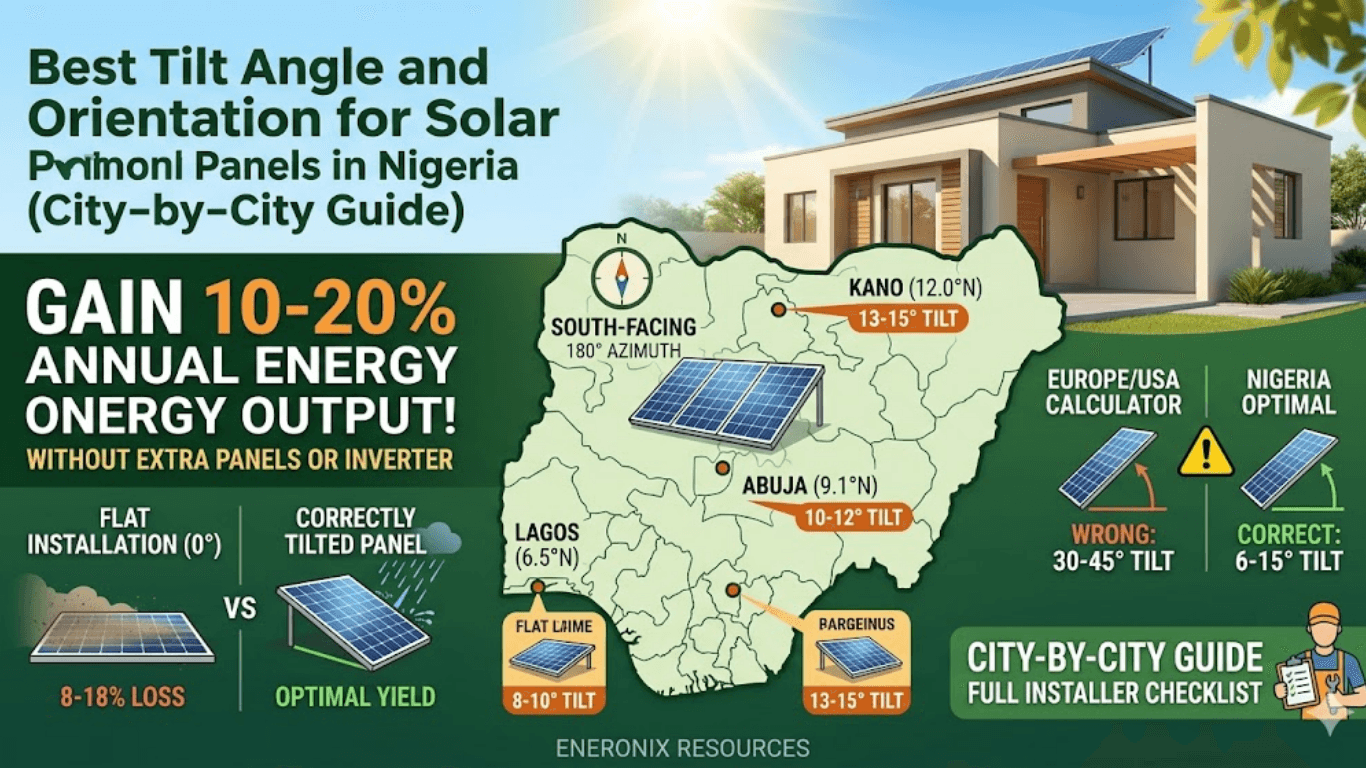
- Lagos: 8–10°
- Abuja: 10–12°
- Kano: 13–15°
- Port Harcourt: 6–8°
- Minimum tilt anywhere in Nigeria: 5°
- Best direction: Face due south (180° azimuth)
The best tilt angle for solar panels in Nigeria is typically latitude + 2–3 degrees, which results in 8–15° for most cities, with panels facing due south for maximum annual energy output.
What Is the Best Tilt Angle for Solar Panels in Nigeria?

The table below shows the recommended tilt angles for Nigeria’s major cities. The optimal annual fixed tilt is the single angle that maximises total yearly energy output. Dry season and rainy season tilts are given for reference if you are evaluating an adjustable mounting system.
| City | Latitude | Optimal Annual Fixed Tilt | Dry Season Tilt | Rainy Season Tilt | Minimum Tilt |
| Lagos | 6.5°N | 8 to 10° | 12 to 15° | 5 to 8° | 5° |
| Port Harcourt | 4.8°N | 6 to 8° | 10 to 12° | 5 to 6° | 5° |
| Benin City | 6.3°N | 8 to 10° | 12 to 14° | 5 to 8° | 5° |
| Enugu | 6.5°N | 8 to 10° | 12 to 15° | 5 to 8° | 5° |
| Ibadan | 7.4°N | 9 to 11° | 13 to 16° | 6 to 9° | 5° |
| Abuja | 9.1°N | 10 to 12° | 15 to 18° | 7 to 10° | 5° |
| Kaduna | 10.5°N | 11 to 13° | 16 to 20° | 8 to 10° | 5° |
| Kano | 12.0°N | 13 to 15° | 18 to 22° | 8 to 12° | 5° |
Quick Installation Rules
- Tilt = latitude + 2–3°
- Face due south (180°)
- Minimum tilt: 5°
- Avoid north-facing panels
- Use tilt frames on flat roofs
For most locations, the optimal fixed tilt angle is your latitude + 2–3 degrees.
Most solar panels in Nigeria are installed flat, or at whatever angle the installer finds convenient. No latitude check. No calculation. Just panels on a roof.
That single oversight costs 10 to 20 percent of annual energy output, with no extra equipment needed. No additional panels. No new inverter. Just the correct angle.
This guide explains the best solar panel tilt angle in Nigeria, including Lagos, Abuja, and Kano, based on real solar irradiance data.
Why Tilt Angle Matters More Than Most Installers Acknowledge

Here is the number that should stop you from accepting a flat installation:
A panel installed horizontally in Lagos loses approximately 8 to 12 percent of its annual energy yield compared to a correctly tilted panel. In Kano at 12 degrees north, the annual loss from a flat installation is 12 to 18 percent.
Over a 25-year panel lifespan, that is a significant fraction of the system’s total lifetime output, given away for free because nobody calculated the angle.
To put this in practical terms: on a 10-panel system, getting the tilt right is the equivalent of adding one free panel. To understand how tilt angle compounds with other output losses, read our article on 400W solar panel output derating in Nigeria.
Orientation matters just as much. A panel facing east or west instead of south loses 15 to 25 percent of annual yield. A north-facing panel in Nigeria loses 30 to 40 percent. These are not edge cases. They describe the actual state of many rooftop systems in Nigerian cities right now.
The correct tilt angle and south-facing orientation are two of the simplest, lowest-cost performance improvements available in any solar installation. Both are decided before the first bolt is tightened.
Why the Sun’s Position Determines Your Panel Angle

You do not need to understand solar geometry in detail. But a basic grasp of why the sun moves across the sky the way it does in Nigeria will help you understand why the numbers in this guide are what they are.
Nigeria sits between 4 degrees north and 14 degrees north latitude. The sun’s daily path across the sky is always biased toward the south, meaning it rises in the roughly east direction, arcs through the southern part of the sky, and sets in the roughly west direction. A panel tilted toward the south and angled to face the sun’s average position intercepts significantly more direct beam radiation than a flat or north-facing panel.
The sun’s north-south position in the sky also shifts through the year. This shift is called solar declination. Around June, the sun is overhead or slightly north of overhead across Nigeria. Around December, it is south of overhead. The swing runs from +23.5 degrees in June to -23.5 degrees in December. For a fixed panel that cannot track the sun, the goal is to find the single angle that catches the most light across the full year.
The Latitude Rule of Thumb and Its Limits
The classic starting point: optimal fixed tilt angle is approximately equal to your latitude. For Lagos at 6.5 degrees north, that means a tilt of roughly 6 to 7 degrees. For Kano at 12 degrees north, roughly 12 degrees.
In practice, slightly above latitude angle, latitude plus 2 to 3 degrees often maximises annual yield because it better captures the lower winter sun during Nigeria’s dry season. The practical optimal range for Nigerian locations is latitude to latitude plus 3 degrees.
This rule is a starting point, not a precise answer. For commercial installations where precision matters, the PVGIS tool from the European Commission provides location-specific optimised tilt data based on historical irradiance records.
One important warning: if you search online for solar tilt angle calculators, most are designed for Europe and North America at latitudes of 40 to 55 degrees north. They return tilt recommendations of 30 to 45 degrees. Those numbers are wrong for Nigeria. They will cost you energy, not save it.
Fixed Tilt vs Seasonal Adjustment

A single fixed tilt angle is the right choice for almost every Nigerian residential installation.
Seasonal tilt adjustment, changing the panel angle twice per year to match the dry and wet season sun positions can recover an additional 3 to 8 percent of annual yield in theory. In practice, the labour cost, safety risk of working on a roof twice a year, and wear on mounting hardware rarely justify this for homes.
For large commercial ground-mounted arrays where a 5 percent yield gain translates to significant revenue, seasonal adjustment or single-axis solar tracking may be worth evaluating. For the purposes of this guide, fixed tilt is the recommended and practical approach.
Best Solar Panel Tilt Angle in Lagos, Port Harcourt, Benin City, Enugu
At 4 to 7 degrees north, the sun is close to directly overhead for much of the year in southern Nigeria. The optimal fixed tilt is 6 to 10 degrees depending on your specific city.
The difference between a flat installation and the optimal tilt in this region is 8 to 12 percent of annual energy output. That gap is real but smaller than in the north, which can give the false impression that flat is acceptable. It is not. There is a second reason tilt matters in southern Nigeria beyond pure energy output: dust and rain.
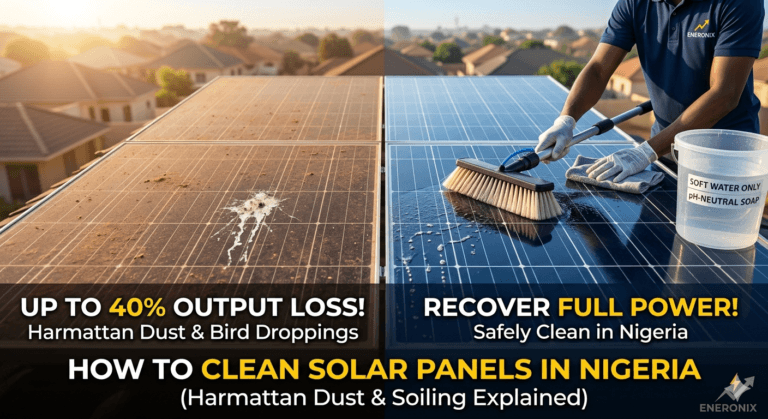
Lagos and Port Harcourt receive heavy rainfall. A 5-degree minimum tilt allows rain to wash harmattan and atmospheric dust off your panels naturally. Flat panels accumulate dust with no runoff gradient, and dirty panels in humid coastal cities can lose 10 to 15 percent of output from soiling alone.
Flat roofs are the dominant roof type in Lagos and Port Harcourt. If your building has a flat concrete roof, tilt frames are not optional. Use frames set to at least 8 degrees for best results. Use our off-grid solar system sizing calculator to factor in your corrected peak sun hours once you know your tilt angle.
Best Solar Panel Tilt Angle in Central Nigeria: Abuja, Kaduna, Ibadan
At 7 to 11 degrees north, the optimal fixed tilt rises to 10 to 13 degrees. The seasonal variation in sun angle is more pronounced in this region than in the south.
During Nigeria’s dry season (October to March), the sun is noticeably lower in the sky in central Nigeria than in the rainy months. A tilt of 12 degrees catches this lower dry season sun better than 8 degrees. The penalty for using a fixed 12-degree tilt during the rainy season, when the sun is higher is minor, perhaps 2 to 3 percent yield reduction in the wet months.
Abuja, in particular, sits at 9.1 degrees north with excellent dry season irradiance. A correctly installed system in Abuja at 10 to 12 degrees south-facing will outperform a poorly installed system with more panels.
Best Solar Panel Tilt Angle in Northern Nigeria: Kano, Kaduna, Sokoto, Maiduguri
At 12 to 14 degrees north, the optimal fixed tilt rises to 13 to 16 degrees. Northern Nigeria also has the strongest annual solar irradiance in the country, averaging 6.0 to 6.5 peak sun hours per day.
This combination means a correctly tilted system in Kano genuinely outperforms a poorly tilted system in Lagos even with the same number of panels. The north is Nigeria’s strongest solar resource region, but only if installations are done properly.
Harmattan is most intense in northern Nigeria. Dust accumulation on solar panels during harmattan season is severe and can cut output by 15 to 25 percent on flat installations with no runoff. A 15-degree tilt in Kano is not just a performance choice. It is a maintenance decision that allows rainfall to clean panels between harmattan episodes.
The effect of operating temperature on panel output is significant in the north’s high ambient temperatures. A raised, tilted mount with an air gap underneath runs 5 to 10 degrees Celsius cooler than a panel flush-mounted on an iron sheet roof. Cooler panels produce more power. For a technical explanation of this relationship, see our article on monocrystalline vs polycrystalline solar panels in Nigeria which covers temperature coefficients in detail.
Which Direction Should Your Panels Face?
Tilt angle gets most of the attention in solar installation guides. Orientation gets less attention than it deserves. In Nigeria, both matter, and orientation mistakes are harder to fix after installation.
Why Due South Is Optimal for All of Nigeria
Nigeria is entirely in the northern hemisphere. The sun’s daily arc is always biased toward the south. A panel facing due south (180 degrees azimuth) intercepts maximum integrated daily irradiance because it is most directly aligned with the sun’s path throughout the day.
This is consistent year-round in Nigeria. There is no seasonal reason to deviate from south-facing. Unlike locations north of the Tropic of Cancer where some east-west adjustment might be considered for certain applications, Nigeria’s position means due south is always the correct primary orientation.
What Happens When Your Roof Faces the Wrong Direction
Many roofs do not face due south. Here is the annual yield penalty for common orientation deviations:
| Deviation from Due South | Estimated Annual Yield Loss | Practical Recommendation |
| 0 to 10 degrees (east or west) | 0 to 2% | Negligible. Install as planned. |
| 10 to 30 degrees | 2 to 8% | Acceptable. Note the reduction in system design. |
| 30 to 45 degrees | 8 to 15% | Significant. Consider splitting across two roof faces. |
| 45 to 90 degrees (SE or SW) | 15 to 25% | Serious. Redesign array layout where possible. |
| North-facing (180 degrees off) | 30 to 40% | Unacceptable. Never use north-facing installation. |
If your roof faces southeast or southwest beyond 45 degrees from south, the practical solution is to split the array across two roof faces. Place some panels on the southeast face and some on the southwest face. The morning peak from the east-facing panels and the afternoon peak from the west-facing panels complement each other and produce a flatter, more useful daily generation curve.
Total daily yield from a split east-west array is significantly better than putting all panels on one sub-optimal face. This approach also helps with load matching if your household consumption is spread across the day rather than concentrated in one period.
For a deeper look at how array configuration affects your charge controller selection, see our MPPT charge controller selection guide.
Best Solar Panel Tilt Angle for Flat Roofs: The Minimum Tilt Rule

Most urban Nigerian commercial and residential buildings have flat concrete roofs. This is where the most preventable tilt mistakes happen. Flat roof installations need deliberate tilt frames, and there are specific rules for getting them right.
Why You Should Never Install Panels Completely Flat
There are two reasons tilt matters on a flat roof, and both are important.
Performance reason:
A horizontal panel captures less direct beam radiation than a tilted panel. It is also more susceptible to irradiance losses at morning and afternoon hours when the sun is at a low angle. Even a 5-degree tilt produces measurable improvement over zero degrees.
Maintenance reason:
A flat panel has no runoff gradient. Harmattan dust, bird droppings, and atmospheric debris accumulate and stay. Rain cannot clean a flat panel. A 5-degree tilt gives rain enough slope to carry dust off the surface. A 10-degree tilt washes more effectively. In northern Nigeria, 15 degrees is recommended partly for this reason.
For a broader overview of panel care and performance in Nigerian conditions, the solar panels Nigeria buyer’s guide covers maintenance and product selection in detail.
Tilt Frame Options for Nigerian Flat Roofs

The most common tilt frame options available for Nigerian flat roof installations are:
- Fixed aluminium racking: the standard option. Set to the desired angle at installation and left there. Cost-effective and low-maintenance.
- Adjustable racking: allows tilt angle to be changed between seasons. Mechanically simple but requires someone to actually make the seasonal adjustment. Rarely done in practice.
- Concrete ballast frames: no roof penetrations required. Panels rest on weighted frames. Common on commercial flat roofs where penetrating the waterproofing membrane is not permitted.
- Roof-penetrating fixed frames: bolted directly into the roof structure. Most secure option. Requires proper waterproofing at penetration points to prevent leaks.
Wind loading is a real consideration on Nigerian flat roofs, particularly in Lagos and Port Harcourt. A higher tilt angle presents more surface area to the wind. If you are in a coastal location or an area with strong seasonal winds, keep tilt angles moderate (8 to 12 degrees) and ensure mounting hardware is correctly specified. For array wiring implications of your chosen configuration, see our guide on series vs parallel solar panel wiring.
Row Spacing for Multi-Row Flat Roof Installations
When you install multiple rows of panels on a flat roof, the rear rows can shade the front rows at low sun angles. Getting row spacing right matters for performance.
The good news for Nigeria: because the country sits between 4 and 14 degrees north, the minimum sun elevation angle during useful operating hours is approximately 50 to 55 degrees. This is much higher than in Europe or North America, which means row shading is less severe and row spacing requirements are easier to meet.
Practical rule of thumb for Nigerian flat roof installations: minimum row gap = 1.5 times the panel height. For a standard 1.1-metre tall panel at 10 degrees tilt, this means approximately 1.65 metres between the front edge of the rear row and the back edge of the front row.
For commercial installations with many rows, use PVGIS or a shadow analysis tool for precise spacing calculation. Our solar and MPPT calculator can help you check array configurations once spacing is established.
Quick calculation: minimum row spacing (metres) = panel height (metres) x 1.5. For most residential panels at 10 degrees tilt on a Nigerian flat roof, 1.7 metres of clear space between rows is sufficient.
Best Solar Panel Tilt Angle for Pitched Roofs

Many Nigerian residential buildings have pitched iron sheet or tile roofs. The roof pitch is fixed by the structure, and you usually cannot change it. This section covers the three common scenarios you will encounter.
When Your Roof Pitch Approximately Matches the Optimal Tilt
If your roof pitch falls within 5 degrees of the optimal tilt for your city, roughly 8 to 15 degrees in southern Nigeria and 12 to 20 degrees in northern Nigeria, you are in good shape. Install panels flush on the roof surface and ensure there is a ventilation gap of at least 50 millimetres between the panel underside and the roof surface.
That air gap is important. Without it, heat builds up under the panels, cell temperature rises, and output falls. A well-ventilated flush mount on a correctly pitched roof is very close to the ideal installation. To understand exactly how temperature affects your panels’ output, check our article on monocrystalline vs polycrystalline panels and temperature coefficients.
When Your Roof Pitch Is Too Steep
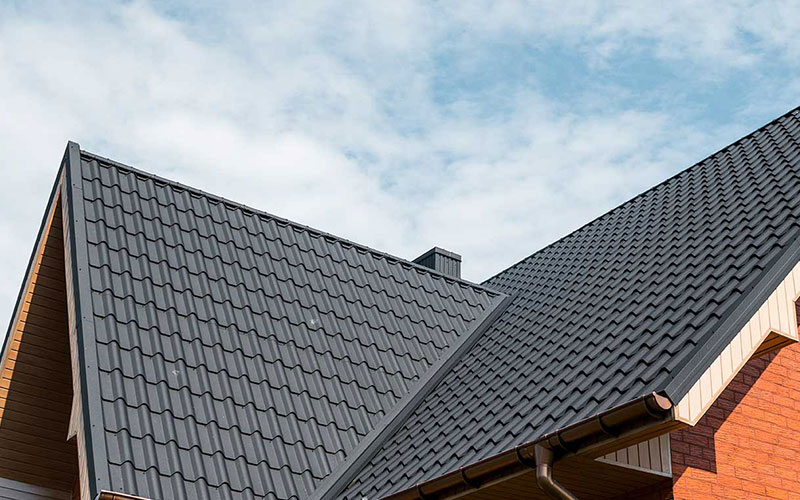
Older Nigerian buildings sometimes have roof pitches of 25 to 35 degrees. These were common in colonial-era construction and in some traditional architectural styles.
For a Lagos building with a 25-degree pitched roof facing south, the tilt is about 15 to 17 degrees too steep compared to the optimal 8 to 10 degrees. This causes approximately 5 to 8 percent annual yield loss relative to optimal, which may be acceptable depending on your system goals and budget.
If you want to correct a steep pitch, a counter-tilt mount can bring panels to a lower effective tilt angle. This adds cost and complexity. For most residential installations, accepting the mild performance penalty is more practical than custom mounting hardware.
When Your Roof Pitch Is Too Shallow
A very shallow pitched roof of 5 to 8 degrees is common on some Nigerian residential buildings. For southern Nigeria where the optimal tilt is 6 to 10 degrees, this is acceptable as-is. The performance difference from optimal is minor at these latitudes.
The one concern with a very shallow pitch is the same as with flat roofs: self-cleaning. If your roof pitch is less than 5 degrees, dust will accumulate between rain events. Plan for more frequent manual panel cleaning, especially during harmattan.
Multi-Pitch Roofs
Buildings with multiple roof faces pointing in different directions are common in Nigerian residential construction. Here is how to approach them:
- Evaluate each roof face separately for orientation and tilt.
- Prioritise south-facing faces. Install the majority of your panels here.
- Southeast or southwest faces within 30 degrees of south are acceptable secondary locations.
- Avoid north-facing roof faces entirely.
- Do not mix north-facing and south-facing panels on the same MPPT string. Keep them on separate charge controller inputs. See our solar array sizing guide for how to handle multi-string configurations.
Common Mistakes and How to Avoid Them
These are the most frequent tilt and orientation errors seen in Nigerian solar installations.
- Using European or American online tilt calculators. They return 30 to 45 degrees. That is wrong for Nigeria. Use the city-specific numbers in this guide or use PVGIS with your actual coordinates.
- Treating flat as acceptable because it looks clean. Flat is never acceptable in Nigeria for both performance and maintenance reasons. Five degrees minimum, always.
- Installing on a pitched roof without checking the pitch angle first. A 30-degree north-facing roof is one of the worst possible installation locations. Measure and verify before committing to a roof face.
- Installing multiple rows without calculating row spacing. Rear rows shade front rows at low sun angles if spacing is wrong. Use the 1.5x panel height rule for Nigeria.
- Ignoring the airflow benefit of tilt. A flush-mounted panel on an iron sheet roof in northern Nigeria can run 10 to 15 degrees Celsius hotter than a raised tilted panel. That temperature difference costs real output.
- Not using a south-facing orientation check before finalising roof placement. A compass check before installation costs nothing. Discovering a major orientation error after installation is expensive to fix.
How Tilt Angle Feeds Into Your Full System Design
Tilt angle is not an isolated decision. It affects several other parts of your solar system design.
Peak sun hours:
A panel at optimal tilt receives more effective peak sun hours than a flat panel. When you input peak sun hours into a sizing calculation, use the value for a tilted surface at your location, not the horizontal surface value. The off-grid solar system sizing calculator allows you to enter the correct peak sun hour figure for your city and tilt.
MPPT configuration:
If you are splitting an array across multiple roof faces with different tilts or orientations, each face should ideally be on a separate MPPT input. Mixing strings with different irradiance profiles on one MPPT input causes the controller to average the mismatch and you lose output from the better-performing string. Use the solar and MPPT calculator to check your array configuration against your charge controller’s input limits.
Battery bank sizing:
A correctly tilted array produces more energy per panel per day than a flat one. If you sized your battery bank based on a flat installation estimate, you may be undersizing storage relative to what your correctly tilted array can deliver. Run your numbers through the off-grid solar sizing calculator with corrected tilt-adjusted peak sun hours before finalising your battery bank capacity.
For a complete guide to getting your array size right from first principles, see our solar array sizing guide for off-grid systems.
Frequently Asked Questions
What is the best tilt angle for solar panels in Lagos?
The optimal fixed tilt angle for Lagos is 8 to 10 degrees, facing due south. Lagos is at 6.5 degrees north latitude, and panels installed at this angle maximise annual energy output. The minimum acceptable tilt for any installation in Lagos is 5 degrees, which is required for rain to clean dust off the panel surface naturally.
What is the best tilt angle for solar panels in Abuja?
Abuja is at 9.1 degrees north. The optimal fixed tilt for Abuja is 10 to 12 degrees, facing due south. During the dry season, a tilt of 15 to 18 degrees would capture slightly more energy from the lower sun, but a fixed 10 to 12 degree angle provides the best average performance across the full year.
What is the best tilt angle for solar panels in Kano?
Kano is at 12 degrees north. The optimal fixed tilt for Kano is 13 to 15 degrees. Kano also has the best solar irradiance in Nigeria, with 6.0 to 6.5 peak sun hours per day. Harmattan dust is most severe in Kano, making the minimum 5-degree tilt rule especially important here.
What direction should solar panels face in Nigeria?
Solar panels in Nigeria should face due south (180 degrees azimuth) for maximum annual output. Nigeria is entirely in the northern hemisphere, and the sun’s daily path is always biased toward the south. A deviation of up to 30 degrees from south is acceptable with minor yield loss. North-facing installation is never acceptable in Nigeria.
How much energy does wrong tilt angle cost in Nigeria?
A flat installation in Lagos loses 8 to 12 percent of annual energy output compared to the optimal tilt. In Kano, the loss from flat installation is 12 to 18 percent annually. An east or west-facing installation instead of south-facing loses 15 to 25 percent of annual yield. These are significant losses on any system size.
Do I need tilt frames for a flat roof in Nigeria?
Yes. Tilt frames are necessary for flat roof installations in Nigeria. The minimum recommended tilt is 5 degrees for self-cleaning. For performance, 8 to 10 degrees is recommended for southern Nigeria and 12 to 15 degrees for northern Nigeria. Panels installed completely flat accumulate dust with no runoff and underperform year-round.
Can I adjust my solar panel tilt angle seasonally in Nigeria?
You can, but it is rarely worth it for residential installations. Seasonal tilt adjustment can recover 3 to 8 percent of additional annual yield, but the labour cost, safety risk, and hardware wear usually outweigh the gain. For large commercial ground-mounted systems where the energy gain translates to significant revenue, seasonal adjustment is worth evaluating.
What happens if my roof faces southeast or southwest instead of south?
A 30 to 45 degree deviation from south causes 8 to 15 percent annual yield loss. For deviations beyond 45 degrees, the practical solution is to split the array across both roof faces some panels facing southeast and some facing southwest. The morning peak from the east side and afternoon peak from the west side complement each other, and total daily yield is significantly better than all panels on one sub-optimal face.
How do I calculate row spacing for multiple panel rows on a flat roof in Nigeria?
For Nigerian conditions, use a minimum row gap of 1.5 times the panel height. For a standard 1.1-metre tall panel, this means at least 1.65 metres of clear space between the front edge of the rear row and the back edge of the front row. Nigeria’s high minimum sun angles (50 to 55 degrees) mean row shading is less severe here than in Europe, but spacing still needs to be checked for multi-row installations.
Does panel tilt affect temperature and output in Nigeria?
Yes. A tilted panel on a raised mount with an air gap underneath runs 5 to 10 degrees Celsius cooler than a panel flush-mounted on an iron sheet roof with no airflow. Solar panels lose approximately 0.3 to 0.5 percent of output for every degree Celsius above 25 degrees. In northern Nigeria where ambient temperatures regularly exceed 40 degrees, proper tilt and mounting ventilation is a meaningful performance factor.
Tilt and Orientation Checklist for Nigerian Solar Installations
Use this checklist before finalising any solar installation in Nigeria.
- Step 1: Find your city in the tilt table. Use the optimal annual fixed tilt value for your location.
- Step 2: Check your roof orientation. South-facing within 30 degrees is acceptable. Beyond 45 degrees, plan a split array.
- Step 3: For flat roofs, use tilt frames set to a minimum of 5 degrees. Use 8 to 10 degrees for southern Nigeria and 12 to 15 degrees for northern Nigeria.
- Step 4: For pitched roofs, if the pitch is within 5 degrees of optimal, flush mount with a 50mm ventilation gap.
- Step 5: For multi-row installations, maintain minimum 1.5 times panel height as row spacing.
- Step 6: Never install north-facing panels. Not even as a secondary array.
- Step 7: Use your corrected peak sun hours (for a tilted surface, not horizontal) when sizing your battery bank and MPPT. Use the off-grid solar sizing calculator to get your final system specification.
- Step 8: For commercial or multi-string arrays, use the solar and MPPT calculator to verify your charge controller sizing and array configuration.
For the full solar planning toolkit, visit the Eneronix resources page where you will find the off-grid sizing calculator, MPPT calculator, and solar vs generator ROI comparison tool — all built for Nigerian conditions and pre-filled with real Nigerian field data.

I am Engr. Ubokobong Ekpenyong, a solar specialist and lithium battery systems engineer with over five years of hands-on experience designing, assembling, and commissioning off-grid solar and energy storage systems. My work focuses on lithium battery pack architecture, BMS configuration, and system reliability in off-grid and high-demand environments.