Anti-Islanding Protection in Hybrid Solar Systems: What It Is, Why It Matters, and What It Means for Nigeria
Anti-islanding protection in hybrid solar systems explained: what it is, why it exists, how hybrid inverters satisfy it while still providing backup power, and what it means for Nigerian installations where NEPA fails daily.
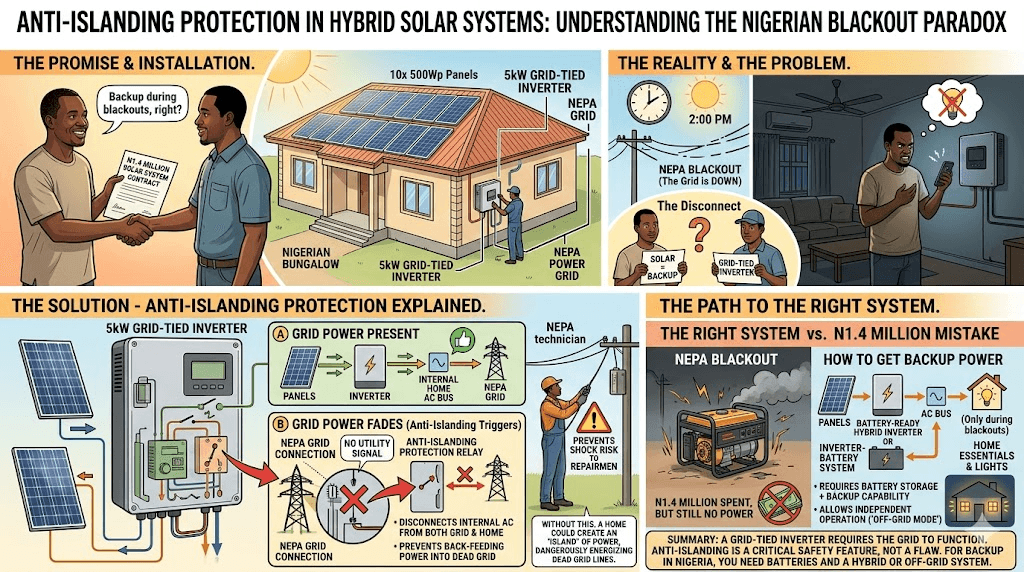
An homeowner installs a solar system. The installer recommends a 5kW grid-tied inverter with ten 500Wp panels. No battery. Total cost: N1.4 million.
The first time NEPA takes light in the afternoon, the solar system shuts off completely. Panels on the roof in full sun. Inverter display dark. House dark. The owner calls the installer. The installer says the system is working correctly.
The owner is furious. The installer is right.
This scenario plays out daily across Nigeria. The owner bought a grid-tied system expecting backup capability. The installer supplied exactly what was specified. The disconnect is not dishonesty. It is a fundamental misunderstanding of one safety function built into every grid-interactive inverter in the world: anti-islanding protection.
Understanding anti-islanding protection is the difference between buying the right system for Nigeria and spending N1.4 million on a system that shuts off for 8 to 14 hours every day.
What is anti-islanding protection in solar systems?
Anti-islanding protection is a mandatory safety function built into every grid-connected solar inverter that detects when the utility grid has gone down and stops the inverter from pushing electricity onto the grid conductors. It operates within 2 seconds of grid failure per IEEE 1547, and within 10 to 200 milliseconds in most modern hybrid inverters. It does not mean the inverter must shut down completely. It means the inverter must stop energising the grid conductors.
This article explains what islanding is, why it is dangerous, how inverters detect it, and most importantly, how a hybrid solar system with a battery satisfies anti-islanding requirements while still delivering uninterrupted backup power during every NEPA outage.
What Is Islanding and Why Is It Dangerous?
Islanding is the electrical condition where a section of the power network continues to be energised by local generation (your solar system) after that section has been disconnected from the main utility grid.
Picture this. NEPA experiences a fault on a feeder supplying your street. The DISCO opens the feeder breaker at the substation to isolate the fault. Your street is now disconnected from the main grid. But your solar inverter is still producing electricity from your panels. That electricity is flowing out through your meter, onto the street’s distribution cables, along the disconnected feeder. The feeder is dead from the substation’s perspective. It is live from your inverter’s perspective.
A DISCO lineman arrives at a pole on your street to repair the fault. He uses his voltage tester on the cable before making contact. If he trusts that a disconnected feeder is dead, he may skip the test. Your inverter has energised that cable. He makes contact. The consequences are severe.
This is not a theoretical scenario. Utility worker electrocutions from undetected islanding are documented internationally. It is the primary reason anti-islanding protection is mandatory in every grid interconnection standard in the world.
The secondary dangers of undetected islanding
Beyond the immediate safety risk to linesmen, islanding creates equipment and power quality problems.
In normal grid-connected operation, voltage and frequency are regulated by the utility’s large synchronous generators. Their combined inertia holds the network at 230V and 50Hz with extraordinary stability. When a section of the network islands, the local solar inverter becomes the sole voltage and frequency reference for that section. The inverter’s control system is not designed to regulate a network. Voltage can drift above or below nominal. Frequency can shift. If the utility reconnects the feeder while the islanded waveform is at a different phase from the grid waveform, the reconnection creates a voltage surge that can damage appliances on both the islanded section and the grid.
The final danger: if multiple properties on the same feeder have solar systems, and all of them island simultaneously, the combined generation can maintain a voltage high enough to sustain the island for extended periods. The utility’s protection system believes the feeder is de-energised and safe. It is not. This multi-inverter islanding scenario is increasingly relevant as solar penetration grows in Nigerian residential estates.
What Anti-Islanding Protection Actually Is
Anti-islanding protection is a mandatory function built into every grid-interactive inverter that detects the loss of grid connection and stops the inverter from energising the network conductors within a defined time limit.
The word “energising” is doing important work in that definition. The standard does not require the inverter to shut down completely. It requires the inverter to stop pushing electricity onto the grid conductors. What happens to the inverter’s internal output after that is a separate question and the answer is what distinguishes a hybrid system from a grid-tied system.
The IEEE 1547 requirement:
For an unintentional island in which the PV Plant energizes a portion of the grid through the interconnection point, the PV Plant interconnection system shall detect the island and cease to energize the grid within two seconds of the formation of an island. Clean Energy Reviews
Two seconds is the maximum. According to IEEE 1547 compliance, a solar inverter must stop exporting power within roughly 2 seconds of detecting a grid outage. Most modern hybrid inverters available in the Nigerian market achieve this in 10 to 200 milliseconds. They satisfy the standard with significant margin.
What “cease to energise the grid” means in hardware terms:
Every hybrid inverter has a transfer relay inside it. This is a physical switch that connects the inverter’s AC output to the grid input port. When the grid is present and stable, the relay is closed. Current can flow in both directions between the inverter and the NEPA network.
When anti-islanding detection triggers, the relay opens. The inverter’s AC output is physically disconnected from the NEPA conductors. The NEPA network at your meter and beyond is no longer energised by your inverter. Anti-islanding is satisfied.
The critical point that most Nigerian buyers miss:
The hybrid inverter stops feeding the grid. It only powers the home’s internal circuits, with an automatic transfer switch ensuring no electricity reaches the utility lines. Prasun Barua
After the relay opens and the NEPA conductors are de-energised, a hybrid inverter with a battery does something a grid-tied inverter cannot: it continues to generate its own AC waveform and power your home from the battery and solar array. Your home is now an island, physically isolated from NEPA, self-powered internally.
A hybrid inverter can form an island on a critical loads panel during an outage. It opens the grid relay, establishes a stable AC waveform, and manages PV, battery, and loads. ScienceDirect
A grid-tied inverter has no battery. After the relay opens, there is nothing to power the home. The inverter shuts down completely because there is no internal energy source to sustain its output. Anti-islanding is satisfied. Your house is dark.
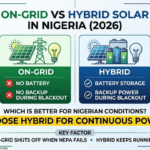
This is the entire distinction between a grid-tied system and a hybrid system in a Nigerian power environment. Both satisfy anti-islanding. Only one continues working when NEPA fails.
The Three Detection Methods For Anti-Islanding
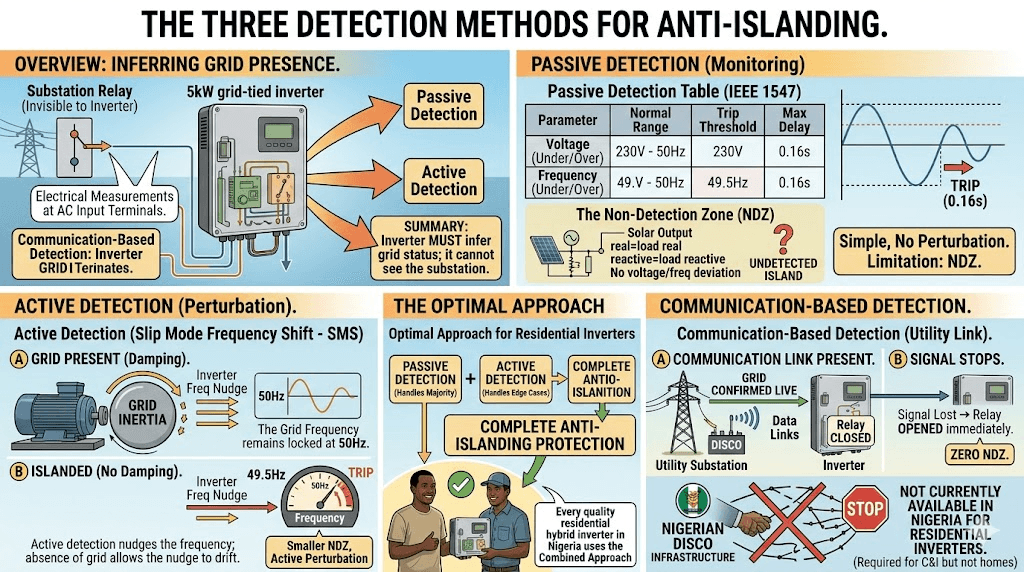
The inverter cannot physically see whether the grid relay at the substation is open or closed. It has to infer grid presence from electrical measurements at its own AC input terminals. Three detection methods are used, often in combination.
Passive Detection
Passive detection works by continuously monitoring the voltage and frequency of the grid. The inverter compares these values against defined thresholds. If voltage or frequency moves outside those thresholds, the inverter concludes the grid has failed and opens its relay.
The threshold values per IEEE 1547 for a 230V 50Hz system:
Parameter
Normal Range
Trip Threshold
Maximum Trip Delay
Voltage (under)
88 to 110% of nominal
Below 202V
2 seconds
Voltage (over)
88 to 110% of nominal
Above 253V
0.16 seconds
Frequency (under)
49.5 to 50.5Hz
Below 49.5Hz
0.16 seconds
Frequency (over)
49.5 to 50.5Hz
Above 50.5Hz
0.16 seconds
Passive detection is simple, requires no additional hardware, and adds no perturbation to the grid waveform. It works well in the majority of grid failure scenarios because grid failures typically cause voltage or frequency to deviate immediately outside normal bounds.
The limitation: passive detection has a non-detection zone (NDZ). If the islanded load happens to match the solar generation output exactly in both real power and reactive power, voltage and frequency remain within normal bounds even after the grid disconnects. The inverter sees apparently normal voltage and frequency and concludes the grid is still present. It is not.
In practice, perfect power balance between generation and load is unlikely to persist for more than a few seconds because loads switch on and off continuously. But the NDZ is a documented failure mode that motivated the development of active detection methods.
Active Detection
Active detection solves the NDZ problem by deliberately introducing small disturbances into the inverter output and observing the response.
The most widely implemented active method is Slip Mode Frequency Shift (SMS). The Slip Mode Frequency Shift technique varies the reactive power output of the inverter. The goal of this protection method is to destabilize an islanded feeder by trying to influence the frequency.
Here is what this means in practice. The inverter continuously nudges its output frequency slightly off nominal. When the grid is present, the grid’s enormous inertia absorbs this nudge and holds frequency at exactly 50Hz. The inverter cannot move the grid. When the grid disconnects and the inverter is islanded, the small frequency nudge is no longer damped. The islanded network frequency drifts in the direction of the nudge. The inverter detects this frequency drift, confirms it exceeds the threshold, and opens its relay.
Active detection has a far smaller NDZ than passive detection. Anti-islanding is usually achieved through passive detection (monitoring grid conditions) or active detection (intentionally perturbing the system) while in real-world practice it is usually by the combination of both of them to detect when the utility grid goes offline and ceases the power export from the inverter.
The combination approach is correct. Passive detection handles the straightforward majority of grid failures quickly and without any grid perturbation. Active detection provides backup coverage for the edge cases where passive detection would fail. Every quality hybrid inverter in the Nigerian market uses this combined approach.
Communication-Based Detection
The most reliable anti-islanding method uses a communication link between the utility and the inverter. The utility continuously sends a signal to the inverter confirming that the grid is live. When the signal stops, the inverter opens its relay without waiting for voltage or frequency to deviate.
This method has essentially zero NDZ because it does not rely on electrical measurements at all. It works even under perfect power balance conditions.
The limitation for Nigeria: communication-based detection requires infrastructure. The utility must have the capability to send signals to individual residential inverters. Nigerian DISCOs do not currently have this infrastructure at the residential level. Communication-based detection is available in large commercial and industrial grid-connected systems but is not applicable to residential hybrid solar installations in Nigeria today.
Detection Method Comparison
Detection Method
Reliability
NDZ
Nigeria Applicability
Passive (voltage and frequency monitoring)
Good for most scenarios
Exists under balanced load
Yes, built into all inverters
Active (Slip Mode Frequency Shift)
Very good
Near zero
Yes, built into quality hybrid inverters
Passive plus active combined
Excellent
Negligible
Yes, standard in Deye, Growatt, Victron, Felicity
Communication-based
Near perfect
Zero
No, requires DISCO infrastructure not yet available
Anti-Islanding vs Island Mode
This is the concept that sits at the heart of every Nigerian solar buyer’s confusion about why their system shuts off during a NEPA outage.
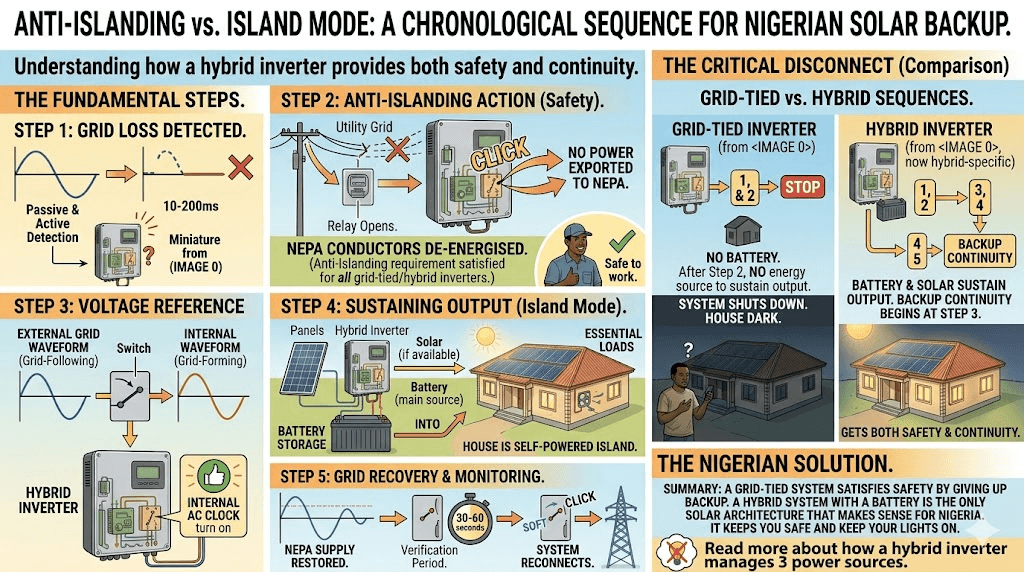
Anti-islanding and island mode sound like opposites. They are not. They are two sequential actions that happen within milliseconds of each other in a hybrid system. Understanding the sequence is everything.
Anti-islanding protection is the action of detecting grid loss and stopping the inverter from energising the NEPA conductors. This is the safety action. It happens in both grid-tied inverters and hybrid inverters. It happens within 10 to 200 milliseconds of grid failure detection.
Island mode is the operating state that a hybrid inverter enters after satisfying anti-islanding requirements. With the grid relay open and the NEPA conductors de-energised, the hybrid inverter uses the battery as its energy source and generates its own AC waveform for the home’s internal circuits. This operating state is called island mode or intentional islanding because the home is now operating as an intentional electrical island, isolated from the NEPA network and self-powered.
On grid loss, the inverter opens its grid relay and stops any export. It starts producing a stable AC waveform locally.
These two actions happen in rapid sequence:
Step 1:
Inverter detects grid loss (passive and active detection, 10 to 200ms).
Step 2:
Grid relay opens. NEPA conductors at the meter and beyond are de-energised. Anti-islanding requirement satisfied.
Step 3:
Inverter switches its internal voltage reference from the external grid waveform to its own internally generated waveform. This is the transition from grid-following mode to grid-forming mode.
Step 4:
Battery begins discharging to sustain the inverter output. Solar continues contributing if irradiance is available. Your home’s essential loads continue running without interruption.
Step 5:
When NEPA restores supply, the inverter monitors the incoming grid voltage and frequency for 30 to 60 seconds to verify stability. Once verified, the relay closes and the system reconnects.
A grid-tied inverter follows steps 1 and 2 and stops. It has no battery. After step 2, there is no energy source to sustain output. The inverter shuts down. House goes dark.
A hybrid inverter follows all five steps. Anti-islanding is satisfied at step 2. Backup power begins at step 3. The buyer gets both safety and continuity.
This is why the hybrid system with a battery is the only solar architecture that makes sense for Nigerian conditions. The grid-tied system satisfies anti-islanding by giving up backup capability entirely. The hybrid system satisfies anti-islanding and retains backup capability through the island mode mechanism.
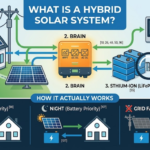
For a complete explanation of how a hybrid inverter manages three power sources simultaneously during island mode, read our article on what a hybrid solar system is.
The Transfer Relay
The transfer relay is the physical component inside a hybrid inverter that makes anti-islanding protection possible while preserving island mode capability. It is a switch rated for the inverter’s full AC current capacity. Everything else in the anti-islanding system is software and detection logic. The transfer relay is the hardware that physically separates the home from the NEPA network.
Normal operation (grid present, relay closed):
The relay contacts are closed. Current flows freely between the inverter’s AC bus and the NEPA network through the relay. The inverter synchronises its output to the grid’s voltage and frequency. Solar charges the battery and powers loads. The grid provides backup when battery SOC reaches the low threshold.
Grid failure (relay opening sequence):
Anti-islanding detection registers grid loss. The detection circuit sends a signal to the relay drive coil. The relay contacts begin to separate. On quality hybrid inverters, the contacts are fully separated within 10 to 20 milliseconds. The NEPA conductors at the inverter’s grid input terminals are now floating, not energised by the inverter. The inverter’s internal AC bus is now a separate electrical island.
The 10 to 20 millisecond transfer time means the entire grid isolation process happens in less than one full AC cycle (one 50Hz cycle takes 20 milliseconds). Your LED lights may flicker once as the inverter transitions from grid-following to grid-forming mode. Computers, routers, medical equipment continue operating without resetting because the interruption is shorter than the hold-up time of their internal power supplies.
Transfer relay failure:
The most dangerous failure mode of the transfer relay is contact welding. If the relay is exposed to fault current significantly above its rated breaking capacity, the arc energy during contact separation is sufficient to weld the contact surfaces together. The relay appears to be in the open position from the drive coil’s perspective, but the contacts are physically fused. The relay cannot open. Anti-islanding fails.
Quality hybrid inverters monitor relay integrity. After issuing an open command, the inverter checks whether its AC input and AC output terminals are still connected by monitoring voltage cross-talk. If they are connected when they should not be, the inverter raises a relay fault alarm and attempts a protective shutdown. Cheaper hybrid inverters do not perform this check. A welded relay in a cheaper inverter is silent and undetected until a linesman event reveals it.
This is one of the clearest technical reasons why inverter brand quality matters in a Nigerian installation. The relay quality, relay break rating, and relay integrity monitoring are not visible on a basic spec sheet but are critical safety parameters. Deye, Growatt SPH, and Victron Multiplus-II all carry certified anti-islanding compliance that includes relay performance testing.
False Tripping
False tripping is when the anti-islanding detection system opens the relay and takes the system offline in response to a grid disturbance, even though the grid is still connected. The protection has triggered correctly from the inverter’s perspective, but from the user’s perspective, the system has unnecessarily interrupted backup.
False tripping is a documented problem in every grid environment with poor power quality. In Nigeria, it is the most common anti-islanding related complaint from hybrid system owners. It manifests as the hybrid inverter switching in and out of island mode repeatedly during periods of unstable NEPA supply.
Why Nigerian NEPA supply causes false tripping:
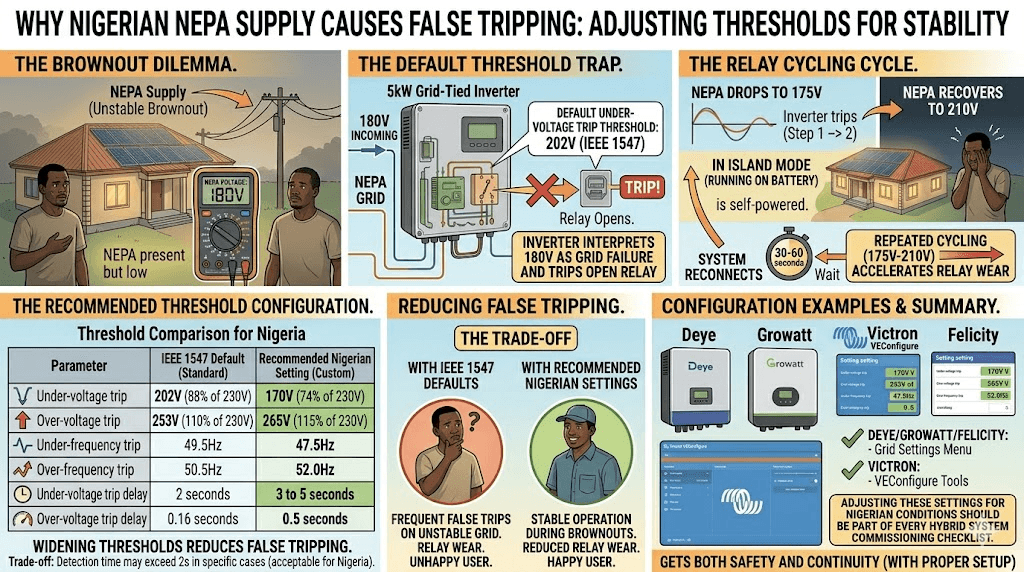
Nigerian DISCO supply frequently delivers voltage between 140V and 200V during brownout periods. IEEE 1547 default under-voltage trip threshold is 202V (88% of 230V nominal). At 180V, NEPA supply is still technically present and available. But the inverter, following IEEE 1547 defaults, interprets 180V as a grid failure and opens its relay.
The inverter enters island mode. It runs on battery. NEPA recovers to 210V. The inverter detects grid return, waits 30 to 60 seconds, and reconnects. NEPA drops back to 175V. The inverter opens its relay again. This cycle repeats continuously during an unstable NEPA supply period. Each reconnection event is a switching transient on the inverter’s relay. Repeated cycling at high frequency accelerates relay wear.
The correct threshold configuration for Nigerian conditions:
Parameter
IEEE 1547 Default
Recommended Nigerian Setting
Under-voltage trip
202V (88% of 230V)
170V (74% of 230V)
Over-voltage trip
253V (110% of 230V)
265V (115% of 230V)
Under-frequency trip
49.5Hz
47.5Hz
Over-frequency trip
50.5Hz
52.0Hz
Under-voltage trip delay
2 seconds
3 to 5 seconds
Over-voltage trip delay
0.16 seconds
0.5 seconds
Widening these thresholds reduces false tripping during Nigerian power quality events while preserving detection of genuine grid failures. The trade-off is that the 2-second maximum IEEE 1547 detection time may not always be met with widened thresholds during specific edge case scenarios. In the Nigerian context, this trade-off is acceptable. The immediate safety risk of a linesman event within 2 seconds of a local outage is lower in Nigeria than in markets with dense urban grid infrastructure and rapid utility response.
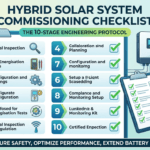
Most Deye, Growatt, and Felicity hybrid inverters allow these thresholds to be configured in the grid settings menu. On Victron systems, the thresholds are configured through VEConfigure. Adjusting these settings for Nigerian conditions should be part of every hybrid system commissioning checklist.
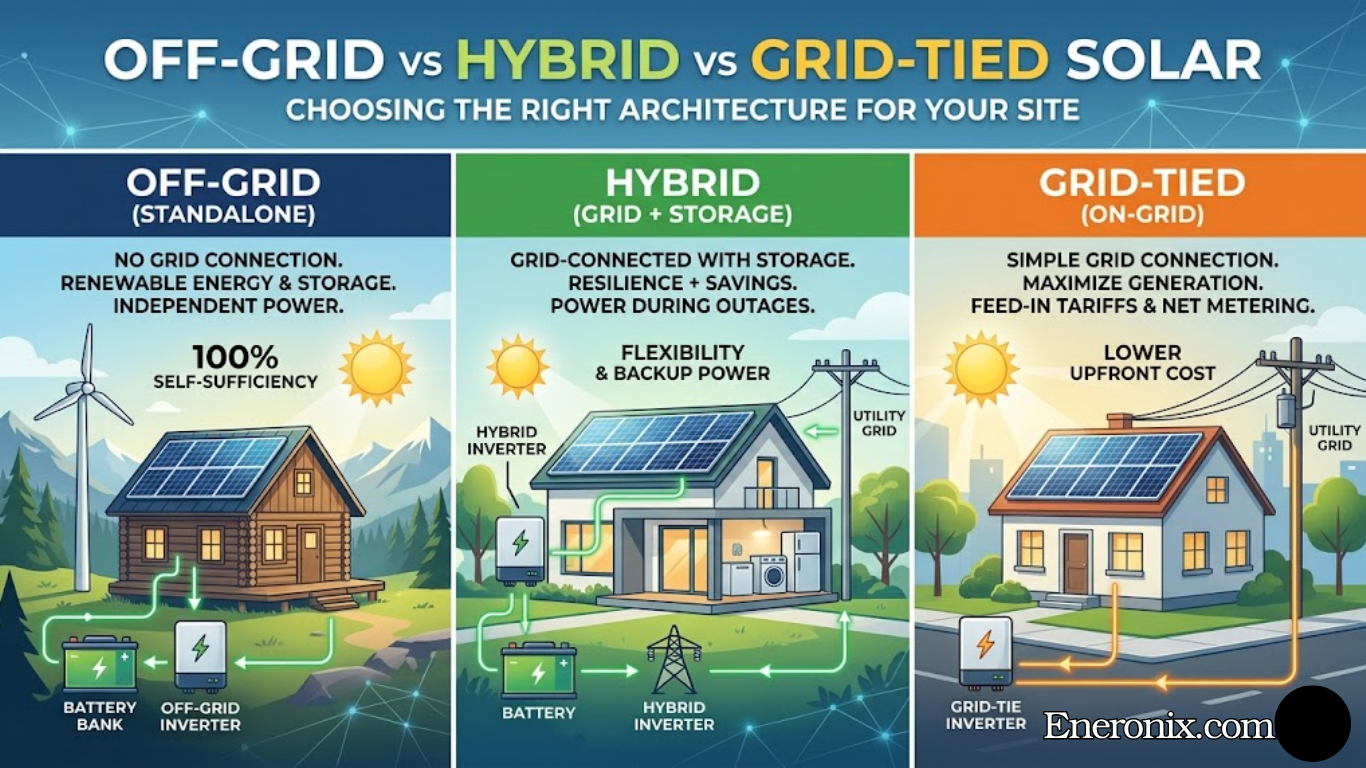
What Anti-Islanding Means for Your System Choice in Nigeria
Anti-islanding protection is not a reason to avoid solar. It is a reason to buy the right type of solar system for Nigerian conditions.
System Type
Anti-Islanding Behaviour
Backup During NEPA Outage
Nigeria Fit
Grid-tied (no battery)
Shuts down completely within 2 seconds of grid failure
None
Poor: shuts down 8 to 14 hours per day
Hybrid (battery plus grid relay)
Opens relay (satisfies anti-islanding), enters island mode (battery plus solar power home)
Full backup for essential loads
Excellent
Off-grid (no grid connection)
Not applicable, no grid connection exists
Continuous, no dependency on grid
Good for rural, no grid locations
For a Lagos home with 8 to 14 hours of daily NEPA outage, a grid-tied system spends 8 to 14 hours per day in anti-islanding shutdown. The solar panels are generating electricity. The inverter is blocking all of it. Every hour of sunshine during a NEPA outage is wasted. The owner gets zero backup and zero solar benefit during outage hours.
A hybrid system handles the same 8 to 14 hours differently. At the moment NEPA fails, the relay opens in 10 to 20 milliseconds. Island mode activates. Battery and solar power the home continuously. When NEPA returns, the relay closes and the grid connection resumes. The owner gets full backup and continues using solar generated power throughout the outage period.
The hybrid system costs more because it contains more: a battery, a more sophisticated inverter with a transfer relay and island mode capability, and a BMS communication system. Every additional component serves a specific function in delivering what the grid-tied system cannot: anti-islanding compliance plus backup power simultaneously.
Nigeria does not currently have a formally implemented residential solar grid interconnection standard equivalent to IEEE 1547. NERC has published guidelines and the Electricity Act 2023 creates the framework for distributed generation regulations. At the residential level, enforcement is limited and grid connection procedures for small solar systems are not consistently implemented across all DISCOs.
In practice, hybrid inverters sold in the Nigerian market by reputable distributors carry IEEE 1547 or IEC 62116 certification as part of their product approval for export to regulated markets. IEC 62116 provides test procedures for anti-islanding for utility-interconnected PV inverters. This certification means the anti-islanding function has been independently tested and verified to meet the standard. The function operates within the inverter firmware regardless of whether Nigerian local regulations specifically require it. SolarTech
The practical consequence: when a Nigerian homeowner connects a certified hybrid inverter to the NEPA supply, the anti-islanding function protects NEPA linesmen even in the absence of a formal local standard requiring it. The protection is delivered by the inverter’s firmware, not by local regulation.
What to look for on an inverter specification sheet:
When purchasing a hybrid inverter for a Nigerian installation, verify that the specification sheet carries at least one of the following certification references:
IEEE 1547: US interconnection standard, widely adopted internationally
IEC 62116: International anti-islanding test procedure
VDE-AR-N 4105: German grid connection standard (carried by Victron and some Deye models)
AS/NZS 4777: Australian grid connection standard
Any of these certifications confirms that the anti-islanding function has been independently tested and verified. An inverter without any grid interconnection certification has not been tested for anti-islanding compliance and should not be connected to the NEPA supply.
How to Verify Anti-Islanding Is Working at Commissioning
Every hybrid solar system commissioned in Nigeria should include an anti-islanding verification test before handover. The procedure is adapted from the IEC 62116 field test protocol.
6-step field verification protocol:
Step 1:
Confirm the system is running in grid-connected mode with loads connected to the solar DB. Verify the inverter display shows grid voltage and frequency within normal bounds.
Step 2:
Note the inverter’s AC output voltage and the loads running. Verify the monitoring app or display shows grid-connected status.
Step 3:
Open the grid input isolator at the inverter (or the grid MCB at the NEPA DB). This simulates a grid failure. Start timing from the moment the isolator opens.
Step 4:
Observe the inverter display. The inverter should transition to island mode within 2 seconds. The display should switch from grid-connected to battery or island mode. The AC output to loads should continue without interruption (LED lights may flicker once). Record the transition time.
Step 5:
Measure voltage at the grid input terminals of the inverter (the terminals on the NEPA side of the transfer relay) using a multimeter. With the relay open and the grid isolator open, this reading should be 0V. If it reads 230V, the relay has failed to open and the inverter output is back-feeding through the relay. This is a relay fault. Do not close the installation until it is resolved.
Step 6:
Close the grid input isolator (simulate grid return). Observe the inverter. It should wait 30 to 60 seconds monitoring grid stability before closing the relay and reconnecting. Verify the display shows reconnection and returns to grid-connected status.
A passing result:
Transition to island mode within 2 seconds (ideally under 200ms). Loads continue without interruption. Grid input terminals read 0V during island mode. Reconnection occurs after 30 to 60 second stability verification.
A failing result:
Transition takes longer than 2 seconds. Loads drop during transition. Grid input terminals still read 230V during island mode (relay fault). Reconnection happens immediately without stability verification delay.
What is anti-islanding protection in solar systems?
Anti-islanding protection is a mandatory safety function built into every grid-connected solar inverter. It detects when the utility grid has gone down and stops the inverter from pushing electricity onto the grid conductors within 2 seconds. Its primary purpose is to protect utility linesmen from being electrocuted by a line they believe is dead but your solar system is energising. It is required by IEEE 1547, IEC 62116, and every major grid interconnection standard.
Why does my hybrid solar system shut down when NEPA takes light?
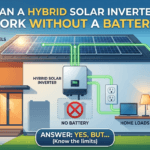
If your hybrid system has a battery and shuts down completely during NEPA outages, the most likely cause is incorrect configuration. A correctly configured hybrid system should enter island mode when NEPA fails, not shut down. Check that the battery type is set correctly, BMS communication is active, and the low SOC threshold is not set so high that the battery is always considered depleted. A hybrid system without a battery (batteryless mode) will shut down during NEPA outages because there is no energy source for island mode. Read our article on can a hybrid solar inverter work without a battery for the full explanation.
What is the difference between anti-islanding and island mode?
Anti-islanding is the action of opening the grid relay and stopping the inverter from energising the NEPA conductors when the grid fails. Island mode is the operating state the inverter enters after satisfying anti-islanding by opening the relay. In island mode, the inverter uses the battery and solar array to power the home’s internal loads independently. Anti-islanding satisfies the safety requirement. Island mode delivers backup power. A hybrid inverter does both in sequence, within milliseconds of grid failure.
Does anti-islanding mean my solar system cannot provide backup power?
No. Anti-islanding only prevents the inverter from energising the external NEPA conductors. It does not prevent the inverter from powering your home’s internal loads. A hybrid system with a battery opens the relay (satisfying anti-islanding) and then enters island mode (powering your home from battery and solar). The backup capability is preserved. Only grid-tied systems without batteries lose backup capability because they have no energy source to sustain island mode after the relay opens.
Why does my hybrid inverter keep tripping off when NEPA supply is unstable?
This is false tripping caused by IEEE 1547 default voltage thresholds being too tight for Nigerian grid conditions. If your NEPA supply drops below 202V during brownouts, the inverter interprets this as grid failure and opens its relay. Configure the under-voltage trip threshold to 170V and the trip delay to 3 to 5 seconds in the inverter’s grid settings. This prevents false tripping during brownouts while still detecting genuine grid failures. Refer to the threshold configuration table in Section 6 of this article.
How fast does a hybrid inverter open its relay when NEPA fails?
Quality hybrid inverters open their relay within 10 to 20 milliseconds of detecting grid failure. IEEE 1547 requires the process to be completed within 2 seconds. The 10 to 20ms transfer time means the entire isolation process happens in less than one AC cycle. Your LED lights may flicker once. Computers and routers continue without interruption because the interruption is shorter than their internal power supply hold-up time.
Is anti-islanding required in Nigeria?
Formally, Nigeria does not yet have a residential solar grid interconnection standard equivalent to IEEE 1547. However, all reputable hybrid inverters sold in Nigeria carry IEEE 1547 or IEC 62116 certification from their testing for regulated export markets. The anti-islanding function operates regardless of local regulatory enforcement. Connecting a certified hybrid inverter to the NEPA supply means NEPA linesmen are protected by the inverter’s built-in anti-islanding function even without a local standard requiring it.
Conclusion
Anti-islanding protection is a safety function, not a limitation.
It exists to protect the people who maintain the electricity network. Every certified solar inverter in the world includes it. It is not optional, and it should not be disabled or worked around.
The confusion that costs Nigerian solar buyers money is not about anti-islanding itself. It is about not understanding that different solar system types satisfy anti-islanding in different ways.
A grid-tied inverter satisfies anti-islanding by shutting down completely. In Nigeria, this means 8 to 14 hours of shutdown per day. It is technically correct and practically useless for Nigerian conditions.
A hybrid inverter satisfies anti-islanding by opening the grid relay and isolating from the NEPA network. It then enters island mode and continues powering the home from battery and solar. Both requirements are satisfied simultaneously: the linesmen are safe, and the lights are on.
The hybrid system with a battery is the architecture that resolves the anti-islanding constraint in the Nigerian context. It is not more expensive because it is premium. It is more expensive because it does more. It contains a transfer relay, island mode control logic, battery storage, and BMS communication. Each of those components serves a specific function in delivering anti-islanding compliance plus backup power simultaneously.
For the complete engineering framework behind hybrid system design including how island mode interacts with all other system functions, read our complete hybrid solar system design guide. For the system architecture comparison that puts anti-islanding in context across all three solar system types, read our article on off-grid vs hybrid vs grid-tied solar.
I am Engr. Ubokobong Ekpenyong, a solar specialist and lithium battery systems engineer with over five years of hands-on experience designing, assembling, and commissioning off-grid solar and energy storage systems. My work focuses on lithium battery pack architecture, BMS configuration, and system reliability in off-grid and high-demand environments.
Contains information related to marketing campaigns of the user. These are shared with Google AdWords / Google Ads when the Google Ads and Google Analytics accounts are linked together.
90 days
__utma
ID used to identify users and sessions
2 years after last activity
__utmt
Used to monitor number of Google Analytics server requests
10 minutes
__utmb
Used to distinguish new sessions and visits. This cookie is set when the GA.js javascript library is loaded and there is no existing __utmb cookie. The cookie is updated every time data is sent to the Google Analytics server.
30 minutes after last activity
__utmc
Used only with old Urchin versions of Google Analytics and not with GA.js. Was used to distinguish between new sessions and visits at the end of a session.
End of session (browser)
__utmz
Contains information about the traffic source or campaign that directed user to the website. The cookie is set when the GA.js javascript is loaded and updated when data is sent to the Google Anaytics server
6 months after last activity
__utmv
Contains custom information set by the web developer via the _setCustomVar method in Google Analytics. This cookie is updated every time new data is sent to the Google Analytics server.
2 years after last activity
__utmx
Used to determine whether a user is included in an A / B or Multivariate test.
18 months
_ga
ID used to identify users
2 years
_gali
Used by Google Analytics to determine which links on a page are being clicked
30 seconds
_ga_
ID used to identify users
2 years
_gid
ID used to identify users for 24 hours after last activity
24 hours
_gat
Used to monitor number of Google Analytics server requests when using Google Tag Manager
1 minute
You can find more information in our Cookie Policy and .