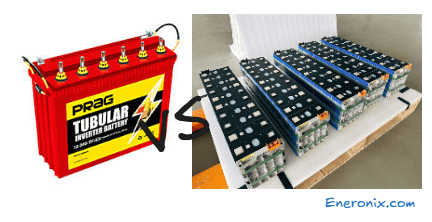
Walk into any solar equipment shop in Lagos, Abuja, or Port Harcourt and ask about batteries for your inverter system. The salesperson will quote you a tubular battery first. It is cheaper. It is familiar. And for many buyers, that is where the conversation ends.
But the question you actually need to answer is not which battery costs less to buy. It is which battery costs less to own over the years your inverter system will be running. Those are two very different questions, and the answers point in opposite directions.
This guide breaks down the real numbers behind lithium (specifically LiFePO4) and tubular lead-acid batteries in the Nigerian context. We compare upfront cost, cycle life, usable capacity, maintenance burden, performance in Nigerian heat, and total 10-year cost of ownership. By the end, you will have the numbers to make your own decision with confidence.
Understanding the Two Technologies
Tubular Lead-Acid Batteries
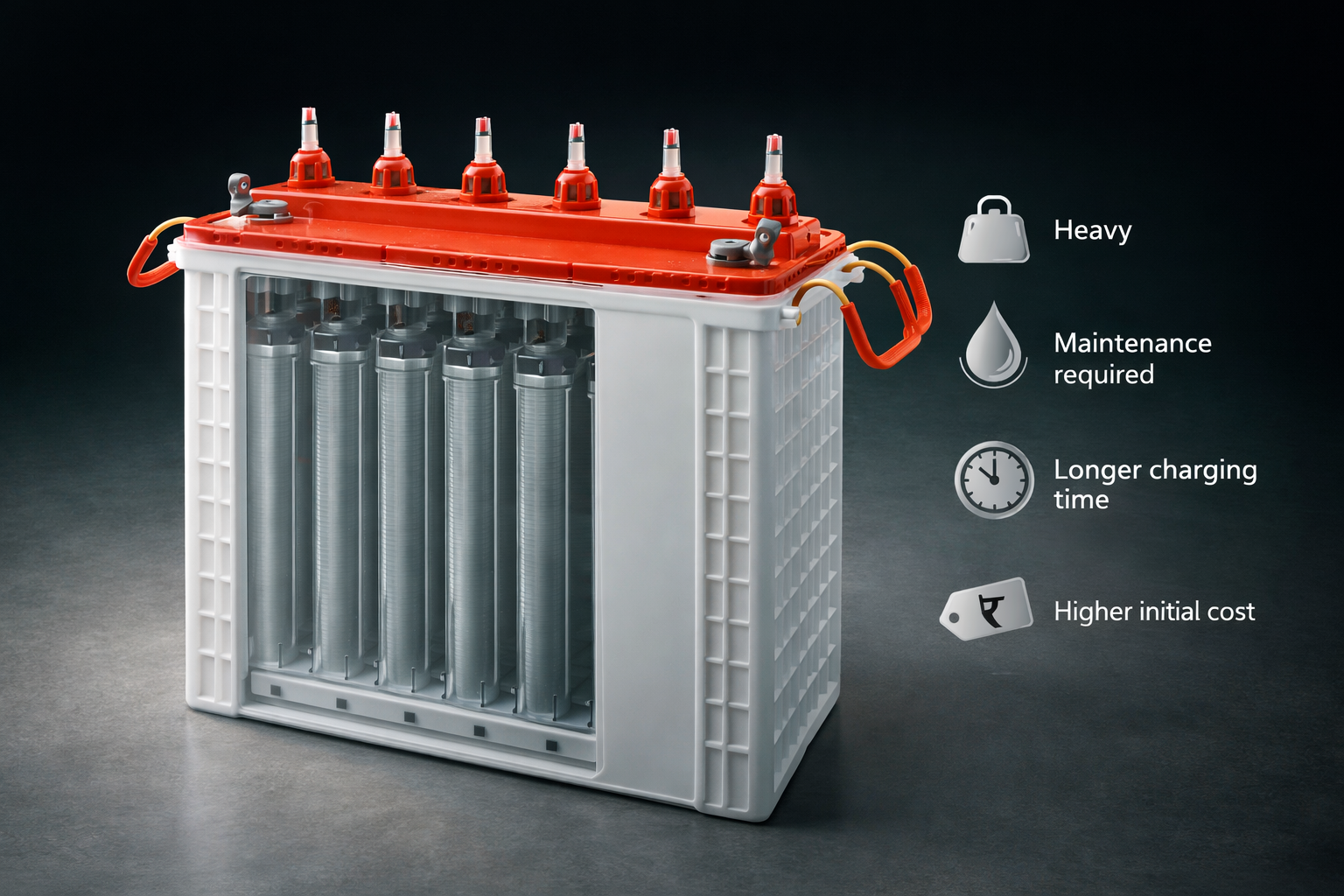
Tubular batteries are a variant of flooded lead-acid batteries. They use a tubular positive plate design that is more durable than the flat-plate AGM design, which is why they outlast AGM and sealed batteries in inverter applications. Popular brands in Nigeria include Luminous, Sukam, Genus, and Deka.
They store energy through a chemical reaction between lead plates and sulfuric acid electrolyte. That electrolyte is liquid, which means the battery must be stored upright, requires periodic water top-up, and produces hydrogen gas during charging. That gas is why tubular batteries must never be installed in sealed, unventilated spaces.
The key performance limitation of tubular batteries is their depth of discharge (DoD). Discharging a tubular battery below 50% of its rated capacity on a regular basis causes accelerated sulfation of the lead plates, dramatically shortening its lifespan. A 200Ah tubular battery is therefore practically a 100Ah battery in a daily cycling application.
LiFePO4 (Lithium Iron Phosphate) Batteries
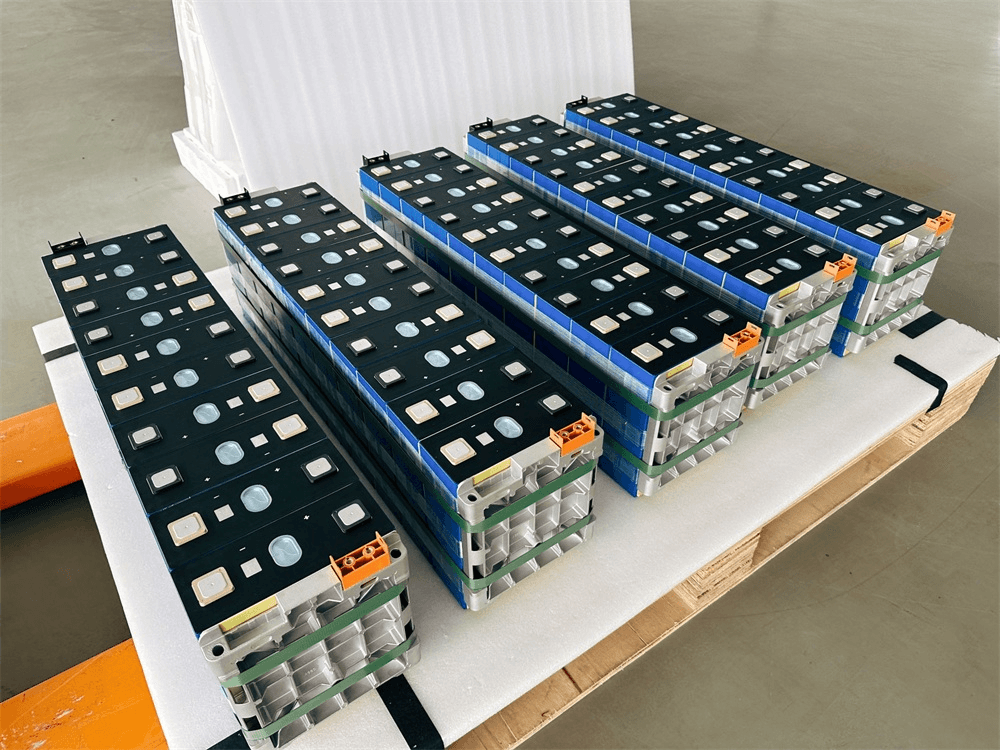
LiFePO4 is a specific lithium chemistry selected for energy storage applications because of its thermal stability, long cycle life, and safety profile compared to other lithium variants like NMC or NCA. It does not experience thermal runaway under normal operating conditions, which makes it the appropriate choice for home and commercial energy storage.
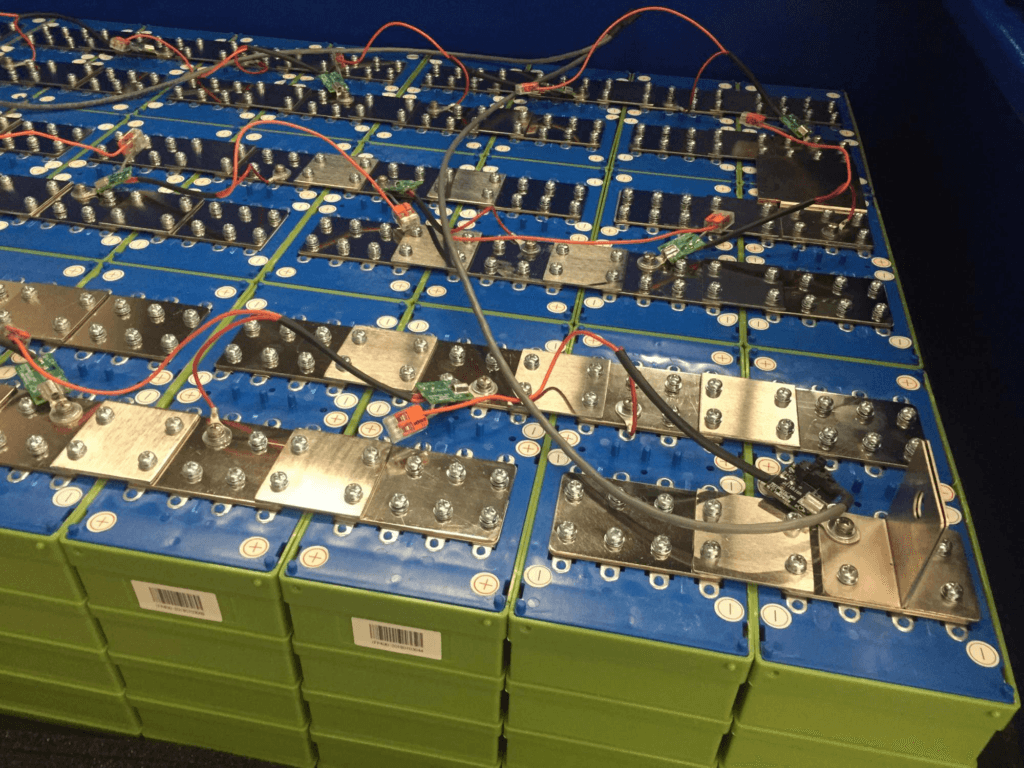
LiFePO4 batteries are managed by a Battery Management System (BMS), which monitors cell voltage, temperature, and current in real time. The BMS protects the cells from overcharge, over-discharge, over-temperature, and short circuit conditions. This active management is a large part of why LiFePO4 achieves such long cycle life compared to lead-acid.
The practical DoD for LiFePO4 in daily cycling applications is 80 to 90%. A 200Ah LiFePO4 battery gives you 160 to 180Ah of usable capacity, compared to 100Ah from a 200Ah tubular. The Eneronix guide on the 80/20 rule for lithium batteries explains why this operating window exists and how keeping your battery within it dramatically extends its usable life.
Upfront Cost Comparison (Nigeria, 2026)
Let us establish current market pricing before comparing performance. All prices below are approximate naira figures as of early 2026, based on Lagos wholesale and retail market data. Prices fluctuate with dollar exchange rates, so verify with your supplier before purchasing.
Battery Type
Capacity
Approx. Price Range (NGN)
Voltage
Luminous Tubular (ILTT 18048)
150Ah
N120,000 – N180,000
12V
Luminous Tubular (ILTT 26066)
200Ah
N160,000 – N250,000
12V
Genus Tubular (IT 500)
150Ah
N130,000 – N190,000
12V
Sukam Tubular 200Ah
200Ah
N170,000 – N260,000
12V
Pylontech US2000C (LiFePO4)
50Ah / 2.4kWh
N350,000 – N450,000
48V
Pylontech US3000C (LiFePO4)
74Ah / 3.55kWh
N500,000 – N650,000
48V
Blue Carbon 48V 100Ah (LiFePO4)
100Ah / 4.8kWh
N450,000 – N600,000
48V
Felicity 48V 100Ah (LiFePO4)
100Ah / 4.8kWh
N380,000 – N520,000
48V
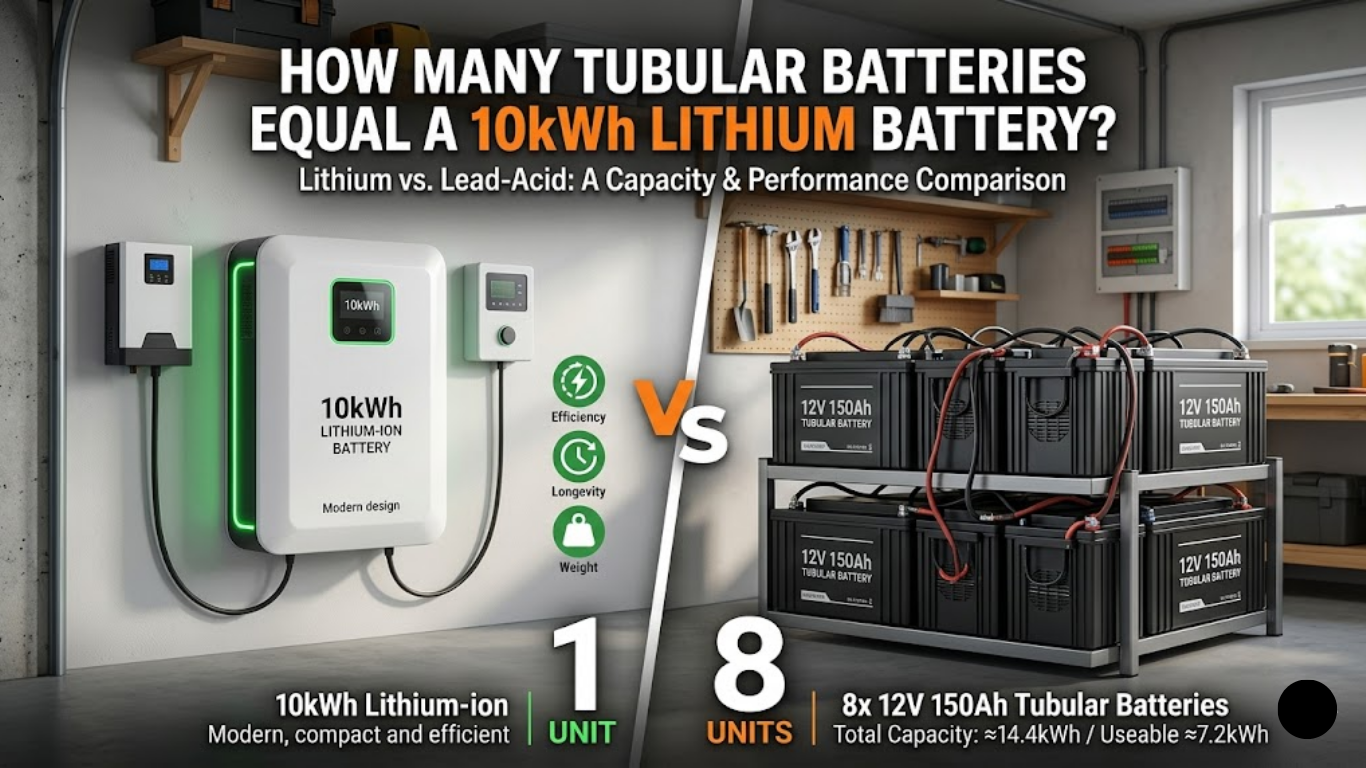
Looking at these prices in isolation, tubular batteries appear far cheaper. But before drawing any conclusions, it helps to understand what you actually get per naira spent. The Eneronix breakdown of how many tubular batteries equal a 10kWh lithium battery puts the capacity comparison in direct naira terms, and the numbers shift significantly once DoD is applied to both sides.
The Right Way to Compare Battery Cost: Cost Per Cycle and Cost Per kWh
The most honest way to compare battery economics is to calculate how much each battery costs to deliver one kilowatt-hour of usable energy over its total lifespan. This metric — cost per kWh delivered — accounts for capacity, DoD, cycle life, and purchase price all at once.
The Formula
Cost per kWh delivered = Battery price / (Usable kWh per cycle x Total cycle life)
Worked Example: 200Ah Tubular Battery at N200,000
Rated capacity: 200Ah at 12V = 2.4kWh
Usable DoD: 50% = 1.2kWh usable per cycle
Cycle life at 50% DoD: approximately 600 cycles (field average for Nigerian conditions)
Total usable energy over life: 1.2kWh x 600 cycles = 720kWh
Cost per kWh delivered: N200,000 / 720kWh = N278 per kWh
Worked Example: 48V 100Ah LiFePO4 at N500,000
Rated capacity: 100Ah at 48V = 4.8kWh
Usable DoD: 80% = 3.84kWh usable per cycle
Cycle life at 80% DoD: approximately 3,500 cycles (conservative estimate for quality LiFePO4)
Total usable energy over life: 3.84kWh x 3,500 cycles = 13,440kWh
Cost per kWh delivered: N500,000 / 13,440kWh = N37 per kWh
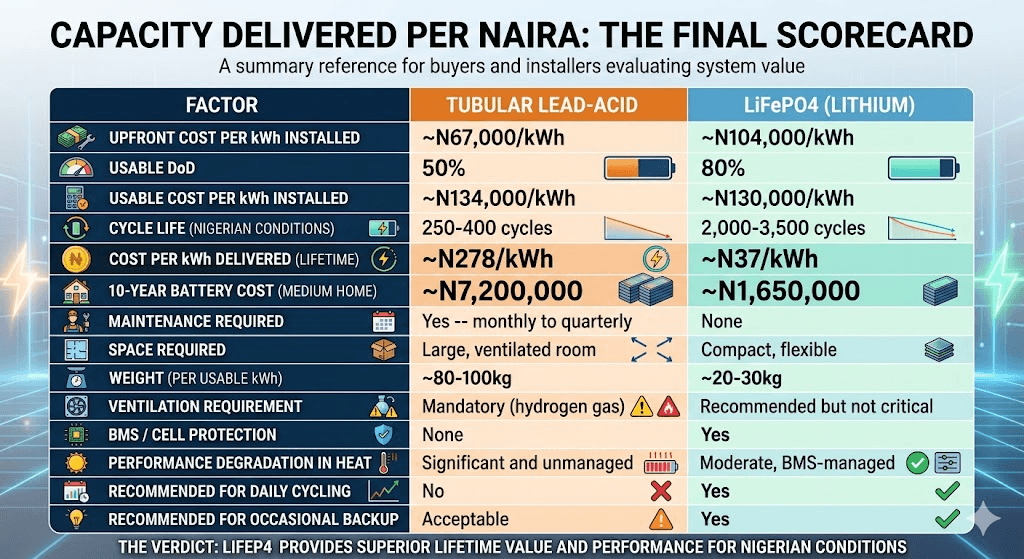
Tubular battery: N278 per kWh delivered. LiFePO4: N37 per kWh delivered. The lithium battery delivers usable energy at roughly one-seventh the cost of a tubular battery when measured over the full lifespan.
This is not a rounding error or a cherry-picked comparison. It is the result of the compounding difference between 600 cycles and 3,500 cycles, combined with nearly double the usable capacity per rated amp-hour. The upfront price gap looks large. The lifetime cost gap is even larger but it runs in the opposite direction.
Total Cost of Ownership: A Real 10-Year Comparison
Let us apply this to a real system scenario. A medium-sized home in Nigeria running an off-grid or hybrid inverter system with the following requirements:
Average daily load: 1,200W
Daily backup needed: 8 hours
Required usable energy per day: 9.6kWh
System voltage: 48V
Option A: Tubular Battery Bank
To deliver 9.6kWh of usable energy at 50% DoD, the required installed capacity is 9.6kWh / 0.5 = 19.2kWh. At 48V, that is 400Ah. This requires eight 200Ah tubular batteries wired as two parallel strings of four (4 in series to reach 48V, then two strings in parallel to reach 400Ah).
Cost Item
Year 1
Year 3-4 (Replacement 1)
Year 6-7 (Replacement 2)
10-Year Total
Battery purchase (8x 200Ah)
N1,600,000
N2,400,000*
N2,800,000*
N6,800,000
Distilled water (quarterly)
N12,000
N12,000
N12,000
N120,000
Equalization charging (electricity)
N18,000/yr
N18,000/yr
N18,000/yr
N180,000
Terminal cleaning / maintenance
N10,000/yr
N10,000/yr
N10,000/yr
N100,000
TOTAL
—
—
—
~N7,200,000
Replacement costs are projected with 10-15% annual naira inflation on battery prices.
Option B: LiFePO4 Battery Bank
To deliver 9.6kWh usable at 80% DoD, the required installed capacity is 9.6kWh / 0.8 = 12kWh. This is met by three 48V 100Ah modules (14.4kWh installed, giving comfortable headroom). At current prices, three quality LiFePO4 modules average N1,500,000 to N1,800,000.
Cost Item
Year 1
Year 5-8 (Optional top-up)
Year 10
10-Year Total
Battery purchase (3x 48V 100Ah)
N1,650,000
N0 (within warranty)
N0
N1,650,000
Maintenance
N0
N0
N0
N0
BMS firmware updates (if any)
N0
N0
N0
N0
TOTAL
—
—
—
~N1,650,000
Over 10 years, the tubular option costs approximately N7,200,000 in batteries and maintenance. The LiFePO4 option costs approximately N1,650,000. That is a N5,550,000 difference in favour of lithium -- despite the lower sticker price on tubular.
These figures assume the LiFePO4 batteries are correctly sized, properly installed, and operating within their rated temperature range. If your installation environment runs very hot (above 40 degrees Celsius regularly), add the cost of one additional module and factor in slightly reduced cycle life.
The Maintenance Reality in Nigeria
The tubular battery’s maintenance requirements deserve a dedicated section because they are routinely understated by sellers and underestimated by buyers especially first-time solar system owners.
What Tubular Battery Maintenance Actually Involves
Flooded tubular batteries lose water during charging as the electrolyte gasses off hydrogen and oxygen. In Nigeria’s heat, this process accelerates. A battery bank that might need water top-up every 3 months in Europe may need it every 6 to 8 weeks in Lagos from March through October.
The process requires distilled water — not tap water, not table water, not borehole water. Tap water in Nigeria contains dissolved minerals that contaminate the electrolyte and cause accelerated plate corrosion. Finding consistent distilled water supply in smaller cities and towns can itself become a maintenance challenge.
Beyond water topping, tubular batteries require periodic equalization charging — a controlled overcharge cycle designed to break up sulfation on the plates and rebalance electrolyte concentration across cells. The charge behaviour of lead-acid versus lithium is fundamentally different. Our article on lead-acid vs lithium charging key differences explains why the two chemistries require completely different charge algorithms and why using the wrong settings on either type causes significant damage over time.
What Happens When Maintenance Is Skipped
Field data from Nigerian installations shows a consistent pattern: tubular battery banks that are well-maintained achieve 500 to 700 cycles. Banks where maintenance is sporadic or inconsistent, which describes the majority of residential installations, average 200 to 400 cycles before capacity drops below 70% of rated.
At 300 cycles, a 200Ah tubular battery bank that started life delivering 100Ah of usable capacity is now delivering 70Ah. The homeowner notices shorter backup times but rarely connects it directly to maintenance. By the time they realize the bank is at end of life, they have already paid for a bank that never achieved its rated performance.
Skipped maintenance is one of the leading causes of premature battery system failure in Nigeria. Our post on why most solar battery systems fail before year 2 identifies the specific failure patterns including missed equalization, incorrect charge voltages, and thermal neglect that cut battery life in half across Nigerian installations.
A tubular battery that is not maintained is not a cheap battery. It is a battery that will be replaced in 2 to 3 years instead of 5. In a daily-cycling application in Nigeria's heat, inconsistent maintenance is the rule, not the exception.
LiFePO4 Maintenance Requirements
A properly installed LiFePO4 system with a communicating BMS requires no routine maintenance from the user. The BMS handles cell balancing automatically during charging. There is no electrolyte to check, no water to add, no equalization charge to initiate manually. The system owner’s only task is to keep the installation space within a reasonable temperature range and ensure the inverter firmware and BMS firmware are updated when the manufacturer releases updates.
If you want to get the maximum lifespan out of a LiFePO4 bank, the Eneronix guide on how to increase lithium battery lifespan covers the practical steps operating temperature, charge voltage optimisation, DoD management, and firmware practices that the best-performing installations in Nigeria have in common.
How Nigerian Heat Affects Each Technology Differently
Temperature is the single biggest factor differentiating battery performance in Nigeria compared to the temperate-climate specifications on battery datasheets. Both technologies are affected, but in different ways and to different degrees.
Tubular Batteries in High Heat
Lead-acid batteries follow the Arrhenius equation for chemical reaction rates — broadly speaking, for every 10 degrees Celsius increase in operating temperature, the reaction rate (and therefore the self-discharge and aging rate) approximately doubles. A tubular battery rated for 600 cycles at 25 degrees Celsius may deliver only 300 to 350 cycles when operating at 35 to 40 degrees Celsius, which is realistic for a battery room in Lagos from April through September.
High heat also accelerates water loss from the electrolyte, meaning maintenance intervals must shorten in hot weather, the opposite of what most owners do in practice.
LiFePO4 in High Heat
LiFePO4 cells also degrade faster above 35 degrees Celsius, but the BMS provides a layer of protection that lead-acid does not have. Most quality BMS units will reduce charge current or temporarily suspend charging if cell temperatures exceed the safe operating threshold. This thermal management, while not a substitute for a cool installation environment, prevents the worst-case heat damage scenarios.
Field data from Nigerian LiFePO4 installations shows approximately 2 to 3% annual capacity loss in well-ventilated installations and 10 to 15% annual capacity loss in poorly ventilated equipment rooms. The lesson is the same as for tubular: battery room environment matters. But LiFePO4 arrives with active protection that tubular batteries simply do not have.
Temperature Factor
Tubular Lead-Acid
LiFePO4
Rated cycle life (25C)
500-700 cycles
3,000-5,000 cycles
Actual cycle life (35-40C, Nigeria)
250-400 cycles
2,000-3,500 cycles
Thermal protection mechanism
None
BMS current limiting / cutoff
Water loss rate in heat
High — accelerates with temperature
Not applicable
Self-discharge rate in heat
High (1-5% per week)
Very low (1-3% per month)
Risk of thermal damage
Plate corrosion, warping
BMS-protected — low risk
Lithium vs Tubular Battery: Capacity Delivered Per Naira
Let us now pull everything together into a single comparison scorecard. This is the summary buyers and installers can use as a reference when evaluating a specific system.
Factor
Tubular Lead-Acid
LiFePO4 (Lithium)
Upfront cost per kWh installed
~N67,000/kWh
~N104,000/kWh
Usable DoD
50%
80%
Usable cost per kWh installed
~N134,000/kWh
~N130,000/kWh
Cycle life (Nigerian conditions)
250-400 cycles
2,000-3,500 cycles
Cost per kWh delivered (lifetime)
~N278/kWh
~N37/kWh
10-year battery cost (medium home)
~N7,200,000
~N1,650,000
Maintenance required
Yes, monthly to quarterly
None
Space required
Large, ventilated room
Compact, flexible
Weight (per usable kWh)
~80-100kg
~20-30kg
Ventilation requirement
Mandatory (hydrogen gas)
Recommended but not critical
BMS / cell protection
None
Yes
Performance degradation in heat
Significant and unmanaged
Moderate, BMS-managed
Recommended for daily cycling
No
Yes
Recommended for occasional backup
Acceptable
Yes
When Does Tubular Still Make Sense?
Being fair to tubular batteries means acknowledging the specific scenarios where they remain a reasonable choice.
Occasional Backup, Not Daily Cycling
If your grid power supply is reliable — more than 18 hours per day on average — and your inverter battery is genuinely only a backup for occasional short outages, a tubular battery bank can serve that purpose at lower upfront cost. A battery that cycles 50 to 100 times per year instead of 300 to 365 times will last 5 to 8 years regardless of chemistry. In that scenario, the cycle life advantage of LiFePO4 matters much less.
Very Tight Upfront Budget
For a customer who genuinely cannot access the capital for a LiFePO4 bank, a tubular battery is better than no battery. The key is sizing it with the knowledge that it will need replacement in 3 to 5 years, and building that replacement cost into the financial plan from the start.
Short-Term Installation
For a temporary installation a construction site, a short-term rental property, or a bridging solution while awaiting capital for a permanent system — tubular batteries represent a lower sunk cost if the system will be decommissioned or transferred within 2 to 3 years.
Outside these specific scenarios, tubular batteries are not the economical choice in Nigeria in 2026. The cycle life gap, the maintenance burden, and the usable capacity difference make LiFePO4 the better financial decision for any system that will cycle daily.
What Drives the Price of LiFePO4 Batteries in Nigeria
One question buyers ask frequently is why LiFePO4 batteries are so expensive in Nigeria compared to what they see quoted online in US dollars or Chinese yuan. The answer is a combination of four factors.
Exchange Rate Exposure
Almost all LiFePO4 batteries sold in Nigeria are imported from China primarily, with some European brands. The pricing is therefore dollar or euro-denominated at the wholesale level. With the naira having depreciated significantly against the dollar over the past three years, the naira price of imported batteries has risen sharply even when dollar prices have stayed flat or fallen.
Import Duties and Clearing Costs
Lithium batteries attract import duties in Nigeria. Combined with port clearing costs, logistics fees, and the time cost of capital tied up in transit inventory, the landed cost of a battery can be 25 to 40% above the manufacturer’s FOB price.
Distribution Margins
The Nigerian solar distribution chain typically involves a manufacturer, a regional distributor, a Lagos importer, a state-level wholesaler, and a retail installer. Each step adds margin. Buying directly from an authorised importer or a large distributor reduces cost compared to buying through a small retail shop.
Battery Prices Are Falling
Globally, LiFePO4 cell prices have fallen by approximately 70% between 2020 and 2024, driven by Chinese manufacturing scale. That cost reduction is gradually flowing through to Nigerian end-users, though exchange rate movements have partially offset it. Over the next 3 to 5 years, LiFePO4 prices in Nigeria are expected to continue declining in dollar terms, making the economics even more favourable relative to tubular.
It is also worth being honest about the genuine limitations of lithium technology. Our article on the biggest disadvantage of a lithium battery covers the upfront cost barrier, BMS failure risks, and the consequences of buying low-quality cells a fair counterpoint that every buyer should read before making a final decision.
How to Verify What You Are Buying
The Nigerian solar market has a counterfeit battery problem. Both tubular and LiFePO4 batteries are subject to counterfeiting, relabelling, and grey-market imports of degraded or repackaged cells. Here is how to verify you are getting what you paid for.
For Tubular Batteries
Check the battery case for the manufacturer’s hologram sticker and verify it on the brand’s website or SMS verification system (Luminous and Sukam both have this).
Check the manufacture date on the label. A battery sitting in a warehouse for 12 months has already lost capacity and cycle life. Refuse batteries older than 6 months from date of manufacture.
The electrolyte should be clear, not yellow or cloudy. Yellow electrolyte indicates the battery has been sitting discharged.
Weigh the battery if possible. Underweight batteries have less active plate material and deliver less capacity than stated.
For LiFePO4 Batteries
Buy from authorised distributors for the brand you are purchasing. Pylontech, for example, maintains an authorised dealer list on their website.
Request the BMS communication test before installation. A functioning BMS should communicate with your inverter and display cell voltage, state of charge, and temperature data. A battery with a non-functional or missing BMS is not a LiFePO4 battery — it is a bare cell pack without protection.
Check the battery serial number against the manufacturer’s warranty registration portal.
For rack-mounted or wall-mount units, inspect the internal BMS board if possible. Counterfeit units often use substandard BMS electronics with lower current ratings than stated.
Making the Decision: A Simple Framework
If you are deciding between tubular and LiFePO4 for your next inverter system in Nigeria, run through this decision framework:
Question
If Yes — Consider
If No — Consider
Will the battery cycle daily?
LiFePO4
Tubular may be acceptable
Is grid supply less than 12hrs/day average?
LiFePO4 strongly
Tubular acceptable
Can you reliably maintain the battery monthly?
Tubular acceptable
LiFePO4 only
Is your battery room well-ventilated and cool?
Both viable
LiFePO4 preferred (BMS protection)
Do you plan to keep the system for 7+ years?
LiFePO4 strongly
Either could work
Is upfront capital the binding constraint?
Tubular acceptable with replacement plan
LiFePO4
Frequently Asked Questions (FAQ)
1. Which is better: lithium or tubular battery in Nigeria?
For most Nigerian homes and businesses with frequent power outages, lithium (LiFePO4) batteries are the better choice. They last significantly longer, deliver more usable capacity, require no maintenance, and have a much lower cost over time compared to tubular batteries.
2. Why are lithium batteries more expensive than tubular batteries?
Lithium batteries have a higher upfront cost because of advanced cell technology and built-in Battery Management Systems (BMS). However, they last 5–7 times longer than tubular batteries, making them cheaper in the long run.
3. How long do tubular batteries last in Nigeria?
In real Nigerian conditions (heat and inconsistent maintenance), tubular batteries typically last 2 to 4 years with daily use. Well-maintained systems may reach 4–5 years, but this is less common.
4. How long do LiFePO4 batteries last in Nigeria?
LiFePO4 batteries typically last 7 to 10 years in Nigeria, even with daily cycling. High-quality batteries can exceed 3,000–5,000 cycles depending on usage and temperature.
5. What is the main disadvantage of lithium batteries?
The main disadvantage is the high initial cost. Additionally, low-quality lithium batteries with poor BMS can fail early, so buying from trusted suppliers is critical.
6. Do tubular batteries require maintenance?
Yes. Tubular batteries require:
Regular distilled water top-up
Terminal cleaning
Equalization charging
Failure to maintain them properly significantly reduces their lifespan.
7. Do lithium batteries require maintenance?
No. LiFePO4 batteries are maintenance-free. Their built-in BMS automatically manages charging, balancing, and protection.
8. Which battery is better for frequent power outages in Nigeria?
Lithium batteries are far better for frequent outages because they:
Support deep discharge (80–90%)
Recharge faster
Last thousands of cycles
Tubular batteries degrade quickly under daily use.
9. How many tubular batteries equal one lithium battery?
Due to lower usable capacity and shorter lifespan, you may need 2 to 3 times more tubular batteries to match one lithium battery over time.
10. Is lithium battery safe for home use in Nigeria?
Yes. LiFePO4 batteries are one of the safest lithium chemistries. They are thermally stable and include BMS protection against overheating, overcharging, and short circuits.
Conclusion
The tubular vs lithium debate in Nigeria is not really a debate about preferences or brand loyalty. It is a math problem. And the math consistently resolves in favour of LiFePO4 for any system that will cycle daily — which is the reality for the vast majority of Nigerian households and businesses operating with unreliable grid power.
Tubular batteries have their place. They are well-suited for systems with reliable grid backup, where battery cycling is infrequent. For daily-cycling systems, especially those running air conditioning or heavy loads, a tubular bank will cost more in replacements and maintenance over 10 years than the equivalent LiFePO4 bank costs to buy once.
The battery with the lower price tag is not the battery that costs you less. Know the difference before you buy.
LiFePO4 delivers usable energy at roughly one-seventh the cost per kWh of tubular over its lifetime.
A medium-home tubular bank costs approximately N7,200,000 over 10 years versus N1,650,000 for the equivalent LiFePO4 bank.
Tubular batteries require monthly to quarterly maintenance that most owners do not perform consistently, further reducing their real-world lifespan.
LiFePO4 is the financially sound choice for any Nigerian system that cycles daily.
Tubular remains acceptable for occasional backup where cycling is less than 100 times per year.
Related posts in this cluster:
– How Many Batteries for a 5kVA Inverter – Best Lithium Battery for Inverter in Nigeria – 48V Lithium Battery Sizing Guide
I am Engr. Ubokobong Ekpenyong, a solar specialist and lithium battery systems engineer with over five years of hands-on experience designing, assembling, and commissioning off-grid solar and energy storage systems. My work focuses on lithium battery pack architecture, BMS configuration, and system reliability in off-grid and high-demand environments.
Contains information related to marketing campaigns of the user. These are shared with Google AdWords / Google Ads when the Google Ads and Google Analytics accounts are linked together.
90 days
__utma
ID used to identify users and sessions
2 years after last activity
__utmt
Used to monitor number of Google Analytics server requests
10 minutes
__utmb
Used to distinguish new sessions and visits. This cookie is set when the GA.js javascript library is loaded and there is no existing __utmb cookie. The cookie is updated every time data is sent to the Google Analytics server.
30 minutes after last activity
__utmc
Used only with old Urchin versions of Google Analytics and not with GA.js. Was used to distinguish between new sessions and visits at the end of a session.
End of session (browser)
__utmz
Contains information about the traffic source or campaign that directed user to the website. The cookie is set when the GA.js javascript is loaded and updated when data is sent to the Google Anaytics server
6 months after last activity
__utmv
Contains custom information set by the web developer via the _setCustomVar method in Google Analytics. This cookie is updated every time new data is sent to the Google Analytics server.
2 years after last activity
__utmx
Used to determine whether a user is included in an A / B or Multivariate test.
18 months
_ga
ID used to identify users
2 years
_gali
Used by Google Analytics to determine which links on a page are being clicked
30 seconds
_ga_
ID used to identify users
2 years
_gid
ID used to identify users for 24 hours after last activity
24 hours
_gat
Used to monitor number of Google Analytics server requests when using Google Tag Manager
1 minute
You can find more information in our Cookie Policy and .