How Many Batteries Do You Need for a 5kVA Inverter?
Most people buying a 5kVA inverter system in Nigeria ask one question before anything else: how many batteries do I need? It sounds simple. It is not. The answer depends on five variables — your load, your backup hours, your battery voltage, your chemistry, and your depth of discharge. Get any of those wrong and you will either run out of power by midnight or spend N500,000 more than you needed to.
This guide gives you the complete calculation. Not a vague range. Not ‘it depends.’ You will walk away knowing exactly how many batteries your specific 5kVA system needs, how to verify that number yourself, and which battery configurations actually make sense in the Nigerian market in 2026.
Why 5kVA Is Not the Same as 5,000 Watts of Load
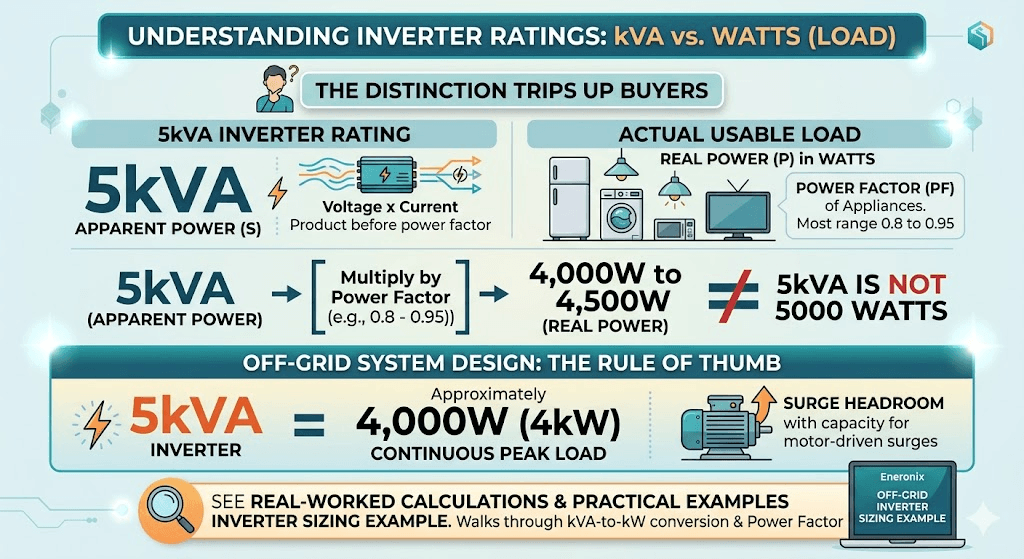
This distinction trips up more buyers than almost anything else. A 5kVA inverter rating describes the apparent power it can handle the product of voltage and current before accounting for the power factor of your appliances.
Most household appliances have a power factor between 0.8 and 0.95. So a 5kVA inverter delivers a real power output of roughly 4,000 to 4,500 watts of actual usable load. The official rule of thumb used in off-grid system design is that a 5kVA inverter serves a peak load of approximately 4,000W (4kW) continuously, with surge headroom for motor-driven loads.
If you want to see how this plays out across different inverter sizes with real worked calculations, the Eneronix off-grid inverter sizing example walks through the kVA-to-kW conversion and power factor in a practical system context.
Rule of thumb: Never plan to run your 5kVA inverter at more than 80% of its rated capacity continuously. That means your simultaneous load should not exceed 4,000W.
Why does this matter for battery sizing? Because your battery bank must supply that load entirely from stored energy. If your actual running load is 2,000W, the battery drains at a very different rate than if it is 3,500W. The inverter rating sets the ceiling. Your actual load profile determines how fast the bank depletes.
The Four Variables That Determine Your Battery Count
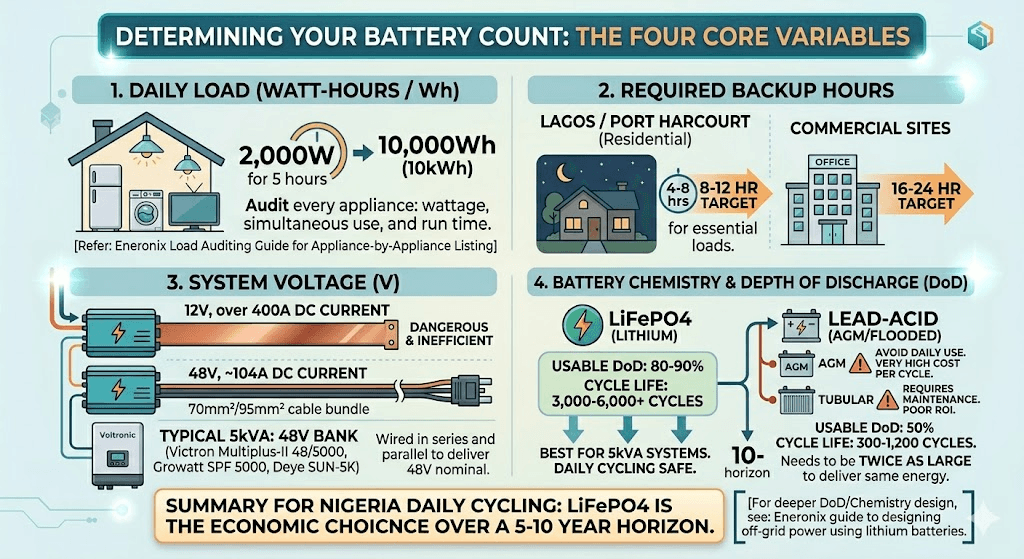
Battery sizing is not a lookup table exercise. It is an energy balance calculation with four core inputs:
1. Your Daily Load in Watt-Hours (Wh)
This is the total energy your loads consume over the period you need the inverter to run. If you run a 2,000W load for 5 hours, that is 10,000Wh (10kWh) of required energy. You need to audit every appliance — its wattage, how many you run simultaneously, and for how long.
A thorough load audit is the foundation of every reliable battery sizing calculation. The Eneronix guide to off-grid system load auditing explains exactly how to list every appliance, assign realistic run hours, and calculate your true daily Wh demand — including phantom loads that most people forget to count.
2. Your Required Backup Hours
How many hours do you need the battery to sustain your load without grid power or solar input? In Lagos or Port Harcourt, where NEPA supply averages 4 to 8 hours per day at best in many areas, most homeowners target 8 to 12 hours of backup for essential loads. Commercial sites often target 16 to 24 hours.
3. Your System Voltage
A 5kVA inverter can run on a 12V, 24V, or 48V battery bank depending on the model. However, virtually every quality 5kVA inverter on the Nigerian market — Victron Multiplus-II 48/5000, Growatt SPF 5000, Voltronic Axpert 5kVA, Deye SUN-5K — runs on a 48V battery bank. This is not coincidence. At 5kW of power, running on 12V would require over 400A of DC current. That is dangerous, inefficient, and requires cable sizes that are impractical in the field. At 48V, the same 5kW draws only about 104A, which is manageable with standard 70mm squared or 95mm squared cable.
If your 5kVA inverter is 48V (which it almost certainly is), your battery bank must be configured to deliver 48V nominal. This determines how you wire your batteries in series and parallel.
4. Battery Chemistry and Depth of Discharge (DoD)
Different battery chemistries allow you to use different percentages of their rated capacity before damage occurs. This is called depth of discharge (DoD).
Battery Type
Usable DoD
Cycle Life
Notes
LiFePO4 (Lithium Iron Phosphate)
80-90%
3,000-6,000+ cycles
Best for 5kVA systems. Daily cycling safe.
AGM / Sealed Lead-Acid
50%
300-700 cycles
Avoid for daily use. Very high cost per cycle.
Tubular Flooded Lead-Acid
50%
500-1,200 cycles
Requires maintenance. Poor ROI for daily cycling.
For a deeper look at how DoD, cycle count, and battery chemistry interact when designing a full off-grid system, the Eneronix guide on designing an off-grid power system using lithium batteries covers the chemistry decisions and their downstream effects on system sizing and long-term cost.
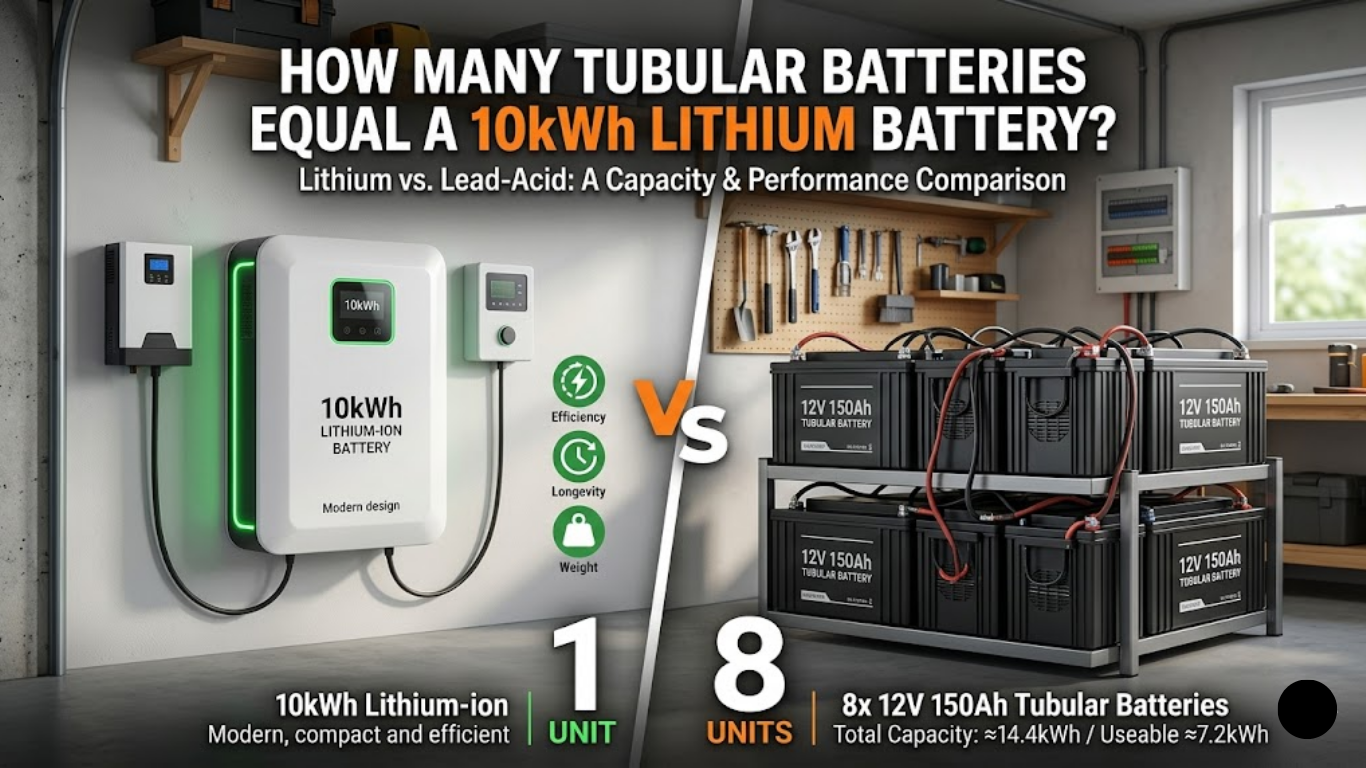
For a 5kVA system in Nigeria that will cycle daily — and it will, because this is not a backup system for occasional outages, this is your primary power source — LiFePO4 is the only chemistry that makes economic sense over a 5 to 10-year horizon. A tubular battery bank at 50% DoD needs to be twice as large as the equivalent LiFePO4 bank to deliver the same usable energy, and it will need replacing in 3 to 5 years instead of 10.
The Battery Sizing Formula (Step by Step)
Here is the complete calculation you need to apply to your own numbers.
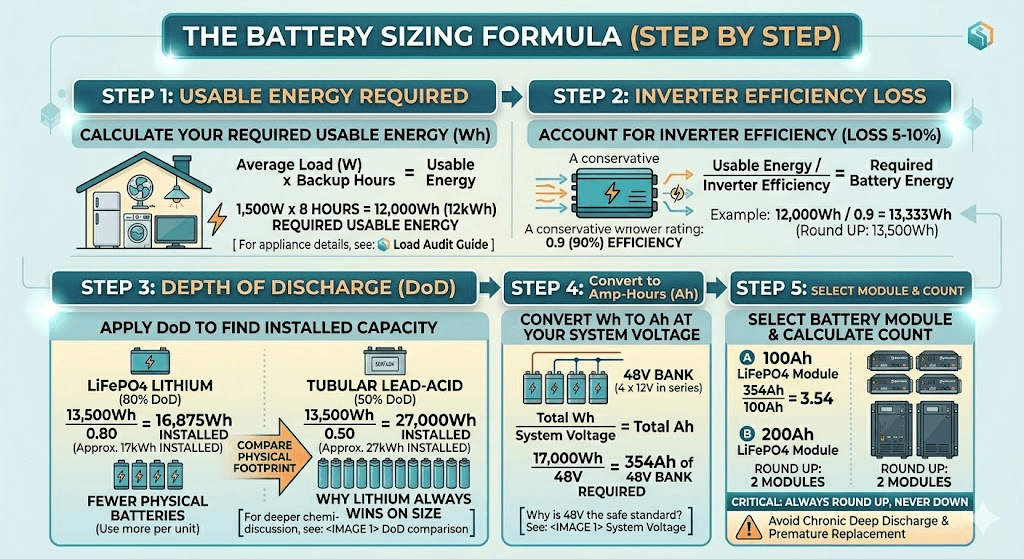
Step 1: Calculate Your Required Usable Energy
Required usable energy (Wh) = Average load (W) x Backup hours required
Example: A home with an average running load of 1,500W (TV, fans, lighting, fridge) needing 8 hours of backup:
1,500W x 8 hours = 12,000Wh = 12kWh of usable energy required
Step 2: Account for Inverter Efficiency
Your inverter is not 100% efficient. It converts DC battery power to AC with a loss of roughly 5 to 10% depending on load level and inverter quality. Use 90% (0.9) as a conservative efficiency figure for a quality inverter.
Required battery energy = Usable energy / Inverter efficiency
12,000Wh / 0.9 = 13,333Wh round up to 13,500Wh
Step 3: Apply Depth of Discharge
Divide by your battery’s DoD to find the total rated capacity you need to install.
For LiFePO4 at 80% DoD: 13,500Wh / 0.80 = 16,875Wh approximately 17kWh of installed battery capacity
For tubular at 50% DoD: 13,500Wh / 0.50 = 27,000Wh approximately 27kWh of installed battery capacity
This is why lithium almost always requires fewer physical batteries. You are using more of each one.
Step 4: Convert to Amp-Hours at Your System Voltage
For a 48V system: Total Ah = Total Wh / System voltage
17,000Wh / 48V = 354Ah of 48V battery bank capacity required
Step 5: Select Your Battery Module and Calculate Count
Now divide the required Ah by the Ah rating of the individual battery module you intend to use.
If you are using 100Ah LiFePO4 modules (like Pylontech US2000 or Blue Carbon 100Ah): 354Ah / 100Ah = 3.54 round up to 4 modules.
If you are using 200Ah LiFePO4 modules: 354Ah / 200Ah = 1.77, round up to 2 modules
Always round up, never down. Undersizing a battery bank causes chronic deep discharge, premature aging, and early replacement.
The Eneronix battery bank sizing guide for off-grid systems covers this full calculation in depth, including autonomy days, series-parallel configuration, and how to size correctly when your load varies significantly between day and night.
Worked Examples: Common 5kVA Scenarios in Nigeria
Below are four real-world scenarios covering different household sizes and backup requirements. All calculations use LiFePO4 at 80% DoD on a 48V system.
Scenario A: Small Home, Minimal Loads, 6-Hour Backup
Parameter
Value
Loads
4x LED bulbs (40W), 2x ceiling fans (130W), 1x TV (100W), 1x fridge (150W)
Average running load
~420W
Backup required
6 hours
Required usable energy
420W x 6h = 2,520Wh
After 90% inverter efficiency
2,800Wh
After 80% DoD (LiFePO4)
3,500Wh = 3.5kWh installed
At 48V
3,500Wh / 48V = 73Ah
Battery count (100Ah modules)
1 module (gives margin)
Scenario B: Medium Home, Air Conditioner Excluded, 8-Hour Backup
This is where many Nigerian solar installations fail technically. Wiring batteries incorrectly even the right number of them causes cell imbalance, BMS trips, and accelerated degradation.
Series vs Parallel & What Each Does
Connecting batteries in series adds their voltages together but keeps capacity (Ah) the same. Connecting them in parallel keeps voltage the same but adds their capacities together.
For a 48V system using 12V batteries: you need 4 batteries in series to achieve 48V nominal. Each additional parallel string adds Ah capacity.
For a 48V system using 24V batteries: you need 2 in series, then parallel for more capacity.
For a 48V system using 48V lithium rack modules (like Pylontech US3000C, CATL, or Blue Carbon rack units): each module is already 48V. You simply parallel them together to increase capacity.
Practical 48V Configurations for a 5kVA Inverter
Configuration
Total Capacity
Usable (80% DoD)
Typical Use Case
1x 48V 100Ah LiFePO4
4.8kWh
3.84kWh
Minimal backup, small loads only
2x 48V 100Ah (parallel)
9.6kWh
7.68kWh
Medium home, 6-8h backup
4x 48V 100Ah (parallel)
19.2kWh
15.36kWh
Large home with AC, 8h+
4x 12V 200Ah in series-parallel (2S2P)
19.2kWh
15.36kWh
Alternative using 12V cells
2x 48V 200Ah (parallel)
19.2kWh
15.36kWh
Cleaner wiring, same result
Critical wiring rule: All batteries in a parallel bank must be identical -- same brand, same model, same age, same state of charge before connection. Mixing old and new batteries, or different capacity modules, causes uneven current sharing, accelerated degradation of the weaker units, and potential BMS conflicts.
The Maximum Charge and Discharge Current Constraint
Battery count is not only about energy capacity. It is also about current. A 5kVA inverter at full load draws approximately 104A from a 48V bank (5,000W / 48V = 104A). Your battery bank must be able to deliver this current continuously without triggering the BMS over-current protection.
Most 48V LiFePO4 modules are rated for a continuous discharge current of 50A to 100A depending on the model. A single 100Ah LiFePO4 module rated at 50A continuous cannot safely supply 104A on its own. Two modules in parallel can be delivering up to 100A combined, which is close to the inverter’s full-load draw and adequate for most real-world loads below 5kW.
This is a second reason why undersizing the battery bank fails in practice. For a detailed breakdown of charge and discharge current limits for common lithium modules, the Eneronix article on maximum charging current for a 100Ah lithium battery explains the 0.2C and 0.5C charge rate limits and how they apply to real-world system design.
Inverter Load
48V Draw Current
Min. Modules Needed (50A/module)
Min. Modules Needed (100A/module)
1,000W (20% load)
~21A
1 module
1 module
2,000W (40% load)
~42A
1 module
1 module
3,000W (60% load)
~63A
2 modules
1 module
4,000W (80% load)
~84A
2 modules
1 module
5,000W (100% load)
~104A
3 modules
2 modules
Peak vs Average Load: Why the Numbers Are Different
One of the most common errors in battery sizing is confusing peak load with average load. Your average running load is what the battery actually drains over time. Your peak load is the maximum the system must handle at any single moment and this figure determines whether your inverter trips, not whether your battery runs out.
Motor-driven loads, refrigerators, air conditioners, water pumps draw 3 to 7 times their running wattage at startup. Understanding how peak load and average load interact is critical for both inverter and battery sizing. The Eneronix guide on peak load and average load in off-grid design covers exactly how to calculate both figures and use them correctly in your system spec.
For battery sizing purposes, always use average load, not peak load as your input. The battery supplies energy over time, not instantaneous surge current (that is the inverter’s job). The battery does need to supply surge current, but the BMS current rating handles that constraint separately from the energy calculation.
What About Tubular Batteries? The True Cost Comparison
Tubular batteries remain common for 5kVA inverter systems in Nigeria because the upfront cost is lower. A 200Ah tubular battery costs roughly N150,000 to N250,000 compared to N350,000 to N600,000 for an equivalent-capacity LiFePO4 module. On paper, that looks like a compelling argument. Over time, it is not.
Consider the Scenario C example above a larger home needing roughly 17.5kWh of installed capacity. With tubular batteries at 50% DoD, you need 35kWh of installed capacity to achieve 17.5kWh of usable energy. At 48V, that is 729Ah of bank capacity, which requires approximately eight 200Ah tubular batteries wired as two parallel strings of four.
Cost Factor
Tubular (8x 200Ah)
LiFePO4 (4x 100Ah modules)
Upfront battery cost
~N1,400,000-N2,000,000
~N1,400,000-N2,400,000
Expected lifespan (daily cycling)
3-5 years
8-12 years
Replacements over 10 years
2-3 times
0-1 times
Total 10-year battery spend
~N4,200,000-N6,000,000
~N1,400,000-N4,800,000
Maintenance required
Monthly water topping, equalisation
None
Heat sensitivity
High — degrades faster above 35C
Moderate — BMS-managed
Space required
Large, ventilated battery room
Compact rack or wall-mount
How Nigerian Climate Affects Your Battery Count
This section matters specifically for Nigerian installations and is routinely ignored by generic battery sizing guides written for temperate climates.
LiFePO4 batteries have an optimal operating temperature range of 20C to 35C. Below that, capacity is reduced. Above that, degradation accelerates. In Nigeria’s climate, particularly in the South-South and South-East where ambient temperatures regularly exceed 35C from March through October, batteries installed in non-climate-controlled equipment rooms can see internal temperatures of 40C to 45C during peak afternoon hours.
Field data from Nigerian solar installations shows that batteries in poorly ventilated equipment rooms can lose 12 to 18% of capacity within the first year of installation. The same models in climate-controlled spaces show approximately 2% capacity loss over the same period. This is a six to nine times difference in degradation rate driven entirely by installation environment.
The practical implication for battery sizing: if your battery room is not air-conditioned or at minimum well-ventilated with forced airflow, factor in a 10 to 15% capacity buffer in your sizing calculation. That means the 4-module bank calculated for Scenario C should be sized at 4 to 5 modules if the installation environment runs hot.
Battery sizing for Nigeria is not just an energy calculation. It is also a thermal management problem. Where you install the batteries matters as much as how many you install.
Quick Reference: Battery Count for a 5kVA Inverter
Based on the calculations above, here is a consolidated reference for the most common scenarios using 48V LiFePO4 modules at 80% DoD:
Scenario
Avg Load
Backup Hours
Energy Needed
100Ah Modules
200Ah Modules
Minimal (lights + fans)
400W
6h
~3.0kWh
1
1
Small home (no AC)
700W
8h
~6.5kWh
2
1
Medium home (no AC)
1,200W
8h
~11kWh
3
2
Larger home (1.5HP AC)
1,600W
8h
~15kWh
4
2
Larger home (1.5HP AC)
1,600W
12h
~23kWh
6
3
Small office/business
1,800W
12h
~26kWh
7
4
Note: These are minimum recommended installed capacities. Always size to the next standard module count above your calculated minimum. Factor in an additional module if your installation environment is poorly ventilated.
Common Mistakes That Lead to Wrong Battery Counts
Mistake 1: Sizing Based on Inverter Rating, Not Actual Load
A 5kVA inverter does not mean you are running 5kW of load. If your actual running load is 1,200W, sizing the battery for 5,000W will leave you with a massively oversized, overpriced bank. Always audit your actual appliances first.
Mistake 2: Ignoring Surge Requirements in the Battery Current Rating
Motor-driven loads — refrigerators, air conditioners, water pumps — draw 3 to 7 times their running current at startup. The battery bank must handle this surge current without the BMS tripping on over-current protection. If your system repeatedly trips at startup, the bank may be undersized for current even if it is correctly sized for energy.
Mistake 3: Using Nameplate Capacity Without Applying DoD
A 200Ah battery does not give you 200Ah of usable capacity. It gives you 100Ah at 50% DoD (tubular) or 160Ah at 80% DoD (LiFePO4). Failing to apply DoD in the calculation leads to chronic over-discharge and early battery failure.
Mistake 4: Mixing Batteries of Different Ages or Brands
This is one of the most common and most damaging mistakes in Nigerian solar installations. When you add new batteries to an existing string, the new cells must charge and discharge in lock-step with older, degraded cells. The BMS manages each module independently, but the parallel combination will be limited by the weakest module. You end up with a bank that is neither old nor new in performance, it degrades faster than either would individually.
Recommended 48V LiFePO4 Batteries Available in Nigeria (2026)
The following brands are currently available in the Nigerian market with established supply chains, verified BMS integration with common inverters, and some level of local technical support or warranty coverage:
Brand / Model
Capacity
Approx. Price (2026)
Inverter Compatibility
Pylontech US3000C
74Ah / 3.55kWh
N500,000-N650,000
Victron, Growatt, Goodwe, Solis
Pylontech US2000C
50Ah / 2.4kWh
N350,000-N450,000
Victron, Growatt, Goodwe
Blue Carbon Lithium (48V 100Ah)
100Ah / 4.8kWh
N450,000-N600,000
Most hybrid inverters
Felicity 48V 100Ah
100Ah / 4.8kWh
N380,000-N520,000
Felicity inverters, generic hybrid
SRNE 48V 100Ah
100Ah / 4.8kWh
N400,000-N550,000
SRNE, Growatt, Deye
Prices are approximate field-verified figures as of early 2026 and will fluctuate with exchange rates. Always confirm current pricing with your local supplier and verify BMS compatibility with your specific inverter model before purchasing.
Frequently Asked Questions (FAQ)
1. How many batteries do I typically need for a 5kVA inverter?
There is no fixed number, but most real-world 5kVA systems in Nigeria fall within these ranges:
2 to 4 lithium (48V 100Ah) batteries for homes without air conditioning
4 to 6 batteries for homes with air conditioning or longer backup time
6 to 8 or more batteries for offices or 12+ hour backup
If your setup falls far outside these ranges, your load or backup expectations may be unusual, or the system may not be sized correctly.
2. Can I run a 5kVA inverter with just one battery?
Technically yes, but it is not practical. A single 48V 100Ah lithium battery, about 4.8kWh, can only support very small loads for a short time. It will also struggle with higher current demand. For anything beyond lights, fans, and a TV, one battery is not enough.
3. Is it better to use many small batteries or fewer large ones?
Fewer large batteries such as 200Ah modules are usually better because they offer:
Cleaner wiring
Lower risk of imbalance
Better current delivery
Simpler expansion planning
Smaller modular batteries like 100Ah units are still useful if you plan to expand gradually.
4. Why is 48V the standard for 5kVA systems?
The reason is current. At full load:
A 12V system draws about 400A, which is impractical and unsafe
A 48V system draws about 104A, which is manageable
Higher voltage means lower current, better efficiency, and safer operation.
5. Can I use tubular batteries instead of lithium?
Yes, but it is rarely the right choice for daily use. Tubular batteries:
Require about twice the capacity because only 50 percent is usable
Last 3 to 5 years compared to 8 to 12 years for lithium
Require maintenance such as water topping and ventilation
They are only suitable if your budget is very tight or the system is used occasionally.
6. What happens if I undersize my battery bank?
Several problems occur:
Power runs out too quickly
Batteries discharge too deeply and wear out faster
The system may shut down under load due to BMS limits
Undersizing often leads to higher long-term costs.
7. Can I add more batteries later?
Yes, but only if done properly:
Use the same brand, model, and capacity
Ensure similar age, ideally within a few months
Balance them before connecting
Mixing old and new batteries usually leads to poor performance and early failure.
8. Do batteries determine how much load I can run?
Not directly.
The inverter determines the maximum load in kilowatts
The batteries determine how long that load can run
However, batteries must still be able to supply enough current for the load.
9. How do I know my actual load?
You need a proper load audit. List every appliance along with:
Wattage
Quantity
Hours of use
Then calculate total energy consumption in watt-hours. Guessing often leads to large errors.
10. Should I size for peak load or average load?
Use average load for battery sizing
Use peak load for inverter sizing
Using peak load for batteries will result in an oversized and expensive system.
11. How many hours of backup should I plan for in Nigeria?
Typical targets are:
6 to 8 hours for basic needs
8 to 12 hours for standard residential use
12 to 24 hours for premium systems or business use
Your local power supply situation should guide your choice.
12. Does heat affect battery performance?
Yes, significantly. Poor ventilation can lead to:
10 to 15 percent capacity loss within the first year
Faster long-term degradation
Proper ventilation or slight oversizing can help manage this.
13. What matters more, battery capacity or current rating?
Both are important:
Capacity determines how long the system runs
Current rating determines whether the system can handle the load safely
A system can have enough energy but still fail if it cannot supply enough current.
14. Why do installers sometimes recommend more batteries than I calculated?
Possible reasons include:
Adding a safety margin
Planning for future expansion
Accounting for hot installation environments
However, it can also be unnecessary upselling, so it is important to verify the numbers yourself.
15. What is the most common mistake people make when buying batteries?
Sizing based on inverter capacity instead of actual energy use. A 5kVA inverter does not mean you need a battery sized for 5kW. You need a battery sized for your energy consumption in kilowatt-hours.
16. How long should a properly sized battery bank last?
Lithium batteries typically last 8 to 12 years with daily use
Tubular batteries typically last 3 to 5 years
Shorter lifespan usually indicates poor sizing, excessive heat, or incorrect setup.
17. Is there a simple way to sanity-check my battery size?
Yes. A quick rule:
For a typical Nigerian home, every 1kW of average load running for 8 hours requires about 8 to 10kWh of lithium battery capacity.
If your calculation is far from this range, review your assumptions.
Conclusion
There is no universal answer to how many batteries a 5kVA inverter needs. There is only the correct answer for your load, your backup hours, your chemistry, your system voltage, and your installation environment. The calculation is not complicated, but it must be done with real numbers — not rules of thumb borrowed from systems designed for different climates and different load profiles.
To summarise the key decisions:
Run your actual load audit before buying a single battery.
Size for backup hours, not inverter capacity — what you need is usable kWh, not kVA.
Use LiFePO4 at 80% DoD if you are cycling daily. The lower upfront cost of tubular is not lower total cost.
Check the current rating of your chosen battery module against the inverter’s worst-case DC draw.
Add a 10-15% thermal buffer if your installation space is poorly ventilated.
Never mix batteries of different ages or capacities in the same bank.
Get these decisions right and your 5kVA system will run for a decade without significant degradation. Get them wrong and you will be replacing a bank that was never correctly sized in the first place.
I am Engr. Ubokobong Ekpenyong, a solar specialist and lithium battery systems engineer with over five years of hands-on experience designing, assembling, and commissioning off-grid solar and energy storage systems. My work focuses on lithium battery pack architecture, BMS configuration, and system reliability in off-grid and high-demand environments.
Contains information related to marketing campaigns of the user. These are shared with Google AdWords / Google Ads when the Google Ads and Google Analytics accounts are linked together.
90 days
__utma
ID used to identify users and sessions
2 years after last activity
__utmt
Used to monitor number of Google Analytics server requests
10 minutes
__utmb
Used to distinguish new sessions and visits. This cookie is set when the GA.js javascript library is loaded and there is no existing __utmb cookie. The cookie is updated every time data is sent to the Google Analytics server.
30 minutes after last activity
__utmc
Used only with old Urchin versions of Google Analytics and not with GA.js. Was used to distinguish between new sessions and visits at the end of a session.
End of session (browser)
__utmz
Contains information about the traffic source or campaign that directed user to the website. The cookie is set when the GA.js javascript is loaded and updated when data is sent to the Google Anaytics server
6 months after last activity
__utmv
Contains custom information set by the web developer via the _setCustomVar method in Google Analytics. This cookie is updated every time new data is sent to the Google Analytics server.
2 years after last activity
__utmx
Used to determine whether a user is included in an A / B or Multivariate test.
18 months
_ga
ID used to identify users
2 years
_gali
Used by Google Analytics to determine which links on a page are being clicked
30 seconds
_ga_
ID used to identify users
2 years
_gid
ID used to identify users for 24 hours after last activity
24 hours
_gat
Used to monitor number of Google Analytics server requests when using Google Tag Manager
1 minute
You can find more information in our Cookie Policy and .