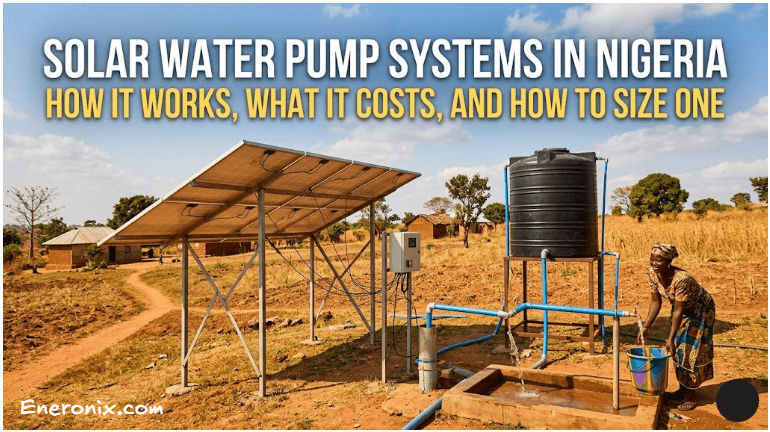

A solar water pump system uses solar panels to generate electricity that powers a pump, lifting water from a borehole or well into a storage tank. It replaces diesel or generator-powered pumps with a free, renewable energy source. The system works by day, fills a tank for 24-hour use, and requires no fuel or grid connection to operate.
What Is a Solar Water Pump System?

A solar water pump system is a complete setup that uses energy from sunlight to move water from one place to another. It typically pulls water from underground through a borehole, pushes it into an overhead or ground-level storage tank, and then distributes it by gravity to wherever it is needed.
The problem it solves in Nigeria is straightforward. Millions of Nigerian homes, farms, and businesses depend on boreholes for their water supply. Without a reliable power source to run the pump, most people end up running petrol or diesel generators for several hours every day just to fill their tanks. Fuel costs have gone up significantly, and generator maintenance adds even more to the bill.
A solar water pump system eliminates all of that. Here is how it works in simple terms:
- Solar panels absorb sunlight and convert it into direct current (DC) electricity.
- A pump controller receives that electricity and regulates it to match what the pump motor needs.
- The pump motor uses that electricity to spin impellers that push water up through the borehole pipe.
- Water flows into a storage tank where it is available day and night, even when the sun is not shining.
The beauty of this setup is that there are no moving parts in the panels, no fuel to buy, and very little maintenance required once it is properly installed. A well-sized solar water pump system in Nigeria can pump everything a household or farm needs within six to eight hours of sunlight, filling a tank large enough to last through the night and into the next morning.
The 3 Types of Solar Water Pump Systems
Not all solar pumping systems are the same. There are three main architectures, and choosing the wrong one is one of the most common and expensive mistakes in Nigerian solar installations.
1. Direct DC Pump System (No Battery)
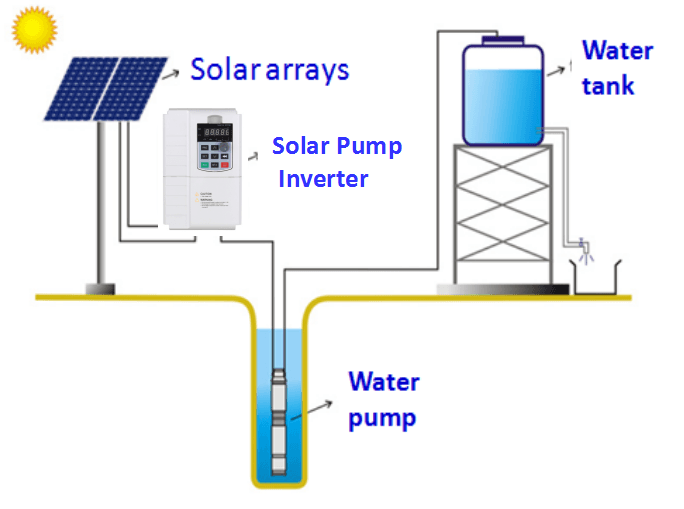
This is the simplest and most cost-effective setup. Solar panels connect directly to a pump controller, which connects to a DC submersible pump in the borehole. There is no battery, no inverter, and no generator backup.
The pump runs only when the sun is shining. During the day it fills a storage tank, and that tank supplies water at night. This setup works perfectly for most Nigerian households and farms where daytime pumping is enough.
Best for: Household boreholes, small-scale farming, and rural water supply where a storage tank is available.
2. AC Pump with Solar VFD or Inverter
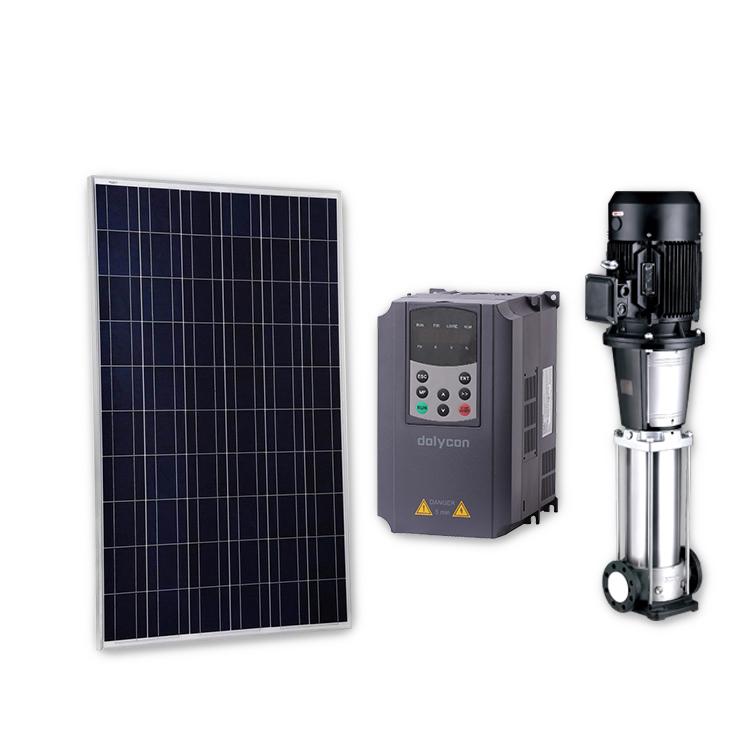
This system uses a Variable Frequency Drive (VFD), also called a solar pump inverter, to convert the DC electricity from the panels into variable AC power for a standard AC pump motor.
The VFD is the intelligent part of the system. It continuously monitors available solar power and adjusts the frequency and voltage it delivers to the pump motor. When there is less sun, it slows the motor down rather than letting it stall. This keeps the motor safe and maintains some flow even on partially cloudy days.
Why this matters in Nigeria:
Standard AC submersible pumps are widely available from Lagos to Kano. Spare parts are easy to find. DC pump spare parts are not. For most Nigerian commercial and agricultural installations, an AC pump with a VFD is the smarter long-term choice.
Best for: Medium to large boreholes, farms, schools, and commercial properties where an AC pump is already in place or locally available.
3. Battery-Backed Solar Pump System
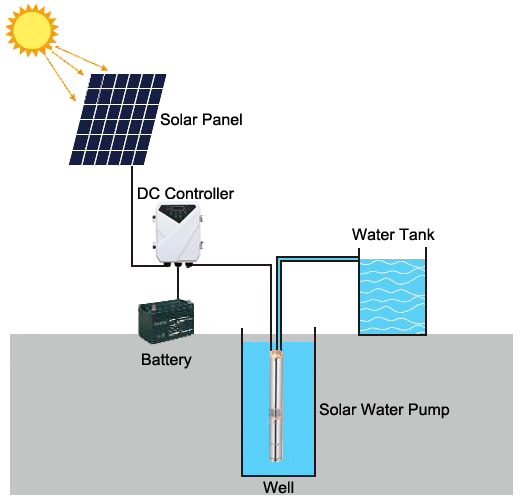
This system adds a battery bank between the panels and the pump. The batteries store energy during the day and release it at night or on cloudy days to keep the pump running.
It is the most expensive and complex option. Battery replacement alone every five to eight years can cost as much as the original system. Unless you have a specific need for nighttime pumping or live somewhere with very unreliable sun, this setup is usually unnecessary and financially wasteful.
Best for: Off-grid medical facilities, livestock watering systems that need 24-hour supply, or locations with fewer than four peak sun hours per day.
Comparison Table: The 3 Solar Pump System Types
| System Type | Approx. Cost (Installed) | Complexity | Battery Needed? | Best Use Case |
| Direct DC Pump | N350,000 – N550,000 | Low | No | Household borehole, rural water supply |
| AC Pump with VFD | N420,000 – N700,000 | Medium | No | Farms, commercial buildings, larger boreholes |
| Battery-Backed System | N800,000 – N1,500,000+ | High | Yes | Night pumping, medical facilities, livestock |
Key Components and What Each One Does
Understanding each part of a solar water pump system helps you ask better questions when buying and catch installation mistakes before they cost you money.
| Component | Function | What to Look for in Nigeria |
| Solar Panels | Convert sunlight into DC electricity to power the pump | Monocrystalline panels, 400W each. Buy from established dealers with genuine warranties |
| Pump Controller / VFD | Regulates power from panels to match pump motor requirements | Must match pump type (DC or AC). Ensure dry-run protection is built in. Brands: Grundfos CU, Lorentz MPPT2 |
| Submersible Pump | Pulls water from borehole and pushes it upward through the pipe | Brushless motor only. IP68 waterproof rating. HDPE body for acidic southern Nigerian water. Stainless steel impellers for sandy boreholes |
| Drop Pipe | Carries water from the pump up through the borehole casing to surface | HDPE pipe, correct diameter for flow rate. Size matters – small pipe increases friction losses |
| Drop Cable | Carries electricity from the surface controller down to the submerged pump | Copper cable, correctly sized (4mm2 minimum for depths up to 50m; 6mm2 for 50m to 80m). Under-sized cable causes voltage drop and overheating |
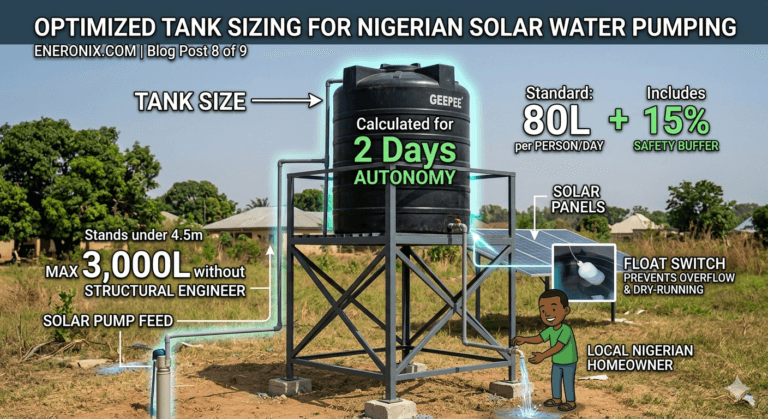
| Storage Tank | Stores pumped water for use at night and on low-sun days | Polyethylene tank. Size for 2 to 3 days of demand. Position at height for gravity flow to taps |
| Float Switch / Level Sensor | Stops the pump automatically when the tank is full | Non-negotiable. Without this, pump runs continuously, wasting energy and wearing out faster |
| Dry-Run Protection | Shuts down pump if borehole water level drops too low | Critical in Nigeria, especially in northern states during dry season. Electronic under-current detection or float sensor in borehole casing |
| Non-Return (Check) Valve | Prevents water from flowing back down into borehole when pump stops | Fit at the pump outlet and optionally at the surface. Prevents re-priming problems and reduces pump wear |
Note on the pump controller:
A solar pump controller is not the same as a standard MPPT solar charge controller. A battery MPPT controller tracks maximum power into a fixed-voltage battery. A pump MPPT controller has no fixed voltage load. Instead, it varies the motor frequency and voltage to keep the pump running on the correct torque curve even as solar power fluctuates. Without this regulation, a pump on a partially cloudy day will stall, draw a very high stall current, and burn out the motor. Always confirm your controller is designed specifically for pumps. For deeper reading on how MPPT works in general, see this guide on how to select an MPPT charge controller.
Solar Pump vs Diesel Pump in Nigeria: Real Cost Comparison (2026)
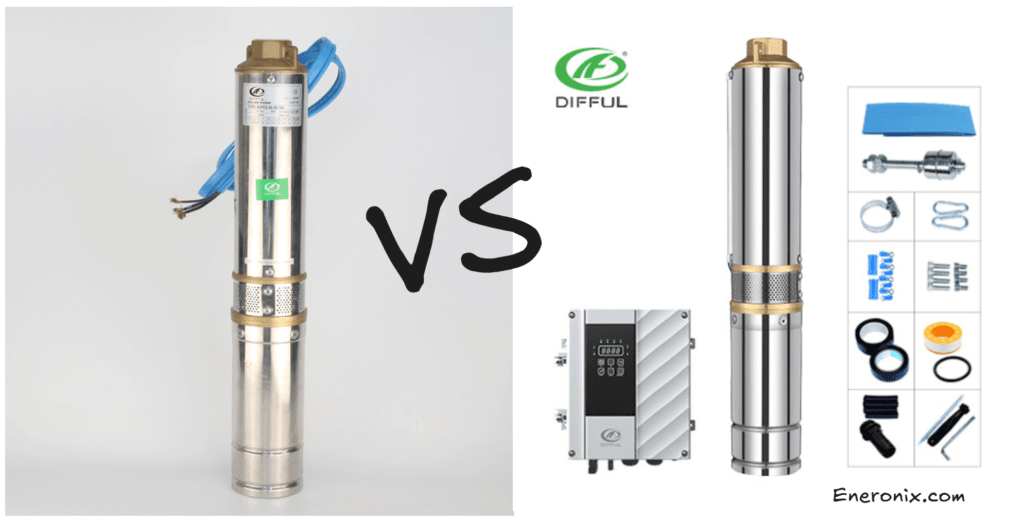
This is the section that changes minds. When you put real Naira figures side by side, the case for a solar water pump system in Nigeria becomes impossible to argue with.
Diesel pump running costs (1.5HP pump, 6 hours per day, 2026 fuel prices):
- PMS consumption: 1.5 litres per hour
- Fuel price: N1,000 per litre
- Daily fuel cost: 1.5 x 6 x N1,000 = N9,000
- Monthly fuel cost: N9,000 x 30 = N270,000
- Annual fuel cost: N270,000 x 12 = N3,240,000
- This does not include engine oil, spark plugs, carburettor repairs, or replacement pumps
| Cost Item | Diesel Pump | Solar Pump System |
| System purchase and installation | N80,000 – N150,000 (pump + gen set) | N350,000 – N600,000 (all-in) |
| Fuel cost per month | N270,000 | N0 |
| Maintenance per year | N30,000 – N80,000 | N5,000 – N15,000 (cleaning, checks) |
| Total Year 1 cost | N3,400,000+ | N365,000 – N615,000 |
| Total Year 2 cost | N3,300,000 | N5,000 – N15,000 |
| Payback period | Not applicable | 2 to 3 months of diesel savings |
| 5-Year Total Cost of Ownership | N16,000,000+ | N430,000 – N700,000 |
The numbers above assume diesel at N1,000 per litre and six pumping hours per day. Even if your usage is lower, the solar pump system recovers its cost within a few months. By the end of Year 2, you are essentially pumping water for free.
For a more detailed analysis of how solar compares to generator power across different use cases, read our post on off-grid solar vs generator cost comparison in Nigeria.
How to Size a Solar Pump System for a Nigerian Borehole
Sizing is where most installations go wrong. People buy a pump that is too small, or panels that cannot handle the load, or they forget to account for harmattan. This section walks you through the correct calculation step by step.
Step 1: Calculate Your Total Dynamic Head (TDH)

Total Dynamic Head is the total resistance your pump must overcome to push water from the bottom of the borehole to the top of your storage tank. It is measured in metres and is the single most important number in pump sizing.
TDH Formula:
TDH = Pump Setting Depth + Vertical Lift to Tank + Friction Losses in Pipe
Worked Example: Abuja Borehole (North-Central Nigeria)
- Static water level in borehole: 50 metres below surface
- Pump set depth (50m + 15m safety margin): 65 metres
- Overhead tank height above ground level: 4 metres
- Friction losses in 80m of 1.25-inch HDPE pipe: approximately 4 metres
- TDH = 65 + 4 + 4 = 73 metres
This means you need a pump rated for at least 73 metres of head. Buy a pump with a head rating above this figure, not exactly at it. Always leave a margin of 10 to 15 per cent.
Friction losses increase with longer pipe runs and smaller pipe diameters. For a full guide on calculating pipe and cable losses, refer to this post on DC cable sizing for off-grid solar systems which covers the same voltage and resistance principles that apply to pump drop cables.
Step 2: Calculate Your Required Flow Rate
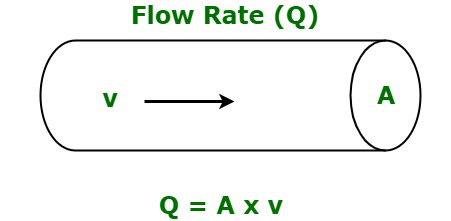
Flow rate is how many litres of water the pump needs to deliver per hour to meet your daily demand within the available sunlight window.
Baseline figure (per WHO and UNICEF rural water demand guidelines): 50 litres per person per day for basic household use. Allow 80 to 100 litres per person if you have a large garden or livestock.
Example: Family of 8 in Abuja
- Daily demand: 8 x 50 = 400 litres
- Available peak sun hours in Abuja: 5.5 to 6 hours per day (annual average)
- Minimum flow rate needed: 400 litres divided by 6 hours = 67 litres per hour
- Select a pump rated for at least 80 litres per hour at your TDH to give a comfortable margin
This same calculation logic is used in a full off-grid system load audit. Understanding your demand first is always the right starting point before buying any component.
Step 3: Select the Right Pump
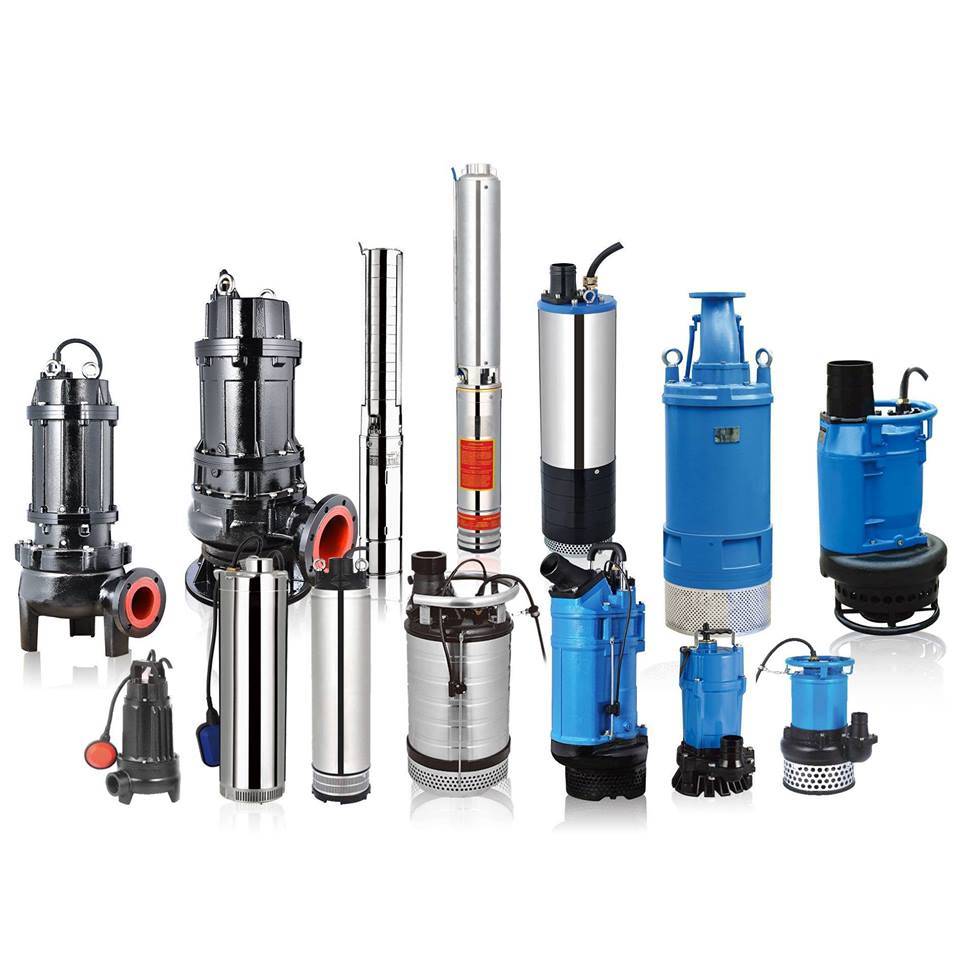
Every pump has a performance curve that shows how flow rate changes as head increases. At low head (shallow water), flow is high. As head increases, flow drops. You need a pump whose curve puts your required flow rate at your calculated TDH.
Think of it this way: a pump rated at 200 litres per hour might only deliver 80 litres per hour at 70m of head. If you only looked at the maximum flow rating on the label, you would massively undersize the system.
Performance curve data is published by reputable manufacturers. Grundfos publishes detailed pump selection data on their website. Always cross-reference the pump curve at your specific TDH before buying. See the Grundfos product documentation for the SQFlex and SP series curves commonly used in Nigerian solar pump installations.
For submersible pump selection in Nigeria, follow these rules:
- Choose brushless DC motors or AC induction motors only. Avoid brushed DC motors. Brush wear from sandy groundwater is a leading cause of early failure in Nigerian boreholes.
- Minimum IP68 waterproof rating for any submersible pump.
- HDPE or stainless steel body for corrosion resistance. Acidic groundwater in southern Nigeria will corrode cheaper materials within two to three years.
- Stainless steel impellers if your borehole is sandy. Plastic impellers fail quickly in abrasive water.
Step 4: Size the Solar Array
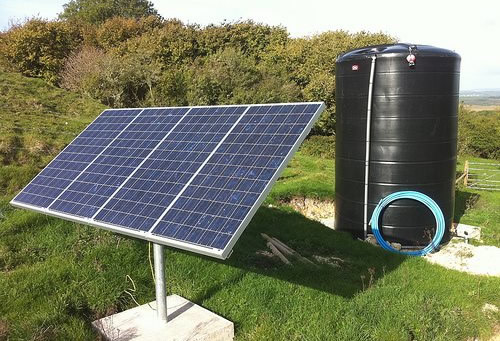
Once you know the pump motor size, sizing the solar array is straightforward. There are two rules to follow.
Rule 1: Size the array at 1.5 times the motor's rated wattage.
Pumps have a high starting current, called the Locked Rotor Current (LRC), which is significantly higher than the running current. If the array is barely large enough for running power, the pump will fail to start on mornings with low sun.
Rule 2: Add a 25 to 30 per cent harmattan allowance.
Harmattan dust between December and February can reduce panel output by 25 to 40 per cent. If you only size for clean-panel performance, your pump will underperform for three months of the year. Oversizing the array upfront is far cheaper than adding panels later.
Worked Example: 1HP (750W) AC pump via VFD
- Motor rated power: 750W
- Minimum array before harmattan adjustment: 750W x 1.5 = 1,125W
- With 30% harmattan buffer: 1,125W x 1.30 = 1,462W
- Practical choice: 4 x 400W panels = 1,600W array. This is the recommended configuration.
For a detailed guide on how to size any solar array correctly, including tilt angle optimisation for different Nigerian states, refer to this guide on how to size your solar array for Nigerian conditions. The same principles that apply to off-grid battery systems apply here, with the additional pump-specific factors above.
Note on panel string configuration: how you wire your panels in series or parallel affects the voltage and current that reaches your controller. Read the full explanation in our post on series vs parallel solar array wiring before connecting your array.
Borehole Depth in Nigeria by Region and What It Means for Your System
Where you are in Nigeria directly determines how deep your borehole is, what your TDH will be, and how large a solar array you need. This table is based on field data from hydrogeological surveys across Nigerian geopolitical zones.
| Region / Zone | States | Typical Static Water Level | Typical Pump Setting Depth | Minimum Array Needed |
| South-South | Rivers, Delta, Bayelsa, Cross River, Akwa Ibom, Edo | 5 to 20m | 20 to 40m | 800W to 1,200W |
| South-West | Lagos, Ogun, Oyo, Osun, Ekiti, Ondo | 15 to 40m | 35 to 60m | 1,200W to 1,600W |
| South-East | Anambra, Enugu, Imo, Abia, Ebonyi | 20 to 45m | 40 to 65m | 1,200W to 1,600W |
| North-Central | Abuja, Kogi, Benue, Niger, Kwara, Plateau, Nassarawa | 30 to 60m | 50 to 80m | 1,600W to 2,000W |
| North-West | Kano, Sokoto, Kaduna, Kebbi, Zamfara, Katsina, Jigawa | 40 to 90m | 70 to 110m | 2,000W to 2,800W |
| North-East | Borno, Adamawa, Bauchi, Gombe, Taraba, Yobe | 50 to 120m | 80 to 130m | 2,400W to 3,200W |
A Lagos borehole at 40m TDH needs roughly half the panel wattage of a Kano borehole at 90m TDH. This is why national pricing guides are almost useless. The cost of your system must be calculated for your specific location and borehole depth.
For Nigerian-specific solar resource data by state, including peak sun hours used in sizing calculations, refer to the NASENI and REA Nigeria solar resource map.
Advantages and Limitations of Solar Water Pumps
Being honest about both sides of this technology will help you make a better decision and avoid disappointment after installation.
Advantages:
- Zero fuel cost after installation. The sun is free.
- Very low maintenance. No engine oil, no spark plugs, no carburettor cleaning.
- Long operational life. Quality submersible pumps last 8 to 15 years. Solar panels last 25 years or more.
- Runs silently. No generator noise, no fumes.
- Scales easily. Add more panels to increase output as demand grows.
- Works anywhere with sunlight. No grid connection needed, making it ideal for rural farms and off-grid settlements.
- Dramatically reduces carbon emissions compared to diesel pumping.
Limitations:
- Upfront cost is higher than a diesel pump. The payback comes from fuel savings over time.
- Output is lower on cloudy and harmattan days. Proper oversizing reduces but does not eliminate this.
- No pumping at night unless batteries are added, which significantly increases cost.
- Requires a storage tank to provide round-the-clock water supply. This is an additional cost and space requirement.
- Panel performance degrades slightly each year, typically 0.5 per cent annually.
- Dry season water table drops in northern Nigeria can cause pump damage if dry-run protection is not installed.
What Most Installers Will Not Tell You
These are the four things that are rarely explained upfront but which make the difference between a system that runs well for ten years and one that fails within eighteen months.
1. You do not need batteries for most Nigerian borehole applications.
The battery misconception is the most expensive mistake in Nigerian solar pump installations. Adding batteries doubles or triples the system cost, adds complexity, and introduces a component that will need replacing in five to eight years. For any application where you pump during the day into a storage tank, batteries are completely unnecessary. Store water, not electricity.
2. Harmattan will cut your pump output by 25 to 40 per cent.
From December through February, dust from the Sahara coats everything in northern and central Nigeria, including your solar panels. A 400W panel may only produce 250W during heavy harmattan. If you sized your system exactly to your demand under clean conditions, you will be short of water for three months every year. Size your array with a 25 to 30 per cent buffer from the start, and clean your panels at least once a week during harmattan season.
3. Dry-run protection is not optional. It is the difference between a pump that lasts ten years and one that burns out in two.
Between January and April, static water levels in Nigerian boreholes, particularly in the North-Central and North-West zones, can drop by 5 to 15 metres. If your pump is set near the current water level and the water drops below it, the pump starts running dry. A dry-running submersible pump has no water flowing past it to cool the motor. It overheats and burns out within minutes.
The solution is a water level sensor (float switch) placed in the borehole casing above the pump intake, or a controller with electronic under-current protection that detects the drop in motor load when no water is present and shuts the system down automatically. Buy a controller with this feature built in. Do not skip it.
4. An AC pump with a VFD is usually the smarter choice for Nigeria.
DC solar pumps are technically elegant but they create a support problem. If the DC motor fails two years after installation, you may struggle to find a matching replacement motor in Lagos, let alone Gusau or Maiduguri. AC pump motors and mechanical components are standard items available in every plumbing and electrical market in Nigeria. When an AC pump fails, a local technician can fix it the same day. A VFD is the only extra component, and quality VFDs from Grundfos and Lorentz are widely stocked by solar dealers in major cities.
For a related explanation of how peak and starting loads affect controller and inverter sizing, see our post on peak load vs average load in off-grid design.
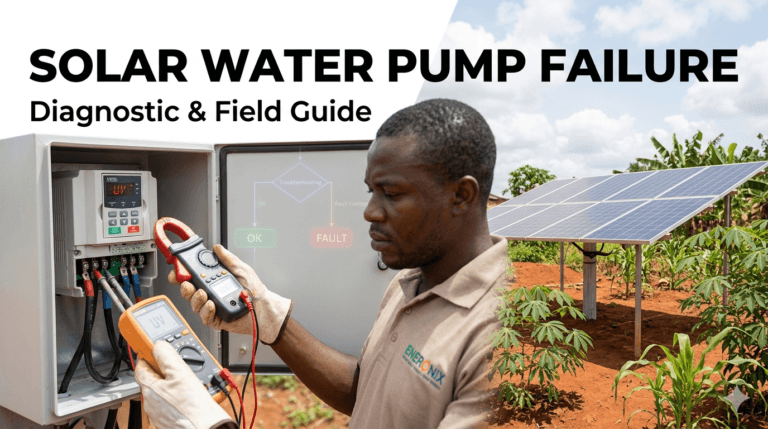
Common Solar Water Pump Problems and How to Prevent Them
These are the five most frequent failure scenarios in Nigerian solar pump installations, along with practical solutions for each one.
Problem 1: Pump does not start on a cloudy or cold morning
Cause:
Panel voltage is below the pump controller’s minimum startup threshold. This happens when the array is undersized or when the morning is unusually cold and panels have not yet warmed up to operating temperature.
Solution:
Add more panels in series to raise the open-circuit voltage of the array. Also check that the controller’s maximum input voltage rating is not exceeded at the lowest expected temperature. Nigerian harmattan mornings can drop to 18 degrees Celsius, and panels produce their highest voltage at cold temperatures.
Problem 2: Pump runs but flow rate is low
Cause:
Either the TDH was underestimated during sizing, or the drop pipe diameter is too small, creating friction losses that were not accounted for. Also check that the pump is not air-locking, which can happen if the non-return valve is not installed.
Solution:
Measure flow at the pump outlet using a bucket and stopwatch. Compare to the pump’s rated flow at your TDH from the manufacturer’s performance curve. If measured flow is significantly lower, the problem is likely friction in the pipe. Increase pipe diameter or reduce pipe length with a more direct routing.
Problem 3: Pump burns out within 3 to 12 months
Cause:
This is almost always dry-run damage from borehole water level drop during dry season, combined with no dry-run protection. It is the number one cause of early pump failure in Nigeria and it is entirely preventable.
Solution:
Install a water level sensor in the borehole casing or buy a controller with electronic under-current dry-run detection. This is not an optional upgrade. If your installer did not include it, push back before accepting the installation.
Problem 4: Pump runs continuously but tank never fills
Cause:
The supply pipe from the pump to the tank is too small in diameter, restricting flow. Alternatively, the float valve at the tank outlet may be stuck partially open, allowing water to drain out as fast as it enters.
Solution:
Check the float valve first. If it is functioning correctly, measure the pipe diameter and compare to the flow rate requirements. For most residential installations pumping 80 to 150 litres per hour, a 25mm (1-inch) HDPE pipe is the minimum from pump to tank.
Problem 5: Controller showing error codes on cold mornings
Cause:
The open-circuit voltage (Voc) of the cold panel array is exceeding the controller’s maximum input voltage rating. Solar panels produce their highest voltage at low temperatures. This is a wiring and sizing issue, not a controller fault.
Solution:
Recalculate the array Voc at the expected minimum morning temperature using the panel’s temperature coefficient (found on the panel datasheet). If the result exceeds the controller’s max Voc, rewire panels to reduce the series string length or choose a controller with a higher input voltage rating.
For a structured approach to battery system maintenance that applies the same diagnostic logic, see this guide on how to increase lithium battery lifespan. Many of the root causes of premature failure are identical across solar system components.
Solar Pump Brands Available in Nigeria (2026)
Choosing the right brand matters because it determines whether you can get spare parts and service support in Nigeria three years after installation.
Pump Brands:
- Grundfos (SP and SQFlex series): The most trusted brand for deep borehole submersibles. Dealer presence in Lagos (Victoria Island and Ikeja), Abuja, and Port Harcourt. Full warranty and spare parts support. Higher upfront cost but lowest total lifetime cost.
- Lorentz (PS2 and PS+ series): Designed specifically for solar pumping. The Lorentz MPPT2 controller is one of the best available for solar-direct DC pump applications. Available through authorised dealers in Lagos and Abuja. Excellent technical documentation online.
- DAB and Pedrollo: Italian brands with good quality AC submersibles and surface pumps. Available through plumbing and pump suppliers in Alaba International Market, Lagos and major cities. Suitable for VFD-driven AC configurations.
- Leo Pumps: More affordable than Grundfos and DAB. Quality has improved in recent years. Available widely. Suitable for households on a tighter budget where the borehole conditions are not extreme.
- Generic Chinese OEM brands (CN Solar, Hanyu, etc.): Available from Alaba Market and Chinese trading stores in most state capitals. Lower purchase cost but very limited warranty support and difficult spare parts. Acceptable as a short-term solution if budget is severely constrained, but plan for replacement sooner.
Controller and VFD Brands:
- Grundfos CU200 and CU301: Designed specifically for Grundfos submersible pumps. Includes dry-run protection, frost protection, and multi-pump management. Best-in-class reliability.
- Lorentz MPPT2: Compatible with Lorentz PS2 pump series. Excellent for direct solar-DC applications. Cloud monitoring available.
- Generic Chinese VFD units from Alaba Market and Computer Village: Very low cost. Suitable for basic AC pump control but verify that dry-run protection is included. Many cheap units have no protection features at all, which makes them a liability in Nigerian dry season conditions.
What to avoid:
- Any submersible pump with a brushed DC motor. Brush wear in sandy Nigerian groundwater is a documented failure mode.
- Pump controllers priced below N15,000 to N20,000 that have no dry-run protection feature. The saving on the controller will cost you a pump within eighteen months.
- Used or refurbished submersible pumps. You have no way of knowing the actual hours of operation or what conditions the pump ran in.
For sizing guidance on how to correctly match controllers to your panel array using the IEC 62253 standard for PV pumping systems, see the Lorentz PS2 Technical Manual, which provides detailed minimum irradiance and startup voltage specifications for their pump range.
Frequently Asked Questions
Q1: Can a solar water pump work without batteries in Nigeria?
Yes, and for most Nigerian applications it should. Batteries are unnecessary when you pump during the day into a storage tank. The tank is your buffer, supplying water at night and through low-sun periods. Adding batteries to a basic borehole pump system roughly doubles the cost and introduces components that need replacing every five to eight years. Only consider batteries if you have a genuine need for nighttime pumping or if your location receives fewer than four peak sun hours per day.
Q2: How deep can a solar pump lift water in Nigeria?
Most quality solar submersible pumps available in Nigeria handle total dynamic head (TDH) values of 30 to 120 metres. For boreholes in Kano, Sokoto, or Borno where depths commonly exceed 80 metres, you need a high-head pump and a solar array of at least 2,000W. Always calculate TDH for your specific borehole, which includes static water level, pump setting depth, vertical lift to tank, and pipe friction losses.
Q3: What happens to a solar pump during harmattan season?
Harmattan dust accumulating on panels can reduce their output by 25 to 40 per cent. Your pump will continue running but at a lower speed and lower flow rate. To manage this, oversize your solar array by 25 to 30 per cent when designing the system. During harmattan season between December and February, clean your panels at minimum once a week using water and a soft cloth. Never use harsh chemicals or abrasive materials on panel surfaces.
Q4: How much does a solar borehole pump system cost in Nigeria in 2026?
A complete 1HP solar borehole pump system including panels, controller, submersible pump, drop pipe and cable, and installation costs between N350,000 and N600,000 depending on borehole depth and location. Systems for deeper boreholes in northern states cost more. Against a diesel pumping cost of N270,000 per month, this investment pays for itself within two to three months. Over five years, the solar pump system costs roughly 95 per cent less than a diesel equivalent.
Q5: Do I need a VFD for my solar pump in Nigeria?
Only if you are using a standard AC pump motor, which is the recommended choice for most Nigerian installations because of local spare parts availability. The VFD regulates the frequency and voltage delivered to the AC motor as solar power varies through the day, preventing motor stall on low-sun mornings and protecting the motor from voltage spikes. If you are using a brushless DC pump, you need a DC solar pump MPPT controller instead of a VFD. The two are not interchangeable.
Q6: What is the most common cause of solar pump failure in Nigeria?
Dry-run damage. When the borehole water level drops during dry season, the pump continues running without water to cool and lubricate the motor. The motor overheats and burns out within minutes. This single failure mode accounts for the majority of premature pump replacements in Nigerian installations. Install a borehole water level sensor or buy a controller with electronic under-current dry-run detection. This single feature can double the working life of your pump.
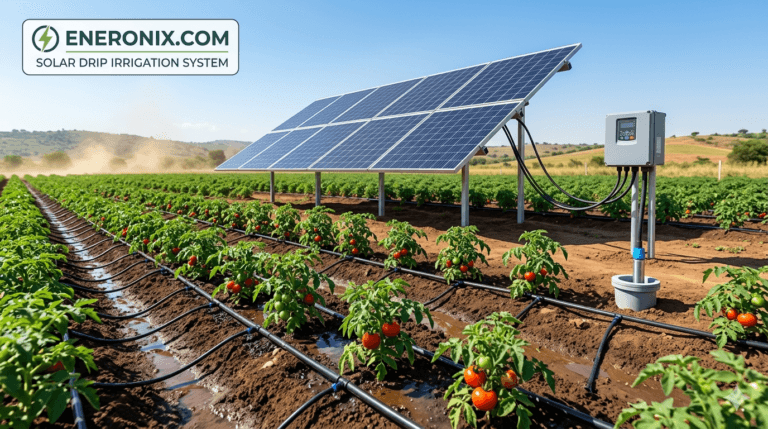
Q7: Can I use a solar pump for irrigation on my farm?
Yes. Solar pumping systems are increasingly popular for Nigerian farm irrigation, particularly for drip irrigation and overhead sprinkler systems. For drip irrigation, match the pump flow rate to the total emitter output of your drip lines at operating pressure. Size the storage tank for at least one full irrigation cycle so you can irrigate in the early morning or evening using water pumped and stored during the day. This avoids leaf scorch and maximises water use efficiency.
Q8: Which solar pump brands are actually available in Nigeria?
Grundfos (SP and SQFlex series), DAB, Pedrollo, Leo, and Lorentz are the most accessible brands with dealer support in Lagos, Abuja, and Port Harcourt. Grundfos and Lorentz offer the best after-sales support and have published technical documentation available online for self-verification of specifications. Generic Chinese-branded pumps are available from Alaba Market at lower prices but typically carry limited warranty support and difficult-to-source spares. For critical infrastructure such as community water supply or hospital boreholes, invest in a named brand with genuine Nigerian dealer support.

I am Engr. Ubokobong Ekpenyong, a solar specialist and lithium battery systems engineer with over five years of hands-on experience designing, assembling, and commissioning off-grid solar and energy storage systems. My work focuses on lithium battery pack architecture, BMS configuration, and system reliability in off-grid and high-demand environments.