Pylontech US2000C vs US3000C: Which One Is Right for Your System?
Pylontech US2000C vs US3000C explained for Nigerian solar systems. Compare capacity, current, cost per kWh, and choose the right battery for your inverter.
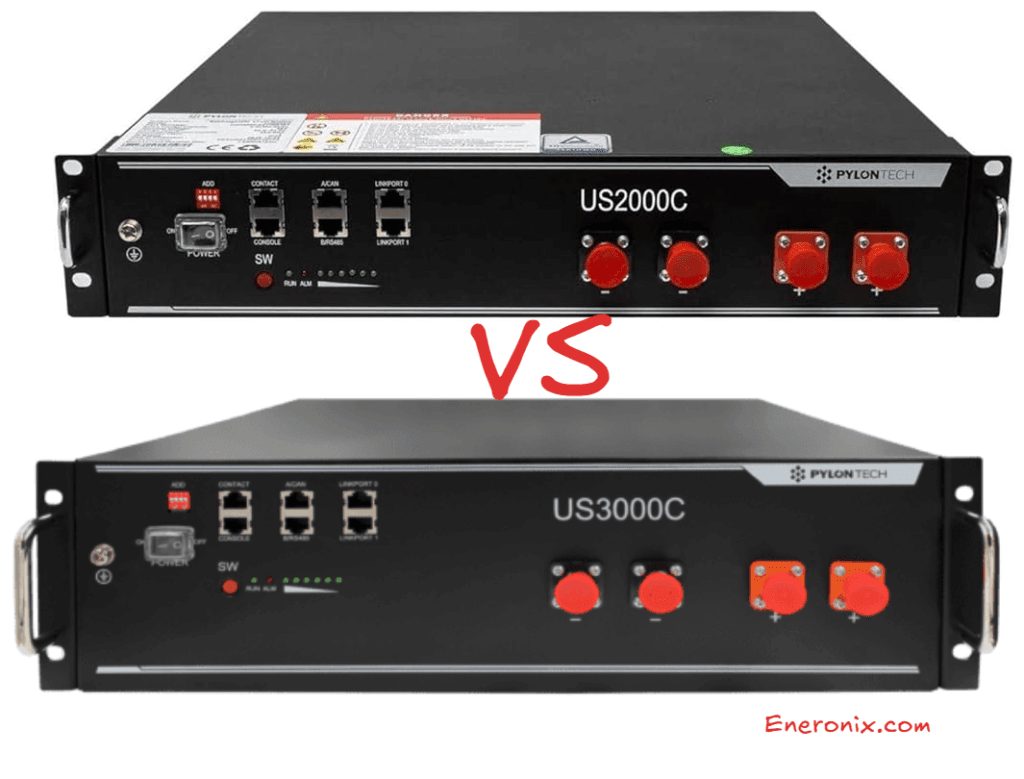
Both batteries carry the Pylontech name. Both use LiFePO4 chemistry. Both fit the same 48V inverter setup. The US3000C costs more but not always by much and most product pages stop at listing the capacity difference without explaining what that actually means for your system.
This guide goes further. It compares every spec that matters, explains the one technical difference most buyers overlook (and that causes problems after installation), maps both models to real Nigerian load scenarios, and gives you a clear decision framework before you spend a single naira.
Quick Answer: If you are running a 5kVA inverter or plan to install three or more battery modules, the US3000C is the better choice for most Nigerian systems. If you only need one or two modules for light loads, the US2000C is more cost-effective. Read on for the full technical breakdown.
What Both Batteries Share
Before the differences, understand what makes these two models essentially the same battery at a fundamental level.
Both the US2000C and US3000C use lithium iron phosphate (LiFePO4) cells developed internally by Pylontech. LiFePO4 is the chemistry chosen for home and commercial energy storage because of its thermal stability, long cycle life, and safety profile. Unlike NMC or NCA lithium chemistries, LiFePO4 does not undergo thermal runaway under normal operating conditions. That matters in Nigerian heat.
Both models share the same core architecture:
48V nominal voltage (15 cells in series, each 3.2V nominal)
6,000 cycle rating at 95% depth of discharge
15-year design life at 25 degrees Celsius
Integrated BMS with cell-level voltage and temperature monitoring
CAN bus and RS485 communication ports
Maximum charge voltage: 53.5V | Recommended: 52.5V
Operating temperature: 0 to 50 degrees Celsius
Maximum 16 units in parallel without requiring an LV-Hub
Both communicate using the same Pylontech protocol and are compatible with Victron, Growatt, Deye, Solis, Sofar, Goodwe, and most other hybrid inverters sold in Nigeria. The BMS sends CVL, CCL, and DCL signals to the inverter in real time. For a full explanation of these dynamic limits, read the Eneronix guide on CVL, CCL, and DCL: Understanding Dynamic Battery Limits in Real Time.
The practical implication: the decision between US2000C and US3000C is not a quality decision or a reliability decision. It is purely a sizing decision.
Full Specification Comparison
Specification
US2000C
US3000C
Nominal capacity
2,400 Wh (2.4 kWh)
3,552 Wh (3.55 kWh)
Usable capacity at 95% DoD
2,280 Wh (2.28 kWh)
3,374 Wh (3.37 kWh)
Nominal voltage
48V
48V
Amp-hour rating
50 Ah
74 Ah
Recommended charge/discharge current
25A
37A
Maximum continuous discharge current
50A
74A
Peak current (15 seconds)
90A
90A
Max units in parallel (no LV-Hub)
16
16
Max bank capacity at 16 units
38.4 kWh
56.8 kWh
Weight
24 kg
~30 kg
Height
89 mm (2U)
132 mm (3U)
Width
440 mm
440 mm
Depth
410 mm
410 mm
Cycle life
6,000 at 95% DoD
6,000 at 95% DoD
Design life
15 years at 25°C
15 years at 25°C
Communication protocols
CAN, RS485, RS232
CAN, RS485, RS232
Charge voltage (recommended)
52.5V
52.5V
Charge voltage (maximum)
53.5V
53.5V
What the numbers mean in practice: the 50 Ah vs 74 Ah difference is not just a capacity gap. It is also a current gap. The US3000C can push or accept 74A continuously per module. The US2000C caps at 50A. At a 48V system bus, every kilowatt of load draws approximately 20.8A. A 2 kW load draws about 42A. A 3.5 kW load draws about 73A. This means a single US2000C module is already stressed at a 2.4 kW load, while a single US3000C handles that same load with current headroom to spare.
The Current Rating Difference
This section is what separates a correctly sized system from one that trips the BMS at startup when the air conditioner kicks in on a Monday morning.
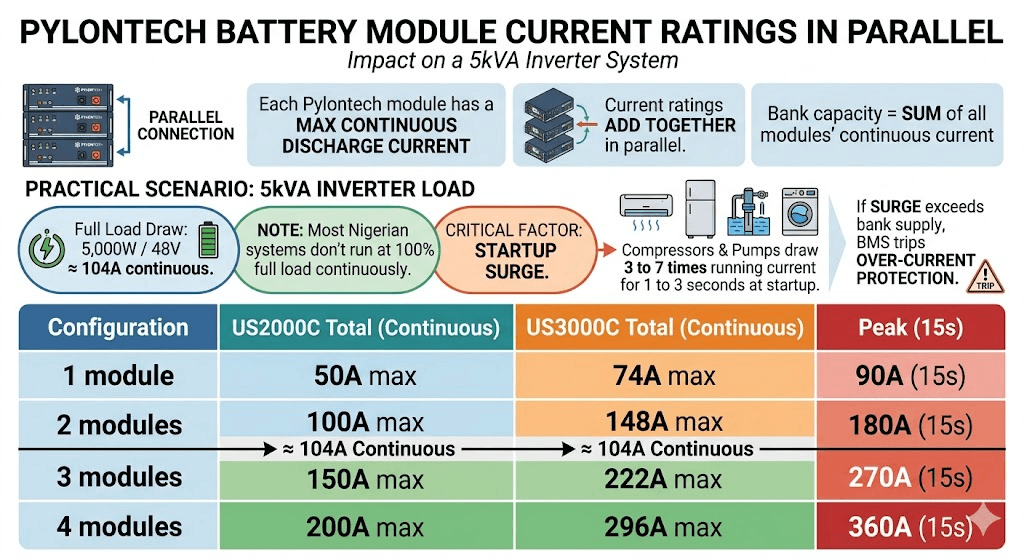
Every Pylontech module has a maximum continuous discharge current. When you connect multiple modules in parallel, their current ratings add together. The bank can supply as much continuous current as the sum of all modules connected.
A 5kVA inverter at full load draws approximately 104A from a 48V battery bank: 5,000W divided by 48V = 104.2A. Most Nigerian systems do not run at 100% load continuously, but they do hit high currents during startup events. Air conditioner compressors, refrigerator compressors, borehole pumps, and washing machines all draw 3 to 7 times their running current for the first 1 to 3 seconds at startup. If the surge exceeds what the battery bank can supply, the BMS trips over-current protection.
Configuration
US2000C Total
US3000C Total
Peak (15s)
1 module
50A max
74A max
90A (15s)
2 modules
100A max
148A max
180A (15s)
3 modules
150A max
222A max
270A (15s)
4 modules
200A max
296A max
360A (15s)
For a 5kVA system running air conditioning or any motor load, two US3000C modules provide adequate current headroom where three US2000C modules are needed to reach the same safety margin. This directly affects how many modules you buy and what you spend.
Loads: 4 LED bulbs (40W), 2 ceiling fans (130W), 1 fridge (150W), 1 TV and decoder (120W). Average running load: approximately 440W. 48V draw: 9.2A continuous.
Verdict: Either model handles this easily. A single US2000C gives approximately 5.2 hours of runtime. A single US3000C gives approximately 7.7 hours. If you need 8 hours of backup overnight, one US3000C is cleaner than two US2000C modules.
Scenario 2: Medium Home With 1.5HP Air Conditioner
Loads: 1.5HP inverter AC (1,100W running, 2,500W startup surge), fridge (150W), lighting (80W), TV and decoder (120W), 2 fans (130W). Average running load: approximately 1,580W. 48V draw: approximately 33A continuous.
Verdict: A single US2000C at 50A max handles this but leaves no margin for simultaneous startup events. A single US3000C at 74A handles this comfortably. For 8 hours of backup, 4 US3000C modules or 5 US2000C modules are needed. The US3000C bank handles AC startup surge more confidently.
Scenario 3: Office or Small Business
Loads: 4 computers (400W), 1.5HP AC (1,100W), lighting (100W), router and modem (30W), printer (150W peaks). Average running load: approximately 1,780W.
Verdict: For a 12-hour backup target, this system needs approximately 30 kWh installed capacity. That is 7 US2000C modules or 5 US3000C modules. The US3000C reaches the target with fewer modules, fewer cables, and simpler commissioning.
Scenario 4: Inverter Kettle or Microwave
A 2,000W inverter kettle draws approximately 41.7A from a 48V bank. A 1,500W microwave draws approximately 31.3A. These are short bursts of 3 to 8 minutes.
Verdict: A single US2000C at 50A max handles a kettle with minimal headroom. A single US3000C at 74A handles the same load with proper margin. For systems where a microwave and kettle may run simultaneously, the US3000C is the safer specification.
Capacity Per Rack Unit
Both modules mount in a standard 19-inch rack or on Pylontech wall brackets but occupy different heights. The US2000C is 89mm tall (approximately 2U). The US3000C is 132mm tall (approximately 3U).
For an equivalent total capacity of 14.4 kWh installed:
Model
Modules
Total Height
Power Terminals
Link Cables
US2000C
6 units
534 mm
12 terminals
5 cables
US3000C
4 units
528 mm
8 terminals
3 cables
Fewer modules means fewer potential failure points at cable terminations, fewer BMS communication links in the daisy chain, and faster commissioning. In a Nigerian installation where the equipment room is small and ventilation is limited, four compact US3000C units often fit more practically than six US2000C units stacked in a column.
Cost Per Usable kWh
Looking at the sticker price of a single module is the wrong comparison. The US2000C and US3000C are different sizes. The correct comparison is cost per usable kilowatt-hour, which accounts for the capacity difference.
Factor
US2000C
US3000C
Price per module (NGN)
N350,000 to N450,000
N500,000 to N650,000
Usable capacity per module
2.28 kWh
3.37 kWh
Cost per usable kWh
N153,000 to N197,000
N148,000 to N193,000
The US3000C delivers slightly better cost per usable kWh at current Nigerian market prices. The advantage is not dramatic, but it means the higher sticker price is not actually a premium. You are paying for more capacity, and the gap per kWh is comparable.
Concrete Scenario: Building a 14.4 kWh System
A medium Nigerian home needing 14.4 kWh of installed LiFePO4 capacity:
US2000C (6 modules at N400,000 midpoint): N2,400,000 total. Usable: 13.68 kWh. Combined current: 300A. 12 power cable terminations. 5 RJ45 link cables.
US3000C (4 modules at N575,000 midpoint): N2,300,000 total. Usable: 13.48 kWh. Combined current: 296A. 8 power cable terminations. 3 RJ45 link cables.
For equivalent usable capacity, the US3000C bank costs less, requires fewer modules, delivers essentially the same current capacity, and installs faster. The US2000C’s only remaining advantage is a lower per-module entry cost when the total bank is small.
When the US2000C is the smarter buy: If your system requires only one or two modules for a small home with basic loads needing 3 to 5 kWh of storage, the US2000C keeps the entry cost lower without sacrificing performance.
Mixing US2000C and US3000C: What You Need to Know
Pylontech permits mixing C-series models in the same bank, but with conditions most installers do not explain at the time of sale.
The newest and highest-capacity module must be designated as the master. The master battery is the module with its Link 0 port left free (unconnected to other batteries). For a mixed bank containing both US2000C and US3000C, the US3000C must be the master.
The master battery’s BMS is the one that communicates with the inverter. It sends the CVL, CCL, and DCL signals that govern how the entire bank charges and discharges. When the bank contains different-sized modules, the master BMS manages the bank as a whole but does not have individual visibility into the exact state of each slave module beyond the inter-battery link protocol.
Practical recommendation: Mixing is technically supported, but in practice it reduces performance and complicates troubleshooting. The bank performs to the lowest common denominator across module types. Avoid mixing unless expanding an existing installation where full replacement is not yet possible. For new systems, build with a single model.
Most professional solar installers in Nigeria who have moved through multiple installation cycles now default to the US3000C for new systems above 5 kWh. The reasons are practical: fewer modules to commission, fewer cable connections to torque correctly, fewer BMS links to test, and fewer points of potential failure at the power terminals. On a residential installation, the difference in commissioning time between four US3000C modules and six US2000C modules is 20 to 40 minutes. On a commercial installation where the installer is paid per day, that difference is significant.
There is also a fault isolation argument. If one module fails in a four-module US3000C bank, you replace one module. If one module fails in a six-module US2000C bank, you face more complexity when the failed module’s Ah rating has degraded relative to the remaining five.
What to Verify Before Buying in Nigeria
Both models are subject to counterfeiting and grey-market supply in Nigeria. A fake Pylontech module will have the correct label and often the correct weight, but the BMS will be non-functional or use substandard electronics that fail to protect cells under sustained load.
Register the serial number at pylontech.com.cn/service/support before the installer leaves. A genuine module registers without issue. A counterfeit or grey-market module often fails to register or has a serial number already tied to a different location.
Request a BMS communication test before payment is complete. With the battery connected to your inverter and the correct communication cable installed, the inverter display should show cell-level data: individual cell voltages, BMS-reported temperature, and a state-of-charge reading that updates in real time under load changes. If the inverter shows only terminal voltage and a smooth incrementing percentage, BMS communication is not active.
Buy from suppliers who can produce Pylontech distributor authorisation documentation. An unauthorised supplier cannot produce this document, and that alone removes a significant category of counterfeit risk.
For a deeper explanation of how to verify BMS communication is active versus estimated, and what the difference means for battery lifespan, read the Eneronix guide on Hybrid Inverter Battery Compatibility.
Decision Framework: Which Model Is Right for Your System
What is the difference between the Pylontech US2000C and US3000C?
The US3000C has 48% more capacity per module (3.55 kWh vs 2.4 kWh), a higher continuous discharge current per module (74A vs 50A), and a taller physical profile (132mm vs 89mm). Both share the same chemistry, cycle life, communication protocols, voltage specifications, and 16-unit maximum parallel configuration. The decision between them is a sizing decision, not a quality or reliability decision.
Can I mix Pylontech US2000C and US3000C in the same system?
Pylontech permits it with one condition: the US3000C must be the master battery (the module with its Link 0 port left free). Mixing is supported for system expansion but reduces performance to the lowest common denominator across module types and complicates warranty claims. For new installations, build the bank using a single model.
How many Pylontech US3000C batteries do I need for a 5kVA inverter?
The minimum for current handling at full inverter load (approximately 104A at 48V) is 2 modules providing 148A combined. For energy capacity, a Nigerian home running 1,500W of loads for 8 hours needs approximately 17 kWh installed, which requires 5 US3000C modules. Calculate your specific requirement using your actual load profile.
How many Pylontech US2000C batteries do I need for a 5kVA inverter?
For current handling alone at full 5kVA load (104A at 48V), the minimum is 3 modules providing 150A combined. For the same 1,500W load for 8 hours, approximately 17 kWh installed is needed, which is 8 US2000C modules. The US2000C requires more modules to meet the same capacity and current requirements as the US3000C.
Which Pylontech battery has the higher discharge current?
The US3000C has a higher continuous discharge current per module: 74A maximum continuous vs 50A for the US2000C. Both models share the same 90A peak current rating for 15-second surge events. In a parallel bank, the difference scales with the number of modules.
Do the US2000C and US3000C use the same communication cable?
Yes. Both models use the same Pylontech CAN bus or RS485 communication cable to connect the master battery to the inverter. The inter-battery link cables (RJ45 daisy chain between modules) are also the same standard format for both models. Check the specific pinout required for your inverter brand against Pylontech’s compatibility documentation.
Can I add US3000C batteries to an existing US2000C bank?
Technically yes, but the US3000C module must become the new master. This requires changing the physical cable configuration so the US3000C’s Link 0 port is free. Both module types must be brought to the same state of charge before connecting. If the existing US2000C modules are more than two years old, the capacity difference between old and new modules will grow over time as the older ones degrade.
What is the maximum bank size for Pylontech US3000C without an LV-Hub?
The US3000C supports up to 16 modules in parallel in a single group without the Pylontech LV-Hub. At 16 units, the maximum bank capacity is 56.8 kWh. For systems exceeding 16 modules, the LV-Hub is required to manage communication across multiple groups.
Which Pylontech battery lasts longer, the US2000C or the US3000C?
Both models have identical rated lifespans: 6,000 cycles at 95% DoD and a 15-year design life at 25 degrees Celsius. Longevity is not a factor in choosing between them. The only things that affect how long either model lasts in a Nigerian installation are operating temperature, correct inverter configuration (LiFePO4 settings with no float and no equalization), and whether BMS communication is active.
Conclusion
The US2000C and US3000C are the same battery at a fundamental level. Same chemistry, same BMS architecture, same cycle life, same communication protocols, same inverter compatibility. The differences are capacity, continuous current rating, and physical size.
For most Nigerian systems running 5kVA inverters with air conditioning or any motor-driven loads, the US3000C is the correct specification. It delivers more current per module, better cost per usable kWh, fewer modules for the same capacity, and simpler installation. Two US3000C modules handle the full current draw of a 5kVA inverter at load. Three US2000C modules are needed to reach the same current safety margin.
The US2000C earns its place in systems where the total bank is small, one or two modules for a light-load application where the lower per-module cost makes financial sense.
I am Engr. Ubokobong Ekpenyong, a solar specialist and lithium battery systems engineer with over five years of hands-on experience designing, assembling, and commissioning off-grid solar and energy storage systems. My work focuses on lithium battery pack architecture, BMS configuration, and system reliability in off-grid and high-demand environments.
Contains information related to marketing campaigns of the user. These are shared with Google AdWords / Google Ads when the Google Ads and Google Analytics accounts are linked together.
90 days
__utma
ID used to identify users and sessions
2 years after last activity
__utmt
Used to monitor number of Google Analytics server requests
10 minutes
__utmb
Used to distinguish new sessions and visits. This cookie is set when the GA.js javascript library is loaded and there is no existing __utmb cookie. The cookie is updated every time data is sent to the Google Analytics server.
30 minutes after last activity
__utmc
Used only with old Urchin versions of Google Analytics and not with GA.js. Was used to distinguish between new sessions and visits at the end of a session.
End of session (browser)
__utmz
Contains information about the traffic source or campaign that directed user to the website. The cookie is set when the GA.js javascript is loaded and updated when data is sent to the Google Anaytics server
6 months after last activity
__utmv
Contains custom information set by the web developer via the _setCustomVar method in Google Analytics. This cookie is updated every time new data is sent to the Google Analytics server.
2 years after last activity
__utmx
Used to determine whether a user is included in an A / B or Multivariate test.
18 months
_ga
ID used to identify users
2 years
_gali
Used by Google Analytics to determine which links on a page are being clicked
30 seconds
_ga_
ID used to identify users
2 years
_gid
ID used to identify users for 24 hours after last activity
24 hours
_gat
Used to monitor number of Google Analytics server requests when using Google Tag Manager
1 minute
You can find more information in our Cookie Policy and .