
QUICK ANSWER
How much output do dirty solar panels lose?

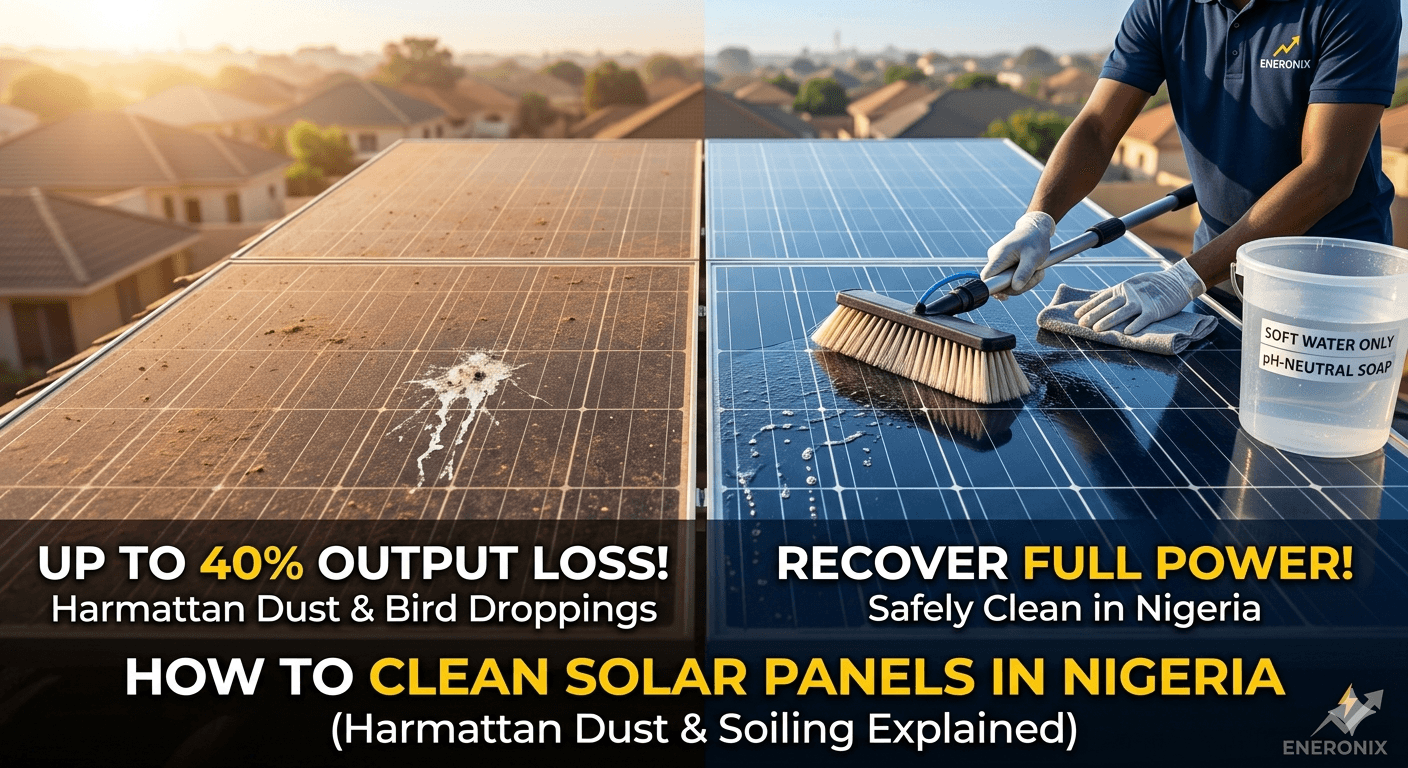
In Nigeria, dirty solar panels lose 8–14% output after 2–4 weeks of dust in Abuja, and 15–40% output during harmattan season in the north. Bird droppings cause 15–30% loss even from small deposits. Cleaning immediately restores full output the recovery is equal to the soiling loss. One cleaning session per month during harmattan is the minimum for northern and central to have clean solar panels in Nigeria .
A rooftop in Abuja. Six panels, installed eight months ago. The owner is getting noticeably less power than when the system was new so they call their installer, convinced something has failed. The installer arrives, looks at the panels, wipes one corner of a panel with a damp cloth, and shows the owner the grey-brown smear on the cloth. Nothing has failed. The panels just need cleaning.
A solar panel covered in two weeks of harmattan dust is not a broken panel. It is a panel producing 15–25% less than it should silently, every day, with no fault code and no warning from the inverter.
Cleaning is the highest return-on-effort maintenance action you can take on any solar system. It costs nothing but time, and the recovery is immediate. This guide tells you exactly when to clean, how to do it without damaging your panels, and what output you actually recover.
PLAIN ENGLISH EXPLANATION
Dust:
A layer of dust blocks some of the sunlight reaching your panel cells. The more dust, the less light gets through, and output drops proportionally. Thin, even dust causes gradual loss serious over weeks but not dramatic in a single day.
Bird droppings:
Far worse than they look. A dropping blocks one spot completely rather than dimming the whole panel evenly. That blocked section can drag down an entire row of cells meaning a small dropping covering 5% of panel area can cause more loss than dust covering 25% of the same panel.
How Much Output Are You Losing Right Now?
The table below shows soiling losses across realistic Nigerian conditions. For context on what your panels should be producing when clean, see 400W solar panel output in Nigeria.
| Condition | Output Loss | Derating Factor |
| Clean / freshly rained on | 0–2% | 0.98–1.00 |
| Light dust Lagos / PH, 1–2 weeks | 3–6% | 0.94–0.97 |
| Moderate dust Abuja, 2–4 weeks | 8–14% | 0.86–0.92 |
| Harmattan 2–3 weeks, north/central | 15–25% | 0.75–0.85 |
| Heavy harmattan 4–6 weeks uncleaned | 25–40% | 0.60–0.75 |
| Bird droppings on 10% of panel surface | 15–30% | 0.70–0.85 |
| Coastal / industrial soiling (Lagos, PH) | 10–20% | 0.80–0.90 |
Put those percentages into naira. A 6-panel, 2,400W array losing 20% to soiling:
Output loss calculation 6-panel 2,400W array, 20% soiling

Lost power output  = 2,400W × 0.20 = 480W

Daily energy lost  = 480W × 5 peak sun hours = 2,400 Wh = 2.4 kWh/day

Monthly energy lost = 2.4 kWh × 30 = 72 kWh

At ₦1,200/kWh generator displacement value:

Monthly cost of not cleaning = ₦86,400

Annual cost of not cleaning  = ₦1,036,800
That is the cost of skipping a cleaning session that takes 30 minutes. The return on those 30 minutes is immediate and measurable from the next morning.
25–40% Output loss from 4–6 weeks of uncleaned harmattan dust
₦86,400/mo Monthly cost of 20% soiling on a 2.4kW array at ₦1,200/kWh
30 min Time needed to fully clean a standard 6-panel rooftop array
What Causes Soiling Losses and Why Bird Droppings Are Worse Than Dust
Soiling losses come in two forms: uniform soiling and selective soiling. Understanding the difference explains why you should respond to a bird dropping the same morning you see it, but you can schedule dust cleaning on a regular calendar basis.
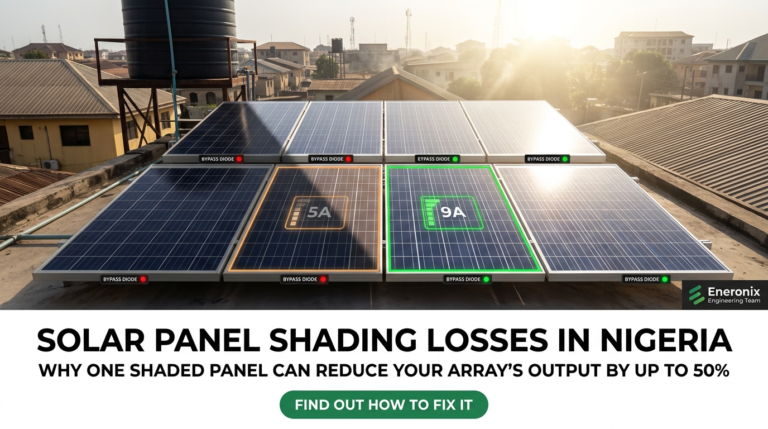
Uniform dust reduces irradiance evenly across the panel surface. Output loss is proportional to coverage. Selective soiling a concentrated opaque deposit is different. A bird dropping sitting on a group of 20–24 cells blocks light from that group almost completely, dropping its output to near zero. That cell group activates its bypass diode, which removes roughly one third of the panel’s total output from that section. A dropping covering 5% of panel area therefore causes more output loss than dust covering 30% of the same area.
For the technical explanation of how bypass diode activation affects panel output under selective soiling, see solar panel efficiency explained.
Rule of thumb: Treat bird droppings as urgent. Treat dust as scheduled. A dropping left for a week does not just reduce output for that week it also creates hotspot conditions that can cause permanent cell degradation over time.
Harmattan Dust Nigeria’s Biggest Soiling Problem

Harmattan is a dry, dust-laden wind that blows from the Sahara across West Africa from November to February. The particles PM10 and PM2.5 fine Saharan dust travel thousands of kilometres and deposit on every exposed surface in Nigeria. Unlike coarser particles that blow off in wind, fine PM2.5 dust adheres to panel glass and builds up in layers.
The problem is doubled during harmattan: the same atmospheric dust that coats your panels also scatters and absorbs incoming solar irradiance before it reaches the ground. You lose output from both the panel coating and the reduced irradiance. This is why harmattan-season output can be significantly below what your sizing model predicts even for freshly cleaned panels.
Regional severity varies significantly. Kano, Maiduguri, and Sokoto receive the heaviest deposits panels can accumulate visible dust layers within 4–5 days during peak harmattan. Abuja and Kaduna receive moderate but still substantial dust. Lagos and Port Harcourt get lighter harmattan dust, but their high humidity causes deposited dust to cake onto panel surfaces rather than remain loose making it harder to rinse off with rain alone.
According to NREL research on PV system soiling, fine particle soiling from desert dust transport is among the highest-impact soiling sources globally, with derating factors comparable to those measured in the Saharan dust belt that covers northern Nigeria during harmattan season.
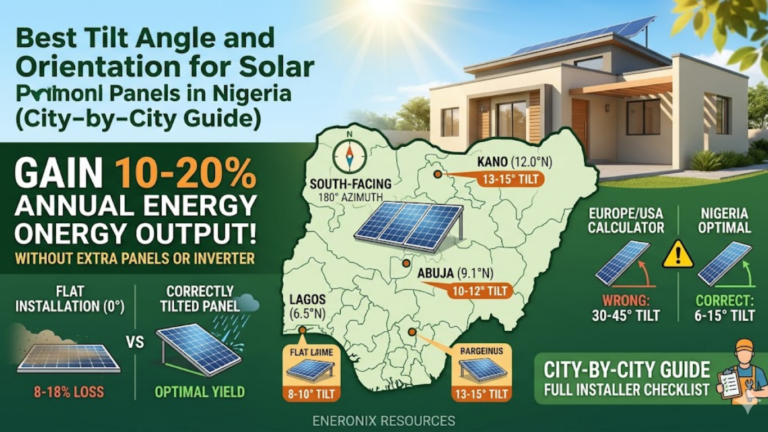
Panel tilt angle interacts with harmattan soiling. A 10–15° tilt gives rainwater a gradient to wash deposited dust downward. A flat (0°) installation means dust sits permanently with no natural drainage path. See monocrystalline vs polycrystalline solar panels Nigeria for how panel specification choices interact with soiling performance.
Rainy Season Self-Cleaning When Nature Does the Work

Heavy rainfall in southern Nigeria (May–October in Lagos and Port Harcourt) is an effective cleaner for uniform dust. In peak rainy season, frequent rainfall can keep panels at 3–5% soiling loss with no manual cleaning particularly on properly tilted arrays.
However, rainfall has three limitations as a cleaning mechanism:
- Bird droppings are too viscous and adhesive to be removed by rainfall. They require manual cleaning regardless of how much it rains.
- Hard water in many Nigerian locations (Abuja, parts of Lagos) leaves mineral deposits after evaporation that can reduce output over time if not periodically rinsed with cleaner water.
- Moderate rainfall heavy enough to wet panels but not heavy enough to wash them can leave a mud film worse than dry dust alone.
Monitor your charge controller output through the rainy season. If power readings are not recovering between rain events, a manual clean or rinse is still needed even when it looks like the panels have been washed.
How to Clean Solar Panels in Nigeria Safely

When to Clean Time of Day and Safety Rules

Clean in the early morning. This is not a preference it is a technical requirement. At midday, a Nigerian rooftop panel surface can reach 65–75°C. Pouring cold borehole water onto a 70°C glass surface creates a rapid temperature differential that thermally stresses the tempered glass and underlying cell structure. This thermal shock can create micro-cracks in cells that are invisible to the naked eye but reduce output and accelerate degradation over time.
Early morning panels are at ambient temperature (often 25–30°C), water evaporates slowly enough to allow effective cleaning without residue, and cleaning before the high-irradiance period maximises the output you recover that same day.
Roof safety: Unsafe roof access during panel cleaning is a real and underacknowledged injury risk in Nigeria. Never climb wet iron sheet roofing. Use appropriate rubber-soled footwear. For roofs above 4m, use a secured ladder or safety harness. If the roof is not safely accessible, clean from the ground using a soft brush on an extension pole.
What to Use Materials and Water Quality
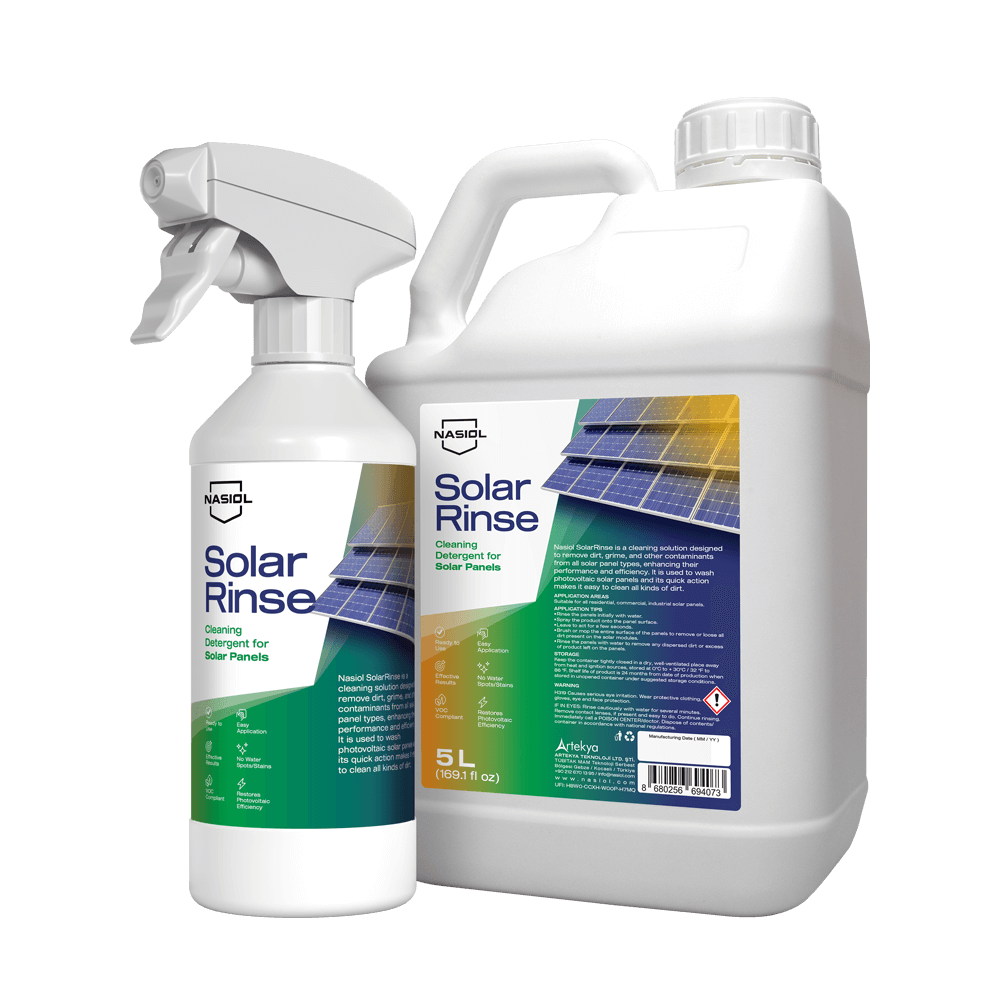
The only safe cleaning materials are soft microfibre cloth, soft-bristle brush, or a soft sponge. Nothing else. Steel wool, abrasive pads, rough cloths, and high-pressure water jets all cause damage some of it visible immediately, some compounding over months.
Water quality matters more than most people realise. Hard borehole water with high mineral content leaves a residue film after evaporation that can match or exceed the soiling it removed. If only borehole water is available, add 2–3 drops of pH-neutral washing-up liquid per 5 litres of water. Always follow with a rinse of the cleanest available water. Do not use alkaline or acidic cleaning agents: the panel glass has an anti-reflective coating that requires near-neutral pH (6.5–7.5).
Step-by-Step Cleaning Process
1. Confirm panels are cool. Early morning, or at least 30 minutes after sunset. Surface temperature should feel cool to the back of your hand before you apply water.
2. Pre-rinse with clean water. Wet the entire panel surface to loosen surface dust before any contact. This prevents dragging abrasive particles across the glass during wiping.
3. Gentle wipe with soft cloth or brush. Use straight parallel strokes from top to bottom, following the natural drainage direction. Avoid circular motions they grind loosened particles against the glass.
4. Treat stubborn deposits. For bird droppings or caked harmattan mud, apply a small amount of diluted pH-neutral soap solution and let it sit for 1–2 minutes to soften before wiping. Do not scrub hard reapply and wait if needed.
5. Final rinse thoroughly. Rinse from top to bottom with the cleanest available water. Any soap residue left on the surface reduces anti-reflective coating effectiveness over time.
6. Inspect while you are up there. Visually inspect frames for corrosion, junction box seals for integrity, cables for chafing or UV damage, and mounting brackets for looseness. A 2-minute visual inspection during a cleaning visit can catch problems that go unnoticed for months.
What NOT to Do
.jpg)
| Mistake | Consequence | Severity |
| Cleaning hot panels with cold water | Thermal shock micro-cracks in cells, accelerated degradation | High |
| Abrasive pads or rough cloths | Permanent scratching of anti-reflective coating irreversible output loss | High |
| High-pressure water jets | Water forced into junction box seals and frame gaskets corrosion and electrical faults | High |
| Alkaline or acidic cleaners | Chemical degradation of anti-reflective coating over repeated use | Medium |
| Hard water without rinse | Mineral film deposit replaces dust soiling with mineral soiling | Medium |
| Walking on panels | Cell cracking and frame deformation permanent damage | High |
| Cleaning at midday | Thermal shock risk is highest; water also evaporates before effective cleaning | Medium |
Cleaning Frequency by Location
These are minimum recommended intervals based on regional soiling data. Proximity to dust sources, panel tilt angle, rainfall patterns, and presence of birds will move your specific installation toward the more frequent end of each range.
| Location | Rainy Season | Dry Season | Harmattan Peak |
| Lagos / Port Harcourt | Every 6–8 weeks | Every 4–5 weeks | Every 3–4 weeks |
| Abuja / Kaduna | Every 4–6 weeks | Every 3–4 weeks | Every 2–3 weeks |
| Kano / Northern cities | Every 3–4 weeks | Every 2–3 weeks | Every 1–2 weeks |
PVGIS irradiance data for Nigerian cities confirms that harmattan season reduces ground-level direct normal irradiance by 15–25% in northern cities even independently of panel soiling compounding the case for aggressive cleaning schedules during this period.
How to Know When Your Panels Need Cleaning Without a Monitoring System
Most Nigerian system owners do not have panel-level monitoring. Here is a zero-equipment diagnostic that works reliably: on a sunny morning with similar weather to a previous sunny morning, check your charge controller’s input power or charging current reading. If it is noticeably lower than it was previously and nothing else has changed soiling is a likely cause.
Confirm it with a simple field test: take a damp cloth and wipe a small section of one panel clean, then check the charge controller reading again. If the cleaned section shows a measurable output increase, the panel needs a full clean.
If your inverter display shows unexpected low battery percentage in the afternoon despite good sun conditions, soiling is one of the first things to check see inverter battery percentage wrong for a full diagnostic checklist.
Output Recovery What You Gain After Cleaning
Output recovery from cleaning is equal to the soiling loss not additive above it. If your panels were running at 80% of rated output due to 20% soiling loss, cleaning restores them to 100% of rated output. The recovery is real, immediate, and starts from the first hour after cleaning.
Recovery calculation 6-panel 2,400W array, 20% soiling loss recovered

Output before cleaning = 2,400W × 0.80 = 1,920W

Output after cleaning = 2,400W × 1.00 = 2,400W

Daily recovery = 480W × 5hrs  = 2.4 kWh

Monthly recovery = 2.4 kWh × 30 = 72 kWh

Annual recovery (average 15% soiling maintained between cleans)

Annual recovery ≈ 1.8 kWh/day × 365 = 657 kWh/year

Value at ₦1,200/kWh = ₦788,400/year from consistent cleaning
For accurate system sizing that accounts for soiling derating from the start, use the off-grid solar sizing calculator with a soiling derating factor applied to your location’s peak sun hours.
Why Cleaning Affects Battery Life
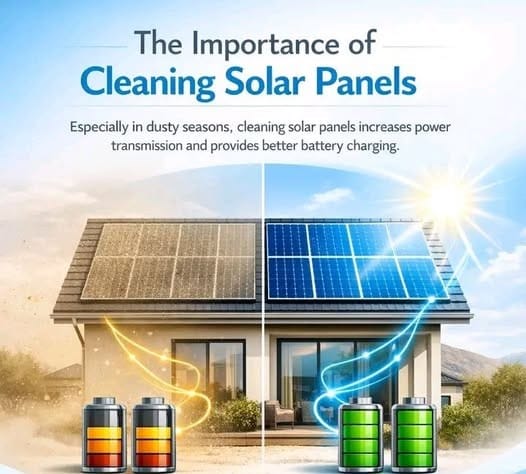
The connection between panel soiling and battery degradation is direct and underappreciated. A soiled panel delivers less current to the battery bank during the charging window. On days when soiling is heavy, the battery may not reach full state of charge before the charging window closes.
A lithium battery that regularly ends the day at 75–80% state of charge instead of 95–100% is being chronically undercharged. Over months, this creates cell imbalance and reduces usable capacity. Lead-acid batteries suffer more acutely: incomplete charging accelerates sulphation, which permanently reduces capacity.
Keeping panels clean is not just about daily energy output. It is about protecting the most expensive component in your system. For a full guide on how charging behaviour affects battery longevity, see how to increase lithium battery lifespan.
Simple rule: If your battery is not reaching full charge on a sunny day, check panel soiling before assuming a battery or charging system fault.
The Anti-Reflective Coating Why Cleaning Method Matters Long-Term

Quality solar panels have an anti-reflective (AR) coating on the glass surface that reduces surface reflection from approximately 4% down to less than 1%. That difference 3–4% of incoming irradiance is permanently captured as output by the AR coating. It is not a marketing feature. It is a measurable contribution to rated wattage.
Abrasive cleaning destroys this coating. The damage is not visible at first it looks like a light haze or slight scratch. But measured output on an AR-coated panel cleaned with a rough cloth for two years versus one cleaned with microfibre cloth will be measurably different. The damage is permanent: once scratched, the coating cannot be restored.
IEC 61215 and IEC 61730 panel qualification standards test AR coating durability under standardised conditions, but these tests assume appropriate cleaning methods. Manufacturers’ warranties typically exclude damage from inappropriate cleaning materials meaning a scratched AR coating is an unwarrantied, permanent output reduction.
Using a soft cloth and clean water is not just the careful choice. It is protecting 3–4% of your panel’s rated output for the full 25-year system lifetime.
Final Verdict Cleaning Is Free Output

Soiling is the most recoverable performance loss in any Nigerian solar system. Unlike shading, inverter sizing, or battery capacity which require design decisions or hardware changes to fix soiling loss disappears completely with 30 minutes and a bucket of water.
The return is immediate. A panel cleaned at 6am produces at full rated output by 8am. The financial value of consistent cleaning on a standard Nigerian residential system runs into hundreds of thousands of naira per year. The only cost is the time.
Clean in the morning. Use soft materials. Rinse with clean water. Do it on schedule not when you notice the panels look dirty, because by then you have already lost weeks of output.
For a complete guide to evaluating and purchasing a solar system in Nigeria before installation, see the solar panels in Nigeria buyer’s guide.
Frequently Asked Questions

How often should I clean my solar panels in Nigeria?
It depends on location. In Lagos and Port Harcourt: every 4–5 weeks dry season, 3–4 weeks harmattan, 6–8 weeks rainy season. In Abuja: every 3–4 weeks dry season, 2–3 weeks harmattan. In Kano and northern cities: every 1–2 weeks during harmattan peak. These are minimums if you have birds roosting near your panels, inspect weekly regardless of season.
Does rain clean solar panels properly?
For uniform dust, yes heavy rainfall in the rainy season is an effective cleaner that can maintain panels at 3–5% soiling loss with minimal manual intervention. But rain does not remove bird droppings (too viscous and adhesive), and hard water rain in areas like Abuja can leave mineral deposits after evaporation. If output is not recovering between rain events, manual cleaning is still needed.
Are bird droppings worse than dust?
Yes, significantly. Dust reduces irradiance proportionally across the panel surface. A bird dropping blocks one concentrated area completely, triggering bypass diode activation in that cell group and removing roughly one third of the panel’s output from that section. A dropping covering 5% of panel area typically causes more output loss than dust covering 25–30% of the same panel. Treat bird droppings as urgent.
Can I clean my panels with tap water or borehole water?
You can, but be aware of water quality. Tap water and borehole water in Nigeria often have high mineral content. The mineral residue left after water evaporation can form a new soiling layer on the panel glass. If only hard water is available, add 2–3 drops of pH-neutral washing-up liquid per 5 litres, and finish with the cleanest water available for rinsing. Never use hard water as a final rinse.
Can dirt permanently damage solar panels?
Gradual uniform dust does not cause permanent damage it is fully reversible by cleaning. Bird droppings, however, can. A dropping left on a panel for days or weeks creates hotspot conditions in the covered cells: reverse current through the shaded cell generates heat that can cause delamination and cell discolouration over time. The damage accumulates over multiple events. Remove bird droppings promptly.
What time of day should I clean my solar panels?
Early morning before 8am is ideal. Panel surface temperatures are at ambient at this time, eliminating thermal shock risk. Water also evaporates slowly in the morning, allowing effective cleaning without residue. Never clean at midday or early afternoon when panel surfaces can reach 65–75°C. Cold water on a hot panel can create invisible micro-cracks in cells, reducing output and accelerating degradation.
How much output does cleaning actually recover?
The recovery is exactly equal to the soiling loss. If 20% soiling has reduced your 2,400W array to 1,920W output, cleaning restores the full 2,400W. That 480W difference across 5 peak sun hours = 2.4 kWh/day = 72 kWh/month = approximately ₦86,400/month at ₦1,200/kWh generator displacement value. The recovery starts from the first hour after cleaning on the same day.
Can I use a pressure washer to clean solar panels?
No. High-pressure water jets force water into the junction box seals and frame gaskets that protect internal wiring from moisture. Once these seals are breached, water ingress causes corrosion and electrical faults that can be expensive to diagnose and repair. Panels are rated for rain, not pressurised water jets. Use a soft cloth, soft brush, or sponge with gentle poured water only

I am Engr. Ubokobong Ekpenyong, a solar specialist and lithium battery systems engineer with over five years of hands-on experience designing, assembling, and commissioning off-grid solar and energy storage systems. My work focuses on lithium battery pack architecture, BMS configuration, and system reliability in off-grid and high-demand environments.