
How Solar Panel Shading Losses in Nigeria Destroys Output and What to Do About It
QUICK ANSWER
Partial shading on one solar panel can reduce your entire array’s output by 30–50%, not just that one panel’s output. In a series-wired string, all panels share the same current the weakest shaded panel limits every other panel. Bypass diodes reduce but cannot eliminate this loss. Proper panel placement and shade analysis before installation are the only reliable fixes.
Picture a Lagos rooftop. Six panels, freshly installed. The system looks clean. Then at 2pm, the overhead water tank casts a thin diagonal shadow across the bottom row of two panels. The installer shrugged “it’s only a small shadow.” Within six months, the owner is getting half the expected output and wondering what went wrong.
The common assumption is this: a shadow on one panel reduces that panel’s output proportionally. If one panel is 50% shaded, you lose 8% of a 6-panel array. That assumption is wrong and it costs thousands of naira in lost energy every year across Nigerian solar installations.
This article explains the real physics behind shading losses, gives you the tools to identify shading risks on any Nigerian rooftop, and shows you what design choices actually prevent the problem.
Why One Shaded Panel Affects the Entire System
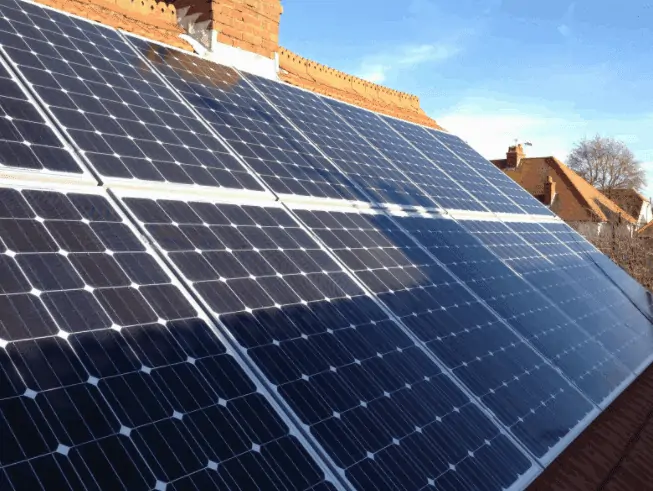
To understand shading loss, you need to understand how solar panels in a standard installation are wired. Most residential and commercial arrays in Nigeria use series vs parallel solar wiring and the choice matters enormously when shading is involved.
How Series Wiring Creates the Problem
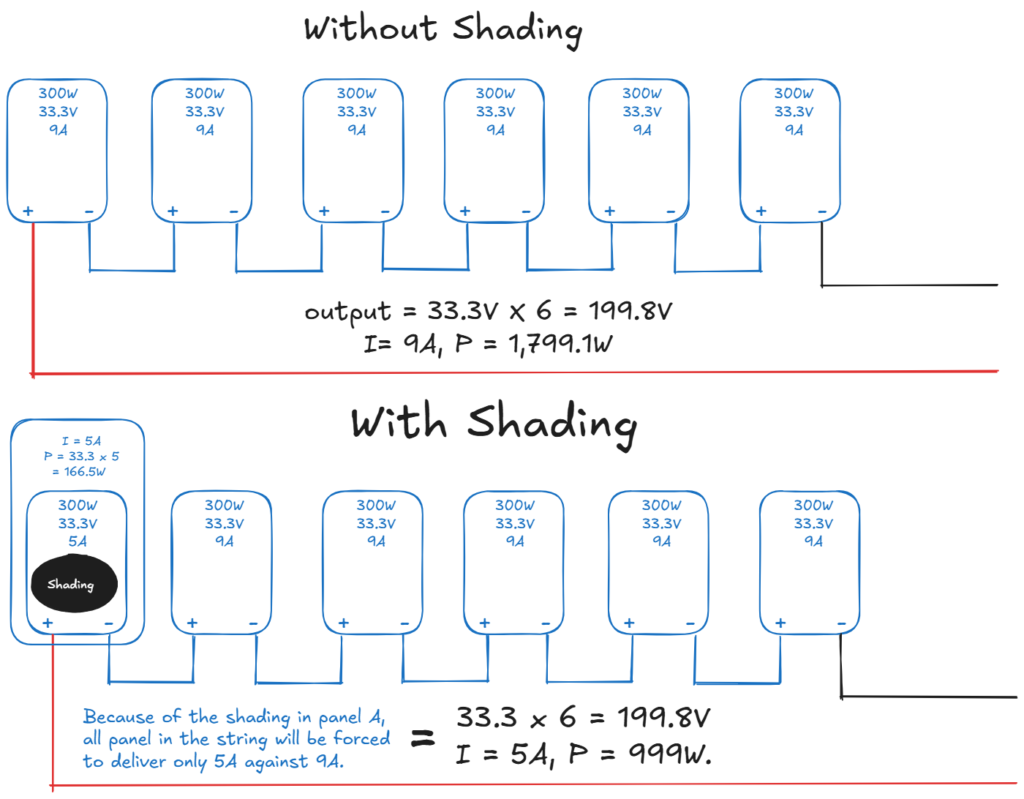
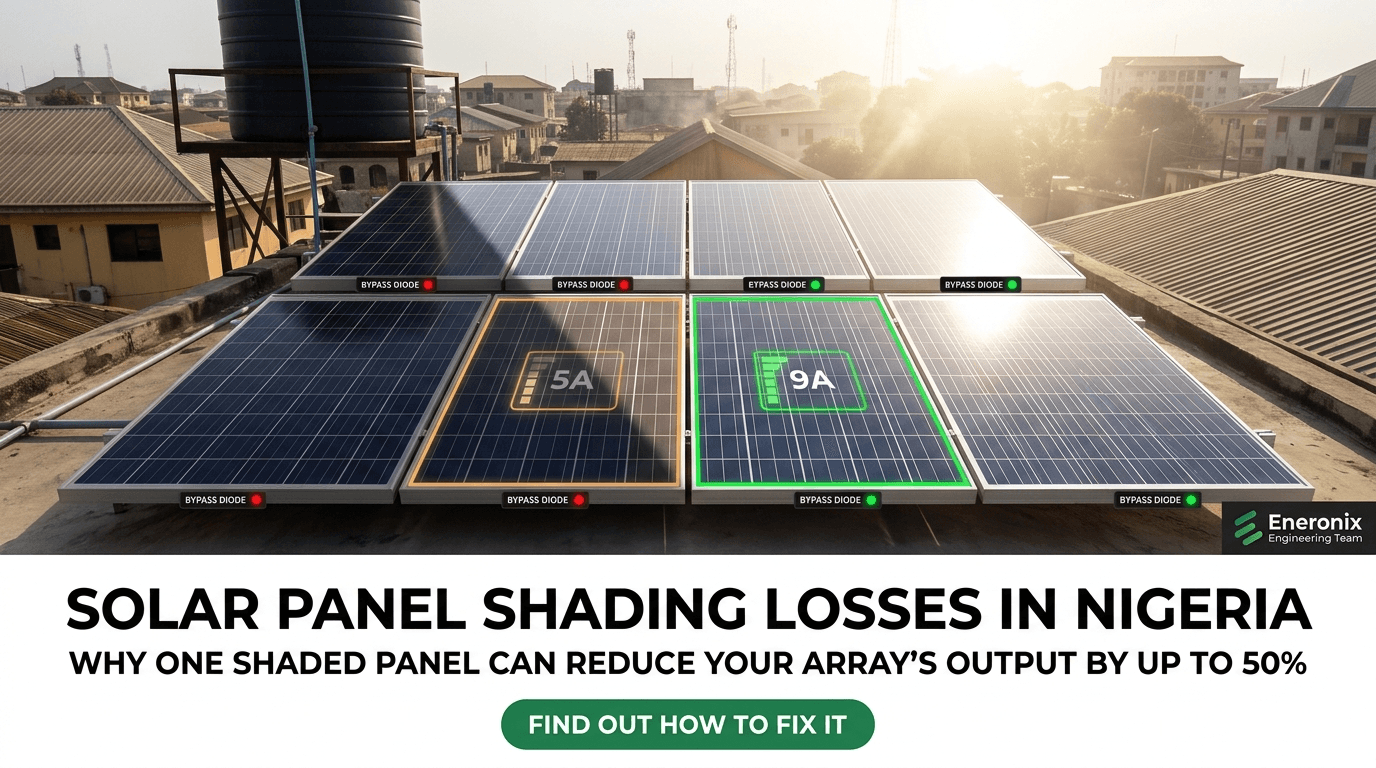
When panels are wired in series, their voltages add together but their current is shared. If you have 6 panels wired in series, each producing 9 amps, the string delivers 9A total (not 54A). The MPPT charge controller draws the same current from every panel in the string simultaneously.
Now shade one panel. That shaded panel can only produce 5A. The controller can only draw 5A from the entire string. The five perfectly healthy panels are physically capable of producing 9A each but they are throttled down to 5A. Their excess capacity is wasted.
The result:
A 6-panel string where one panel is producing 56% of normal current loses approximately 44% of total string output not 7%. That is the chain effect of series wiring. The weakest link sets the limit for everyone.
~50% String output loss from one partially shaded panel (no bypass diode)
30–50% Typical real-world string loss in Nigerian urban installations
8% What most people assume they lose from one shaded panel in a 6-panel array
What Bypass Diodes Actually Do and What They Cannot Fix

Every modern solar panel contains 2–3 bypass diodes, each protecting a group of 20–24 cells. When one cell group is severely shaded below approximately 30–40% of normal irradiance its bypass diode activates and short-circuits that group, allowing string current to flow around it rather than through it.
This does two things: it prevents the hotspot effect (explained below), and it limits the output loss to roughly one third of the affected panel’s contribution, rather than the entire string current being constrained.
But bypass diodes only activate under severe shading. Light to moderate shading the kind produced by a distant satellite dish, a neighbour’s staircase housing, or early-morning low-angle sun hitting a parapet wall does not trigger the bypass diodes. In these cases, the full string current penalty still applies. This is the shading scenario that catches most Nigerian installations off-guard.
According to NREL research on partial shading in distributed PV systems, mismatch losses from shading are consistently underestimated in system models that assume bypass diodes are always active.
For a technically precise explanation of how MPPT controllers interact with partially shaded I-V curves, see the MPPT charge controller selection guide.
The Hotspot Effect Damage, Not Just Lost Output
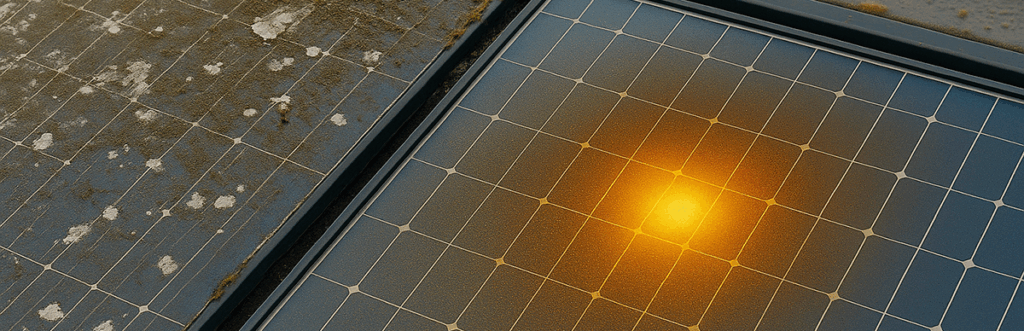
When a shaded cell in a series string cannot produce current but is forced to carry reverse current from the rest of the string, that reverse current dissipates as heat inside the cell. This is the hotspot effect and it is why shading is not just a performance issue but a long-term degradation issue.
Repeated hotspot events cause permanent damage: cell discolouration, delamination of the encapsulant layer, and reduced output that compounds over time. A system with chronic structural shading on cells that fall below the bypass diode activation threshold will degrade significantly faster than an unshaded system.
Critical point:
Cell temperatures during a hotspot event can exceed 150°C. IEC 61215 tests panels for hotspot resistance, but this is a durability test, not a prevention standard. Chronic structural shading is not what the test is designed for.
How Much Power You Actually Lose From Shading
Realistic output losses for a standard 6-panel, 2,400W array of 400W panels. See also: 400W solar panel output in Nigeria for baseline performance data.
| Scenario | String Output | Array Output | Daily Loss (5hr sun) |
| No shading | 100% | 2,400W | 0 Wh |
| One panel 50% shaded no bypass diode activation | ~50% | ~1,200W | ~6,000 Wh |
| One panel 50% shaded bypass diode active | ~67–75% | ~1,600–1,800W | ~3,000–4,000 Wh |
| One panel 50% shaded with DC optimizer | ~90–95% | ~2,160–2,280W | ~600–1,200 Wh |
| Complete shading of one panel bypass active | ~83% | ~2,000W | ~2,000 Wh |
The daily loss column shows why this matters economically. At ₦200/kWh, losing 6 kWh per day costs approximately ₦1,200 daily over ₦430,000 per year from a shading problem that a one-hour pre-installation analysis would have prevented.
Identifying Shading Sources on Nigerian Rooftops
Before finalising any panel layout, every shading source within 10 metres of the proposed array location needs to be identified and quantified. In Nigerian urban environments particularly Lagos, Port Harcourt, and Abuja this is non-negotiable.
The Shadow Analysis: How to Do It Before Installation
The key calculation is shadow length. Given an object’s height and the sun’s elevation angle at the worst-case time of day and year, you can calculate exactly how much shadow it throws onto your roof.
Shadow length formula
Shadow length = Object height ÷ tan(Sun elevation angle)
Example:
Lagos, 9am in December (worst case lowest sun angle)
Sun elevation at 9am, December, Lagos ≈ 25–30°
Using 25° (conservative)
Shadow length = 1.5m (water tank) ÷ tan(25°) = 1.5 ÷ 0.466= 3.2 metres ← minimum safe clearance from tank
For a 2m parapet wall:
Shadow length = 2.0 ÷ 0.466 = 4.3 metres
This is your minimum safe clearance. For Nigerian latitudes, use 25° as your worst-case morning elevation angle (December, 9am). At solar noon, Lagos sun elevation reaches 80–85°, so shading from tanks and walls is not a midday problem it is a morning and afternoon problem when irradiance is still significant.
PVGIS (Photovoltaic Geographical Information System), maintained by the EU’s Joint Research Centre, provides free irradiance-weighted shading impact analysis for any location in Nigeria. Worth using for commercial installations above 5kW.
Common Nigerian Rooftop Shading Sources
Overhead water tanks
The most common shading source on Nigerian residential rooftops. Always placed on the roof, always tall (typically 1.2–2m), and almost always positioned without consideration for the solar array. Safe clearance: minimum 3.5m in Lagos, 4m in northern states. Place panels on the opposite roof face from the tank whenever possible.
Parapet walls
The perimeter walls on flat roofs cast long shadows at low sun angles. A 1.2m parapet throws a 2.6m shadow at 25° sun elevation. Rule: minimum clearance from any parapet wall equals parapet height × 2.5 for Nigerian latitudes.
Satellite dishes and aerials
Individually small, but a single dish casting a diagonal line across two panels in a series string at 2pm causes measurable daily output loss. Always relocate dishes before panel installation. A dish cannot be moved once panels are around it without removing panels.
Neighbouring buildings
In dense urban areas, a two-storey building on an adjacent plot can shade your entire east-facing array for the first two hours of each morning. In rapidly developing areas of Lagos (Lekki, Ikorodu, Gbagada), Abuja (Wuse, Gwarinpa), and Port Harcourt, site analysis should also consider likely future development on adjacent plots.
Trees
The shading source that changes over time. A tree 4m from the roof edge that does not currently shade panels may shade half the array in 8–10 years. Assess current canopy spread and species growth rate. Mango and iroko trees common in Nigerian compounds can add 1–2m of canopy per year.
Harmattan note: Harmattan haze is not structural shading, but it reduces direct irradiance and increases diffuse irradiance for 2–3 months per year across northern and central Nigeria. Account for it in system sizing, not as a shading problem.
How to Prevent Solar Shading Losses
Panel Placement Rules
The most effective shade mitigation strategy has no cost: avoid shade entirely. Map every shading source before finalising panel layout. Apply the shadow length formula to each object. Then place panels in the zone that receives unobstructed sun from 9am to 3pm minimum.
This six-hour window is your core generating window. Irradiance outside this window is lower early morning and late afternoon sun contributes significantly less energy than midday sun. Design around the high-irradiance hours first.
If roof space is constrained and some panels must be in partial shade, put them in a separate string from the unshaded panels. Never mix shaded and unshaded panels in the same series string.
String Configuration Strategy
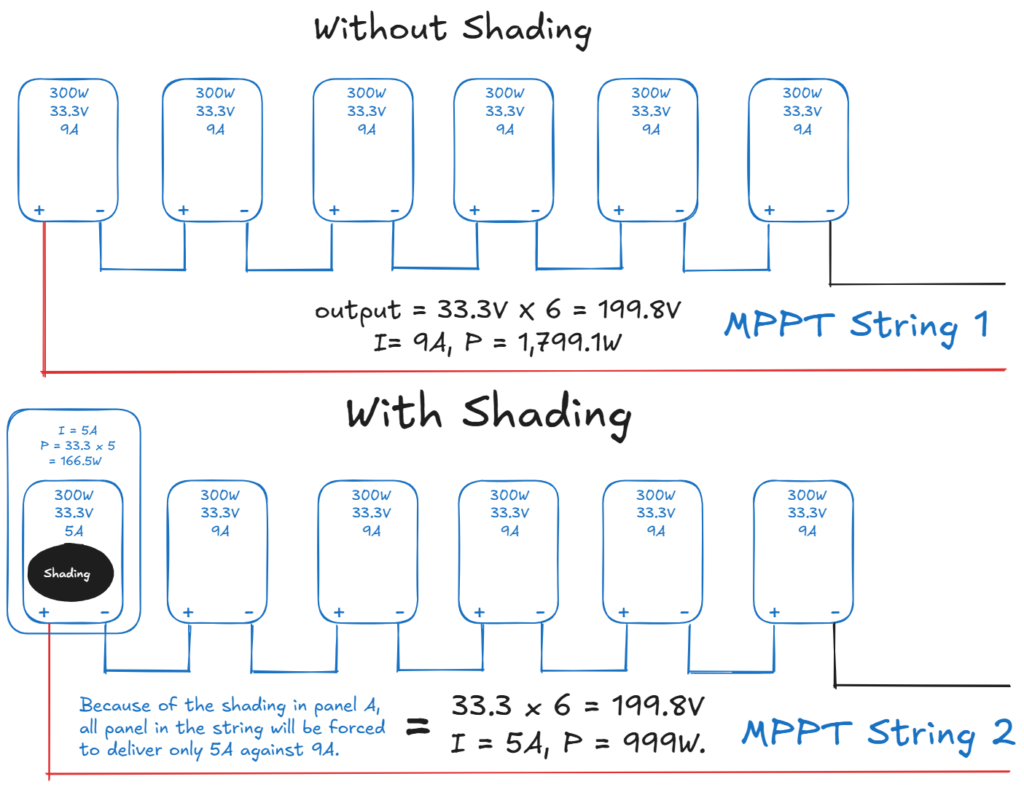
When shading is unavoidable for some panels, string configuration becomes your primary mitigation tool. Isolate the shaded panels into their own string and the healthy panels are protected. A shaded string underperforms, but an unshaded string in parallel with it runs at full capacity.
This requires an MPPT controller with at least two independent MPPT inputs, so each string can be tracked independently.
For details on how to configure your array, see the solar array sizing guide.
When to Use DC Optimizers or Microinverters
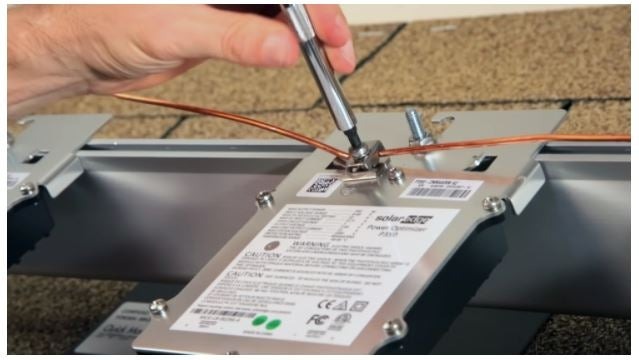
DC optimizers (SolarEdge, Tigo) attach to each individual panel and give it independent maximum power point tracking. A shaded panel no longer constrains its neighbours it simply produces less itself while every other panel operates at full output.
Microinverters (Enphase) achieve the same result at the AC level. The performance benefit is identical for shade tolerance.
When are these worth the cost in Nigeria?
- Structural shading from fixed objects affects 2 or more panels unavoidably
- The shaded panels are in the high-irradiance 9am–3pm window
- Roof geometry makes separate string routing impractical
- The installation is 5kW or larger (the premium cost per watt falls at scale)
The cost premium for DC optimizers is approximately 15–25% over standard string wiring. For a standard 3–5kW residential installation where shading is mild or affects only morning/evening hours, correct string configuration and panel placement is usually sufficient and far cheaper.
SolarEdge’s shade impact analysis tools can quantify the expected annual output difference between standard string wiring and DC optimizer configurations for any shading scenario. Worth running on any commercial installation.
Why Shading Destroys System Design Accuracy
Every solar system sizing calculation assumes a specific daily energy harvest from the array. That figure is based on peak sun hours, panel wattage, and system efficiency none of which account for unquantified shading losses.
If your sizing calculation assumes 5 peak sun hours per day and your array actually delivers the equivalent of 3.2 peak sun hours due to shading, every downstream component battery capacity, inverter sizing, load calculations is undersized for the real operating condition.
Use the off-grid solar sizing calculator only after you have accounted for shading losses. And before installation, review the common off-grid solar mistakes to avoid other design errors that compound this problem.
Pre-Installation Shading Checklist
Run through this before any panel is mounted. A shade analysis takes one hour. Correcting a shading problem after installation can take days and significant cost.
- Identify all objects within 10m of the proposed array location (tanks, walls, dishes, trees, neighbouring structures)
- Calculate shadow length for each object using the tan formula at 25° sun elevation (Lagos 9am December baseline)
- Mark the shadow-free zone on the roof and confirm all panel positions fall within it
- Relocate satellite dishes and aerials before installation not after
- Assess tree canopy growth over 10-year horizon trim or account for future shading
- Assign any unavoidably shaded panels to a separate string from unshaded panels
- Verify MPPT controller supports dual-string input if using separate shaded and unshaded strings
- Document shading conditions in writing so future system audits have a baseline
Final Verdict
Shading is the most preventable cause of solar underperformance in Nigerian installations and the most consistently ignored at installation time. The physics are not complicated: one shaded panel in a series string does not cause a proportional loss. It causes a disproportionate loss that affects every panel connected to it.
The correct response is not to buy more expensive equipment. It is to do the shadow analysis before the first bracket is drilled. Map your shading sources. Calculate shadow lengths. Place panels in the clear zone. Separate shaded and unshaded strings. Only after those steps are done should you consider whether DC optimizers are justified.
Before purchasing panels, read the solar panels in Nigeria buyer’s guide for a complete overview of what to evaluate before committing to any system design.
Frequently Asked Questions
Can one shaded panel really reduce my whole system’s output?
Yes and significantly. In a series-wired string, all panels share the same current. One panel producing half its normal current forces every other panel in the string to produce at that reduced level as well. In a 6-panel string, one panel at 50% output can reduce total string output by 40–50%, not the 8% most people expect.
Do bypass diodes eliminate shading losses?
No. Bypass diodes limit the damage but do not eliminate the loss. Each diode protects a group of cells when that group is severely shaded (below ~30–40% irradiance), the diode activates and routes current around it. This prevents the hotspot effect and reduces output loss from ~50% to ~25–33% of the string. But bypass diodes only activate under severe shading. Light to moderate shade does not trigger them.
Does shading permanently damage solar panels?
Yes, under certain conditions. When a shaded cell is forced to carry reverse current from the rest of the string and the bypass diode has not activated, the reverse current generates heat the hotspot effect. Temperatures can exceed 150°C. Repeated hotspot events cause cell discolouration, delamination, and permanent output degradation over time.
How much shading is too much for a solar array?
Any structural shading shade from a fixed object that falls on the array during the 9am–3pm core generating window is worth quantifying and mitigating. Even 10–15 minutes of shading per day from a satellite dish casting a thin shadow across a series string can cause measurable annual energy loss.
Are microinverters worth the cost in Nigeria?
For most residential installations (3–5kW), microinverters are difficult to justify on cost alone the 20–30% premium is significant. They become justifiable when structural shading is unavoidable on 3 or more panels during peak hours, the installation is 5kW or larger, or per-panel monitoring is important.
How do I calculate the shadow length from my water tank?
Use this formula: Shadow length = Tank height ÷ tan(Sun elevation angle). For Lagos at 9am in December, the sun elevation is approximately 25–30°. A 1.5m tank at 25° sun elevation casts a shadow of 1.5 ÷ 0.466 = 3.2 metres. For Kano and cities above 12°N latitude, use 20° as your worst-case angle.
Can I fix a shading problem after installation?
Sometimes, but it is costly and disruptive. Options include adding DC optimizers to affected panels (requires compatible inverter), reconfiguring strings so shaded panels are isolated, physically relocating panels, or removing the shading object. Prevention during installation planning is always faster and cheaper than retrofit correction.

I am Engr. Ubokobong Ekpenyong, a solar specialist and lithium battery systems engineer with over five years of hands-on experience designing, assembling, and commissioning off-grid solar and energy storage systems. My work focuses on lithium battery pack architecture, BMS configuration, and system reliability in off-grid and high-demand environments.