Cheap vs premium BMS explained for Nigerian solar systems. Learn how active balancing, RS485 communication, fault logging, and MOSFET quality affect battery lifespan, generator fuel costs, and long-term performance.
Every week, somewhere in Nigeria, an installer is standing in front of two BMS options. One costs 6,000 naira. One costs 28,000 naira. Both are rated 16S. Both are rated 200A. Both claim to be smart BMS units. The customer is watching. The installer picks the cheaper one.
Eighteen months later, the customer calls. The battery is not lasting as long as it used to. The inverter keeps switching to generator too early. The system that was supposed to run through the night is cutting out at 2am.
The 22,000 naira saved on the BMS has now cost 60,000 naira in additional generator fuel, one site visit, and a customer relationship that is strained. And the cells are still fine. The BMS specification is the problem.
This article explains, component by component and naira by naira, what you actually get when you pay more for a BMS. Not in abstract terms but in practical field consequences. The goal is not to convince you to always buy the most expensive option. It is to help you understand exactly what each price tier buys and where the money goes.
TL;DR
What this covers: the real engineering differences between cheap and premium BMS units, and whether the price gap is justified for Nigerian off-grid solar. Who it is for: solar installers, DIY battery builders, and system owners deciding whether to upgrade a budget BMS. Key takeaways: – Cheap BMS units lack configurable thresholds, active balancing, and fault logging. This costs more over time than the upfront saving. – The price gap between budget and full-feature BMS is typically 10,000 to 25,000 NGN.
One avoided site visit pays for it. – Premium does not mean most expensive. It means correctly specified. A 200A JK BMS active balancer is premium for a 5kVA system. A 500A Daly is premium for a 10kVA system. – What you are actually paying for: MOSFET quality, balancing current, communication depth, threshold configurability, and thermal management. Estimated read time: 12 to 15 minutes.
What the Price Gap Actually Buys
The difference between a 6,000 naira BMS and a 28,000 naira BMS is not primarily brand margin. It is five specific engineering features, each of which has a direct operational consequence in a Nigerian daily-cycling solar system.
1. Active Balancing vs Passive Balancing
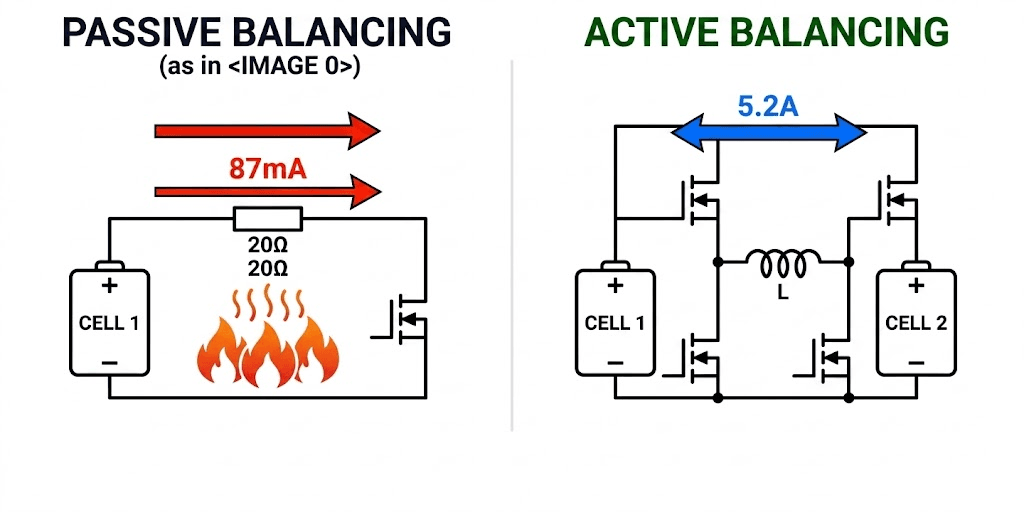
A budget BMS uses passive balancing: bypass resistors that divert a small amount of current (30 to 60 milliamps) away from cells that are slightly higher-voltage than their neighbours, wasting that energy as heat. It is simple, cheap to implement, and genuinely inadequate for packs above 100Ah in daily cycling service.
A premium BMS uses active balancing: an inductor-based switching circuit that transfers energy from high cells to low cells at 1 to 2 amps. Nothing is wasted. The correction happens fast enough to keep pace with daily imbalance accumulation.
The practical consequence: a 200Ah pack with a passive budget BMS develops 150 to 200mV cell voltage spread after 18 months of daily cycling. It delivers 140Ah instead of 190Ah per cycle. A pack with an active premium BMS shows under 20mV spread at the same point and delivers close to 190Ah.
KEY TAKEAWAY
The active balancing circuit is the single most important engineering difference between a cheap and premium BMS. Every other feature matters less than this one for long-term pack health in daily-cycling solar systems.
2. Communication vs No Communication
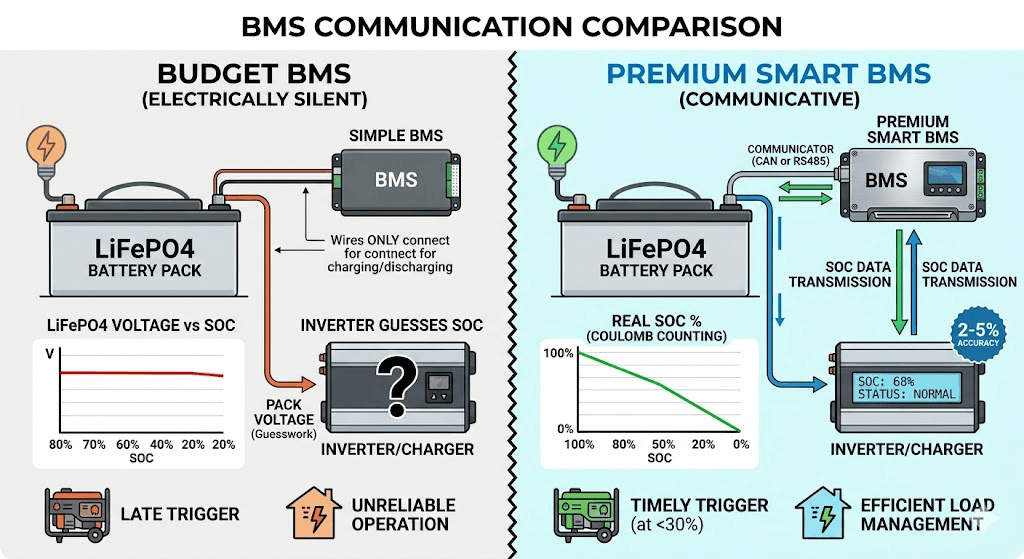
A budget BMS is electrically silent. The inverter cannot hear it. The inverter guesses the battery SOC from the pack terminal voltage, which for LiFePO4 is a poor approximation because the voltage curve is nearly flat across 80% of the usable range. The inverter sees roughly the same voltage whether the battery is at 80% or 40% SOC, and its guess is correspondingly unreliable.
A premium smart BMS broadcasts real SOC data to the inverter via RS485 or CAN. The inverter gets a number calculated from coulomb counting, accurate to within 2 to 5%. Generator trigger points, charge termination decisions, and load shedding all happen at the right moment rather than at a guessed moment.
The financial and operational cost of running a LiFePO4 system without BMS communication is quantified in our article: SOC drift: why your BMS and inverter disagree. The generator fuel numbers are specific and the case is quantified.
3. Configurable Thresholds vs Fixed Thresholds
A budget BMS has fixed protection thresholds. The manufacturer set OVP at some voltage and UVP at some other voltage, and you get what you get. Maybe the OVP is 3.70V when you need 3.65V. Maybe the UVP is 2.50V when your cells do better at 2.80V. Maybe the OTP is 60 degC when Nigerian enclosure conditions demand 50 degC. Fixed. You cannot change it.
A premium BMS lets you configure every threshold through the app. You set OVP at exactly 3.65V for your LiFePO4 cells. You set UVP at 2.80V for conservative daily cycling. You set charge OTP at 50 degC for the Nigerian climate. The BMS is optimised for your specific system, not a global average.
When a budget BMS trips, you know it tripped. You do not know why, which cell caused it, what the temperature was, or whether it has tripped before. You are working blind.
When a premium BMS trips, you open the app and read a timestamped log showing every protection event with a full snapshot of all 16 cell voltages, temperatures, and current at the time. You know exactly what happened, which cell triggered it, and whether the pattern suggests a configuration issue, a cell problem, or an enclosure temperature problem.
One remote diagnostic session with a fault log saves a site visit. In Lagos traffic, a single unnecessary site visit costs more time and fuel than the price premium of a premium BMS over a budget one.
5. MOSFET Quality and Thermal Design
This is the one nobody talks about because you cannot see it from the outside. Budget BMS units use minimum-specification MOSFETs with limited thermal headroom. At 25 degC ambient they perform adequately. In a Nigerian battery enclosure running at 45 degC ambient, they are operating near their junction temperature limits at normal current levels. The degradation that follows produces the symptoms covered in our article on failing BMS signs.
Premium BMS units use better-derated MOSFETs or put more of them in parallel to reduce per-device current stress. The MOSFET operates well within its thermal rating even in hot enclosures. The hardware lasts longer and protection functions remain reliable over a longer service life.
KEY TAKEAWAY
You pay for five things: active balancing, communication, configurable thresholds, fault logging, and MOSFET quality. Each has a direct operational consequence. None is cosmetic.
None. Diagnosis requires physical presence during a fault event.
Basic. Last fault only on some variants.
Full timestamped log with cell voltage snapshot at each event.
MOSFET quality
Minimum-spec MOSFETs. Lower thermal headroom. Shorter lifespan in hot enclosures.
Standard commercial MOSFETs.
Industrial-grade or well-derated commercial MOSFETs with adequate thermal margins.
SCP response
Firmware-based on most. 500us or slower.
Varies. Hardware on some premium variants.
Hardware comparator. Under 200us.
Temperature sensors
0-1 thermistors. Limited thermal coverage.
1-2 thermistors.
2-4 thermistors. Configurable OTP thresholds.
Typical NGN cost (16S, 100-200A)
3,000-8,000 NGN
8,000-18,000 NGN
18,000-45,000 NGN
Suitable for
Small packs, low cycling, cost-constrained builds, test benches.
Small to medium packs, moderate cycling.
Any daily-cycling solar storage pack above 100Ah. All serious installations.
IMPORTANT NOTE
The mid-tier category is the most dangerous purchasing decision in this market. A mid-tier BMS looks like it has the features you need at a price that seems like a reasonable compromise. But passive balancing at 500mA to 1A on a 200Ah daily-cycling pack is still inadequate, limited CVL/CCL/DCL support means the inverter is still making some decisions without full data, and limited threshold configurability means you cannot fully optimise for Nigerian conditions. For serious installations, go full-feature or accept the limitations of budget consciously. The mid-tier is often the worst value.
Breaking Down the Price Premium: Where the Money Goes
The 22,000 naira premium between a budget BMS and a full-feature premium BMS is not arbitrary. It buys specific engineering components and firmware development. Here is how that premium breaks down.
What You Are Paying For
Approximate Cost Contribution
What You Get Back
Active balancing inductor and gate driver circuit
3,000-8,000 NGN of the price premium
Corrects daily imbalance accumulation within one charge cycle. Prevents the 20-30% capacity loss that passive balancing allows after 18 months of daily cycling. Saves the equivalent of replacing 30-50Ah of cell capacity that passive balancing would have let degrade.
RS485 communication module and firmware
2,000-4,000 NGN of the price premium
Enables inverter to use accurate coulomb-counted SOC instead of flat-curve voltage estimation. Eliminates 15-25% SOC error on LiFePO4. Correct inverter decisions around generator trigger, charge termination, and load shedding.
Fully configurable firmware and app
1,000-3,000 NGN of the price premium
OVP settable to 3.65V, UVP to 2.80V, charge OTP to 50 degC. Without this, the BMS runs on global defaults that do not match Nigerian conditions. Configurable thresholds are the difference between a BMS optimised for your system and one making do.
Higher-grade MOSFETs and thermal design
2,000-5,000 NGN of the price premium
MOSFETs that maintain their rated current capacity at 55-65 degC junction temperature rather than derate aggressively. In Nigerian enclosure conditions, this is what separates a 5-year BMS lifespan from a 2-year one.
Fault history log and advanced app
1,000-2,000 NGN of the price premium
One remote diagnosis session via the fault log saves a site visit. In Lagos traffic, a site visit costs more in time and fuel than the entire price premium of a premium BMS. The fault log pays for itself the first time you use it.
KEY TAKEAWAY
The total cost of premium BMS features is approximately 9,000 to 22,000 NGN in component and firmware costs above a budget unit. Every line in this table pays back more than it costs within the first year of daily cycling service.
18-Month Cost Comparison
Let me put some specific numbers on this. These are realistic estimates based on field observations from Nigerian off-grid solar installations with a 200Ah 48V LiFePO4 pack on a 5kVA Deye hybrid inverter cycling daily at 80% depth of discharge.
Cost Element
Budget BMS (6,000 NGN)
Premium BMS (28,000 NGN)
BMS purchase cost
6,000 NGN
28,000 NGN
Capacity retained at 18 months (200Ah pack, daily cycling)
~140Ah (30% loss from imbalance)
~190Ah (5% loss)
Capacity loss value (at 3kWh/day load impact)
~1.8 kWh/day less
~0.3 kWh/day less
Generator cost from early switching (18 months)
+45,000 NGN estimated additional fuel
Negligible
Site visits for fault diagnosis (18 months)
2-3 visits: ~30,000-45,000 NGN
0-1 visits: ~0-15,000 NGN
Pack replacement discussion at month 24?
Likely. Customer perceives battery as failing.
No. Pack still performing near rated capacity.
Total 18-month system cost
~81,000-96,000 NGN
~28,000-43,000 NGN
Verdict
False economy. Cheap BMS cost 3x more over 18 months.
Correct specification. Premium pays for itself in month 4-6.
The numbers are conservative. They do not include the cost of a premature pack replacement discussion that may arise at month 24 with the budget BMS installation, or the loss of customer trust that follows a system that performs noticeably worse in year 2 than it did in year 1.
The premium BMS costs 22,000 naira more at purchase. It saves 38,000 to 53,000 naira over 18 months in generator fuel and avoided site visits alone. That is a 1.7 to 2.4 times return on the price premium within 18 months.
FOR INSTALLERS
This calculation is the conversation you need to have with price-sensitive customers. Not ‘the cheap BMS is bad.’ But: ‘The 22,000 naira difference will save you between 38,000 and 53,000 naira in the next 18 months through lower generator costs and fewer service calls. The premium BMS is the cheaper option over the system’s life.’ Frame it as a financial decision, not a quality argument.
What Premium Does Not Mean
Premium does not mean most expensive. It means correctly specified for the application.
A 500A Daly BMS on a 10kVA 48V system is a premium specification for that system. A JK BMS 200A is premium for a 5kVA system. A JK BMS 100A is premium for a 3kVA system. A budget 100A passive BMS on a 100Ah backup UPS that cycles weekly is an adequate specification for that system.
The question is never ‘is this BMS expensive enough?’ The question is ‘does this BMS have the specific capabilities required by this application?’
The five capabilities that define a premium-adequate specification for a daily-cycling Nigerian solar storage system are: active balancing at the right current for the pack size, full RS485 or CAN communication, configurable thresholds, fault logging, and sufficient current rating for the inverter. A BMS that has all five is premium for its application. A BMS that has them at a lower cost than alternatives is even better value.
When a Budget BMS Is Perfectly Fine
I want to be balanced. Budget BMS units are not universally wrong. They are wrong for the application they are most commonly put in. Here is when they are acceptable.
Scenario
Budget BMS Rating
Rationale
12V or 24V pack under 100Ah, cycling weekly or less, no inverter RS485 port available
Adequate
Low cycling frequency means passive balancing keeps pace. No communication port means the premium communication feature adds no value here.
Test bench or prototype build with temporary cells
Adequate
Not a production system. Budget protection unit is sufficient for development testing.
Backup UPS system, rarely discharged, generator always available
Adequate
UVP events are rare in well-managed UPS systems. When they occur, manual reset is acceptable.
Customer has explicitly refused the BMS upgrade after being informed of the tradeoffs
Acceptable with documented informed consent
Document the recommendation and the customer’s decision. You have done your job.
Notice what is not on this list: any 48V system above 100Ah cycling daily with a hybrid inverter. That is the majority of Nigerian residential and commercial solar storage. For those systems, a budget BMS is a specification error, not a cost saving.
The Counterfeit Problem: Why Premium Price Does Not Guarantee Premium Quality
There is one more dimension to the cheap versus premium discussion that does not appear in any spec sheet: counterfeits.
The Nigerian BMS market has a meaningful counterfeit problem. Units are sold as JK BMS active balancers that are, internally, passive units using a JK-branded enclosure. Units are sold as 200A rated with MOSFETs that will fail at 120A sustained. Units are sold with Bluetooth apps that pair successfully but display fabricated data rather than real cell measurements.
Paying premium price does not guarantee premium quality if you are purchasing from an unverified source. This is why the sourcing question matters as much as the specification question.
How to Verify Before You Buy
Request the technical datasheet. A genuine premium BMS has a published datasheet. If the supplier cannot provide one, the specification cannot be verified.
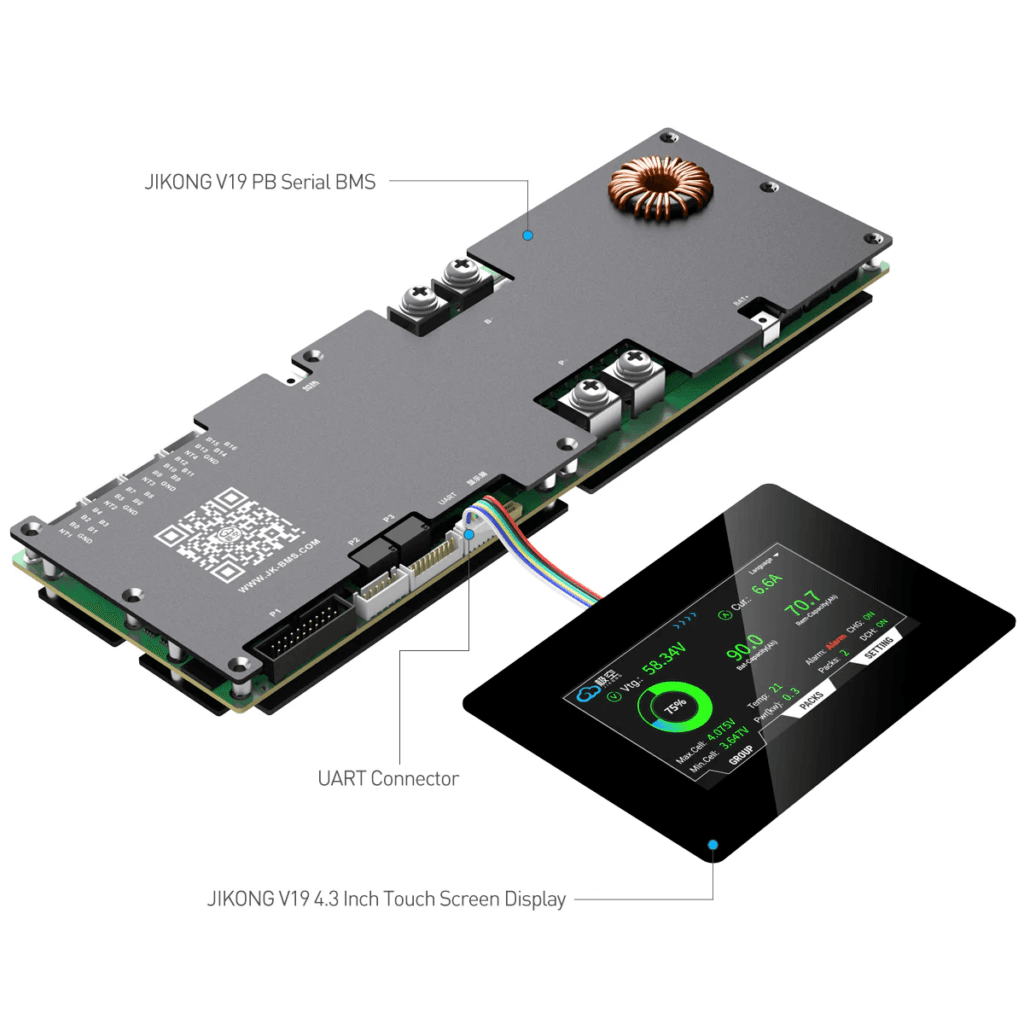
Scan the QR code on the PCB if purchasing JK BMS. Genuine units have a manufacturer verification QR code that links to the Jikong portal.
Pair the Bluetooth app before installation. A genuine active balancer will show active balance current (non-zero amps during CV phase when cells are not perfectly matched). A counterfeit passive unit will never show balance current above zero regardless of cell state.
Purchase from established, verifiable distributors with a physical presence, not anonymous social media sellers or market stalls where the product has no documentation.
The full counterfeit verification procedure is covered in our article on best BMS for 48V LiFePO4 solar batteries. The JK BMS verification steps in particular are ones every installer should know before purchasing.
What Most People Get Wrong About BMS Pricing
MISTAKE 1
Comparing budget BMS to premium BMS on current rating alone. Both may say 200A on the label. The current rating is one parameter. The balancing, communication, configurability, logging, and MOSFET quality are the differentiators. A 200A passive BMS with fixed thresholds and no communication is a different class of product from a 200A active BMS with full RS485 and configurable OTP.
MISTAKE 2
Using upfront cost as the only decision criterion without calculating 18-month total cost. The budget BMS costs less on day one. It costs more by month 6. This is demonstrable with real numbers. Any installer who has tracked system performance across budget and premium BMS installations over 18 months has seen this pattern.
MISTAKE 3
Assuming that a BMS from a known brand is automatically premium quality. The JK BMS brand includes active balancer variants and passive variants at very different price points. ‘JK BMS’ on a label does not confirm active balancing. Read the specific model number and verify the feature set from the datasheet.
MISTAKE 4
Upgrading from budget to premium after the pack has already lost capacity. You can replace the BMS, but you cannot replace the capacity that passive balancing allowed to diverge over 18 months of daily cycling. The premium BMS will stabilise what remains and correct further imbalance accumulation, but the lost capacity from the budget BMS period is gone. Specify correctly from commissioning.
For the full list of specification mistakes that lead to premature system failure, our article on why most solar battery systems fail before year 2 covers the complete failure pattern including BMS under-specification as one of the top three root causes.
The Bottom Line
For any 48V LiFePO4 pack above 100Ah cycling daily in a Nigerian off-grid or hybrid solar system, a full-feature smart BMS with active balancing is not the premium option. It is the minimum adequate specification.
The budget BMS is adequate for small infrequent-cycling systems. It is a specification error for everything else.
The price premium of 10,000 to 25,000 naira between a budget and a full-feature BMS is recovered within 6 to 12 months through retained battery capacity, reduced generator runtime, and avoided site visits. The customer who pays more for the correct BMS on day one is the customer who does not call you in month 18 with a battery performance complaint.
That is the full case for premium, made in numbers, not in brand preference.
KEY TAKEAWAY
Premium BMS for a Nigerian solar system: 18,000 to 45,000 NGN upfront. Budget BMS total system cost at 18 months: 3x the premium BMS purchase price in fuel, site visits, and capacity loss. The premium BMS is cheaper.
Frequently Asked Questions
What is the actual difference between a cheap and expensive BMS?
The price difference between a 5,000 NGN budget BMS and a 30,000 NGN full-feature BMS buys you: active balancing instead of passive (which directly affects how much capacity your battery retains after 18 months of daily cycling), full RS485 communication with CVL/CCL/DCL broadcasting (which determines how intelligently your inverter operates), configurable protection thresholds (which determines whether the BMS is optimised for your specific cells and Nigerian temperatures), a timestamped fault history log (which determines whether you can diagnose problems remotely), and higher-grade MOSFETs with better thermal management (which determines BMS hardware lifespan). Every one of those differences has a direct cost consequence in the field.
Is it worth spending more on a premium BMS?
For any LiFePO4 pack above 100Ah cycling daily in a Nigerian off-grid or hybrid solar system, yes, definitively. The typical price premium for a full-feature smart BMS with active balancing over a budget passive unit is 10,000 to 25,000 NGN. A passively balanced 200Ah pack typically loses 20 to 30% of usable capacity within 18 months of daily deep cycling. That capacity loss represents real runtime loss for the customer, generator fuel cost increases, and eventually a pack replacement discussion. The BMS premium is recovered within 6 to 12 months of operation through retained capacity and avoided service costs.
What does a cheap BMS actually fail to do?
A budget BMS typically: uses passive balancing only at 30 to 60mA (cannot maintain cell matching in daily cycling packs above 100Ah), has fixed protection thresholds that cannot be adjusted for your specific cells or Nigerian temperatures, transmits no data to the inverter (the inverter guesses SOC from terminal voltage with 15 to 25% error on LiFePO4), stores no fault history (you cannot diagnose recurring problems without being present during a fault event), and uses lower-grade MOSFETs with less thermal headroom (shorter hardware lifespan in hot enclosures). It will protect against hard faults. It will not optimise long-term performance.
What should I look for in a premium BMS for solar storage?
Five things in priority order: active balancing at 1A minimum for packs above 100Ah (2A preferred for 200Ah+); full RS485 or CAN communication broadcasting SOC, cell voltages, CVL, CCL, and DCL to the inverter; configurable OVP, UVP, and OTP thresholds with OTP settable to 50 degC for Nigerian conditions; a Bluetooth app with per-cell voltage display and a timestamped fault history log; and current rating at 125% of maximum inverter demand plus 15% Nigerian thermal derating. A BMS that meets all five is a premium BMS. A BMS that meets only three or four is a mid-tier unit.
Does a more expensive BMS mean better cell protection?
Not automatically. Protection quality depends on three things: whether the protection thresholds are correctly configured for the installed cells, whether the MOSFET quality is adequate for the thermal environment, and whether the short circuit detection uses hardware comparators rather than firmware detection. A cheap BMS with fixed thresholds incorrectly set for your cells provides worse protection than a mid-tier BMS correctly configured. The premium BMS advantage is that you can configure it correctly and that its hardware is designed for reliable operation over a longer service life.
Can I use a cheap BMS and upgrade later?
Technically yes, but it is not as clean as specifying correctly from the start. The cells will have operated for however long without active balancing, likely developing some imbalance that the premium BMS will need to correct once installed. The RS485 communication cable will need to be run and connected. The inverter battery type setting will need to be updated. Protection thresholds will need to be configured from scratch. The upgrade is not wasted effort but it is avoidable work, and the cell imbalance accumulated during the budget BMS period may have already caused some capacity loss that cannot be fully recovered.
What is the minimum BMS specification for a serious Nigerian solar installation?
For a 48V LiFePO4 pack above 100Ah in daily cycling service with a Deye, Growatt, or Solis hybrid inverter: 16S cell count, current rating at minimum 125% of inverter maximum DC demand plus 15% thermal derating, active balancing at 1A minimum, RS485 Modbus communication with full CVL/CCL/DCL broadcasting, configurable OVP/UVP/OTP thresholds, Bluetooth app with fault log, and a charge OTP threshold settable to 50 degC. The JK BMS active balancer series meets this specification. Anything below this specification is under-specified for the application.
I am Engr. Ubokobong Ekpenyong, a solar specialist and lithium battery systems engineer with over five years of hands-on experience designing, assembling, and commissioning off-grid solar and energy storage systems. My work focuses on lithium battery pack architecture, BMS configuration, and system reliability in off-grid and high-demand environments.
Contains information related to marketing campaigns of the user. These are shared with Google AdWords / Google Ads when the Google Ads and Google Analytics accounts are linked together.
90 days
__utma
ID used to identify users and sessions
2 years after last activity
__utmt
Used to monitor number of Google Analytics server requests
10 minutes
__utmb
Used to distinguish new sessions and visits. This cookie is set when the GA.js javascript library is loaded and there is no existing __utmb cookie. The cookie is updated every time data is sent to the Google Analytics server.
30 minutes after last activity
__utmc
Used only with old Urchin versions of Google Analytics and not with GA.js. Was used to distinguish between new sessions and visits at the end of a session.
End of session (browser)
__utmz
Contains information about the traffic source or campaign that directed user to the website. The cookie is set when the GA.js javascript is loaded and updated when data is sent to the Google Anaytics server
6 months after last activity
__utmv
Contains custom information set by the web developer via the _setCustomVar method in Google Analytics. This cookie is updated every time new data is sent to the Google Analytics server.
2 years after last activity
__utmx
Used to determine whether a user is included in an A / B or Multivariate test.
18 months
_ga
ID used to identify users
2 years
_gali
Used by Google Analytics to determine which links on a page are being clicked
30 seconds
_ga_
ID used to identify users
2 years
_gid
ID used to identify users for 24 hours after last activity
24 hours
_gat
Used to monitor number of Google Analytics server requests when using Google Tag Manager
1 minute
You can find more information in our Cookie Policy and .