
How Much Load Can a Battery Carry?
Quick Answer:
A battery can carry any load up to the continuous current limit its BMS will allow and its inverter can output. A 48V 200Ah LiFePO4 running at 1C can push 200A — 9,600W at 48V. But nobody is connecting a 9.6kW load to that battery. The inverter decides what actually comes out. A 3kVA unit on that same bank caps you at roughly 2,400W continuous. Full stop. How long it holds that load is a different question with different math, and mixing the two up is where things fall apart.
Most customers want one number. Can this battery run my load or not. And I get it — that’s a reasonable thing to want to know. But the question has two completely separate answers and if you only get one of them you’re going to have a bad time on site.
Power capacity is how many watts the system can deliver right now. This second. It’s a current and voltage problem, bounded by your BMS current limit and your inverter output rating. Energy capacity is how long the system delivers that before it’s empty. That’s watt-hours, depth of discharge, inverter efficiency losses. Not the same question. Not even close.
Every third installation argument I’ve seen in this market comes back to this exact confusion. Installer tells a customer his 200Ah battery can run 2,000W. Customer hears that and thinks he’s sorted. Nobody says for how long. Nobody draws the line between power and energy. The battery dies in three hours, customer is furious, installer is defensive, and everyone is talking past each other because they were never actually having the same conversation. I watched this play out on a site in Ajah and I’ve seen versions of it everywhere from Lekki to Trans-Amadi. NEPA stays off, load runs longer than anyone planned, and suddenly the energy math matters a lot.
This article splits the two apart and answers both. The calculation methodology used throughout is:
Usable Wh = Battery Voltage x Ah x 0.80 (DoD for LiFePO4) x 0.90 (inverter efficiency)
Same methodology across the full Eneronix battery cluster. Full breakdown in the battery backup time formula guide.
Part 1: Power Capacity (How Many Watts Right Now)
Power capacity is about instantaneous delivery. How many watts can the battery push through the inverter at this moment? This is determined by three limits, and the most restrictive one wins.
Limit 1: BMS Maximum Discharge Current
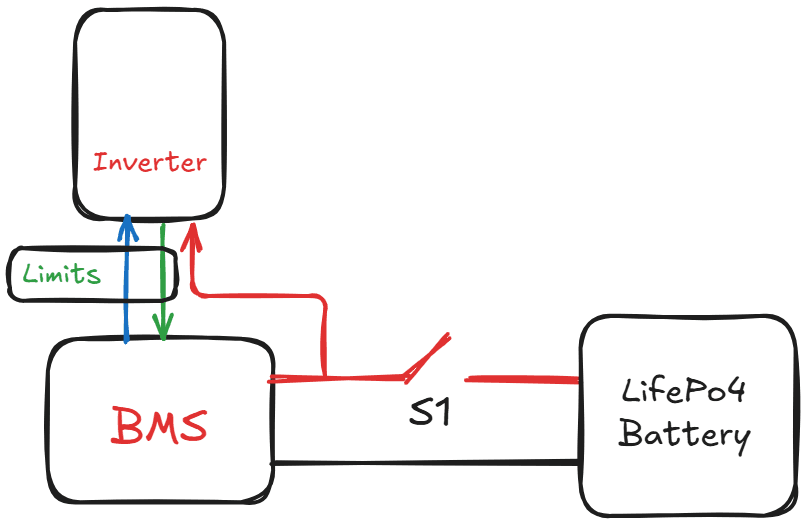
The BMS protects the cells by capping how much current can leave the battery at once. That limit is in the datasheet maximum continuous discharge current, listed in amps. Find it before you size anything.
For LiFePO4 the standard is 1C continuous discharge. Which means the current limit in amps equals the Ah rating numerically. 100Ah battery, 100A limit. 200Ah battery, 200A limit. Straightforward.
Watts from that: multiply discharge current by system voltage. 48V system, 200Ah battery, 1C discharge 200A x 48V = 9,600W. That’s your theoretical power ceiling from the BMS side.
Some batteries are rated 0.5C continuous, 1C peak. Some datasheets bury this. Some datasheets lie. Always pull the spec sheet for the exact battery on your order, not a category average, not what the vendor tells you verbally. The number that matters is continuous, not peak because your load doesn’t care about peak ratings, it runs continuously.
Here’s where it gets uncomfortable in this market. Pylontech, CATL, Winston proper 1C continuous, documented, tested. The unbranded stuff coming in through Alaba and Computer Village? Some of it is rated lower and the datasheet either doesn’t exist or was clearly written by someone who has never touched a battery. I’ve seen 200Ah cells from no-name Chinese suppliers that couldn’t sustain 0.5C without the BMS tripping. Customer paid for 200Ah, got something that behaves like 100Ah under real load. Budget batteries are a real part of this market and I’m not saying never use them — but go in with your eyes open and derate accordingly.
Limit 2: Inverter Continuous Output Rating
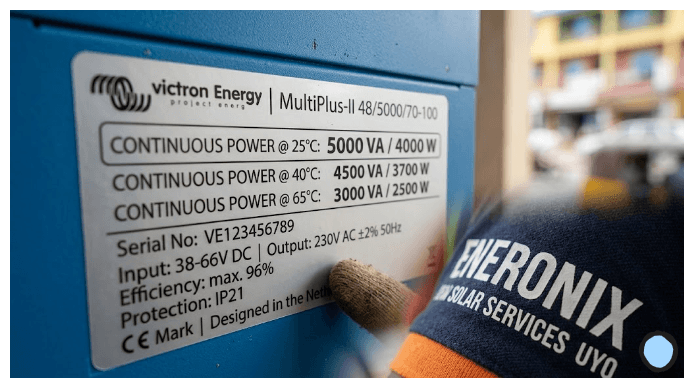
The inverter is almost always the practical ceiling on load capacity, not the battery. A 3kVA inverter connected to a 48V 200Ah LiFePO4 limits usable AC load to approximately 2,400W continuous (3kVA x 0.8 power factor). The battery could theoretically deliver 9,600W, but the inverter can only convert 2,400W of it to AC.
| Inverter Size | Continuous AC Output (0.8 PF) | DC Draw from Battery at Full Load | Max Practical Load for This System |
| 1kVA | 800W | ~889W at 90% eff. | 800W AC continuous |
| 2kVA | 1,600W | ~1,778W at 90% eff. | 1,600W AC continuous |
| 3kVA | 2,400W | ~2,667W at 90% eff. | 2,400W AC continuous |
| 5kVA | 4,000W | ~4,444W at 90% eff. | 4,000W AC continuous |
| 8kVA | 6,400W | ~7,111W at 90% eff. | 6,400W AC continuous |
| 10kVA | 8,000W | ~8,889W at 90% eff. | 8,000W AC continuous |
The inverter's rated kVA is not the same as its output in watts. kVA is apparent power. Watts (real power) = kVA x power factor. For residential loads in Nigeria, a power factor of 0.8 is a standard conservative estimate. A 5kVA inverter delivers approximately 4,000W of real power to your appliances, not 5,000W.
Limit 3: Surge vs Continuous Rating

Show more
2:01 PM
Claude responded: Both the BMS and the inverter have two ratings: continuous and peak surge.
Both the BMS and the inverter have two ratings: continuous and peak surge. Continuous is what the system holds indefinitely. Peak is what it absorbs for a few seconds during motor startup before something trips or something breaks.
A 3kVA inverter might carry a 6kVA surge rating. Fridge compressor kicks on at 1,500W surge, no problem. But a 4kW AC unit starting up can blow past that 3kVA inverter’s peak ceiling and shut the whole thing down. This is not a edge case. This happens on Nigerian sites constantly, especially where someone sized the inverter for running watts only and never thought about what the compressor pulls at startup.
For motor loads, the number you want is LRA — locked rotor amperage. That’s the current the motor draws in the first fraction of a second before it gets moving. Multiply by system voltage, that’s your actual surge demand. Air conditioners, water pumps, compressors — anything with a motor. Check LRA against inverter peak rating before you commit to a selection.
Now here’s the problem. Nigerian distributors and local manufacturers list surge ratings all over the place. Some are honest figures. Some are optimistic. Some appear to have been invented. I’ve seen inverters from the same product line with different surge specs on the box versus the manual versus the vendor’s WhatsApp catalogue. When you cannot trust the published number, stop guessing and measure. Clamp meter on the supply line, record the startup surge directly. That’s the actual number. Use that.
Full surge calculation for common Nigerian appliances including AC units and pumps is in our off-grid inverter sizing guide.
Part 2: Energy Capacity (How Long at That Load)
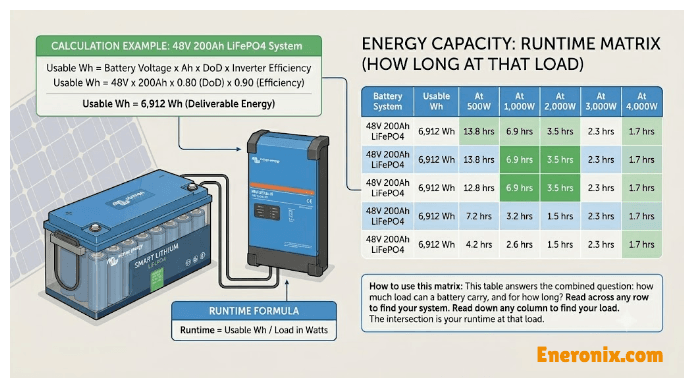
Once you know the maximum load the system can carry, the next question is how long it can sustain that load. This is determined entirely by the battery’s usable energy and the runtime formula.
Usable Wh = Battery Voltage x Ah x DoD x Inverter Efficiency. For 48V LiFePO4: DoD = 80%, Inverter efficiency = 90%. A 48V 200Ah LiFePO4 delivers 48 x 200 x 0.80 x 0.90 = 6,912 Wh usable. Runtime = Usable Wh / Load in Watts.
| Battery System | Usable Wh | At 500W | At 1,000W | At 2,000W | At 3,000W | At 4,000W |
| 48V 100Ah LiFePO4 | 3,456 Wh | 6.9 hrs | 3.5 hrs | 1.7 hrs | 1.2 hrs | 0.9 hrs |
| 48V 150Ah LiFePO4 | 5,184 Wh | 10.4 hrs | 5.2 hrs | 2.6 hrs | 1.7 hrs | 1.3 hrs |
| 48V 200Ah LiFePO4 | 6,912 Wh | 13.8 hrs | 6.9 hrs | 3.5 hrs | 2.3 hrs | 1.7 hrs |
| 48V 200Ah x2 parallel | 13,824 Wh | 27.6 hrs | 13.8 hrs | 6.9 hrs | 4.6 hrs | 3.5 hrs |
| 48V 400Ah LiFePO4 | 13,824 Wh | 27.6 hrs | 13.8 hrs | 6.9 hrs | 4.6 hrs | 3.5 hrs |
This table answers the combined question: how much load can a battery carry, and for how long? Read across any row to find your system. Read down any column to find your load. The intersection is your runtime at that load.
For individual battery size breakdowns with more load scenarios, see our dedicated articles: how long a 100Ah battery lasts, how long a 200Ah battery lasts, and how long a 2000W inverter runs on battery.
What a Battery Can Carry vs What It Should Carry
This is the part most installers skip. And it’s the part that determines whether a battery lasts four years or ten.
A 48V 200Ah LiFePO4 can technically deliver 9,600W at 1C. The BMS allows it. The cells won’t immediately complain. But running a battery at its maximum rated discharge current every single day is not a design decision, it’s a shortcut that the battery will charge you for later in degraded capacity and shortened cycle life.
The relationship between discharge rate and cycle life is documented. Battery University’s discharge rate analysis for LiFePO4 cells shows measurably higher capacity fade per cycle at 1C compared to 0.5C or lower. For a battery you’re expecting to run seven to ten years in a Lagos home where PHCN isn’t coming back anytime soon, that difference compounds. Design for 0.3C to 0.5C and you’re protecting your investment. Design for 1C because the numbers technically work and you’re just slowly destroying it.
| Discharge Rate | For 48V 200Ah Battery | Maximum Watts | Practical Daily Use Assessment |
|---|---|---|---|
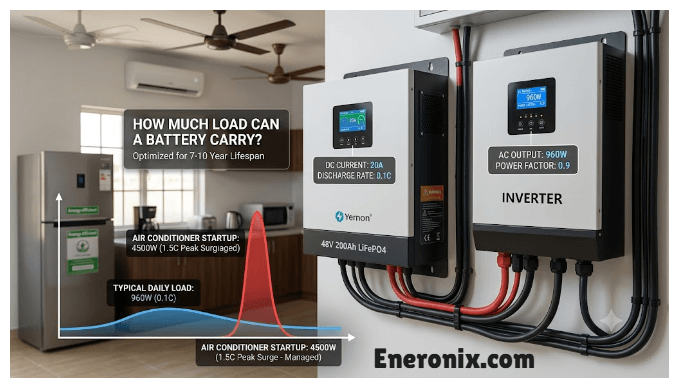
| 0.1C (gentle) | 20A | 960W | Maximum lifespan, appropriate for passive home loads |
| 0.2C (light) | 40A | 1,920W | Excellent for most Nigerian homes without AC |
| 0.3C (moderate) | 60A | 2,880W | Good balance of capacity use and cycle life |
| 0.5C (standard) | 100A | 4,800W | Typical design point for homes with one AC unit |
| 0.7C (heavy) | 140A | 6,720W | Acceptable occasionally, not as daily operating point |
| 1C (maximum) | 200A | 9,600W | BMS limit, causes accelerated capacity fade if sustained daily |
Engineer's note: Size your battery bank so your typical daily load draws at 0.2C to 0.5C. This keeps the cells comfortable, maximises cycle life, and gives you headroom to absorb load spikes without triggering BMS current protection. A home drawing 2,000W average needs a 48V bank with at least 100Ah for 0.5C operation. For 0.3C, go 140Ah or more. Just because the battery can carry it does not mean it should carry it. That distinction is the whole job.
How Much Load Your Battery Can Carry:
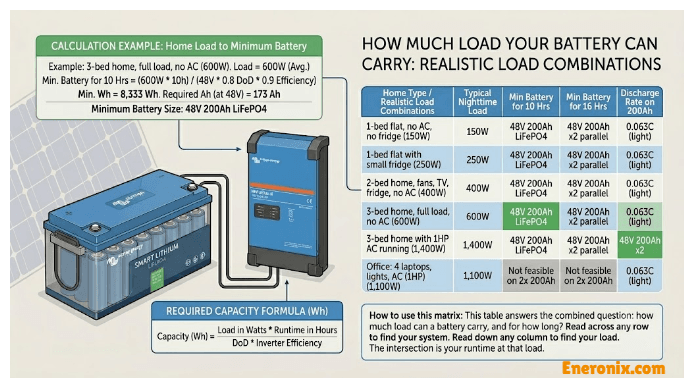
Here are the realistic load combinations for different home types and whether a given battery can carry them for a full overnight outage.
| Home Type | Typical Nighttime Load | Min Battery for 10 Hrs | Min Battery for 16 Hrs | Discharge Rate on 200Ah |
| 1-bed flat, no AC, no fridge | 150W (lights, fan, charging) | 48V 50Ah LiFePO4 | 48V 80Ah LiFePO4 | 0.016C (very light) |
| 1-bed flat with small fridge | 250W (above + 100W fridge avg) | 48V 80Ah LiFePO4 | 48V 130Ah LiFePO4 | 0.026C (light) |
| 2-bed home, fans, TV, fridge, no AC | 400W | 48V 130Ah LiFePO4 | 48V 200Ah LiFePO4 | 0.042C (light) |
| 3-bed home, full load, no AC | 600W | 48V 200Ah LiFePO4 | 48V 200Ah x2 | 0.063C (light) |
| 3-bed home with 1HP AC running | 1,400W | 48V 200Ah x2 | Not feasible on 2x 200Ah | 0.146C on 200Ah x2 |
| Office: 4 laptops, lights, AC (1HP) | 1,100W | 48V 200Ah (6.3 hrs only) | 48V 200Ah x2 | 0.115C on 200Ah x2 |
Look at that table properly. A typical Nigerian home without AC fans, lights, a TV, maybe a freezer might pull 400W total. On a 200Ah battery that’s 0.042C. Four percent of the battery’s rated maximum. The cells are barely working. At that rate you’re looking at 3,000 to 4,000 cycles comfortably, and the battery will probably outlast the inverter.
This is actually good news for the average Nigerian household running solar to cover basic loads during outages. The system is gentle by default. The battery is not being stressed.
AC changes everything.
One 1HP unit pushes a single 200Ah battery past 0.1C on its own. Add a second unit and you’re past 0.2C continuously, and now the battery is actually working for a living. Three units on a single 200Ah bank and you’re having a different conversation entirely, one that should have happened before anyone signed a purchase order.
I’ve been on sites where someone sold a customer a single 200Ah battery with two AC units and called it a solar system. The runtime was embarrassing and the cells were being hammered daily. Nobody did the discharge rate math. Or if they did, they kept quiet about it because the customer had a budget and the installer had a margin to protect. That situation plays out in this market more than anyone wants to admit.
For households with multiple AC units, the battery bank needs to be sized for two things at once: enough watt-hours for the runtime you need, and enough Ah capacity to keep the discharge rate sane. Those are not always the same number. Sometimes energy gets you there. Sometimes current does. Check both.
Resistive Loads vs Inductive Loads
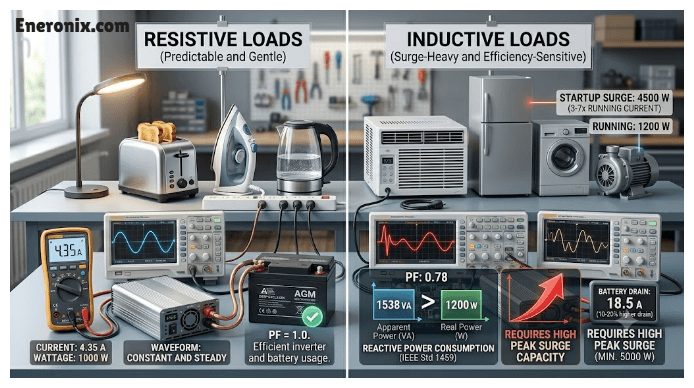
Not all loads behave the same way from the battery’s perspective. The distinction between resistive and inductive loads affects both the instantaneous current drawn from the battery and the efficiency of the inverter.
Resistive Loads: Predictable and Gentle
Resistive loads convert electricity directly to heat or light. LED bulbs, incandescent bulbs, electric heaters, electric irons, and electric kettles are resistive. They draw a constant, predictable current with no startup surge. What you see on the wattage label is what they draw continuously. These are the easiest loads for a battery to carry.
Inductive Loads: Surge-Heavy and Efficiency-Sensitive
Inductive loads contain motors or transformers. Air conditioners, refrigerators, ceiling fans, water pumps, and washing machines are inductive. They draw 3 to 7 times their running wattage for the first 0.5 to 3 seconds of every startup. After startup, they settle to their normal running current.
For battery systems, inductive loads create two considerations:
- Startup surge: The inverter must handle the peak surge without tripping. A 1.5HP AC unit with a 4,500W startup surge requires an inverter with at least 4,500W peak capacity, even though the running load is only 1,200W.
- Power factor: Inductive loads have a power factor below 1.0, typically 0.7 to 0.85 for motors. The inverter must supply both real power (watts) and reactive power (VAR). The battery supplies all of this. An air conditioner drawing 1,200W real power may actually require the inverter to supply 1,400 to 1,600VA from the battery due to the power factor. This is why inductive loads drain batteries faster than pure wattage figures suggest.
The difference between a battery carrying resistive loads and the same battery carrying inductive loads of the same rated wattage is typically 10 to 20% more battery drain per hour for inductive loads. Factor this into any runtime estimate involving motors. According to the IEEE standard on power factor in AC circuits (IEEE Std 1459), reactive power consumption in inductive loads is real energy drawn from the source even though it does not perform useful work in the load itself.
What Other Guides on Battery Load Capacity Get Wrong
Three specific gaps that appear in almost every article on this topic.
1. Confusing Inverter kVA with Battery Watt Capacity
A 5kVA inverter does not deliver 5,000W to your appliances. It delivers approximately 4,000W at 0.8 power factor. When a salesman says “this 5kVA system can carry all your loads,” they are using kVA as if it equals watts. For resistive loads (heaters, lights, simple electronics), kVA and watts are close. For inductive loads (air conditioners, motors), the gap matters. Always convert kVA to watts using: Watts = kVA x 0.8 for mixed residential loads.
2. Ignoring the Battery-to-Inverter Current Limit
The DC connection between battery and inverter has its own current limit determined by cable size and inverter input specs. A 5kVA inverter drawing 4,000W from a 48V battery requires approximately 4,000 / 48 / 0.90 = 92.6A of DC current. The cables connecting the battery to the inverter must be sized to carry this current without significant voltage drop or heat buildup. In many Nigerian installations, the installer uses undersized DC cables that limit effective power delivery before the inverter or BMS limits are reached. See our DC cable sizing guide for the correct cable specifications at every system voltage and current level.
3. Treating Peak Load as Continuous Load
When sizing a battery for “how much load it can carry,” many guides add up all the nameplate ratings of every appliance in the home. This produces a wildly inflated figure because it assumes everything runs simultaneously at full rated power. In a real Nigerian home, not every appliance runs at the same time, and cyclic loads like fridges and air conditioners do not draw their rated wattage continuously.
The correct approach is to calculate the average continuous load across your actual usage pattern, not the theoretical maximum. Our off-grid system load audit guide shows you how to build an honest load profile that accounts for duty cycles, usage hours, and load diversity.
How to Size a Battery for Your Actual Load
Combining the power and energy considerations from this article, here is the four-step process for sizing a battery correctly.
- Step 1: Calculate your average continuous load. Add up the average watts of every appliance you run simultaneously during the longest outage window. Account for duty cycles on cycling loads. Include inverter no-load consumption (30 to 80W). This is your design load.
- Step 2: Determine required usable Wh. Multiply your design load by the number of hours you need backup. Divide by 0.90 for inverter efficiency. This is your minimum usable Wh requirement.
- Step 3: Calculate required battery Ah. Divide required usable Wh by (System Voltage x DoD%). For a 48V LiFePO4 system: Required Ah = Required Wh / (48 x 0.80). Round up to the next standard battery size.
- Step 4: Check discharge rate. Verify your design load draws at 0.3 to 0.5C maximum. Design Load Watts / System Voltage / Battery Ah = discharge rate in C. If this exceeds 0.5C, increase the battery bank size.
Worked example for a 3-bedroom Lagos home without AC:
- Design load: 600W (lights, fans, fridge, TV, charging, inverter no-load)
- Required Wh: 600W x 10 hours / 0.90 = 6,667 Wh
- Required Ah: 6,667 / (48 x 0.80) = 6,667 / 38.4 = 174Ah. Round up to 200Ah.
- Discharge rate check: 600W / 48V / 200Ah = 0.0625C. Well within the 0.3C comfortable limit.
Result: A 48V 200Ah LiFePO4 is the correct size. It delivers 6,912 Wh usable against a 6,667 Wh requirement, a 3.7% safety margin. The 0.0625C discharge rate means the battery is operating extremely gently and will achieve maximum cycle life.
Frequently Asked Questions
How many watts can a 100Ah battery carry?
A 48V 100Ah LiFePO4 can deliver up to 4,800W at 1C discharge. That’s the BMS ceiling. In practice your inverter decides what actually comes out on the AC side. 2kVA inverter, you’re at 1,600W. 3kVA, you’re at 2,400W. For how long the battery holds those loads is a separate question answered in our dedicated article on how long a 100Ah battery lasts.
Can a battery carry too much load?
Yes. Push past the BMS maximum discharge current and the BMS cuts the battery off to protect the cells. Push past the inverter’s continuous output rating and the inverter shuts down or goes into overload protection. In most Nigerian installations the inverter trips first because it’s the tighter limit. A simple way to avoid this: keep your peak load under 80% of the inverter’s continuous rating. That margin absorbs spikes without nuisance tripping.
Does adding more batteries increase the load I can carry?
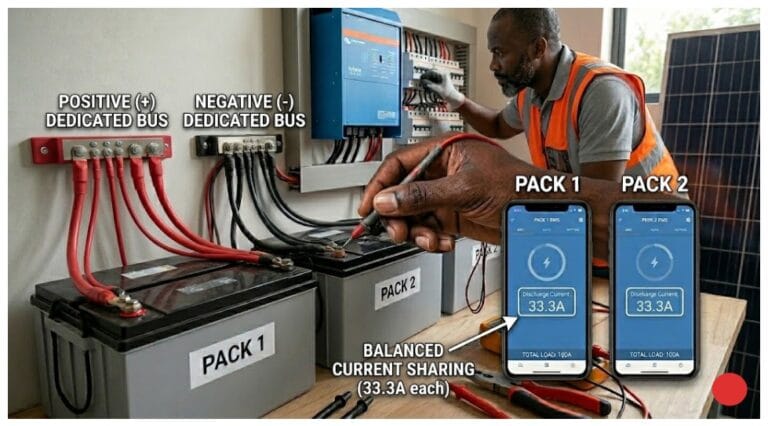
Partially. Two 200Ah batteries in parallel doubles the current capacity of the bank and extends runtime significantly. It also means neither battery is being pushed as hard individually, which is good for cycle life. But the inverter is still the ceiling on maximum AC load. More batteries behind the same inverter does not move that ceiling. If the load is the problem, the inverter is what needs to change.
What happens if I run too much load on my battery?
Depends which limit you hit first. Exceed the inverter’s continuous rating and it trips into overload protection. Exceed the BMS discharge current limit and the BMS disconnects. Sustain a heavy but within-limit load for too long and battery temperature climbs, thermal protection may kick in, and cycle life starts declining faster than it should. None of this causes permanent damage in a single event. But do it repeatedly and you’re shortening the life of both the inverter and the battery, usually quietly, usually until something stops working earlier than anyone expected.
How do I find out what load my battery is currently carrying?
Most hybrid inverters show current power draw on the front panel or in the monitoring app. A clamp meter on the DC cables between battery and inverter gives you the current directly. Multiply that by battery voltage to get DC watts. AC output will be roughly 90% of that. For ongoing monitoring with real numbers and history, a Victron SmartShunt is the tool. Fits cleanly into most Nigerian residential setups and actually tells you what’s happening inside the system.
Does the load I carry affect battery lifespan?
Yes, and more than most people account for when sizing. Higher discharge rates mean more heat inside the cells, which accelerates electrolyte degradation and capacity fade. Running at 0.2 to 0.3C instead of 0.7 to 1C can double or triple effective cycle life. Battery University’s analysis of lithium discharge characteristics covers the physics if you want to go deeper. For most Nigerian homes without AC the natural discharge rate sits in the 0.05 to 0.15C range anyway, so the battery is being treated gently by default. That’s one of the underappreciated advantages of right-sizing a system.
The Bottom Line
How much load a battery can carry is two questions pretending to be one. The power question: a 48V 200Ah LiFePO4 can theoretically push 9,600W. The real ceiling is the inverter, typically 2,400 to 4,000W for common Nigerian residential systems. The energy question: at 2,000W that same battery lasts 3.5 hours. At 600W, 11.5 hours. Different math, different answer.
The more useful question isn’t the maximum anyway. It’s the optimal. What load should you actually design for so the battery runs seven to ten years, handles your outages without drama, and doesn’t stress the inverter into early failure. For most Nigerian homes without AC, a 200Ah battery is already generously sized and running at a fraction of its rated capacity. That’s not a problem. That’s exactly what you want.
To size a complete system properly from the start, use the four-step process in this article alongside our off-grid solar system design guide for Nigeria. If your current system isn’t lasting as long as it should, the nine causes in our article on why your battery dies faster than expected will point you at what to fix.

I am Engr. Ubokobong Ekpenyong, a solar specialist and lithium battery systems engineer with over five years of hands-on experience designing, assembling, and commissioning off-grid solar and energy storage systems. My work focuses on lithium battery pack architecture, BMS configuration, and system reliability in off-grid and high-demand environments.