
Can a Hybrid Solar Inverter Work Without a Battery
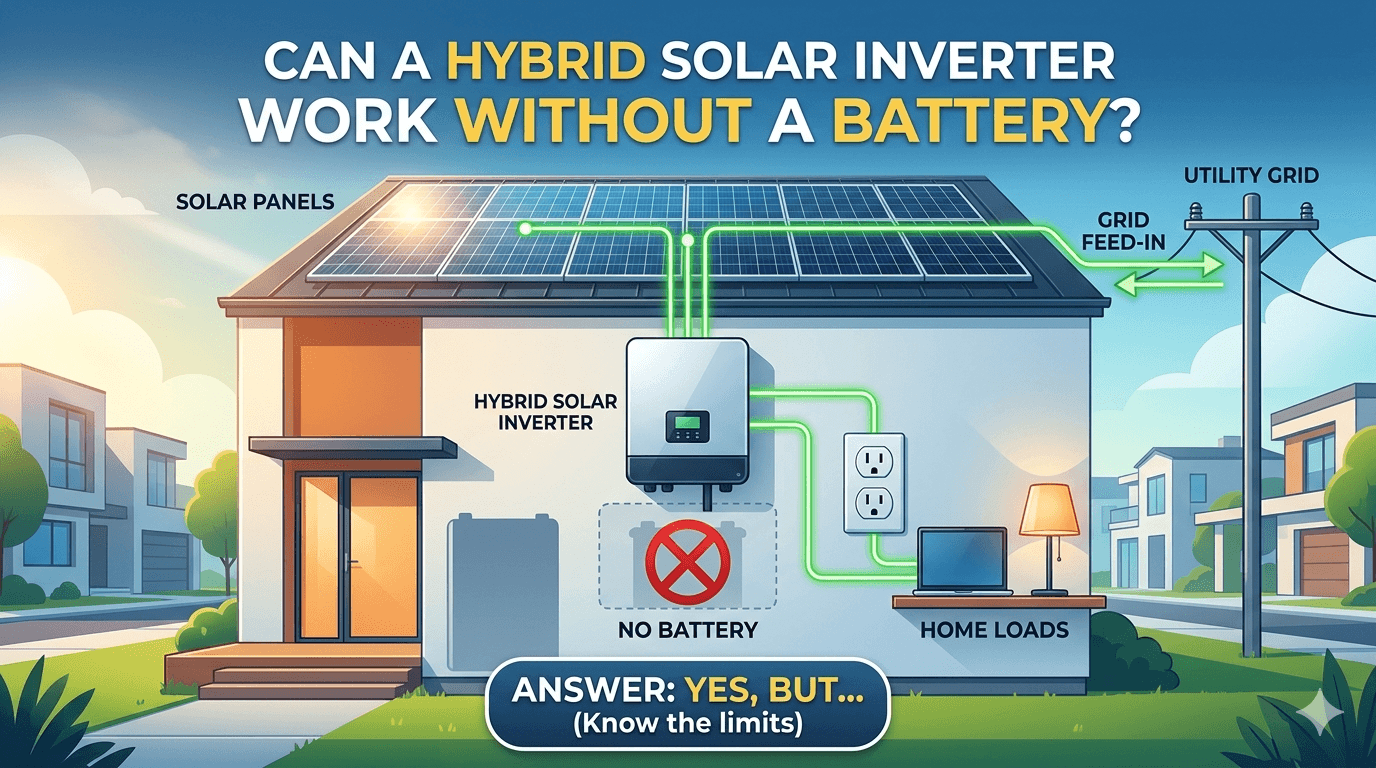
Yes. hybrid solar inverter can work without battery.
But the moment you remove the battery, the system stops being hybrid. It becomes a grid-tied inverter. In Nigeria, a grid-tied inverter shuts down completely every time NEPA takes light, even in full afternoon sun.
That is the short answer. The rest of this article explains exactly why, what changes technically when the battery is absent, how each major brand handles it, and what the minimum viable battery looks like for a Nigerian home.
In one sentence: A batteryless hybrid inverter works only when the grid is present and the sun is up simultaneously. In Lagos, that overlap averages 4 to 6 hours per day.
What a Battery Actually Does in a Hybrid System
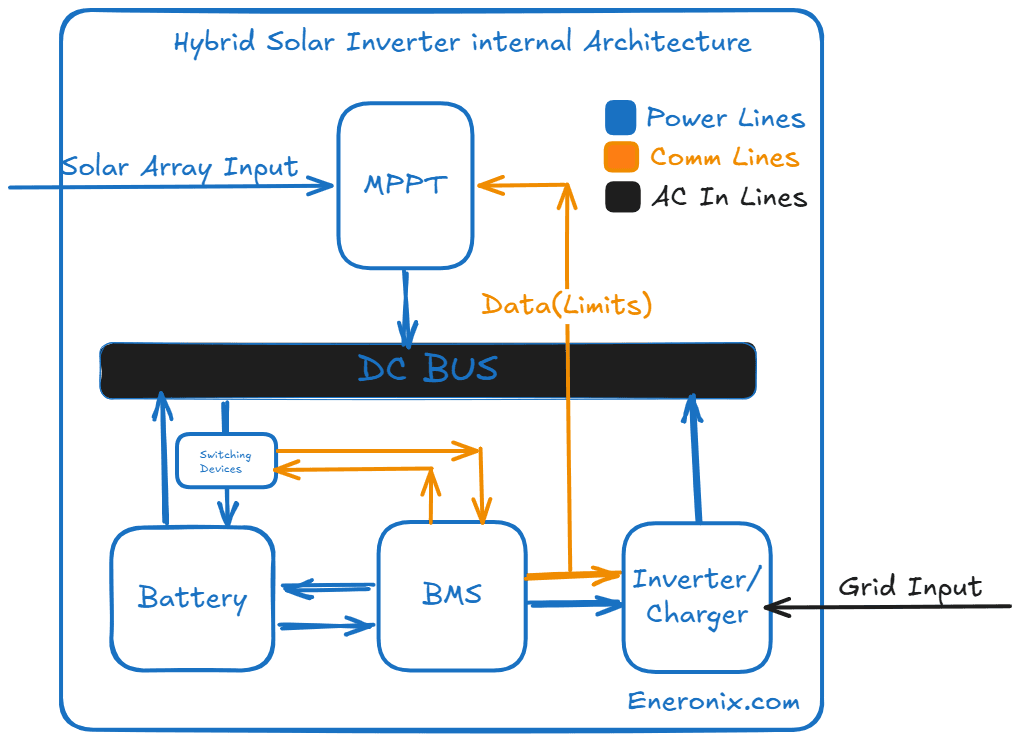
Most buyers think the battery is a storage tank. It is more than that.
In a DC-coupled hybrid system, the battery bank is the DC bus reference. Every component in the system orients itself around this bus. The MPPT charges into it. The inverter draws from it. The BMS signals tell the inverter exactly how much current that bus can accept or deliver at any moment.
The battery does three things simultaneously that no other component can replicate.
1. It stabilises DC bus voltage
A LiFePO4 bank holds the 48V bus between 48V and 58.4V across its entire SOC range. When irradiance drops 30% in one second as a cloud passes, the battery absorbs the generation shortfall instantly. When a motor load spikes demand, the battery sources the current spike before the MPPT can respond. This is low-impedance bus clamping. The battery’s internal resistance is typically 20 to 50 milliohms for a well-configured LiFePO4 bank. It responds to transients faster than any control loop can.
2. It is the AC generation reference during blackouts.
The hybrid inverter synthesises a 230V 50Hz AC waveform using the DC bus as its energy source. Without the battery, there is no stable DC bus. The inverter cannot synthesise AC independently. It needs the grid’s waveform as a reference instead, which is exactly why batteryless operation requires the grid to be present at all times.
3. It enables BMS-managed charge optimisation.
With a battery connected and BMS communication active, the inverter receives CVL, CCL, and DCL signals every second. These signals tell the inverter what voltage to apply, how much current to push, and how much current the battery will allow to be drawn. Without a battery, this entire layer of intelligent charge management does not exist.
For a deep technical breakdown of how these three signals work in real time, read our guide on CVL, CCL, and DCL dynamic battery limits.
What Happens Without a Battery
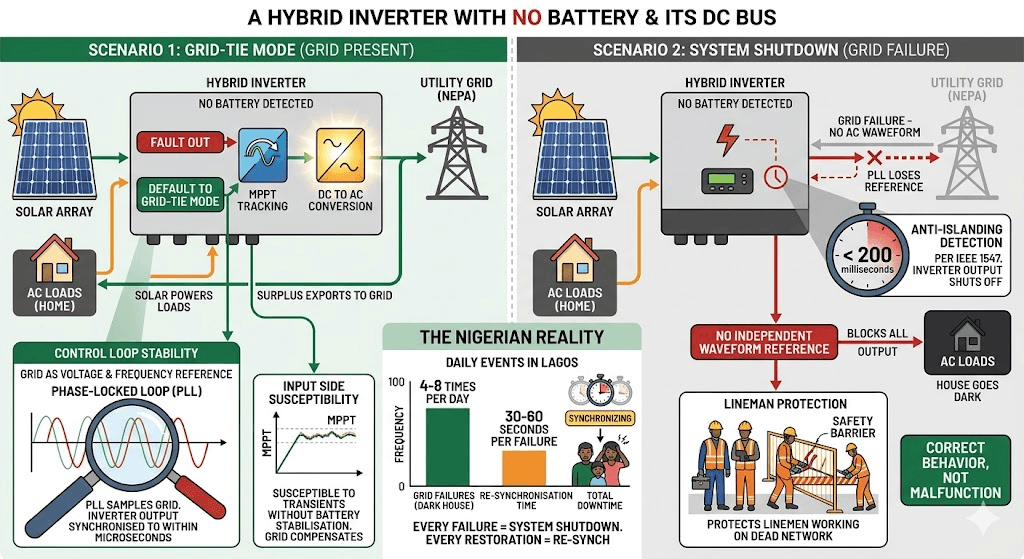
When a hybrid inverter detects no battery on its DC bus, it does one of two things depending on firmware: it faults out, or it defaults to grid-tie mode.
In grid-tie mode, the inverter uses the grid’s AC waveform as its voltage and frequency reference. It runs the MPPT, tracks the array’s maximum power point, converts DC to AC, and synchronises that AC output with the grid. Solar powers your loads. Any surplus exports to the grid.
The control loop stability in this mode is entirely dependent on the grid. The grid is the stiff voltage source that the inverter’s output stage locks onto via a phase-locked loop (PLL). The PLL continuously samples grid voltage and frequency and keeps the inverter’s output synchronised to within microseconds. Without the battery’s DC bus stabilisation, the inverter’s input side is more susceptible to transient voltage swings from load changes or irradiance fluctuations. Most modern hybrid inverters handle this adequately in grid-tie mode. The grid on the output side compensates for what the battery would have absorbed on the input side.
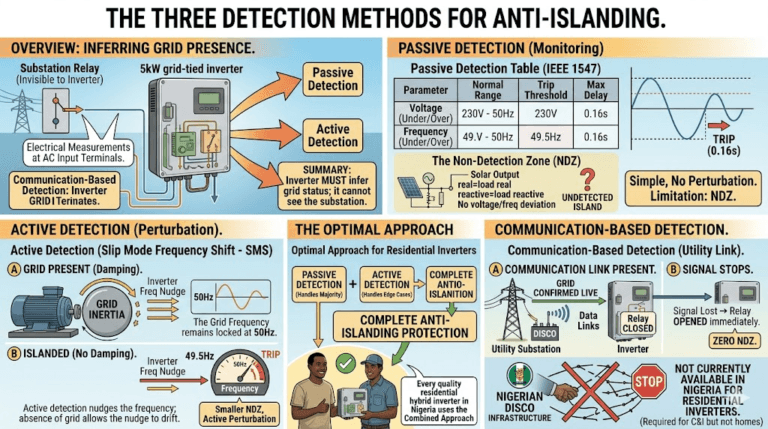
The moment the grid fails, the PLL loses its reference. The inverter’s anti-islanding detection triggers within 200 milliseconds per IEEE 1547 requirements. The inverter shuts its output off. Your house goes dark. The solar array is still producing full power. The MPPT is still tracking. But the inverter blocks all output because it has no reference waveform to synchronise to and no battery to generate one independently.
This is not a malfunction. It is correct behaviour. It protects NEPA linemen working on the dead network from being electrocuted by your system’s output.
The problem for a Nigerian buyer is the frequency of this event. NEPA fails multiple times per day in most locations. Every failure is a complete system shutdown. Every restoration requires the inverter to re-synchronise, which takes 30 to 60 seconds. A typical Lagos home triggers this cycle 4 to 8 times per day in a batteryless hybrid system.
What You Lose Without a Battery vs What Still Works
| Capability | With Battery | Without Battery |
| Blackout operation (island mode) | Yes | No |
| Overnight use from solar storage | Yes | No |
| Solar during NEPA outage | Yes | No |
| BMS-managed charge protection | Yes | No |
| TOU grid charge scheduling | Yes | No |
| Daytime solar self-consumption | Yes | Yes |
| Grid export of surplus solar | Yes | Yes (if DISCO allows) |
| MPPT solar tracking | Yes | Yes |
| Remote monitoring | Yes | Yes |
Every capability that makes a hybrid system worth buying in Nigeria requires the battery. The two capabilities that work without a battery (daytime self-consumption and grid export) are available in a standard grid-tied inverter at significantly lower cost. There is no financial case for buying a hybrid inverter to use only in batteryless mode permanently.
Brand-Specific Behaviour in Nigeria
Felicity Hybrid Inverters
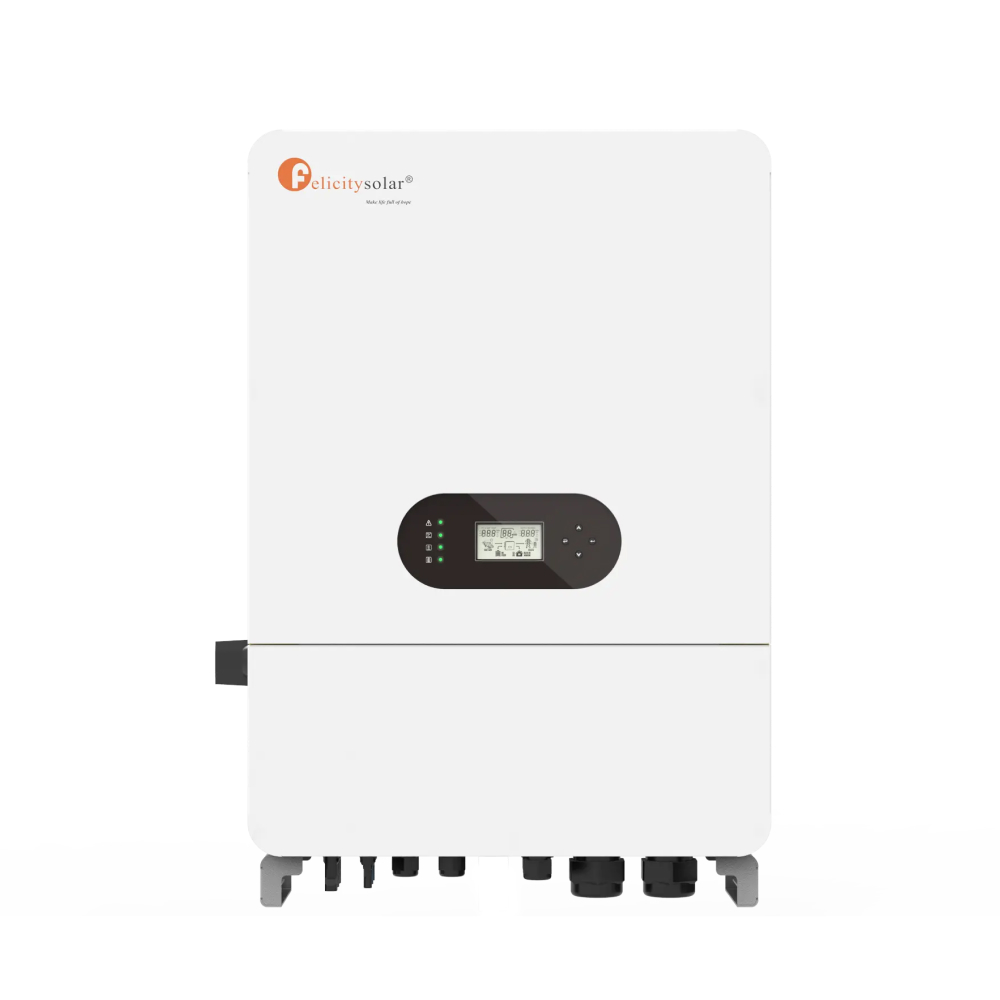
Felicity is one of the most widely deployed hybrid brands in Nigeria. Their hybrid range supports batteryless grid-tie operation in most models. Without a battery connected, the inverter runs in on-grid mode: solar powers loads, surplus exports to grid if available.
In island mode with no battery: Felicity hybrid inverters shut down output. No backup capability.
When adding a battery to a Felicity system: the inverter communicates via RS485. Verify that the LiFePO4 battery BMS supports the Felicity RS485 protocol. Felicity-branded batteries are pre-configured for compatibility. Third-party batteries require manual protocol matching.
Deye Hybrid Inverters
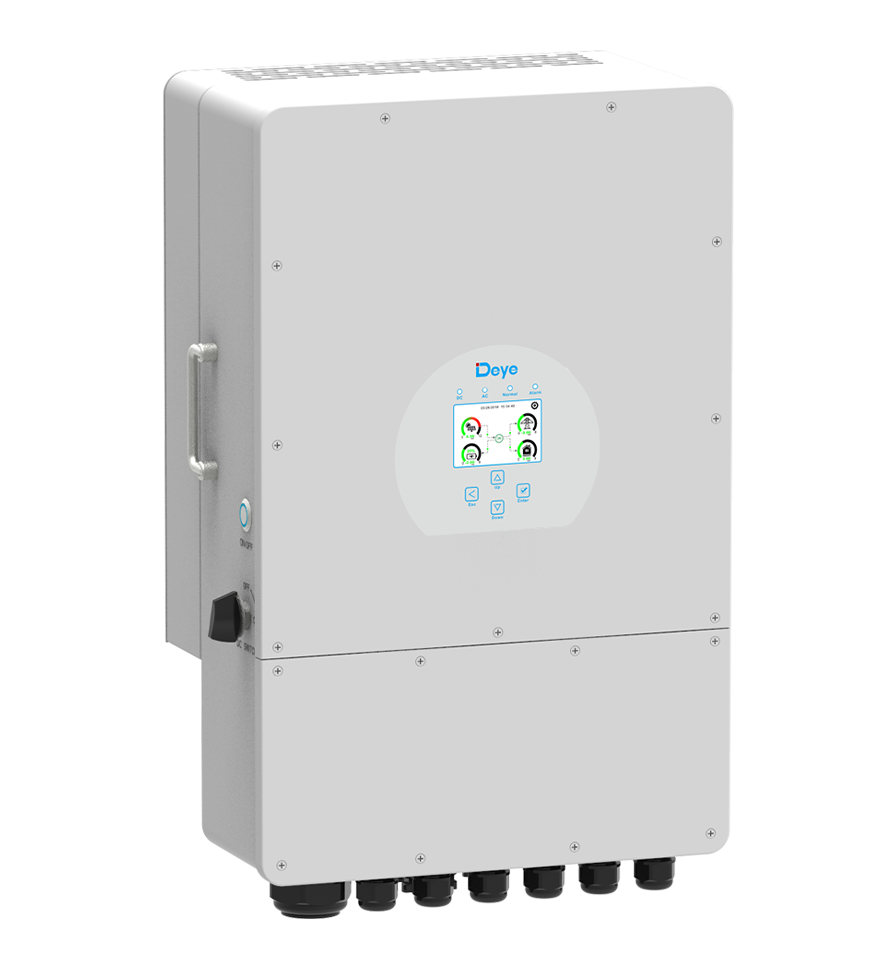
Deye hybrid inverters support batteryless grid-tie operation natively on most models. The firmware detects battery absence and defaults to grid-interactive solar operation without requiring a workaround.
In island mode without a battery: Deye shuts down output. No backup.
Deye is the most flexible brand for staged installations where the battery is added later. The transition from batteryless grid-tie mode to full hybrid mode at battery commissioning is clean and does not require firmware changes.
Growatt SPH Series
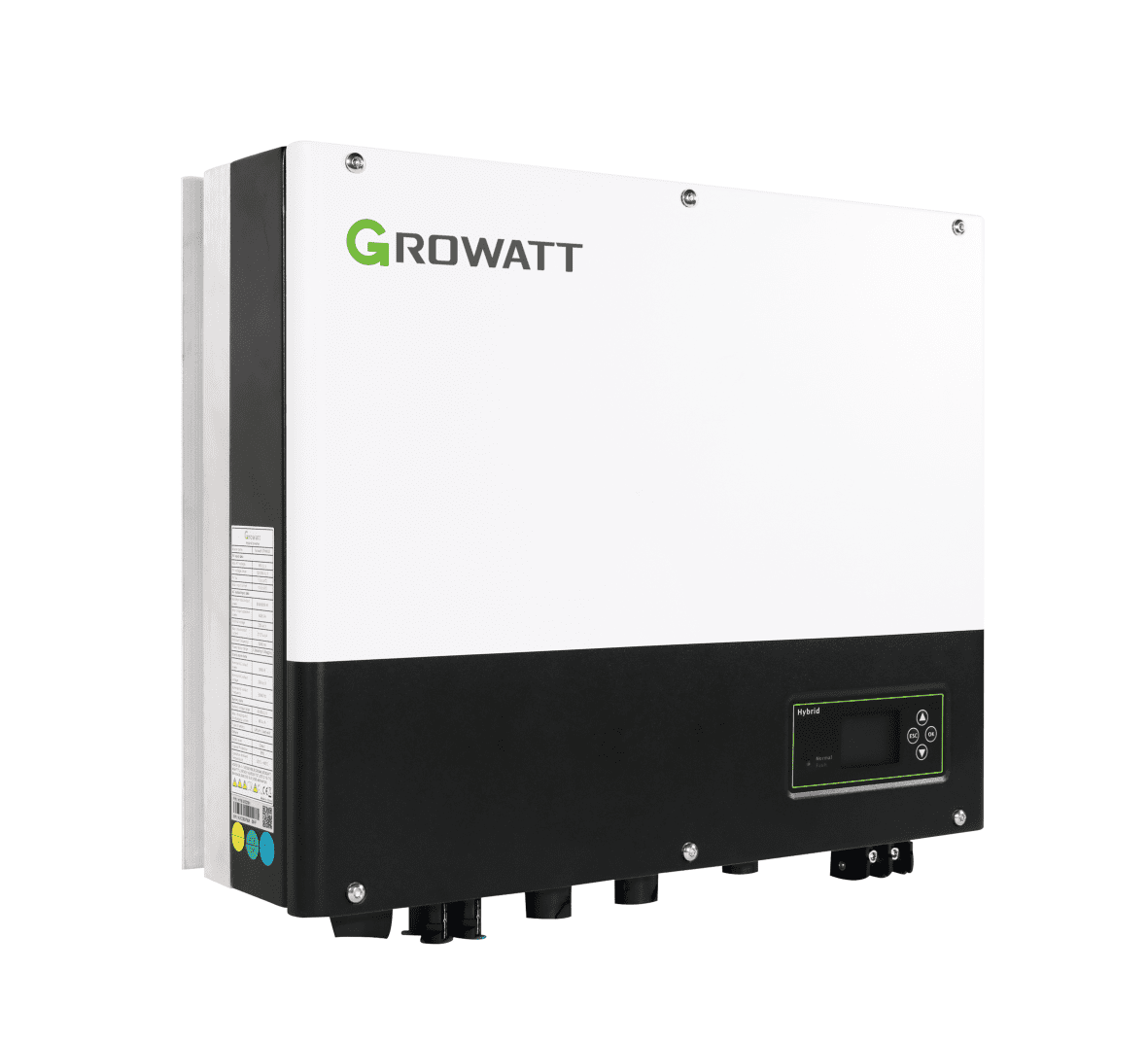
The Growatt SPH series does not natively detect no battery and default to grid-tie mode in older firmware. The workaround confirmed in the field: connect a short copper wire across the inverter’s battery positive and negative terminals. This simulates a battery presence signal and allows the inverter to enter grid-tie mode.
This is a workaround, not a designed feature. Remove it before connecting the battery bank.
In island mode without a battery: Growatt SPH shuts down. The EPS output socket, which is the dedicated backup port, requires a battery to function. Without one, EPS output is dead.
Victron Multiplus-II
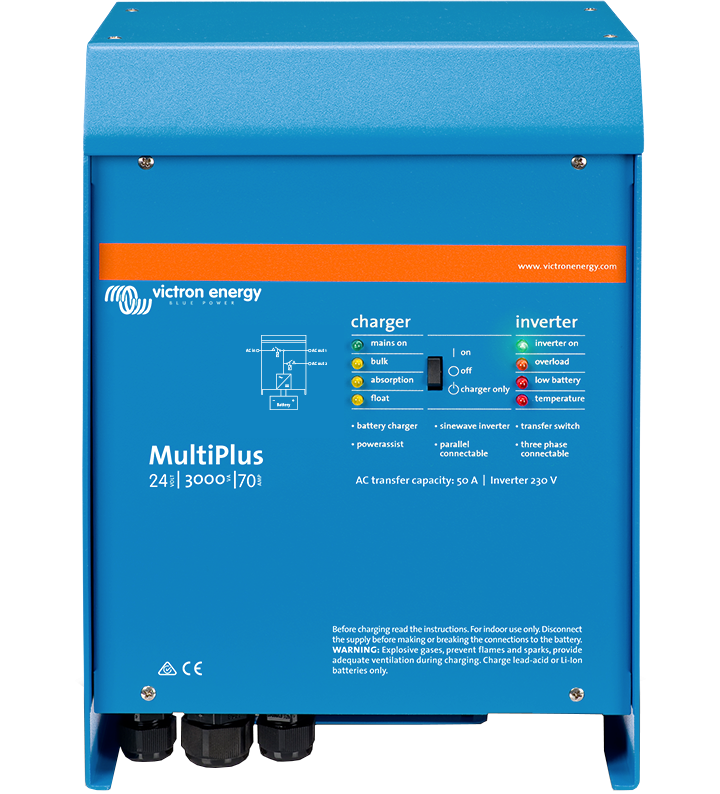
Victron Multiplus-II is an inverter-charger by design, not a grid-tied inverter. It requires a battery to generate its AC output in any mode. Without a battery, the Multiplus-II does not operate as a solar inverter.
In a Victron system, the solar array connects to a separate SmartSolar MPPT charge controller. Without a battery, the SmartSolar has nowhere to push charge and the Multiplus has nothing to invert. The system does not function.
This architecture is correct for Nigerian conditions. It makes skipping the battery impossible by design. If you are building a Victron system, the battery is not optional at any stage.
Luminous and Prag Hybrid Inverters
Both brands are common in the Nigerian market at the entry level. Both support batteryless grid-tie operation in their hybrid models. In island mode without a battery: both shut down. Grid export capability depends on DISCO metering configuration. These brands are best used with their own branded battery range to avoid BMS communication compatibility issues.
The Three Scenarios Where Batteryless Makes Sense
Scenario 1: Staged Installation
You buy the inverter and solar array first. You commission in grid-tie mode. You add the battery when the budget is ready, typically 3 to 9 months later.
During the staging period: daytime solar reduces generator or NEPA consumption. You get partial value immediately. No blackout backup.
This is the only scenario where batteryless operation makes financial sense for a Nigerian residential buyer. The condition is that the battery purchase date is committed, not indefinite.
Scenario 2: Daytime-Only Commercial Load
A business that operates only during daylight hours and has reliable generator backup for after-hours needs. A school, a workshop, a market stall cluster, or a manufacturing unit that shuts at 6pm.
For this application, batteryless hybrid operation in grid-tie mode reduces generator running hours during business hours. The generator covers the gaps when NEPA fails during the day.
Scenario 3: Commissioning and Testing
During installation, the battery may not be connected while the installer verifies solar production, MPPT tracking, and monitoring platform operation. Batteryless grid-tie operation for a few hours during commissioning is normal and expected.
Why Batteryless Is the Wrong Permanent Choice for Nigerian Homes
A Nigerian household on typical DISCO supply experiences:
- 8 to 14 hours of NEPA absence per day
- 10 to 12 of those hours overnight with zero solar production
- Multiple daily grid failures during daylight hours
In a batteryless hybrid system in Lagos:
- Overnight hours: complete blackout, no solar, no battery
- Daytime NEPA failures: inverter shuts down in full sun within 200ms
- System operational window: NEPA present AND sun producing simultaneously
That overlap in Lagos averages 4 to 6 hours per day in the dry season. Less in the wet season.
For a system that costs N380,000 to N1,500,000 for the inverter alone, 4 to 6 hours of daily benefit is an expensive daytime grid supplement. A N250,000 standard grid-tied inverter delivers the same capability at lower cost.
The hybrid premium is justified only when the battery is present and the island mode, overnight operation, and BMS management capabilities are active.
Read our article on what a hybrid solar system actually is to understand why the battery is not a component of a hybrid system. It is the definition of one.
What Changes When You Add the Battery
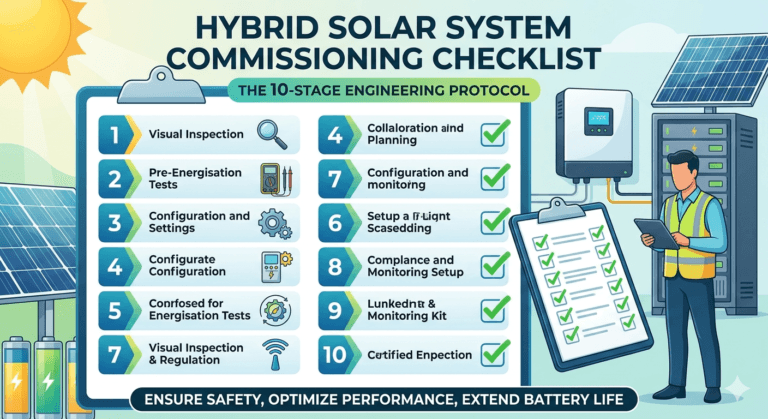
When the battery arrives, here is the exact commissioning sequence.
Step 1: Physical Connection
Connect battery positive and negative to the inverter’s battery terminals using correctly rated DC cables. Install an ANL fuse within 300mm of the battery positive terminal. Cable sizing must match the battery’s maximum DCL current, not just the inverter’s rated current.
Step 2: BMS Communication Cable
Connect the battery’s BMS communication port to the inverter’s CAN or RS485 port using the manufacturer-supplied communication cable. Verify the correct port designation on the inverter’s rear panel before connecting.
Step 3: Parameter Configuration
This is the step most Nigerian installers skip. Configure these settings before closing the installation:
- Battery type: LiFePO4 (not AGM, not lead-acid, not sealed)
- Charge voltage limit: 56.8V to 58.4V for 48V LiFePO4 (match your battery datasheet)
- Discharge cut-off: 44V to 46.4V for 48V LiFePO4
- Float charging: Disabled or set equal to absorption voltage
- Low SOC threshold: 20% minimum
- BMS communication protocol: CAN or RS485 as applicable
- AC input current limit: Set to match NEPA meter rating or generator capacity
Step 4: Verify BMS Communication Is Active
On the inverter display, the battery SOC should read from the BMS, not from a voltage estimate. If the SOC reads as a voltage-based estimate (e.g., 48.2V = 60%), BMS communication is not working. Do not close the installation until this is confirmed active.
A system that runs without active BMS communication is managing the battery blind.
Read our guide on inverter-battery communication protocols and our article on why most solar battery systems fail before year 2 to understand exactly what happens when this step is skipped.
The Minimum Viable Battery for a Nigerian Hybrid System
If budget is the constraint, the question is not whether to include a battery. It is what the minimum battery capacity is that makes the system genuinely hybrid.
| Battery Size | Usable Capacity (80% DoD) | Overnight Backup (800W load) | Approx. Cost (Naira) |
| 5kWh (48V 100Ah) | 4kWh | 5 hours | N1,050,000 to N1,400,000 |
| 10kWh (48V 200Ah) | 8kWh | 10 hours | N1,650,000 to N2,650,000 |
| 15kWh (48V 300Ah) | 12kWh | 15 hours | N2,300,000 to N3,100,000 |
A 5kWh LiFePO4 battery is the minimum that delivers genuine hybrid capability. It gives you island mode during blackouts, 5 hours of overnight backup for essential loads, BMS-managed charge protection, and full TOU scheduling capability.
Below 5kWh, backup duration is too short to cover a typical Lagos overnight. Above 10kWh, you have comfortable all-night coverage for a standard 3-bedroom essential load profile.
Use our LiFePO4 battery bank calculator to calculate exactly what battery capacity your load and autonomy target require. For the full system cost picture, read our hybrid solar system price guide.
Your Next Three Steps
Step 1: Calculate your daily essential load and overnight energy requirement. Use our load audit guide and off-grid solar system sizing calculator.
Step 2: Size the battery from your overnight load and autonomy target. Use our LiFePO4 battery bank calculator. Target 10 to 12 hours of essential load coverage as your minimum for Nigerian conditions.
Step 3: Select your inverter based on peak load, surge requirement, and temperature-derated output. Use our inverter sizing calculator and read our complete hybrid solar system design guide for the full design sequence.
Frequently Asked Questions

Can a hybrid solar inverter work without a battery?
Yes, most hybrid inverters run in grid-tie mode without a battery. They convert solar DC to AC, power your daytime loads, and export surplus to the grid. But without a battery, the system loses island mode, overnight operation, and BMS charge management. It shuts down completely during every NEPA blackout. For Nigerian conditions this delivers 4 to 6 hours of daily practical benefit at best.
What happens when the grid fails and the hybrid inverter has no battery?
Anti-islanding protection triggers within 200 milliseconds. The inverter cuts its output. This happens regardless of solar production. A 4kW array producing at full capacity in midday Lagos sun will be completely blocked. The grid is the inverter’s AC reference in batteryless mode. Without the grid, there is no reference and no output.
Which hybrid inverter brands in Nigeria work without a battery?
Felicity, Deye, Growatt SPH (with copper wire workaround), Luminous hybrid, and Prag hybrid all support batteryless grid-tie operation. Victron Multiplus-II does not operate without a battery by design. For staged installations where the battery comes later, Deye and Felicity are the cleanest options because they support batteryless operation natively without firmware tricks.
Is it worth buying a hybrid inverter without a battery to save money?
Only as a staged installation with a committed battery purchase timeline. As a permanent configuration, a batteryless hybrid delivers only daytime solar self-consumption, which a standard grid-tied inverter provides at lower cost. The hybrid inverter premium is justified only when the battery is present and active.
What is the minimum battery for a hybrid system to be worth it in Nigeria?
A 5kWh LiFePO4 (48V 100Ah) is the minimum. It provides 5 hours of essential load backup, island mode during blackouts, and BMS-managed charge protection. For a standard 3-bedroom Lagos home, 10kWh is the practical target for full overnight coverage.
Can a hybrid inverter charge a battery without the grid?
Yes. In a correctly configured system, the MPPT charges the battery from solar regardless of grid availability. Grid presence does not affect solar-to-battery charging. The inverter uses solar to charge the battery and power loads simultaneously. The grid is supplementary, not required.
Does adding a battery later void the inverter warranty?
No. Hybrid inverters are designed for battery addition at any stage. The battery connects to dedicated terminals and a BMS communication port. No inverter modification is required. Verify battery-to-inverter protocol compatibility (CAN or RS485) before purchasing the battery to ensure BMS communication will work correctly at commissioning.
Conclusion
A hybrid solar inverter can work without a battery. What it cannot do without one is be a hybrid system in any meaningful sense for a Nigerian buyer.
In grid-tie mode without a battery, the inverter works 4 to 6 hours per day during the overlap of daylight and NEPA supply. For the other 18 to 20 hours, it is either shut down due to NEPA failure or inactive because the sun is not up.
A 5kWh LiFePO4 battery changes everything. Island mode activates. Overnight operation is possible. BMS communication protects the cells. TOU scheduling works. The system earns its price.
If budget requires a staged approach, buy the inverter and panels now, run in grid-tie mode, and add the battery within 6 to 9 months. But commit to that timeline.
A batteryless hybrid in Lagos is a grid-tied inverter with extra steps. The battery is what makes it something worth buying.
eneronix.com Your Energy, Our Precision

I am Engr. Ubokobong Ekpenyong, a solar specialist and lithium battery systems engineer with over five years of hands-on experience designing, assembling, and commissioning off-grid solar and energy storage systems. My work focuses on lithium battery pack architecture, BMS configuration, and system reliability in off-grid and high-demand environments.