What Is the Biggest Disadvantage of a Lithium Battery?
The biggest disadvantage of a lithium battery systems isn’t what most articles claim. See how BMS dependency and configuration errors drive premature failure.
A ₦1.3 million lithium battery can lose 40% capacity in under 18 months, not because it’s defective, but because of one configuration mistake almost every installer makes
Search for the biggest disadvantage of a lithium battery and you will find the same five points recycled across dozens of articles: high cost, aging, safety risks, temperature sensitivity, and transportation restrictions. Some articles add a sixth point about the need for a protection circuit.
The biggest LiFePO4 battery disadvantages in solar systems is BMS dependency. Everything else, cost, temperature, lifespan, matters less if the BMS or configuration is wrong.
That framing produces answers that are simultaneously technically correct and operationally useless.
The lithium-ion family encompasses chemistries with materially different performance profiles, failure modes, and disadvantage hierarchies. Lithium Nickel Manganese Cobalt Oxide, known as NMC, has a nominal cell voltage of 3.6 to 3.7V, high energy density, and a significant thermal runaway risk if overcharged or physically damaged. Lithium Iron Phosphate, known as LiFePO4, has a nominal cell voltage of 3.2V, lower energy density, and a substantially more stable thermal profile. An article that discusses thermal runaway as a primary disadvantage of lithium batteries without specifying which chemistry it is describing is providing incomplete information. LiFePO4, which is the chemistry in virtually every serious off-grid solar installation in Nigeria, is in a different risk category from NMC on the thermal question.
The application context matters equally. A battery powering a smartphone in an air-conditioned office has a different disadvantage profile from the same chemistry powering a 10kWh solar storage system in an unventilated equipment room in Port Harcourt during harmattan season. Transportation restrictions that are the primary disadvantage for a logistics operator are irrelevant to a system owner whose battery is installed and stationary. Aging characteristics that are negligible in a lightly cycled backup system are critical in a system that cycles daily.
This post answers the question correctly, which means answering it in the specific context where the question is most commonly asked on Eneronix: off-grid and solar backup power systems operating in tropical environments, predominantly using LiFePO4 chemistry, installed and maintained in a market where installer competence and product quality vary significantly.
The disadvantages covered here are ranked by their actual impact in that context, not by how frequently they appear in generic lists. Some of the most damaging disadvantages in real-world Nigerian installations do not appear in any of the top-ranking articles on this topic. That gap is precisely what this post exists to fill.
The cost disadvantage of LiFePO4 relative to tubular and lead-acid batteries is real and significant in the Nigerian market. A quality 48V 100Ah LiFePO4 battery currently costs between N1.1 million and N1.5 million at Lagos retail prices. An equivalent tubular battery bank delivering the same nominal capacity costs roughly a quarter of that. For households and small businesses where the purchase decision is driven primarily by what is affordable today, this gap is not theoretical. It is disqualifying.
What most generic disadvantage lists stop short of examining is whether the upfront cost premium represents a genuine disadvantage over the life of the system or whether it is a financing problem masquerading as a value problem.
The total cost of ownership calculation requires accounting for three factors that the upfront price comparison ignores. The first is usable capacity. A 100Ah tubular battery should not be cycled below 50% depth of discharge without accelerating degradation significantly. A 100Ah LiFePO4 battery can be cycled to 80% depth of discharge with minimal impact on rated cycle life. Two batteries with the same nameplate capacity deliver materially different usable energy per cycle, which means the tubular bank must be sized larger to deliver the same daily energy as the lithium alternative.
The second factor is replacement frequency. A well-managed tubular battery bank in daily cycling service in a Nigerian solar system typically needs replacement within three to five years. The same daily service on a quality LiFePO4 installation with correct configuration, adequate ventilation, and a competent BMS delivers eight to twelve years of service before reaching 80% of original capacity. Over a ten-year horizon the tubular bank has been replaced at least once, often twice, and the cumulative spend frequently exceeds the single lithium investment.
The third factor is round-trip efficiency. LiFePO4 operates at approximately 95 to 98% round-trip efficiency. Tubular lead-acid operates at 75 to 85%. In a solar system where every kilowatt-hour of charge costs panel capacity and MPPT controller throughput, the efficiency gap translates directly into array sizing. A system designed around tubular batteries needs a larger solar array to deliver the same net daily energy to loads, adding capital cost that the upfront battery price comparison does not capture.
Where cost is genuinely a disqualifying disadvantage is in two specific scenarios. The first is a lightly cycled backup system that discharges only during infrequent grid outages and spends most of its life in standby. In this application the lithium cycle life advantage is not realised because cycles are infrequent, and the upfront premium is harder to justify against the lower-cost alternative. The second is a system where the capital constraint is absolute and the choice is between a functional tubular system today and no system at all. The theoretically superior technology is not superior if the capital to purchase it does not exist.
Outside those two scenarios, cost is better understood as a cash flow challenge than a fundamental disadvantage. The battery is cheaper on a per-kilowatt-hour-delivered basis over its service life. It is more expensive to acquire. That distinction matters for how the purchasing decision is framed and financed.
2. BMS Dependency
Of all the disadvantages on this list, BMS dependency is the one that most directly separates lithium from every lead-acid and tubular alternative, and it is the one that receives the least attention in generic disadvantage articles.
A tubular battery bank has no BMS. Connect it to power, configure the inverter voltage thresholds, and the system works. It will tolerate misconfiguration, overvoltage, undervoltage, and a wide range of installer errors with reduced performance and accelerated aging but without catastrophic failure. The chemistry is forgiving precisely because the electrolyte and plate chemistry are robust to a degree of abuse.
LiFePO4 cells without a functioning BMS are unprotected electrochemistry. Every safety and performance characteristic that makes LiFePO4 the preferred choice for off-grid solar, the cycle life, the thermal stability, the consistent voltage delivery, exists only as long as the BMS is correctly specified, correctly configured, and functioning as designed. Remove the BMS from the equation and you have 16 cells in series whose individual voltages are unmonitored, whose charge and discharge current is unconstrained, and whose temperature state is invisible to the charge sources. An inverter configured to charge such a pack will push it to whatever voltage its programmed absorption setting specifies, which may be above or below the pack’s safe operating limit, and no protection will intervene.
This creates a structural dependency that has no equivalent in lead-acid technology. The quality of the BMS determines everything. A BMS with a 20mA passive balancing current cannot maintain cell alignment in a high-discharge solar system cycling at 60 to 100A every day. A BMS with a single temperature sensor cannot detect localised hot spots in a 16-cell series pack. A BMS with voltage cutoff thresholds set wrong at the factory will allow the cells to be overcharged or over-discharged on every single cycle without triggering any protective disconnect.
The market reality in Nigeria amplifies this disadvantage significantly. The majority of lithium batteries sold at the volume end of the market are sourced from Chinese manufacturers whose BMS specifications are not independently verified. Marketing materials cite cycle life figures, capacity, and maximum current ratings. Balancing current, temperature sensor count, cutoff voltage accuracy, and communication protocol support are rarely specified and almost never verified by the buyer or the installer.
A battery with excellent cells and a poor BMS will degrade faster than its chemistry warrants. A battery with mediocre cells and an excellent BMS will outperform its chemistry specification because the BMS is continuously protecting the cells from the stress events that accelerate degradation. The BMS is not an accessory. It is the component that determines whether the investment in LiFePO4 chemistry is realised or wasted.
This dependency also creates a single point of failure that does not exist in tubular technology. A BMS electronics failure does not merely reduce performance. Depending on how the failure occurs, it can leave the cells unprotected during a subsequent charge event or permanently lock the battery in protection mode, rendering it inoperable until the BMS is repaired or replaced. In markets where BMS repair capability is limited and replacement units may not be available for the specific battery model purchased, a BMS failure can effectively end the battery’s service life prematurely regardless of the condition of the cells themselves.
For a detailed technical breakdown of how BMS quality determines real-world battery longevity in high-discharge solar applications, Why Passive Balancing BMS Fails in High-Discharge Solar Battery Systems covers the failure mechanisms with specific current calculations and timeline projections.
3. Configuration Sensitivity
Lead-acid and tubular batteries are forgiving technologies. Connect them to an inverter with incorrect settings and the result is accelerated aging and reduced performance. The battery degrades faster than it should, the installer may not notice for months, and the customer eventually calls with a complaint about shortened runtime. The failure mode is gradual and visible.
LiFePO4 connected to incorrect inverter settings fails differently. The damage is not visible and it begins immediately.
The most common misconfiguration in the Nigerian market is a LiFePO4 battery connected to an inverter whose battery type is set to lead-acid or AGM. The installer completes the physical connection, powers the system on, sees the battery charging and the inverter display showing normal operation, and signs off on the installation. The system appears functional because it is functional. What is not visible is that the lead-acid absorption voltage on a 48V inverter is typically set between 57.6V and 59.2V.
The correct absorption voltage for a 48V LiFePO4 pack is 57.6V at most. Every charge cycle is pushing the cells above their safe operating voltage by up to 1.6V. Electrolyte oxidation is accelerating. The SEI layer is growing faster than the chemistry warrants. The rated cycle life is being consumed at a rate the spec sheet does not predict for correct operation.
Eighteen months later the battery’s capacity has visibly degraded. The installer attributes it to a defective product. The manufacturer’s warranty team requests commissioning documentation. There is none. The claim is denied. The customer replaces the battery, the same installer connects it to the same incorrectly configured inverter, and the cycle repeats.
This failure pattern is not rare. It is one of the most consistent findings in post-failure analysis of lithium battery installations across the Nigerian solar market. The battery was not defective. The installation was.
The configuration problem extends beyond absorption voltage. Float voltage set too high causes the battery to be held at elevated voltage indefinitely after each charge event. Low battery cutoff set too low allows the cells to discharge below their safe minimum before the inverter disconnects the load. Charge current limit left at inverter factory default, which is calibrated for lead-acid, may exceed the BMS CCL on every charge cycle, relying on BMS overcurrent protection as the daily current management mechanism rather than a backstop.
Each of these errors is individually damaging. In combination, which is not uncommon in installations where the entire configuration was left at factory defaults, they produce a battery that is being overcharged, held at elevated voltage indefinitely, occasionally over-discharged, and charged at excessive current on every cycle simultaneously. Under these conditions a quality LiFePO4 battery can be functionally destroyed within two years.
The asymmetry between lead-acid and LiFePO4 in response to misconfiguration is a genuine disadvantage that should be part of every honest evaluation. It does not make lithium inferior in correctly configured systems. It makes lithium significantly less tolerant of the installation quality variability that characterises the Nigerian solar market at scale.
For the complete commissioning verification procedure that prevents every one of these configuration errors, Top 10 Costly Off-Grid Solar Mistakes and How to Avoid Them documents the correct settings and the diagnostic steps to verify them before the system is handed over.
4. Thermal Sensitivity in Tropical Environments
Temperature sensitivity appears on every generic disadvantage list, typically as a single sentence noting that lithium batteries degrade faster at high temperatures and should not be charged below freezing. That framing undersells the operational significance of the thermal disadvantage in a tropical installation environment by a considerable margin.
The published performance specifications for LiFePO4 batteries, cycle life ratings, capacity figures, and degradation curves, are stated at 25°C. This is the standard test condition used across the battery industry. It is also a temperature that most unventilated battery rooms in Nigeria exceed by 10 to 20°C during charging hours for a significant portion of the year.
At 35°C ambient, cell-level temperatures during bulk charge(CV) at 0.5C reach 43 to 47°C in a typical 48V pack. At this temperature the SEI layer growth rate is approximately 50% higher than at 25°C. Calendar aging is accelerating. The rated cycle life figure is no longer the applicable reference. At 45°C ambient, cell temperatures during charging can reach 53 to 58°C. The BMS enforces a high-temperature charge cutoff at most LiFePO4 packs around 50°C cell temperature. Charging stops. The solar array is producing but the battery is refusing charge. The system appears to malfunction. The root cause is an installation environment that was never brought within the battery’s thermal operating envelope.
The thermal disadvantage operates through two distinct mechanisms that compound each other. The first is accelerated electrochemical aging. At sustained operating temperatures above 40°C, the rate of capacity fade per cycle is significantly higher than the datasheet assumes. A battery rated for 3,000 cycles at 25°C may deliver fewer than 2,000 effective cycles at 40°C consistent operating temperature, which in a daily-cycling system represents a service life reduction of several years.
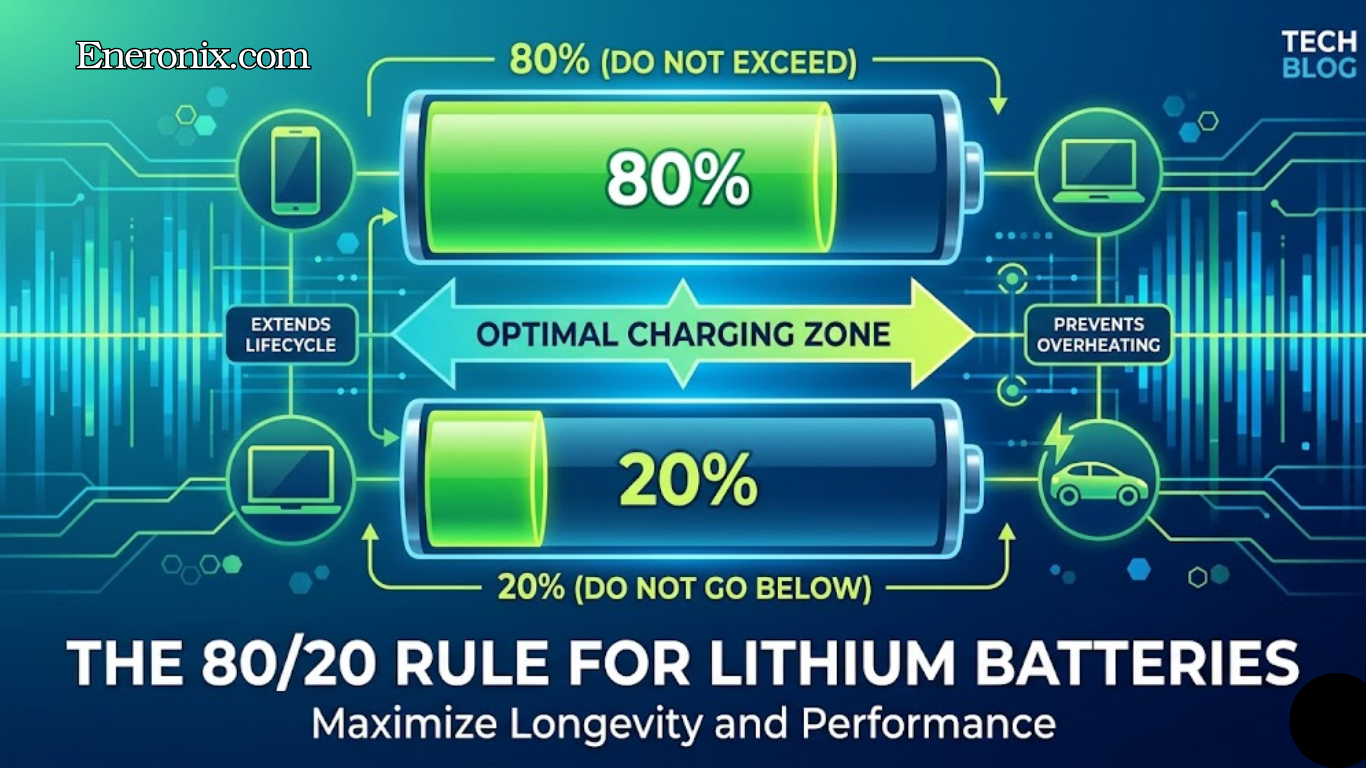
The second mechanism is the interaction between temperature and charge state. A battery sitting at 100% state of charge in a 40°C room undergoes calendar aging at a rate that is disproportionately higher than either the 40°C effect alone or the full charge effect alone. The combination is synergistic rather than additive. This is why the recommendation to charge to 90% rather than 100% for daily operation carries a disproportionate benefit in hot environments compared to temperate ones.
The cold charging risk is less prevalent in most Nigerian locations but is a genuine concern in highland areas such as the Jos Plateau and parts of Adamawa and Plateau States where night temperatures during harmattan can approach or reach 0°C. Charging below 0°C causes irreversible lithium plating on the anode. A quality BMS enforces a low temperature charge cutoff to prevent this. A budget BMS with no temperature sensor or an incorrectly set temperature cutoff will allow cold temperature charging damage to accumulate without any visible indication until the capacity loss becomes large enough to notice.
Thermal management for a LiFePO4 installation is not optional in the Nigerian climate. It is a prerequisite for achieving anything close to the rated performance. The battery room must maintain ambient temperature below 35°C during charging hours. This requires deliberate ventilation design at the installation planning stage, not a fan installed as an afterthought when the battery starts cutting out on hot afternoons.
5. The Irrecoverability Problem
The conventional wisdom about lithium batteries is that they are more robust than lead-acid. This is true in normal operation. Under abuse conditions or after specific failure events, lithium is significantly less forgiving.
A tubular battery bank that has been discharged to zero volts and left in that state for several days can often be recovered through a careful slow-charge recovery procedure. The chemistry is damaged and the capacity will not fully return, but the battery is often usable for continued service at reduced capacity. Lead-acid technology tolerates partial recovery in a way that provides a second chance after a failure event.
LiFePO4 cells that have dropped below their minimum safe voltage, typically 2.5V per cell, and been held below that threshold for an extended period, undergo copper dissolution at the anode. Copper ions migrate through the electrolyte and deposit on the cathode, permanently altering the cell’s internal chemistry. This damage is irreversible. No charging procedure recovers a cell from deep discharge copper dissolution. The cell is permanently compromised, and in a series pack, one compromised cell compromises the entire string.
The BMS is supposed to prevent this by cutting off discharge when any cell reaches its minimum voltage cutoff, typically set between 2.5V and 2.8V per cell. However, a BMS that has tripped into protection mode and then discharged its own internal power draw through the cells over an extended period, which occurs in systems left unattended for weeks with no charge source connected, can deliver exactly the deep discharge condition the cutoff was designed to prevent. This is not a theoretical failure mode.
It occurs in backup power systems that cycle infrequently, in systems disconnected for extended storage, and in installations where the owner was unaware that the BMS itself has a small continuous power consumption that continues drawing from the cells even after the protection disconnect activates.
The recycling and end-of-life dimension compounds the irrecoverability problem at the infrastructure level. When a LiFePO4 battery reaches end of life in Nigeria, there is no established formal recycling pathway available. Informal e-waste collection exists in urban centres but does not have the technical capability to safely dismantle, sort, and process lithium battery chemistry. Cells are often discarded in municipal waste streams or stored indefinitely at the installation site. The environmental consequence of lithium cell disposal in unmanaged waste streams is a genuine concern that is not yet being addressed at the policy or infrastructure level in Nigeria.
This is a disadvantage that the current market largely ignores because the first generation of LiFePO4 batteries installed in Nigerian solar systems is only now beginning to approach end of life. As the installed base grows and ages, the absence of a responsible disposal pathway will become increasingly visible.
When Lithium Is Genuinely the Wrong Choice
None of the articles ranking for this query say this clearly. They discuss disadvantages in isolation and then conclude with a paragraph explaining why lithium is still excellent. That conclusion is often correct. It is not always correct. There are specific applications and deployment contexts where LiFePO4 is genuinely the wrong technology choice, and an honest engineering answer to the question this post addresses must include them.
The first scenario is a low-utilisation backup system. A system installed purely for grid outage backup in a location where grid power is reliable and outages are infrequent will cycle the battery rarely. The cycle life advantage of LiFePO4 over tubular, which is the primary driver of its total cost of ownership case, is not realised if the battery completes only 50 to 100 cycles per year. Calendar aging, which continues regardless of cycle count, will consume a meaningful fraction of the battery’s service life before the cycle count advantage becomes financially significant. In this application a correctly sized tubular bank, managed with appropriate depth of discharge limits, may deliver comparable service life at a substantially lower capital outlay.
The second scenario is an installation where qualified commissioning is not available. The configuration sensitivity discussed in Section 4 is not an abstract risk. It is a specific and predictable failure mode in installations where the inverter settings are not correctly configured for LiFePO4 chemistry. If the installation cannot be commissioned by someone who understands the required voltage parameters, understands BMS communication requirements, and will verify the settings before handover, a tubular battery that tolerates misconfiguration is the safer choice from a system reliability perspective. Deploying a more sensitive technology into a low-competence installation environment produces worse outcomes than deploying a more robust technology correctly.
The third scenario is a capital-constrained system where the budget gap between lithium and tubular cannot be bridged. The total cost of ownership argument is valid over a ten-year horizon. It is not valid for a household or small business that cannot access the capital to purchase lithium and whose planning horizon is constrained by immediate cash flow. A functional tubular system running today delivers more value than the theoretically superior lithium system that the budget cannot accommodate.
The fourth scenario is any installation where the battery room thermal environment cannot be managed to below 35°C during charging hours. As documented in Section 5, a LiFePO4 battery operating consistently at 40 to 45°C cell temperature during charge will not deliver its rated cycle life. In a building where the equipment room is a sealed interior space with no practical ventilation option, installing a tubular battery that is more thermally tolerant is a better engineering decision than installing a lithium battery that will underperform its specification from the first hot season.
Acknowledging these scenarios is not a concession that lithium is inferior. It is a recognition that technology selection is application-specific and that the correct answer to any battery specification question depends on the deployment context. In correctly specified, correctly installed, and properly managed off-grid solar systems in Nigeria, LiFePO4 remains the superior choice on virtually every performance metric over the system’s lifetime. In the four scenarios above, it is not.
Frequently Asked Questions
What is the biggest disadvantage of a lithium-ion battery?
The biggest disadvantage depends on the application, but in off-grid solar systems using LiFePO4 batteries, the most critical issue is dependence on the Battery Management System (BMS). If the BMS is poorly designed, incorrectly configured, or fails, the battery can degrade rapidly or become unusable regardless of cell quality.
Are lithium batteries more dangerous than lead-acid batteries?
Not inherently. LiFePO4 batteries are thermally stable and significantly safer than other lithium chemistries like NMC. However, they are less tolerant of system errors. Poor configuration, overheating, or BMS failure can still create safety and performance risks, whereas lead-acid batteries degrade more gradually under misuse.
Why are lithium batteries considered expensive?
Lithium batteries have a high upfront cost, especially compared to tubular or lead-acid batteries. However, over the full system lifecycle, they are often more cost-effective due to:
Higher usable capacity (deeper discharge)
Longer lifespan (8–12 years vs. 3–5 years)
Higher efficiency (less energy loss)
The real disadvantage is initial capital requirement, not long-term value.
Do lithium batteries degrade faster in hot climates
Yes. High temperatures significantly accelerate lithium battery degradation. In tropical environments:
Elevated temperatures increase chemical aging rates
Batteries may lose capacity faster than datasheet estimates
Charging may stop entirely if the BMS triggers thermal protection
Proper ventilation and thermal management are essential.
What happens if a lithium battery is deeply discharged?
Deep discharge below the safe voltage threshold can cause permanent internal damage. Unlike lead-acid batteries, LiFePO4 batteries:
Cannot be reliably recovered after severe over-discharge
May suffer irreversible chemical changes (e.g., copper dissolution)
Can become completely unusable
This makes low-voltage protection and proper system design critical.
Can a lithium battery work without a BMS?
No. A lithium battery should never be operated without a functioning BMS. The BMS is responsible for:
Overcharge and over-discharge protection
Cell balancing
Temperature monitoring
Current control
Without it, the battery operates without safeguards and can fail quickly.
Are lithium batteries sensitive to inverter settings?
Yes, significantly more than lead-acid batteries. Incorrect inverter configuration (e.g., wrong charging voltage or current limits) can:
Cause silent long-term damage
Reduce lifespan drastically
Void manufacturer warranties
Proper commissioning is essential for safe operation.
Is lithium always better than lead-acid for solar systems?
No. Lithium is superior in most cases, but not all.
Lead-acid may be the better choice when:
The system is used only occasionally (low cycle usage)
Budget constraints prevent lithium adoption
Qualified installation and configuration are not available
The installation environment is excessively hot and unmanaged
Battery selection should always be application-specific.
How long do lithium batteries last in real solar installations?
In properly installed and managed systems, LiFePO4 batteries typically last:
8 to 12 years
2,000 to 4,000+ cycles
However, poor installation, high temperatures, or bad BMS design can reduce this to 2–3 years in extreme cases.
What is the main operational risk of lithium batteries in Nigeria?
The biggest real-world risk is installation quality. Common issues include:
Incorrect inverter settings
Poor ventilation
Low-quality or unverified BMS
Lack of commissioning verification
In many cases, battery failure is caused by system design errors, not the battery itself.
Conclusion
The biggest disadvantage of a lithium-ion battery depends on which chemistry you are discussing, which application you are deploying it in, and which operating environment it will face. The generic five-point list that dominates this topic in search results does not answer any of those questions. It recycles surface-level observations that are technically accurate, contextually incomplete, and operationally unhelpful.
For LiFePO4 in off-grid solar applications in Nigeria, the disadvantage hierarchy ranked by actual impact on system outcomes is the following. Upfront cost is a real barrier but not a fundamental value disadvantage across the system’s lifetime. BMS dependency is the most underappreciated structural vulnerability, creating a single point of failure whose quality determines whether the investment in premium chemistry is realised or wasted. Configuration sensitivity punishes the installation quality variability that characterises the Nigerian solar market more severely than any other battery technology. Thermal sensitivity is an operational reality that the published specifications do not fully communicate for tropical deployment conditions. And irrecoverability after deep discharge or BMS failure removes the tolerance for error that lead-acid technology provides.
None of these disadvantages are insurmountable. Every one of them has a known mitigation that Eneronix has covered across this cluster of posts. The battery that is correctly specified for its load, installed in a ventilated environment, commissioned with the correct voltage parameters, equipped with a quality BMS, and monitored over time will deliver performance that no lead-acid alternative can match at equivalent system cost over a decade of service.
The disadvantages are real. They are manageable. Managing them starts with understanding them accurately, which is what this post exists to do.
I am Engr. Ubokobong Ekpenyong, a solar specialist and lithium battery systems engineer with over five years of hands-on experience designing, assembling, and commissioning off-grid solar and energy storage systems. My work focuses on lithium battery pack architecture, BMS configuration, and system reliability in off-grid and high-demand environments.
Contains information related to marketing campaigns of the user. These are shared with Google AdWords / Google Ads when the Google Ads and Google Analytics accounts are linked together.
90 days
__utma
ID used to identify users and sessions
2 years after last activity
__utmt
Used to monitor number of Google Analytics server requests
10 minutes
__utmb
Used to distinguish new sessions and visits. This cookie is set when the GA.js javascript library is loaded and there is no existing __utmb cookie. The cookie is updated every time data is sent to the Google Analytics server.
30 minutes after last activity
__utmc
Used only with old Urchin versions of Google Analytics and not with GA.js. Was used to distinguish between new sessions and visits at the end of a session.
End of session (browser)
__utmz
Contains information about the traffic source or campaign that directed user to the website. The cookie is set when the GA.js javascript is loaded and updated when data is sent to the Google Anaytics server
6 months after last activity
__utmv
Contains custom information set by the web developer via the _setCustomVar method in Google Analytics. This cookie is updated every time new data is sent to the Google Analytics server.
2 years after last activity
__utmx
Used to determine whether a user is included in an A / B or Multivariate test.
18 months
_ga
ID used to identify users
2 years
_gali
Used by Google Analytics to determine which links on a page are being clicked
30 seconds
_ga_
ID used to identify users
2 years
_gid
ID used to identify users for 24 hours after last activity
24 hours
_gat
Used to monitor number of Google Analytics server requests when using Google Tag Manager
1 minute
You can find more information in our Cookie Policy and .