
Why Does My Inverter Battery Die Faster Than Expected
Quick Answer:
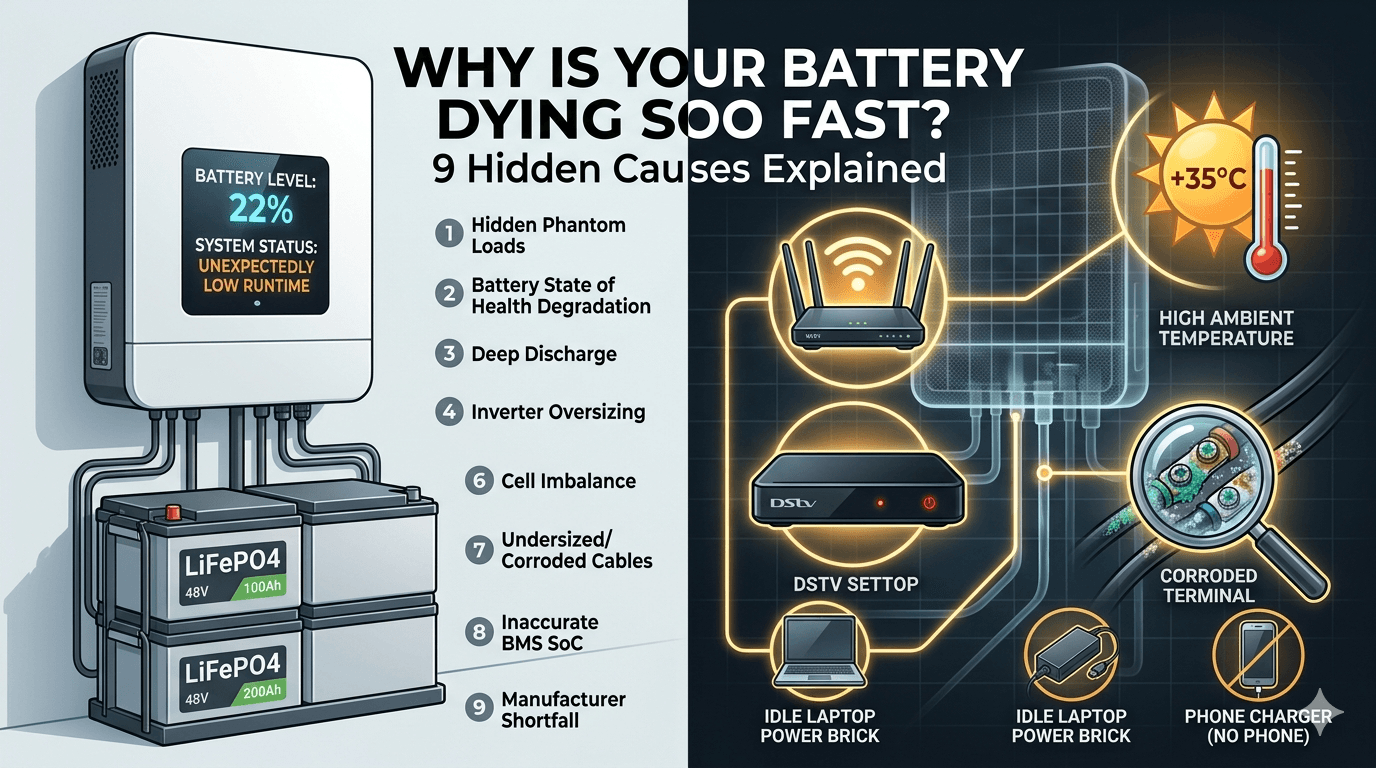
The nine most common causes are: hidden phantom loads, battery state of health degradation, incorrect depth of discharge limits, inverter oversizing, high ambient temperature, cell imbalance, undersized or corroded cables, inaccurate BMS state of charge readings, and a battery that was never at its rated capacity to begin with. Most cases involve two or three of these working together, not just one.
You bought the battery. The installer said it would last 8 hours. Three months later it is dying after 5. Six months after that, you are lucky to get 3 hours from a full charge.
This is one of the most common complaints from Nigerian inverter users, and it almost never has a single cause. The battery is usually fine. The system around it is not. Poor installation decisions, unmanaged loads, incorrect settings, and Nigerian heat work together quietly until the battery that was supposed to last 5 years starts feeling like it needs replacement after 18 months.
This article covers every cause, in order of how commonly it appears in Nigerian installations. Each section includes a diagnostic step you can perform yourself, and a fix. By the end, you will know exactly which combination of factors is shortening your battery life, and what to do about each one.
Calculation methodology used in this article: All runtime figures are based on: Battery Wh = Voltage x Ah. Usable Wh = Battery Wh x DoD% x Inverter Efficiency (90%). DoD = 80% for LiFePO4, 50% for lead-acid. A 48V 200Ah LiFePO4 delivers 6,912 Wh usable. These figures are consistent with the full explanation in our battery backup time formula guide.
Cause 1: Hidden Phantom Loads You Have Never Measured
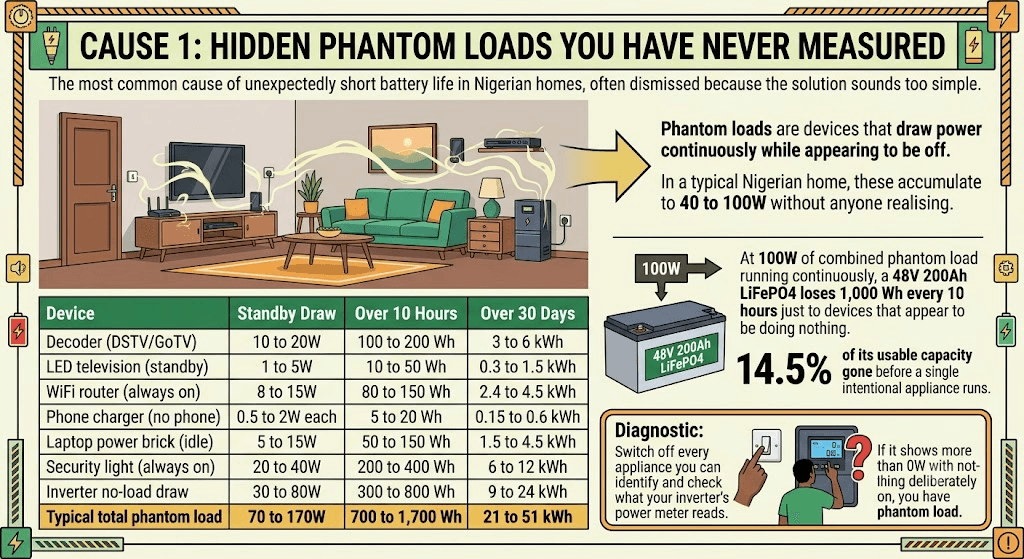
This is the most common cause of unexpectedly short battery life in Nigerian homes, and the one most people dismiss too quickly because the solution sounds too simple.
Phantom loads are devices that draw power continuously while appearing to be off. In a typical Nigerian home with an inverter, these accumulate to 40 to 100W without anyone realising. The list is longer than most people expect:
| Device | Standby Draw | Over 10 Hours | Over 30 Days |
| Decoder (DSTV/GoTV) | 10 to 20W | 100 to 200 Wh | 3 to 6 kWh |
| LED television (standby) | 1 to 5W | 10 to 50 Wh | 0.3 to 1.5 kWh |
| WiFi router (always on) | 8 to 15W | 80 to 150 Wh | 2.4 to 4.5 kWh |
| Phone charger (no phone) | 0.5 to 2W each | 5 to 20 Wh | 0.15 to 0.6 kWh |
| Laptop power brick (idle) | 5 to 15W | 50 to 150 Wh | 1.5 to 4.5 kWh |
| Security light (always on) | 20 to 40W | 200 to 400 Wh | 6 to 12 kWh |
| Inverter no-load draw | 30 to 80W | 300 to 800 Wh | 9 to 24 kWh |
| Typical total phantom load | 70 to 170W | 700 to 1,700 Wh | 21 to 51 kWh |
At 100W of combined phantom load running continuously, a 48V 200Ah LiFePO4 loses 1,000 Wh every 10 hours just to devices that appear to be doing nothing. That is 14.5% of its usable capacity gone before a single intentional appliance runs.
Diagnostic: Switch off every appliance you can identify and check what your inverter’s power meter reads. If it shows more than 0W with nothing deliberately on, you have phantom loads. Use a plug-in energy monitor on individual sockets to identify the sources. Our dedicated guide on phantom loads in off-grid energy budgets walks through the full identification and elimination process.
Cause 2: Battery State of Health Has Degraded
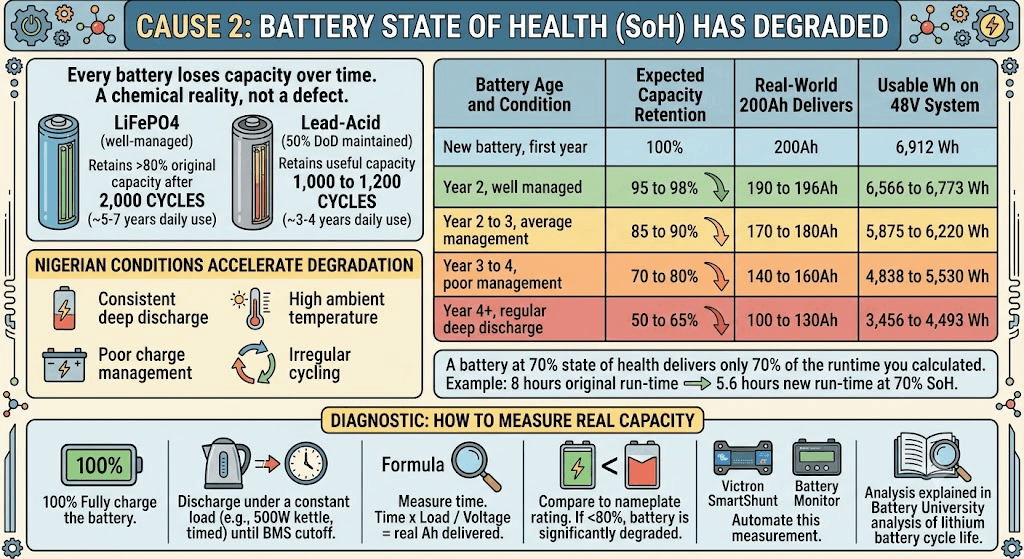
Every battery loses capacity over time. This is not a defect. It is a chemical reality of how batteries work. The question is how fast the degradation happens and whether it is happening faster than it should.
A LiFePO4 battery well-managed within its recommended operating parameters retains over 80% of original capacity after 2,000 cycles. That is approximately 5 to 7 years of daily use. A lead-acid tubular battery properly maintained at 50% depth of discharge retains useful capacity for 1,000 to 1,200 cycles, roughly 3 to 4 years.
But Nigerian conditions accelerate degradation in ways that most battery specifications do not account for. Consistent deep discharge past the recommended limits, high ambient temperature, poor charge management, and irregular cycling all compound to shorten battery life significantly.
| Battery Age and Condition | Expected Capacity Retention | Real-World 200Ah Delivers | Usable Wh on 48V System |
| New battery, first year | 100% | 200Ah | 6,912 Wh |
| Year 2, well managed | 95 to 98% | 190 to 196Ah | 6,566 to 6,773 Wh |
| Year 2 to 3, average management | 85 to 90% | 170 to 180Ah | 5,875 to 6,220 Wh |
| Year 3 to 4, poor management | 70 to 80% | 140 to 160Ah | 4,838 to 5,530 Wh |
| Year 4+, regular deep discharge | 50 to 65% | 100 to 130Ah | 3,456 to 4,493 Wh |
A battery at 70% state of health delivers only 70% of the runtime you calculated based on its nameplate rating. If your original calculation said 8 hours and you are now getting 5.6 hours, 70% state of health is almost exactly what explains that gap.
Diagnostic: Fully charge the battery to 100% SoC. Then discharge it under a known constant load (for example, a 500W kettle or electric iron that you can time) until the BMS cuts off. Measure the time. Calculate: Time x Load / Voltage = real Ah delivered. Compare to the nameplate rating. If it is below 80% of rated capacity, the battery has degraded significantly. A Victron SmartShunt or similar battery monitor can automate this measurement in real time. The underlying degradation mechanism is explained in Battery University’s analysis of lithium battery cycle life.
Cause 3: The Battery Is Being Discharged Past Its Safe Limit
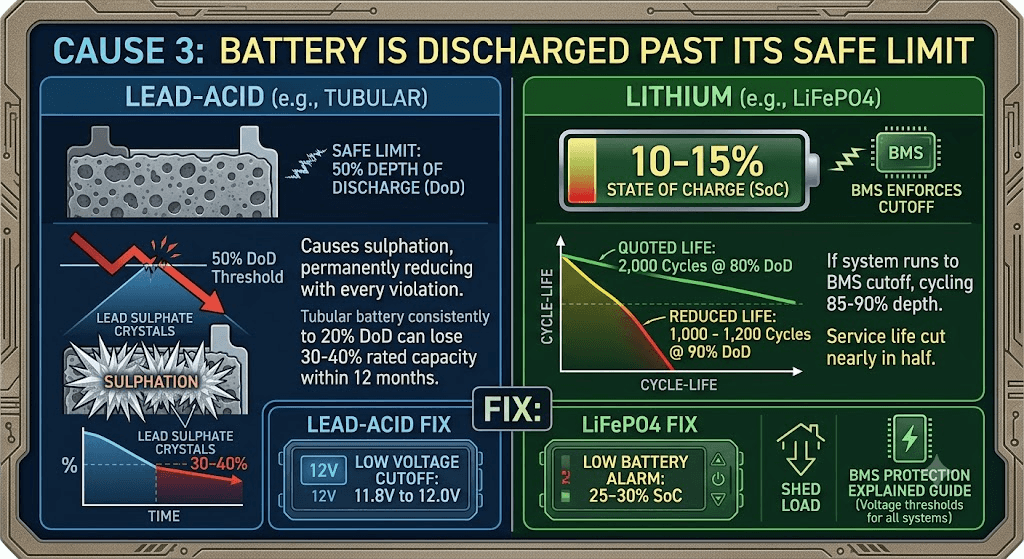
This one matters more for lead-acid users but affects lithium users too.
Lead-acid batteries have a hard limit at 50% depth of discharge. Discharging below this threshold does not just reduce tonight’s backup time. It causes sulphation, the formation of lead sulphate crystals on the battery plates that permanently reduces capacity with every violation. A tubular battery discharged to 20% DoD consistently can lose 30 to 40% of its rated capacity within 12 months.
For LiFePO4, the BMS enforces a cutoff at 10 to 15% SoC. Operating occasionally down to 20% is fine. But if your system regularly runs to the BMS cutoff, you are cycling through 85 to 90% of the battery’s depth every night. The manufacturer’s cycle life rating of 2,000 cycles is typically quoted at 80% DoD. At 90% DoD daily, cycle life can drop to 1,000 to 1,200 cycles, cutting the battery’s service life nearly in half.
Fix: For lead-acid: configure your inverter’s low voltage cutoff to stop discharge at 50% DoD. For a 12V lead-acid system, that is approximately 11.8 to 12.0V under load. For LiFePO4: set your low battery alarm at 25 to 30% SoC so you have time to shed load before the BMS hard cutoff triggers. Our BMS protection explained guide provides the correct voltage thresholds for every battery chemistry and system voltage.
Cause 4: Your Inverter Is Oversized for Your Load
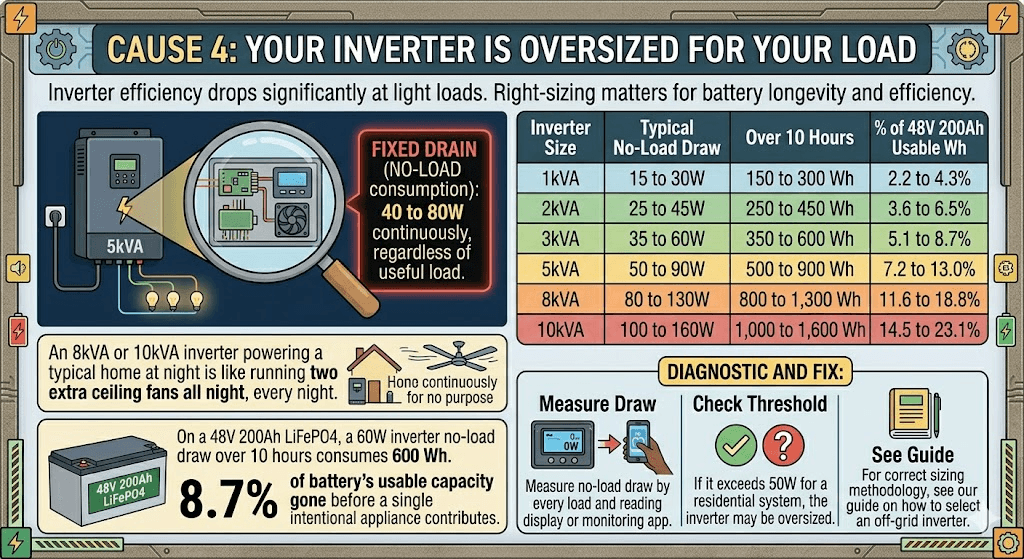
Inverter efficiency is not a fixed number. It peaks at 50 to 70% of the inverter’s rated load and drops significantly at very light loads. A 5kVA inverter powering a 150W evening load is running at 3% of its rated capacity. At that load level, the inverter draws 40 to 80W just for its own internal electronics, fan, and display.
That no-load and light-load consumption is a fixed drain on the battery regardless of how little you are actually using. On a 48V 200Ah LiFePO4, a 60W inverter no-load draw over 10 hours consumes 600 Wh. That is 8.7% of the battery’s usable capacity gone before a single intentional appliance contributes.
| Inverter Size | Typical No-Load Draw | Over 10 Hours | % of 48V 200Ah Usable Wh |
| 1kVA inverter | 15 to 30W | 150 to 300 Wh | 2.2 to 4.3% |
| 2kVA inverter | 25 to 45W | 250 to 450 Wh | 3.6 to 6.5% |
| 3kVA inverter | 35 to 60W | 350 to 600 Wh | 5.1 to 8.7% |
| 5kVA inverter | 50 to 90W | 500 to 900 Wh | 7.2 to 13.0% |
| 8kVA inverter | 80 to 130W | 800 to 1,300 Wh | 11.6 to 18.8% |
| 10kVA inverter | 100 to 160W | 1,000 to 1,600 Wh | 14.5 to 23.1% |
An 8kVA or 10kVA inverter powering a typical 3-bedroom home at night is consuming 100 to 160W of its own power continuously. That is the equivalent of running two extra ceiling fans all night, every night, for no purpose. This is why right-sizing your inverter matters not just for efficiency but for battery longevity.
Diagnostic and Fix: Measure your inverter’s no-load draw by switching off every load and reading the power consumption on the inverter display or monitoring app. If it exceeds 50W for a residential system, the inverter may be oversized or have high standby consumption. For correct inverter sizing methodology, see our guide on how to select an off-grid inverter.
Cause 5: High Ambient Temperature Is Robbing Capacity
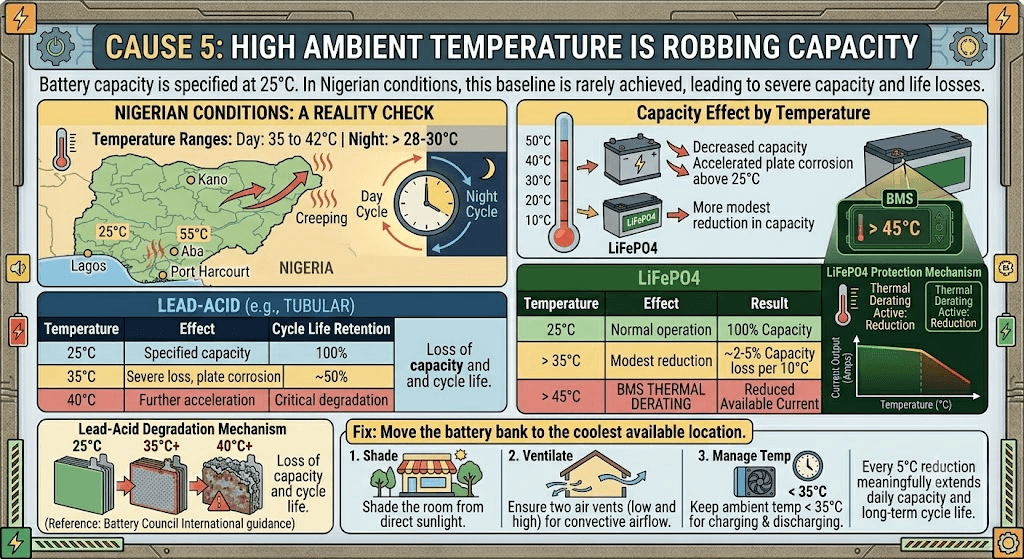
Battery capacity is specified at 25 degrees Celsius. In Nigerian conditions, this baseline is rarely achieved. Battery rooms in Lagos, Kano, or Aba regularly hit 35 to 42 degrees Celsius during the day and remain above 28 to 30 degrees Celsius at night during the hot season.
For lead-acid batteries, the effect is severe. Capacity decreases below 25 degrees Celsius and the plate corrosion rate increases significantly above it. A tubular battery operating at 35 degrees Celsius loses approximately 50% of its cycle life compared to operation at 25 degrees Celsius, according to the Battery Council International’s technical guidance on lead-acid temperature effects. At 40 degrees Celsius, that degradation accelerates further.
For LiFePO4, the capacity effect at high temperature is more modest: roughly 2 to 5% capacity reduction per 10 degrees Celsius above 25 degrees Celsius in the normal operating range. But above 45 degrees Celsius, the BMS begins thermal derating, reducing available current to protect the cells. In a sealed battery room on a hot Port Harcourt afternoon, this thermal limit is reachable.
Fix: Move the battery bank to the coolest available location. Shade the battery room from direct sunlight. Ensure adequate ventilation: a minimum of two air vents at low and high positions in the battery room to create convective airflow. For LiFePO4 batteries, keep ambient temperature below 35 degrees Celsius during charging and discharging. Every 5 degrees Celsius reduction in battery ambient temperature meaningfully extends both daily capacity and long-term cycle life.
Cause 6: Cell Imbalance Is Causing Early BMS Cutoff
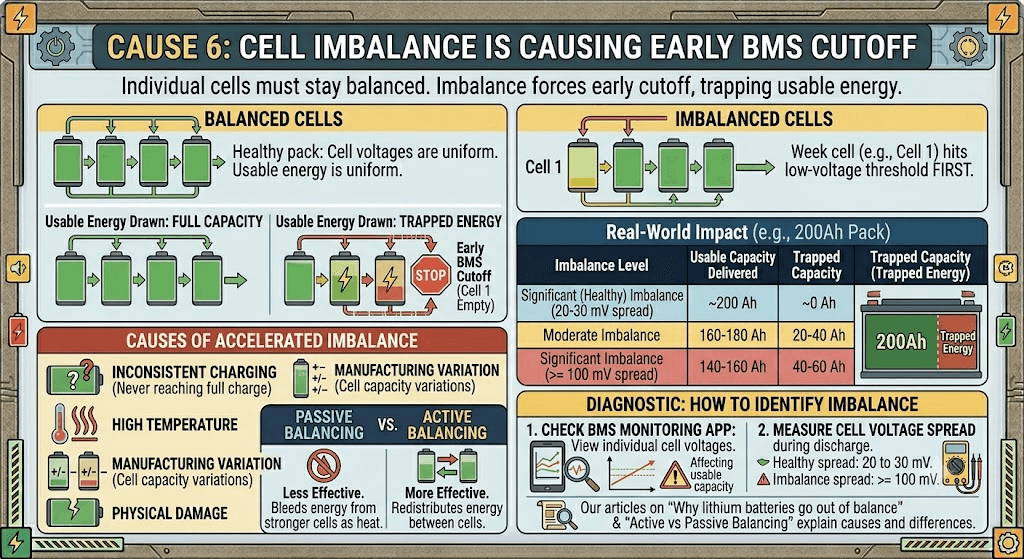
Inside every lithium battery pack, individual cells are supposed to stay at approximately the same state of charge. When they drift apart, the BMS is forced to cut off the entire pack when the weakest cell hits its minimum voltage threshold, even if the other cells still have usable energy remaining.
In practice, this means a 200Ah battery with significant cell imbalance may only deliver 140 to 160Ah before the BMS triggers low-voltage protection, because one or two weak cells pull down the pack average. The battery appears to die early. The remaining cells still have energy. But the BMS correctly shuts the system down to protect the weak cells from over-discharge.
Cell imbalance grows over time and is accelerated by: inconsistent charging (never reaching full charge to allow balancing), high temperature, manufacturing variation in cell capacity, and physical damage to individual cells. The BMS balancing circuit tries to compensate, but passive balancing in cheaper BMS units bleeds energy from stronger cells rather than redistributing it, which is less effective than active balancing.
Diagnostic: If your BMS has a monitoring app, check individual cell voltages during discharge. A healthy pack should show cells within 20 to 30 mV of each other throughout the discharge curve. Cells diverging by 100 mV or more indicate imbalance that is affecting usable capacity. Our articles on why lithium batteries go out of balance and active vs passive balancing explain the causes and the difference in balancing quality between BMS types.
Cause 7: Your Battery Was Never at Its Rated Capacity
This is a hard truth about the Nigerian battery market, and it deserves a direct conversation.
Batteries sold through informal channels in Alaba International Market, Computer Village, and roadside solar shops in secondary cities are frequently not at their stated capacity. A battery labelled 200Ah may actually deliver 150 to 170Ah. The label is not a lie in the seller’s mind. It is often based on the maximum theoretical cell capacity, not the tested delivered capacity of the assembled pack with its specific BMS, connection quality, and cell selection.
This is not unique to Nigeria. Unbranded and grey-market battery packs globally routinely overstate capacity by 10 to 30%. The difference in Nigerian market conditions is that third-party capacity testing is rarely done by the buyer before installation, and the seller has no accountability structure after purchase.
A battery that was 170Ah from day one will always behave as if it is dying early when compared against an 8-hour runtime calculation based on 200Ah. The battery is not degrading. The specification was never honest.
How to verify: The only way to know true capacity is to test it. Fully charge the battery, apply a known constant DC load (or AC load through the inverter at a measured wattage), and time the discharge to BMS cutoff. Calculate real Ah: (Load Watts / System Voltage) x Hours = Ah delivered. For a 48V system with a 480W load running for 8 hours to cutoff: (480/48) x 8 = 80Ah delivered. If that was supposed to be a 100Ah battery, it is a 20% shortfall.
A Victron Energy SmartShunt battery monitor automates this measurement continuously and logs historical capacity data, making it significantly easier to track real-world degradation over time. For trusted battery brands that consistently deliver rated capacity in the Nigerian market, see our guide to the best lithium batteries for inverters in Nigeria.
Cause 8: Undersized or Corroded Cables Are Wasting Energy
DC cables carry high current at relatively low voltage. Even modest resistance in undersized or corroded cables causes real energy loss at these current levels. This loss appears as heat in the cables and as reduced voltage at the inverter terminals, both of which reduce effective battery runtime.
Consider a 48V system drawing 40A (approximately 1,920W output). A 20 milliohm total cable and connection resistance causes a voltage drop of 0.8V at the inverter terminals. The power lost in the cables: 40A x 40A x 0.02 ohms = 32W. Over 10 hours: 320 Wh lost to cable resistance. On a 48V 200Ah battery that represents 4.6% of usable capacity, gone before it reaches any appliance.
In Nigerian installations, undersized cables are common because thick copper cable is expensive and installers sometimes cut corners. Corroded terminals and loose connections compound the problem, especially in coastal cities like Lagos and Port Harcourt where humidity accelerates oxidation.
Diagnostic: Measure the voltage directly at the battery terminals and then at the inverter DC input terminals while the system is under load. A voltage difference greater than 0.5V indicates significant cable resistance losses. Tighten all connections. Clean corroded terminals with a wire brush. For correct cable sizing specifications at every system voltage and current level, see our DC cable sizing guide for off-grid solar systems.
Cause 9: Your BMS State of Charge Reading Is Inaccurate
The percentage on your inverter display is not a direct measurement of how much energy is in the battery. It is an estimate calculated by the BMS based on voltage readings and accumulated current measurements. This estimate drifts over time and can be significantly inaccurate in ways that make the battery appear to die early.
There are two common drift scenarios:
Optimistic drift (battery dies earlier than displayed): The BMS shows 20% but the battery physically has less. This happens when the battery has never been fully charged to allow BMS recalibration, or when the current measurement circuit has accumulated error. The result: the battery reaches BMS cutoff while still displaying 15 to 20% SoC, making it seem like the last 20% disappeared instantly.
Pessimistic drift (battery appears to die at a high displayed percentage): The BMS cuts off at what appears to be 25 to 30% SoC. This often indicates the BMS low-voltage cutoff is set too conservatively, or that the BMS is reading a voltage spike from a weak cell as a pack-level low-voltage event. The battery physically still has energy but the BMS correctly protects the weakest cell.
Fix: Recalibrate the BMS by performing a full charge cycle from the lowest SoC you can achieve to 100% (until the charger switches to float or the BMS shows full), then discharging under moderate load to the natural BMS cutoff. This full cycle resets the coulomb counter and recalibrates the SoC algorithm. For a detailed explanation of why BMS and inverter SoC readings sometimes disagree, see our article on SOC drift in lithium battery systems.
The Complete Diagnostic Table: Match Your Symptom to the Cause
Use this table to narrow down which cause or combination of causes is responsible for your specific situation.
| Symptom | Most Likely Cause(s) | Priority Action |
| Battery always lasted 8 hrs, now lasts 5 hrs after 18 months | State of health degradation + possible temperature damage | Test real capacity. Check installation environment temperature. |
| Battery capacity drops sharply in hot weather | Temperature derating (Cause 5) | Improve battery room ventilation. Move battery to cooler location. |
| Battery was never as good as expected from day one | Undersized capacity from supplier (Cause 7) or phantom loads (Cause 1) | Measure real capacity. Do full phantom load audit. |
| Battery dies early at night but not in the morning | Cell imbalance causing early BMS cutoff (Cause 6) | Check individual cell voltages via BMS app. Top balance if needed. |
| Battery display shows 20% then dies immediately | BMS SoC drift (Cause 9) or cell imbalance (Cause 6) | Full charge cycle for BMS recalibration. Check cell voltages. |
| Battery is fine but inverter is hot and runs continuously | Oversized inverter with high no-load draw (Cause 4) | Measure no-load consumption. Consider right-sizing inverter. |
| New battery dying as fast as old one in same system | Phantom loads (Cause 1) + cable losses (Cause 8) + deep discharge (Cause 3) | Load audit, cable inspection, inverter low-voltage cutoff check. |
| Cables warm to touch during normal operation | Undersized cables causing resistive losses (Cause 8) | Measure voltage drop under load. Upgrade cable gauge. |
What Other Guides on This Topic Do Not Cover
Most articles about batteries dying early focus on the obvious: high loads, battery age, temperature. Here are three factors they consistently miss.
The Partial Charge Problem
Many Nigerian solar installations are sized just barely for the daily load. On cloudy days or during harmattan when irradiance drops, the solar array does not fully recharge the battery before sunset. The battery starts each night at 75 to 85% SoC instead of 100%. Over weeks, this compounds. The BMS never gets a full-charge event to recalibrate. Cell imbalance grows without correction. The progressive result is a battery that seems to decline steadily even when nothing has changed in the system.
The fix is to run a full charge at least once per week, either by extending solar charging through the midday window or by running a generator or grid power through the inverter charger to reach 100% SoC. This single habit prevents BMS drift, enables balancing, and gives you an accurate weekly capacity reference. According to NREL research on battery management best practices for off-grid systems, periodic full charge cycles are one of the highest-impact maintenance practices for extending battery service life in renewable energy installations.
Generator Charging Pushing Too Much Current
In Nigerian homes where the generator is used to charge the battery, the inverter charger settings determine how fast the battery receives charge. Many inverter chargers default to their maximum charge current setting, which for a 5kVA unit can be 60 to 80A into a 48V battery.
For a 100Ah LiFePO4 battery, a 60A charge current is 0.6C, which is above the recommended 0.5C maximum for most LiFePO4 cells. Repeated high-rate charging accelerates lithium plating and electrolyte degradation, shortening cycle life. Set your inverter charger’s charging current to no more than 0.5C of your battery’s Ah rating. For a 200Ah battery, that is 100A maximum. For a 100Ah battery, 50A maximum.
The Fake Battery Problem in the Nigerian Market
Beyond the capacity shortfall discussed in Cause 7, there is a more serious problem with counterfeit batteries entering the Nigerian market through informal import channels. These batteries use recycled or reconditioned cells that may be at 50 to 60% of their original capacity before the battery is even installed. They measure at the correct voltage, pass basic installation checks, and fail within 6 to 12 months.
The signs of a recycled or substandard cell pack: the battery gets warm during normal charging (not just during high-rate charging), the BMS reports high cell voltage variance from the first week of use, and capacity degrades visibly within the first 3 months. Purchase batteries only from verified distributors with manufacturer traceability. The few hundred naira saved on an unverified battery typically costs multiples in replacement costs within 18 months.
Frequently Asked Questions
How do I know if my battery is genuinely degraded or just poorly managed?
Perform a capacity test: fully charge the battery, then discharge it under a known constant load while timing the discharge to BMS cutoff. Calculate the actual Ah delivered. If it is below 80% of the rated nameplate Ah, the battery has degraded beyond serviceable condition. If it delivers 80% or more of rated capacity, the problem is in your system management (load, settings, cables) rather than the battery itself.
Can a battery recover from deep discharge?
LiFePO4 batteries can recover from occasional deep discharge without permanent damage, as long as the BMS low-voltage protection activated before cell voltage dropped below the absolute minimum (approximately 2.5V per cell). If the BMS cut off the system correctly, a full recharge cycle typically restores normal operation. Lead-acid batteries do not recover from deep discharge. Each violation below 50% DoD causes permanent sulphation that reduces capacity irreversibly.
Why does my battery die faster in the rainy season?
Two reasons. First, reduced solar irradiance during cloudy rainy season days means the battery is not fully recharged each day, starting each night at a lower SoC. Second, increased humidity accelerates terminal corrosion in lead-acid batteries and can affect connection quality in lithium packs with unsealed terminals. Check terminal cleanliness and ensure your solar system is producing adequate charge during overcast days. Our article on solar panel output during cloudy weather in Nigeria.
My battery is 6 months old and already dying faster. Is it defective?
Six months is too soon for normal capacity degradation in a quality battery. At 6 months the most likely causes are: the battery was never at its rated capacity (Cause 7), it has been consistently deep-discharged past its limits (Cause 3), it has been stored or operated in excessive heat (Cause 5), or the installation has phantom loads and cable issues that are making the battery work harder than the calculations suggest (Causes 1 and 8). Work through the diagnostic table above before concluding the battery is defective.
How much does it cost to replace a degraded battery in Nigeria?
Replacement costs for a 48V 100Ah LiFePO4 battery from a reputable brand in Nigeria range from approximately 180,000 to 350,000 naira depending on brand and where you purchase it. This cost is avoidable in most cases. Proper installation, correct depth of discharge limits, adequate ventilation, and regular full-charge calibration cycles can extend a quality battery’s service life to 5 to 8 years in Nigerian conditions. The investment in getting the system right from the start pays for itself within the first battery replacement cycle.
Does turning the inverter off at night save battery?
Yes, if you have no loads that need to run overnight. Turning the inverter off eliminates the no-load draw of 30 to 80W, which saves 240 to 640 Wh over an 8-hour night. However, the fridge needs power continuously, so if your fridge is on the inverter circuit, turning the inverter off will warm the fridge. A separate circuit for the fridge, or a fridge on its own dedicated inverter, allows you to turn off the main inverter while keeping cold chain intact.
The Bottom Line
When a battery dies faster than expected, the instinct is to blame the battery. In most Nigerian installations, the battery is not the primary problem. Hidden phantom loads, an oversized inverter drawing its own power, undersized cables losing energy to heat, a BMS that has drifted off its calibration, and a battery room that runs 10 degrees hotter than it should are all more likely to be the cause than a genuinely defective battery.
Work through the nine causes in this article systematically. Start with the phantom load audit because it is free and fast. Then check the installation temperature. Then verify actual battery capacity with a timed discharge test. In most cases, the combination of these three steps will identify the cause without needing to replace anything.
If your system is running correctly but you want to know exactly how long your battery should last under your specific load, the battery backup time formula guide gives you the complete calculation methodology.

I am Engr. Ubokobong Ekpenyong, a solar specialist and lithium battery systems engineer with over five years of hands-on experience designing, assembling, and commissioning off-grid solar and energy storage systems. My work focuses on lithium battery pack architecture, BMS configuration, and system reliability in off-grid and high-demand environments.