
Battery Backup Time Formula Explained
Quick Answer:
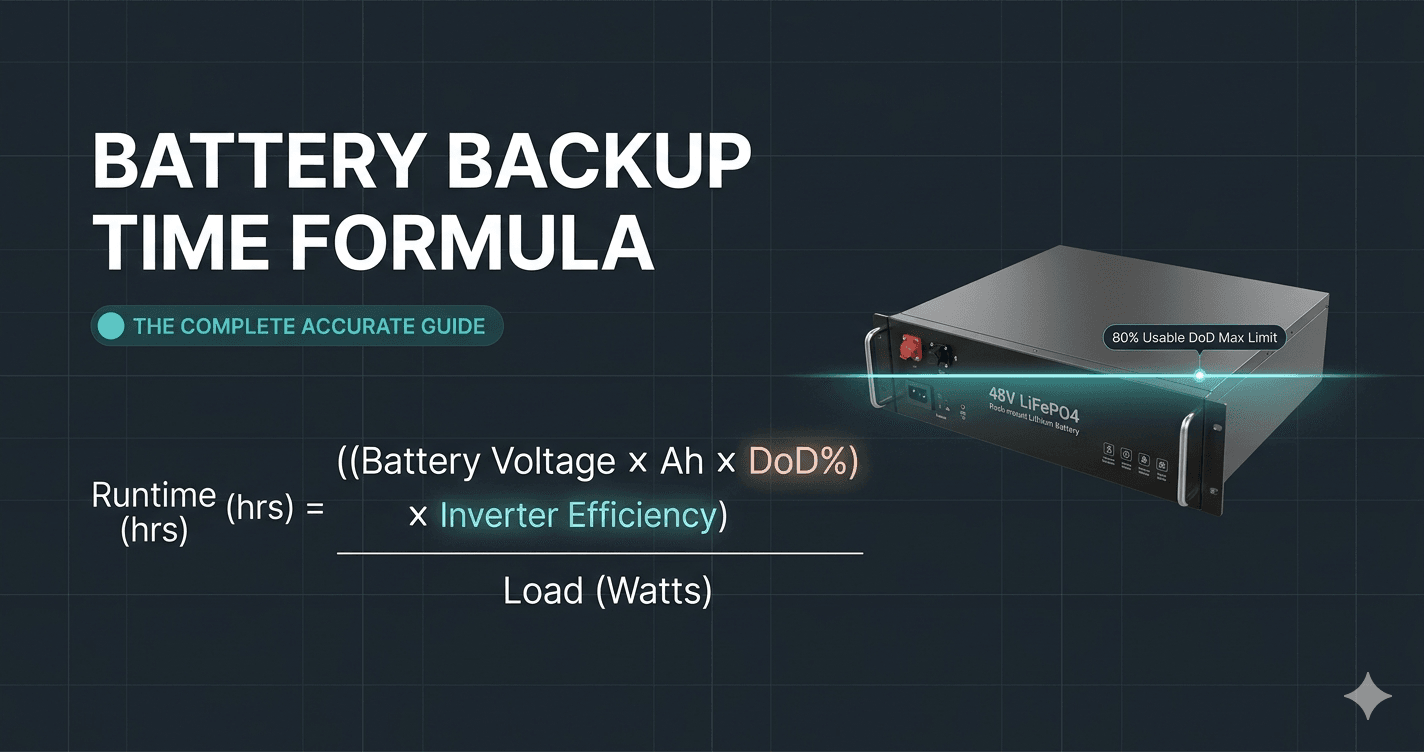
Battery backup time (hours) = (Battery Voltage × Ah × Usable % × Inverter Efficiency) / Load in Watts. For a 48V 200Ah LiFePO4 at 80% DoD, 90% inverter efficiency, running 500W: (48 × 200 × 0.80 × 0.90) / 500 = 6,912 / 500 = 13.8 hours. Every variable in that formula has a right value and a wrong value. This article explains all of them.
The battery backup time formula is not a secret. Search for it and you will find a version of it on dozens of solar websites. Most of them look like this: hours = Ah / Amps. Or: runtime = capacity / load. Simple. Clean. And in the real world, consistently wrong.
The formula is not wrong in theory. What is wrong is the way its variables get filled in. People use the rated battery capacity instead of usable capacity. They forget inverter efficiency. They ignore the voltage difference between a 12V and 48V battery. They treat load as a fixed number when it cycles. And then they wonder why the battery died two hours before the calculation said it would.
This article gives you the complete formula, every variable explained with the correct value to use, four worked examples covering Nigerian home and office scenarios, and a diagnostic table for when your real-world runtime does not match your calculation. By the time you finish, you will not just know the formula , you will know why it works and exactly what to adjust when it does not.
The Complete Battery Backup Time Formula
There are two versions of this formula. The simplified version gets you into the right range. The complete version gets you accuracy. Start with the complete version from day one , it takes 30 seconds longer and it is what actually predicts real-world runtime.
The Simplified Version (What Most Guides Show)
Runtime (hrs) = Battery Wh / Load (W)
Where Battery Wh = Voltage × Ah. A 48V 200Ah battery = 9,600 Wh. At 500W load: 9,600 / 500 = 19.2 hours. This number is optimistic. It assumes you can use 100% of the battery and that the inverter wastes nothing. Neither is true.
The Complete Version (What You Should Always Use)
Runtime (hrs) = (Battery Wh × DoD%) × Inverter Efficiency / Load (W)
Same example: (9,600 × 0.80) × 0.90 / 500 = 6,912 / 500 = 13.8 hours. That is 5.4 hours less than the simplified version. On a 10-hour outage that difference is everything.
The methodology used throughout this article: All calculations are based on the complete formula. Battery Wh = Voltage × Ah. DoD = 80% for LiFePO4, 50% for lead-acid. Inverter efficiency = 90% (quality unit at moderate load). These values are stated once here and applied consistently in every table and example that follows.
For A very accurate backup time calculation, use this tool carefully designed; the Battery Backup Time Calculator
Every Variable in the Formula: The Right Value and the Wrong Value
Variable 1: Battery Voltage (V)
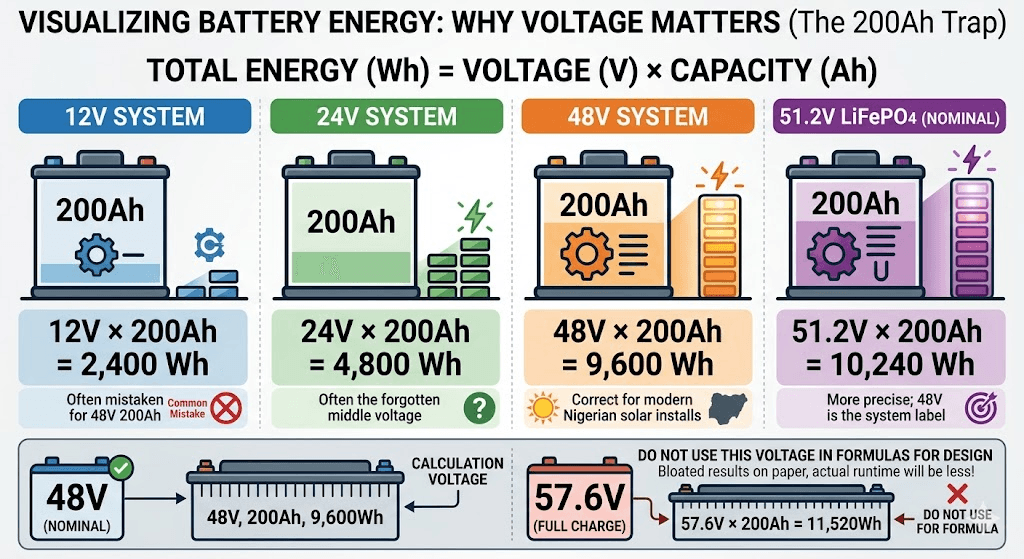
Voltage is the variable most people get wrong by omission. They know their battery is “200Ah” and stop there. But a 12V 200Ah battery and a 48V 200Ah battery are not the same energy. The formula requires watt-hours, which is voltage multiplied by amp-hours.
| System Voltage | Capacity | Total Wh (Energy Stored) | Common Mistake |
| 12V | 200Ah | 2,400 Wh | Used in formula as if equal to 48V 200Ah |
| 24V | 200Ah | 4,800 Wh | Often the forgotten middle voltage |
| 48V | 200Ah | 9,600 Wh | Correct for modern Nigerian solar installs |
| 51.2V (LiFePO4 nominal) | 200Ah | 10,240 Wh | More precise; 48V is the system label |
Always use the nominal system voltage in the formula, not the full-charge voltage. A 48V LiFePO4 battery charges to 57.6V but is labelled and calculated at 48V. Using 57.6V in the formula overstates capacity by 20%. This is a common error in online calculators that pull the charge voltage from datasheets rather than the nominal system voltage.
Variable 2: Amp-Hours (Ah)
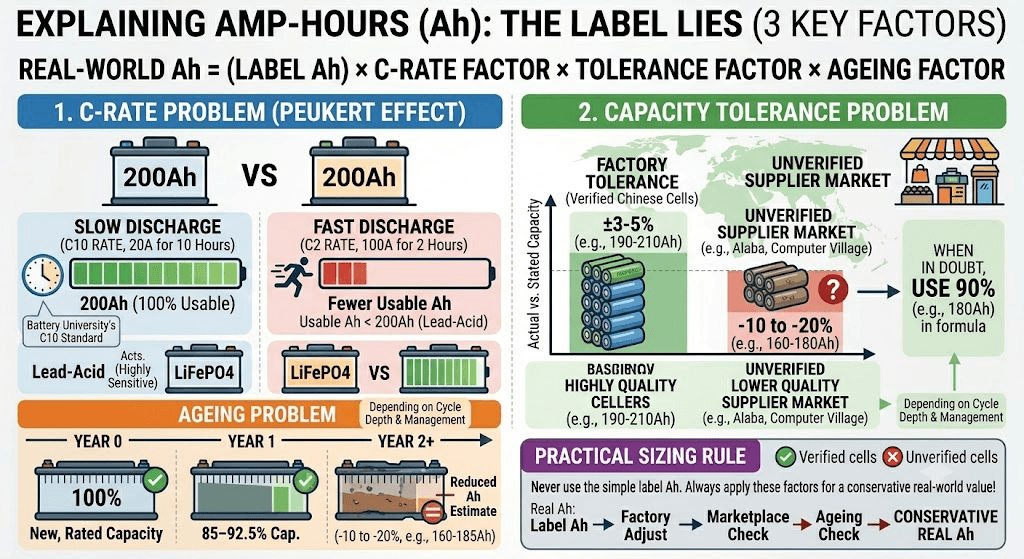
The Ah rating on a battery label is almost never the number you should use in your formula. There are three reasons for this.
The C-rate problem. Battery capacity is rated at a specific discharge rate, usually C10 (the 10-hour rate). This means the battery was tested by drawing one-tenth of its capacity in amps for 10 hours. A 200Ah battery was tested at 20A for 10 hours. If you draw it faster , say at 100A , you get fewer usable amp-hours due to the Peukert effect. Lead-acid batteries are highly sensitive to this. LiFePO4 batteries are much less affected. Battery University’s explanation of Peukert’s law shows why lithium chemistry largely eliminates this problem while lead-acid does not.
The capacity tolerance problem. A battery labelled 200Ah may actually deliver 190Ah or 210Ah from the factory. Chinese-manufactured cells, which dominate the Nigerian market, have capacity tolerances of plus or minus 3 to 5%. More importantly, batteries from unverified suppliers in Alaba or Computer Village are frequently 10 to 20% below their stated capacity with no testing done to verify. When in doubt, use 90% of the stated Ah in your formula as a conservative real-world figure.
The ageing problem. A 200Ah battery after two years of cycling will not deliver 200Ah. Depending on cycle depth and management quality, it may deliver 160 to 185Ah. Use the rated capacity for a new battery. Reduce your Ah estimate by 10 to 20% for batteries over two years old.
Variable 3: Depth of Discharge (DoD%)
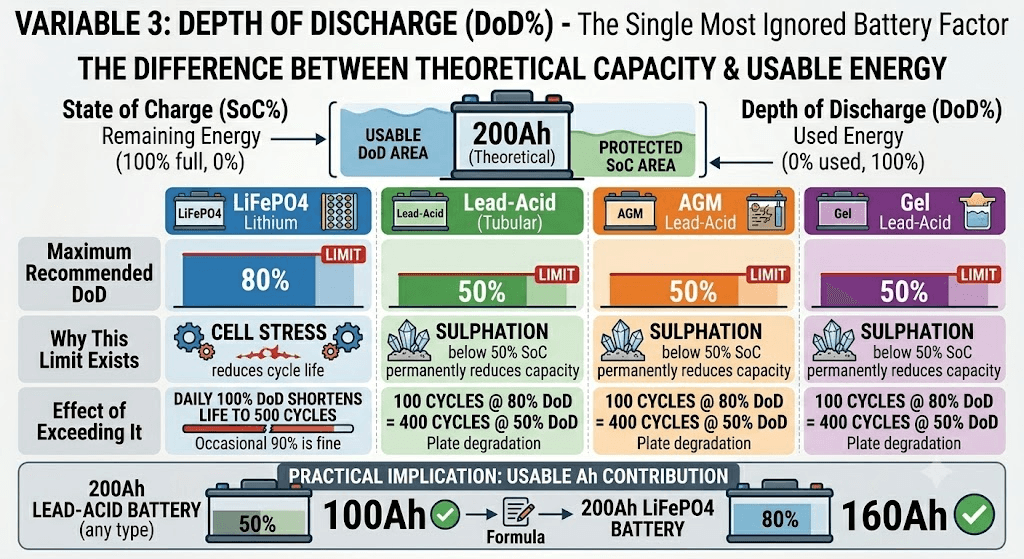
This is the single most commonly ignored variable in online battery calculators, and it is the one that makes the biggest difference between a theoretical calculation and what you actually get.
| Battery Chemistry | Maximum Recommended DoD | Why This Limit Exists | Effect of Exceeding It |
| LiFePO4 lithium | 80% | Cell stress above this level reduces cycle life | Occasional 90% is fine; daily 100% shortens life to 500 cycles |
| Lead-acid (tubular) | 50% | Sulphation below 50% SoC permanently reduces capacity | 100 cycles at 80% DoD = same life as 400 cycles at 50% DoD |
| AGM lead-acid | 50% | Same sulphation mechanism as tubular | AGM is more sensitive , 50% is a firm limit |
| Gel lead-acid | 50% | Sulphation and plate degradation below 50% | Gel recovers poorly from deep discharge |
The practical implication: a 200Ah lead-acid battery that you plan to use at 50% DoD contributes 100Ah to your formula. A 200Ah LiFePO4 at 80% DoD contributes 160Ah. This is the primary reason lithium batteries deliver more runtime per Ah of rated capacity , not just chemistry, but accessible chemistry. The full explanation of why these limits exist is in our guide on why lithium batteries need a BMS.
Variable 4: Inverter Efficiency
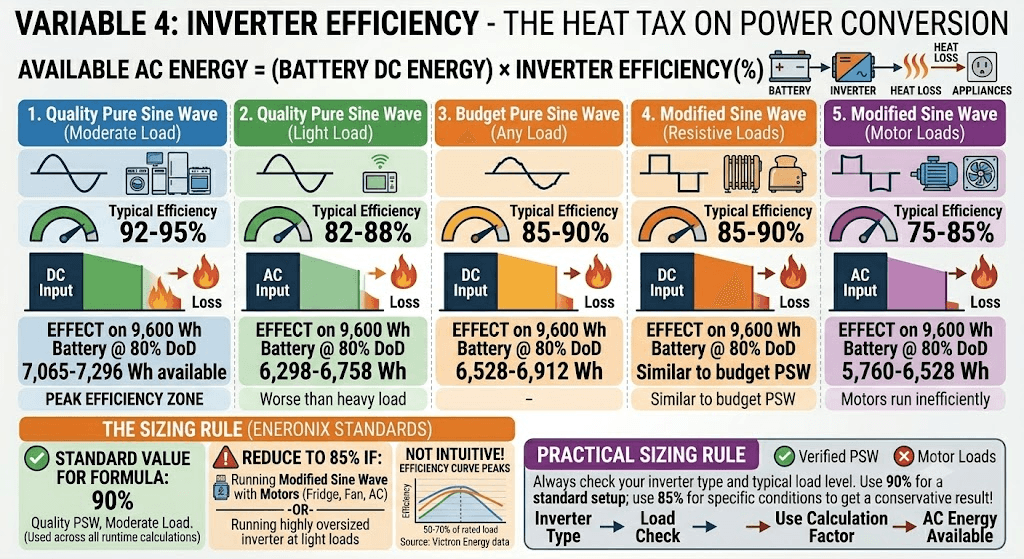
Your inverter converts DC battery power to AC power. That conversion is not lossless. The difference between what the battery puts in and what your appliances receive is heat , literally. Efficiency varies by inverter quality and by load level.
| Inverter Type / Load Level | Typical Efficiency | Effect on a 9,600 Wh Battery at 80% DoD |
| Quality pure sine wave, moderate load (40 to 70%) | 92 to 95% | 7,065 to 7,296 Wh available to appliances |
| Quality pure sine wave, light load (10 to 20%) | 82 to 88% | 6,298 to 6,758 Wh , worse than heavy load |
| Budget pure sine wave, any load | 85 to 90% | 6,528 to 6,912 Wh |
| Modified sine wave, resistive loads | 85 to 90% | Similar to budget pure sine wave |
| Modified sine wave, motor loads (fridge, fan, AC) | 75 to 85% | 5,760 to 6,528 Wh , motors run inefficiently |
The standard value used in this article and across all Eneronix runtime calculations is 90%, representing a quality pure sine wave inverter at moderate load. If you are on a modified sine wave inverter running motor loads, reduce this to 85% in your formula. If you are running an oversized inverter at light loads, reduce it to 85% as well. The efficiency curve is not intuitive , Victron Energy’s inverter efficiency testing data demonstrates how efficiency peaks at 50 to 70% of rated load and drops significantly at very light loads.
Variable 5: Load in Watts
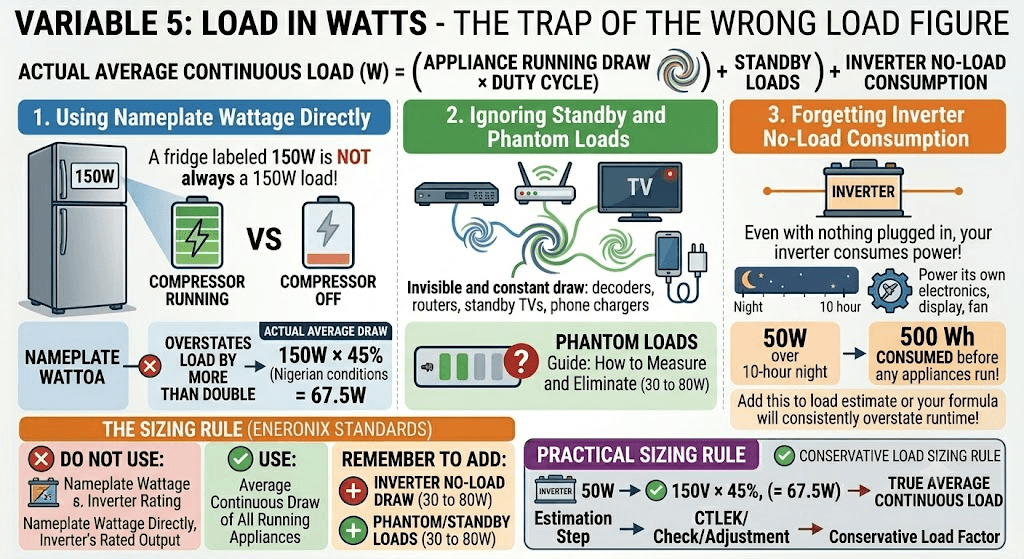
This is where most people introduce the most error. The load figure you use must be the average continuous draw of all running appliances, not the peak draw, not the rated wattage on the label, and not the inverter’s rated output.
Three load estimation mistakes that consistently produce wrong calculations:
- Using nameplate wattage directly. A fridge labelled 150W draws 150W only when the compressor is running. With a 45% duty cycle in Nigerian conditions, the average draw is 67.5W. Using 150W overstates the fridge load by more than double.
- Ignoring standby and phantom loads. Decoders, routers, standby TVs, and phone chargers plugged in with no phone draw 30 to 80W continuously in a typical Nigerian home. This load is invisible but constant. Our phantom loads guide shows you how to measure and eliminate it.
- Forgetting inverter no-load consumption. Even with nothing plugged in, your inverter draws 30 to 80W to power its own electronics, display, and fan. At 50W over a 10-hour night, that is 500 Wh consumed before a single appliance runs. Add this to your load estimate or your formula will consistently overstate runtime.
The Formula in Action: Four Nigerian Scenarios
These four worked examples cover the most common battery backup scenarios in Nigeria. The calculation methodology is identical in every case: Total Wh × DoD% × Inverter Efficiency / Average Load.
Scenario A: Small Flat in Lagos (Band B Area, 10-Hour Outage)
System: 48V 100Ah LiFePO4. Load inventory:
| Appliance | Avg Draw | Hours Active | Wh Consumed |
| 3 LED lights (10W each) | 30W | 10 hrs | 300 Wh |
| 1 standing fan | 65W | 10 hrs | 650 Wh |
| Phone charging (2 phones) | 30W | 3 hrs | 90 Wh |
| WiFi router | 12W | 10 hrs | 120 Wh |
| Inverter no-load | 35W | 10 hrs | 350 Wh |
| Total | 142W avg | 1,510 Wh |
Applying the complete formula:
- Battery Wh: 48 × 100 = 4,800 Wh
- Usable at 80% DoD: 4,800 × 0.80 = 3,840 Wh
- After 90% inverter efficiency: 3,840 × 0.90 = 3,456 Wh
- Runtime at 142W avg load: 3,456 / 142 = 24.3 hours
Result: The 48V 100Ah LiFePO4 handles this 10-hour outage with over 14 hours of reserve. This flat is undershooting its battery capacity. The owner could add a small fridge or reduce battery size to 75Ah without any noticeable change in backup performance.
Scenario B: Medium Home in Port Harcourt (16-Hour Outage, No AC)
System: 48V 200Ah LiFePO4. Load inventory:
| Appliance | Avg Draw | Hours Active | Wh Consumed |
| 5 LED lights | 50W | 16 hrs | 800 Wh |
| 2 ceiling fans | 110W | 16 hrs | 1,760 Wh |
| 32-inch TV + decoder | 65W | 8 hrs | 520 Wh |
| Medium fridge (150L) | 85W avg | 16 hrs | 1,360 Wh |
| Laptop + phone charging | 80W | 6 hrs | 480 Wh |
| Inverter no-load | 45W | 16 hrs | 720 Wh |
| Total energy needed | 5,640 Wh |
Formula check , can the battery supply 5,640 Wh?
- Usable Wh: 48 × 200 × 0.80 × 0.90 = 6,912 Wh
- Required Wh: 5,640 Wh
- Margin: 6,912 − 5,640 = 1,272 Wh (18% headroom)
Result: The 48V 200Ah LiFePO4 covers the full 16-hour Port Harcourt outage with 18% reserve. If the outage extends to 18 or 20 hours, the battery will last if night loads (no TV after midnight, reduce to 1 fan) are managed. This is a well-matched system.
Scenario C: Small Office in Abuja with AC (8-Hour Outage)
System: 48V 200Ah LiFePO4. Office load:
| Appliance | Avg Draw | Hours Active | Wh Consumed |
| 6 LED office lights | 60W | 8 hrs | 480 Wh |
| 4 laptops | 240W | 8 hrs | 1,920 Wh |
| WiFi router + switch | 25W | 8 hrs | 200 Wh |
| 1HP split AC (running) | 800W avg | 8 hrs | 6,400 Wh |
| Inverter no-load | 50W | 8 hrs | 400 Wh |
| Total energy needed | 9,400 Wh |
Formula check:
- Usable Wh: 48 × 200 × 0.80 × 0.90 = 6,912 Wh
- Required: 9,400 Wh
- Deficit: 9,400 − 6,912 = 2,488 Wh short
Result: The single 48V 200Ah battery cannot power this office with AC running for 8 hours. It runs out after approximately 5.8 hours. Two options: add a second 200Ah battery in parallel (14,400 Wh usable , covers 9,400 Wh with margin), or run the AC for 4 hours then switch to fans for the remaining 4 hours, which brings total consumption to approximately 5,600 Wh , within the battery’s capacity.
Scenario D: Rural Home, Full Off-Grid, 24-Hour Coverage
System: 48V 200Ah LiFePO4 with solar panels. Modest rural home load:
| Appliance | Avg Draw | Hours Active | Wh Consumed |
| 4 LED lights | 40W | 8 hrs night | 320 Wh |
| 2 fans | 110W | 12 hrs | 1,320 Wh |
| Small fridge (100L) | 55W avg | 24 hrs | 1,320 Wh |
| Phone charging | 20W | 4 hrs | 80 Wh |
| Water pump (0.5HP, daily) | 370W | 0.5 hrs | 185 Wh |
| Inverter no-load | 35W | 24 hrs | 840 Wh |
| Total daily energy | 4,065 Wh |
- Usable Wh: 6,912 Wh per full charge
- Required: 4,065 Wh per day
- Days of autonomy without solar: 6,912 / 4,065 = 1.7 days (just under two days)
For full off-grid design, two days of autonomy without solar is the standard recommendation. This system just misses that threshold on one 200Ah battery. Adding a second battery in parallel provides 13,824 Wh usable , 3.4 days of autonomy, which comfortably covers two cloudy days. For a full off-grid system design calculation including solar panel sizing, see our off-grid solar system design guide for Nigeria.
Why Your Real Runtime Does Not Match the Formula , And How to Fix It
The formula is mathematically correct. When the answer it produces does not match your real experience, one or more of the input variables is wrong. Here is a diagnostic table covering every common mismatch and its fix.
| Symptom | Most Likely Cause | Variable to Adjust | Fix |
| Battery dies 20 to 30% earlier than calculated | Inverter efficiency overestimated or phantom loads not counted | Inverter efficiency and Load | Reduce efficiency to 85%, add 50W to load estimate for phantom loads |
| Battery dies 40 to 50% earlier than calculated | Battery state of health degraded below rated capacity | Battery Wh (Ah) | Reduce Ah by 15 to 20% in formula , battery is ageing |
| Battery dies immediately at low SoC | BMS cutoff set higher than expected , e.g. at 20% not 10% | DoD% | Reduce usable DoD to 60 to 65% to match actual BMS behaviour |
| Formula correct but real runtime varies widely night to night | Load is not constant , AC cycling, fridge restocking, variable usage | Load | Use a clamp meter or energy monitor to measure real average draw |
| Runtime dropped gradually over 12 to 18 months | Battery cycle ageing , capacity declining with each cycle | Battery Wh (Ah) | Reduce Ah by 5% per year after year 2 for lead-acid, after year 4 for LiFePO4 |
| Formula matches in winter but overestimates in harmattan | High ambient temperature increasing fridge and AC duty cycle | Load | Add 15% to load estimate in months above 35 degrees Celsius ambient |
The most reliable way to eliminate formula error is to measure your actual load with a clamp meter or an inline energy monitor. A Victron Energy SmartShunt or similar battery monitor gives you real-time Wh consumed, state of charge, and historical data that makes formula-based estimation unnecessary for day-to-day use. For Nigerian installations, the Victron SmartShunt is available through solar equipment distributors in Lagos, Abuja, and Port Harcourt.
The Variables Other Guides Leave Out of the Formula
The five-variable formula above is complete for most purposes. But there are three additional factors that affect real-world runtime in ways the standard formula does not capture. These are not usually included in online calculators, but they matter for Nigerian conditions specifically.
1. Self-Discharge Rate
All batteries lose charge even when nothing is connected. LiFePO4 loses approximately 1 to 3% of charge per month through self-discharge. Lead-acid loses 4 to 8% per month. In a system that sits unused for two weeks , for example, a holiday home or a backup system that has not been tested , the battery starting state of charge may be 94 to 98% rather than 100%, reducing usable Wh by a small but measurable amount. NREL’s battery self-discharge research provides validated self-discharge figures across multiple lithium chemistries.
2. Temperature Derating
Battery capacity is rated at 25 degrees Celsius. In Nigerian conditions, this creates two opposing effects: daytime heat (30 to 42 degrees Celsius) causes slight capacity reduction in lithium and significant reduction in lead-acid; harmattan nights (15 to 20 degrees Celsius in northern Nigeria) reduce discharge capacity in both chemistries. For a precise calculation in Nigerian conditions, apply a temperature derating factor of 0.95 to the battery Wh for daytime high-temperature operation and 0.92 for cold harmattan nights.
A simple adjusted formula for Nigerian summer conditions:
Runtime (hrs) = (Battery Wh × DoD% × Temp Factor × Inverter Eff.) / Load (W)
Where Temp Factor = 0.95 for ambient above 35 degrees Celsius, 1.00 for 20 to 35 degrees Celsius, and 0.92 for ambient below 20 degrees Celsius.
3. Cable and Connection Losses
DC cables between the battery and inverter have resistance. At high currents, this resistance dissipates energy as heat , energy that never reaches the inverter. For a 48V system drawing 40A (approximately 1,920W), a 10 milliohm total cable resistance wastes 16W continuously. Over a 10-hour night that is 160 Wh , roughly 2% of a 200Ah battery’s usable energy, never reaching any appliance.
Properly sized cables, as specified in our DC cable sizing guide for off-grid solar systems, eliminate this loss almost entirely. Undersized cables , which are common in Nigerian installations due to cost pressure , can increase these losses to 3 to 5% of total energy, which is not negligible over the life of the system.
Quick Reference: Formula Results for Common Nigerian Systems
All figures below use the complete formula: Battery Wh × 80% DoD × 90% inverter efficiency / Load. For 48V LiFePO4 systems only. Lead-acid users: replace 80% DoD with 50% and expect approximately 45 to 50% of the runtimes shown.
| Battery Size | Usable Wh | At 200W load | At 400W load | At 700W load | At 1,000W load | At 1,500W load |
| 48V 100Ah | 3,456 Wh | 17.3 hrs | 8.6 hrs | 4.9 hrs | 3.5 hrs | 2.3 hrs |
| 48V 150Ah | 5,184 Wh | 25.9 hrs | 13.0 hrs | 7.4 hrs | 5.2 hrs | 3.5 hrs |
| 48V 200Ah | 6,912 Wh | 34.6 hrs | 17.3 hrs | 9.9 hrs | 6.9 hrs | 4.6 hrs |
| 48V 200Ah x2 | 13,824 Wh | 69.1 hrs | 34.6 hrs | 19.7 hrs | 13.8 hrs | 9.2 hrs |
| 48V 400Ah | 13,824 Wh | 69.1 hrs | 34.6 hrs | 19.7 hrs | 13.8 hrs | 9.2 hrs |
These are the reference numbers. Every article in the Eneronix battery runtime cluster (see links below) is built from these same calculations using this same formula. The numbers are consistent across the entire cluster because the methodology is identical.
Frequently Asked Questions
What is the formula for battery backup time?
The complete formula is: Runtime (hours) = (Battery Voltage × Ah × DoD% × Inverter Efficiency) / Load in Watts. Use 80% for DoD with LiFePO4, 50% for lead-acid, and 90% for inverter efficiency with a quality pure sine wave unit. Always use the actual continuous load of your appliances, not the inverter’s rated output.
How do I calculate how long my battery will last?
Step 1: Multiply your battery voltage by its amp-hours to get watt-hours (e.g. 48V × 200Ah = 9,600 Wh). Step 2: Multiply by your usable depth of discharge (0.80 for LiFePO4, 0.50 for lead-acid). Step 3: Multiply by your inverter efficiency (0.90 is standard). Step 4: Add up the average watts of all appliances running simultaneously, including standby devices and inverter no-load consumption. Step 5: Divide the result of steps 1 to 3 by the result of step 4. The answer is your runtime in hours.
Why does the formula give different results from online calculators?
Most online calculators use simplified assumptions that overstate runtime. Common oversimplifications: using 100% of battery capacity instead of 80% DoD, ignoring inverter efficiency losses, using nameplate wattage instead of average draw for cycling loads like fridges, and not accounting for inverter no-load consumption. The complete formula in this article accounts for all of these. The resulting number will be lower than most online calculators show , and more accurate.
Can I use the formula for lead-acid batteries?
Yes, with one critical change: replace the 80% DoD figure with 50%. A 12V 200Ah lead-acid battery: 12 × 200 × 0.50 × 0.90 / Load = 1,080 / Load. At 300W load: 1,080 / 300 = 3.6 hours. Exceeding the 50% DoD threshold on lead-acid causes sulphation and permanently reduces capacity with every cycle. For a full comparison of lead-acid and lithium runtime performance, see our article on lithium vs tubular battery in Nigeria.
How do I account for a battery that is not fully charged?
If your battery starts at 80% SoC instead of 100%, multiply your battery Wh by 0.80 before applying the DoD percentage. For a 48V 200Ah LiFePO4 starting at 80% SoC: (9,600 × 0.80) × 0.80 DoD × 0.90 inverter efficiency = 5,530 Wh available, not 6,912 Wh. This is exactly the kind of calculation covered in our articles on how to make 30% battery last all day and how to make 20% battery last 2 hours.
What is the difference between Ah and Wh in the formula?
Amp-hours (Ah) measure charge quantity , how many electrons the battery holds. Watt-hours (Wh) measure energy , the ability to do actual work. To convert: Wh = Voltage × Ah. A 48V 200Ah battery holds 9,600 Wh of energy. A 12V 200Ah battery holds only 2,400 Wh. They have the same Ah but very different energy content. The formula must use Wh, not Ah alone, which is why voltage must always be included.
How accurate is the battery backup time formula?
Using the complete formula with accurate inputs, real-world results typically fall within 10 to 15% of the calculated figure. The main sources of variance are: load fluctuation (appliances cycling on and off), temperature changes during the discharge period, and battery state of health differing from the rated capacity. For critical applications , hospitals, telecommunications, cold storage , always add a 20% safety margin to the calculated result. For home backup in Nigeria, a 15% buffer above your required runtime is a sensible design standard.
The Bottom Line
The battery backup time formula is not complicated. What makes it unreliable in practice is not the mathematics , it is the inputs. Use the wrong DoD. Forget inverter efficiency. Ignore standby loads. Assume nameplate wattage for a cycling appliance. Do any of these and your real-world runtime will consistently disappoint your calculation.
The complete formula , Battery Wh × DoD% × Inverter Efficiency / Load , gives you accuracy within 10 to 15% of real-world results when every variable is correct. That level of accuracy is enough to size a battery bank, plan for an outage, and understand why last night’s battery lasted longer or shorter than expected.
For the specific runtime breakdowns at every common battery size, see our cluster of runtime articles: how long a 100Ah battery lasts, how long a 200Ah battery lasts, and how long a 2000W inverter runs on battery. Every figure in those articles uses the exact formula and methodology explained on this page.

I am Engr. Ubokobong Ekpenyong, a solar specialist and lithium battery systems engineer with over five years of hands-on experience designing, assembling, and commissioning off-grid solar and energy storage systems. My work focuses on lithium battery pack architecture, BMS configuration, and system reliability in off-grid and high-demand environments.