
Tank Sizing for Solar Water Pumping Systems
In a solar water pumping system, the storage tank does a job that is easy to underestimate. It is not just a container for water. It is the system’s energy buffer, its supply reservoir for nights and cloudy days, and the component that determines whether a correctly sized pump actually delivers reliable 24-hour water supply.
A pump that is correctly sized but paired with an undersized tank will leave a family without water every evening. A tank that is too large for its stand height will supply water at inadequate pressure. A tank made of the wrong material will contaminate water or fail structurally within three years of Nigerian sun exposure.
This guide covers every dimension of tank sizing for solar pump systems in Nigeria: volume, material, elevation, structural support, and the float switch integration that connects the tank to the pump controller.
This is Post 8 in the Eneronix Solar Water Pumping series. For the complete pump sizing method, see: How to Size a Solar Submersible Pump for a Borehole in Nigeria. For the full system overview, see: Solar Water Pump System in Nigeria.
The Role of the Tank in a Solar Pump System
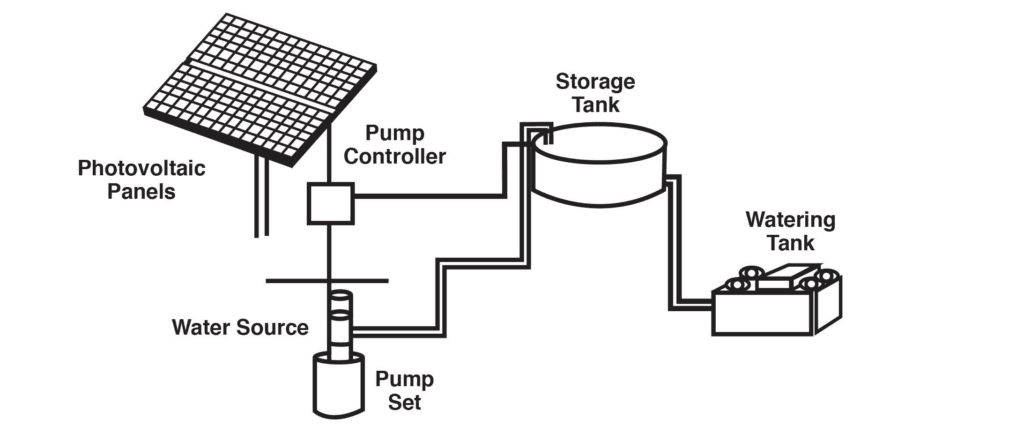
A solar pump only runs during daylight hours when the panels are producing power. Demand for water does not stop at sunset. The tank bridges this gap by storing water pumped during the day and releasing it as needed through the evening, night, and early morning.
The tank serves three distinct functions simultaneously:
- Energy buffer: stores the hydraulic energy (water at elevation) produced during daylight pumping hours for use when the pump is not running
- Pressure source: when elevated above the distribution system, the tank provides constant gravity pressure to all outlet points without requiring the pump to run continuously
- Surge capacity: absorbs peak demand events (morning showers, simultaneous usage) that momentarily exceed the pump’s flow rate
The tank is the battery of a solar water system. Just as a battery bank stores electrical energy for night use, the elevated tank stores hydraulic energy. The key difference: water storage is far cheaper per unit of useful energy than battery storage.
This is exactly why most solar pump systems do not need a battery bank. The tank provides overnight autonomy at a fraction of the cost. For more on when a battery is and is not needed, see: Solar Water Pump System in Nigeria.
Step 1: Calculate Daily Water Demand
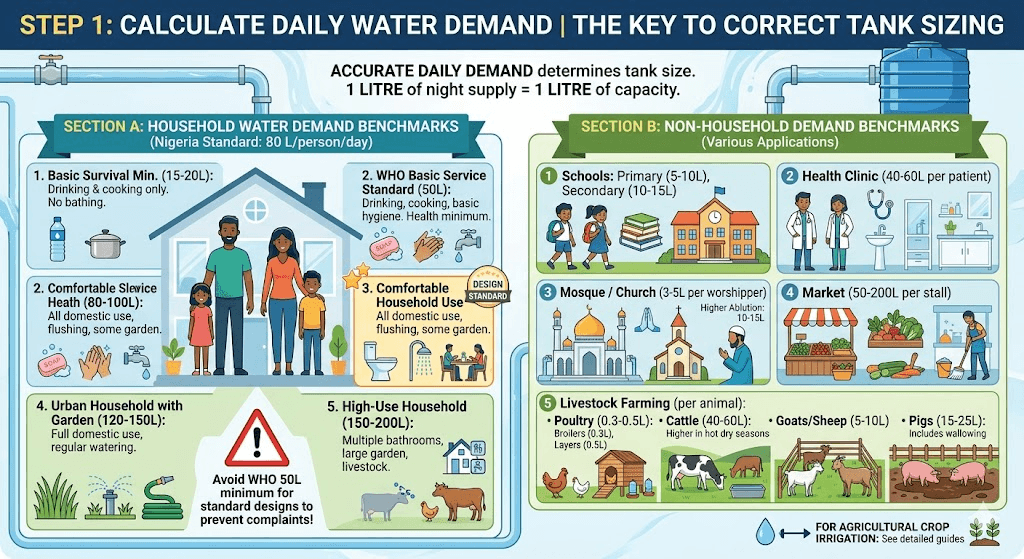
Tank sizing starts with an accurate daily demand figure. Every litre of demand that the tank must supply through the night requires one litre of tank capacity.
Household Water Demand Benchmarks
| Usage Category | Daily Demand per Person | Includes |
| Basic survival minimum | 15 to 20 litres | Drinking and cooking only. No bathing or laundry. |
| WHO basic service standard | 50 litres | Drinking, cooking, basic hygiene. Minimum for health. |
| Comfortable household use | 80 to 100 litres | Drinking, cooking, bathing, toilet flushing, some garden use. |
| Urban household with garden | 120 to 150 litres | Full domestic use plus regular garden watering. |
| High-use household | 150 to 200 litres | Multiple bathrooms, large garden, livestock watering. |
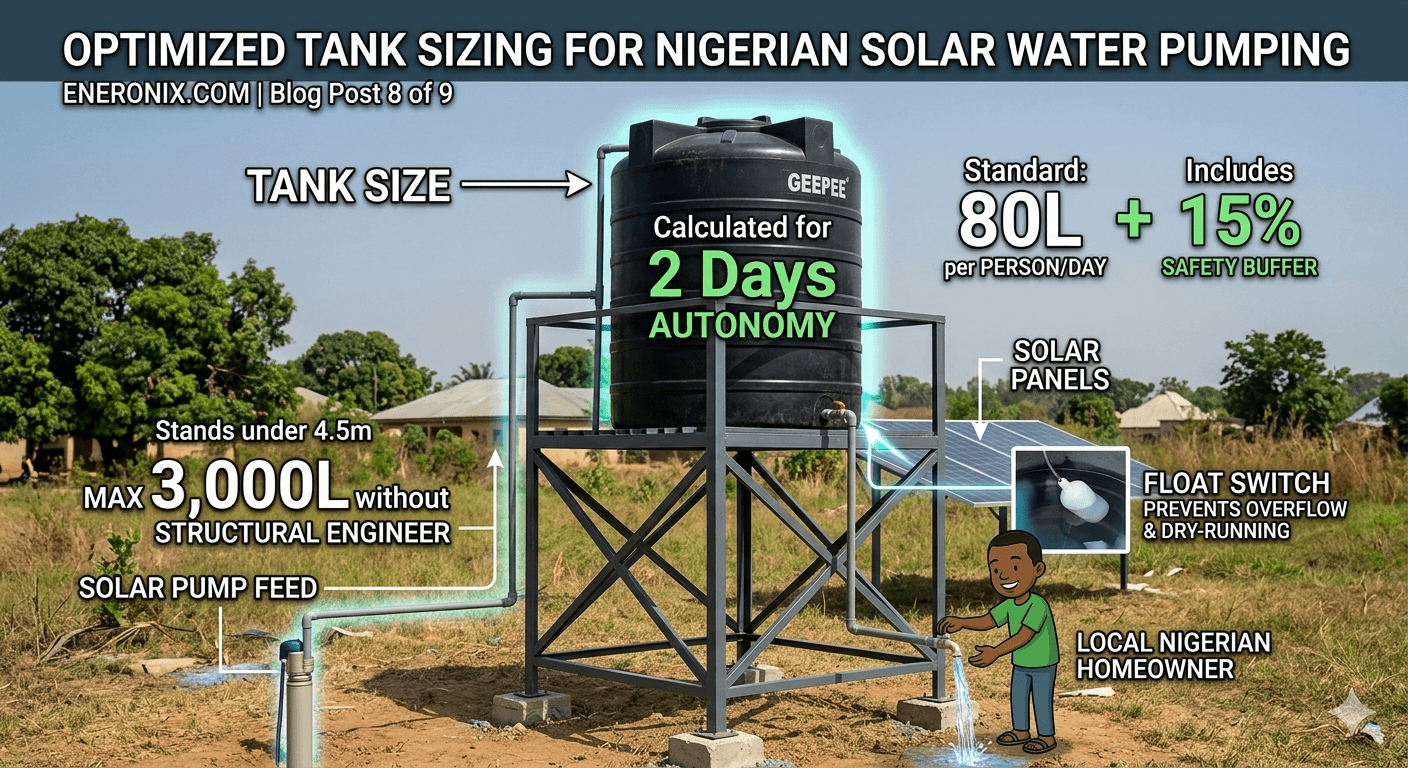
For system design in Nigeria, use 80 litres per person per day as the standard household design figure. This accounts for real usage patterns including toilet flushing, cooking, bathing, and incidental use. Designs based on the WHO 50-litre minimum consistently result in complaints of inadequate supply.
Non-Household Demand Benchmarks
| Application | Demand | Notes |
| Primary school (per pupil per day) | 5 to 10 litres | Higher for schools with kitchen facilities |
| Secondary school (per pupil per day) | 10 to 15 litres | Accounts for more active water use |
| Health clinic (per patient visit) | 40 to 60 litres | Includes hand washing, equipment cleaning |
| Mosque / church (per worshipper, per visit) | 3 to 5 litres | Ablution use for mosques is higher: 10 to 15 L |
| Market (per stall per day) | 50 to 200 litres | Depends on food preparation activities |
| Poultry (per bird per day) | 0.3 to 0.5 litres | Broilers: 0.3L, layers: 0.5L |
| Cattle (per animal per day) | 40 to 60 litres | Higher in hot dry season |
| Goats and sheep (per animal per day) | 5 to 10 litres | |
| Pigs (per animal per day) | 15 to 25 litres | Includes wallowing water in traditional setups |
For agricultural water demand including crop-specific irrigation requirements, see the detailed demand tables in: How to Design a Solar Drip Irrigation System for a Nigerian Farm.
Step 2: Determine the Autonomy Requirement
Autonomy is the number of days the tank can supply demand without any pumping. Higher autonomy means a larger tank. The correct autonomy depends on your location, your pump reliability, and the consequences of running out of water.
Autonomy Recommendations by Scenario
| Scenario | Recommended Autonomy | Reasoning |
| Urban/peri-urban home, reliable grid backup available | 1 day | Short outages are recoverable. Keeps tank size manageable. |
| Standard rural home, solar-only supply | 2 days | Covers one full cloudy day plus overnight without pumping. |
| Remote rural home, no backup supply | 3 days | Extended cloud cover during rainy season in South Nigeria. |
| School or health facility | 2 to 3 days | Institutional continuity. Running dry is unacceptable. |
| Community water point (multiple households) | 2 to 3 days | Multiple families dependent on one source. |
| Farm livestock supply (critical) | 3 days | Animal welfare risk from water interruption. |
| Northern Nigeria (harmattan season, dusty) | 3 days | Consecutive low-output days during heavy harmattan possible. |
Two days of autonomy is the standard design target for a residential solar pump system in Nigeria. One day is acceptable for urban homes with alternative supply options. Three days is the correct choice for remote locations and institutional installations.
Step 3: Calculate Minimum Tank Volume
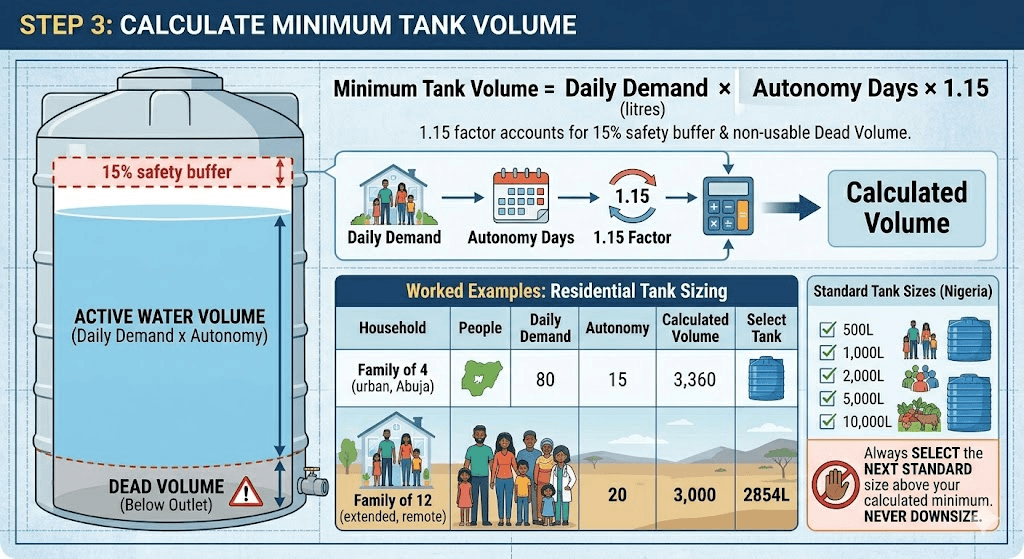
The tank sizing formula combines daily demand and autonomy days:
Minimum Tank Volume = Daily Demand (litres) x Autonomy Days x 1.15 (dead volume and safety factor)
The 1.15 factor accounts for two things: dead volume (the water that sits permanently at the bottom of the tank below the outlet pipe and cannot be used) and a 15 per cent safety buffer for demand variations.
Worked Examples: Residential Tank Sizing
| Household | People | Daily Demand | Autonomy | Calculated Volume | Select Tank |
| Family of 4 (urban, Abuja) | 4 | 4 x 80L = 320L | 1.5 days | 320 x 1.5 x 1.15 = 552L | 750L tank |
| Family of 6 (rural, Oyo) | 6 | 6 x 80L = 480L | 2 days | 480 x 2 x 1.15 = 1,104L | 1,500L tank |
| Family of 8 (rural, Kano) | 8 | 8 x 80L = 640L | 2.5 days | 640 x 2.5 x 1.15 = 1,840L | 2,000L tank |
| Family of 12 (extended, remote) | 12 | 12 x 80L = 960L | 3 days | 960 x 3 x 1.15 = 3,312L | 4,000L tank |
| Family of 6 + garden irrigation | 6 + garden | 480L household + 300L garden = 780L | 2 days | 780 x 2 x 1.15 = 1,794L | 2,000L tank |
Standard Tank Sizes Available in Nigeria
Nigerian suppliers stock polyethylene tanks in standard sizes. Always select the next standard size above your calculated minimum. Never downsize to save money on the tank.
| Standard Size | Dimensions (approx) | Weight When Full | Typical Application |
| 500 litres | 0.85m diameter x 1.1m height | 500 kg | Small family, backup tank |
| 750 litres | 0.95m diameter x 1.25m height | 750 kg | Family of 4, urban use |
| 1,000 litres | 1.1m diameter x 1.3m height | 1,000 kg | Family of 5 to 6 |
| 1,500 litres | 1.2m diameter x 1.5m height | 1,500 kg | Family of 6 to 8 |
| 2,000 litres | 1.35m diameter x 1.65m height | 2,000 kg | Family of 8 to 10 |
| 3,000 litres | 1.5m diameter x 1.85m height | 3,000 kg | Large family, community use |
| 4,500 litres | 1.7m diameter x 2.1m height | 4,500 kg | Small community water point |
| 5,000 litres | 1.8m diameter x 2.2m height | 5,000 kg | Community or institutional |
| 10,000 litres | 2.2m diameter x 2.8m height | 10,000 kg | Large farm or community |
A 2,000-litre tank full of water weighs 2,000 kg. A 5,000-litre tank weighs 5,000 kg. The structural support for an elevated tank must be engineered for the full water weight, not the empty tank weight. This is where most Nigerian DIY tank stands fail.
Step 4: Determine Tank Elevation for Adequate Pressure
An elevated tank supplies water by gravity. The pressure at any outlet point is determined by the vertical height difference between the water surface in the tank and the outlet.
Pressure Rule: Every 10 metres of tank elevation above the outlet creates 1 bar (100 kPa) of pressure at the outlet.
Nigerian household plumbing and fixtures are designed for 1.5 to 3.5 bar operating pressure. Overhead tanks typically provide 0.1 to 0.3 bar, which is sufficient for taps and showers but insufficient for instant water heaters, high-pressure fixtures, or water treatment systems that have minimum pressure requirements.
Pressure Requirements for Common Nigerian Fixtures
| Fixture or Application | Minimum Pressure Required | Notes |
| Standard tap (bib cock, pillar tap) | 0.05 bar (0.5 m head) | Works with any tank elevation above the tap |
| Shower (low-pressure showerhead) | 0.1 bar (1 m head) | Minimum for acceptable flow from gravity tank |
| Shower (standard showerhead) | 0.15 to 0.3 bar (1.5 to 3 m head) | Recommended for comfortable showering |
| WC cistern (toilet flush valve) | 0.05 to 0.1 bar | Very low pressure tolerance |
| Electric instant water heater | 1.0 to 2.0 bar (10 to 20 m head) | Cannot run from gravity tank. Needs pump booster. |
| Gas instant water heater | 0.3 to 0.5 bar (3 to 5 m head) | Requires minimum 3 to 5 m tank elevation above heater |
| Solar water heater header tank | 0.1 to 0.2 bar | Most solar water heaters are gravity-compatible |
| Drip irrigation emitters | 0.3 to 0.8 bar (3 to 8 m head) | Minimum 3 m elevation for drip tape systems |
| Reverse osmosis water filter | 2.0 to 4.0 bar | Cannot run from gravity tank. Always needs booster pump. |
| Washing machine | 0.5 to 1.0 bar (5 to 10 m head) | Many machines specify minimum 0.5 bar inlet pressure |
For most standard Nigerian homes with conventional taps, showers, and WC cisterns, a minimum tank elevation of 2.5 to 3 metres above the highest outlet in the building is adequate. This provides 0.25 to 0.30 bar at the highest outlet and higher pressure at lower outlets.
How to Calculate Required Tank Stand Height
The tank stand height is not the same as the pressure head. The pressure head is measured from the water surface inside the tank to the outlet. The tank stand height is the height from ground level to the bottom of the tank.
- Identify the highest outlet in the building (typically an upstairs bathroom or rooftop fixture).
- Measure the height of that outlet above the ground level where the tank will stand.
- Add the minimum pressure head required for that fixture (typically 1.5 to 3 metres).
- Add half the tank height (since the water level averages at mid-tank, not the bottom).
Required Stand Height = Height of Highest Outlet + Minimum Pressure Head Required + (Tank Height / 2)
Example: Highest outlet is a first-floor shower at 3.5 m above ground. Shower requires 2 m pressure head. 1,500L tank is 1.5 m tall. Stand height = 3.5 + 2.0 + 0.75 = 6.25 m. Use a 6.5 m stand.
Standard Tank Stand Heights and Structural Requirements
| Stand Height | Tank Size Supported | Column Size Required | Base Requirement |
| 2.5 m | Up to 1,000L | 4 x 75x75x6mm angle iron | 600mm x 600mm concrete pad, 150mm thick |
| 3.0 m | Up to 1,500L | 4 x 75x75x6mm angle iron | 700mm x 700mm concrete pad, 200mm thick |
| 3.5 m | Up to 2,000L | 4 x 100x100x8mm angle iron | 800mm x 800mm concrete pad, 200mm thick |
| 4.5 m | Up to 3,000L | 4 x 100x100x10mm angle iron | 900mm x 900mm concrete pad, 250mm thick |
| 5.5 m | Up to 5,000L | 4 x 125x125x10mm angle iron | 1.2m x 1.2m concrete pad, 300mm thick |
| 6.5 m | Up to 5,000L | 4 x 150x150x12mm angle iron + bracing | 1.5m x 1.5m concrete pad, 350mm thick |
| Above 7 m | Any size | Structural engineer design required | Site-specific foundation design mandatory |
Do not build a tank stand above 4.5 metres without a qualified structural engineer reviewing the design. A collapsing tank stand is a catastrophic failure. In Nigeria, several fatalities have occurred from improperly designed elevated tank stands failing under load. The cost of a structural review is trivial compared to the risk.
Tank Materials: What to Use and What to Avoid in Nigerian Conditions
The material of your storage tank affects water quality, structural durability, UV resistance, and maintenance requirements. Nigerian conditions include intense UV radiation, temperatures exceeding 40 degrees Celsius, and significant harmattan dust loading.
Polyethylene (Plastic) Tanks
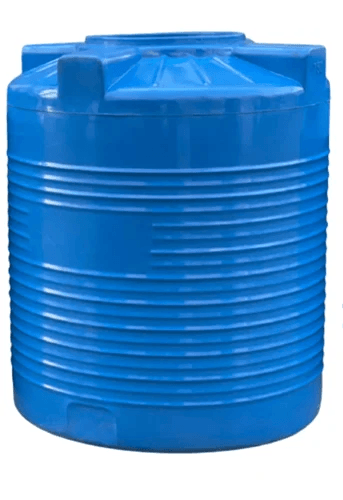
The most common tank type in Nigeria. Available everywhere, affordable, and easy to install. Polyethylene tanks come in two relevant grades for water storage:
- Linear Low-Density Polyethylene (LLDPE): the standard material for Nigerian water tanks. Food-grade LLDPE is safe for drinking water storage. Look for NSF/ANSI 61 certification or equivalent.
- High-Density Polyethylene (HDPE): higher strength, more rigid, better UV resistance than LLDPE. Used for larger industrial tanks. Less common in standard residential sizes.
| Factor | Good | Watch Out For |
| UV resistance | Black polyethylene tanks resist UV well. Prevents algae growth inside. | White or translucent tanks allow light penetration, promoting algae growth. Avoid for water storage. |
| Food safety | Food-grade polyethylene is safe for drinking water. | Recycled or industrial-grade polyethylene may contain contaminants. Buy from reputable brands with food-grade certification. |
| Temperature resistance | Standard LLDPE handles up to 60 degrees C surface temperature. | Avoid leaving tanks empty and exposed to direct sun for extended periods. Empty tanks warp at extreme temperatures. |
| Lifespan | Quality polyethylene tanks last 15 to 25 years with UV stabilisers. | Cheap tanks without UV stabilisers become brittle within 5 to 7 years in Nigerian sun. |
| Brands in Nigeria | Geepee, Linus, Polytank are established brands with reasonable quality control. | Unbranded market tanks have inconsistent wall thickness and no quality certification. |
Galvanised Steel Tanks
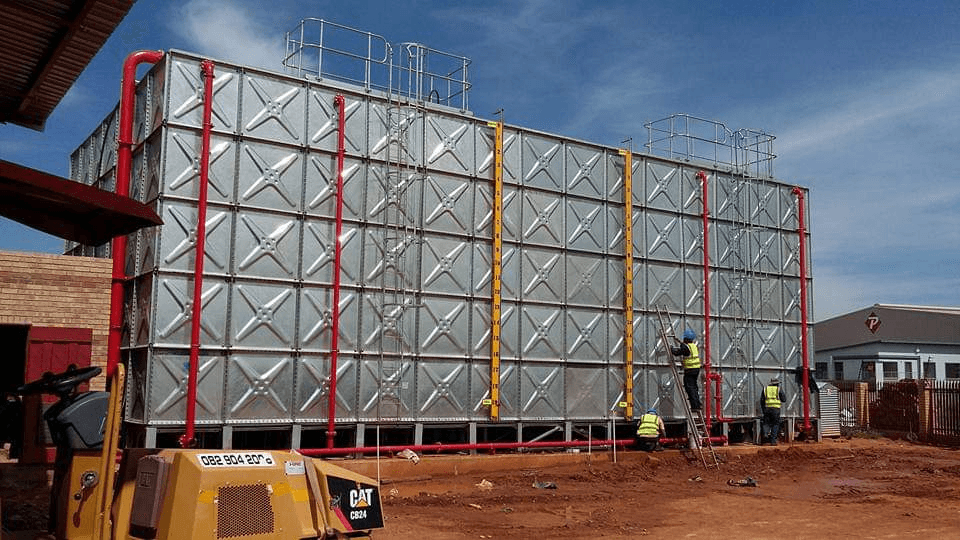
Galvanised steel tanks are an option for very large volumes (above 10,000 litres) where polyethylene tanks become impractical due to structural requirements. They are fabricated on-site or delivered pre-formed.
- Advantages: strong, can be fabricated in any size, long lifespan with proper coating maintenance.
- Disadvantages in Nigeria: galvanised coating corrodes in acidic rainwater environments (common in southern Nigeria), zinc from the coating can leach into water if the interior is not lined, and condensation under the Nigerian diurnal temperature swing accelerates corrosion on external surfaces.
- If using galvanised tanks: line the interior with approved food-grade epoxy coating and inspect every two years. Replace or reline if corrosion is visible inside.
Reinforced Concrete (Ferrocement) Tanks
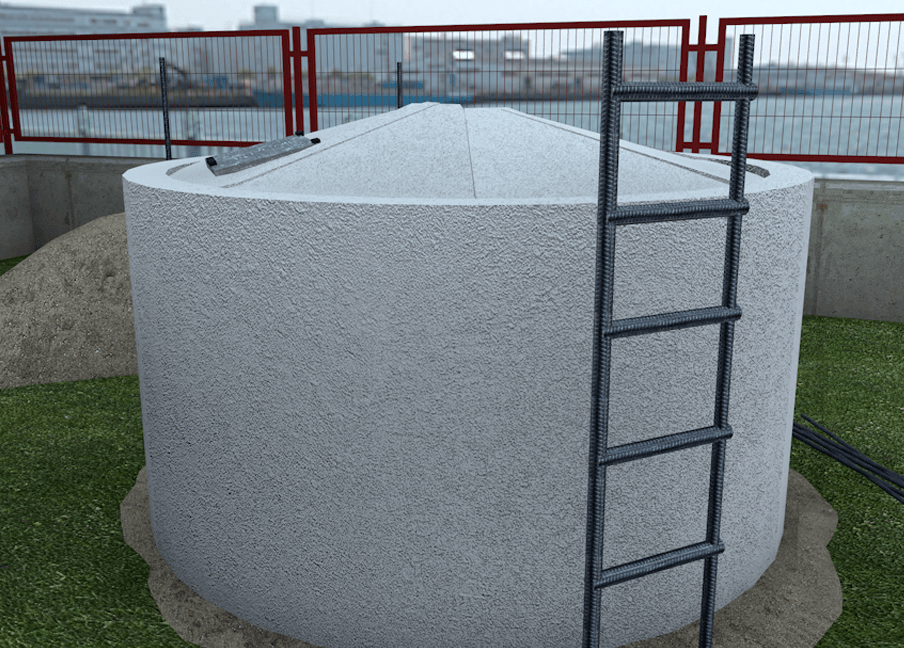
Common for community water schemes and institutional installations in rural Nigeria. Constructed in place by trained masons.
- Advantages: very long lifespan (30 to 50 years), low material cost for large volumes, can be built in any shape.
- Disadvantages: construction quality is highly variable and depends entirely on the mason’s skill. Poor construction leads to cracking and leakage. Interior must be plastered with approved waterproof mortar and painted with food-grade coating.
- Not recommended for elevated overhead tanks: the weight of a ferrocement tank is significantly greater than a polyethylene tank of the same volume, creating larger structural requirements for the support stand.
Float Switch Installation: Connecting the Tank to the Pump Controller
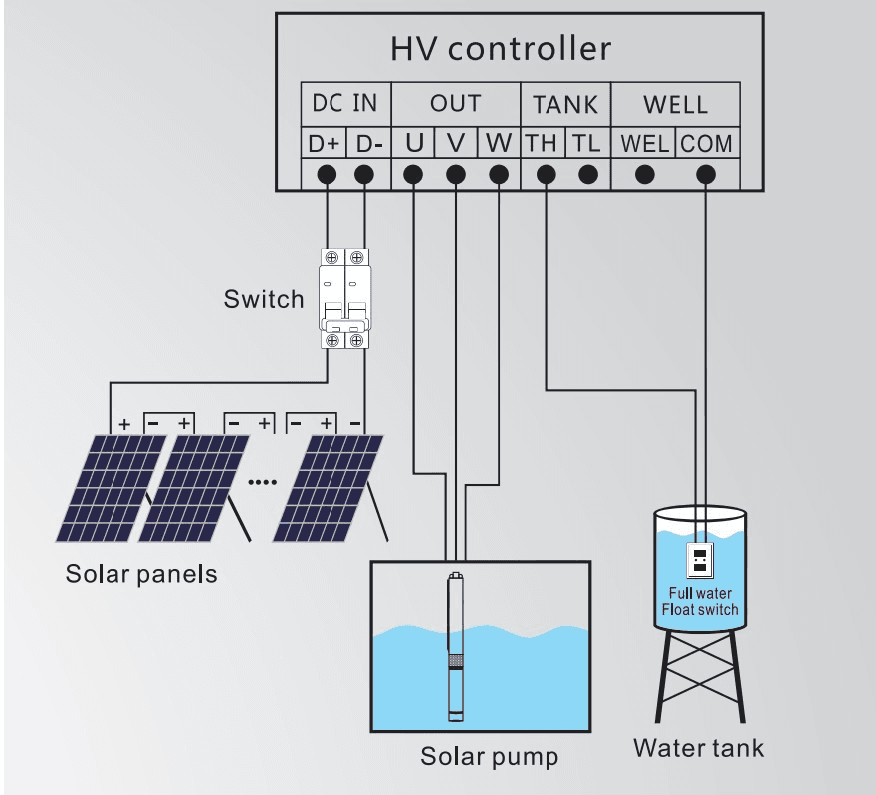
The float switch is the feedback mechanism between the tank and the pump. When the tank is full, the float switch signals the VFD or pump controller to stop the pump. When the water level drops below the switch set point, the pump restarts.
A correctly installed float switch prevents three serious problems:
- Tank overflow: pump running with a full tank overflows the tank and wastes water. In Nigeria where water is a scarce resource in many areas, overflow is a significant operational loss.
- Pump dry-running against a full tank: a pump pushing against a closed or restricted outlet has no flow. The motor draws locked-rotor current, overheats, and burns out.
- Continuous pump cycling: without a float switch, the pump may start and stop repeatedly as the tank level fluctuates. Short-cycling reduces motor lifespan.
Float Switch Types and Selection
| Float Switch Type | How It Works | Best Use in Nigeria |
| Vertical float switch (ball float) | Float rises with water level. At full level, internal mechanism opens or closes circuit. | Most common type. Simple, reliable, widely available. Use for tanks up to 5,000L. |
| Horizontal float switch | Floats horizontally. Tilts to open or close circuit as water level changes. | For tanks with restricted top access. Works in any orientation. |
| Electronic level sensor (ultrasonic) | Measures water level by sound reflection. No moving parts. | Best for large tanks and farm systems. More expensive but more reliable long-term. |
| Electrode float (conductivity type) | Detects water level by electrical conductivity between electrodes. | Suitable for ferrocement and steel tanks. Not recommended for polyethylene tanks due to installation complexity. |
For standard residential and small commercial installations in Nigeria, the vertical ball float switch at 230V rated is the correct and most practical choice. Select a switch rated for at least 10 amperes at 230V AC. Ensure the cable entry into the switch body is sealed to prevent moisture ingress in the outdoor installation environment.
Float Switch Wiring to the VFD Controller
The float switch connects to the VFD or pump controller’s digital input terminal designated for the tank full signal. The wiring depends on the switch type (Normally Open or Normally Closed) and the controller input configuration.
- Normally Open (NO) float switch: circuit is open when tank is not full, closes when tank is full. VFD is configured to stop motor when input circuit closes.
- Normally Closed (NC) float switch: circuit is closed when tank is not full, opens when tank is full. VFD is configured to stop motor when input circuit opens.
As covered in the controller settings guide, Normally Open switches are safer for Nigerian installations because a broken or disconnected float switch cable causes the VFD to see an open circuit, which it interprets as tank not full, keeping the pump running rather than incorrectly stopping it.
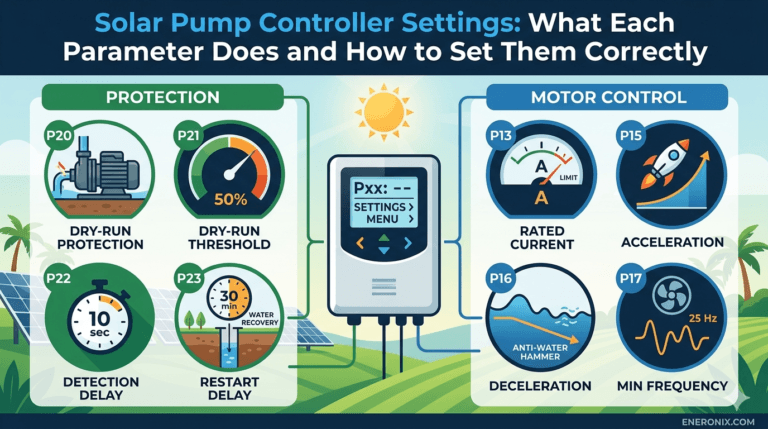
For the complete float switch wiring parameter settings in the VFD controller, including the P30 float switch input mode configuration, see: Solar Pump Controller Settings: What Each Parameter Does.
Float Switch Placement Inside the Tank
The float switch must be positioned at the correct height inside the tank. Incorrect placement causes either overflow (float set too high) or the pump stopping before the tank is adequately full (float set too low).
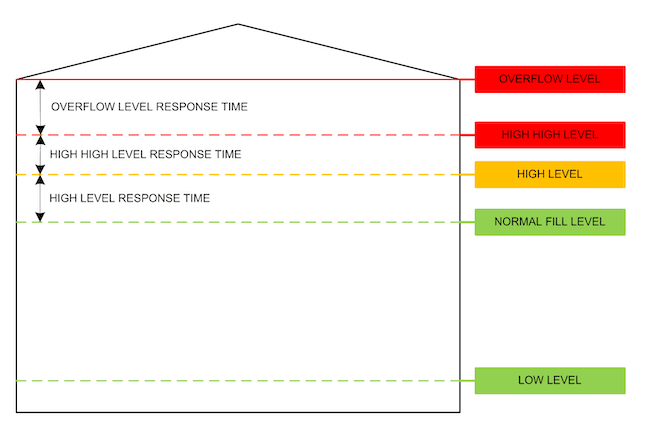
- Stop level (tank full): position the float so it trips when the tank is at 90 to 95 per cent of its volume. Leave 5 to 10 per cent headspace to account for float switch response delay and any surge from the pump stopping.
- Restart level (tank low): if using a two-float system (separate start and stop floats), set the restart float at 20 to 30 per cent of tank volume. This creates a hysteresis band that prevents rapid short-cycling.
- Single float switch systems: most simple installations use one float switch wired to stop the pump at the full level. The pump restarts when the float drops below the trip point as water is drawn from the tank. The natural hysteresis of the float mechanism provides adequate protection against rapid cycling in most cases.
Ground-Level vs Overhead Tank: When to Use Each
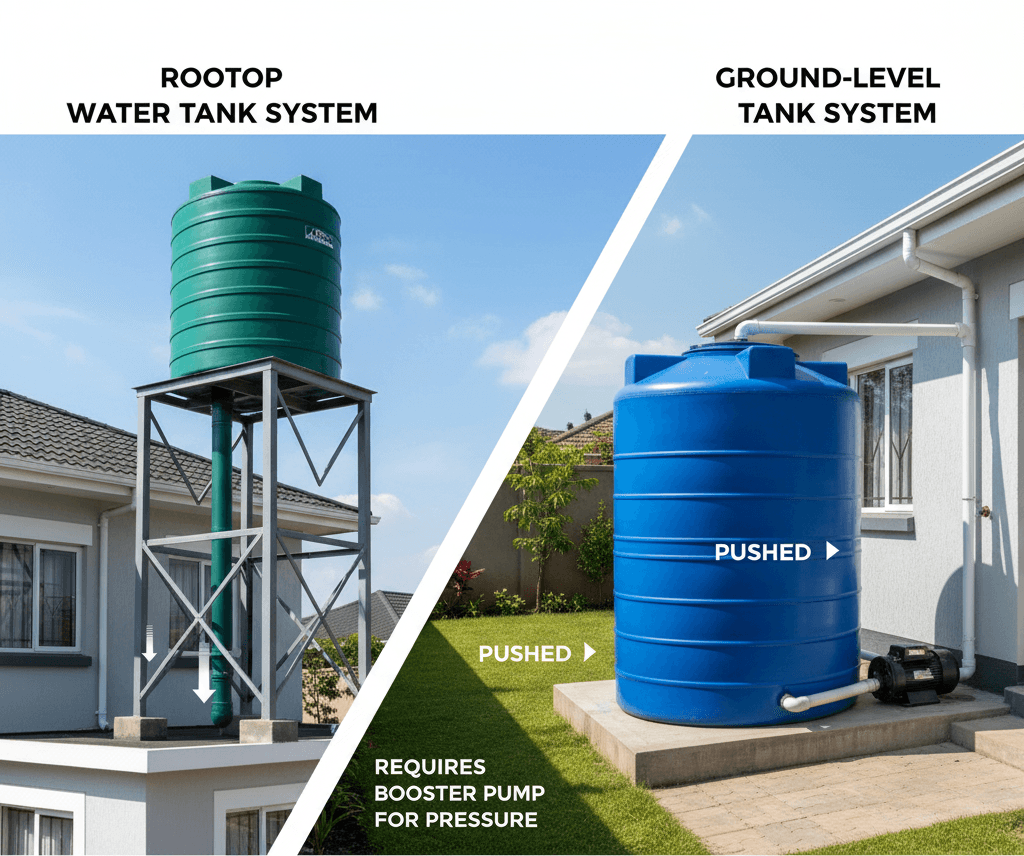
Not every solar pump installation uses an elevated overhead tank. Ground-level storage tanks serve a different function and are appropriate in different scenarios.
| Factor | Overhead Elevated Tank | Ground-Level Tank |
| Pressure supply | Gravity pressure. No booster pump needed for standard fixtures. | No pressure. Requires a booster pump for distribution. |
| Cost | Higher. Tank plus elevated stand structure. | Lower. Tank only, no stand required. |
| Structural risk | Elevated load requires engineered stand. Collapse risk if poorly built. | No structural risk from elevation. Only foundation loading. |
| Water quality | More exposure to heat and UV if not insulated. Algae risk in non-black tanks. | Cooler temperatures at ground level. Lower UV exposure. |
| Overflow risk | Overflow from height can damage structures and waste significant water. | Overflow at ground level is contained and less damaging. |
| Access for cleaning | Difficult. Requires ladder or elevated platform. | Easy. Hatch access at ground level. |
| Best application | Residential homes, schools, clinics where gravity pressure is sufficient. | Large farms where a transfer or booster pump is already part of the system design. |
For residential installations in Nigeria, an elevated overhead tank is the standard and correct approach. The gravity pressure eliminates the need for a constant-pressure pump or booster system for standard household fixtures. The cost of a properly built tank stand is recovered immediately in the elimination of a booster pump and its ongoing energy consumption.
Multiple Tank Configurations: When One Tank Is Not Enough
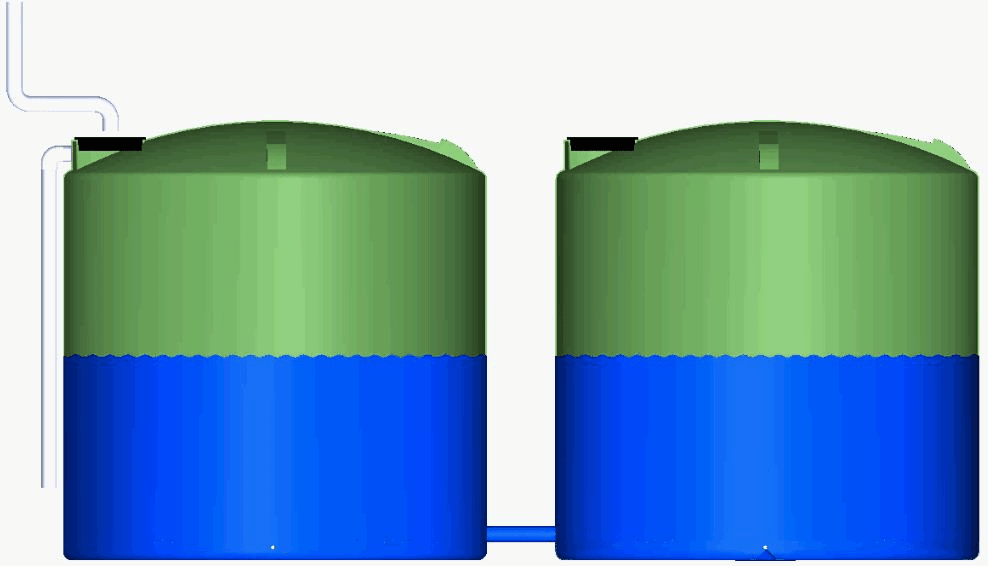
Some Nigerian installations benefit from using two tanks in a specific arrangement rather than one large tank.
Two-Tank System: Ground Storage Plus Overhead Supply
This configuration uses a large ground-level tank as the primary storage reservoir and a smaller elevated tank as the pressure supply tank. The solar pump fills the ground tank. A small electric booster pump transfers water from the ground tank to the elevated tank on demand.
This arrangement is useful when:
- The required storage volume is too large to elevate economically (above 5,000 litres)
- The borehole is located far from the building and a long ground-level run to the building is more practical than a long elevated pipe run
- The ground tank serves as a communal source with individual elevated tanks for each household
The disadvantage is the additional complexity and cost of the booster pump and its power supply. In solar-only installations, the booster pump requires either its own small solar panel or a connection to a home battery system.
Dual Overhead Tank Configuration
Two overhead tanks of equal size connected in parallel double the available storage without requiring a taller or wider single tank. Both tanks fill simultaneously from the pump. Both drain simultaneously to the distribution system.
This is the correct approach when the required volume exceeds the largest practical tank size for a given stand height, or when the structural load of a single large tank would require a prohibitively expensive stand upgrade.
Example: 4,000 litres is needed but the stand is rated for 2,000 litres. Install two 2,000-litre tanks side by side on a reinforced stand rated for 4,000 kg. Connect inlets in parallel from the pump outlet. Connect outlets in parallel to the distribution system. Wire both float switches to the VFD controller using a series connection so the pump stops only when both tanks are full.
Tank Hygiene and Maintenance in Nigerian Conditions
A correctly sized tank that is poorly maintained becomes a health hazard. Bacterial contamination of storage tanks is a significant cause of waterborne disease in Nigeria, particularly in rural areas.
Minimum Maintenance Requirements
- Clean and disinfect the tank at least once every six months. More frequently in high-demand or high-dust environments.
- Inspect the inlet pipe, outlet pipe, overflow pipe, and float switch at least quarterly for debris, corrosion, or biological growth.
- Keep the tank lid securely closed at all times. An open tank collects dust, insects, leaves, and small animals.
- Check the tank exterior and base for cracks, leaks, or structural deterioration annually.
- Replace float switch if any sign of sticking, corrosion at terminals, or erratic pump cycling is observed.
Disinfection Procedure
- Empty the tank completely by opening the drain valve or siphoning.
- Scrub the internal walls and bottom with a stiff brush. Do not use soap or detergent.
- Rinse thoroughly with clean water until runoff is clear.
- Prepare a chlorine solution: 50mL of household bleach (5% chlorine) per 1,000 litres of tank capacity.
- Pour the chlorine solution into the tank, then fill the tank completely with clean water.
- Allow the chlorinated water to stand for at least 4 hours before use.
- Drain and refill with clean water. The residual chlorine level should be 0.2 to 0.5 mg/L after disinfection.
Never use the tank water during the disinfection period. Post a visible notice on the tank when disinfection is in progress. This is especially important for community tanks shared by multiple families.
Complete Tank Sizing Reference Table for Nigerian Installations
| Application | People/Units | Daily Demand | Autonomy | Tank Volume | Recommended Tank |
| Urban family (Lagos/Abuja) | 4 people | 320L | 1.5 days | 552L | 750L polyethylene |
| Rural family (South-West) | 6 people | 480L | 2 days | 1,104L | 1,500L polyethylene |
| Rural family (North) | 8 people | 640L | 2.5 days | 1,840L | 2,000L polyethylene |
| Extended family (remote) | 12 people | 960L | 3 days | 3,312L | 4,000L or 2 x 2,000L |
| Primary school (100 pupils) | 100 pupils | 800L | 2 days | 1,840L | 2,000L polyethylene |
| Secondary school (300 pupils) | 300 pupils | 3,750L | 2 days | 8,625L | 10,000L or 2 x 5,000L |
| Health clinic (50 visits/day) | 50 visits | 2,500L | 2 days | 5,750L | 5,000L + 1,000L buffer |
| Mosque (500 worshippers) | 500 people | 5,000L | 1 day | 5,750L | 5,000L or 2 x 3,000L |
| Poultry farm (500 birds) | 500 birds | 200L | 2 days | 460L | 500L polyethylene |
| Cattle ranch (50 cattle) | 50 cattle | 2,500L | 2 days | 5,750L | 5,000L polyethylene |
| Small drip irrigation farm (0.5ha) | Farm | 34,500L | 1 day (tank fills daily) | 39,675L | 2 x 20,000L or custom |
Summary
Tank sizing for a solar pump system is not an afterthought. It is a core design decision that determines whether the system delivers reliable 24-hour supply or leaves people without water every night.
The correct sizing sequence is: calculate daily demand at 80 litres per person per day, multiply by your autonomy target (2 days for standard rural installations), add 15 per cent for dead volume and safety, and select the next standard tank size above the calculated volume.
Tank elevation determines gravity pressure. The stand height must place the water surface at least 1.5 to 3 metres above the highest outlet for adequate flow. Tank stands above 4.5 metres require professional structural design.
The float switch connects the tank to the pump controller and must be correctly configured in the VFD parameter settings. Use a Normally Open float switch, wire it to the correct controller input terminal, and test its operation before the system is handed over.
For the final post in this series covering diagnosis and repair of common solar pump failures, see: Common Solar Water Pump Failures and How to Diagnose Them.
Frequently Asked Questions
Q1: How do I know if my existing tank is large enough for my household?
Calculate your household’s actual daily water consumption. Multiply the number of people by 80 litres as a starting point, then add any garden, livestock, or other non-household uses. Multiply that daily demand by 2 for a two-day autonomy target. If your existing tank capacity is less than this result, it is undersized. The practical sign of an undersized tank is running dry overnight or by early morning on normal usage days.
Q2: My tank is overflowing even though the float switch is connected. What is wrong?
There are four common causes. First, the float switch is wired to the wrong input type: if a Normally Closed switch is wired to a Normally Open input on the VFD, the pump stops when the tank is empty and runs when it is full, the opposite of correct behaviour. Second, the float switch may be stuck in the down position due to sediment or scale buildup on the float mechanism. Third, the float switch cable terminal at the VFD controller may be loose or corroded, giving a false open-circuit reading. Fourth, the VFD float switch parameter (P30) may be set to the wrong mode. Check each of these before replacing the float switch.
Q3: What is the difference between a 500-litre tank and a 1,000-litre tank in terms of pressure supply?
For gravity pressure, the tank volume has no effect on pressure. Only the water surface height above the outlet determines pressure. A 500-litre tank and a 1,000-litre tank at the same elevation provide identical pressure at the tap. The volume affects only how long supply is sustained before the tank empties and the pump must refill it.
Q4: Can I increase the pressure from my gravity tank without installing a booster pump?
Yes. Raise the tank stand height. Every additional metre of elevation adds 0.1 bar of pressure at the outlet. If your current stand is 3 metres and you raise it to 5 metres, pressure increases by 0.2 bar. This is the simplest and most reliable way to increase gravity pressure. Alternatively, install a header pressure vessel (small pressurised bladder tank) on the gravity outlet line. This stores water at elevated pressure and maintains near-constant pressure even as the gravity tank level drops, without requiring a motorised booster pump.
Q5: How high can I safely elevate a tank without professional structural help?
As a practical guide for competent Nigerian metalwork fabricators following the specifications in this guide, tank stands up to 4.5 metres supporting tanks up to 3,000 litres can be built safely using the angle iron sizes and base pad specifications provided. Above 4.5 metres or for tanks larger than 3,000 litres, a qualified structural engineer should review the design. The risk of a catastrophic stand failure increases significantly with height and load, and the consequences are severe.
Q6: How often should I clean my water storage tank in Nigeria?
Minimum once every six months for residential tanks. Once every three months for institutional tanks (schools, clinics, mosques) that serve large numbers of people. After any period where the tank was left unused for more than one month, disinfect before returning to service. During harmattan season in northern Nigeria, increase inspection frequency because dust ingress through imperfect seals can introduce turbidity and biological contamination.
Q7: My tank develops green algae inside despite being covered. What is causing this and how do I fix it?
Algae growth requires light, water, and nutrients. If your tank is covered and still growing algae, light is entering through a crack in the tank body, a transparent or semi-transparent tank wall (white or pale-coloured polyethylene tanks transmit sufficient light to support algae growth), or a poorly fitted lid or access hatch. Replace a cracked tank immediately. If the tank colour is transparent or light-coloured, paint the exterior with opaque black or dark-coloured paint to block light transmission. Ensure the lid and hatch seal completely. If algae is already established, perform a thorough disinfection and address the light entry point before refilling.
External Links Used in This Post

I am Engr. Ubokobong Ekpenyong, a solar specialist and lithium battery systems engineer with over five years of hands-on experience designing, assembling, and commissioning off-grid solar and energy storage systems. My work focuses on lithium battery pack architecture, BMS configuration, and system reliability in off-grid and high-demand environments.