
Can a 200Ah Battery Run a Fridge?
Quick Answer:
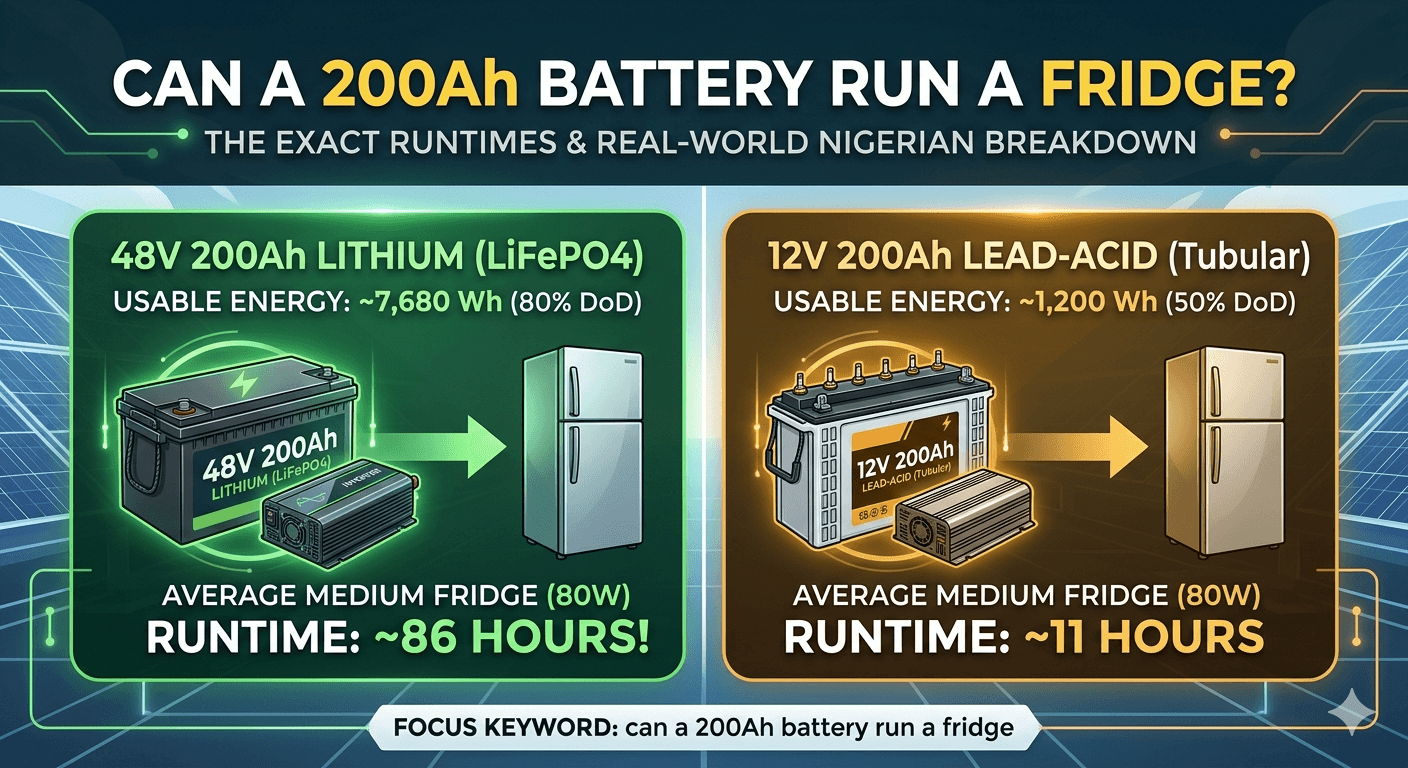
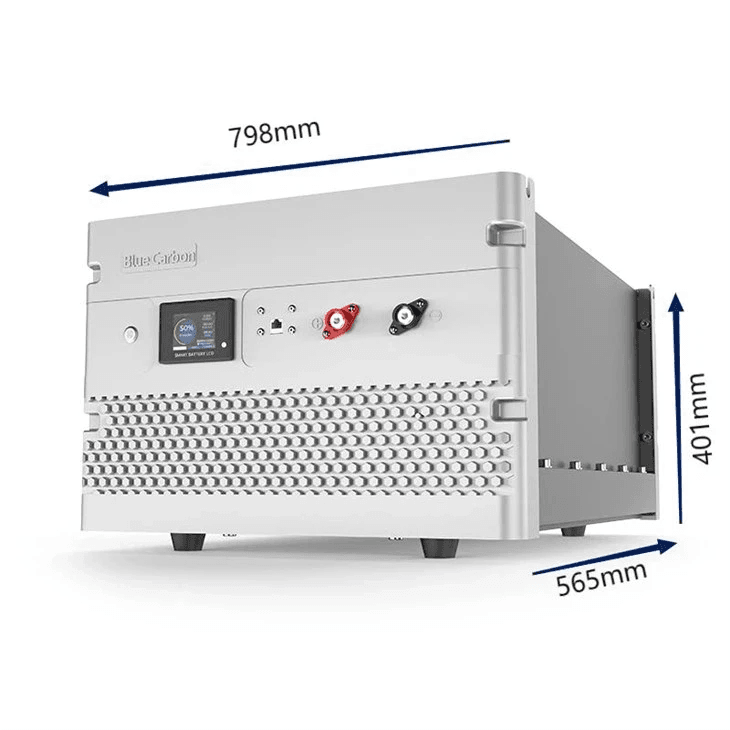
Yes. A 48V 200Ah LiFePO4 battery (9,600 Wh, 80% DoD) can run a 100L fridge averaging 80W for approximately 86 hours on its own, and comfortably through any overnight outage combined with other moderate loads. A 12V 200Ah lead-acid battery (2,400 Wh, 50% DoD) can run that same fridge for roughly 11 hours alone. The real question is not whether it can. It is which fridge, at what voltage, alongside what other loads, and for how long.
Can a 200Ah battery run a fridge is one of the most searched questions in Nigerian solar circles. And the answer people usually get is a single yes or no with a vague number attached. That answer is not wrong. It is just useless without context.
The fridge in a one-bedroom apartment in Yaba drawing 60W average is not the same as the Haier Thermocool double-door in a Port Harcourt family home drawing 220W average. The 48V 200Ah LiFePO4 system installed in 2024 is not the same as the 12V 200Ah tubular battery that has been running for three years. And running a fridge alone is not the same as running it alongside lights, fans, a TV, and phone charging.
This article answers the question properly. Every scenario Nigerian homes actually face — fridge size, battery type, system voltage, combined loads, overnight vs daytime outages — is covered with the actual calculations. By the time you finish reading, you will know exactly how long your specific battery will run your specific fridge, with and without other loads.
Why the Fridge Is a Unique Battery Load
Every other appliance in your home draws a relatively predictable, consistent wattage. A fan runs at 55W continuously. An LED bulb runs at 10W continuously. A fridge does not work like this, and understanding why is essential to calculating how long your battery will actually last.
What Your Fridge Actually Draws
A modern compressor refrigerator does not run at a fixed wattage 24 hours a day. It cycles on and off based on the internal temperature relative to the thermostat setting. When the compressor is running, a 100L fridge typically draws 150 to 200W. When the compressor is off (the fridge is holding temperature), it draws virtually nothing 2 to 5W for the interior light and control electronics.
The duty cycle the percentage of time the compressor is actually running depends on the ambient temperature, the thermostat setting, how often the door is opened, and how full the fridge is. In a typical Nigerian home at 28 to 32 degrees Celsius ambient with moderate door opening, a 100L fridge runs its compressor approximately 40 to 50% of the time. That means the average power draw is 40 to 50% of the running wattage, not the full rated wattage.
This is the critical number: average power draw, not peak draw. A fridge rated at 150W peak compressor draw with a 45% duty cycle has an average draw of approximately 67.5W. This is why when you see fridges listed with “average consumption” figures, those numbers look much smaller than the compressor wattage. It is the same fridge. It is just using time-averaged arithmetic. For a full explanation of how Nigerian ambient temperatures affect fridge duty cycles and battery drain, see Energy Star’s refrigerator efficiency testing methodology which details how duty cycles are measured across temperature ranges.
Startup Surge:
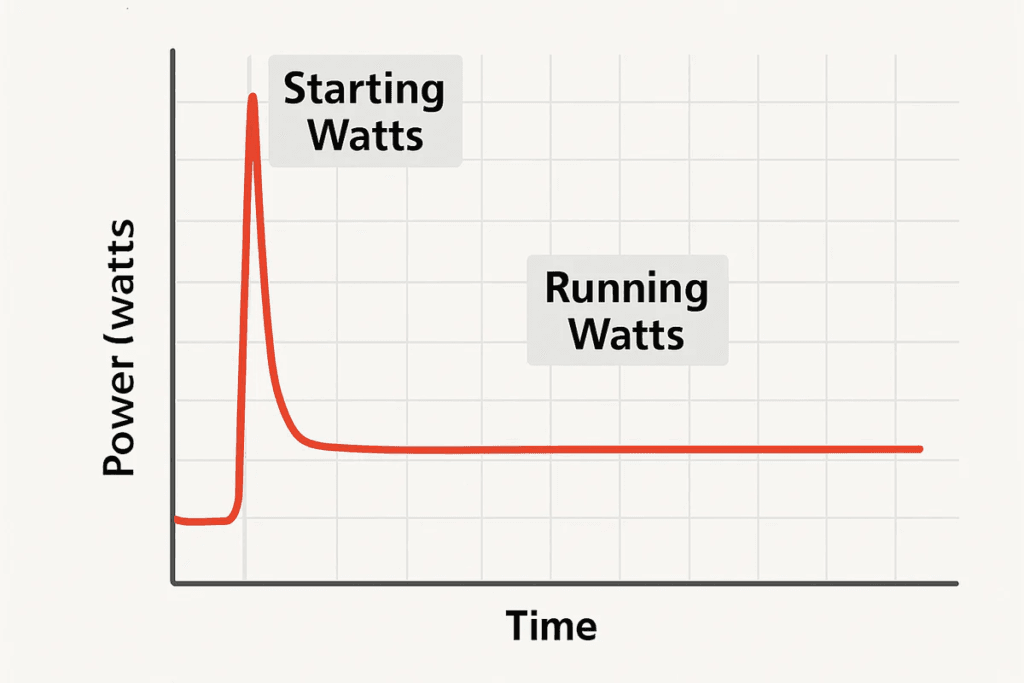
Every time the fridge compressor starts, it draws a surge current that is 3 to 7 times its running wattage for 0.5 to 2 seconds. A fridge with a 150W running compressor may surge to 450 to 900W at every startup. On a 200Ah battery this is not a runtime issue the surge is too brief to consume meaningful Wh. But it is an inverter issue.
An inverter must be able to handle this surge without shutting down or faulting. A 1000W continuous inverter may only have a 2000W surge rating. A fridge with a 900W startup surge could trip that inverter repeatedly. This is one of the reasons quality inverters specify both continuous and peak surge capacity. If your fridge is tripping your inverter at startup, the problem is surge tolerance, not battery capacity.
Ambient Temperature in Nigeria Changes Everything
In a Lagos kitchen during harmattan afternoon at 38 degrees Celsius, a fridge compressor works significantly harder than the same fridge in a 25-degree Celsius air-conditioned room. The duty cycle can increase from 45% to 65 to 70% in hot ambient conditions, increasing the average power draw by 40 to 50%.
This is why the “average watts” figure on a Nigerian fridge in summer conditions is higher than what the manufacturer quotes in their European testing lab. According to the Lawrence Berkeley National Laboratory’s research on refrigerator energy consumption in hot climates, refrigerators in high-ambient-temperature environments can consume 20 to 40% more energy than their rated figures, a factor that must be built into any honest battery runtime calculation for Nigeria.
Real Fridge Power Consumption Figures for Nigerian Homes
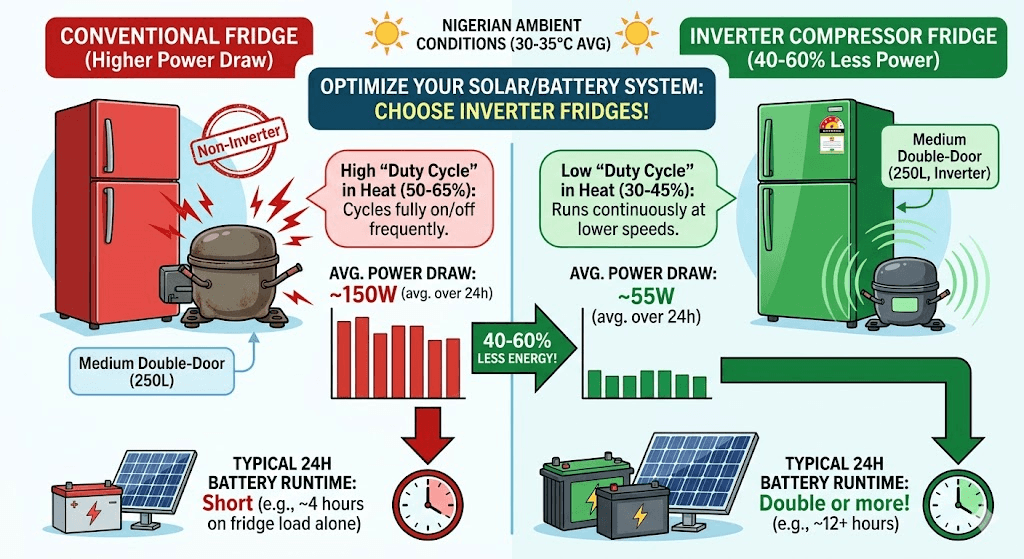
Here are realistic average power consumption figures for the most common fridge types found in Nigerian homes, adjusted for Nigerian ambient conditions (30 to 35 degrees Celsius average). These are average consumption figures, not peak compressor wattage.
| Fridge Type | Size | Compressor Wattage | Duty Cycle (Nigerian Conditions) | Average Draw Used in Calculations |
| Small bar fridge / single door | 50 to 100L | 90 to 130W | 40 to 50% | 45 to 65W avg |
| Medium single-door upright | 100 to 180L | 130 to 180W | 45 to 55% | 65 to 100W avg |
| Large single-door upright | 180 to 250L | 160 to 220W | 50 to 60% | 90 to 130W avg |
| Double-door (top-freezer) | 200 to 320L | 180 to 280W | 50 to 65% | 100 to 180W avg |
| Side-by-side / French door | 350 to 600L | 220 to 380W | 55 to 70% | 130 to 265W avg |
| Chest freezer (100L) | 100L | 120 to 160W | 25 to 35% | 35 to 55W avg |
| Chest freezer (200L) | 200L | 150 to 200W | 30 to 40% | 50 to 80W avg |
| Inverter compressor fridge (energy-rated) | 150 to 300L | 80 to 140W | 30 to 45% | 30 to 65W avg |
Key finding: Inverter compressor fridges (the ones with the energy efficiency star ratings) consume 40 to 60% less average power than conventional compressor fridges of the same size. If you are planning a solar or battery backup system and you have not yet bought your fridge, an inverter compressor model is one of the single most impactful hardware decisions you can make. It doubles the effective runtime of your battery on fridge load alone.
How Long Will Your 200Ah Battery Run Your Fridge?
Runtime (hrs) = (Battery Wh × DoD%) × Inverter Efficiency / Avg Fridge Watts
Variables for a 48V 200Ah LiFePO4:
- Total energy: 48V × 200Ah = 9,600 Wh
- Usable at 80% DoD: 9,600 × 0.80 = 7,680 Wh
- After 90% inverter efficiency: 7,680 × 0.90 = 6,912 Wh effective
Fridge-Only Runtime: 48V 200Ah LiFePO4
| Fridge Type | Avg Draw | Runtime (fridge alone) | Overnight 10hrs? | Full 24hrs? |
| Small bar fridge (50 to 100L) | 55W avg | ~125 hrs | Yes | Yes |
| Medium single-door (100 to 180L) | 80W avg | ~86 hrs | Yes | Yes |
| Large single-door (180 to 250L) | 110W avg | ~62 hrs | Yes | Yes |
| Double-door top-freezer (200 to 320L) | 140W avg | ~49 hrs | Yes | Yes |
| Side-by-side / French door (350 to 600L) | 200W avg | ~34 hrs | Yes | Yes |
| Large side-by-side (600L+) | 265W avg | ~26 hrs | Yes | Yes |
| Chest freezer (100L) | 45W avg | ~153 hrs | Yes | Yes |
| Inverter compressor fridge (150 to 300L) | 50W avg | ~138 hrs | Yes | Yes |
On a 48V 200Ah LiFePO4, running just the fridge, every single fridge type listed above lasts more than 24 hours. This is the right answer to the basic question. But nobody in Nigeria runs only the fridge.
Combined Load Runtime: Fridge + Typical Nigerian Home Loads
Here is what the numbers look like when the fridge is running alongside a realistic Nigerian home load:
| Combined Load | Total Avg Watts | Runtime on 48V 200Ah LiFePO4 | Gets Through Night? (10 hrs) |
| Small fridge + 3 LED lights + 1 fan + phone charging | 195W | ~35.4 hrs | Yes — comfortably |
| Medium fridge + 4 LED lights + 2 fans + TV + phone charging | 360W | ~19.2 hrs | Yes — twice over |
| Large fridge + full home load (lights, fans, TV, laptops) | 510W | ~13.5 hrs | Yes — with margin |
| Double-door fridge + full home load + 1HP AC | 1,090W | ~6.3 hrs | No — cut AC |
| Large double-door + full load + 1.5HP AC | 1,490W | ~4.6 hrs | No — cut AC |
| Large double-door + full load + 2 AC units | 2,740W | ~2.5 hrs | No — cut everything |
The pattern is unmistakable. Every scenario without air conditioning gets through the night. Every scenario with air conditioning does not. The fridge is not the battery killer. The air conditioner is.
For context on how these runtimes compare to different battery sizes, see our detailed breakdowns of how long a 100Ah battery lasts and how long a 150Ah battery lasts.
48V Lithium vs Lead-AcidDifferent Battery Profile Runtime Comparison
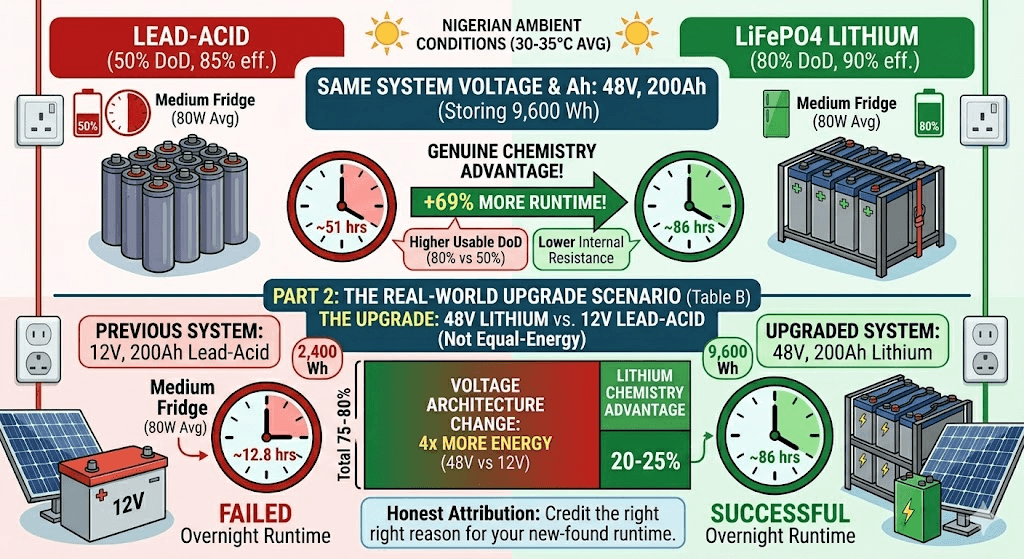
Table A: Same voltage, chemistry difference only (true apples-to-apples). Both systems below are 48V 200Ah storing 9,600 Wh. The only difference is chemistry and usable DoD:
| Load | 48V 200Ah LiFePO4 (80% DoD, 90% eff.) | 48V 200Ah Lead-Acid (50% DoD, 85% eff.) | Lithium Advantage |
| Medium fridge only (80W avg) | ~86 hrs | ~51 hrs | +69% |
| Fridge + lights + 1 fan (195W) | ~35.4 hrs | ~21 hrs | +68% |
| Fridge + full home load (360W) | ~19.2 hrs | ~11.3 hrs | +70% |
| Fridge + full load + AC (1,090W) | ~6.3 hrs | ~3.7 hrs | +70% |
At the same voltage and Ah rating, LiFePO4 consistently delivers 68 to 70% more fridge runtime than lead-acid. This advantage comes entirely from the higher usable depth of discharge (80% vs 50%) and lower internal resistance. It is a genuine chemistry advantage, not a marketing claim.
Table B: Real-world Nigerian upgrade scenario (48V lithium vs 12V lead-acid). These are not equal-energy systems. A 48V 200Ah stores 9,600 Wh. A 12V 200Ah stores only 2,400 Wh — four times less. Most of the runtime gap below is the voltage difference, not chemistry.
| Load | 48V 200Ah LiFePO4 (9,600 Wh) | 12V 200Ah Lead-Acid (2,400 Wh) | Primary Cause of Gap |
| Medium fridge only (80W avg) | ~86 hrs | ~12.8 hrs | 4x energy + chemistry |
| Fridge + lights + fan (195W) | ~35.4 hrs | ~5.2 hrs | 4x energy + chemistry |
| Fridge + full home (360W) | ~19.2 hrs | ~2.8 hrs | 4x energy + chemistry |
If you recently upgraded from 12V lead-acid to 48V lithium and your fridge now runs overnight when it never used to, credit the voltage architecture change for 75 to 80% of that improvement. The lithium chemistry contributes the remaining 20 to 25%. Both are real. Neither should be misattributed.
For a full comparison of lithium and tubular lead-acid in Nigerian conditions, including the full cost-of-ownership calculation, see our article on lithium vs tubular battery in Nigeria.
What Other Blogs About Batteries and Fridges Don’t Tell You
Most articles on this topic give you a runtime estimate and stop. Here is the layer of information they skip — and it is the layer that actually matters for Nigerian homes.
1. Your Fridge Works Harder When the Battery Is Low
When battery voltage drops below the optimal range as the battery approaches its low cutoff, the inverter output voltage can become slightly unstable on cheaper units. A fridge compressor receiving slightly unstable AC voltage runs less efficiently drawing more current to maintain the same cooling output. This creates a feedback loop: low battery causes inverter instability, which causes the fridge to draw more, which depletes the battery faster.
On quality pure sine wave inverters, this effect is minimal because the inverter maintains clean output voltage down to its cutoff threshold. On modified sine wave or cheaper units, it can be measurable. This is one of the practical arguments for investing in a quality pure sine wave inverter for any system that runs a fridge. Our guide on how to select an off-grid inverter covers what to look for in inverter output quality for motor loads.
2. A Fridge That Was Just Restocked Works the Battery Harder
A fridge packed with room-temperature groceries after a market run in Lagos is not the same load as a stable, half-full fridge that has been maintaining temperature for 24 hours. The newly loaded fridge has to pull down a large thermal mass from ambient temperature (say 30 degrees Celsius) to target temperature (say 4 degrees Celsius). During this pull-down period which can last 2 to 4 hours the compressor runs almost continuously, not at its normal duty cycle.
During grocery loading pull-down, a medium fridge that normally averages 80W can average 160 to 200W for 2 to 3 hours. On a battery at 30% state of charge, a grocery run at the wrong time can cut your remaining runtime in half. Time your grocery loading for when NEPA is on or when your solar array is at peak output not right before a likely outage window.
3. Door Opening Frequency Has a Real Impact in Nigerian Households
A fridge in a household with 4 to 6 people where the door opens 15 to 20 times a day behaves completely differently from one in a single-occupancy flat with 4 to 5 door openings. Each door opening lets warm humid Nigerian air into the fridge. The compressor must work to re-cool the interior and handle the moisture condensation. Research from the American Council for an Energy-Efficient Economy on residential fridge usage patterns shows that door opening frequency is one of the top three factors affecting real-world fridge energy consumption, alongside ambient temperature and thermostat setting.
The practical implication: train everyone in the household to minimise door opening time. Decide what you want before opening the door. In high-traffic households, a well-organised fridge where items are easy to locate reduces door-open duration by 30 to 50%. It sounds trivial but over a 24-hour period with 20 door openings, it measurably reduces compressor duty cycle.
4. The Fridge Location in Your Home Affects Battery Drain
A fridge placed next to the gas cooker, on a sun-facing wall, or in a kitchen with poor ventilation runs its compressor 15 to 25% more than a fridge in a cool, shaded location. The ambient temperature around the fridge condenser coils directly determines how hard the compressor works. In Nigerian kitchens where the fridge is often in a tight corner against a hot wall with the condenser coils against the wall rather than facing open air, the efficiency penalty can be significant.
Leave at least 5 to 10 cm of space behind and above the fridge for condenser heat dissipation. Move the fridge away from the cooker if possible. In a hot kitchen, these changes can reduce average fridge consumption by 10 to 20%, which translates directly to longer battery runtime.
5. A Fridge Connected to a Modified Sine Wave Inverter Consumes More
Modified sine wave inverters produce a stepped approximation of a sine wave, not a true sine wave. Fridge compressors are inductive loads that are sensitive to waveform quality. A compressor motor running on modified sine wave draws 10 to 20% more current than the same motor on pure sine wave, due to additional harmonic currents that do useful work in a true sine wave environment but simply generate heat in a modified sine wave environment.
If you are on a modified sine wave inverter and your fridge seems to drain the battery faster than the calculations suggest, the waveform penalty is likely contributing. Upgrading to a pure sine wave inverter recovers this loss entirely.
8 Ways to Reduce Your Fridge’s Battery Drain Without Buying a New Fridge
You do not need new hardware to reduce what your fridge takes from the battery. These eight strategies are free or near-free and together can reduce average fridge consumption by 20 to 40%.
- Set the thermostat correctly. Many Nigerian homes set the fridge to maximum cold out of habit. Recommended fridge temperature is 3 to 5 degrees Celsius. Each degree colder than necessary increases compressor duty cycle. Setting a dial from 7 to 5 (or maximum to mid) typically reduces average consumption by 10 to 15%.
- Keep the fridge at least 70% full. A full fridge has more thermal mass. It holds temperature longer when the compressor is off and recovers faster when it cycles on. An empty fridge has only air, which warms rapidly every time the door opens. If the fridge is sparse, fill empty spaces with water bottles.
- Cool food before loading. Never put hot or warm food directly into the fridge. Let it cool to near-ambient temperature first. Hot food raises the internal temperature significantly, triggering extended compressor runtime.
- Check the door seal. A damaged or poorly sealing door gasket allows warm air infiltration continuously. To check: close the door on a piece of paper. If you can pull it out without resistance, the seal needs replacement. A failing seal can increase average consumption by 15 to 25%.
- Clean the condenser coils annually. Dust and grease accumulate on the condenser coils at the back of the fridge, reducing heat dissipation efficiency and forcing the compressor to work harder. Annual cleaning with a vacuum or brush reduces consumption meaningfully.
- Move the fridge away from heat sources. As discussed above, every degree of ambient temperature reduction around the fridge is a reduction in compressor duty cycle. Moving from next to the cooker to a cooler wall position is free and permanent.
- Defrost the freezer compartment regularly. Ice buildup in the freezer acts as insulation between the refrigerant coils and the food. The thicker the ice, the harder the compressor works to maintain temperature. Manual defrost every 3 to 6 months keeps the system running efficiently.
- Switch to an inverter compressor fridge at replacement time. When your current fridge eventually needs replacing, invest in an inverter compressor model with at least a 2-star energy efficiency rating. As shown in the consumption table above, these run at 30 to 50W average versus 80 to 130W for conventional compressor models of the same size — a 40 to 65% reduction in battery draw for the same cooling capacity. Nigeria’s Standards Organisation (SON) energy labelling programme covers the energy efficiency ratings required on appliances sold in Nigeria.
How to Size a Battery Bank That Actually Keeps Your Fridge Running
Rather than asking “can a 200Ah battery run a fridge,” the more useful question is: what battery size do I actually need to run my fridge alongside my other loads for my typical outage duration?
The formula:
Required Wh = (Total Avg Watts × Hours) / DoD% / Inverter Efficiency
Examples for common Nigerian scenarios:
| Scenario | Total Avg Load | Outage Duration | Required Usable Wh | Recommended Battery |
| Small flat: fridge + lights + fan | 195W | 8 hrs | ~2,167 Wh | 48V 100Ah LiFePO4 (3,840 Wh usable) |
| Medium home: fridge + lights + fans + TV | 360W | 10 hrs | ~4,444 Wh | 48V 200Ah LiFePO4 (7,680 Wh usable) |
| Large home: big fridge + full load (no AC) | 510W | 12 hrs | ~7,500 Wh | 48V 200Ah LiFePO4 (just enough) |
| Home with 1HP AC + fridge + full load | 1,090W | 10 hrs | ~13,457 Wh | 48V 200Ah x2 parallel or 400Ah bank |
| Full off-grid: fridge + full load, 2-day autonomy | 400W | 48 hrs | ~26,667 Wh | 48V 400Ah+ or multiple strings |
Note: Recommended battery sizes include a safety buffer above required Wh. Do not size a battery bank to exactly your calculated requirement — always add 20 to 30% headroom for cloudy days, battery ageing, and load variability. For a complete system sizing walkthrough, see our 48V lithium battery sizing guide and our off-grid solar system design guide for Nigeria.
Frequently Asked Questions
Can a 200Ah battery run a fridge all night?
Yes. On a 48V 200Ah LiFePO4, running a medium fridge (80W average) alongside lights, a fan, and phone charging (approximately 195W combined), you get about 35 hours of runtime — more than three times what a typical overnight outage requires. Even a large double-door fridge at 200W average running with a full home load of 360W total gives you over 19 hours on a 48V 200Ah LiFePO4. The fridge alone is not the constraint.
How many watts does a fridge use per hour in Nigeria?
A Nigerian fridge does not use a fixed number of watts per hour — it cycles. A medium 150L single-door fridge in Nigerian conditions (30 to 35 degrees Celsius ambient) averages approximately 65 to 90W, meaning it draws 65 to 90 Wh per hour. Over 24 hours that is approximately 1,560 to 2,160 Wh per day. A small bar fridge averages 45 to 65 Wh per hour. A large double-door averages 120 to 180 Wh per hour. See the consumption table above for the full breakdown by fridge type.
Can a 200Ah battery run a fridge and an air conditioner?
Not for a full night. A 1HP split AC draws 750 to 900W running. A medium fridge draws 80W. Combined with other loads you are at 1,000 to 1,200W total. On a 48V 200Ah LiFePO4, that gives you approximately 5.8 to 6.9 hours. With a 1.5HP AC, you drop to 4 to 5 hours. For overnight AC plus fridge, you need at least two 200Ah batteries in parallel (or a 400Ah bank). Our guide on how long a 2000W inverter runs on battery covers AC load calculations in detail.
Does a fridge damage a battery?
No, a fridge does not damage a battery in normal operation. The concern is the startup surge, which on poorly sized or older inverters can cause tripping. The fridge itself draws no more than 200 to 280W at full compressor, well within the discharge capacity of any 200Ah 48V battery. The battery risk comes from over-discharge if the fridge runs the battery past the BMS cutoff repeatedly, that stresses cells over time. Configure your BMS low-voltage cutoff correctly and the fridge will never cause battery damage. See our BMS protection explained guide for correct threshold settings.
What is the minimum battery size to run a fridge in Nigeria?
For a small 100L fridge alone through a typical 8 to 10 hour outage: a 48V 100Ah LiFePO4 (3,840 Wh usable) is sufficient — the fridge at 65W average consumes only 520 to 650 Wh in that window. For a medium fridge alongside lights and fans through a 10-hour outage: a 48V 100Ah LiFePO4 is borderline. A 48V 150Ah LiFePO4 gives you comfortable headroom. For a large double-door fridge plus household loads: 48V 200Ah is the practical minimum. See our breakdown of how long a 150Ah battery lasts for the 150Ah comparison.
Can a 12V 200Ah battery run a fridge overnight?
A 12V 200Ah battery stores only 2,400 Wh. At 50% DoD (to protect lead-acid cells), you have 1,200 Wh usable. A medium fridge at 80W average draws 800 Wh over 10 hours alone — that is tight but technically feasible for the fridge alone. Add lights and fans at 100W extra and you exceed the 12V 200Ah’s usable capacity in about 7 hours. In practice, no. A 12V 200Ah lead-acid is not the right tool for overnight fridge plus home loads. Upgrading to a 48V system is the correct solution, not adding more 12V batteries.
Why does my battery die overnight even with the fridge switched off?
If the battery dies overnight with the fridge off, the fridge is not the problem. The most likely causes are: other high-draw loads left on (air conditioner, water heater, iron that someone forgot), phantom loads from standby devices accumulating to 50 to 100W, an undersized battery for the remaining load, or a degraded battery that can no longer deliver its rated capacity. Our dedicated article on why your battery dies faster than expected walks through a full diagnostic process.
The Bottom Line
A 200Ah battery at 48V with LiFePO4 chemistry will run a fridge through any overnight outage in Nigeria without breaking a sweat. It will run a medium fridge alone for 86 hours. It will run a fridge alongside a full home load of lights, fans, and a television for over 19 hours. The fridge is not the problem in most Nigerian battery systems. The air conditioner is.
The decision that matters more than battery size is fridge choice. An inverter compressor fridge averaging 40 to 50W consumes less than half the power of a conventional compressor fridge of the same volume. On a 200Ah battery, that difference translates directly to 30 to 40 extra hours of combined runtime. If you are about to buy a fridge for a solar or battery backup system, that is the specification to prioritise.
And if you are sizing a complete system rather than just asking about the fridge, start with our complete off-grid system design checklist. It covers every component from panels to BMS with the same level of detail this article applies to the fridge question alone.

I am Engr. Ubokobong Ekpenyong, a solar specialist and lithium battery systems engineer with over five years of hands-on experience designing, assembling, and commissioning off-grid solar and energy storage systems. My work focuses on lithium battery pack architecture, BMS configuration, and system reliability in off-grid and high-demand environments.