
How Long Will a 200Ah Battery Last?
TL;DR
A fully charged 200Ah battery at 48V holds about 9.6 kWh of energy. With a 1,000W load, it will last roughly ~6.9 hours hours on lithium (LiFePO4) or 4 to 5 hours on a tubular/lead-acid battery. Your actual runtime depends on your load, battery type, depth of discharge, and inverter efficiency.
Picture this: it is 11 PM in Lagos. NEPA has been out since noon. Your inverter clicks on and you settle in, confident your 200Ah battery will carry you through the night. Then, at 2 AM, the lights go out again.
That is not a battery failure. That is a calculation failure. Most people buy a battery based on the Ah rating alone, with no idea what that number actually means in terms of real-world hours. This article fixes that.
By the time you finish reading, you will know exactly how long your 200Ah battery lasts under your specific loads, why the answer is different for lithium vs. lead-acid, and what you can do to stretch every amp-hour as far as possible.
What Does 200Ah Actually Mean?
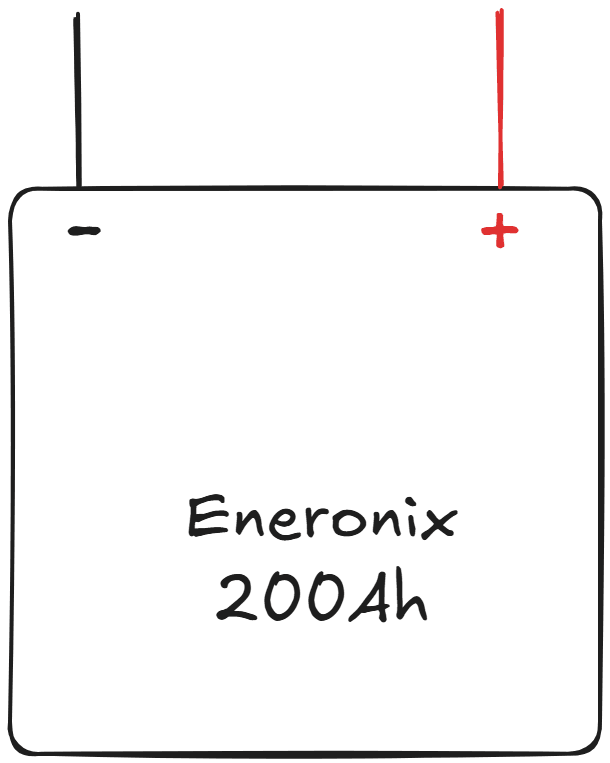
The “Ah” in 200Ah stands for amp-hours. It tells you how much charge the battery can store, not how long it will last. Think of it like a fuel tank: knowing the tank is 60 litres does not tell you how far you will drive. That depends on how hard you press the accelerator.
For batteries, the “accelerator” is your load in watts. The heavier the load, the faster you drain the tank.
But there is something the spec sheet does not always make obvious: the 200Ah rating assumes a specific discharge rate, usually the 10-hour rate (C10 or C/10). This means the battery was tested by drawing 20A continuously for 10 hours. Push more current than that, and you get fewer usable amp-hours out of it. This is called the Peukert effect, and it matters a lot for lead-acid batteries. Lithium batteries are far less affected by it, which is one reason they are increasingly the go-to choice for serious off-grid setups. You can read more about that in our guide on the best lithium battery chemistry for solar systems.
How to Calculate Battery Runtime
The basic formula is straightforward:
Runtime (hours) = (Battery Capacity in Wh x Usable %) / Load (W)
Battery capacity in Wh = Voltage x Ah. For a 48V 200Ah lithium battery: 48 x 200 = 9,600 Wh (9.6 kWh).
Usable percentage = For LiFePO4 lithium, you can safely use 80 to 90% of rated capacity. For tubular lead-acid batteries, the safe limit is 50% to protect battery life. Going deeper shortens their lifespan significantly, as explained in our article on why 100% maximum usable capacity is a lithium battery death sentence.
Load in watts = the total wattage of everything running at the same time.
Worked Example: 48V 200Ah Lithium Battery
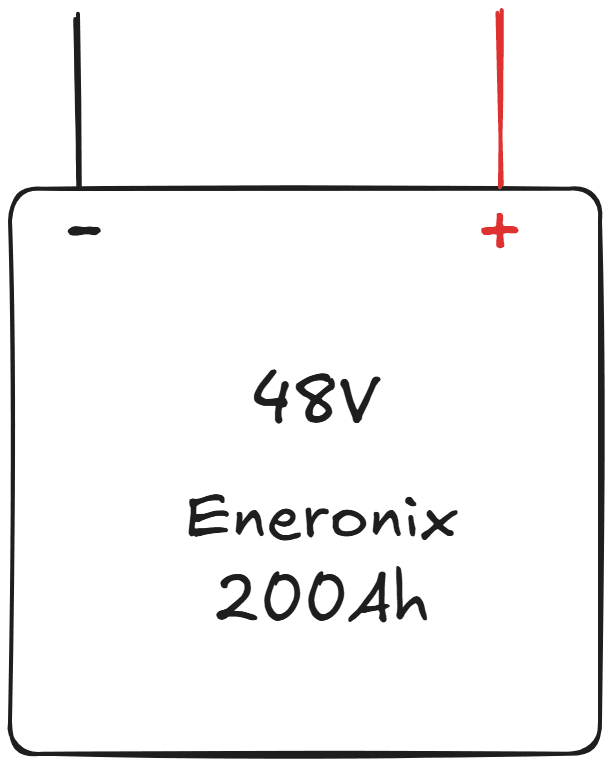
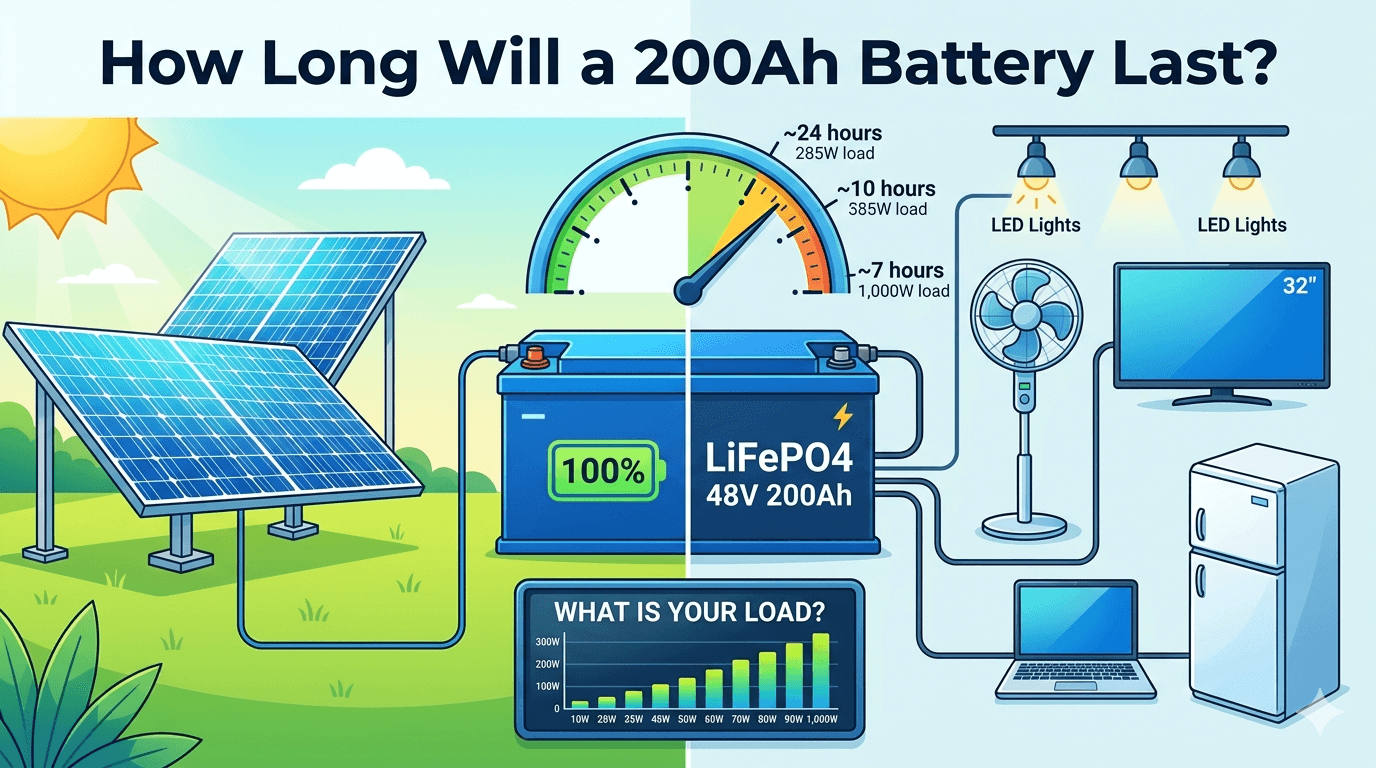
Suppose you are running the following appliances in a typical Nigerian home at night:
| Appliance | Watts | Qty | Total Watts |
| LED ceiling lights (4) | 10W | 4 | 40W |
| Standing fan | 65W | 1 | 65W |
| 32-inch LED TV | 50W | 1 | 50W |
| Phone/laptop charging | 60W | 2 | 120W |
| WiFi router | 10W | 1 | 10W |
| Total Load | 285W |
Applying the formula:
- Battery capacity: 48V x 200Ah = 9,600 Wh
- Usable capacity (80%): 9,600 x 0.80 = 7,680 Wh
- Inverter efficiency loss (typically 90%): 7,680 x 0.90 = 6,912 Wh effective
- Runtime: 6,912 Wh / 285W = approximately 24 hours
At 285W, your 200Ah lithium battery comfortably covers a full night and more. But increase that load, and the picture changes fast.
What If You Run More Loads?
Before you read this table, one important clarification: A 48V 200Ah lithium battery stores 9,600 Wh of energy. A 12V 200Ah lead-acid battery stores only 2,400 Wh. These are not equal-energy systems. Comparing them directly makes lithium appear up to 4 to 5 times better, but much of that gap is the voltage difference, not chemistry. The table below shows two separate comparisons so you can see both effects clearly.
Table A: Same Energy, Different Chemistry (Fair Comparison)
Both systems below are 48V 200Ah, meaning both store 9,600 Wh. The only difference is chemistry. This is the honest apples-to-apples comparison:
| Total Load | 48V 200Ah LiFePO4 (80% DoD) | 48V 200Ah Lead-Acid (50% DoD) |
| 200W | ~34.6 hours | ~21.6 hours |
| 500W | ~13.8 hours | ~8.6 hours |
| 1,000W | ~6.9 hours | ~4.3 hours |
| 1,500W | ~4.6 hours | ~2.9 hours |
| 2,000W | ~3.5 hours | ~2.2 hours |
At the same voltage and same Ah rating, lithium genuinely lasts 60 to 80% longer than lead-acid. That difference comes from the higher usable depth of discharge (80% vs 50%), lower internal resistance, and better efficiency under load. This is the real chemistry advantage.
Table B: What Most Nigerian Homes Actually Have (Typical Real-World Setup)
In reality, most Nigerian homes using inverters have either a 12V or 24V lead-acid setup (older installs) or a 48V lithium system (newer installs). This table reflects the systems people actually buy and compare:
| Total Load | 48V 200Ah LiFePO4 (9,600 Wh, 80% DoD) | 12V 200Ah Lead-Acid (2,400 Wh, 50% DoD) |
| 200W | ~34.6 hours | ~5.4 hours |
| 500W | ~13.8 hours | ~2.2 hours |
| 1,000W | ~6.9 hours | ~1.1 hours |
| 1,500W | ~4.6 hours | ~0.7 hours |
| 2,000W | ~3.5 hours | ~0.5 hours |
The dramatic gap here is mostly the energy difference, not just chemistry. A 12V 200Ah system stores four times less energy than a 48V 200Ah system. If you upgraded from a 12V lead-acid to a 48V lithium and your backup time jumped massively, the voltage upgrade deserves as much credit as the chemistry change. For a detailed breakdown of why the industry has moved to 48V, see our comparison of lithium vs tubular battery in Nigeria.
The 5 Things That Silently Drain Your Battery Faster
The formula gives you the theoretical maximum. Real-world runtime is almost always shorter. Here are the culprits most people never account for:
1. Inverter Inefficiency
Every inverter wastes some energy converting DC battery power to AC. Quality inverters run at 90 to 95% efficiency. Cheap ones can drop to 75 to 80%. That gap alone can cost you 2 to 3 hours of runtime on a heavy load. You can check our detailed guide on how to select an off-grid inverter to understand how inverter sizing affects efficiency.
2. Battery Temperature
Hot weather reduces battery capacity. In a Lagos afternoon where ambient temperatures regularly hit 35 to 40 degrees Celsius, a lead-acid battery can lose 10 to 20% of its rated capacity. LiFePO4 lithium batteries handle heat significantly better, but performance still degrades above 45 degrees Celsius. Keep your battery bank in a ventilated space, away from direct sunlight.
3. Battery Age and State of Health
A “200Ah” battery that has been through 500 charge cycles without proper care might actually deliver only 160Ah or less. Battery capacity degrades over time. If your system has been running for two or more years and backup time feels shorter than it used to be, age is likely a factor. Read our article on how charge and discharge cycles affect lithium battery lifespan to understand this better.
4. Phantom Loads
Devices that are “off” but still pulling power, like TVs on standby, routers, decoders, and chargers plugged into the wall. In a typical Nigerian home, phantom loads can add 30 to 80W of invisible consumption. Over 8 hours, that is 240 to 640 Wh silently draining your battery. Our guide on phantom loads in off-grid energy budgets breaks down exactly how to find and eliminate them.
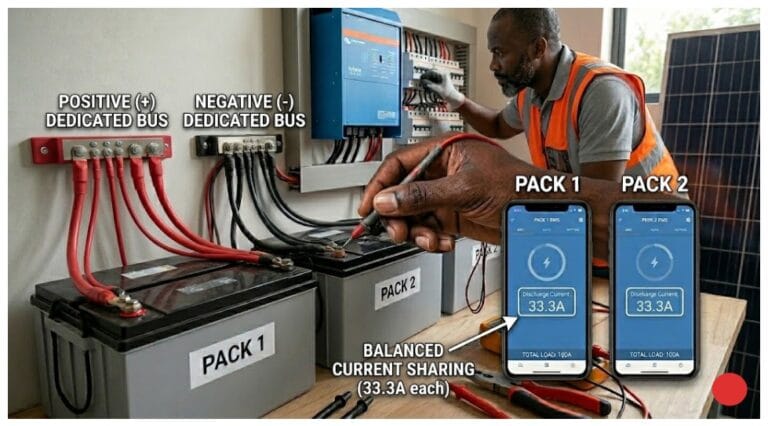
5. Incorrect Battery Configuration
If you are wiring multiple batteries together and the connections are wrong, some batteries work harder than others, shortening runtime and lifespan. This is especially common in parallel battery banks. The system reads “full” but two of your four batteries are carrying most of the load.
200Ah Battery Runtime for Common Nigerian Appliances
Here is a quick-reference table for how long a 48V 200Ah LiFePO4 battery (80% DoD, 90% inverter efficiency) will last running single appliances:
| Appliance | Typical Wattage | Estimated Runtime |
| LED bulb (1 bulb) | 10W | ~550 hours (impractical alone) |
| Standing fan | 65W | ~106 hours |
| 32-inch LED TV | 50W | ~138 hours |
| Refrigerator (100L) | 100W avg | ~69 hours |
| Refrigerator (300L) | 200W avg | ~34 hours |
| Laptop | 60W | ~115 hours |
| 1.5HP Air conditioner | 1,200W | ~5.7 hours |
| Freezer (chest type) | 150W avg | ~46 hours |
| Washing machine | 500W | ~13.8 hours |
| Water pump (0.5HP) | 370W | ~18.7 hours |
These are standalone figures. Once you combine appliances, use the load addition method from the worked example above. To understand how to properly size a full system for a Nigerian home, see our 48V lithium battery sizing guide.
How to Make Your 200Ah Battery Last Longer
Small adjustments in how you use your system can meaningfully extend runtime every single night:
- Switch to LED lighting throughout. A 60W incandescent replaced by a 10W LED saves 50W. Across 6 bulbs, that is 300W recovered.
- Set your inverter’s low voltage cutoff correctly. Cutting off at 47V (for a 48V LiFePO4 system) instead of 44V protects the battery and gives you a reliable warning before it goes flat. See our guide on BMS protection explained for the right thresholds.
- Unplug standby devices before bed. Routers, decoders, and chargers all pull phantom loads.
- Run high-wattage appliances like washing machines and water pumps during the day when solar is available, not from the battery at night.
- Do not over-discharge your battery. For lead-acid, stop at 50% state of charge. For LiFePO4, 20% is the safe floor. Our article on the 80/20 rule for lithium batteries explains exactly why this matters.
12V vs 24V vs 48V: Does System Voltage Affect Runtime?
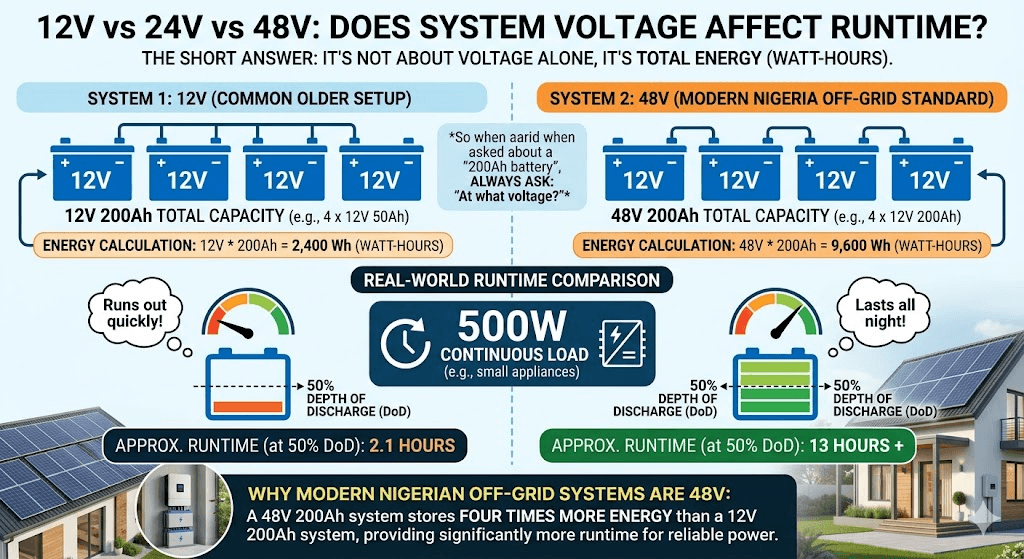
The short answer is: it does not change how long the battery lasts in theory, because energy (Wh) is what matters, not voltage alone. A 12V 200Ah battery and a 48V 200Ah battery do not store the same energy. The 48V system stores four times more (9,600 Wh vs 2,400 Wh).
So if someone tells you they have a “200Ah battery,” the first question to ask is: at what voltage? A 12V 200Ah system running a 500W load will last about 2.1 hours (at 50% DoD). The 48V version of the same Ah rating lasts over 13 hours. This is why modern off-grid and hybrid solar installations in Nigeria have moved almost entirely to 48V systems.
Frequently Asked Questions

How long will a 200Ah battery last with a 1000W inverter?
At a 1,000W load, a 48V 200Ah LiFePO4 battery (80% DoD, 90% inverter efficiency) will last approximately 6.9 hours. A 12V 200Ah lead-acid at 50% DoD will last roughly 1.2 hours at the same load. See our dedicated article on how long a 100Ah battery lasts on a 1000W inverter for a direct comparison.
Can a 200Ah battery power a fridge overnight?
Yes, comfortably, if your fridge is a standard 100 to 200L compressor-type (averaging 100 to 200W). A 48V 200Ah LiFePO4 will run a 150W average fridge for roughly 46 hours on its own. In a combined load scenario with lights and fans, it will still cover 8 to 10 hours easily. See our detailed breakdown in can a 200Ah battery run a fridge.
Is a 200Ah battery enough for a 3-bedroom house in Nigeria?
It depends heavily on the load. For a modest setup with LED lights, fans, TV, and phone charging averaging around 300 to 500W at night, a single 200Ah lithium battery handles it comfortably. Add air conditioning or a fridge and you will need more capacity. Our guide on how to size an off-grid solar system walks you through the full calculation.
Does the brand of 200Ah battery affect how long it lasts?
Yes, more than most people realise. Two batteries labelled 200Ah can deliver very different real-world performance depending on cell quality, BMS accuracy, and whether the rated capacity was independently verified. Cheap batteries from unverified sources are often 10 to 30% below their stated capacity. Our guide to the best lithium batteries for inverters in Nigeria covers which brands actually deliver what they promise.
Why does my 200Ah battery die faster than expected?
The most common reasons are: hidden phantom loads, battery aging past its cycle rating, incorrect inverter efficiency assumptions, and operating in high ambient temperatures. See our detailed post on why your battery dies faster than expected for a full diagnostic.
What is the difference between a 200Ah and 100Ah battery?
A 200Ah battery stores exactly twice the energy of a 100Ah battery at the same voltage. It will last twice as long on the same load. If you are unsure which size fits your needs, read our comparison of 100Ah vs 200Ah battery for a full breakdown by use case.
The Bottom Line
A 200Ah battery is a serious piece of equipment. At 48V with lithium chemistry, it holds 9.6 kWh of energy, enough to carry a well-managed Nigerian home through an entire night with power to spare. But “enough” is only true if you know your actual load, pick the right battery chemistry, and do not let phantom drains and inverter inefficiency silently chip away at your runtime.
Use the formula. Know your load. And if you are still sizing your system from scratch, start with our complete off-grid system design checklist to make sure everything from your panels to your BMS is matched correctly.

I am Engr. Ubokobong Ekpenyong, a solar specialist and lithium battery systems engineer with over five years of hands-on experience designing, assembling, and commissioning off-grid solar and energy storage systems. My work focuses on lithium battery pack architecture, BMS configuration, and system reliability in off-grid and high-demand environments.