LiFePO4 vs NMC vs NCA: Best Lithium Battery Chemistry for Solar Systems?
Discover the best lithium battery chemistry for solar systems. Compare LiFePO4 vs NMC vs NCA on lifespan, safety, charging, and total cost of ownership.
Walk into any solar equipment store in Lagos, Abuja, or Port Harcourt and you will see batteries labelled as lithium. Some are cheap. Some are expensive. Some carry brand names you recognise; most do not.
What almost nobody tells you is that the word lithium covers at least three chemically distinct battery technologies with very different performance profiles. Choosing the wrong one for a solar storage application is not just a suboptimal decision. In some cases, it is a safety risk. In most cases, it is an expensive mistake that takes 18 to 24 months to fully reveal itself.
This guide breaks down the three mainstream lithium battery chemistries used in solar storage today: Lithium Iron Phosphate (LiFePO4), Lithium Nickel Manganese Cobalt Oxide (NMC), and Lithium Nickel Cobalt Aluminium Oxide (NCA). We compare them on the metrics that actually matter for solar engineers: cycle life, thermal stability, energy density, BMS requirements, charging behaviour, and total cost of ownership over a 10-year installation horizon.
By the end, the choice will be straightforward.
Understanding the Chemistry
All three chemistries belong to the lithium-ion family. They share the same fundamental electrochemical principle: lithium ions move from the anode (typically graphite) to the cathode during discharge, and reverse during charging. The differences in behaviour all come from the cathode material.
The cathode is where the chemistry diverges, and where the performance characteristics are determined.
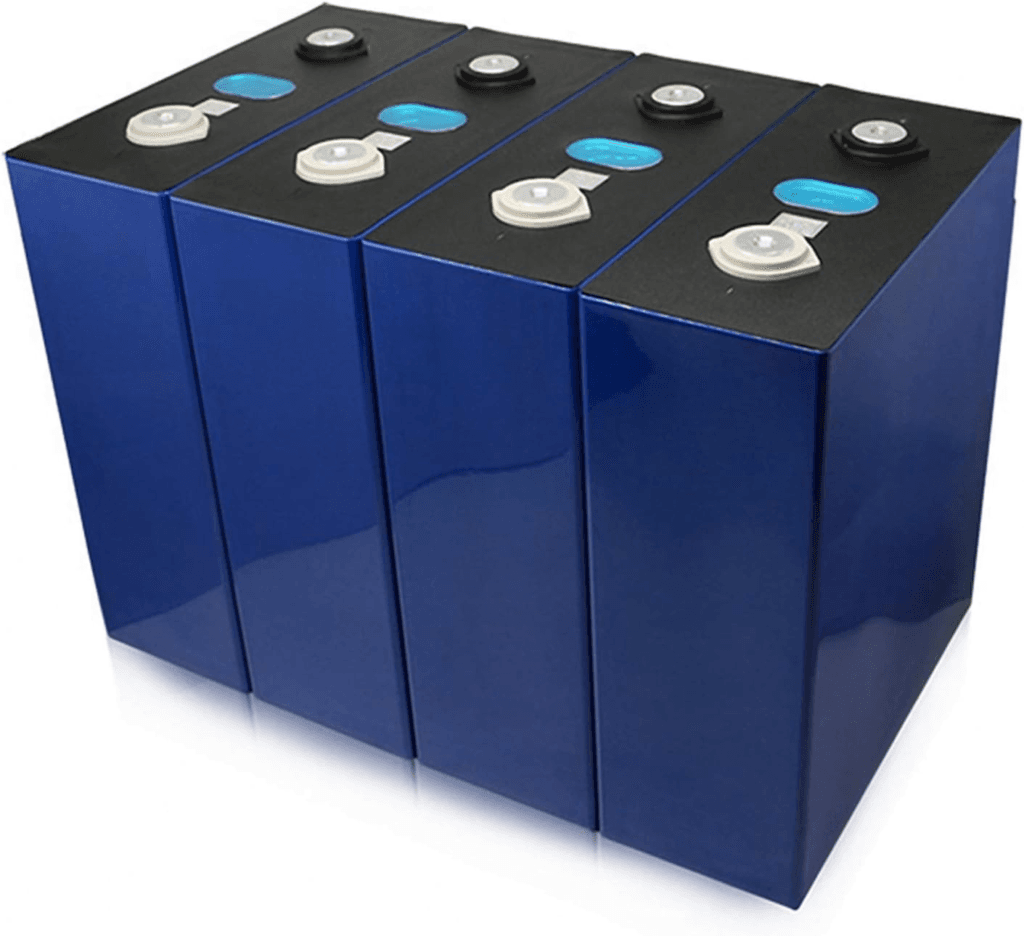
LiFePO4: Lithium Iron Phosphate
LiFePO4 uses an iron phosphate cathode. The iron-oxygen bond in the phosphate structure is extremely strong, which makes it very difficult for the cathode to release oxygen under stress. This is the fundamental reason LiFePO4 has such excellent thermal stability.
The tradeoff is energy density. The nominal cell voltage is only 3.2V, lower than NMC or NCA. A 16S pack (16 cells in series) produces 51.2V nominal. The gravimetric energy density ranges from 90 to 160 Wh/kg depending on cell format and manufacturer.
The flat discharge curve is both a strength and a complication. From 90% SOC down to around 20% SOC, the cell voltage barely changes, staying between 3.2V and 3.3V. This is excellent for loads that require stable voltage, but it makes voltage-based SOC estimation nearly useless. A proper communicating BMS is not optional for LiFePO4 systems; it is the only reliable way to know what state the battery is actually in.
NMC uses a cathode with varying ratios of nickel, manganese, and cobalt. The most common formulations are NMC 111 (equal parts), NMC 532, NMC 622, and the increasingly dominant NMC 811 (80% nickel, 10% manganese, 10% cobalt).
Higher nickel content increases energy density but reduces thermal stability. NMC 811 is significantly more energy-dense than NMC 111 but is also more thermally sensitive. This is the fundamental NMC design tension, and it explains why NMC 811 requires more sophisticated BMS management than older NMC formulations.
NMC has a nominal cell voltage of 3.6V and an energy density of 150 to 220 Wh/kg. The higher voltage and energy density make it the preferred chemistry for applications where weight and volume matter: electric vehicles, power tools, laptops.
For solar storage, the weight advantage is largely irrelevant. What matters is cycle life and thermal behaviour under the conditions of daily deep cycling at elevated ambient temperatures. On both counts, NMC underperforms LiFePO4.
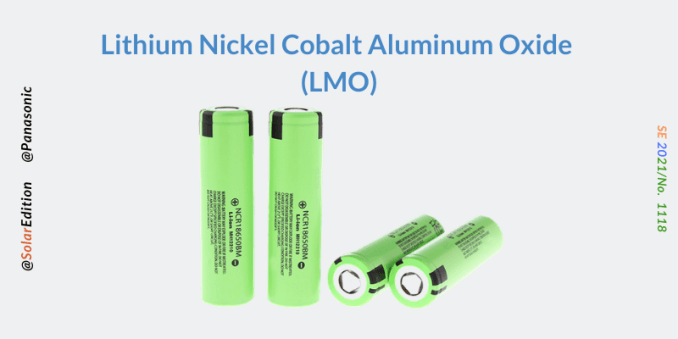
NCA: Lithium Nickel Cobalt Aluminium Oxide
solaredition.com
NCA was pioneered by Panasonic and is most famously associated with early Tesla battery packs. It offers the highest energy density of the three chemistries, typically 200 to 260 Wh/kg, with a nominal cell voltage of 3.6V.
The cost is thermal stability. The NCA cathode begins oxygen release and thermal runaway onset at temperatures around 150 degC, significantly lower than LiFePO4 at around 270 degC. In normal operating conditions this is manageable. But in a solar storage environment in West Africa, where ambient temperatures inside battery enclosures routinely reach 45 to 55 degC during the dry season, NCA cells are under continuous thermal stress even before any fault condition occurs.
NCA is not a storage chemistry. It is a power chemistry engineered for applications where maximum energy density is the primary design constraint and weight, volume, and cost are secondary. That profile does not match solar storage requirements in any meaningful way.
Chemistry Comparison: The Complete Technical Reference
Parameter
LiFePO4
NMC
NCA
Full name
Lithium Iron Phosphate
Lithium Nickel Manganese Cobalt Oxide
Lithium Nickel Cobalt Aluminium Oxide
Nominal cell voltage
3.2 V
3.6 V
3.6 V
Charge cutoff voltage
3.65 V
4.2 V
4.2 V
Discharge cutoff voltage
2.5 V
3.0 V
3.0 V
Gravimetric energy density
90-160 Wh/kg
150-220 Wh/kg
200-260 Wh/kg
Volumetric energy density
Moderate
High
Very high
Cycle life (to 80% SOH)
3,000-6,000+
500-2,000
500-1,500
Thermal runaway threshold
~270 degC (onset)
~210 degC (onset)
~150 degC (onset)
Thermal stability
Excellent
Moderate
Poor to moderate
Calendar life
10-15 years
5-10 years
5-8 years
Cold temperature performance
Poor below 0 degC
Good
Good
High temperature tolerance
Good
Moderate
Poor
Cobalt content
None
Low to moderate
High
Cost per kWh (relative)
Moderate
Moderate to high
High
Typical applications
Solar storage, off-grid, EVs
EVs, power tools, laptops
Tesla, high-performance EVs
Best for solar storage?
Yes
Acceptable if managed well
Not recommended
The numbers in this table represent well-characterised cells from reputable manufacturers tested under standard conditions. Real-world performance varies based on charge/discharge rates, ambient temperature, depth of discharge, and BMS quality. In Nigerian field conditions, expect the lower end of cycle life ranges for all chemistries.
Cycle Life: The Number That Determines Total Cost of Ownership
Cycle life is the single most important metric for solar storage batteries, because solar batteries cycle every day. A battery that charges during the day and discharges at night completes approximately 365 cycles per year. Over a 10-year installation horizon, that is 3,650 cycles.
LiFePO4 cells from quality manufacturers are rated at 3,000 to 6,000 cycles to 80% State of Health (SOH). Under ideal conditions, a LiFePO4 pack handles a 10-year daily cycling requirement comfortably. Under Nigerian field conditions with elevated temperatures and frequent deep cycling, a realistic expectation is 2,500 to 4,000 cycles before capacity drops to 80%, which still represents 7 to 11 years of daily use.
NMC tells a very different story. Standard NMC cells are rated at 500 to 2,000 cycles to 80% SOH. That upper range requires ideal conditions: controlled temperature, conservative depth of discharge (50% or less), and low charge/discharge rates. In a solar storage application where the battery is cycled daily to 80% depth of discharge in a 40 degC environment, a realistic NMC pack lifespan drops to 500 to 800 cycles, which is approximately 1.5 to 2.5 years.
NCA is shorter still: 500 to 1,500 cycles under standard conditions, potentially fewer than 500 in demanding real-world conditions.
The true cost of a battery system is not the purchase price. It is the cost per kWh of energy delivered over the life of the pack.
Consider a 10 kWh battery pack with an 80% usable depth of discharge (8 kWh usable per cycle):
LiFePO4 at 3,000 cycles delivers 24,000 kWh of total energy over its life.
NMC at 800 realistic cycles (Nigerian conditions) delivers 6,400 kWh.
NCA at 500 realistic cycles delivers 4,000 kWh.
If the LiFePO4 pack costs 20% more than the NMC pack upfront, the LiFePO4 pack is still roughly 3.7 times cheaper per kWh delivered over the installation lifetime. This calculation is why every serious solar engineer and every reputable battery manufacturer recommends LiFePO4 for stationary solar storage.
Thermal Safety and Stability: The Factor That Matters Most in Nigeria
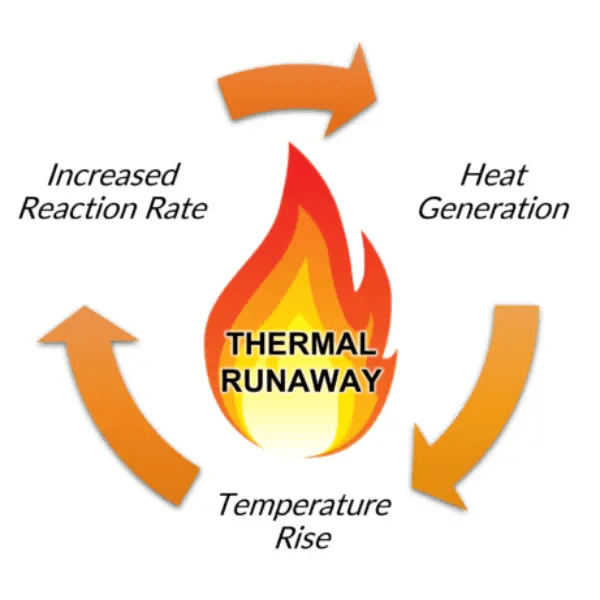
Thermal runaway is the catastrophic failure mode of lithium batteries. It begins when a cell generates more heat than it can dissipate, triggering exothermic reactions that rapidly accelerate. Once a cell enters thermal runaway, the energy is self-sustaining. Neighbouring cells are heated, enter runaway in turn, and the result is a fire that cannot be extinguished with water.
The onset temperature of thermal runaway varies by chemistry. This is not an abstract safety specification. In the Nigerian context, where battery enclosures are frequently under-ventilated and ambient temperatures are high, the gap between operating temperature and thermal runaway onset is the practical safety margin.
Thermal Runaway Onset Temperatures
LiFePO4: Thermal runaway onset at approximately 270 degC. In practice, LiFePO4 cells do not spontaneously enter thermal runaway under any realistic operating or fault condition in solar storage applications. The iron-phosphate cathode does not release oxygen under thermal stress, which is why LiFePO4 fires are extremely rare and far less severe than NMC or NCA fires.
NMC: Thermal runaway onset at approximately 210 degC. Under normal conditions this is adequate, but damaged, overcharged, or internally short-circuited NMC cells can reach these temperatures during fault conditions. NMC fires burn hotter and spread faster than LiFePO4 fires.
NCA: Thermal runaway onset at approximately 150 degC. The lowest margin of the three chemistries. In a scenario where a cell is overcharged (due to BMS failure), physically damaged, or subjected to a sustained high-current fault, NCA cells can reach thermal runaway more easily than NMC or LiFePO4.
For off-grid solar installations in Nigeria, where batteries are frequently installed in generator rooms, utility cupboards, or outbuildings with limited ventilation, LiFePO4 is not just the better technical choice. In many scenarios, it is the responsible choice.
FIELD OBSERVATION
Nigerian solar installers increasingly report that battery enclosure temperatures in non-air-conditioned buildings regularly reach 45 to 55 degC during the harmattan and dry season. Under these conditions, NCA chemistry should not be used in any enclosed battery installation. NMC requires forced ventilation and careful BMS thermal management. LiFePO4 handles these temperatures with its full cycle life intact.
Energy Density: Where NMC and NCA Win, But the Advantage Is Overstated for Solar
NMC and NCA have meaningfully higher energy density than LiFePO4. At 150 to 260 Wh/kg versus 90 to 160 Wh/kg for LiFePO4, an NMC or NCA pack will be lighter and smaller for a given kWh of storage.
In electric vehicles, drones, laptops, and power tools, this matters enormously. Range, weight, and size are primary design constraints.
In stationary solar storage, the calculation is different. A 10 kWh LiFePO4 battery bank may weigh 80 to 120 kg and occupy a certain volume. The same capacity in NMC may weigh 50 to 70 kg. For a home installation, this weight and size difference is rarely a practical constraint. Battery enclosures have space. The floor supports the weight.
The energy density advantage of NMC and NCA does not compensate for their cycle life and thermal disadvantages in the solar storage context. This is why the global solar storage industry converged on LiFePO4 as the standard chemistry, and why manufacturers like BYD, Pylontech, Dyness, and Huawei use LiFePO4 exclusively in their residential and commercial solar battery products.
BMS Requirements by Chemistry
Each chemistry has different BMS requirements, and getting the BMS configuration wrong is one of the most common causes of premature battery failure in solar installations.
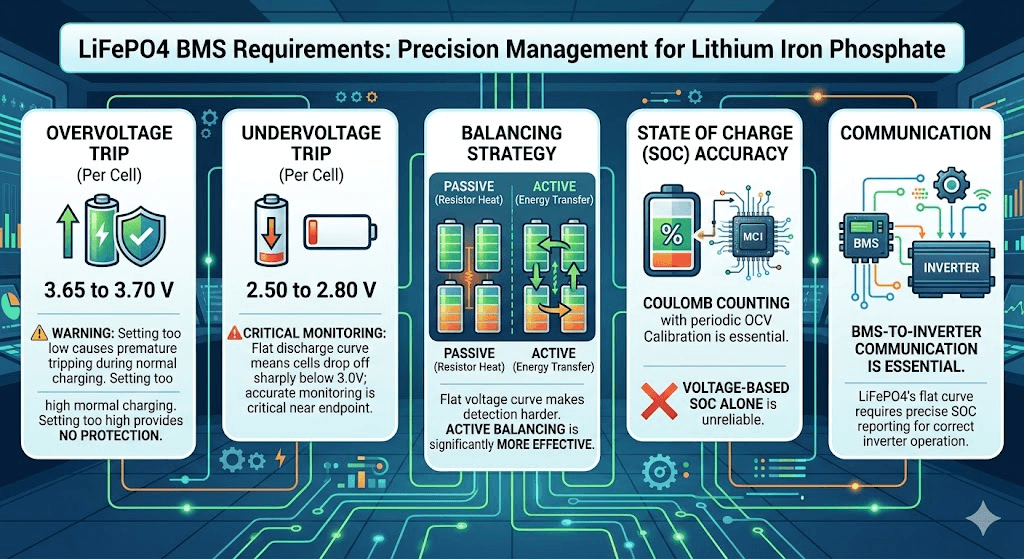
LiFePO4 BMS Requirements
Overvoltage trip: 3.65 to 3.70V per cell. Setting this too low causes premature tripping during normal charging; setting it too high provides no protection.
Undervoltage trip: 2.50 to 2.80V per cell. The flat discharge curve means cells drop off sharply below 3.0V; accurate monitoring is critical near the discharge endpoint.
Balancing: Because the flat voltage curve makes cell-to-cell differences harder to detect by voltage alone, active balancing is significantly more effective than passive balancing for LiFePO4.
SOC accuracy: Coulomb counting with periodic OCV calibration is essential. Voltage-based SOC alone is unreliable for LiFePO4.
Communication: LiFePO4’s flat curve makes BMS-to-inverter communication essential for accurate SOC reporting to the inverter.
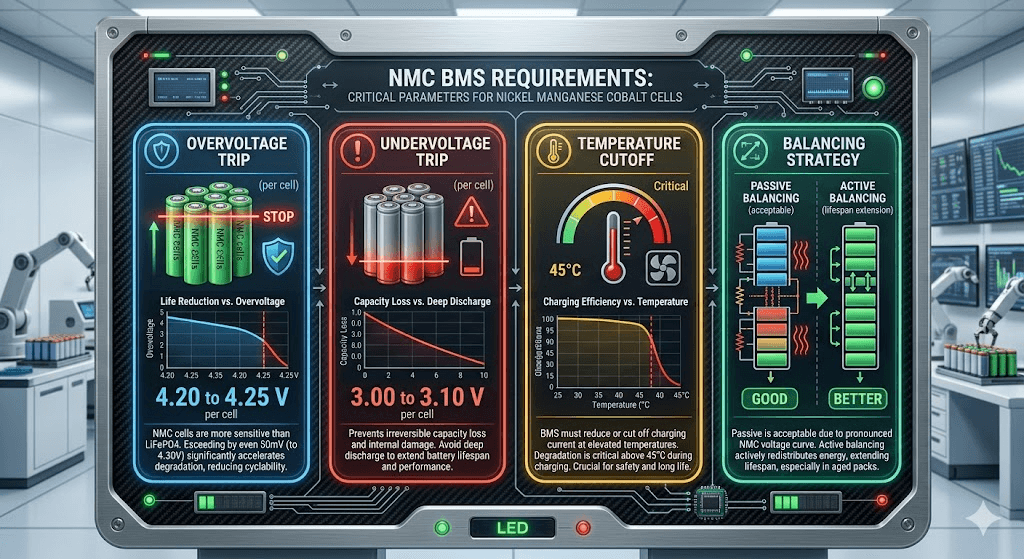
NMC BMS Requirements
Overvoltage trip: 4.20 to 4.25V per cell. NMC cells are more sensitive to overvoltage than LiFePO4; exceeding the charge cutoff by even 50mV significantly accelerates degradation.
Undervoltage trip: 3.00 to 3.10V per cell.
Temperature cutoff: Critical. NMC degrades significantly above 45 degC during charging. The BMS must reduce or cut off charging current when cell temperatures are elevated.
Passive balancing is acceptable for NMC due to its more pronounced voltage curve, but active balancing extends lifespan.
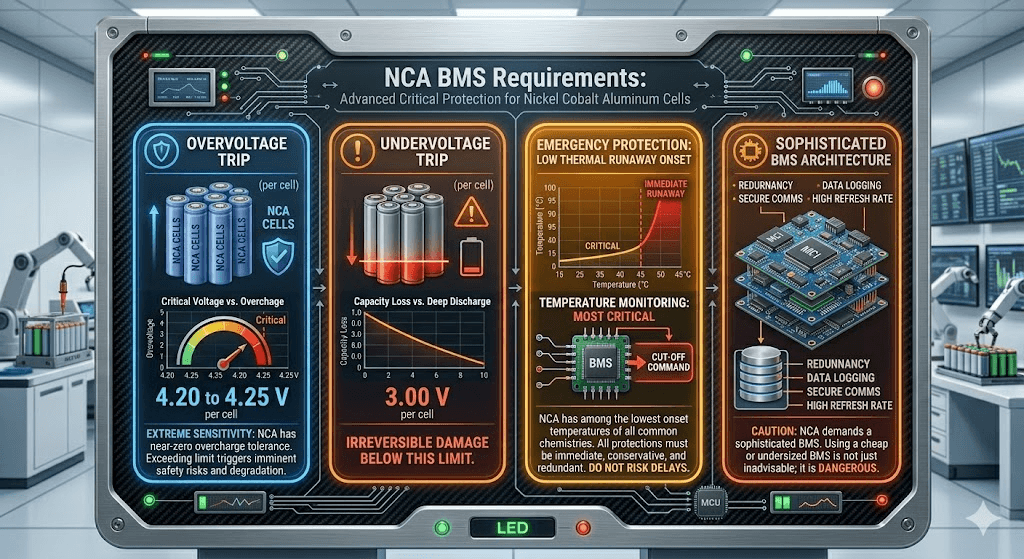
NCA BMS Requirements
Overvoltage trip: 4.20 to 4.25V per cell. NCA is among the most sensitive chemistries to overcharge.
Undervoltage trip: 3.00V per cell.
Temperature monitoring: The most critical requirement for NCA. Given its low thermal runaway onset temperature, temperature-triggered protection must be immediate and conservative.
NCA demands the most sophisticated BMS of the three chemistries. Using NCA with a cheap or undersized BMS is not just inadvisable; it is dangerous.
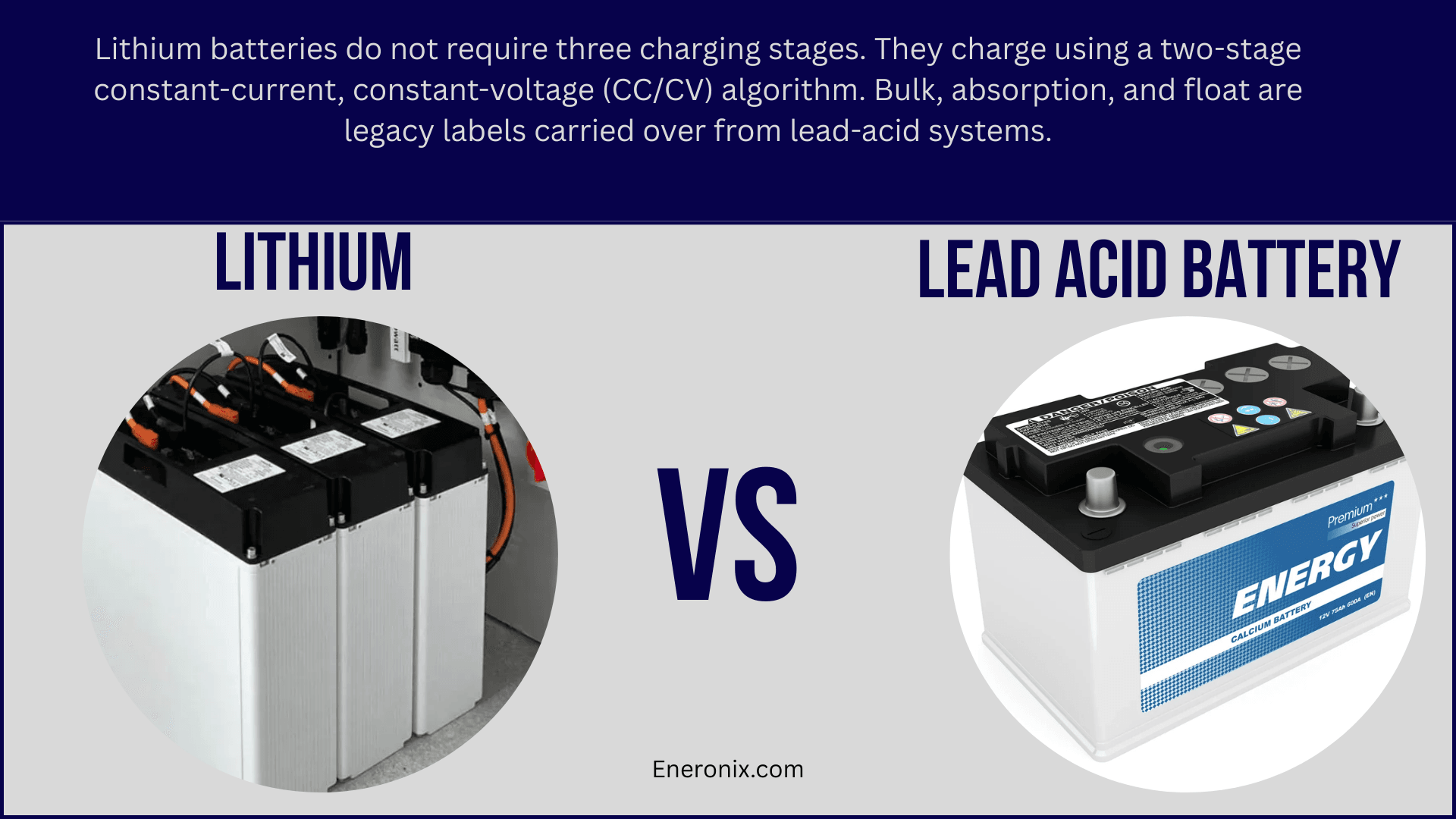
The charging stage behaviour across these chemistries is different in ways that affect inverter configuration. Our article on critical truths about the absorption stage in lithium batteries covers why lithium batteries respond to absorption charging differently than most installers expect.
Charging Parameters by Chemistry: What Your Inverter Needs to Know
Inverter charging parameters must be set correctly for the specific chemistry installed. This is one of the most common configuration errors in solar installations, and it directly affects both battery safety and cycle life.
Parameter
LiFePO4
NMC
NCA
Nominal pack voltage (16S / 48V system)
51.2 V
57.6 V
57.6 V
Typical charge voltage (16S)
58.4 V
67.2 V
67.2 V
Float charging required?
No
Optional
Optional
Recommended max charge rate
0.5C standard, 1C capable
0.5-1C
0.5-1C
Absorption stage sensitivity
Low
Moderate
High
BMS overvoltage trip (per cell)
3.65-3.70 V
4.20-4.25 V
4.20-4.25 V
BMS undervoltage trip (per cell)
2.50-2.80 V
3.00-3.10 V
3.00-3.10 V
Two points worth highlighting from this table:
LiFePO4 does not require float charging. Unlike lead-acid batteries, LiFePO4 does not self-discharge at a rate that requires continuous float maintenance. Applying a float charge voltage to a full LiFePO4 pack keeps the cells at a high SOC and accelerates calendar degradation. Most well-configured hybrid inverters can be set to skip the float stage for lithium batteries.
The charge voltage for a 16S NMC pack (67.2V) is meaningfully different from a 16S LiFePO4 pack (58.4V). Inverters configured for NMC and then switched to LiFePO4 without reconfiguration will undercharge the LiFePO4 pack significantly or, if the original setting was higher, potentially damage it.
Suitability for Nigeria and West Africa: A Practical Assessment
General battery chemistry comparisons are useful as a foundation. But Nigeria and West Africa present specific operating conditions that change the calculus in important ways.
The relevant field realities are:
Ambient temperatures regularly exceed 35 degC, with battery enclosure temperatures reaching 45 to 55 degC in non-air-conditioned spaces.
Solar batteries cycle deeply every day in most off-grid and hybrid installations, due to unreliable grid power and heavy reliance on stored energy.
Installation quality is variable. Many systems are installed without proper BMS-to-inverter communication, without forced ventilation, and with lead-acid charge parameters applied to lithium batteries.
Replacement costs, logistics, and technical support are significantly higher challenges than in European or North American markets.
Given these conditions, the chemistry comparison looks like this:
Factor
LiFePO4
NMC
NCA
Ambient temperature tolerance
Excellent (up to 55 degC discharge)
Moderate (degrades above 40 degC)
Poor (degrades above 35 degC)
Daily deep cycling
Handles 80% DoD daily for 3,000+ cycles
80% DoD reduces to ~800 cycles
80% DoD reduces to ~500 cycles
Safety in enclosed spaces
Highest (no thermal runaway risk at normal temps)
Moderate risk at elevated temps
High risk — avoid enclosed battery rooms
Generator compatibility
Excellent
Good
Good
Inverter compatibility (Nigeria market)
Universal
Good
Limited options
Replacement cost risk
Low (long lifespan)
Medium
High (short lifespan in hot climates)
Overall recommendation
First choice
Acceptable with good BMS
Not recommended
The conclusion from field reality in Nigeria is not subtle. LiFePO4 is the correct chemistry for solar storage in this environment. The combination of thermal tolerance, long cycle life, and forgiving BMS requirements makes it the lowest-risk and highest-value choice across nearly every installation scenario.
For a direct comparison between lithium and lead-acid in the Nigerian context, our article on lithium vs tubular battery in Nigeria covers the full cost and performance comparison.
When NMC Is Acceptable for Solar Storage
NMC is not categorically unsuitable for solar storage. There are scenarios where it works well and may even be the right choice. But those scenarios have specific conditions attached.
Scenario 1: Temperature-Controlled Environments
If a battery installation is in an air-conditioned room maintained below 25 degC, NMC cycle life approaches its rated specification. Commercial and industrial installations with proper infrastructure can use NMC effectively.
Scenario 2: Conservative Depth of Discharge
NMC cycle life improves significantly when depth of discharge is kept below 50%. A system designed to use only half the battery capacity on a normal day extends NMC lifespan considerably. This approach wastes capital cost but may be appropriate for applications where physical size and weight are constrained.
Scenario 3: Short-Horizon Applications
If a system is designed for a 3 to 5 year operational life before decommissioning or significant reconfiguration, NMC may be acceptable given its lower upfront cost in some market configurations. This applies to temporary installations, construction sites, or short-term project deployments.
For all other scenarios, including the typical home, commercial, and off-grid solar installations that represent the majority of the Nigerian market, LiFePO4 is the correct choice.
What Most Installers Get Wrong When Choosing Battery Chemistry
MISTAKE 1
Choosing chemistry based on upfront price per kWh without calculating total cost of ownership. A cheaper NMC pack that lasts 800 cycles costs more per kWh delivered than a LiFePO4 pack that lasts 3,000 cycles. The upfront saving disappears within 18 months and becomes a loss within 3 years.
MISTAKE 2
Applying lead-acid inverter charge parameters to NMC batteries. Lead-acid 48V systems often charge to 56 to 57V. NMC 48V packs (13S or 14S configurations) have very different charge voltage requirements. Mismatched charge parameters cause degradation or BMS trips that are misdiagnosed as battery faults.
MISTAKE 3
Installing NCA or high-nickel NMC batteries in unventilated battery rooms. In Nigeria’s climate, enclosure temperatures can push these chemistries into conditions where thermal degradation becomes a continuous rather than an occasional stress. Enclosure design matters, and chemistry choice must account for worst-case enclosure temperature.
MISTAKE 4
Assuming all lithium batteries are the same and using a generic BMS across chemistries. LiFePO4 and NMC have different protection thresholds, different balancing requirements, and different SOC estimation behaviours. A BMS optimised for one chemistry configured on another chemistry is either underprotecting or overprotecting the cells.
The Decision Framework: How to Choose
For most people reading this, the decision is already made by the technical evidence. But to make it explicit:
If your application is…
The right chemistry is…
Off-grid solar, home or commercial, Nigeria/West Africa
LiFePO4, always
Hybrid solar, daily cycling, any Nigerian installation
LiFePO4, always
Commercial solar with air-conditioned battery room, conservative DoD
LiFePO4 preferred; NMC acceptable
Short-term or temporary installation (under 3 years)
NMC may be acceptable if cost-constrained
High-performance EV or mobility application (not solar storage)
NMC or NCA depending on energy density priority
Any installation where budget does not allow proper BMS and ventilation
LiFePO4 only, other chemistries require better infrastructure to be safe
Once you have confirmed LiFePO4 as the right chemistry, the next decision is correct sizing. Our 48V lithium battery sizing guide walks through the complete calculation for matching battery capacity to inverter and load requirements.
For guidance on maximising the lifespan of your chosen LiFePO4 installation, our guide on how to increase lithium battery lifespan covers depth of discharge management, temperature practices, charge configuration, and BMS maintenance.
Frequently Asked Questions
Which lithium battery chemistry is best for solar storage?
LiFePO4 is the best choice for solar storage in almost every scenario. Its combination of long cycle life (3,000 to 6,000+ cycles), excellent thermal stability, and tolerance for daily deep cycling makes it significantly better suited to solar applications than NMC or NCA. The lower energy density compared to NMC is not a practical limitation in stationary storage where physical space is not critically constrained.
Is LiFePO4 better than NMC for home solar batteries?
Yes, for home solar storage. LiFePO4 outperforms NMC in cycle life, safety at high ambient temperatures, and total lifespan. A well-managed LiFePO4 pack typically delivers 8 to 15 years of service in home solar applications. NMC packs in the same application typically degrade to 80% SOH within 3 to 5 years.
Why do most solar batteries use LiFePO4?
Because LiFePO4 matches the technical requirements of solar storage better than any other lithium chemistry. Solar batteries charge and discharge deeply every day, must tolerate high ambient temperatures, and are often installed in enclosed spaces where thermal runaway risk must be minimised. LiFePO4 addresses all three requirements better than NMC or NCA.
What are the disadvantages of LiFePO4?
Lower gravimetric energy density than NMC or NCA (meaning a heavier pack for the same kWh), poor performance when charging below 0 degC, and a flat discharge voltage curve that makes voltage-based SOC estimation unreliable. The flat voltage curve is why a properly communicating BMS is critical for LiFePO4 systems.
Can NMC batteries be used for solar storage?
Yes, with caveats. NMC batteries can work in solar storage applications if the BMS is well-configured, the system is installed in a cool and ventilated location, and depth of discharge is kept below 80%. However, cycle life is significantly shorter than LiFePO4 under the same conditions, and the long-term cost per kWh of storage is usually higher once replacement cycles are factored in.
Why is NCA not recommended for solar storage in Nigeria?
NCA chemistry has the lowest thermal runaway threshold of the three chemistries (around 150 degC onset) and degrades faster at high ambient temperatures. In Nigerian conditions where battery enclosure temperatures can reach 45 to 55 degC during the dry season, NCA chemistry is under continuous thermal stress. The combination of poor heat tolerance, short cycle life, and high thermal runaway risk makes it unsuitable for the Nigerian solar storage context.
What voltage is a 48V LiFePO4 battery fully charged?
A 16S (48V nominal) LiFePO4 pack is fully charged at 58.4V (16 cells x 3.65V per cell). At rest after charging, the voltage typically settles to around 53.6 to 54.4V as the cells relax from their charge endpoint. This resting voltage does not indicate a partially charged state.
How many cycles does a LiFePO4 battery last?
Quality LiFePO4 cells from reputable manufacturers are rated for 3,000 to 6,000 cycles to 80% SOH under standard test conditions (25 degC, 0.5C charge/discharge, 80% depth of discharge). In real-world solar storage applications with elevated temperatures and daily deep cycling, 2,500 to 4,000 cycles is a realistic expectation. This translates to roughly 7 to 12 years of daily use.
What is the difference between LiFePO4 and lithium-ion?
LiFePO4 is a type of lithium-ion battery. The term lithium-ion describes the general class of rechargeable batteries that move lithium ions between anode and cathode during charge and discharge. LiFePO4, NMC, and NCA are all lithium-ion chemistries. The differences lie in the cathode material, which determines voltage, energy density, thermal stability, and cycle life.
Does LiFePO4 need a BMS?
Yes. All lithium battery chemistries including LiFePO4 require a BMS. While LiFePO4 is inherently more stable than NMC or NCA, it still requires per-cell voltage monitoring, temperature monitoring, balancing, and protection from overcharge, deep discharge, and overcurrent. Without a BMS, LiFePO4 cells will drift out of balance over time and degrade prematurely.
I am Engr. Ubokobong Ekpenyong, a solar specialist and lithium battery systems engineer with over five years of hands-on experience designing, assembling, and commissioning off-grid solar and energy storage systems. My work focuses on lithium battery pack architecture, BMS configuration, and system reliability in off-grid and high-demand environments.
Contains information related to marketing campaigns of the user. These are shared with Google AdWords / Google Ads when the Google Ads and Google Analytics accounts are linked together.
90 days
__utma
ID used to identify users and sessions
2 years after last activity
__utmt
Used to monitor number of Google Analytics server requests
10 minutes
__utmb
Used to distinguish new sessions and visits. This cookie is set when the GA.js javascript library is loaded and there is no existing __utmb cookie. The cookie is updated every time data is sent to the Google Analytics server.
30 minutes after last activity
__utmc
Used only with old Urchin versions of Google Analytics and not with GA.js. Was used to distinguish between new sessions and visits at the end of a session.
End of session (browser)
__utmz
Contains information about the traffic source or campaign that directed user to the website. The cookie is set when the GA.js javascript is loaded and updated when data is sent to the Google Anaytics server
6 months after last activity
__utmv
Contains custom information set by the web developer via the _setCustomVar method in Google Analytics. This cookie is updated every time new data is sent to the Google Analytics server.
2 years after last activity
__utmx
Used to determine whether a user is included in an A / B or Multivariate test.
18 months
_ga
ID used to identify users
2 years
_gali
Used by Google Analytics to determine which links on a page are being clicked
30 seconds
_ga_
ID used to identify users
2 years
_gid
ID used to identify users for 24 hours after last activity
24 hours
_gat
Used to monitor number of Google Analytics server requests when using Google Tag Manager
1 minute
You can find more information in our Cookie Policy and .