
Nigeria Sizing Guide with Real Load Examples
Most solar proposals in Nigeria give you a panel count without showing the calculation. The installer sizes the array from experience or from a rough estimate of your load. Sometimes the result is close. Often it is not. This guide shows you the exact method for calculating how many panels your system requires with real numbers, real Nigerian conditions, and three complete worked examples.
The method works for any system size. A 3-bedroom flat in Lagos, a small shop in Abuja, or a rural home in Kano the calculation structure is the same. Only the inputs change.
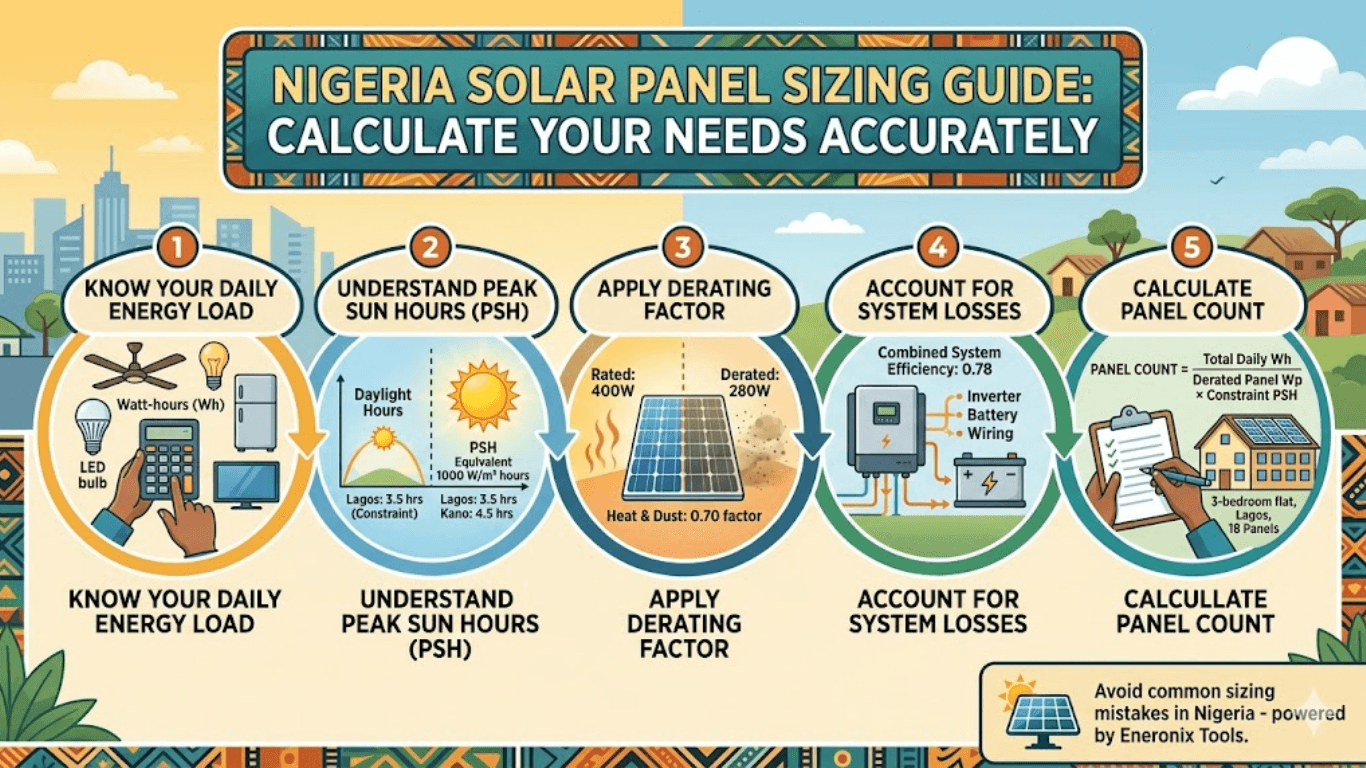
Step 1: Know Your Daily Energy Consumption
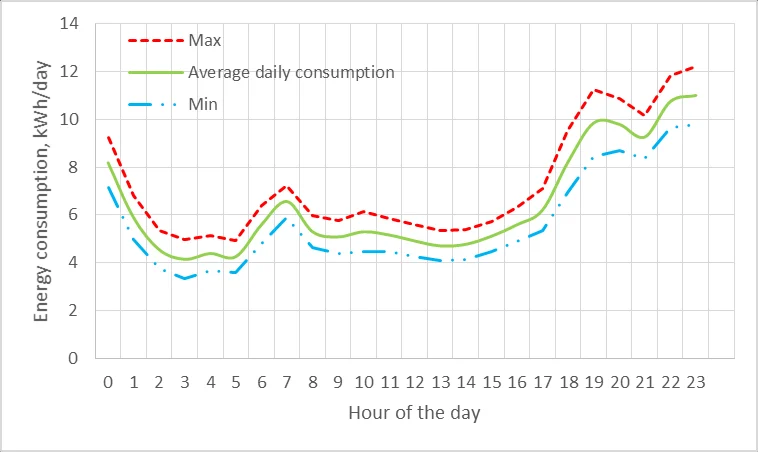
You cannot size a solar array without first knowing how much energy your loads consume each day. This figure is your daily energy demand, measured in watt-hours (Wh) or kilowatt-hours (kWh).
The calculation is simple. For each appliance, multiply its wattage by the number of hours it runs per day. Sum every appliance. That total is your raw daily demand.
Daily demand = appliance wattage × hours of use per day
Total daily demand = sum of all appliances
Use these reference wattages for common Nigerian household loads:
| Appliance | Running Wattage | Typical Daily Hours | Daily Wh |
| Ceiling fan | 50–75W | 10 hrs | 500–750 Wh |
| LED bulb (x6) | 7–15W each | 6 hrs | 252–540 Wh |
| 32″ LED TV | 40–65W | 6 hrs | 240–390 Wh |
| Refrigerator (medium) | 100–180W | 24 hrs (cycles) | 600–1,080 Wh |
| Deep freezer | 100–200W | 24 hrs (cycles) | 600–1,200 Wh |
| Air conditioner (1HP) | 750–900W | 8 hrs | 6,000–7,200 Wh |
| Water pump (0.5HP) | 370W | 2 hrs | 740 Wh |
| Laptop | 45–65W | 8 hrs | 360–520 Wh |
| Phone charging (x3) | 10–20W each | 2 hrs | 60–120 Wh |
One important point on Nigerian conditions: grid instability means most households run solar for 18 to 20 hours daily, not 8 to 12. Account for total daily consumption, not just the hours NEPA is out.
Step 2: Understand Peak Sun Hours
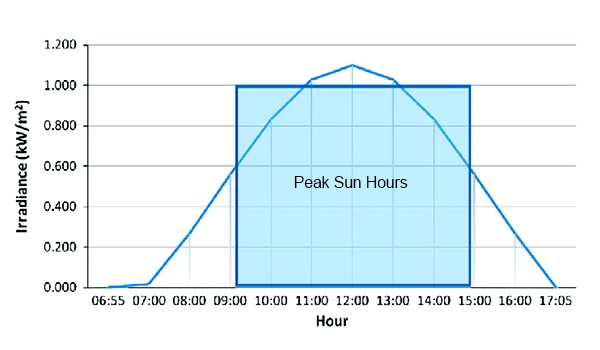
Peak sun hours (PSH) is not the same as daylight hours. This is one of the most common errors in solar sizing.
Daylight hours in Lagos might be 12 hours. But the sun does not produce 1,000 W/m² for all 12 of those hours. It rises at low intensity, reaches peak intensity midday, then drops. PSH is the equivalent number of hours at exactly or closer 1,000 W/m² that would deliver the same total solar energy as your actual variable day.
| Example: If Lagos receives 4.5 kWh/m² of solar energy in a day, its peak sun hours figure is 4.5 hours regardless of the fact that the sun was up for 12 hours. |
Peak sun hours vary by location and season. For sizing, you must use the constraint month the worst month of the year for solar production in your region. Sizing for the average gives you a system that fails several months of the year. Sizing for the worst month gives you a system that performs all year.
| City | Annual Average PSH | Dry Season PSH | Constraint Month PSH | Constraint Month |
| Lagos | 4.5 | 5.0–5.5 | 3.5–4.0 | July |
| Port Harcourt | 4.0 | 4.5–5.0 | 3.0–3.5 | August |
| Abuja | 5.5 | 6.0–6.5 | 4.0–4.5 | August |
| Kano | 6.0 | 6.5–7.0 | 4.5–5.0 | August* |
*Note on Kano: Harmattan (January–February) reduces irradiance through dust and haze. For installations in the far north, verify whether your worst month is harmattan or rainy season by checking NASA POWER data for your exact coordinates.
Step 3: Apply the Derating Factor
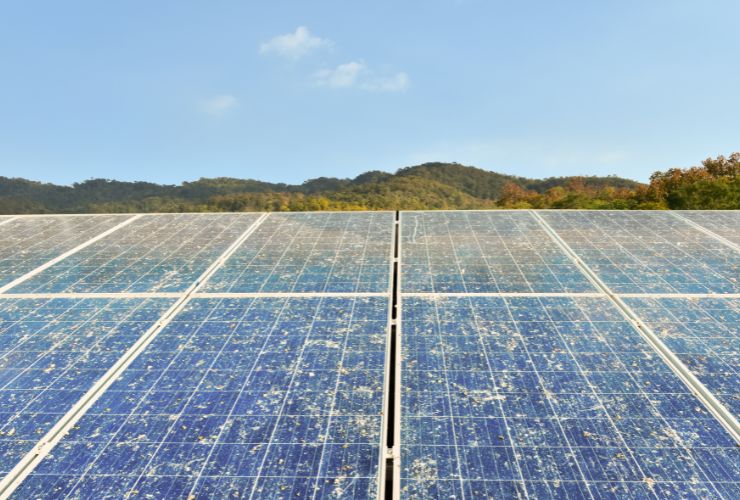
A 400W solar panel is rated at Standard Test Conditions: 25°C cell temperature, 1,000 W/m² irradiance, and clean panels. In Nigerian conditions, none of those hold. Cell temperatures regularly reach 55–70°C. Panels accumulate dust during harmattan. Irradiance varies with cloud cover and haze.
The result is that real-world output is significantly lower than rated output. A derating factor of 0.70 is the correct conservative value for Nigerian conditions. This means you plan for each panel to produce 70% of its rated wattage.
Derated panel output = rated Wp × 0.70
Example: 400W panel × 0.70 = 280W derated output
Never use nameplate wattage directly in a panel count calculation. A system sized at STC ratings will be chronically undersized from day one.
Step 4: Account for System Losses
Energy is lost at every conversion point in your system. A watt-hour generated by your panels is not a watt-hour delivered to your load. The main loss points are:
- Inverter efficiency: 92–96% at typical operating load. Plan for 94% (6% loss).
- Battery round-trip efficiency: 95% for LiFePO4. Every watt-hour stored and retrieved loses 5%.
- Wiring losses: 2–3% on a well-installed system with correctly sized DC cables.
These losses compound. The combined system efficiency for a lithium-based off-grid system in Nigeria is typically 0.75 to 0.80. Use 0.78 as a conservative working figure.
Adjusted daily generation required = daily demand ÷ system efficiency
Example: 5,000 Wh ÷ 0.78 = 6,410 Wh of solar generation needed
Step 5: Calculate Panel Count
With your adjusted generation requirement, derated panel output, and constraint month PSH, you now have everything for the panel count formula.
Panel count = Adjusted daily generation ÷ (Derated panel output × Constraint month PSH)
Round up to the next whole number. Never round down. A panel count of 5.2 means 6 panels, not 5.
Engr. Lion
Worked Examples: Three Nigerian Scenarios
Example 1: 3-Bedroom Flat in Lagos

This is the most common residential sizing request in Nigeria. The household has a split AC in the living room, a refrigerator, deep freezer, fans in three rooms, a TV, LED lighting, phone charging, and a water pump.
| Appliance | Wattage | Hours/Day | Daily Wh |
| Split AC (1HP) | 800W | 8 hrs | 6,400 Wh |
| Refrigerator | 150W | 24 hrs (50% cycle) | 1,800 Wh |
| Deep freezer | 150W | 24 hrs (50% cycle) | 1,800 Wh |
| Ceiling fans (x3) | 65W each | 12 hrs | 2,340 Wh |
| LED TV | 55W | 6 hrs | 330 Wh |
| LED bulbs (x8) | 10W each | 6 hrs | 480 Wh |
| Water pump (0.5HP) | 370W | 1.5 hrs | 555 Wh |
| Laptops + phones | 120W combined | 8 hrs | 960 Wh |
| Total | 14,665 Wh/day |
Calculation:
Adjusted generation needed: 14,665 Wh ÷ 0.78 = 18,802 Wh
Derated 400W panel output: 400W × 0.70 = 280W
Constraint month PSH (Lagos, July): 3.8 hours
Panel count: 18,802 ÷ (280 × 3.8) = 18,802 ÷ 1,064 = 17.7 → 18 panels
| Result: 18 × 400W panels for this Lagos 3-bedroom flat. If you exclude the AC and size only for essential loads, the count drops to approximately 7 panels but that system cannot power the AC when you need it most. |
Example 2: Small Shop / Office in Abuja
A small retail shop or open-plan office in Abuja. No air conditioner, but multiple workstations, lighting, a refrigerator for drinks, and a CCTV system.
| Appliance | Wattage | Hours/Day | Daily Wh |
| Laptops (x4) | 55W each | 9 hrs | 1,980 Wh |
| LED lighting (x10) | 10W each | 10 hrs | 1,000 Wh |
| Refrigerator (drinks) | 150W | 24 hrs (50% cycle) | 1,800 Wh |
| Ceiling fans (x4) | 65W each | 10 hrs | 2,600 Wh |
| Printer / scanner | 80W | 2 hrs | 160 Wh |
| CCTV system (4 cameras) | 60W total | 24 hrs | 1,440 Wh |
| Phone charging (x6) | 15W each | 2 hrs | 180 Wh |
| Total | 9,160 Wh/day |
Calculation:
Adjusted generation needed: 9,160 Wh ÷ 0.78 = 11,743 Wh
Derated 400W panel output: 400W × 0.70 = 280W
Constraint month PSH (Abuja, August): 4.2 hours
Panel count: 11,743 ÷ (280 × 4.2) = 11,743 ÷ 1,176 = 9.98 → 10 panels
| Result: 10 × 400W panels. Abuja’s higher PSH compared to Lagos means a meaningfully lower panel count for the same energy demand. |
Example 3: Rural Home in Kano
A rural household in Kano. No air conditioning. Lighting, fans, a small TV, a refrigerator, and phone charging. Lower total demand but the harmattan factor requires attention.
| Appliance | Wattage | Hours/Day | Daily Wh |
| LED bulbs (x6) | 10W each | 6 hrs | 360 Wh |
| Ceiling fans (x2) | 65W each | 10 hrs | 1,300 Wh |
| Small LED TV | 45W | 5 hrs | 225 Wh |
| Refrigerator (small) | 100W | 24 hrs (50% cycle) | 1,200 Wh |
| Phone charging (x4) | 15W each | 2 hrs | 120 Wh |
| Total | 3,205 Wh/day |
Calculation (Rainy Season Constraint August):
Adjusted generation needed: 3,205 Wh ÷ 0.78 = 4,109 Wh
Derated 400W panel output: 400W × 0.70 = 280W
Constraint month PSH (Kano, August): 4.8 hours
Panel count: 4,109 ÷ (280 × 4.8) = 4,109 ÷ 1,344 = 3.06 → 4 panels
Cross-Check Against Harmattan (January):
Constraint month PSH (Kano, harmattan): 5.2 hours (higher, but haze reduces real output)
Apply additional 10% derating for harmattan dust: 280W × 0.90 = 252W
Panel count: 4,109 ÷ (252 × 5.2) = 4,109 ÷ 1,310 = 3.14 → 4 panels
| Result: 4 × 400W panels. Both constraint scenarios converge on 4 panels. The harmattan cross-check confirms the array is adequate year-round. |
What the Panel Count Tells You About the Rest of the System
Battery Bank Sizing
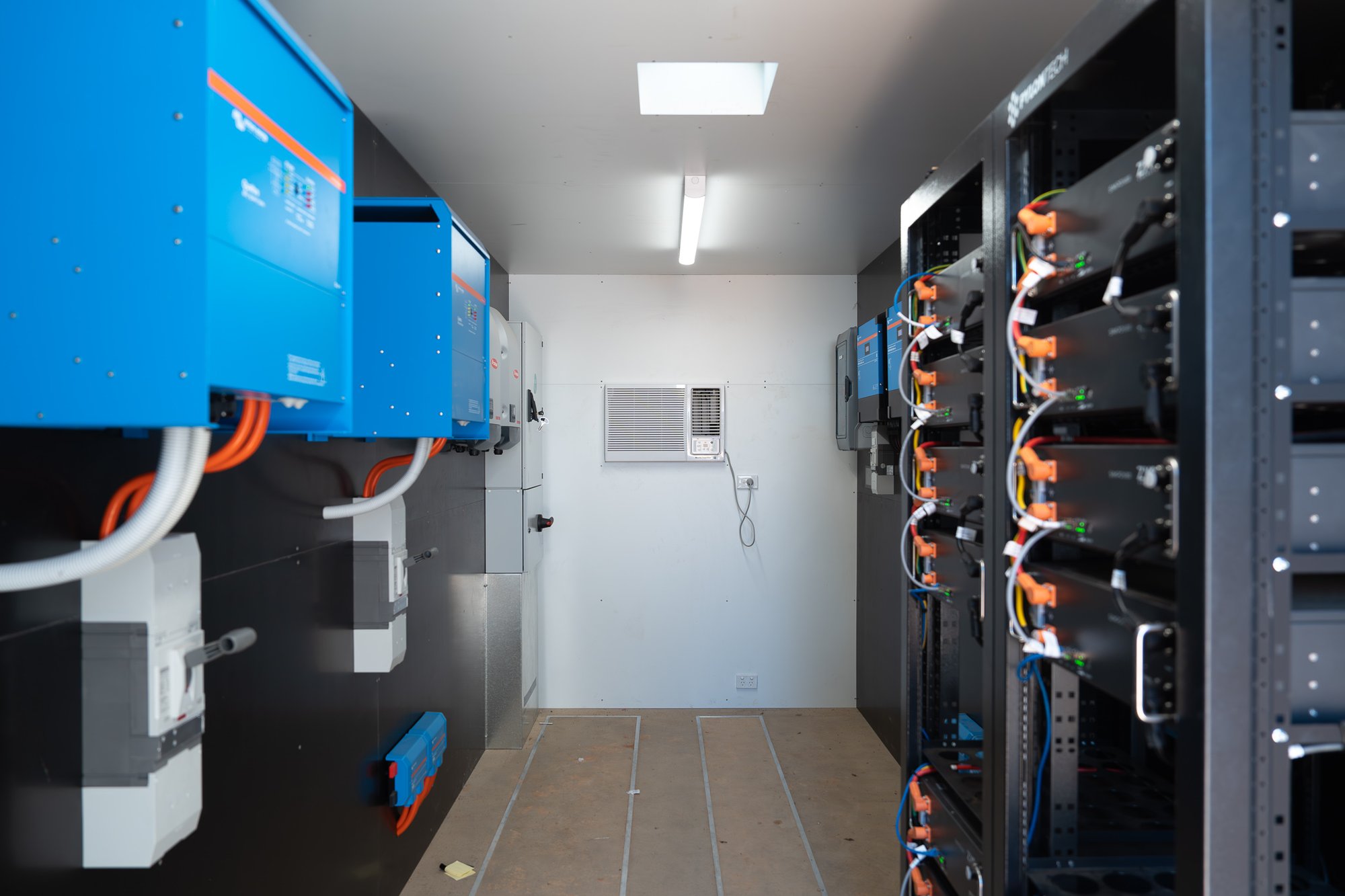
Your panel count and battery bank must be sized together. A large array with a small battery bank means excess energy is wasted every afternoon and the battery runs flat every night. A large battery bank with a small array means the battery never fully charges.
The standard relationship: your array should be able to fully charge your battery bank from a typical 50% state of charge within one to two days of adequate sunshine. For the Lagos example above (18 panels, 18,802 Wh daily requirement), a battery bank of 15–20 kWh usable capacity is the correct pairing.
MPPT Charge Controller Sizing

Every additional panel affects your MPPT controller specification. The controller must handle the total array short-circuit current (Isc) and the total array open-circuit voltage (Voc).
As a rule: never size your MPPT controller to exactly match your current array. Size it to handle 25–30% more capacity than your present array. This allows future expansion without replacing the controller.
If you calculate 18 panels at 10A Isc each, your array short-circuit current is 18 × 10A in a parallel configuration. Confirm your controller can handle that current before purchasing it. An undersized controller becomes a bottleneck and reduces the effective output of the entire array.
Autonomy Days
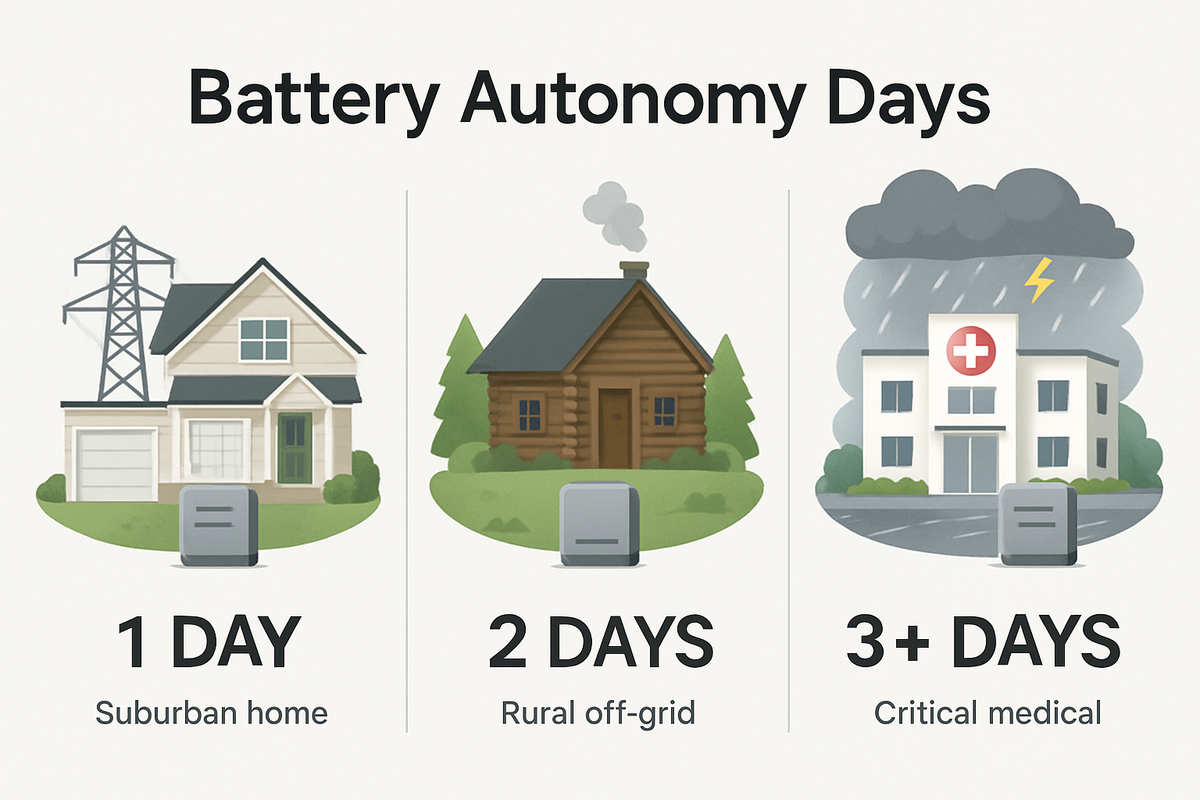
Autonomy days is the number of days your battery bank can supply your load without any solar input. For most Nigerian installations, 1.5 to 2 autonomy days is the design target.
The constraint month calculation already accounts for this indirectly sizing for the worst solar month means your array can still produce meaningful charge during overcast periods. But for extended rainy season stretches of 3 to 5 consecutive overcast days (common in Port Harcourt and Lagos), battery capacity becomes the limiting factor, not panel count.
The Most Expensive Sizing Mistakes in Nigeria
Using STC panel ratings without derating. A system sized on 400W nameplate output per panel, not 280W derated output, is undersized by 30% before installation is complete.
Using dry season PSH for a year-round system. A Lagos system sized at 5.5 PSH (dry season) instead of 3.8 PSH (July) will run short of power for three to four months every year.
Ignoring system losses. Assuming 100% efficiency from panel to load means your battery runs flat before the calculation says it should. The 22% difference between gross panel output and usable load energy is not optional it is physics.
Sizing for essential loads only. A system sized for ‘NEPA outage’ loads that excludes the AC will disappoint every user who expects to run the AC when the grid is down. Size for your actual daily consumption.
Undersizing to reduce upfront cost. Buying 4 panels when 6 are needed and adding 2 more later costs more total than buying 6 correctly from the start. Retrofit additions require re-evaluation of the controller, wiring, and mounting.
Not checking MPPT controller capacity against the final array. A 60A MPPT controller cannot handle an array that produces 80A. The excess current is either clipped or the controller trips. Always verify controller capacity after panel count is finalised.
Summary: The Complete Panel Sizing Sequence
Every solar panel count in Nigeria should follow this sequence:
- Conduct a load audit. List every appliance, wattage, and daily hours. Sum to get total daily Wh.
- Divide by system efficiency (0.78 for lithium systems) to get adjusted generation requirement.
- Identify your constraint month PSH from the table above for your city.
- Calculate derated panel output: rated Wp × 0.70.
- Apply the formula: Panel count = Adjusted daily generation ÷ (Derated output × Constraint PSH).
- Round up. Never round down.
- Cross-check your MPPT controller can handle the resulting array.
- Verify battery bank sizing matches the array capacity.
Any solar proposal that gives you a panel count without showing this calculation has not been properly engineered. Ask your installer to show the load audit and the panel count formula with real numbers. If they cannot, you do not have a design you have a guess.
Verify Your Calculation with the Eneronix Sizing Tools
The manual method above gives you the engineering logic and the ability to verify any proposal. To run your own system sizing quickly, use the Eneronix tools:
- Off-Grid Solar Sizing Calculator enter your load list and location, get panel count, battery bank size, and MPPT specification
- Solar & MPPT Calculator verify your array configuration against your controller
Before you open either calculator, have these inputs ready:
- Complete appliance list with wattage and daily hours
- Your city or GPS coordinates
- Your target autonomy days (1.5 or 2 for most Nigerian applications)
- Your battery chemistry (LiFePO4 or lead-acid)
- Your inverter model or efficiency rating if known
| Related reading: Solar Array Sizing for Off-Grid Systems eneronix.com/solar-array-sizing-off-grid-system/ | Battery Bank Sizing eneronix.com/battery-bank-sizing-off-grid-systems/ | MPPT Charge Controller Selection Guide eneronix.com/mppt-charge-controller-selection-guide/ |
Frequently Asked Questions (FAQ)
How many solar panels do I need per day in Nigeria?
The number of solar panels you need depends on your daily energy consumption, peak sun hours in your location, and system efficiency.
Basic rule:
Panel count = Daily energy demand (Wh) ÷ (Panel wattage × derating × peak sun hours × system efficiency)
For example, a home using 5,000Wh/day in Lagos (with ~3.8 PSH) typically needs 5–7 panels of 400W each under real Nigerian conditions.
How many solar panels are needed for a 3-bedroom house in Nigeria?
A typical 3-bedroom house in Nigeria requires 15 to 20 solar panels (400W each) if it includes:
- Refrigerator
- Freezer
- Fans
- Lighting
- TV
- Water pump
- Air conditioner (optional but significant load)
If you exclude air conditioning, the requirement drops to 6 to 8 panels, but the system will not support AC usage.
Can I run an air conditioner with solar panels in Nigeria?
Yes, but air conditioners are high-load appliances and significantly increase system size.
- A 1HP AC (≈800W) running 8 hours/day consumes ~6.4kWh
- This alone may require 6–8 solar panels
To run AC reliably:
- Increase panel count
- Use a sufficiently large battery bank (15kWh+ recommended)
- Ensure inverter capacity can handle surge and continuous load
What is peak sun hours (PSH) in Nigeria?
Peak Sun Hours (PSH) is the number of hours per day when solar irradiance averages 1,000 W/m².
Typical values:
- Lagos: 3.5 – 4.0 (rainy season constraint)
- Port Harcourt: 3.0 – 3.5
- Abuja: 4.0 – 4.5
- Kano: 4.5 – 5.0
Always size your system using the lowest PSH (constraint month), not the yearly average.
Why don’t 400W solar panels produce 400W in Nigeria?
Because panel ratings are based on Standard Test Conditions (STC), which do not reflect real operating environments.
In Nigeria:
- High temperatures reduce efficiency
- Dust (harmattan) blocks sunlight
- Cloud cover reduces irradiance
Real output is typically 65%–75% of rated power.
A 400W panel realistically delivers about 260W–300W.
What is the derating factor for solar panels in Nigeria?
A derating factor of 0.70 is recommended for system design.
This accounts for:
- Temperature losses
- Dust and dirt
- Wiring inefficiencies
- Real-world operating conditions
Using no derating leads to undersized systems by ~30%.
How do I calculate my daily energy consumption?
List all appliances and calculate:
Daily energy (Wh) = Power (W) × Hours used per day
Then sum all values.
Example:
- Fan (60W × 10h) = 600Wh
- TV (50W × 6h) = 300Wh
- Fridge ≈ 1,000Wh/day
Total = 1,900Wh/day
How many solar panels do I need for 1kWh per day?
For Nigerian conditions:
1kWh/day typically requires 1 to 2 panels (400W each)
This depends on:
- Location (PSH)
- System efficiency
- Derating
In Lagos (low PSH), closer to 2 panels is more realistic.
How does battery size affect the number of solar panels?
Battery size and panel count must be matched.
- Too few panels → battery never fully charges
- Too many panels → excess energy is wasted
A good design rule:
Your solar array should recharge your battery from 50% to full within 1–2 days
How many days of backup (autonomy) should I design for in Nigeria?
Recommended:
- 1.5 to 2 days for most systems
- 2–3 days for areas with heavy rainfall (e.g., Port Harcourt, Lagos)
More autonomy = larger battery bank (not necessarily more panels)
Can I add more solar panels later?
Yes, but it depends on your system design.
Before expansion, check:
- MPPT controller current and voltage limits
- Inverter capacity
- Cable sizing
Best practice:
Oversize your MPPT controller by 25–30% during initial installation.
What is the biggest mistake in solar panel sizing in Nigeria?
The most common mistakes are:
- Using panel nameplate rating (400W) instead of derated output
- Designing with dry season PSH instead of worst month
- Ignoring system losses
- Undersizing to reduce upfront cost
These errors lead to systems that fail during rainy season.
Is it better to oversize or undersize a solar system?
Oversizing is safer.
- Oversizing → higher reliability, longer battery life
- Undersizing → constant power shortage, battery stress
In Nigerian conditions, slight oversizing is recommended engineering practice.

I am Engr. Ubokobong Ekpenyong, a solar specialist and lithium battery systems engineer with over five years of hands-on experience designing, assembling, and commissioning off-grid solar and energy storage systems. My work focuses on lithium battery pack architecture, BMS configuration, and system reliability in off-grid and high-demand environments.