Which country is number 1 in lithium? The answer depends, Chile leads in reserves, Australia in production, and China controls supply. Here’s how it affects battery prices in Nigeria.
If you ask ten different people which country is number 1 in lithium, you will likely get three different answers. Some will say Chile. Some will say Australia. A few who follow the battery industry closely will say China. The interesting thing is that all three answers are correct, depending on what exactly you are measuring.
This matters because the question people are really asking when they search this is not a geography trivia question. They want to understand where the lithium in their battery came from, who controls the supply, and what that means for the price they paid or will pay in the future. Those are genuinely important questions for anyone running a solar system in Nigeria, because the global lithium supply chain directly influences what batteries cost here, how available they are, and how prices will move over the next decade.
So let us answer all three versions of the question properly.
Chile is number one if you are talking about proven lithium reserves in the ground. No other country comes close. Australia is number one if you are talking about how much lithium is actually being mined and sent to market right now. And China is number one if you are talking about who controls the processing, manufacturing, and pricing of the finished product that ends up in your battery.
Three different measures. Three different leaders. And each one tells you something different and important about where battery technology is headed and what it will cost.
Chile sits at the top of every global lithium reserves table, and by a significant margin. As of 2024, Chile holds approximately 9.3 million metric tons of proven lithium reserves, which represents roughly one-third of all the economically extractable lithium on the planet. No other single country is close to that number.
Almost all of Chile’s lithium comes from one place: the Salar de Atacama, a vast salt flat in the northern Atacama Desert. This is one of the driest places on earth, which turns out to be ideal for lithium extraction. The lithium sits dissolved in underground brine, essentially salty water trapped beneath the surface. Mining companies pump this brine to the surface and allow it to evaporate in large shallow pools over many months. What remains after evaporation is a lithium-rich concentrate that gets processed into lithium carbonate or lithium hydroxide for use in batteries.
The two companies that dominate Chile’s lithium production are SQM and Albemarle, both operating large-scale brine extraction operations in the Atacama. Chile was the second largest lithium producer in the world in 2024, with output of approximately 49,000 metric tons, despite holding the largest reserves by far. The gap between its reserve position and its production position is deliberate in part. Chile has historically been cautious about how fast it extracts its lithium, and in 2023 President Gabriel Boric announced plans to partially nationalise the country’s lithium industry in a move to ensure the state captures more value from the resource.
Chile is part of what the mining industry calls the Lithium Triangle, a geographic region of South America that includes Chile, Argentina, and Bolivia. Together these three countries hold an estimated 44% of the world’s total lithium reserves. Argentina is expanding its production rapidly, with mining major Rio Tinto announcing in late 2024 plans to invest $2.5 billion to expand lithium extraction at its operations on Argentina’s Rincon salt flat. Bolivia holds some of the largest lithium resources on the planet but has struggled to develop them commercially due to difficult terrain, political complexity, and a lack of infrastructure at its Uyuni salt flat.
The key thing to understand about Chile’s position is that having the most lithium in the ground does not automatically translate into leading the world in production. As we will see in the next section, the country that actually digs up and ships the most lithium every year is on the other side of the world entirely.
Australia
While Chile sits on the largest lithium reserves in the world, Australia is the country that actually produces the most of it. In 2024, Australia mined approximately 88,000 metric tons of lithium, representing roughly 36.7% of total global production. That is nearly double Chile’s output in the same year, despite Australia holding significantly smaller reserves at around 7 million metric tons.
The reason Australia produces more than Chile even with smaller reserves comes down to the type of lithium deposit and how it is extracted. Australia’s lithium is not dissolved in underground brine like Chile’s. It is locked inside hard rock, specifically a mineral called spodumene, which is mined from open-pit operations the same way you would mine iron ore or copper. Hard-rock mining is faster to scale up, easier to manage technically, and less dependent on weather and evaporation timelines than brine extraction. Once the ore is blasted and loaded onto trucks, it can be processed relatively quickly compared to the months-long evaporation process that brine extraction requires.
The heart of Australia’s lithium production is Western Australia, which hosts the majority of the country’s operational lithium mines. The single most important of these is the Greenbushes mine, operated by Talison Lithium, a joint venture between Tianqi Lithium, the Australian miner IGO, and Albemarle. Greenbushes is the largest hard-rock lithium mine in the world by production volume and has been operating since the 1980s, long before lithium became the strategic resource it is today.
Australia’s dominance in production did not happen by accident. The country invested heavily in lithium mining infrastructure during the first major wave of EV interest in the early 2010s, and those investments paid off as global demand accelerated through the 2020s. Australian spodumene is shipped primarily to China, where it is processed into battery-grade lithium carbonate and lithium hydroxide before being manufactured into battery cells.
This is actually a critical point that is often missed in simple narratives about which country produces the most lithium. Australia mines the rock and ships it out. It does not, for the most part, process that rock into the refined battery-grade material that actually ends up inside a battery cell. That processing step happens predominantly in China, which is why China’s role in the lithium supply chain is so significant despite not being the largest miner.
Understanding the difference between mining and processing is essential to understanding why battery prices behave the way they do globally, and why a drop in raw lithium prices does not always translate immediately into cheaper batteries at the consumer level.
China
China is not the largest holder of lithium reserves. It is not the largest miner of raw lithium. But when it comes to the global battery supply chain, China is the most powerful player by a considerable distance, and understanding why explains a lot about how battery prices are set and where they are likely to go.
China produces approximately 41,000 metric tons of lithium annually, roughly 17% of global production. That puts it third behind Australia and Chile in raw mining output. But raw mining output is only one part of the story. The more important part is what happens to lithium after it leaves the ground.
Lithium mined in Australia as spodumene ore, or extracted from Chilean and Argentine brine, does not go directly into a battery cell. It first needs to be refined and processed into battery-grade lithium carbonate or lithium hydroxide. This refining step is technically demanding, capital intensive, and requires specialised chemical processing facilities. China has built, over the past two decades, an overwhelming dominance in this processing capacity. The majority of the world’s lithium, regardless of where it was originally mined, is processed into battery-grade material inside China before it moves further down the supply chain.
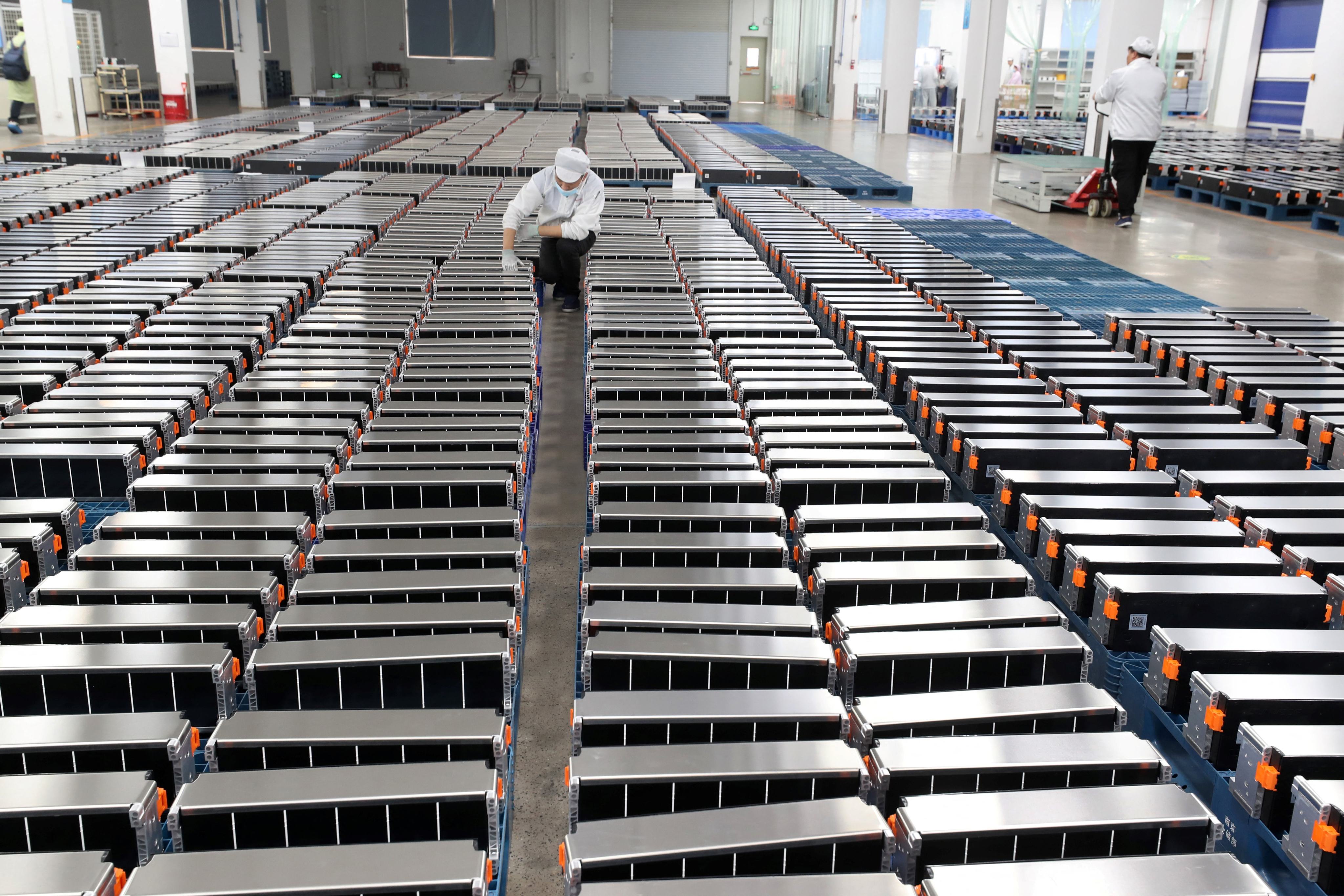
Beyond refining, China dominates battery cell manufacturing itself. CATL, which stands for Contemporary Amperex Technology Co. Limited and is headquartered in Fujian province, is the largest battery manufacturer in the world by a significant margin. Together with other Chinese manufacturers, China accounts for the majority of global lithium battery cell production. The LiFePO4 batteries that power solar systems in Nigeria, the cells assembled into packs by brands sold across West Africa, almost certainly contain cells manufactured in China or processed through Chinese supply chains.
This concentration of processing and manufacturing power gives China extraordinary influence over battery pricing globally. In October 2024, the United States State Department accused China of flooding the lithium market with supply to deliberately drive down prices and eliminate competition from producers outside China. The accusation was pointed: Chinese companies were willing to operate at low margins or losses because the strategic objective was to maintain dominance in the supply chain, not to maximise short-term profit from lithium sales.
China’s domestic lithium position is also strengthening rapidly. In early 2025, the China Geological Survey reported that the country’s total lithium reserves may exceed 30 million metric tons following a major geological survey that identified a 2,800 kilometre lithium belt in the country’s western regions, with proven reserves exceeding 6.5 million tons and potential resources far beyond that. If those figures are accurate, China’s lithium resource position would be fundamentally different from what the global mining industry has assumed for years.
For the Nigerian solar buyer, China’s dominance in processing and manufacturing means that the batteries available in the local market are almost entirely products of Chinese supply chains, regardless of the brand name on the box. This is neither good nor bad in itself. It simply means that anything that affects Chinese battery manufacturing, whether policy decisions, trade tariffs, energy costs, or raw material pricing, flows through to what batteries cost in Lagos, Port Harcourt, and Kano.
Africa’s Emerging Role
Most conversations about global lithium production focus on Australia, Chile, and China. Africa barely gets a mention. But that is changing faster than most people realise, and for Nigerians interested in the long-term direction of battery prices on the continent, what is happening in Zimbabwe right now is worth paying close attention to.
Zimbabwe’s lithium production numbers tell a remarkable story. In 2022, the country produced approximately 800 metric tons of lithium. By 2024, that figure had jumped to 22,000 metric tons, a nearly 27-fold increase in just two years. Year-on-year growth between 2023 and 2024 alone was 47 percent. Zimbabwe is now the fifth largest lithium producer in the world, having gone from almost nothing to a significant global player in an extraordinarily short period of time.
Zimbabwe’s lithium comes primarily from hard-rock spodumene deposits in Mashonaland West province, the same type of deposit that drives Australia’s production. Several large mining operations have come online in quick succession, backed predominantly by Chinese investment. The Arcadia lithium mine and the Bikita minerals operation are among the most significant, both of which have seen major capital injections and expansion programmes in recent years.
What makes Zimbabwe’s approach particularly interesting is a policy decision made in December 2022. The government banned the export of raw lithium ore, requiring that lithium extracted in Zimbabwe must be processed domestically into battery-grade material before it can leave the country. The reasoning was straightforward: Zimbabwe did not want to repeat the pattern of other resource-rich African nations that export raw materials cheaply and then pay a premium to import the finished products. By capturing the processing step, Zimbabwe aimed to build a more complete battery materials industry within its own borders and retain more of the economic value of its lithium resources.
Whether that ambition is fully realised remains to be seen. Processing lithium into battery-grade carbonate and hydroxide requires significant chemical infrastructure and technical expertise that takes years to develop. But the direction of travel is clear, and it signals a broader shift in how African governments are thinking about their lithium resources.
Beyond Zimbabwe, the Democratic Republic of Congo is beginning to attract attention for its lithium potential alongside its already dominant position in cobalt. Namibia has lithium deposits that are drawing exploration interest. Mali, Ghana, and other West African nations have geological surveys pointing to lithium-bearing formations that have not yet been fully characterised.
For Nigeria specifically, there is no significant domestic lithium production or refining capacity. Every lithium battery sold in Nigeria is imported, either as a finished product or assembled from imported cells. The 20 percent import duty the Nigerian government places on batteries adds directly to the cost Nigerian buyers pay, sitting on top of whatever the global market price for the underlying lithium is. As African lithium production grows and if continental processing capacity develops over the coming decade, there is a possibility that battery supply chains serving West Africa could shorten and become less dependent on China. That would have real implications for pricing and availability in the Nigerian market.
For now though, the most important thing to understand is that Africa sits on a significant share of the world’s lithium resources, and the continent is beginning to assert more control over how those resources are developed and who captures the value from them.
Why Lithium Prices Crashed and What Happened in Nigeria
In 2024, something dramatic happened in the global lithium market that made headlines in the energy industry but was barely felt by the average Nigerian solar buyer. The price of lithium carbonate collapsed by approximately 85 percent in the space of twelve months, falling from highs of over $80,000 per metric ton in late 2022 down to around $11,930 per ton by mid-2024. That is the lowest level since 2020 and one of the steepest commodity price drops in recent memory.
The cause was a classic oversupply problem. During 2021 and 2022, lithium prices had surged to extraordinary levels as EV demand exploded and battery manufacturers scrambled to secure supply. Mining companies and governments responded by approving and accelerating dozens of new lithium projects simultaneously. Australia expanded existing operations. New mines opened in Argentina. Zimbabwe ramped up rapidly. China increased domestic production. All of these projects came online within a relatively short window, flooding the market with more lithium than battery manufacturers could absorb at that pace of growth. Prices collapsed as supply outstripped demand.
For buyers of lithium batteries in Europe, North America, and parts of Asia, this price crash fed through into noticeably cheaper battery packs. The global average cost of a lithium-ion battery pack had been falling steadily for years, and the lithium price collapse accelerated that trend meaningfully. New solar installations in those markets became cheaper. EV prices came down. Energy storage projects became more financially attractive.
In Nigeria, the picture was very different. The global lithium price crash did not translate into meaningfully cheaper batteries for Nigerian buyers, and there are three specific reasons why.
The first is the naira devaluation. The most volatile period for the naira against the dollar occurred almost exactly when lithium prices were at their lowest globally. In February 2024, the naira was trading at over N1,800 to the dollar and heading toward N2,000. Batteries are priced and imported in dollars. When the naira weakens by 50 percent, a battery that got 30 percent cheaper in dollar terms can actually end up costing more in naira than it did before the price drop. The currency movement completely swallowed and in some cases reversed the benefit of the global price crash for Nigerian buyers.
The second reason is the 20 percent import duty the Nigerian government places on batteries. This duty applies to the full dollar value of the imported battery before naira conversion, meaning it amplifies the currency effect. Solar industry operators have been vocal about the damage this duty does to solar adoption in Nigeria, arguing that batteries are not luxury items but essential infrastructure for a country where grid power is unreliable. As of now the duty remains in place, adding roughly a fifth to the landed cost of every battery that enters the country.
The third reason is the structure of the Nigerian import and distribution chain. Most batteries sold in Nigeria pass through multiple layers of importers, distributors, and dealers before they reach the end buyer. Each layer adds a margin. In a market with genuine currency and import risk, those margins tend to be wider than in more stable markets, because dealers are pricing in the possibility that the next shipment will cost more to import than the current one. This makes the retail price of batteries in Nigeria structurally higher relative to the global price than it would be in a country with a stable currency and a simpler supply chain.
The practical result is that a 5.4kWh lithium battery in Nigeria was costing between N3 million and N3.5 million in mid-2024, compared with N2 million to N2.2 million in May 2023. The battery got more expensive in naira terms even as the global raw material price was crashing. That is the reality of how global commodity markets interact with local currency instability and import policy.
What This Means for You Going Forward
Understanding where lithium comes from is not just an academic exercise. It has direct, practical implications for anyone who owns a lithium battery system in Nigeria or is planning to buy one. The forces shaping global lithium supply today will determine what batteries cost here for the next decade and beyond.
The single most important trend to understand is that global lithium demand is not slowing down. It is accelerating. Benchmark Mineral Intelligence forecasts that demand from electric vehicles and energy storage systems alone will increase by more than 30 percent year-on-year through 2025 and continue growing through the end of the decade. Meeting that demand will require an estimated 150 new battery factories and over $116 billion in new investment by 2030. The world is in a race to secure lithium supply, process it, and manufacture it into cells fast enough to keep up.
What this means for prices is a two-sided picture. On one hand, the scale of investment flowing into lithium mining, processing, and battery manufacturing is enormous, and economies of scale tend to push costs down over time. The long-term trend for battery prices is downward, and that trajectory is expected to continue even if it slows from the steep drops of the past decade. On the other hand, the oversupply that caused the 2024 price crash is expected to narrow significantly.
Analysts projected that the global surplus would shrink from 84,000 to 33,000 metric tons through 2025 as some mining projects were scaled back or delayed in response to low prices. As demand continues growing and the surplus shrinks, lithium prices will stabilise and eventually recover.
For Nigeria specifically, the trajectory of battery prices depends on factors that go beyond the global commodity market. The naira exchange rate matters enormously, because batteries are priced in dollars. Any strengthening of the naira relative to the dollar makes imported batteries cheaper for Nigerian buyers without any change in the global price. Any further weakening makes them more expensive regardless of what happens to lithium globally. This is a risk that every Nigerian solar buyer carries and one that is very hard to hedge against at the individual level.
The import duty on batteries is a policy variable that could change. If the Nigerian government were to reduce or remove the 20 percent duty on lithium batteries, the immediate effect would be a meaningful reduction in the landed cost of every battery entering the country. Solar industry operators have been making this case consistently, and the argument is straightforward: cheaper batteries accelerate solar adoption, which reduces generator fuel consumption, which reduces foreign exchange outflows on fuel imports. Whether the government moves in this direction is a political question, but it is worth watching.
Africa’s growing role in lithium production is a longer-term development with potentially significant implications for the continent. If Zimbabwe and other African producers succeed in building domestic processing capacity, and if regional trade frameworks develop to the point where battery materials processed in Africa can be manufactured into cells on the continent, the supply chain serving West Africa could become shorter and less dollar-intensive over time. That is a decade-long story at minimum, not something that will change battery prices in Nigeria in the next two or three years, but it is the direction of travel.
The most practical takeaway for a Nigerian solar buyer today is this. The global forces that determine battery prices are largely outside your control. What you can control is how well you manage the battery you already have or the one you are about to buy. A battery that lasts 10 years because it was correctly installed, properly configured, and managed with the right BMS represents far better value than a cheaper battery that fails in three years and needs replacing at whatever the prevailing import price is at that time.
The connection between understanding where lithium comes from and how you manage your battery is direct. The same global dynamics that make batteries expensive to replace in Nigeria are also the reason that protecting the lifespan of your existing battery is one of the most financially sound decisions you can make.
Data note: Production and reserve figures in this post are sourced from USGS Mineral Commodity Summaries and reflect 2024 data. Lithium production statistics are updated annually — figures may shift as new mines come online.
FAQ
Which country has the largest lithium reserves in the world?
Chile holds the largest proven lithium reserves in the world, estimated at approximately 9.3 million metric tons as of 2024, roughly one-third of all economically extractable lithium on the planet. Almost all of Chile’s lithium sits in the Salar de Atacama, a vast salt flat in the northern Atacama Desert, where brine extraction has been operated commercially for decades by SQM and Albemarle.
Which country produces the most lithium?
Australia is the world’s largest lithium producer, mining approximately 88,000 metric tons in 2024, around 36.7% of global production. Australia’s lithium comes from hard-rock spodumene deposits in Western Australia, primarily from the Greenbushes mine, the largest hard-rock lithium mine in the world. Hard-rock mining scales faster than the brine evaporation process used in South America, which explains why Australia produces more despite holding smaller reserves than Chile.
Why does China control the lithium supply chain?
China dominates because it controls the refining and manufacturing steps that happen after lithium leaves the ground. The majority of the world’s mined lithium from Australia, Chile, and elsewhere is shipped to China for processing into battery-grade lithium carbonate or lithium hydroxide. Chinese companies also manufacture the majority of the world’s lithium battery cells, with CATL alone accounting for a significant share of global cell production. This processing and manufacturing dominance gives China pricing power over the finished battery market regardless of where the raw lithium was mined.
Does the global lithium supply chain affect battery prices in Nigeria?
Yes, directly. Almost all lithium batteries sold in Nigeria are manufactured in China or contain cells processed through Chinese supply chains. Anything that affects Chinese battery manufacturing, raw material costs, trade policy, energy prices, or production decisions flows through to retail battery prices in Lagos, Port Harcourt, and Kano. The lithium price crash of 2023–2024 was one reason LiFePO4 battery prices fell significantly in the Nigerian market during that period.
Is Africa becoming a major lithium producer?
Yes, particularly Zimbabwe. In 2022 Zimbabwe produced approximately 800 metric tons of lithium. By 2024 that figure had reached 22,000 metric tons, making Zimbabwe the fifth largest lithium producer in the world. The growth is driven by Chinese investment in hard-rock spodumene deposits in Mashonaland West province. Other African countries including the Democratic Republic of Congo, Namibia, and Mali are at earlier stages of lithium development. African lithium production is likely to grow significantly over the next decade.
Conclusion
Chile holds the most lithium in the ground. Australia digs up and ships the most every year. China processes, manufactures, and prices most of the world’s finished battery products. Zimbabwe and other African nations are emerging as increasingly significant players. And Nigeria sits at the end of this supply chain, importing finished batteries at prices shaped by all of these forces simultaneously, with the naira exchange rate and import duty adding a local premium on top of whatever the global market is doing.
None of this is abstract. Every time a Nigerian household or business buys a lithium battery for a solar system, they are participating in a global supply chain that stretches from the Atacama Desert in Chile to the mines of Western Australia to the processing plants and factories of China and increasingly to the spodumene deposits of Zimbabwe. The price on that battery reflects every step in that chain.
What you can do about it is limited at the policy level. At the personal level, the most powerful response is to buy the right battery once, install it correctly, configure it properly, and manage it in a way that ensures it lasts its full rated lifespan. That is where the real value protection happens, regardless of what the global lithium market does next.
I am Engr. Ubokobong Ekpenyong, a solar specialist and lithium battery systems engineer with over five years of hands-on experience designing, assembling, and commissioning off-grid solar and energy storage systems. My work focuses on lithium battery pack architecture, BMS configuration, and system reliability in off-grid and high-demand environments.
Contains information related to marketing campaigns of the user. These are shared with Google AdWords / Google Ads when the Google Ads and Google Analytics accounts are linked together.
90 days
__utma
ID used to identify users and sessions
2 years after last activity
__utmt
Used to monitor number of Google Analytics server requests
10 minutes
__utmb
Used to distinguish new sessions and visits. This cookie is set when the GA.js javascript library is loaded and there is no existing __utmb cookie. The cookie is updated every time data is sent to the Google Analytics server.
30 minutes after last activity
__utmc
Used only with old Urchin versions of Google Analytics and not with GA.js. Was used to distinguish between new sessions and visits at the end of a session.
End of session (browser)
__utmz
Contains information about the traffic source or campaign that directed user to the website. The cookie is set when the GA.js javascript is loaded and updated when data is sent to the Google Anaytics server
6 months after last activity
__utmv
Contains custom information set by the web developer via the _setCustomVar method in Google Analytics. This cookie is updated every time new data is sent to the Google Analytics server.
2 years after last activity
__utmx
Used to determine whether a user is included in an A / B or Multivariate test.
18 months
_ga
ID used to identify users
2 years
_gali
Used by Google Analytics to determine which links on a page are being clicked
30 seconds
_ga_
ID used to identify users
2 years
_gid
ID used to identify users for 24 hours after last activity
24 hours
_gat
Used to monitor number of Google Analytics server requests when using Google Tag Manager
1 minute
You can find more information in our Cookie Policy and .