
How to Size a Battery Bank for an Off-Grid Commercial Building
Commercial battery bank sizing is where solar engineers actually earn their fees.
Get it wrong on a residential job and you’ve got an unhappy customer whose battery died at 2am on one bad night. Annoying, but recoverable. Get it wrong on a commercial job and a bank can’t open because the ATMs are down, a pharmacy loses its cold chain by morning, or a factory shuts down because the inverter tripped on overload.
The stakes are in a completely different category. So is the methodology.
Commercial buildings don’t sit still the way a house does. Their load profiles are more complex, their uptime requirements leave almost no room for error, and there are critical loads on the circuit that simply cannot be shed, no matter what. On top of that, every specification decision has to hold up under procurement scrutiny. You need the numbers, the rationale, and the engineering logic documented at every step.
This guide walks through the full commercial battery bank sizing methodology, nothing skipped. You’ll get the load audit process for commercial buildings, an eight-step battery capacity formula with every calculation shown in full, inverter architecture selection, BMS specification for multi-pack systems, and a reference table covering typical specifications for common Nigerian commercial building types.
The worked example throughout this article is a 40-person medium-sized office in Lagos. Every step is shown so you can pull the numbers directly and adapt them to your own building.
How Commercial Sizing Differs From Residential
Residential battery sizing is primarily about covering overnight load. The calculation is relatively simple: measure or estimate daily energy consumption, divide by 80% DoD, convert to Ah at the system voltage, and round up to the nearest pack configuration.
Commercial sizing requires three additional considerations that residential sizing ignores.
Diversity Factors
Here is something most residential installers get wrong the first time they size a commercial job.
They add up every load on the audit sheet and use that number. In a house, that works fine. In a 40-person office it will burn your client’s budget on capacity that never gets used.
The reason is diversity. At any moment in that office, some computers are locked, some people are at lunch, one AC unit is in its off-cycle, the printer has been idle for an hour. The full connected load never runs all at once. For a typical commercial office, only 60 to 75% of connected loads are drawing power at peak. That ratio is your diversity factor, and it belongs in every commercial sizing calculation.
Leave it out and your numbers are wrong from step one.
IEC 60364-8-1 puts the diversity factor for office IT equipment at 0.70. Air conditioning runs 0.80 to 0.90 depending on zoning. ASHRAE 90.1 uses the same principle in its plug load and lighting methodology, and it’s the document commercial energy consultants pull out when a client asks them to justify the numbers.
Critical Load Separation
Not every load in a commercial building deserves the same treatment when the battery gets low.
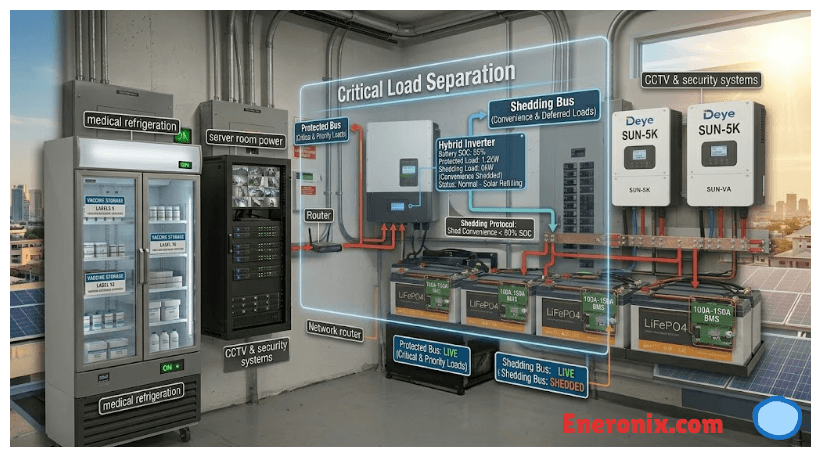
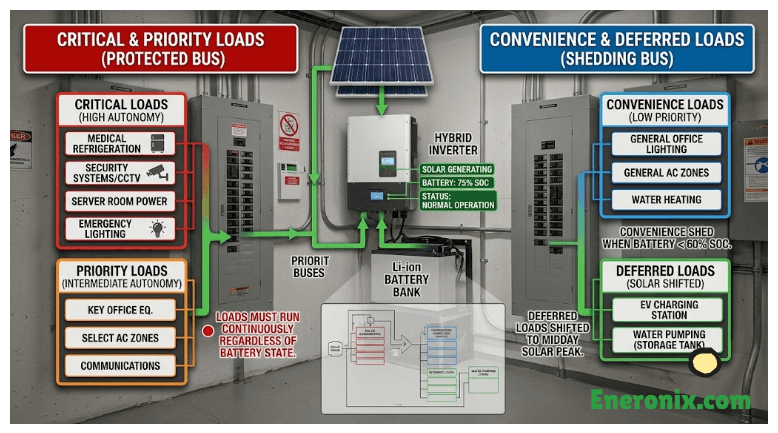
Medical fridges, security systems, server rooms, POS terminals – these cannot go offline. Full stop. You size the battery to keep them running for the entire autonomy period, even at minimum SOC. Everything else in the building is secondary to that.
Below critical loads you have priority loads. Main office equipment, key AC, comms. These run normally but they’re first to be shed if the battery starts dropping hard.
Then convenience loads. General lighting, non-essential AC zones, water heating, EV charging. These run when solar is up or the battery is above 60%. First off when load shedding starts.
Then deferred loads. Water pumping, charging stations, anything time-flexible. You don’t shed these, you shift them to the midday solar peak so they run off generation and never touch the battery.
The inverter architecture has to match this. Critical and priority loads on one protected bus, held up all the way to low-voltage cutoff. Convenience and deferred loads on a second bus, dropped earlier at a higher SOC threshold to protect what’s behind it.
Two buses. If you don’t separate them in the design, none of the load classification work above means anything on site.
Uptime Requirements and Autonomy
A residential system is typically sized for one night. The assumption is that generator backup is available if things run long and the solar doesn’t recover fast enough the next day.
Commercial buildings don’t get that flexibility. If you have customers on site, a retail floor running, or any kind of continuous operation, one night of autonomy is not enough. Most commercial jobs I size come out at 1.5 to 2 nights, with automatic generator integration on top of that for outages that stretch beyond what the battery bank alone can cover.
That autonomy figure is not a minor variable. It multiplies directly against your required battery capacity. The difference between 1 night and 2 nights is the difference between a 200kWh bank and a 400kWh bank. Get the autonomy requirement wrong in either direction and the whole sizing exercise is off.
If you want the residential baseline that this methodology builds on, the battery bank sizing guide for off-grid systems covers those calculations in full. The commercial additions described in this article sit on top of that foundation.
Step 1: The Commercial Load Audit
No audit, no sizing. You are guessing.
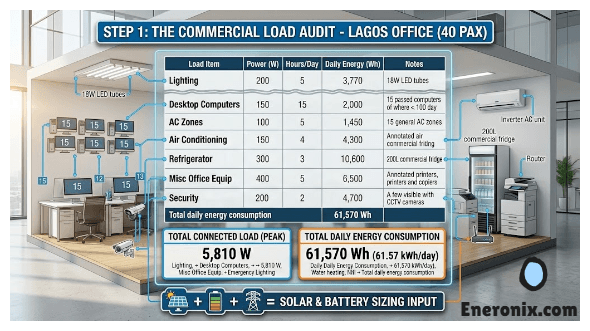
Walk the building. Every load, its wattage, hours per day. Two numbers come out: peak load in watts, daily energy in watt-hours. This whole article runs on those two numbers.
The Lagos office:
Lighting. 20 LED fittings, 18W each, 12 hours. 360W, 4,320Wh. Fluorescent tubes still in there? Replace them first.
Computers. 15 desktops, 150W each. 2,250W connected, but nobody is sizing for 15 people working flat out simultaneously. 70% diversity brings peak to 1,575W. Nine hours, 20,250Wh.
AC. Two 1.5HP inverter units, 1,100W running each, 2,200W combined, ten hours, 22,000Wh. HP is cooling output. You want the input power figure on the nameplate, not the HP.
Refrigerator. 200L commercial unit, 200W average, 24 hours, 4,800Wh. Cycling compressor means you use average load, not starting current.
Office equipment. Printers, copiers, the rest. 500W peak, six hours, 3,000Wh.
Security, CCTV, routers. 300W, 24 hours, 7,200Wh. Non-negotiable. On all night.
Peak load: 5,135 W. With 20% margin: 6,972W. Call it an 8kVA inverter. Daily energy: 61.57kWh. That is your starting point.
Residential audit process is in the 48V lithium battery sizing guide. in more detail. The commercial load audit follows the same methodology with the addition of diversity factors and load category classification.
The Eight-Step Battery Sizing Calculation
Let me be straight with you. Most of the battery bank sizing I see on Nigerian commercial sites is wrong. Not slightly off. Wrong. Either the installer eyeballed it, or they copied a spec from a residential job and scaled it up by feel. Then six months later the client is calling to complain that the system dies at 3am.
So here is how I actually do it.
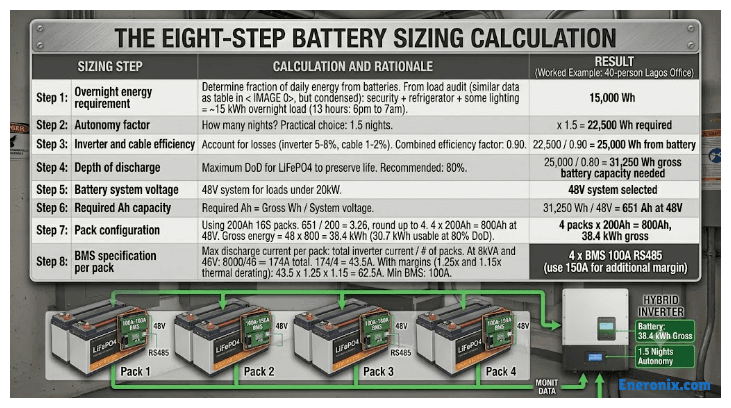
Step 1: Figure out what the battery is actually covering
Forget total daily load for now. That number does not tell you what you need.
What you need to know is: how much energy does this building burn when there is no sun and the generator is off? For most Lagos commercial buildings that window is 6pm to 7am. Thirteen hours. Solar is flat. If the gen is resting, everything runs on battery.
I went through the load audit on this 40-person office and added up what runs overnight: security, server room, refrigerator, some lighting. Came to about 15 kWh. That is my starting number.
Step 2: How many nights are you designing for?
My answer for commercial sites in Nigeria is almost always 1.5 nights. Not 2. People always want to say 2 but when they see what it does to the cost they come back to 1.5.
Two nights of autonomy means your bank is nearly double the size. And that extra capacity sits idle most of the year because NEPA comes back or the generator kicks in. For a building with a standby generator, 1.5 nights covers a rough weekend without burning money on steel you do not need.
15,000 x 1.5 = 22,500 Wh.
Step 3: Make room for losses
Energy leaves the battery, passes through cables, goes through the inverter, and some of it disappears as heat along the way. Inverter losses run 5 to 8%. Cable losses add another couple of percent if your wiring is sized right, more if it is not.
I use 0.90 as my combined efficiency factor. That is what a real installation delivers.
22,500 / 0.90 = 25,000 Wh the battery bank must actually push out.
Step 4: Depth of discharge
LiFePO4 can go to zero. Do not do that to a commercial bank you want running in year seven.
I use 80% DoD for daily cycling. This means your installed capacity has to be bigger than what you are planning to use. You are buying yourself cycle life, not wasting capacity.
25,000 / 0.80 = 31,250 Wh gross.
Step 5: Pick your voltage
If the site is under 20 kW. 48V. Simple.
Above 15 to 20 kW you need to sit down and think about 96V or 120V seriously, because at 48V your DC currents get large and your cables and busbars get expensive and hot.
Step 6: Convert to Ah
Wh/Voltage
31,250 / 48 = 651 Ah.
Step 7: Choose your packs
I am using 16S 200Ah LiFePO4 packs. Most available format in the market here, pricing is reasonable, spare parts when something fails are not a six-week import wait.
651 / 200 = 3.26. Round up. I have never once rounded down on a battery bank and I never will.
4 packs x 200 Ah = 800 Ah. Gross energy 38.4 kWh. Usable at 80% DoD is 30.7 kWh.
That 5.7 kWh above the requirement is not padding. That is the conference room AC that someone left running. That is the security guard who plugged in a hotplate. Commercial loads never come out as clean as the audit.
Step 8: Spec the BMS properly
This is the one step where I see the most shortcuts taken and the most failures result from it.
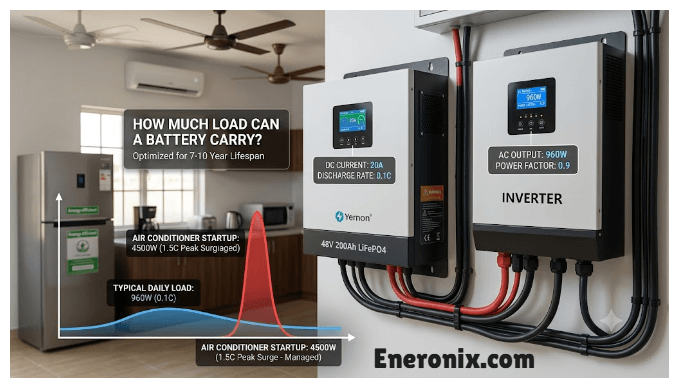
8 kVA inverter, battery at 46V during discharge, not 48V nominal, actual operating voltage. 8,000 / 46 = 174A total from the bank. Across 4 packs that is 43.5A each.
Then margins. 125% for surges and startup spikes. 15% thermal derating because your battery room is not air conditioned and it is hot in there. 43.5 x 1.25 x 1.15 = 62.5A. Minimum BMS 100A per pack.
I put 150A JK BMS RS485 units on this job. The RS485 is not optional for a commercial site. You need monitoring, you need to know what each pack is doing, and you need that data at 2am when something trips without having to go stand in the battery room in the dark.
Final answer
4 x 16S 200Ah LiFePO4 at 48V. 38.4 kWh gross, 30.7 kWh usable. Covers 1.5 nights at 15 kWh with 2.7 kWh left over.
All of it traces back to the load audit. Change those numbers and the bank size changes with them. That is why you do not skip the audit
Inverter Sizing for Commercial Buildings
Inverter and Battery Bank: They Are Sized Together
These two are not independent decisions. The inverter has to handle your peak load. The battery bank has to back that inverter for however long you need it to run. You cannot size one without the other sitting on the table in front of you.
On this Lagos office the peak load calculation looks like this. Computers get a 70% diversity factor because not every machine is hammering full draw at the same time. Everything else runs at face value.
360 + (2,250 x 0.7) + 2,200 + 200 + 500 + 300 = 5,035W
Add a 20% safety margin: 5,035 x 1.2 = 6,042W. That lands you on an 8 kVA inverter.
For a more thorough walkthrough of how to pick and size the inverter itself, the full method is in our guide on how to select an off-grid inverter and how to size an off-grid solar system for commercial buildings.
BMS and Cable Rating
Once you have the inverter size, the BMS current rating follows directly from it. This is not a separate calculation you do later. Do it now.
The number that matters is maximum DC current at minimum battery voltage, not nominal. At near-UVP the battery is sitting around 46V, not 48V. Use 46V.
8,000 / 46 = 174A total from the bank. Across 4 packs in parallel: 43.5A per pack.
Apply the margins. 125% for surges. 15% thermal derating for Nigerian ambient conditions.
43.5 x 1.25 x 1.15 = 62.5A. Minimum BMS per pack is 100A. I prefer 150A on commercial jobs for the thermal headroom.
Your cables have to be sized for 174A on the DC side as well. People remember the BMS and forget the cables. Do not do that.
The full BMS sizing method with worked examples across multiple inverter sizes is in our article on how to size a BMS correctly.
One more thing worth saying: if there is any chance this installation gets a larger inverter in future, size the BMS for that future inverter now. Swapping out BMS units after the bank is installed and cabled is a painful job. The cost difference between a 100A and 150A BMS at purchase is small. The cost of doing it twice is not.
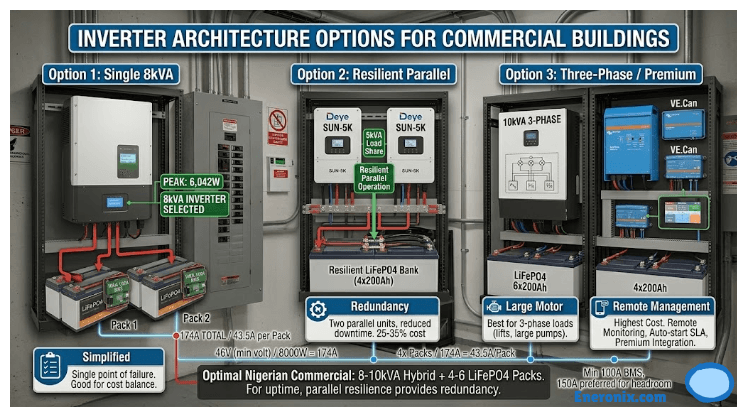
Inverter Architecture Options for Commercial Buildings
Which Architecture Actually Makes Sense for Your Building? There is no universal answer. What works for a five-person accountancy firm in Ikeja is not what I would specify for a 40-person office with a server room and a facilities team. It comes down to two questions: what can this building tolerate when something fails, and what is the client actually willing to pay for.
Here are the four configurations I see and specify regularly on Nigerian commercial sites.
Single 8 kVA inverter + 4 x 200Ah packs.
Most sites I visit end up here and most of them should. One inverter, one brain, manages everything. Commissioning is straightforward. When something goes wrong at 11pm you are not tracing faults across parallel equipment. The facilities manager understands it. The electrician who services it in three years understands it.
The weakness is obvious. That inverter goes down, the building goes down with it. On most Nigerian commercial sites that is not the crisis it sounds like because the generator is sitting right there. The battery system is not the last line of defence, it is one layer of a hybrid setup. Single point of failure on the inverter is a real risk but a manageable one for most clients.
If your client has no generator and genuinely cannot afford downtime, do not sell them this architecture and then hope for the best.
Two 5 kVA inverters in parallel + 4 x 200Ah packs
One inverter trips. The other one keeps the building running at reduced capacity. The lights stay on, the servers stay up, you get a call in the morning instead of a panic at midnight.
That is the pitch and it is a good one for the right client. The cost is real though. You are looking at 25 to 35% more than the single inverter option by the time you factor in the second unit and the parallel commissioning work. And not every inverter on the market actually supports parallel operation properly. The Deye SUN-5K does and you can get it here without a six-week wait. Confirm parallel support before you quote, not after.
For a building with no generator and a real uptime requirement, this is where I go.
10 kVA three-phase inverter + 6 x 200Ah packs
I will say this plainly. Most of the three-phase inverter specifications I have reviewed on Nigerian commercial sites did not need to be three-phase. The building had a three-phase supply so someone assumed the system had to match it. That is not how it works.
Three-phase is the right call when you have loads that genuinely need it: pumps, lifts, large motors, industrial equipment. For those loads it is more efficient and in some cases the only option that makes sense. For a building full of computers, lights and split-unit ACs, it is extra capital cost and extra cable complexity solving a problem that does not exist.
Pull out the load schedule before you specify. If the heavy loads are single-phase, stay single-phase.
Victron Multi + Cerbo GX + 4 x 200Ah packs
This is the top of the range and it justifies the cost in specific situations, not all of them.
Full VE.Can BMS integration, VRM remote monitoring, generator auto-start, proper load management and data logging. If you are a system integrator managing multiple sites remotely, or your client has a formal uptime SLA with their generator provider, or the system is complicated enough that you need real data to diagnose faults without driving to site, Victron earns its price tag.
If your client is a business owner who wants to cut diesel spend on a straightforward installation, Victron is probably solving problems they do not have yet. Sell them what the job needs.
For most Nigerian commercial buildings in the 5 to 15 kVA range I land on a single 8 to 10 kVA hybrid inverter with 4 to 6 parallel LiFePO4 packs. Right balance of cost, simplicity and performance for the majority of sites I work on.
Once you go above 15 kVA the high-voltage architecture conversation becomes worth having properly, because the DC current reduction starts to show up in your cable sizing and your heat numbers in a way that affects the economics. We cover that in detail in our article on high voltage vs low voltage inverters.
Multi-Pack BMS Architecture for Commercial Systems
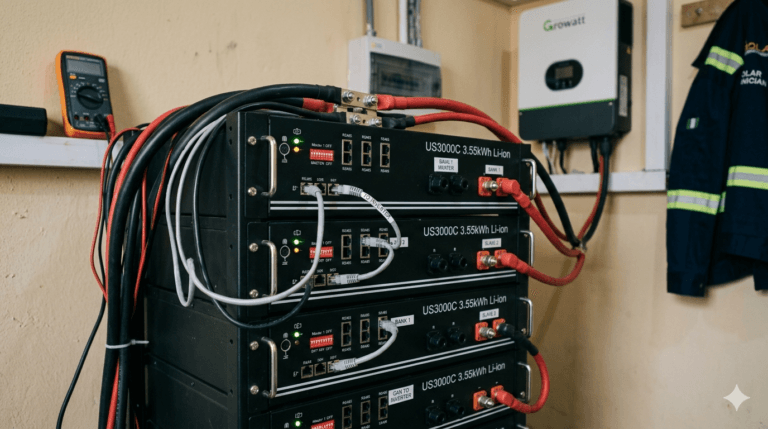
A commercial battery bank with 4 to 8 packs requires a multi-pack BMS architecture. The key decisions are: which BMS brand, how many packs per inverter, and how the BMS communicates aggregate data to the inverter. Read our article on Master-Slave BMS Architecture Explained: 7 Critical Facts for Multi-Pack Solar Systems all you need has been covered here!
BMS Specification for Commercial Multi-Pack
For Nigerian commercial installations with Deye, Growatt, or Solis inverters:
- Use JK BMS active balancer 16S, RS485 variant, rated at 150A or 200A per pack depending on the per-pack current calculation above.
- Configure Pack 1 BMS as RS485 master (address 1). Configure all other packs as RS485 addresses 2, 3, etc.
- Connect Pack 1 RS485 to the inverter. Monitor other packs via Bluetooth.
- Configure identical protection thresholds on all packs: OVP 3.65V, UVP 2.80V, charge OTP 50 degC, balance threshold 10mV, balance current 2A.
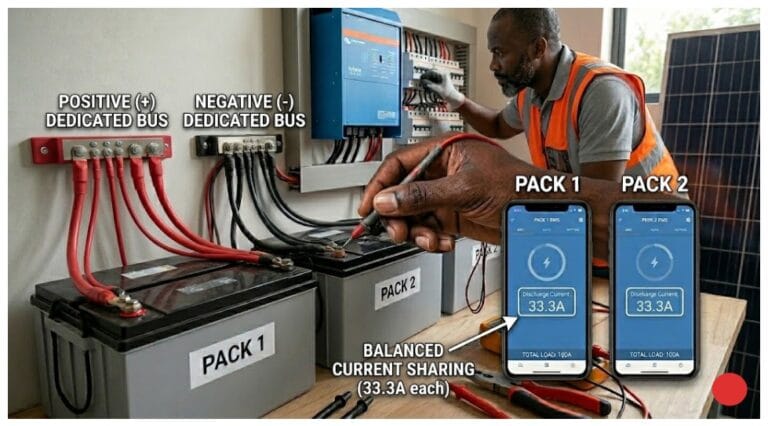
- Verify equal cable lengths from all pack P+ terminals to the common positive bus. Verify current sharing within 15% between all packs under representative load after commissioning.
Fuse Architecture for Commercial Multi-Pack
Each pack needs its own individual ANL fuse between the cell B+ terminal and the BMS B+ terminal. For a 150A BMS per pack: 200A ANL fuse per pack. The main bus fuse on the combined bus-to-inverter cable must be rated for the combined maximum current: for 4 x 150A BMS = maximum 600A combined, use 600 to 800A Class T fuse on the main bus.
The complete fuse sizing methodology and the distinction between individual pack fuses and the main bus fuse is in our article on busbar sizing, cable sizing, and fuse selection for LiFePO4 battery packs. For commercial installations, Class T fuses are preferred over ANL for the main bus fuse due to their higher DC interrupt rating.
Solar Array Sizing: How Much Solar Do You Need to Refill the Battery Daily?
Sizing the Solar Array
The battery stores energy. The solar array has one job: put back what the battery spent overnight and cover the daytime load on top of that. If the array is undersized, you are running a diesel generator to make up the shortfall every afternoon. That is not a solar system, that is a solar-assisted generator system, and your client will notice the difference on their fuel bill.
The daily solar requirement is straightforward. Overnight discharge plus daytime load. For this building that is 15 kWh overnight plus 46.57 kWh across nine hours of office operation. Total: 61.57 kWh per day the array needs to account for.
Now apply Lagos conditions. Average peak sun hours on a south-facing commercial rooftop here runs 4.5 to 5.5 hours per day depending on season and shading. I use 5 hours as my working figure. Then apply a 15% system loss factor for wiring losses, soiling, temperature derating and inverter inefficiency. These losses are real and if you ignore them your array will underperform from day one.
61.57 / (5 x 0.85) = 14.5 kWp
For a commercial building targeting 80% solar coverage of total daily energy, 14 to 16 kWp with appropriate MPPT charge controllers is the right specification. The IEA-PVPS Task 16 report on commercial PV sizing puts a practical heuristic at 1 to 1.2 kWp of solar per kWh of daily battery recharge requirement. This building’s overnight recharge requirement is 15 kWh, which puts you at 15 to 18 kWp by that rule of thumb. The calculated 14.5 kWp sits comfortably within that range.
One thing worth saying clearly: the array size and the MPPT charge controller are not independent decisions. The controller has to match both the array voltage and current to what the battery bank and inverter expect. Get that wrong and you are either clipping solar production or stressing the battery. The full MPPT sizing methodology for this type of system is in our hybrid solar system commissioning checklist, specifically Stage 2 of the commissioning protocol.
Reference Sizing Table:
Use this table as a starting point for common commercial building types. Every actual installation requires a full load audit to validate these estimates against the specific building’s actual loads.
| Building Type | Typical Daily Energy | Inverter | Battery Bank | Notes |
| Small office (10 to 15 staff) | 5 to 8 kWh/day | 1 x 5kVA inverter | 2 x 200Ah packs (20.48 kWh gross, 16.4 kWh usable) | Overnight essentials plus some daytime supplementation from solar. |
| Medium office (25 to 40 staff) | 15 to 25 kWh/day | 1 x 8kVA inverter | 4 x 200Ah packs (38.4 kWh gross, 30.7 kWh usable) | Full overnight load plus 1.5 nights autonomy. |
| Retail shop (mixed loads) | 20 to 35 kWh/day | 1 x 10kVA inverter | 5 x 200Ah packs (48 kWh gross, 38.4 kWh usable) | Covers air conditioning, refrigeration, lighting, POS terminals. |
| Clinic or pharmacy | 25 to 45 kWh/day | 2 x 8kVA parallel | 6 x 200Ah packs (57.6 kWh gross, 46 kWh usable) | Critical medical refrigeration and lighting sized for full 2-night autonomy. |
| Bank branch | 40 to 70 kWh/day | 2 x 10kVA parallel | 8 to 10 x 200Ah packs | ATMs, server rooms, security systems, full air conditioning. |
| Filling station office | 15 to 30 kWh/day | 1 x 8kVA inverter | 4 x 200Ah packs | Forecourt lighting, office, POS, CCTV. Fuel pumps usually on separate generator circuit. |
ALWAYS DO THE LOAD AUDIT
These reference values are starting points only. A 40-person office in Lagos with inverter air conditioning and a server room has a very different load profile from a 40-person office with ceiling fans and no server infrastructure. The load audit is not optional for commercial sizing. Using reference values without verification leads to systems that are either oversized (wasting capital) or undersized (failing to meet the customer's uptime requirements).
Generator Integration for Commercial Systems
Most Nigerian commercial buildings have an existing generator. The battery bank is not a replacement for the generator in most commercial applications. It is a complement: the battery handles the regular daily cycling and eliminates fuel consumption for the predictable overnight load, while the generator handles extended outages beyond the battery’s autonomy period.
The integration design determines which loads are powered by which source and under what conditions the generator starts. A well-designed commercial hybrid system:
- Solar charges the battery and supplies loads directly during solar production hours.
- Battery powers the building overnight and during periods of low solar production.
- Generator starts automatically when battery SOC drops below a configured threshold (typically 20 to 25%) and either charges the battery while running or takes the full load directly.
- Generator stops when battery is recharged to a configured level (typically 70 to 80%) or when solar production resumes.
This automatic generator integration is a standard feature on Deye SUN-xK-SG inverters (configuration in the inverter’s generator settings menu), Growatt SPH series, and Victron MultiPlus systems. Correct configuration of the generator start and stop SOC thresholds directly affects fuel consumption. A generator that starts at 25% SOC and stops at 80% SOC runs less than one that starts at 40% and stops at 100%.
For the complete generator integration commissioning procedure including SOC threshold configuration and auto-start wiring, our hybrid solar system commissioning checklist includes generator integration as Stage 8 of the 10-stage commissioning protocol.
The Lifecycle Cost Analysis
Everything above is engineering. What your client is waiting for is: how long before I get my money back.
A medium Lagos office running a generator 10 to 14 hours a day is spending 400,000 to 600,000 naira a month on diesel. I have seen the receipts. That is up to 7.2 million naira a year going into a tank with nothing to show for it.
A correctly sized solar battery system cuts that generator to 2 to 4 hours daily in the rainy season. Dry season, on a good site, it barely runs at all. Conservative annual saving: 3 to 4.5 million naira.
The system I have been sizing through this article costs approximately 5 to 7.5 million naira installed. Payback: 1.2 to 2.5 years from fuel savings alone, before you count reduced maintenance or the productivity hours lost every time the generator refuses to start.
If your client wants independent benchmarking data that did not come from the person selling them the system, the Nigerian Energy Support Programme has published commercial solar ROI analyses for Nigerian SME applications. Reports are at nespoilgas.com.
One caveat. Those payback numbers assume the system actually delivers for its full lifetime. Under-specified systems do not. The financial case and the engineering case are the same case. We cover what happens when the engineering is wrong in our article on why most solar battery systems fail before year 2.
Frequently Asked Questions
How do I calculate the battery size I need for a commercial building?
The calculation follows eight steps: (1) Complete a load audit listing every electrical load, its wattage, and daily hours of use. Sum to get total daily energy in kWh. (2) Determine the overnight or critical load that must run from battery. (3) Multiply by the autonomy period in days (typically 1 to 1.5 for commercial). (4) Divide by combined inverter and cable efficiency (0.90 typical). (5) Divide by the maximum depth of discharge (0.80 for daily cycling). (6) Divide by system voltage (48V for systems under 20kW). (7) Divide by single pack Ah rating to get pack count. Round up to nearest whole number. (8) Verify the BMS and inverter current ratings match the sized configuration.
What inverter size do I need for a commercial building off-grid system?
The inverter must handle the peak simultaneous load with margin. Sum all loads that could run simultaneously. Apply a 70 to 80% diversity factor for office and retail loads (not all loads run at peak simultaneously). Add 20 to 25% safety margin to the result. For a 40-person office in Nigeria, peak simultaneous load is typically 6 to 10 kVA depending on air conditioning density. An 8 to 10 kVA inverter covers most medium commercial buildings. For buildings with large motor loads (industrial compressors, lifts, large pumps), the inverter must also handle the motor starting current which is typically 3 to 7 times the running current for the first few seconds.
How many battery packs do I need for a 10kVA commercial off-grid system?
For a 10kVA inverter at 48V with 1.5 nights autonomy: maximum DC current = 10,000 / 46V = 217A. For 1.5 nights of 15 kWh overnight load: gross battery capacity = 15 x 1.5 / 0.90 / 0.80 = 31.25 kWh. At 48V: 31,250 / 48 = 651 Ah. Using 200Ah packs: 651 / 200 = 3.26, round up to 4 packs. Each pack’s BMS current: 217 / 4 = 54A per pack. BMS minimum: 54 x 1.25 x 1.15 = 78A. Use 100A or 150A BMS per pack.
Should I use 48V or high-voltage (96V/120V) for a commercial building?
For buildings under 20kW of solar and battery capacity, 48V is standard and has the best availability of compatible inverters, BMS units, and cells in the Nigerian market. For buildings above 15 to 20kW, high-voltage systems (96V or 120V) become worth evaluating because they reduce DC current significantly, which reduces cable cross-section requirements and MOSFET stress in the BMS. A 20kW system at 48V draws 417A DC at full load. The same 20kW at 96V draws only 208A. The cable and BMS savings at high voltage become significant at this scale. Consult our article on high voltage vs low voltage inverters for the full comparison.
What is the difference between sizing for a residential and a commercial building?
Three key differences. First, commercial buildings have more complex load profiles with diversity factors, shift-based usage patterns, and critical versus non-critical load categories that residential sizing ignores. Second, commercial buildings often require higher uptime guarantees, which changes the autonomy calculation from 1 night (residential) to 1.5 to 2 nights with generator backup integration. Third, commercial systems are typically sized to handle growth: a well-designed commercial battery bank should have 20 to 30% headroom above the calculated requirement to accommodate new equipment additions without immediate system expansion.

I am Engr. Ubokobong Ekpenyong, a solar specialist and lithium battery systems engineer with over five years of hands-on experience designing, assembling, and commissioning off-grid solar and energy storage systems. My work focuses on lithium battery pack architecture, BMS configuration, and system reliability in off-grid and high-demand environments.