
Deep Cycle vs Lithium Battery Runtime
Quick Answer:
At 48V 200Ah same voltage, same capacity a LiFePO4 delivers roughly 6,912 Wh usable versus about 4,080 Wh from a deep cycle tubular lead-acid. That’s 69% more runtime from the same-rated battery. But here’s the thing most comparison articles miss: when most Nigerian buyers upgrade from 12V lead-acid to 48V lithium, stored energy quadruples because of the voltage change, not because of the chemistry. Those two effects need to be kept separate, and this article does that.
Every week in solar shops across Nigeria, someone walks in asking about batteries. The salesman shows two options a tubular deep cycle at one price, lithium at nearly double. The customer asks if lithium is worth it. And the salesman either oversells it by conflating chemistry gains with voltage architecture gains, or undersells it by comparing a 12V lead-acid to a 48V lithium as if they’re equivalent systems.
Neither conversation is honest. This one will be. Same voltage, same Ah, different chemistry let the numbers speak.
This article provides that comparison. Same voltage. Same Ah. Different chemistry. The runtime difference between deep cycle lead-acid and LiFePO4 lithium is real, significant, and driven by specific measurable factors. Understanding those factors is what separates a buyer who makes the right decision from one who overpays for a system they did not need or buys the wrong battery for a situation where the cheaper option was adequate.
Calculation methodology:
All runtime figures use: Usable Wh = Voltage x Ah x DoD x Inverter Efficiency (90%). For LiFePO4: DoD = 80%. For deep cycle lead-acid: DoD = 50%. These limits protect cycle life in both chemistries. Figures consistent with the full methodology in our battery backup time formula guide.
What ‘Deep Cycle’ Actually Means and Why It Matters
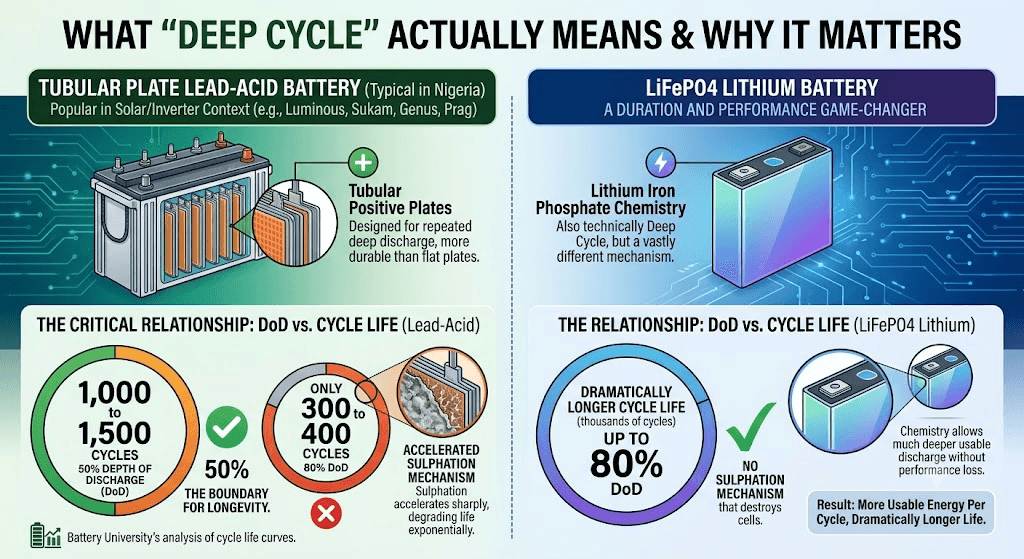
The term gets thrown around loosely in Nigerian solar shops. Deep cycle just means any battery built for repeated, significant discharge as opposed to a car starter battery that delivers one big current burst and immediately recharges. In the Nigerian inverter market, deep cycle almost always means tubular plate lead-acid. Luminous, Sukam, Genus, Prag, the locally assembled units with hand-painted labels all tubular lead-acid.
The key characteristic of tubular deep cycle lead-acid batteries is their cycle life rating, typically 1,000 to 1,500 cycles at 50% depth of discharge. The 50% DoD limit is not a suggestion. It is the boundary above which sulphation accelerates sharply and cycle life degrades exponentially. A tubular battery regularly discharged to 80% DoD may achieve only 300 to 400 cycles before its capacity falls below 80% of original. Battery University’s cycle life analysis for lead-acid batteries provides the depth-versus-cycle-life curves that demonstrate this relationship clearly.
LiFePO4 lithium batteries are also technically deep cycle batteries. But their chemistry allows a much deeper usable discharge, up to 80% DoD, without the sulphation mechanism that destroys lead-acid cells. The result is more usable energy per charge cycle and dramatically longer cycle life at that depth.
Deep Cycle vs Lithium Battery Runtime Comparison
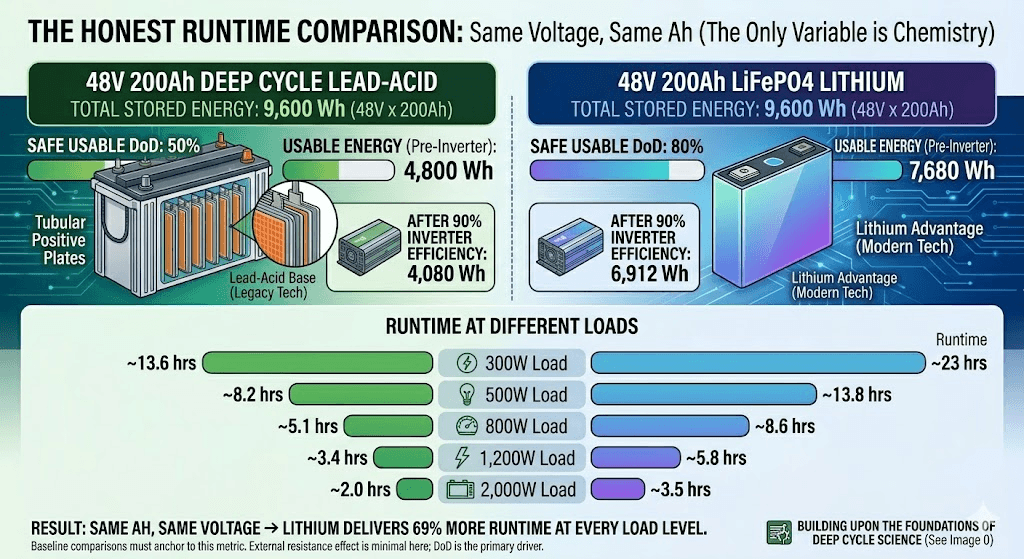
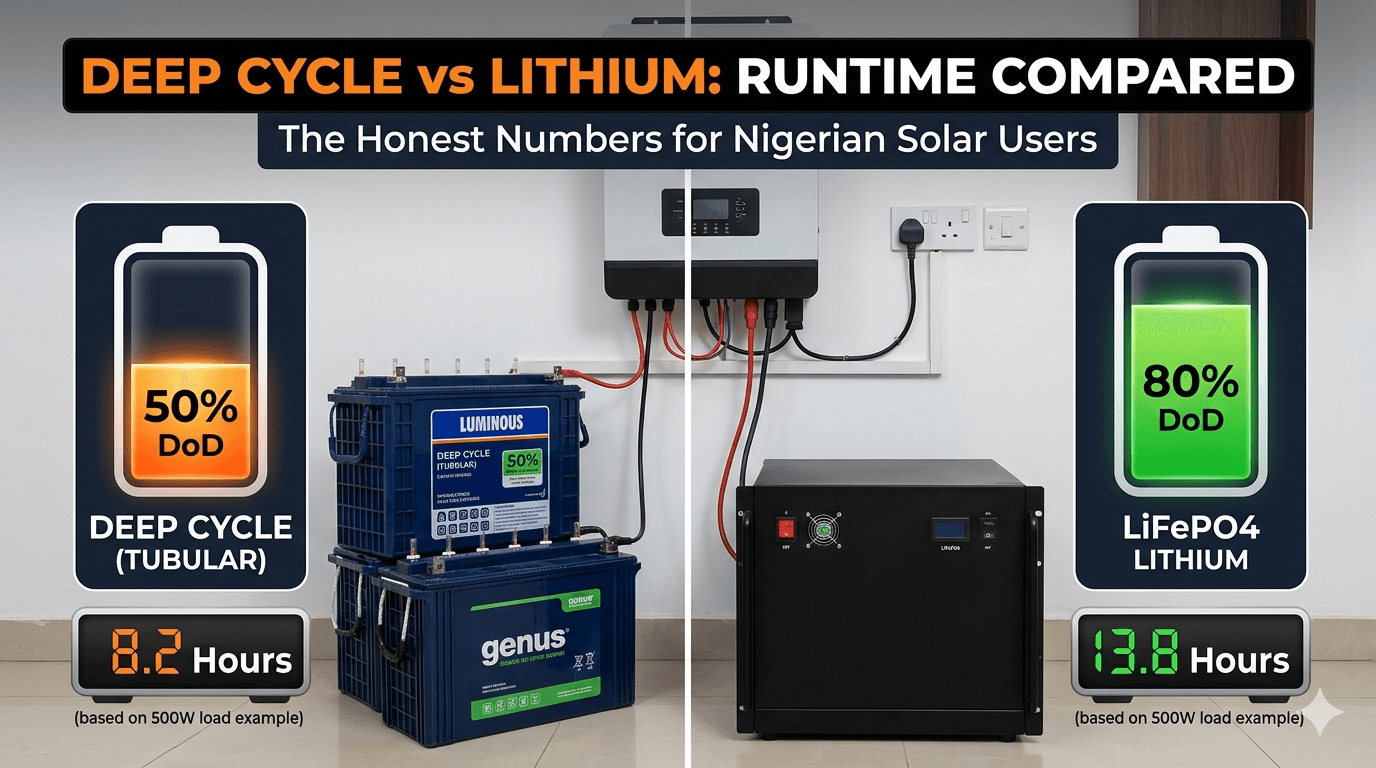
This is the comparison that matters. Both systems at 48V and 200Ah store exactly the same total energy (9,600 Wh). The only variable is chemistry and the usable depth of discharge that each chemistry safely allows.
| Specification | 48V 200Ah Deep Cycle Lead-Acid | 48V 200Ah LiFePO4 Lithium |
| Total stored energy | 9,600 Wh | 9,600 Wh |
| Safe usable DoD | 50% | 80% |
| Usable energy (pre-inverter) | 4,800 Wh | 7,680 Wh |
| After 90% inverter efficiency | 4,080 Wh | 6,912 Wh |
| Runtime at 300W load | ~13.6 hrs | ~23 hrs |
| Runtime at 500W load | ~8.2 hrs | ~13.8 hrs |
| Runtime at 800W load | ~5.1 hrs | ~8.6 hrs |
| Runtime at 1,200W load | ~3.4 hrs | ~5.8 hrs |
| Runtime at 2,000W load | ~2.0 hrs | ~3.5 hrs |
At the same 48V system voltage and same 200Ah rating, LiFePO4 delivers 69% more runtime than deep cycle lead-acid at every load level. This is the genuine chemistry advantage and it comes entirely from two sources: the higher safe depth of discharge and the lower internal resistance of lithium cells that wastes less energy as heat during discharge.
What Most Nigerian Buyers Are Actually Comparing
The comparison above is the honest chemistry test. But it is not what most Nigerian buyers are actually comparing when they ask about deep cycle vs lithium. Most are comparing their existing 12V or 24V lead-acid setup with a new 48V lithium system. The voltage changes alongside the chemistry, and the two effects must be separated.
A 12V 200Ah system stores 2,400 Wh total. A 48V 200Ah system stores 9,600 Wh total. The fourfold energy difference accounts for 75 to 80% of the runtime gap in this table. The remaining 20 to 25% is the chemistry advantage. Both are real benefits, but they should not be conflated.
| Load | 12V 200Ah Deep Cycle Lead-Acid (1,080 Wh usable) | 48V 200Ah LiFePO4 (6,912 Wh usable) | Primary Source of Gap |
| 200W | ~5.4 hrs | ~34.6 hrs | Mostly voltage (4x energy) |
| 400W | ~2.7 hrs | ~17.3 hrs | Mostly voltage (4x energy) |
| 600W | ~1.8 hrs | ~11.5 hrs | Mostly voltage (4x energy) |
| 1,000W | ~1.1 hrs | ~6.9 hrs | Mostly voltage (4x energy) |
| 1,500W | ~0.7 hrs | ~4.6 hrs | Mostly voltage (4x energy) |
When a Nigerian homeowner upgrades from a 12V 200Ah tubular battery to a 48V 200Ah LiFePO4 and their backup time improves from 2.7 hours to 17.3 hours at 400W, the lithium chemistry is responsible for approximately 4 of those extra hours. The voltage architecture change from 12V to 48V is responsible for the other 10.6 hours.
This changes how you think about the upgrade. If you’re on 24V lead-acid and thinking about moving to 48V lithium, understand that a straight 24V-to-48V change alone staying on lead-acid would give you roughly half the runtime improvement before any chemistry benefit enters the picture.
The Five Differences That Change the Total Picture
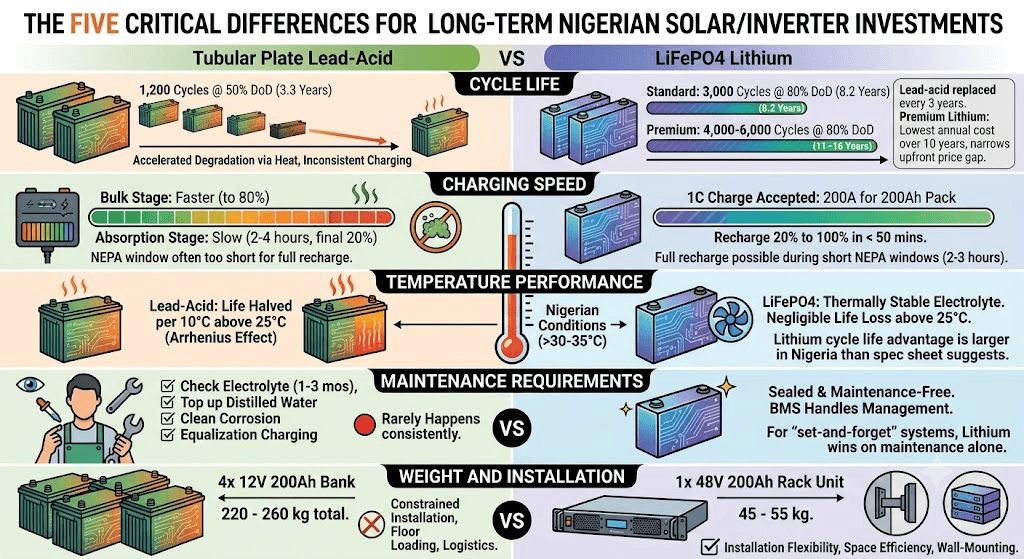
Runtime per charge is one metric. For a Nigerian household making a 5 to 10 year system investment, there are four other differences that are equally important to the decision.
1. Cycle Life: How Many Times You Can Repeat Those Hours
A tubular deep cycle lead-acid battery rated for 1,200 cycles at 50% DoD will reach the end of its useful life after approximately 1,200 full charge-discharge cycles. At one cycle per day, that is 3.3 years. In practice, many Nigerian lead-acid batteries degrade faster due to heat, inconsistent charging, and occasional deep discharge violations.
A quality LiFePO4 battery rated for 3,000 cycles at 80% DoD lasts approximately 8.2 years at one cycle per day. Premium cells from manufacturers like CATL and Eve Energy carry cycle life ratings of 4,000 to 6,000 cycles, extending potential service life to 11 to 16 years.
| Battery Type | Cycle Life Rating | DoD at Rating | Years at 1 Cycle/Day | Annual Cost (200Ah 48V) |
| Deep cycle tubular lead-acid | 1,000 to 1,500 cycles | 50% | 2.7 to 4.1 years | Higher per year |
| Standard LiFePO4 | 2,000 to 3,000 cycles | 80% | 5.5 to 8.2 years | Moderate per year |
| Premium LiFePO4 (CATL, Eve) | 4,000 to 6,000 cycles | 80% | 11 to 16 years | Lowest per year |
The annual cost calculation consistently favours lithium once the full replacement cycle is accounted for. A lead-acid battery replaced every 3 years costs more over 10 years than a lithium battery purchased once and maintained correctly. The upfront price gap narrows significantly when viewed over the investment horizon.
2. Charging Speed: How Quickly You Recover After an Outage
Deep cycle lead-acid batteries charge in two stages: bulk and absorption. The absorption stage, where the battery goes from approximately 80% to 100% SoC, is slow. It can take 2 to 4 hours for the final 20% of capacity. Pushing more current during absorption causes gassing and electrolyte loss. Lead-acid cannot be fast-charged without damage.
LiFePO4 batteries accept up to 1C charge current continuously without damage. A 200Ah LiFePO4 can accept 200A of charge current, recovering from 20% to 100% SoC in under 50 minutes with a sufficiently sized charger or solar array. CATL and Eve Energy both specify continuous charge rates of 0.5C to 1C in their cell datasheets without capacity degradation meaning a 200Ah pack can accept 100A to 200A continuously. In Nigeria, where a NEPA window might last 2 to 3 hours before disappearing again, being able to fully recharge in that window is not a minor advantage. Lead-acid will still be sitting in absorption stage when the power goes again.
3. Temperature Performance in Nigerian Conditions
Nigerian ambient temperatures regularly exceed 30 to 35 degrees Celsius. Lead-acid batteries suffer meaningfully in these conditions: every 10 degrees Celsius above 25 degrees Celsius approximately halves the battery’s service life according to the Arrhenius equation applied to electrochemical degradation, as documented by the Battery Council International. A lead-acid battery in a 35 degree Celsius Lagos environment ages roughly twice as fast as the same battery in a 25 degree Celsius European test lab.
LiFePO4 is significantly more tolerant of high temperatures. Its electrolyte is more thermally stable, and its cycle life degrades much less aggressively above 25 degrees Celsius. The practical implication: in Nigerian conditions, the cycle life advantage of lithium is even larger than the specification sheet suggests, because the lead-acid numbers were measured at 25 degrees Celsius and will not be achieved in a Lagos battery room.
4. Maintenance Requirements
Flooded tubular lead-acid batteries require periodic maintenance: checking electrolyte levels every 1 to 3 months and topping up with distilled water as needed, cleaning terminal corrosion, checking for electrolyte leaks, and equalisation charging to prevent stratification. In Nigerian homes where the battery is often installed in a utility area and forgotten, this maintenance rarely happens consistently.
LiFePO4 batteries are sealed and maintenance-free. The BMS handles cell management automatically. There is no electrolyte to top up, no terminal corrosion from gassing, and no risk of acid spills. For Nigerian homeowners who want a set-and-forget system, lithium wins on maintenance alone.
5. Weight and Installation Flexibility
A 48V 200Ah tubular lead-acid battery bank requires four 12V 200Ah batteries wired in series, each weighing 55 to 65 kg. Total weight: 220 to 260 kg. This constrains installation location, floor loading, and logistics.
A 48V 200Ah LiFePO4 battery typically weighs 45 to 55 kg as a single rack-mounted unit. It can be wall-mounted, stacked, or placed in tight spaces that would be structurally impossible for lead-acid. For Nigerian apartments and homes where space is limited and floors are not designed for heavy battery banks, this weight difference is a practical consideration.
When Deep Cycle Lead-Acid Still Makes Sense in Nigeria
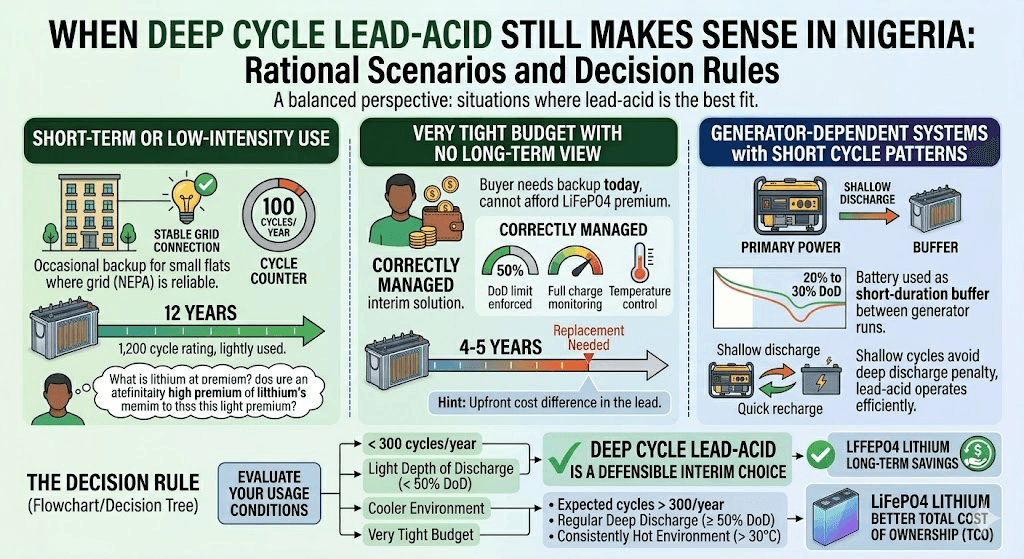
This article is not an advertisement for lithium. There are specific situations where deep cycle tubular lead-acid remains the rational choice for Nigerian buyers, and being honest about those situations serves readers better than blanket recommendations.
Short-Term or Low-Intensity Use
If the system will be used lightly, for example as occasional backup for a small flat where NEPA is relatively reliable and the battery sees fewer than 100 cycles per year, the extended cycle life of lithium delivers less value. At 100 cycles per year, even a lead-acid battery rated for 1,200 cycles lasts 12 years. The lithium premium is harder to justify.
Very Tight Budget with No Long-Term View
For a buyer who needs backup power today and genuinely cannot afford the lithium premium, a correctly sized and correctly managed tubular lead-acid system is a legitimate interim solution. The key word is correctly managed: 50% DoD limit enforced, full charge cycles maintained, temperature controlled. A well-managed lead-acid system in Nigeria can last 4 to 5 years before replacement is needed.
Generator-Dependent Systems with Short Cycle Patterns
Some Nigerian installations use a generator as the primary power source and the battery as a short-duration buffer between generator runs. If the battery is typically discharged to only 20 to 30% DoD before the generator recharges it, lead-acid operates well within its comfort zone and its cycle life penalty for deep discharge does not apply. At shallow discharge depths, lead-acid cycle life improves significantly.
The cutoff is roughly this: if your battery sees more than 300 full cycles a year about one discharge per day or if it regularly goes past 50% DoD, or if your battery room runs hot, LiFePO4 gives you better total cost of ownership. For lighter use, cooler spaces, or genuinely tight budgets, tubular lead-acid is a defensible choice. Nobody should feel pressured into lithium for a system that doesn’t need it.
The Full Cost of Ownership
Most buyers compare sticker price. Here’s what 10 years actually looks like:
| Cost Factor | 48V 200Ah Deep Cycle Lead-Acid | 48V 200Ah LiFePO4 (Standard) |
| Estimated purchase price (2026) | N180,000 to N250,000 | N380,000 to N550,000 |
| Expected replacement cycle | Every 3 to 4 years | Every 7 to 10 years |
| Replacements needed over 10 years | 2 to 3 times | 0 to 1 time |
| Total battery cost over 10 years | N360,000 to N750,000 | N380,000 to N1,100,000 |
| Usable energy per cycle | 4,080 Wh | 6,912 Wh |
| Maintenance requirement | Quarterly checks | None |
| Performance in Nigerian heat | Degrades faster | More stable |
The ranges overlap enough that a well-managed lead-acid system can match lithium’s 10-year cost on paper. The problem is that “well-managed” in a Nigerian home installation consistent 50% DoD limits, quarterly electrolyte checks, temperature-controlled environment rarely happens in practice. That’s where lead-acid loses the comparison in the real world.
For a detailed comparison of specific brands available in the Nigerian market for both battery types, see our article on lithium vs tubular battery in Nigeria.
What Other Guides on This Comparison Get Wrong
Three specific errors appear in nearly every deep cycle vs lithium comparison article online.
1. Comparing Different Voltages as if They Are Equivalent
The most common error in online comparisons is placing a 12V 200Ah lead-acid battery next to a 48V 200Ah lithium battery and attributing all the runtime difference to chemistry. As this article shows, most of that difference is the fourfold energy gap from the voltage change. A reader who sees this comparison and buys lithium based on the chemistry narrative has made the right purchase for the wrong reason. The voltage upgrade alone was doing most of the work.
2. Using Cycle Life Numbers from European Test Conditions
Lead-acid cycle life ratings are measured at 25 degrees Celsius. Every major battery manufacturer uses this standard. In Nigeria, where battery rooms regularly hit 35 to 40 degrees Celsius, those cycle life numbers are not achievable. A battery rated for 1,200 cycles at 25 degrees Celsius may deliver 600 to 800 cycles in a 35 degree Celsius Nigerian installation. NREL’s technical report on battery degradation in high-temperature environments documents the temperature-accelerated degradation rates that make Nigerian-condition cycle life projections consistently shorter than manufacturer datasheet values.
3. Ignoring the Depth of Discharge in Runtime Comparisons
Some comparison articles pit a lead-acid battery at 80% DoD against a lithium battery at 80% DoD to make them look equivalent. This comparison is technically possible but practically wrong. Running lead-acid at 80% DoD causes the rapid sulphation that destroys the battery in 200 to 400 cycles. The 50% DoD limit for lead-acid is not arbitrary. It is the condition under which the cycle life rating was measured. Comparing both batteries at 80% DoD produces a misleading result that makes lead-acid look more competitive than it actually is in sustainable daily use.
Frequently Asked Questions
Is a 200Ah lithium battery better than a 200Ah tubular battery?
At the same system voltage (48V), yes, across almost every metric: 69% more usable runtime, 2 to 4 times more cycle life, faster charging, better heat tolerance, and no maintenance. The only area where tubular wins is upfront cost. For a Nigerian home relying on battery backup daily, the long-term economics and operational advantages of lithium make it the better investment in most scenarios. For very light or infrequent use, the upfront cost difference may not be justified.
How many tubular batteries equal a 200Ah lithium battery?
In usable energy terms at 48V, a 200Ah LiFePO4 delivers 6,912 Wh. A 200Ah tubular lead-acid delivers 4,080 Wh. To match the lithium’s usable energy with lead-acid, you would need approximately 340Ah of lead-acid capacity at 48V, meaning two 200Ah batteries in a parallel-series configuration. You would also need to accept higher weight, more maintenance, and shorter service life. Our specific article on how many tubular batteries equal a 10kWh lithium battery works through the full equivalency calculation.
Can I replace my deep cycle battery with lithium without changing anything else?
Not always. Lithium batteries require different charging parameters from lead-acid. If your inverter or charge controller uses a lead-acid charging profile, it will not charge a lithium battery correctly. Most modern hybrid inverters have a lithium charging mode that must be activated. Older MPPT controllers and inverters may not support lithium charging. Before replacing a lead-acid battery with lithium, verify that your inverter and charge controller support lithium battery charging profiles. Our guide on hybrid inverter battery compatibility covers compatibility requirements in detail.
Which lasts longer overnight: deep cycle or lithium?
At the same 48V 200Ah rating, lithium lasts longer overnight at every load level. The exact difference depends on the load: at 300W, lithium lasts 23 hours versus 13.6 hours for lead-acid, a difference of 9.4 hours. At 800W, lithium lasts 8.6 hours versus 5.1 hours. For practical Nigerian home overnight outages of 8 to 16 hours, a 48V 200Ah lithium handles the night at most load levels without AC, while a 48V 200Ah tubular lead-acid may need load management to reach the same duration.
Does deep cycle battery performance get worse in Nigerian heat?
Yes, significantly. Lead-acid battery service life roughly halves for every 10 degrees Celsius rise above 25 degrees Celsius. In a Lagos battery room at 35 degrees Celsius, a battery rated for 4 years of service at 25 degrees Celsius may deliver only 2 years of useful life. LiFePO4 degrades much less aggressively with temperature. For installations in hot regions of Nigeria such as Kano, Maiduguri, or any poorly ventilated battery room, the heat performance gap between lithium and lead-acid is arguably more important than the runtime gap.
The Bottom Line
At the same 48V 200Ah spec, LiFePO4 gives you 69% more runtime per charge, 2 to 4 times more cycle life, faster recharging, better heat tolerance, and no maintenance. The numbers come from the chemistry 80% DoD versus 50%, lower internal resistance, no sulphation mechanism. That’s what drives the gap.
The thing is: most Nigerian buyers comparing these two batteries aren’t comparing them at the same voltage. They’re upgrading from 12V lead-acid to 48V lithium, and 75 to 80% of the runtime improvement they see comes from the voltage change. Both are real gains. Neither should be misattributed.
For a complete runtime breakdown of what a 200Ah battery of either type actually delivers in Nigerian home conditions, see our articles on how long a 200Ah battery lasts and how long a 2000W inverter runs on battery.

I am Engr. Ubokobong Ekpenyong, a solar specialist and lithium battery systems engineer with over five years of hands-on experience designing, assembling, and commissioning off-grid solar and energy storage systems. My work focuses on lithium battery pack architecture, BMS configuration, and system reliability in off-grid and high-demand environments.