
How to Make 30% Battery Last All Day
Quick Answer:
On a 48V 200Ah LiFePO4, 30% state of charge gives you roughly 2,880 Wh of remaining energy. From this point, with the BMS floor at 10% SoC, you have 1,920 Wh of accessible energy. After 90% inverter efficiency, that is approximately 1,728 Wh usable at the appliance level. At 150W combined load (lights, one fan, phone charging), that is over 11 hours. At 400W, about 4.3 hours. Making 30% last all day is not magic, it is arithmetic applied with discipline.
Here is something most people discover the hard way: 30% on a well-sized lithium battery is not a crisis. On a 48V 200Ah LiFePO4, it represents 2,880 Wh of stored energy. That is more than most Nigerian homes consume in an entire evening of lights, fans, and phone charging.
The problem is not usually the energy. The problem is the behaviour. When the battery display drops to 30%, people start making anxious decisions running the generator unnecessarily, switching on every load because “it might as well run now,” or doing nothing and letting the air conditioner drain the remaining capacity in 90 minutes.
Thirty percent is a management problem, not a hardware problem. This article gives you the exact numbers, the right decisions, and the discipline framework that turns 30% into a full day of reliable power, or close enough that NEPA returning is no longer urgent.
This is also different from the 20% scenario. At 30%, you still have options. You have time to make strategic decisions rather than emergency ones. The strategies here are built for that wider window.
What 30% Actually Means Across Different Battery Systems
The number on your inverter display means very different things depending on your battery system. Before applying any strategy, you need to know what energy you are actually working with.
| Battery System | Total Stored Energy | 30% Remaining (Wh) | Usable From This Point* | “All Day” Threshold at 200W |
| 12V 200Ah lead-acid | 2,400 Wh | 720 Wh | ~0 Wh (already below 50% DoD) | Already in damage zone |
| 24V 200Ah lead-acid | 4,800 Wh | 1,440 Wh | ~408 Wh (marginal) | ~2 hours at 200W |
| 48V 100Ah LiFePO4 | 4,800 Wh | 1,440 Wh | ~864 Wh | ~4.3 hours at 200W |
| 48V 150Ah LiFePO4 | 7,200 Wh | 2,160 Wh | ~1,296 Wh | ~6.5 hours at 200W |
| 48V 200Ah LiFePO4 | 9,600 Wh | 2,880 Wh | ~1,728 Wh | ~8.6 hours at 200W |
| 48V 200Ah x2 parallel | 19,200 Wh | 5,760 Wh | ~3,110 Wh | ~15.5 hours at 200W |
*Usable from 30% means the energy extractable between 30% SoC and the BMS cutoff floor at 10 to 15% SoC, after accounting for 90% inverter efficiency.
The critical insight in this table:
If you are on a 12V or 24V lead-acid system and your battery reads 30%, you are at or below the 50% depth of discharge threshold. You are not working with a cushion. You are in the damage zone. The strategies in this article for stretching power through the day apply primarily to 48V lithium systems. For lead-acid users at 30%, the immediate priority is getting the battery on charge, not planning how to run more loads.
How to Structure Your Loads Across the Day
Making 30% last all day is not just about switching things off. It is about structuring your consumption across time so that your energy use matches what the battery can deliver at each stage of the day.
Nigeria’s average solar generation window runs from roughly 8 AM to 5 PM, with peak irradiance between 10 AM and 2 PM. If you have solar panels, this changes everything about how you manage a low battery. If you do not have solar, the strategy is purely about conservation until NEPA returns or the generator runs.
If You Have Solar Panels: The Bridge Strategy
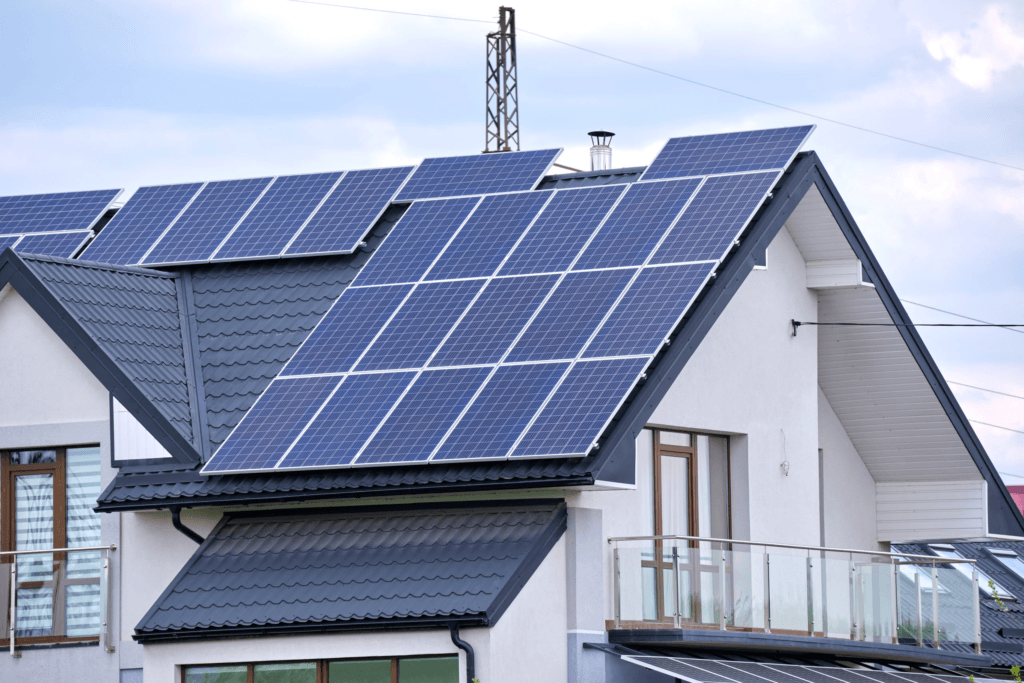
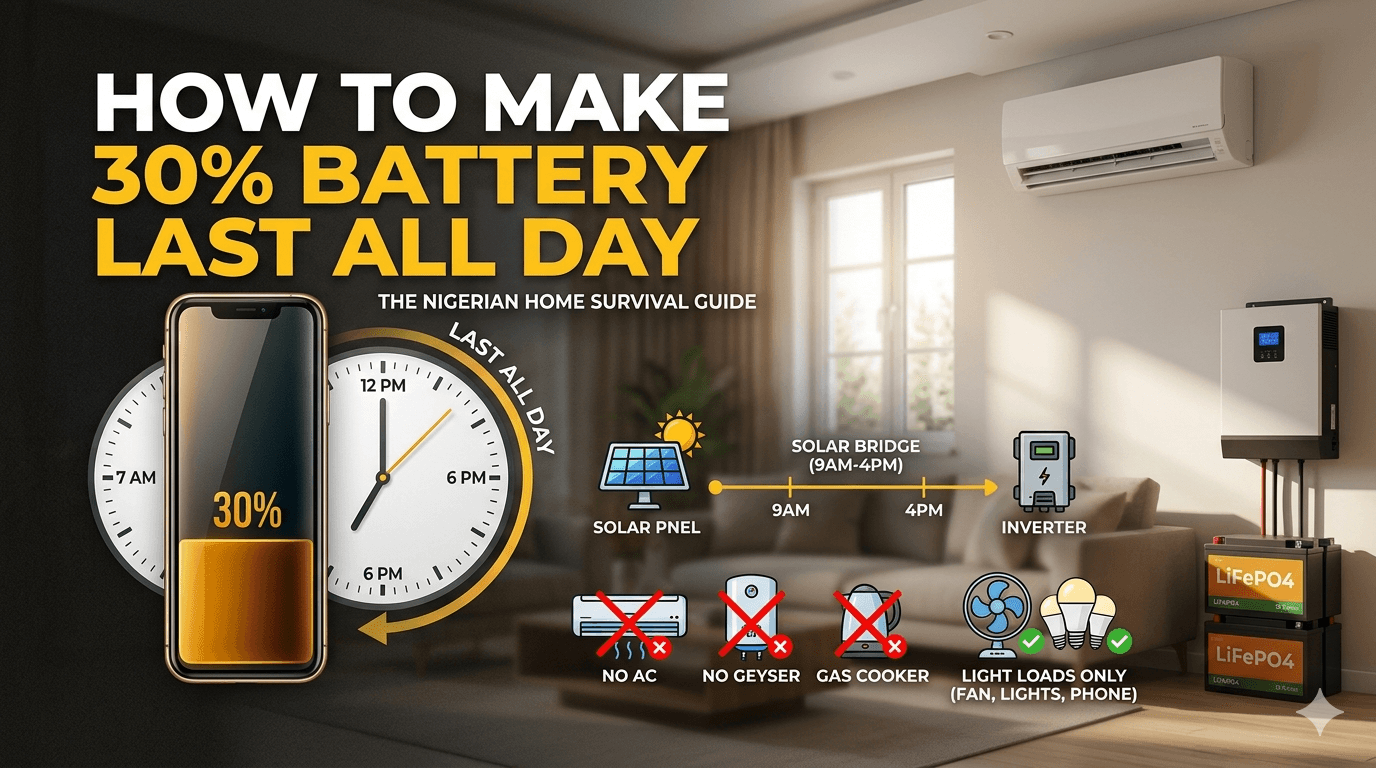
When your battery hits 30% at, say, 7 AM or 8 AM in the morning, you are not in a race against the clock. You are in a brief bridge period before solar takes over. The goal is to consume as little battery energy as possible until your panels are generating enough to power your loads directly and begin recharging simultaneously.
Solar panels in Nigeria start producing meaningful current from around 8 to 8:30 AM. By 9:30 AM, a well-sized array is typically producing enough to run moderate loads without drawing from the battery at all. Your MPPT charge controller handles this automatically, prioritising loads from solar before drawing down the battery. Your MPPT charge controller handles this automatically, prioritising solar before drawing from the battery.
| Time of Day | Solar Availability | Battery Strategy | What to Run |
| 5 AM to 8 AM | None | Minimum draw protect remaining 30% | 1 fan, 2 LED lights, phone charging only (max 120W) |
| 8 AM to 10 AM | Rising (partial) | Let solar take over gradually | Add TV or laptop as solar ramps up monitor MPPT output |
| 10 AM to 2 PM | Peak generation | Solar powers loads + recharges battery | Run most loads freely this is your recovery window |
| 2 PM to 5 PM | Declining | Moderate loads battery should be >60% | Start reducing heavy loads as sun weakens |
| 5 PM to 10 PM | None | Battery now primary manage carefully | Apply load triage from the table below |
| 10 PM onwards | None | Night conservation mode | Lights + 1 fan + charging only |
The bridge strategy works because it treats the battery at 30% not as a tank running empty, but as a 3 to 4 hour buffer until solar takes over. If your panels are correctly sized for your load, the battery will be partially or fully recovered by noon and you will not need to worry about the evening.
For guidance on whether your solar array is properly sized to recharge your battery in a single day, see our solar array sizing guide for off-grid systems. The NREL Global Solar Atlas confirms Nigeria’s average of 5.5 peak sun hours daily, which means a 1,500W array delivers roughly 8,250 Wh on a clear day — more than enough to recover a 200Ah battery from 30% and still power daytime loads simultaneously. You can check the precise irradiance data for your city using the Global Solar Atlas irradiance tool.
If You Do Not Have Solar: The Pure Conservation Strategy
Without solar, 30% battery is a finite resource with no replenishment until NEPA returns or the generator runs. In this scenario, the strategy shifts from bridge management to pure conservation.
The key question to answer immediately: how long is this outage likely to last? In Band A areas of Lagos and Abuja, NEPA typically restores within 4 to 8 hours. In secondary cities like Enugu or Owerri, outages can run 12 to 16 hours. In peri-urban areas, 18 to 24 hours is not unusual according to NERC’s quarterly electricity report tracking zonal supply hours. Your conservation target should be calibrated to your realistic NEPA pattern, not best-case assumptions.
The Exact Numbers: How Long 30% Lasts at Every Load Level
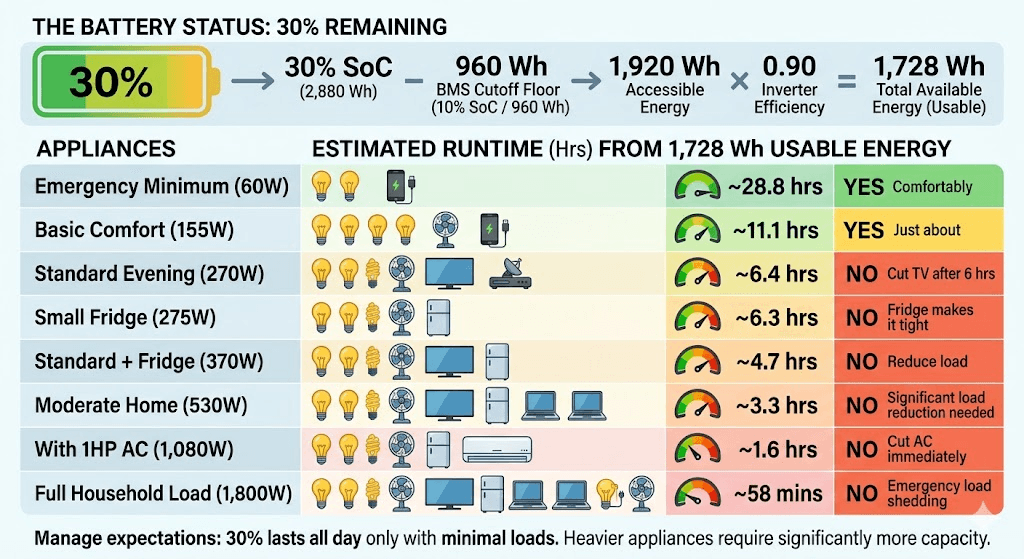
These calculations are for a 48V 200Ah LiFePO4 battery. Starting from 30% SoC (2,880 Wh remaining), minus the BMS cutoff floor at 10% SoC (960 Wh), gives 1,920 Wh of accessible energy. After 90% inverter efficiency: 1,920 × 0.90 = approximately 1,728 Wh available at the appliance level. This single figure is used consistently throughout all tables and calculations in this article.
| Load Combination | Running Watts | Est. Runtime from 30% | Can It Last All Day? (10 hrs) |
| Emergency minimum: 2 lights + 1 phone charge | 60W | ~28.8 hrs | Yes, comfortably |
| Basic comfort: 4 lights + 1 fan + phone charging | 155W | ~11.1 hrs | Yes, just about |
| Standard evening: lights + 1 fan + TV + decoder | 270W | ~6.4 hrs | No, need to cut TV after 6 hrs |
| Lights + fan + fridge (small, 80W avg) | 275W | ~6.3 hrs | No, fridge makes it tight |
| Standard + fridge: lights + fan + TV + fridge | 370W | ~4.7 hrs | No, cut TV, keep fridge + fan |
| Moderate home: lights + 2 fans + TV + fridge + laptops | 530W | ~3.3 hrs | No, needs load reduction |
| With 1HP AC: lights + fans + fridge + 1HP AC | 1,080W | ~1.6 hrs | No, cut AC immediately |
| Full household load | 1,800W | ~58 mins | No, emergency load shed |
The takeaway from this table: 30% on a 48V 200Ah LiFePO4 can last all day if you stay below roughly 170W of continuous load. That is lights, one fan, and phone charging. Add a television and you are at the edge. Add a fridge and you are past it. Add air conditioning and you are done in under 2 hours.
The numbers shift significantly with battery size. If you have two 200Ah batteries in parallel, your 30% gives you double the usable energy. The same 270W load that lasts 6.4 hours on a single battery lasts 12.8 hours on a twin-battery bank. For comparison of runtime across different battery sizes, see our articles on how long a 100Ah battery lasts, how long a 150Ah battery lasts, and how long a 200Ah battery lasts.
The Hour-by-Hour Load Plan for a 30% Battery Day
This is the practical plan most guides never give you. It is built around a 48V 200Ah LiFePO4 system, a Nigerian home with solar panels, and a battery that hits 30% at 6 AM when NEPA cuts out. Adjust the times based on your own NEPA pattern.
6:00 AM: Battery hits 30%. NEPA is out.
Immediately switch off: air conditioner (if running), water heater, electric iron (if anyone started early ironing), and television. Leave on: bedroom fan, toilet light, kitchen light. Do not panic. You have more time than you think.
Current load: approximately 120W (2 fans + 3 LED lights + phone charging). Estimated remaining runtime at this load: 14+ hours. You are not in trouble.
7:00 AM: Morning activity begins
Kitchen activity picks up. People want to use the kettle. Do not. Boil water on gas or use a gas cooker. The kettle alone (1,500 to 2,000W) would consume roughly 90 minutes of your remaining battery life in a single 3-minute boil. Use the laptop or phone for work. Current load target: keep it under 200W.
8:30 AM: Solar panels start producing
Check your MPPT controller display or monitoring app. If your panels are producing 400W or more, your system is now self-sustaining on solar. The battery is no longer draining. Depending on your array size, it may even be slowly charging. At this point, you can relax load restrictions. Add the television, switch on another fan, connect the laptop charger.
If your MPPT controller is not showing production at 8:30 AM on a clear morning, something is wrong. Check for shading, a tripped breaker, or a controller fault. Our guide on why your solar panel is not charging your battery covers the most common causes.
10:00 AM to 2:00 PM: Peak solar window
This is your free energy window. Your panels are at maximum output. Run your water pump, charge all devices, do the laundry if you have a washing machine. The battery is recovering. By noon, a well-sized system with 1,500W of panels should have brought a 30% battery back to 60 to 70% SoC, depending on your daytime load.
4:00 PM: Solar begins declining
Start reducing heavy loads again. Switch off the washing machine if it is still running. Turn off any unnecessary lights. Your MPPT output will drop below your load level around 4:30 to 5 PM, at which point the battery starts contributing again. Check your SoC if the battery recovered well during peak sun, you should be at 70 to 80% by now, which is a comfortable position for the evening.
6:00 PM onwards: Evening load management
NEPA is still out. Now you are running on battery again. Apply the load triage: lights on, one or two fans running, TV is acceptable at this charge level, fridge stays on, but air conditioning should be avoided unless you are back above 60% SoC. Our article on how to make 20% battery last 2 hours covers the next stage if the battery drops further before NEPA returns.
The 6 Appliances That Will End Your 30% Battery Before Lunch
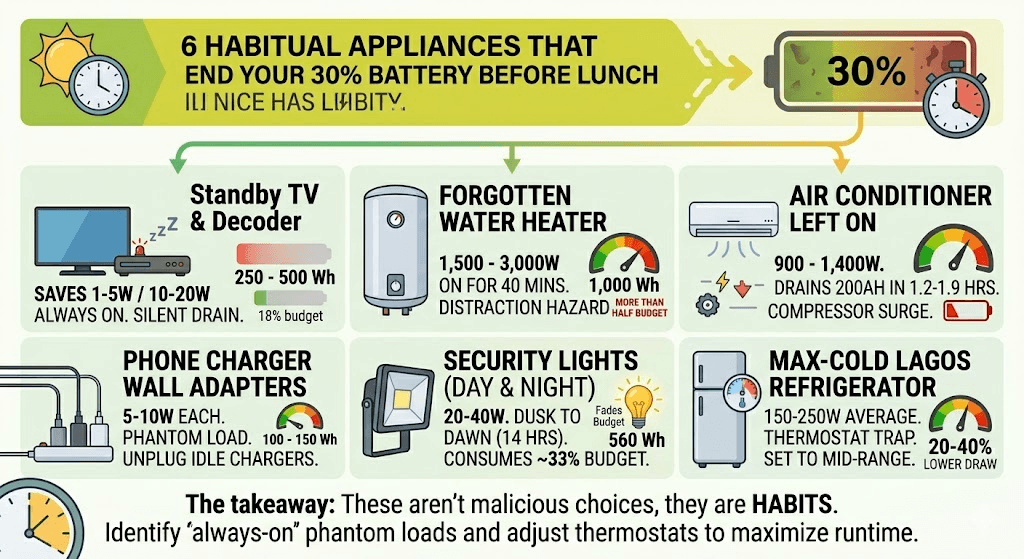
Every item on this list shares one characteristic: people forget they are on. They are not malicious choices. They are habits. Breaking these habits is the single most effective thing most Nigerian homes can do to extend battery life.
1. The standby television and decoder (25 to 50W combined, always on)
A television in standby draws 1 to 5W. A decoder draws 10 to 20W. A soundbar adds another 5 to 15W. Together: 25 to 50W drawing continuously from your battery without displaying a single frame. Over 10 hours that is 250 to 500 Wh up to 18% of your usable 30% budget, gone silently. IEA standby power research puts household standby consumption at 5 to 10% of total electricity use globally. In a battery-backed Nigerian home, that percentage comes directly out of your overnight runtime.
2. The forgotten water heater (1,500 to 3,000W for 20 to 40 minutes)
Someone woke up early and switched on the water heater for a shower. Then they got distracted. A 1,500W heater left on for 40 minutes consumes 1,000 Wh more than half the usable energy remaining in a 30% LiFePO4 200Ah battery. In Nigerian homes where the water heater is wired to the inverter circuit rather than a dedicated NEPA circuit, this is a recurring disaster.
3. The air conditioner (900 to 1,400W)
An air conditioner running at 30% battery will drain a 48V 200Ah LiFePO4 in 1.2 to 1.9 hours. At the same time, the compressor cycling during low-battery conditions increases startup surge frequency, which stresses both the inverter and the BMS. This is not just an energy management issue. Repeated high-current draws at low state of charge accelerate cell degradation, as documented in Battery University’s guide on lithium battery stress factors.
4. The phone charger wall adapter that stays plugged in (5 to 10W each)
A phone charger with no phone attached still draws 0.5 to 2W. Four chargers plus a laptop brick total 10 to 15W continuously 100 to 150 Wh over a 10-hour day. Not catastrophic alone, but combined with other phantom loads it adds up fast. Unplug what is not actively charging.
5. The security light that runs day and night (20 to 40W)
Many Nigerian homes have security floodlights wired to the inverter circuit, running continuously from dusk to dawn. A 40W floodlight over 14 hours consumes 560 Wh nearly a third of your 1,728 Wh budget from 30%. If the motion sensor has failed and the light runs all day too, double that figure. Check this load. It is easy to forget.
6. The refrigerator set to maximum cold (150 to 250W average)
A refrigerator is a legitimate and necessary load. But there is a common habit in Nigerian homes of setting the refrigerator thermostat to maximum cold because “it has more power” during NEPA hours. When the system switches to battery, that thermostat setting stays, and the compressor works harder and more frequently than necessary. Set your fridge to mid-range (3 or 4 on a dial of 1 to 7). The food stays cold. The power draw drops by 20 to 40%.
How Solar Charging Completely Changes the 30% Equation
Everything above assumes you are trying to survive on stored energy alone. Solar changes this from a conservation problem into a load management problem and load management is much easier.
With solar panels and a properly configured MPPT charge controller, your battery at 30% in the morning is not a ceiling. It is a floor. The solar array begins recharging as soon as the sun rises, and by mid-morning your system is typically net-positive on energy generating more than it is consuming and actively refilling the battery.
The key metric to understand is your solar surplus: the difference between what your panels produce and what your loads consume at any given moment. When the surplus is positive, the battery charges. When it is negative, the battery discharges. Managing a 30% battery day with solar means keeping loads below panel output during daylight hours so the surplus remains positive as long as possible.
How to Verify Your Solar Is Actually Recharging the Battery
Many Nigerian homeowners assume their solar is working without ever checking the actual charge current. A properly functioning MPPT controller at 10 AM on a clear Lagos day should be showing 20 to 50A of charge current for a typical 4 to 6 panel array. If it is showing under 10A at that time, something is wrong.
Check these in order:
- Panel voltage: The open-circuit voltage of your panels should be above the system bus voltage. For a 48V system, each panel string should show 70 to 90V at open circuit on a clear morning.
- MPPT output current: Read the charge current on your controller display or app. It should match your array wattage divided by system voltage. 1,200W of panels on a 48V system should produce roughly 25A of charge current in good irradiance.
- Battery voltage: A charging 48V LiFePO4 battery should show rising voltage from around 51V toward 57.6V during the absorption phase. If voltage is flat or falling, the battery is not receiving meaningful charge.
For a complete guide on diagnosing MPPT issues and verifying charge performance, see our our MPPT vs PWM charge controller guide and our our MPPT selection guide.
Three Things Other Guides on This Topic Get Wrong
There are dozens of articles about stretching battery life. Most of them give you the same list: switch off the AC, use LED lights, unplug standby devices. That advice is not wrong. It is just incomplete. Here are three things they miss.
1. They treat all 30% readings as equal
A battery that reads 30% after a night of slow, consistent discharge at 200W is in a fundamentally different state from one that reads 30% after a 2-hour high-current drain from an air conditioner and washing machine. The first battery has cells that are relatively well-balanced and at a stable voltage. The second may have cells that are slightly imbalanced, with some at 28% and others at 32%. The BMS is showing you an average, not the truth of every cell.
In the second scenario, your actual usable energy from “30%” may be 10 to 15% less than in the first scenario, because the weakest cell determines when the BMS triggers its low-voltage cutoff. This is why a battery that was drained hard overnight sometimes feels like it disappears faster the next morning even at the same displayed percentage.
The fix: if you drained your battery hard the previous night, give it 10 to 15 minutes under light load when solar starts in the morning. The voltage will settle and the SoC reading will be more accurate. Our article on why lithium batteries go out of balance explains the cell imbalance mechanism in detail.
2. They ignore the inverter’s own consumption
A 3kVA or 5kVA inverter running a 150W load is not running at 150W from the battery. It is running at approximately 165 to 190W, because the inverter itself draws 15 to 40W of no-load power just to stay active. This is never mentioned in generic battery management articles because it is brand and model specific.
On a 10-hour day, a 40W inverter no-load draw consumes 400 Wh roughly 23% of the usable energy in a 30% LiFePO4 200Ah battery. That is not a rounding error. It is a meaningful portion of your survival budget for the day. If you have a smaller inverter option available for low-load periods, switching to it during the quiet hours of the day can materially extend your runtime.
3. They do not account for battery temperature in Nigerian conditions
During the dry season and harmattan, temperatures in Nigerian cities regularly exceed 35 degrees Celsius during the day. LiFePO4 batteries operate within specification up to 45 degrees Celsius, but their efficiency and capacity degrade slightly above 30 degrees Celsius. Lead-acid batteries lose capacity more significantly, with a drop of roughly 1% capacity per degree above 25 degrees Celsius according to Battery University’s temperature performance data.
A battery bank stored in a closed, unventilated room or in direct sunlight can reach 40 to 45 degrees Celsius on a hot afternoon. At this temperature, your effective capacity is lower than the display suggests. Ensure your battery bank is in a shaded, ventilated space. This is not optional advice it is a free 5 to 10% capacity improvement that costs nothing but attention.
The Long-Term Fix:
Managing 30% is a skill worth having. But needing it regularly is a sign that something in your system design needs attention. A well-designed off-grid or hybrid solar system should not be at 30% by morning under normal use. If it is, one of three things is true:
- Your battery bank is undersized for your load. Calculate your actual nightly consumption and compare it against your battery’s usable capacity. If you are consuming more than 60 to 70% of usable capacity every night, you need more battery.
- Your solar array is not fully recharging the battery each day. A battery that starts each night partially depleted will hit 30% earlier and earlier. If your panels are not recovering the battery to above 80% SoC by 2 PM every day, your array is undersized or has a performance problem. Our the solar array sizing guide gives you the calculation to check this.
- Your load discipline is inconsistent. Night-time loads vary depending on who is home, what they are doing, and whether the air conditioner runs. If some nights end at 70% SoC and others at 25%, the variable is almost certainly load discipline. Establishing a clear protocol for high-draw appliances specifically when the AC can run and when it cannot brings this under control.
For a complete system health check that covers all three of these areas, use our complete off-grid system design checklist.
Frequently Asked Questions

How long will 30% battery last with air conditioning?
A 1HP split AC draws roughly 750 to 900W running. On a 48V 200Ah LiFePO4 at 30% SoC with approximately 1,728 Wh usable, the AC alone will exhaust the battery in 1.9 to 2.3 hours. Combined with other loads (lights, fans, fridge), you are looking at under 90 minutes. Making 30% last all day with air conditioning is not realistic unless solar is simultaneously recharging the battery. Cut the AC, use a fan, and you immediately extend from under 2 hours to 6 to 11 hours depending on other loads.
Can 30% battery last overnight?
Yes, if your load is low enough. On a 48V 200Ah LiFePO4 at 30% with roughly 1,728 Wh usable, a minimal night load of 100 to 150W (2 LED lights, 1 fan, phone charging) gives you 11 to 17 hours. A moderate load of 250 to 300W (lights, fan, fridge on) gives you 5.8 to 6.9 hours. A typical Nigerian 8-hour night with modest loads is achievable. See our companion article on our companion article on managing a battery at 20%.
What percentage battery should I not go below?
For LiFePO4 lithium batteries, the BMS hard cutoff is typically 10 to 15% SoC. Operating down to 20% occasionally is fine and will not cause permanent damage. For daily use, keeping the floor at 20 to 30% extends cycle life significantly. For lead-acid batteries, never go below 50% SoC intentionally. Below 50% on lead-acid causes sulphation and grid corrosion that permanently reduces capacity with every cycle. See our guide on our guide on the 80/20 rule for lithium batteries.
My battery went from 30% to 10% in 2 hours. Is something wrong?
Possibly. At a reasonable load of 400W, a 48V 200Ah LiFePO4 at 30% should last about 4.3 hours, not 2. If it dropped to 10% in 2 hours, either your load is higher than you think (check for hidden loads using our phantom loads guide), the battery has degraded and is delivering less than its rated capacity, or the BMS is displaying inaccurate SoC due to calibration drift. Our article on SOC drift in lithium battery systems explains why BMS and inverter SoC readings sometimes diverge and what to do about it.
Does turning the WiFi router off really make a difference?
In absolute terms, a 10 to 15W router switched off saves 100 to 150 Wh over a 10-hour day. On a 48V 200Ah battery at 30%, that extends runtime by 3.5 to 5 minutes per hour not dramatic on its own. Where it matters is in combination. A router, plus a standby TV, plus a standby decoder, plus two idle phone chargers can total 50 to 80W of invisible consumption. Over 10 hours that is 500 to 800 Wh, which is roughly 29 to 46% of your usable energy from 30%. The router alone is not worth switching off. Everything together is.
How do I know if my 30% reading is accurate?
BMS SoC readings can drift over time, especially if the battery has never been fully charged to 100% or fully discharged to the cutoff threshold. A battery that is regularly kept between 30% and 80% may have a BMS that loses calibration and shows 30% when the actual state of charge is 22% or 38%. To reset and recalibrate: fully charge the battery to 100% (until the MPPT controller switches to float or the BMS shows full), then let it discharge under a moderate consistent load until the BMS cuts off. This full cycle recalibrates the SoC estimation algorithm. Our article on our SOC drift article.
Is 30% on a new battery the same as on a 3-year-old battery?
No. A 3-year-old LiFePO4 battery that has been properly managed retains 80 to 90% of its original capacity. At 30% SoC, its remaining energy is 30% of a smaller total. A 200Ah battery at 85% state of health delivers effectively 170Ah of real capacity. Thirty percent of 170Ah is 51Ah, not 60Ah. The difference translates directly to shorter runtime from the same displayed percentage. If your battery is 2 to 3 years old and 30% seems to last less than these tables suggest, battery ageing is likely the explanation. Read our article on our cycle life guide.
The Bottom Line
Thirty percent on a 48V LiFePO4 battery is not the beginning of the end. It is a management exercise. Handled correctly, with the load discipline outlined in this article and a solar array doing its job from 9 AM onwards, 30% can carry a Nigerian home comfortably through the rest of the day and into the evening.
The discipline required is not complicated. Cut the air conditioner, ignore the water heater, leave the kettle for gas, and trust the solar to do its job in the morning. Those four decisions alone change the day from a countdown to a comfortable stretch of backup power.
And if 30% mornings are a regular occurrence rather than an occasional one, the answer is in your system sizing, not your willpower. A battery bank sized correctly for your load should not be hitting 30% by dawn under normal conditions. Use our our 48V battery sizing guide to check whether your bank matches your actual consumption and if it does not, the our expansion guide shows you exactly how to add capacity without replacing what you already have.

I am Engr. Ubokobong Ekpenyong, a solar specialist and lithium battery systems engineer with over five years of hands-on experience designing, assembling, and commissioning off-grid solar and energy storage systems. My work focuses on lithium battery pack architecture, BMS configuration, and system reliability in off-grid and high-demand environments.