
How Long Will a 100Ah Battery Last?
Quick Answer:
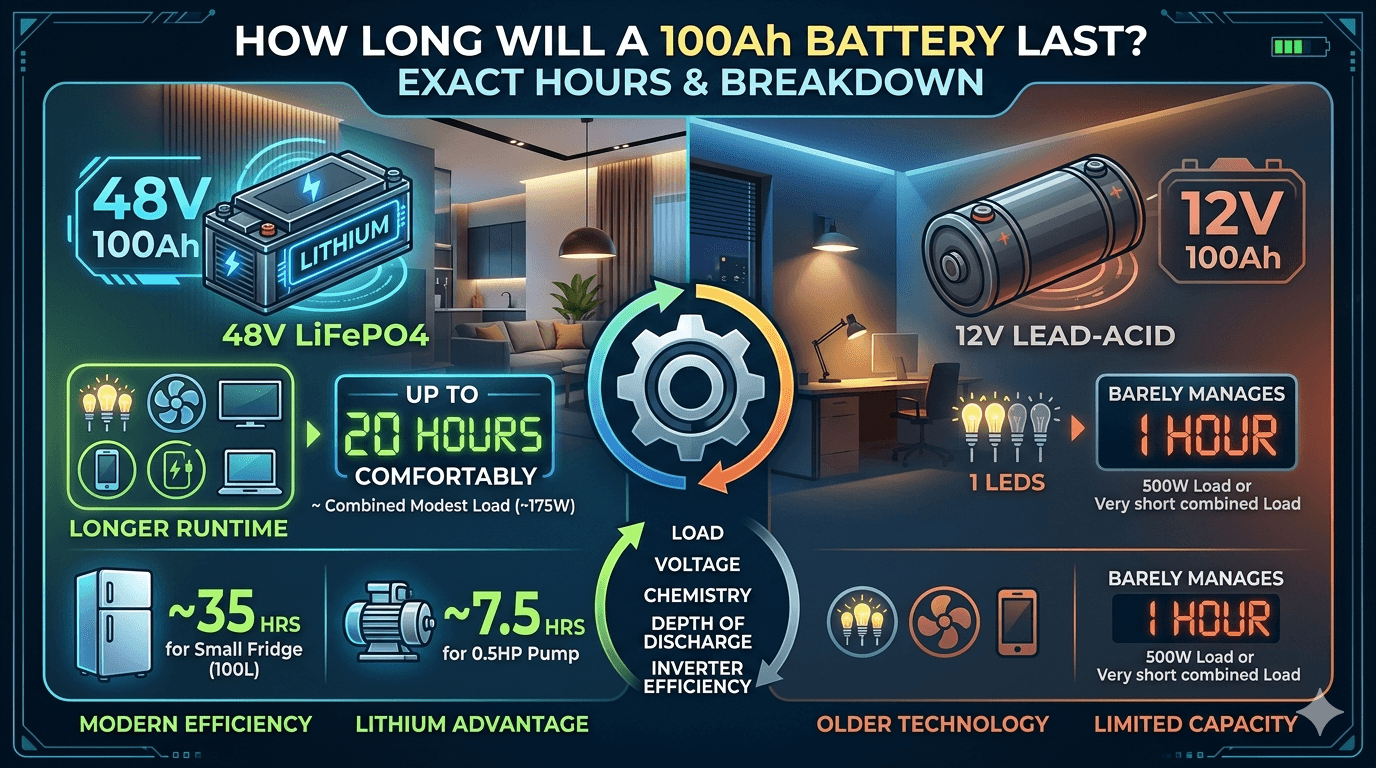
A 48V 100Ah LiFePO4 battery holds 4,800 Wh of energy. At a 500W load it lasts roughly 7 hours. At 200W it stretches to about 17 hours. A 12V 100Ah lead-acid battery holds only 1,200 Wh, so at that same 500W it barely manages 1 hour. Your actual runtime depends on your voltage, load, battery chemistry, and depth of discharge.
The 100Ah battery is the most popular inverter battery size in Nigeria. Walk into any electrical shop in Lagos, Port Harcourt, or Abuja and it is the first thing the salesman reaches for. It is affordable, widely available, and easy to understand. Or so people think.
The number that nobody tells you upfront: a 100Ah battery at 12V and a 100Ah battery at 48V are not the same thing. One holds 1,200 Wh of energy. The other holds 4,800 Wh. They will not last the same number of hours. Not even close.
This article gives you the real numbers, the actual formula, and an honest breakdown of what your specific 100Ah battery will do under your specific load. No inflated claims, no vague estimates.
The Energy Inside a 100Ah Battery: Why Voltage Matters First
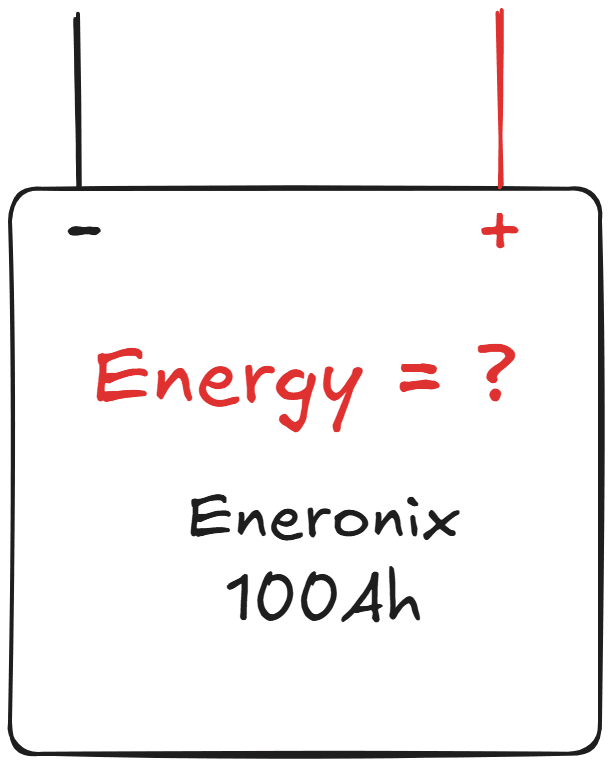
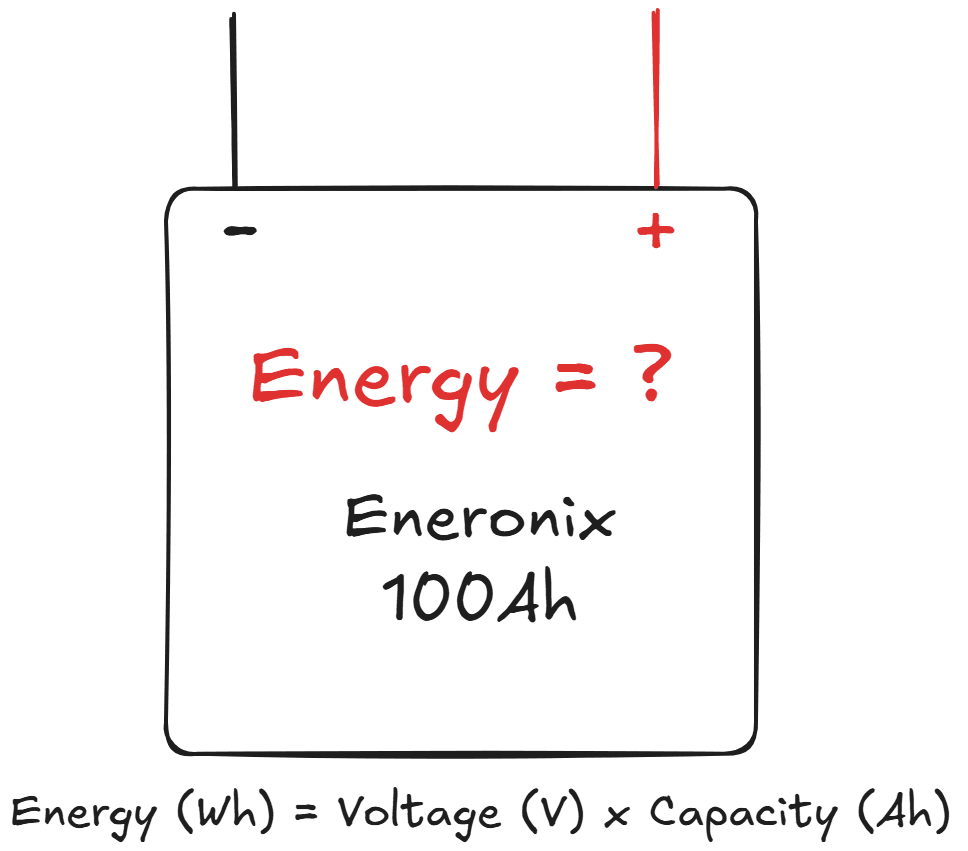
Before you can calculate runtime, you need to know how much energy your battery actually stores. The formula is simple:
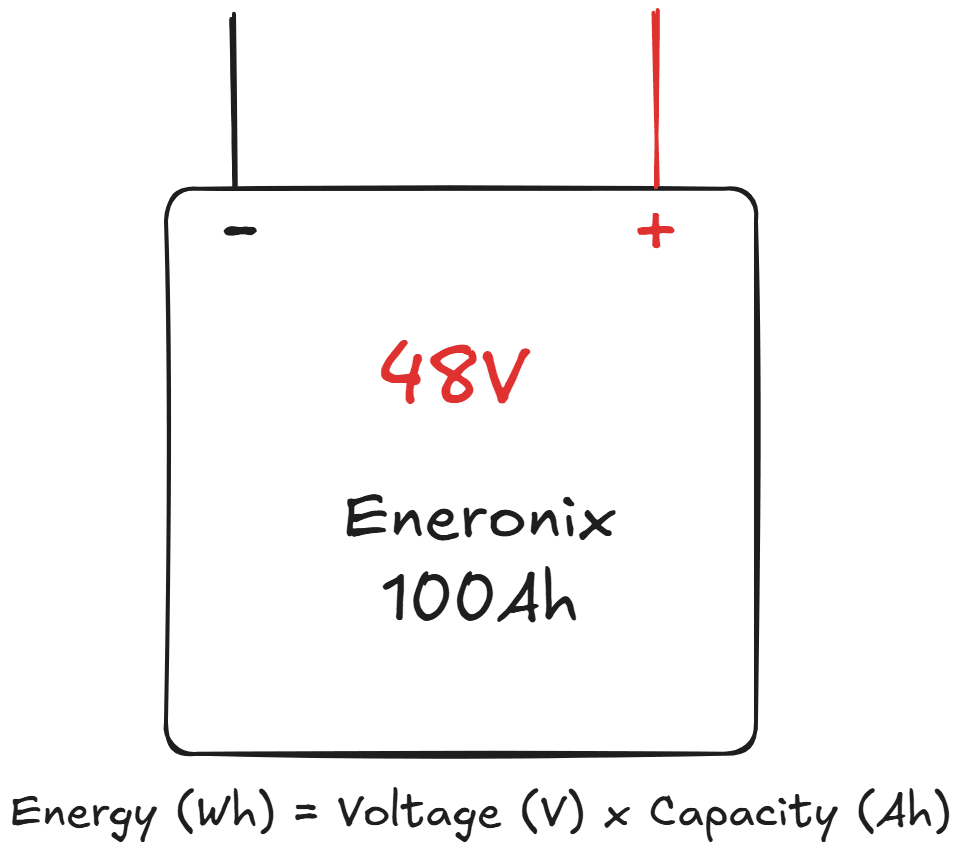
Energy (Wh) = Voltage (V) x Capacity (Ah)
Here is what that means for 100Ah batteries at different system voltages:
| System Voltage | Capacity | Total Energy Stored | Common Use Case |
| 12V | 100Ah | 1,200 Wh (1.2 kWh) | Small systems, older installs |
| 24V | 100Ah | 2,400 Wh (2.4 kWh) | Mid-size off-grid systems |
| 48V | 100Ah | 4,800 Wh (4.8 kWh) | Modern hybrid/off-grid solar |
This table is the single most important thing to understand before reading any runtime estimate. When someone says “my 100Ah battery lasts 8 hours,” the first question to ask is: at what voltage? The answer completely changes the math.
Most modern solar installations in Nigeria now use 48V systems because the energy density, efficiency, and cable sizing advantages are significant. If you are still on a 12V system and wondering why your battery life feels short, the answer may have less to do with the battery and more to do with the voltage architecture. Our guide on designing an off-grid power system using lithium batteries covers why 48V is the right choice for most Nigerian homes today.
The Runtime Formula
Runtime (hours) = (Total Wh x Usable % x Inverter Efficiency) / Load (W)
The variables:
- Total Wh: Voltage x Ah, as shown in the table above.
- Usable %: For LiFePO4 lithium, 80% is the recommended working limit. For lead-acid (tubular or AGM), 50% protects the battery from premature failure. See our article on why 100% maximum usable capacity is a lithium battery death sentence for the science behind this.
- Inverter efficiency: A quality inverter runs at 90 to 95% efficiency. Budget inverters can drop to 80%. Use 90% as a conservative estimate for most setups.
- Load (W): The total watts of all appliances running at the same time. If you are not sure of your load, our off-grid system load audit guide walks you through measuring it accurately.
Worked Example: 48V 100Ah LiFePO4 Battery
A common evening load for a small Nigerian apartment or office:
| Appliance | Watts | Qty | Total |
| LED lights | 10W | 3 | 30W |
| Ceiling fan | 55W | 1 | 55W |
| 24-inch TV | 40W | 1 | 40W |
| Phone charging | 20W | 2 | 40W |
| WiFi router | 10W | 1 | 10W |
| Total | 175W |
Applying the formula:
- Total energy: 48V x 100Ah = 4,800 Wh
- Usable energy (80% DoD): 4,800 x 0.80 = 3,840 Wh
- After inverter losses (90%): 3,840 x 0.90 = 3,456 Wh
- Runtime: 3,456 / 175W = approximately 19.7 hours
At 175W, a 48V 100Ah LiFePO4 battery covers nearly a full 20-hour stretch. That is sufficient for most Nigerians who lose NEPA in the morning and need power until the next morning. Add a fridge or increase the fan count and the picture shifts, but the capacity is still solid for modest loads.
Runtime Tables: Honest Comparisons
Important note on these tables: The comparisons below are split into two tables intentionally. Table A compares same-voltage systems (fair comparison, chemistry only). Table B shows the real-world scenario where most people upgrade from a 12V lead-acid to a 48V lithium, which involves both a chemistry change and a fourfold increase in stored energy. Both effects are real. Showing only one would mislead you.
Table A: Same Voltage, Different Chemistry (True Apples-to-Apples)
Both systems below are 48V 100Ah, storing 4,800 Wh. The only variable is chemistry and usable depth of discharge:
| Load | 48V 100Ah LiFePO4 (80% DoD, 90% eff.) | 48V 100Ah Lead-Acid (50% DoD, 85% eff.) |
| 100W | ~34.6 hrs | ~20.4 hrs |
| 200W | ~17.3 hrs | ~10.2 hrs |
| 500W | ~6.9 hrs | ~4.1 hrs |
| 1,000W | ~3.5 hrs | ~2.0 hrs |
| 1,500W | ~2.3 hrs | ~1.4 hrs |
At the same voltage and Ah rating, lithium genuinely lasts 60 to 70% longer. That difference is entirely down to chemistry: higher usable depth of discharge, lower internal resistance, and better efficiency under load. This is the honest chemistry advantage.
Table B: Typical Upgrade Scenario (12V Lead-Acid vs 48V Lithium)
This is the comparison most people are actually making when they switch systems. The stored energy is different, and that gap is intentional to reflect reality:
| Load | 48V 100Ah LiFePO4 (4,800 Wh, 80% DoD) | 12V 100Ah Lead-Acid (1,200 Wh, 50% DoD) |
| 100W | ~34.6 hrs | ~5.1 hrs |
| 200W | ~17.3 hrs | ~2.6 hrs |
| 500W | ~6.9 hrs | ~1.0 hrs |
| 1,000W | ~3.5 hrs | ~0.5 hrs |
| 1,500W | ~2.3 hrs | ~0.3 hrs |
The massive gap here is mostly the voltage difference, not chemistry. A 12V 100Ah battery stores four times less energy than a 48V 100Ah battery. If you switched from a 12V lead-acid to a 48V lithium and your backup time quadrupled, the voltage architecture change gets most of that credit. The lithium chemistry adds another 60 to 70% on top of that.
For a detailed comparison of real-world performance between lithium and tubular batteries in Nigerian conditions, see our article on lithium vs tubular battery in Nigeria.
100Ah Battery Runtime for Common Appliances
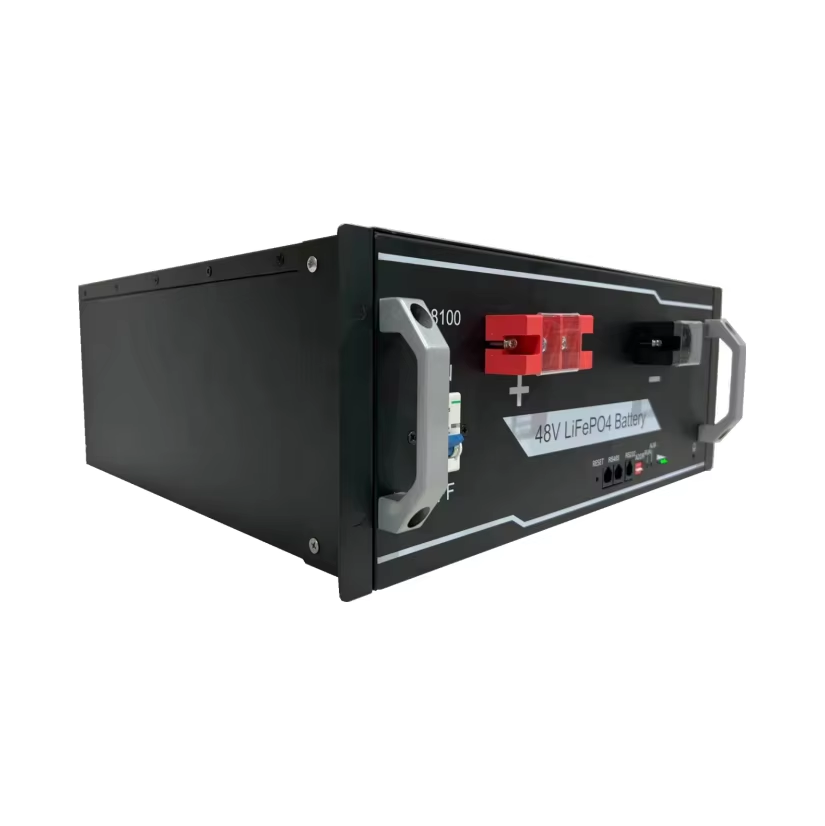
Reference table for a 48V 100Ah LiFePO4 battery (80% DoD, 90% inverter efficiency) running individual appliances:
| Appliance | Avg. Wattage | Estimated Runtime (alone) |
| LED bulb (1 x 10W) | 10W | ~277 hrs |
| Ceiling fan | 55W | ~50 hrs |
| Standing fan | 65W | ~42 hrs |
| 32-inch LED TV | 50W | ~55 hrs |
| Laptop | 60W | ~46 hrs |
| Small refrigerator (100L) | 80W avg | ~35 hrs |
| Medium refrigerator (200L) | 150W avg | ~18.5 hrs |
| Water pump (0.5HP) | 370W | ~7.5 hrs |
| 1HP water pump | 750W | ~3.7 hrs |
| 1.5HP air conditioner | 1,200W | ~2.3 hrs |
These are standalone figures. In a combined load, add up all appliance wattages and apply the formula. For a printable load audit worksheet and system sizing guide, see our off-grid solar system design guide for Nigeria.
Is a 100Ah Battery Enough for Your Needs?
The honest answer: it depends entirely on your voltage and your load. Here is a quick decision guide:
| Use Case | Recommended System | Why |
| Small apartment, lights + fan + phone charging (150 to 200W) | 48V 100Ah LiFePO4 | Covers 15 to 20 hours comfortably |
| Office: lights, laptops, router, AC running part-time | 48V 200Ah LiFePO4 or 2 x 100Ah parallel | 100Ah alone is marginal with AC |
| 3-bedroom house with fridge + fans + TV (400 to 600W) | 48V 200Ah+ LiFePO4 | 100Ah will fall short by morning |
| Generator backup top-up only (2 to 3 hours) | 48V 100Ah LiFePO4 | More than sufficient for short gaps |
| Full off-grid with no generator | Size by daily load, rarely just 100Ah | See full sizing guide |
If you are unsure whether to get a 100Ah or 200Ah battery for your situation, our comparison of how long a 200Ah battery lasts gives you the same level of detail for the larger size, making the choice straightforward.
4 Reasons Your 100Ah Battery Is Not Lasting as Long as Expected
If your real-world runtime is significantly shorter than these numbers, one of these four things is almost certainly to blame:
1. Your load is higher than you think
Most people underestimate their actual consumption. Appliances running in the background, devices on standby, and older equipment drawing more than their rated wattage are common culprits. The only way to know your real load is to measure it. Our phantom loads guide shows exactly how to find the hidden drain in any system.
2. Your battery has degraded
A 100Ah battery that has been through hundreds of deep discharge cycles without proper care may now deliver only 70 to 80Ah of real capacity. The label still says 100Ah but the cells have aged. Our article on how charge and discharge cycles affect lithium battery lifespan explains when to expect degradation and how to slow it down.
3. Your BMS is cutting off too early
A poorly configured BMS may be triggering low-voltage cutoff at a higher state of charge than necessary, leaving usable energy locked in the battery. If your inverter shows 20% and cuts out, but the battery is physically fine, your BMS thresholds may need adjustment. See our guide on BMS protection explained for the correct voltage thresholds per chemistry.
4. Your inverter is oversized for the load
An inverter that is heavily oversized for your actual load runs at low efficiency, wasting energy as heat. A 5kVA inverter powering a 150W load is not running at peak efficiency. Inverter no-load consumption alone can be 30 to 80W on larger units. This is covered in our guide on how to select an off-grid inverter.
Frequently Asked Questions
How long will a 100Ah battery last on a 1000W inverter?
At a 1,000W load, a 48V 100Ah LiFePO4 battery (80% DoD, 90% inverter efficiency) will last approximately 3.5 hours. A 12V 100Ah lead-acid at 50% DoD will last roughly 30 minutes at that load. For a dedicated deep-dive into this exact scenario, see our article on how long a 100Ah battery lasts on a 1000W inverter.
Can a 100Ah battery power a fridge overnight?
A 48V 100Ah LiFePO4 can run a 100 to 150W average compressor fridge for 18 to 35 hours on its own. In a combined load with lights and a fan, it will still comfortably handle an overnight stretch of 8 to 10 hours for a small fridge. A 12V 100Ah lead-acid battery does not have enough energy to run a fridge through the night reliably.
How many 100Ah batteries do I need for a 5kVA inverter?
A 5kVA inverter at full load draws roughly 4,000 to 4,500W. A single 48V 100Ah LiFePO4 would last under an hour at full load. For meaningful backup time at realistic loads (say 1,000 to 1,500W), you need at least 2 to 3 batteries in parallel. See our article on how many batteries you need for a 5kVA inverter for a full sizing breakdown.
Is a 100Ah lithium battery better than a 200Ah tubular battery?
At 48V, a 100Ah lithium stores 4,800 Wh and delivers about 3,840 Wh usably. A 48V 200Ah tubular lead-acid stores 9,600 Wh but delivers only 4,800 Wh at 50% DoD. So in usable energy terms they are roughly equal, but the lithium is lighter, lasts more charge cycles, charges faster, and performs better in Nigerian heat. Our lithium vs tubular battery comparison goes deeper on the full cost-of-ownership picture.
What voltage should I use for a 100Ah battery system?
48V is the right choice for any serious solar installation today. It stores 4x more energy than a 12V system at the same Ah, uses thinner cables for the same power, and is compatible with all modern hybrid and off-grid inverters. 12V systems are only appropriate for very small loads like caravans or single-room setups below 500W. Our off-grid solar system design guide for Nigeria explains how to pick the right voltage for your application.
How do I increase my 100Ah battery backup time?
The three most effective methods: reduce your load (switch to LED, eliminate phantom loads), add a second battery in parallel to double your capacity, or add more solar panels to recharge faster during the day so you rely on the battery for a shorter window each night. Our guide on how to increase lithium battery lifespan also covers usage habits that preserve capacity over the long term.
The Bottom Line
A 100Ah battery is not a single product. It is a specification that means very different things depending on the voltage of your system and the chemistry of your cells. At 48V with LiFePO4 chemistry, 100Ah gives you 4,800 Wh of stored energy and genuinely reliable backup power for modest loads. At 12V with lead-acid, the same “100Ah” label delivers only 1,200 Wh, and you will feel that difference every night.
Use the formula, check your voltage, measure your real load, and stop guessing. If you need help sizing a complete system from scratch, start with our complete off-grid system design checklist, and if you want to understand how a 100Ah battery compares to the 200Ah option in detail, read how long a 200Ah battery lasts next.

I am Engr. Ubokobong Ekpenyong, a solar specialist and lithium battery systems engineer with over five years of hands-on experience designing, assembling, and commissioning off-grid solar and energy storage systems. My work focuses on lithium battery pack architecture, BMS configuration, and system reliability in off-grid and high-demand environments.