
Solar adoption in Nigeria is growing fast and with it, a new wave of buyers trying to make sense of an increasingly confusing market.
From Port Harcourt to Abuja, more homes and businesses are turning to solar as grid power becomes less reliable. But as demand rises, so does misinformation. Sellers throw around terms like “high efficiency,” “premium panels,” and “better performance,” often without explaining what those numbers actually mean.
One of the most misunderstood of these is solar panel efficiency.
Many buyers assume a higher efficiency rating automatically means a better system. So when they see a 21% panel priced higher than a 17% one, the decision feels obvious.
But solar does not work that way.
If you don’t understand what efficiency really measures, you can end up paying more for a system that delivers no real advantage for your specific setup.
This article will show you what solar panel efficiency actually means, when it matters, and how to avoid overpaying for numbers that don’t improve your system performance.
| What this article covers What efficiency actually measures → The formula with a worked example → Cell efficiency vs module efficiency → Half-cut cell technology → Efficiency and physical panel size → The wattage verification check → Efficiency at Nigerian operating temperatures → When efficiency matters and when it does not → Price per watt as the better metric → Bifacial panels: the real gain on Nigerian rooftops → How to read the efficiency figure on a datasheet |
What Solar Panel Efficiency Actually Measures
Efficiency is not a quality score. It is a conversion rate.
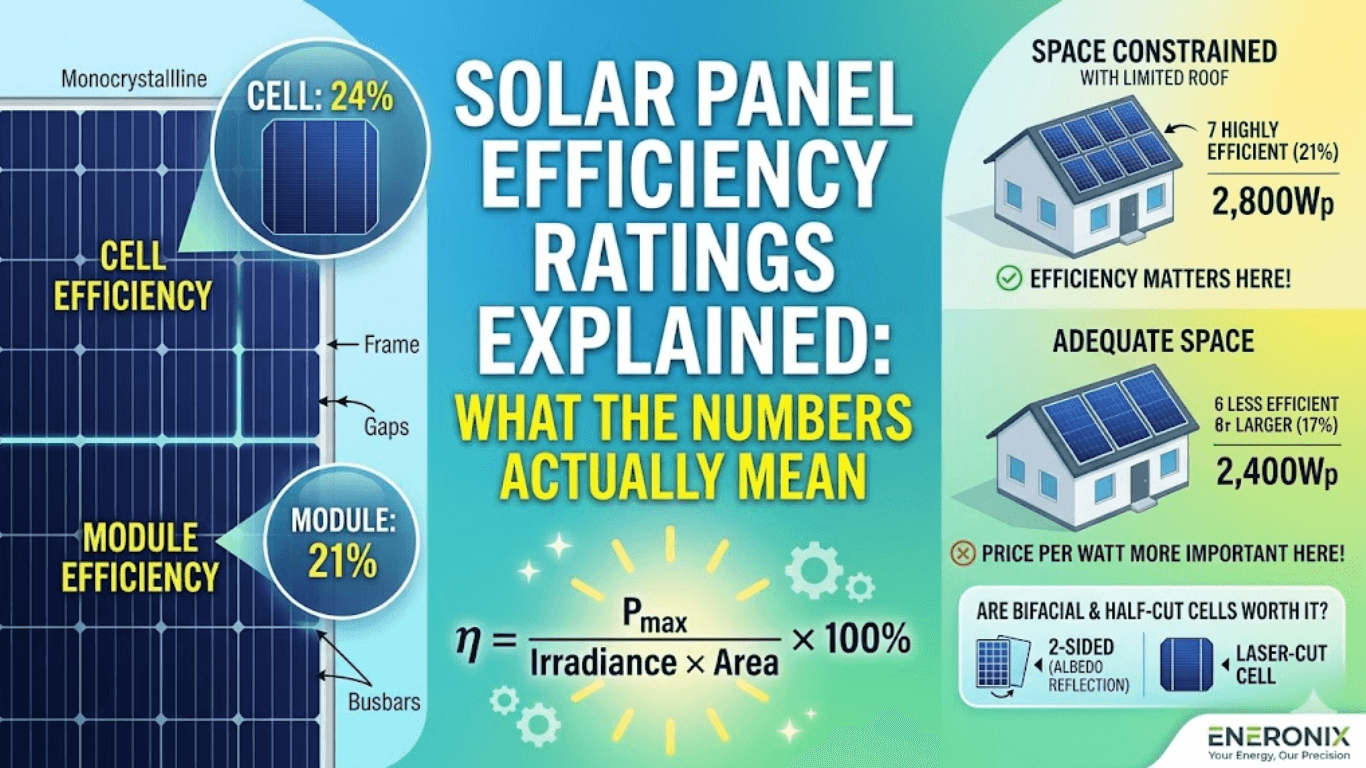
Specifically, it measures how much of the sunlight hitting a panel’s surface is converted into electricity expressed as a percentage of the total solar energy arriving per square metre.
The Efficiency Formula
Before the equation, the plain-language version: take the panel’s rated power output in watts. Divide it by the total solar power hitting the panel’s surface which is the irradiance in watts per square metre multiplied by the panel’s area in square metres. Multiply by 100 to get a percentage. That percentage is efficiency.
η = Pmax / (Irradiance × Area) × 100%
Where η = module efficiency (%), Pmax = rated power at STC (watts), Irradiance = 1,000 W/m² at STC, Area = total panel surface area (m²).
| Worked example 400Wp monocrystalline PERC panel Panel dimensions: 1.722m × 1.134m Step 1 Calculate area: 1.722 × 1.134 = 1.953 m² Step 2 Apply the efficiency formula: η = 400 / (1,000 × 1.953) × 100 η = 400 / 1,953 × 100 η = 0.2048 × 100 η = 20.5% This panel converts 20.5% of the sunlight hitting its surface into electricity at STC. The remaining 79.5% becomes heat. |
What the Percentage Is Actually Telling You
At 1,000 W/m² irradiance the STC reference level 1,000 watts of solar energy hits every square metre of the panel surface.
A panel with 20.5% efficiency converts 205W of that 1,000W per square metre into electricity. The remaining 795W becomes heat. A panel with 17% efficiency converts 170W per square metre. The remaining 830W becomes heat.
That heat matters in Nigeria. The panel that converts less sunlight to electricity produces more waste heat. More heat means a higher cell operating temperature. A higher cell operating temperature means greater output loss from the temperature coefficient. The cycle compounds: lower efficiency panels run hotter, and running hotter makes them less efficient still.
This is why monocrystalline PERC panels which are more efficient also tend to have better temperature coefficients. For the full calculation of how cell temperature drives output loss in Nigerian conditions, see Why Your 400W Solar Panel Doesn’t Produce 400W in Nigeria.
For a full introduction to STC for PV modules and why it matters for Nigerian buyers, see the Solar Panels in Nigeria: Complete Buyer’s Guide.
Cell Efficiency vs Module Efficiency
Walk into a solar shop and ask about efficiency. Most sellers will quote you a single number. What they will not tell you is that there are two different efficiency figures for every solar panel and they are not the same number.
Why Module Efficiency Is Lower Than Cell Efficiency

A solar cell is the individual silicon wafer that converts sunlight to electricity. A solar module what you buy and install on your roof is a collection of those cells assembled into a complete panel.
The assembly process introduces components that take up physical space on the panel surface without contributing to electricity generation:
- The aluminium frame around the perimeter
- Gaps between cells necessary for thermal expansion
- Busbars the metal strips that carry current between cells
- Edge spacing between the outermost cells and the frame
All of this inactive area still counts as panel surface area when you calculate efficiency. Because the total surface area includes both active cells and inactive space, the module efficiency is always lower than the cell efficiency.
A panel with 24% cell efficiency might have 21% module efficiency. The 3 percentage point difference represents real panel surface area that receives sunlight but contributes nothing to output. The number that matters for comparing panels and sizing systems is always module efficiency always.
| Panel Type | Module Efficiency Range (2026) |
| Monocrystalline PERC | 20.0% – 22.8% |
| Half-cut mono PERC | 21.0% – 23.0% |
| Standard polycrystalline | 15.0% – 17.5% |
| Budget / unbranded | Treat any claim above 18% with scepticism unless IEC certified |
| Watch for this in the Nigerian market Some sellers particularly for budget panels cite cell efficiency in marketing materials while the module efficiency on the datasheet is several points lower. When evaluating any panel, check the datasheet specifically for the field labelled ‘Module Efficiency’ or ‘η module.’ If only cell efficiency is stated, ask for clarification before comparing. |
Half-Cut Cells Why They Improve Module Efficiency
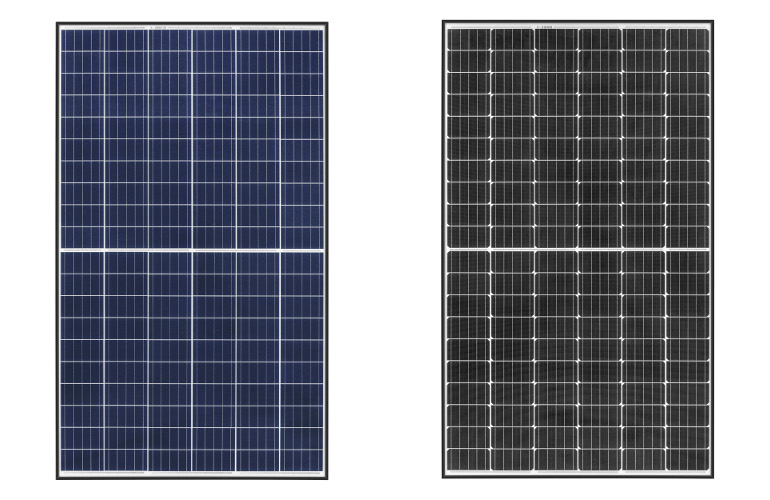
Most tier-1 monocrystalline panels available in Nigeria today use half-cut cell technology. Standard solar cells are full squares or pseudo-squares. Half-cut technology laser-cuts each cell in half before assembly. The result is a panel with twice as many cells, each half the size.
The performance benefit comes from a basic electrical principle. Power lost to resistance inside a solar cell is proportional to the square of the current flowing through it the I²R relationship. When you cut a cell in half, the current flowing through each half-cell drops to approximately half of the original. Because power loss scales with current squared, halving the current reduces resistive losses by approximately 75%.
Less resistive loss means more electricity reaches your battery or inverter instead of being lost as heat inside the panel. This shows up directly as higher module efficiency typically 0.5 to 1.0 percentage points higher than equivalent full-cell panels.
Half-cut cells also improve partial shading performance. In a conventional panel, shade on one cell can reduce output from the entire panel. In a half-cut panel, the top and bottom halves operate as two independent electrical circuits. Shade on the bottom half does not completely eliminate output from the top half.
Half-cut cell technology is a baseline quality indicator on tier-1 panels, not a premium feature. For how cell configuration interacts with string wiring and shading losses, see Series vs Parallel vs Series-Parallel Solar Array Wiring.
Efficiency and Panel Size
Efficiency, wattage, and physical panel size are all connected by the same formula. If you know any two of them, you can calculate the third. Once you understand that relationship, you will see immediately why efficiency matters enormously in some situations and is almost irrelevant in others.
Same Wattage, Different Efficiency What Changes?
Two panels are both rated at 400Wp. One has 21% module efficiency. The other has 17% module efficiency. In terms of power output they are identical. Both produce 400W at STC. What differs is their physical size.
| Area calculation same wattage, different efficiency Using: Area = Pmax / (Irradiance × η) 400Wp panel at 21% efficiency: Area = 400 / (1,000 × 0.21) = 1.90 m² 400Wp panel at 17% efficiency: Area = 400 / (1,000 × 0.17) = 2.35 m² Same rated output. The mono panel fits in 1.90 m². The poly panel needs 2.35 m² nearly 24% more roof space to deliver the same 400W. For a 6-panel array: the efficiency difference means 2.7 m² more roof space required for the poly array. |
Same Size, Different Efficiency What Changes?
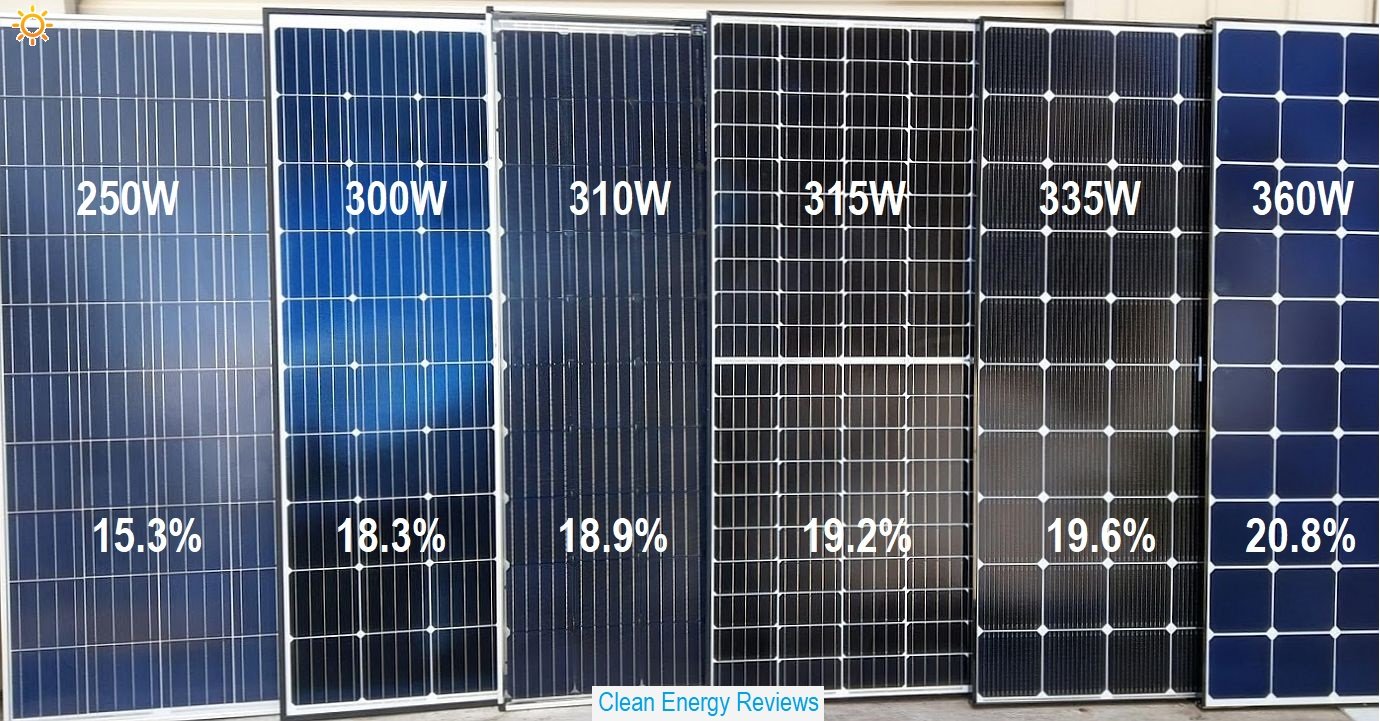
Two panels of identical physical size 2.0 m² each but different efficiency ratings:
| Panel | Area | Efficiency | Calculated Wattage |
| Panel A (mono PERC) | 2.0 m² | 21% | 1,000 × 0.21 × 2.0 = 420Wp |
| Panel B (polycrystalline) | 2.0 m² | 17% | 1,000 × 0.17 × 2.0 = 340Wp |
Same roof footprint. The more efficient panel produces 80W more a 23.5% output difference from identical physical space. This is the scenario where efficiency is everything.
| Lagos bungalow example 15 m² usable roof area At 21% efficiency (mono PERC, 1.90 m² per panel): 15 ÷ 1.90 = 7.9 → 7 panels × 400Wp = 2,800Wp total At 17% efficiency (poly, 2.35 m² per panel): 15 ÷ 2.35 = 6.4 → 6 panels × 400Wp = 2,400Wp total One additional panel 400Wp more capacity from the same 15 m² of roof. That extra panel is what higher efficiency buys you when space is the constraint. |
How to Use Efficiency to Verify Wattage Claims
If a seller tells you a panel is 400Wp, you can verify whether that claim is plausible by checking the panel’s physical dimensions and calculating the implied efficiency.
- Step 1 Record the panel dimensions from the datasheet or the physical panel.
- Step 2 Calculate area: length × width in metres.
- Step 3 Calculate implied efficiency: η = Pmax / (1,000 × area) × 100
- Step 4 Compare against known efficiency ranges for the panel type.
| Scenario | Panel Claim | Dimensions | Area | Implied Efficiency | Verdict |
| Example 1 | 400Wp mono | 2.0m × 1.2m | 2.4 m² | 16.7% | Red flag far below mono PERC range |
| Example 2 | 400Wp mono | 1.75m × 1.10m | 1.925 m² | 20.8% | Plausible within mono PERC range |
| Example 3 | 550Wp mono | 2.28m × 1.13m | 2.577 m² | 21.3% | Plausible within half-cut mono range |
For a complete panel verification framework serial number checks, datasheet verification, and pre-installation output testing see Monocrystalline vs Polycrystalline Solar Panels in Nigeria.
Efficiency at Real Nigerian Operating Temperatures
Everything covered so far applies to Standard Test Conditions 25°C cell temperature, 1,000 W/m² irradiance. Nigerian rooftops are not laboratories.
Cell temperatures of 60–70°C are routine during peak sun hours. At those temperatures, the rated efficiency figure on your panel’s datasheet is no longer the efficiency at which the panel is operating.
How Heat Reduces Your Panel’s Real Operating Efficiency
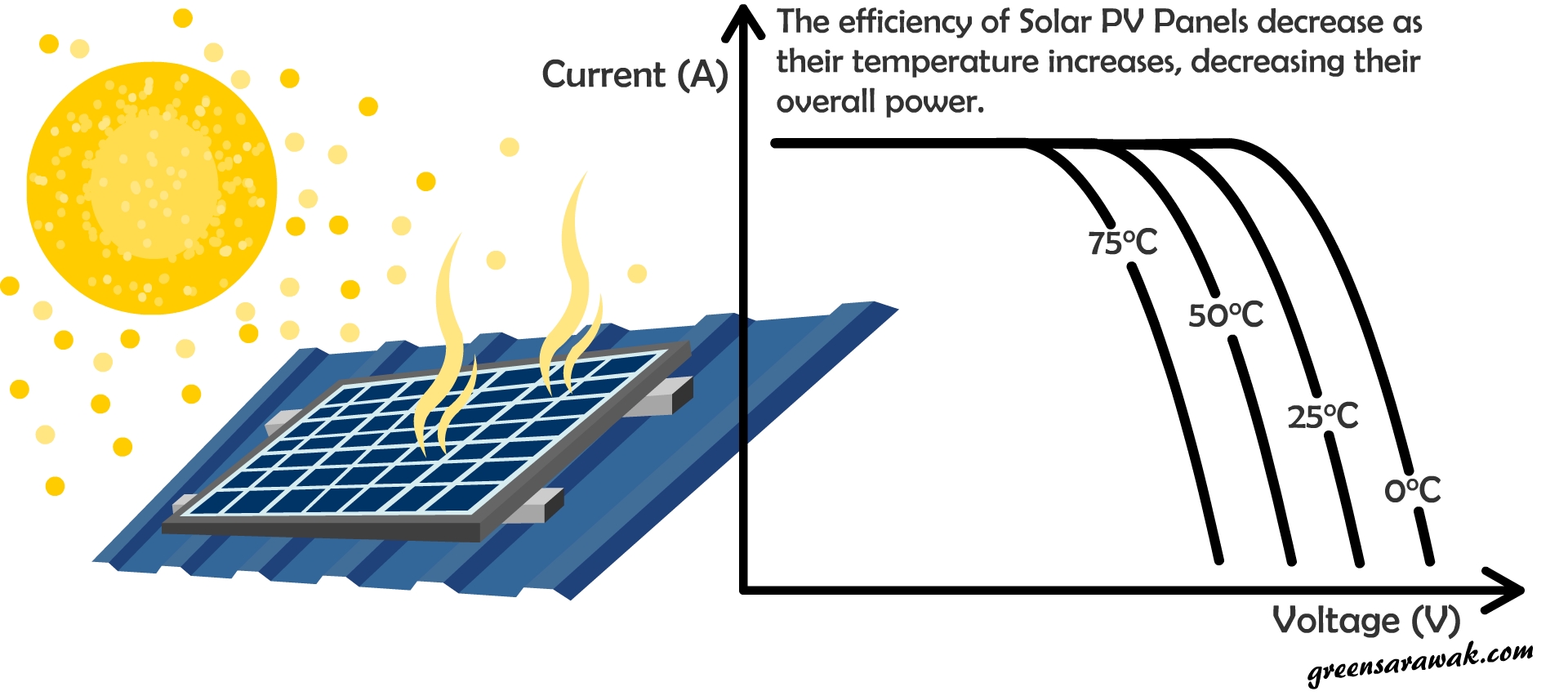
The temperature coefficient of power Pmax expresses how much output a panel loses per degree Celsius above 25°C. The same coefficient applies to efficiency, because efficiency is directly proportional to output power.
| Temperature derating applied to efficiency Abuja, March afternoon Mono PERC: rated efficiency 21%, Pmax = -0.34%/°C, cell temp = 65°C Temperature rise = 65 – 25 = 40°C Power loss = 40 × 0.34% = 13.6% Real operating efficiency = 21% × (1 – 0.136) = 18.1% Polycrystalline: rated efficiency 17%, Pmax = -0.43%/°C, cell temp = 68.9°C Temperature rise = 68.9 – 25 = 43.9°C Power loss = 43.9 × 0.43% = 18.9% Real operating efficiency = 17% × (1 – 0.189) = 13.8% |
| Condition | Mono PERC | Polycrystalline |
| Rated efficiency (STC, 25°C) | 21.0% | 17.0% |
| Cell temperature (Nigerian afternoon) | 65.0°C | 68.9°C |
| Temperature rise above STC | 40.0°C | 43.9°C |
| Power loss from heat | 13.6% | 18.9% |
| Real operating efficiency | 18.1% | 13.8% |
| Efficiency gap at STC | 4.0 percentage points | — |
| Efficiency gap at operating temp | 4.3 percentage points | — |
Two things stand out. First the real operating efficiency of both panels is significantly lower than their STC ratings. Second the efficiency gap between the two panels is larger at Nigerian operating temperatures than at STC. The headline efficiency comparison understates the real-world performance difference.
Why High Efficiency Alone Does Not Exempt a Panel From Derating
A panel with 22% efficiency is subject to exactly the same derating stack as a panel with 17% efficiency temperature reduction, irradiance reduction, dust losses, wiring losses, MPPT inefficiency, and panel mismatch. High efficiency does not reduce any of these losses.
The derating factor of 0.70 introduced in Why Your 400W Solar Panel Doesn’t Produce 400W in Nigeria applies regardless of efficiency. A 400Wp panel at 22% efficiency produces approximately 400 × 0.70 = 280W on a typical Nigerian day. A 400Wp panel at 17% efficiency produces approximately the same 280W because they have the same rated output, just different physical sizes.
The efficiency figure enters the calculation at panel selection it determines how many panels fit on your roof and what wattage they produce from a given area. Once you have selected your panel and know its wattage, the derating calculation from that point forward is identical regardless of efficiency rating.
When Efficiency Matters And When It Does Not
Most of the efficiency conversation in the Nigerian solar market is misdirected. The more important question is whether efficiency is even the right metric for your specific situation.
When Efficiency Is the Right Metric to Prioritise
Efficiency matters when roof space is the binding constraint on your system. If your roof has limited usable area and adding more panels is physically impossible because you have run out of space then every percentage point of efficiency translates directly into more power from that fixed footprint.
- Space-constrained urban rooftops. Lagos bungalows, terraced houses in Abuja, buildings with roof obstructions water tanks, staircase housing, satellite dishes, parapet walls all reduce usable mounting area.
- Rooftops with irregular shapes or multiple orientations. Hipped roofs, L-shaped buildings, and rooftops with multiple pitch sections produce fragmented mounting areas where total usable space is limited.
- Systems where structural load limits panel count. Some older buildings have roof structures that cap the number of panels that can be safely installed. If structural assessment limits you to 6 panels, the wattage of those 6 panels determines your system capacity.
- Commercial rooftops with restricted access zones. Roof areas reserved for HVAC equipment, water storage, or access walkways leave limited mounting area where maximising watts per square metre is the correct design objective.
When Efficiency Is Not the Right Metric to Prioritise
Efficiency does not matter or matters far less when roof space is not your constraint. If you have enough roof area to fit the panel count you need at 17% efficiency, there is no engineering benefit to paying more for 21% efficiency.
- Adequate roof space available. If your roof accommodates your required panel count at lower efficiency without running out of space, efficiency is not your constraint. Focus instead on temperature coefficient, degradation rate, certifications, and price per watt.
- Rural or ground-mounted installations. Land is rarely the constraint. Ground-mounted systems can be sized to whatever panel count the load requires. The correct metric is cost per watt of installed capacity.
- Budget-constrained systems. A verified polycrystalline panel with IEC certification, a good temperature coefficient, and a genuine warranty may deliver better value than an uncertified monocrystalline panel with an inflated efficiency claim.
- Systems where other components are the bottleneck. If your battery bank or MPPT charge controller is the limiting factor, improving panel efficiency will not improve system output.
The Metric That Matters More Than Efficiency Price Per Watt
For the majority of Nigerian solar buyers with adequate roof space, price per watt is a more useful comparison metric than efficiency percentage. It normalises cost against actual output capacity regardless of panel size or efficiency rating.
Price per watt = Panel price ÷ Rated wattage
| Panel | Price | Wattage | Price per Watt | Notes |
| Mono PERC 400Wp (21% eff.) | ₦320,000 | 400Wp | ₦800/Wp | Same output as poly panel below |
| Poly 400Wp (17% eff.) | ₦210,000 | 400Wp | ₦525/Wp | ₦275/Wp cheaper for same output |
| Mono PERC 550Wp (21% eff.) | ₦390,000 | 550Wp | ₦709/Wp | More watts, lower cost per watt than 400Wp mono |
For correctly sizing your array from verified panel output using price per watt alongside real derating factors see Solar Array Sizing for Off-Grid Lithium Battery Systems and use the Eneronix Off-Grid Solar Sizing Calculator.
Bifacial Panels The Efficiency Claim Worth Examining Carefully

Bifacial solar panels are appearing more frequently in the Nigerian market. Sellers market them on the basis of higher effective output sometimes claiming 10–20% more energy than a standard panel of the same rated wattage. The technology is real. The claimed gains, in most Nigerian rooftop installations, are not.
What Bifacial Panels Actually Do
A standard solar panel has active solar cells on one side only the front. A bifacial panel replaces the opaque backsheet with a transparent layer usually glass. Both the front and rear surfaces carry active solar cells.
The front generates power from direct sunlight as normal. The rear generates power from sunlight that has reflected off the surface beneath the panel and bounced upward. This reflected light is called albedo radiation. The proportion of incoming sunlight that a surface reflects upward is its albedo coefficient.
Total bifacial output = front generation + (rear generation × bifacial factor)
The bifacial factor is typically 0.65–0.80. Rear generation depends entirely on how much albedo radiation is available beneath the panel and that is where Nigerian rooftop reality diverges sharply from manufacturer claims.
Why Bifacial Gain Is Often Minimal on Nigerian Rooftops
Manufacturer bifacial gain claims of 10–20% are based on high-albedo surfaces beneath the panels typically white sand, light-coloured gravel, white membrane roofing, or snow-covered ground with panels mounted at height above the surface. Most Nigerian rooftop installations meet none of these conditions.
| Surface | Albedo Coefficient | Realistic Bifacial Rear Gain |
| Unpainted galvanised iron sheet | 0.10 – 0.20 | 2 – 4% |
| Grey or dark concrete | 0.15 – 0.25 | 3 – 5% |
| Dark painted iron sheet | 0.05 – 0.15 | 1 – 3% |
| White-painted concrete | 0.50 – 0.70 | 10 – 14% |
| White membrane roofing | 0.55 – 0.75 | 11 – 15% |
| Light sand / gravel (ground mount) | 0.20 – 0.35 | 4 – 7% |
| The Nigerian rooftop reality The dominant rooftop surface in Nigeria unpainted galvanised iron sheet has an albedo of 0.10–0.20. On this surface, realistic bifacial rear gain is 2–4%. The 10–20% gain marketed by sellers assumes albedo values of 0.40–0.60 or higher typical of open-field or white-surface installations. Buyers paying a bifacial premium expecting 15% more output from a Lagos rooftop will be disappointed. |
Before paying a bifacial premium, ask your seller two specific questions: what is the albedo of my rooftop surface, and what rear gain percentage are you assuming in the system output calculation? If they cannot answer both questions with specific numbers, the bifacial claim is marketing, not engineering.
Reading the Efficiency Figure on a Panel Datasheet

Everything in this article becomes actionable when you can correctly read and verify the efficiency figure on a panel datasheet.
Where to Find It and What to Look For
On a legitimate solar panel datasheet, module efficiency is listed in the electrical performance table labelled ‘Module Efficiency’, ‘η module’, or ‘Panel Efficiency’. It is expressed as a percentage. If the datasheet lists only ‘Cell Efficiency’ without a separate ‘Module Efficiency’ figure, ask specifically for module efficiency.
- Is the efficiency realistic for the stated panel type? Mono PERC: 20.0–22.8%. Half-cut mono: 21.0–23.0%. Standard poly: 15.0–17.5%. Any panel claiming above 23% verify dimensions carefully.
- Does the efficiency match the panel’s physical dimensions? Calculate area from dimensions. Apply: Pmax = Irradiance × Area × η. If the result does not match the stated wattage within 2–3%, something is wrong with the claim.
- Is the efficiency figure backed by IEC certification? Without IEC 61215 from a named testing body TÜV Rheinland, Bureau Veritas, UL the efficiency claim has not been independently tested. Treat it as an estimate, not a specification.
- Is the efficiency measured at STC? All legitimate efficiency figures are measured at STC. If a seller claims their panel maintains high efficiency at Nigerian temperatures, they are misrepresenting the measurement standard.
The thirty-second verification check
1. Get the panel dimensions length × width in metres
2. Calculate area: length × width
3. Calculate implied efficiency: η = Pmax / (1,000 × area) × 100
4. Compare against the stated efficiency and the realistic range for the panel type
5. If implied efficiency is more than 1–2 points above the stated figure, the wattage is overstated
6. If implied efficiency is significantly below the range for the stated panel type, the panel is misclassified This check takes thirty seconds. It requires no equipment. It will immediately expose any panel where the wattage claim is physically inconsistent with the panel’s size.
The Verdict Efficiency Is a Tool, Not a Score
Solar panel efficiency is a specific, well-defined measurement: the percentage of incoming solar irradiance that a panel converts to electricity per unit of surface area, measured at Standard Test Conditions. It is not a quality score. It is a conversion rate.
| Efficiency tells you | Efficiency does NOT tell you |
| How much power a panel produces per m² at STC | How the panel performs in Nigerian heat that is the temperature coefficient |
| How physically large a panel of a given wattage will be | How quickly the panel degrades over 25 years that is the degradation rate |
| Whether a wattage claim is plausible given the panel’s dimensions | Whether the panel is manufactured to its specification that is the certification |
| How much power the panel delivers to your battery that requires a full derating calculation |
For most Nigerian buyers those with adequate roof space and a standard residential or commercial installation the purchase decision should be driven in this order: verified certifications first, temperature coefficient second, degradation rate third, price per watt fourth. Efficiency percentage comes after all of these.
For buyers with genuinely space-constrained rooftops, efficiency moves up the priority list because more efficient panels extract more power from limited area. Even then, the panel must still pass the certification and temperature coefficient checks before efficiency justifies a premium.
The Nigerian solar market will continue to market efficiency percentages prominently because they are simple numbers that are easy to compare. Now you know what the number actually measures, when it matters, and how to verify it is real.
For the complete panel selection framework covering type, efficiency, temperature coefficient, degradation, price, and verification start with the Solar Panels in Nigeria: Complete Buyer’s Guide. To correctly size your system from verified panel output, use the Eneronix Off-Grid Solar Sizing Calculator.
Frequently Asked Questions
1. What does solar panel efficiency actually mean?
Efficiency measures the percentage of incoming solar energy that a panel converts into electricity per unit of surface area, at Standard Test Conditions. A 21% efficient panel converts 210W of every 1,000W of sunlight hitting each square metre into electricity. The remaining 790W becomes heat. It is a conversion rate, not a quality score.
2. What is the difference between cell efficiency and module efficiency?
Cell efficiency is measured on an individual silicon cell in isolation. Module efficiency is measured on the complete assembled panel including frame, gaps between cells, and busbars which reduces the figure by 2–4 percentage points. The number on the datasheet should always be module efficiency. If a seller quotes cell efficiency, ask for the module efficiency figure before comparing panels.
3. What efficiency should I expect from a good solar panel in Nigeria in 2026?
Monocrystalline PERC panels: 20–22.8%. Half-cut mono PERC: 21–23%. Standard polycrystalline: 15–17.5%. Any monocrystalline panel claiming above 23% module efficiency should be verified carefully against its datasheet dimensions. Any uncertified panel claiming above 18% should be treated with scepticism.
4. Does higher efficiency mean more power from my system?
Not necessarily. Two panels with different efficiency ratings but the same wattage produce the same power they are just different physical sizes. Higher efficiency only produces more power when roof space is the constraint and you need maximum watts from a fixed area. If you have adequate roof space for both panel sizes, efficiency does not change your system output.
5. How do I verify a panel’s efficiency claim?
Measure or record the panel dimensions. Calculate area: length × width. Then calculate implied efficiency: η = Pmax ÷ (1,000 × area) × 100. Compare the result against the stated efficiency and the realistic range for the panel type. A significant discrepancy means the wattage or efficiency claim is overstated.
6. Does high efficiency protect a panel from Nigeria’s heat?
No. A high-efficiency panel is subject to the same temperature derating as a low-efficiency panel. The derating factor of 0.70 used for Nigerian system sizing applies to all panels regardless of efficiency rating. What reduces heat losses is a better temperature coefficient not a higher efficiency percentage.
7. Are bifacial panels worth buying for a Nigerian rooftop?
It depends on your rooftop surface. On unpainted iron sheet or grey concrete the most common Nigerian rooftop surfaces realistic bifacial rear gain is 2–5%. This is far below the 10–20% gains marketed by sellers, which assume high-albedo surfaces. Unless your rooftop is white-painted concrete or white membrane roofing, the bifacial premium is unlikely to recover its cost over the system lifetime.
8. What is half-cut cell technology and does it matter?
Half-cut cells reduce resistive losses inside the panel by cutting each cell in half which reduces current per cell and therefore I²R losses by approximately 75%. This improves module efficiency by 0.5–1.0 percentage points and improves partial shading performance. It is a baseline quality indicator on tier-1 monocrystalline panels, not a premium feature.
9. Is price per watt or efficiency percentage a better comparison metric?
Price per watt is the better metric for most Nigerian buyers with adequate roof space. It normalises cost against actual output capacity regardless of panel size or efficiency. Calculate it as: panel price ÷ rated wattage. Two panels producing the same wattage at different efficiencies deliver the same power the lower cost-per-watt option is the better purchase if roof space is not a constraint.
10. What efficiency figure should I use when sizing my solar system?
Do not use efficiency directly in system sizing. Use the panel’s rated wattage verified against its dimensions and apply the 0.70 derating factor for Nigerian conditions. Efficiency determines the physical size of the panel and its wattage per square metre. Once you have the wattage, sizing proceeds from that number using peak sun hours and derating factors, regardless of the efficiency percentage. Use the Eneronix Off-Grid Solar Sizing Calculator for a complete verified calculation.

I am Engr. Ubokobong Ekpenyong, a solar specialist and lithium battery systems engineer with over five years of hands-on experience designing, assembling, and commissioning off-grid solar and energy storage systems. My work focuses on lithium battery pack architecture, BMS configuration, and system reliability in off-grid and high-demand environments.