You have probably heard someone say: never charge your battery above 80% and never let it drop below 20%. Maybe your installer mentioned it. Maybe you saw it online. But most people who follow the 80/20 Rule for Lithium Batteries advice do not fully understand why it works, and because they do not understand it, they either follow it too strictly or ignore it completely.
This post explains the 80/20 rule properly. What it actually means, why it works at the chemistry level, how it applies to the type of battery in your solar or inverter system, and exactly how to set it up on your inverter so you do not have to think about it every day.
The 80/20 rule is simple: in daily use, charge your lithium battery to a maximum of 80% and do not discharge it below 20%. That 60% window in the middle, from 20% to 80%, is where lithium batteries experience the least chemical stress.
It is sometimes called the 20-80 rule. Same thing, just said in reverse. The point is identical: stay out of the extremes.
Now here is the part that surprises most people. It is not just about the bottom 20%. The top 20% is equally damaging, maybe more so.
When a lithium cell is pushed to its maximum voltage, what the battery sees at 100%, the internal chemistry becomes unstable. Electrolyte oxidation accelerates. Lithium plating starts to occur. These are not sudden failures. They are slow, quiet, cumulative processes. You will not notice them for months. Then one day the battery that used to last all night starts cutting off at 10 PM.
The bottom 20% causes a different kind of damage. Lithium-ion anodes become structurally unstable at very low charge. Internal resistance rises. In extreme cases, where the battery sits at zero percent for days, cells can enter deep discharge, a condition that is sometimes irreversible.
The middle 60% keeps voltage moderate, keeps the chemistry stable, and keeps heat generation low. That is the physics behind the rule.
Does This Rule Apply to LiFePO4?
This is an important nuance that most generic battery articles skip past.
The 80/20 rule was originally developed for NMC lithium-ion batteries, the chemistry found in smartphones, laptops, and many electric vehicles. These batteries are more sensitive to voltage extremes, and the rule applies to them strictly.
LiFePO4 (Lithium Iron Phosphate), which is what most quality solar and inverter battery systems use, is more chemically stable. It handles deeper discharges better than NMC. Most LiFePO4 manufacturers rate their batteries at 80% Depth of Discharge, meaning they are designed to go from 100% down to 20% regularly.
So does the 80/20 rule for Lithium Batteries still apply?
Yes, but with a key modification for LiFePO4:
The bottom limit of 20% still stands. Going below 20% regularly accelerates cell degradation even in LiFePO4.
1. The top limit is more flexible. Charging to 90% instead of 100% for daily use is a reasonable target. Charging to 100% occasionally, once or twice a week, is fine and actually helps the BMS balance the cells.
2. The strictest protection comes from never sitting at 100% for long periods, especially in high temperatures. That combination, full charge plus heat, is what ages LiFePO4 fastest.
3. In a Nigerian solar context, where your battery room can get very hot during the day, this matters a lot. A battery sitting at 100% in a 40°C room every afternoon is aging much faster than the spec sheet assumes.
Here is what the 80/20 rule actually does to your cycle count, in concrete terms.
A typical LiFePO4 battery cycled from 100% to 0% repeatedly, what engineers call 100% Depth of Discharge, might deliver around 1,500 to 2,000 cycles before capacity drops to 80% of original.
The same battery cycled within the 20% to 80% range, 60% Depth of Discharge, can deliver 3,000 to 5,000 cycles or more under the same conditions.
That is not a small difference. That is the difference between a battery that lasts 4 years and one that lasts 10 years, running the same system.
At current lithium battery prices in Nigeria, that gap represents a significant amount of money, money that stays in your pocket simply because of how you configured your inverter.
How to Actually Set This Up
Understanding the rule is one thing. Applying it without thinking about it every day is what actually matters. The good news is that modern inverters let you automate both limits completely.
Here is what to configure:
1. Charge voltage limit (upper cutoff): Set your inverter's absorption voltage to the level that corresponds to approximately 90% SOC for your battery. For a 48V LiFePO4 pack, that is typically around 54.4V to 55.2V depending on your battery brand. Check your battery's datasheet, this number is usually called the recommended charge voltage.
2. Discharge cutoff (lower limit): Set your inverter's low battery cutoff to the voltage that corresponds to approximately 20% SOC. For a 48V LiFePO4, this is typically around 48V to 49V. Again, check your battery's datasheet. Different brands have slightly different flat curves.
3. Allow a weekly full charge: Once a week or so, let the battery reach 100%. This gives the BMS the chance to run a full top-balance on the cells. Without occasional full charges, cell imbalance builds up quietly over months and shows up as early shutdowns.
4. Do not let it sit at zero: If NEPA stays off for days and your solar is not enough to recharge the system, do not leave the battery sitting at or below the cutoff for extended periods. Charge it from a generator or any available source if it will sit unused for more than a day or two at a very low state.
A lot of people hear the 80/20 rule and think: so I am only using 60% of the battery I paid for. That feels wasteful.
Here is how to think about it correctly.
You are not losing 40% of your capacity permanently. You are trading a small daily restriction for a dramatically longer total lifespan. The total energy you extract from the battery over its lifetime is significantly higher when you follow the 80/20 rule than when you do not.
Think of it like a generator. You can push it to 100% load every time it runs. Or you can run it at 80% load consistently. The one running at 80% will still be working in 10 years. The one running at 100% will need a rebuild in three.
The battery is the same. The rule is not a restriction. It is an investment strategy.
FAQ
Does the 80/20 rule apply to LiFePO4 batteries?
Yes, with a modification. The 80/20 rule was originally developed for NMC lithium-ion batteries which are more sensitive to voltage extremes. LiFePO4 handles the bottom of the range more tolerantly, most manufacturers rate it at 80% depth of discharge, meaning 100% down to 20% is within normal operating parameters. The top limit still applies: daily charging to 90% rather than 100% meaningfully extends LiFePO4 cycle life, especially in hot climates. Allow full charges to 100% occasionally for cell balancing.
What voltage is 80% on a 48V LiFePO4 battery?
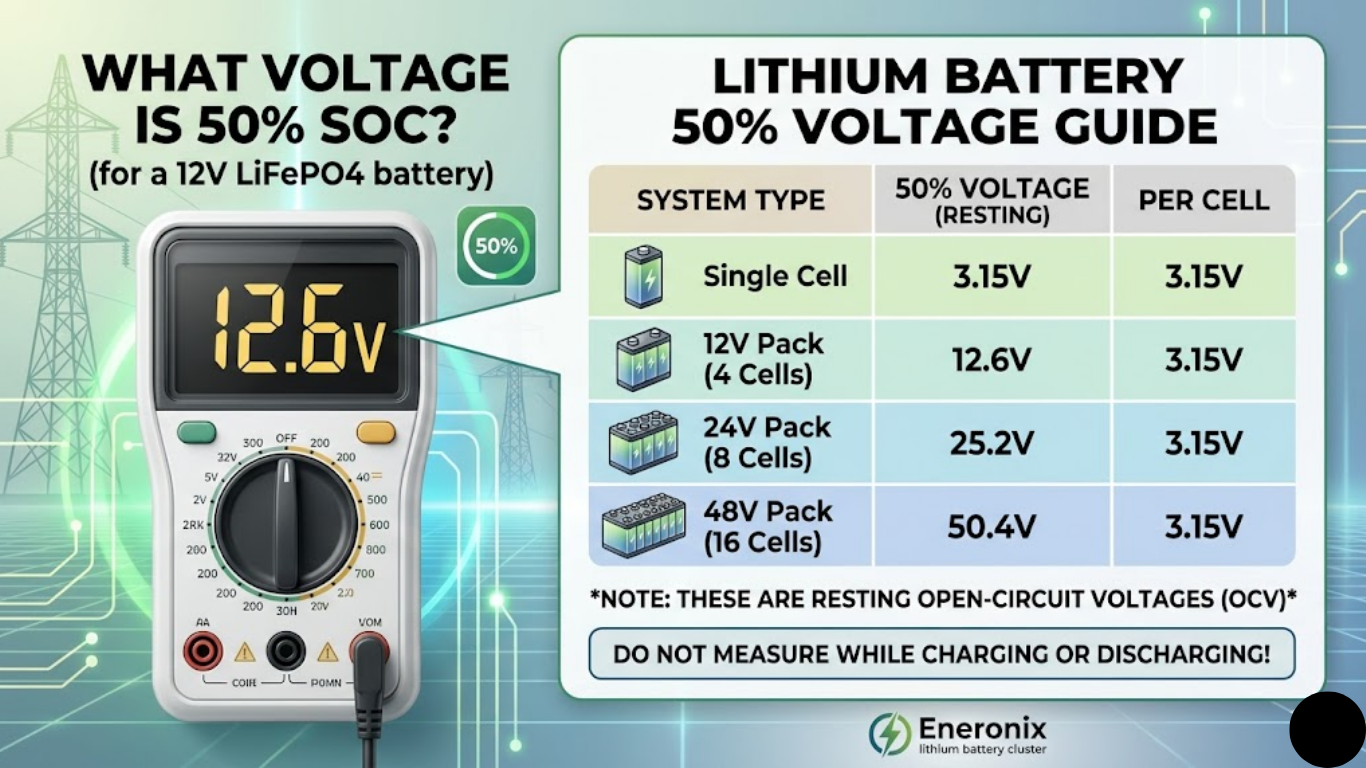
On a 48V LiFePO4 battery pack, 80% state of charge corresponds to approximately 52.8V resting voltage. The charge voltage limit that stops the battery at roughly 90% is typically set at 54.4V to 55.2V depending on your battery brand. Check your battery’s datasheet for the exact recommended charge voltage, this is the figure to enter into your inverter’s absorption voltage setting.
What voltage should I set as the low battery cutoff on my inverter?
For a 48V LiFePO4 battery, set the inverter’s low battery cutoff voltage to 48V to 49V, which corresponds to approximately 20% state of charge. This is the voltage at which the inverter should stop drawing power from the battery. Some BMS units will also enforce their own low-voltage protection cutoff, the inverter setting should engage before the BMS cutoff to avoid the abrupt shutdown that BMS protection trips cause.
Can I damage a lithium battery by following the 80/20 rule too strictly?
No, being conservative about the charge ceiling and discharge floor will never damage a lithium battery. The only risk from following the rule too strictly is that you use less of your available capacity each day than you paid for. If your system has adequate capacity and you are comfortable with the runtime, there is no harm in running within an even narrower window, say 25% to 85%, for even longer cycle life. The rule is a minimum standard, not a ceiling.
How do I set the 80/20 rule on a Victron Multiplus or Growatt inverter?
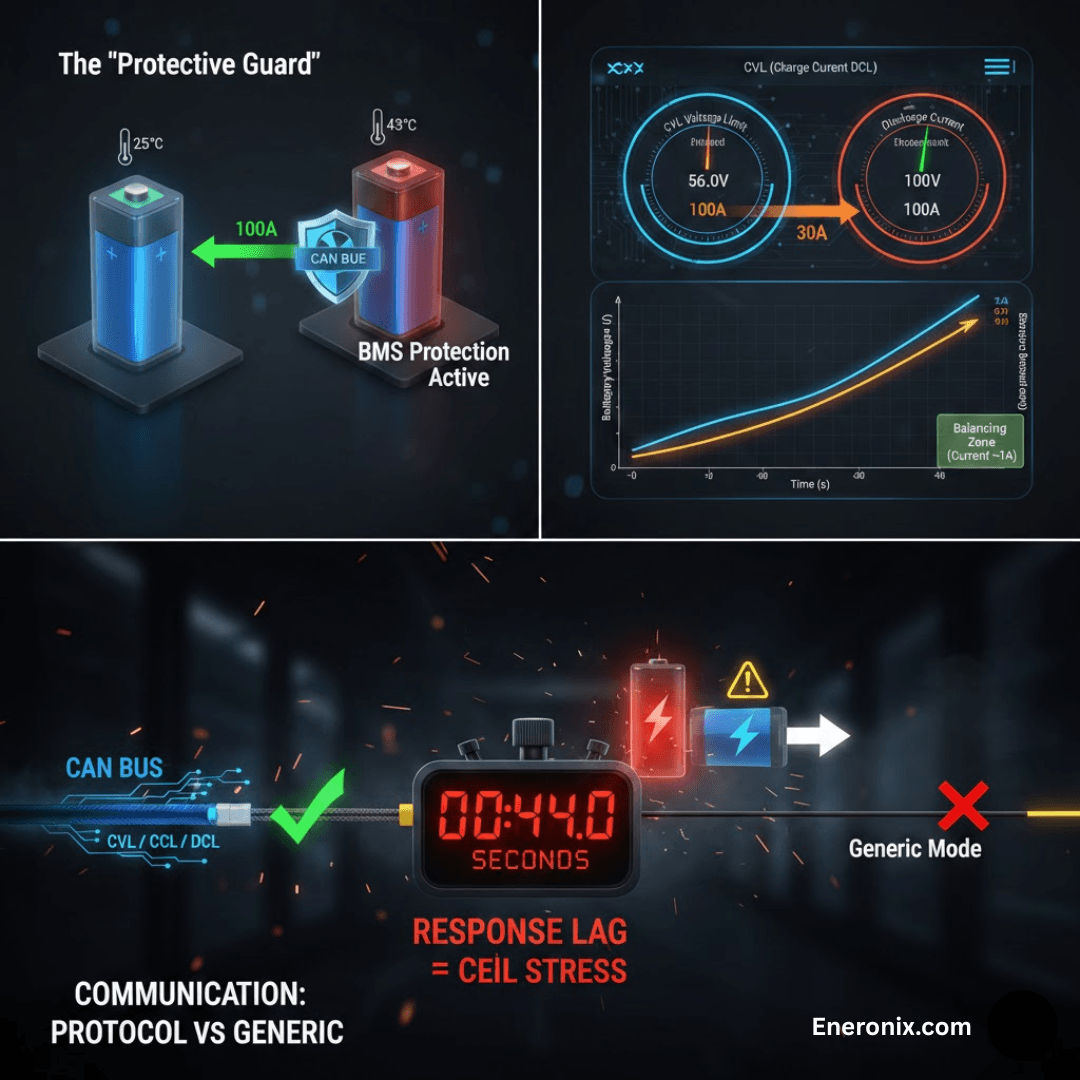
On a Victron Multiplus, set the absorption voltage to the charge ceiling value from your battery datasheet, typically 54.4V to 56.8V for a 48V LiFePO4 system and set the low battery cutoff in the VEConfigure software to 48V to 49V. If using BMS communication via CAN bus, the BMS will send dynamic CVL and CCL values directly to the inverter, which override the manual settings. On a Growatt SPF or SPH series, the equivalent settings are in the battery parameters menu, set charge voltage limit and battery low voltage protection to the values from your battery’s datasheet.
The Bottom Line
The 80/20 rule for lithium batteries is not just internet advice. It is backed by the electrochemistry of how lithium cells age. Stay out of the extremes, both at the top and the bottom, and your battery will last significantly longer than one that is pushed to its limits every day.
For LiFePO4 batteries in a solar system: target 90% as your daily upper limit, set 20% as your lower cutoff, allow a full charge once a week, and configure both limits on your inverter so you never have to think about it again.
That single configuration change is one of the highest-value things you can do for your battery system. No new hardware. No extra cost. Just smarter settings.
I am Engr. Ubokobong Ekpenyong, a solar specialist and lithium battery systems engineer with over five years of hands-on experience designing, assembling, and commissioning off-grid solar and energy storage systems. My work focuses on lithium battery pack architecture, BMS configuration, and system reliability in off-grid and high-demand environments.
Contains information related to marketing campaigns of the user. These are shared with Google AdWords / Google Ads when the Google Ads and Google Analytics accounts are linked together.
90 days
__utma
ID used to identify users and sessions
2 years after last activity
__utmt
Used to monitor number of Google Analytics server requests
10 minutes
__utmb
Used to distinguish new sessions and visits. This cookie is set when the GA.js javascript library is loaded and there is no existing __utmb cookie. The cookie is updated every time data is sent to the Google Analytics server.
30 minutes after last activity
__utmc
Used only with old Urchin versions of Google Analytics and not with GA.js. Was used to distinguish between new sessions and visits at the end of a session.
End of session (browser)
__utmz
Contains information about the traffic source or campaign that directed user to the website. The cookie is set when the GA.js javascript is loaded and updated when data is sent to the Google Anaytics server
6 months after last activity
__utmv
Contains custom information set by the web developer via the _setCustomVar method in Google Analytics. This cookie is updated every time new data is sent to the Google Analytics server.
2 years after last activity
__utmx
Used to determine whether a user is included in an A / B or Multivariate test.
18 months
_ga
ID used to identify users
2 years
_gali
Used by Google Analytics to determine which links on a page are being clicked
30 seconds
_ga_
ID used to identify users
2 years
_gid
ID used to identify users for 24 hours after last activity
24 hours
_gat
Used to monitor number of Google Analytics server requests when using Google Tag Manager
1 minute
You can find more information in our Cookie Policy and .