
How Long Will a 150Ah Battery Last?
Quick Answer:
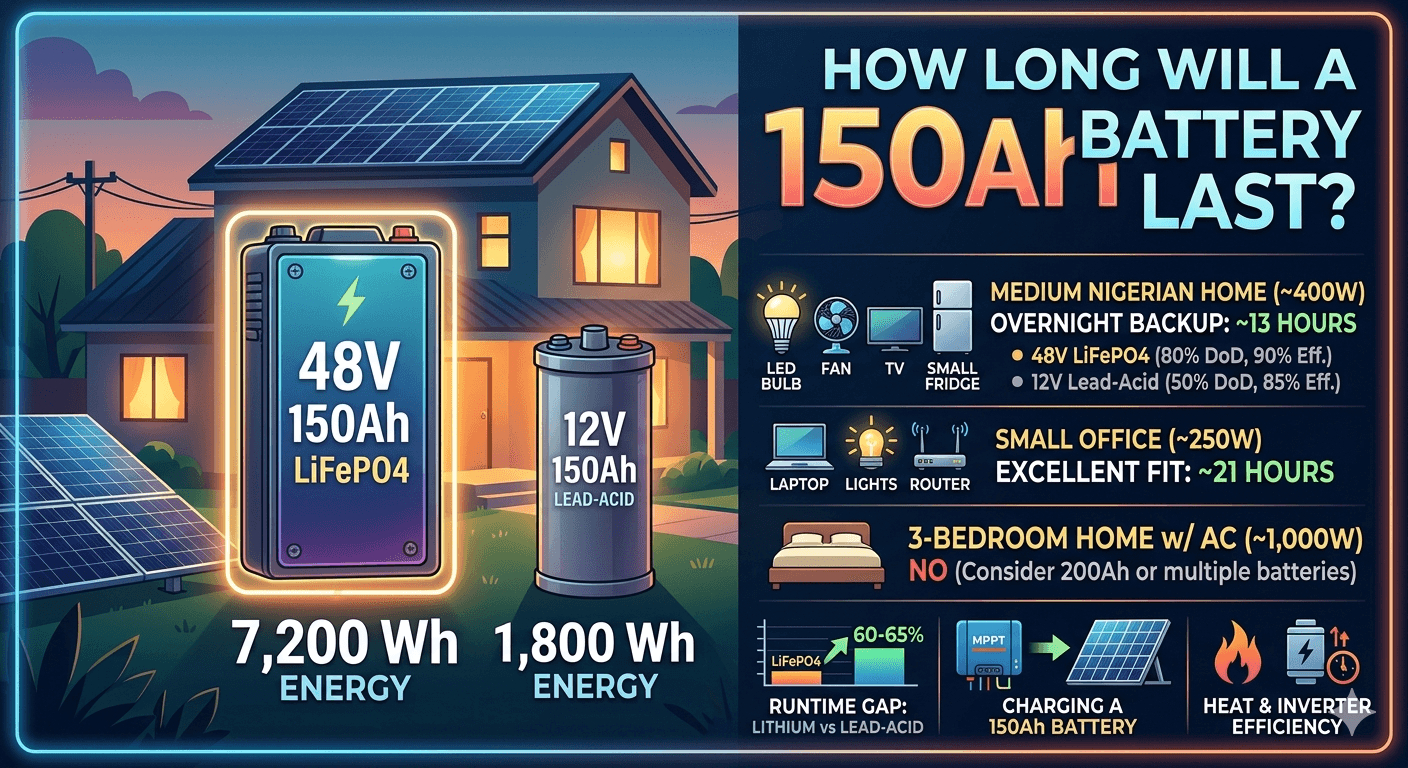
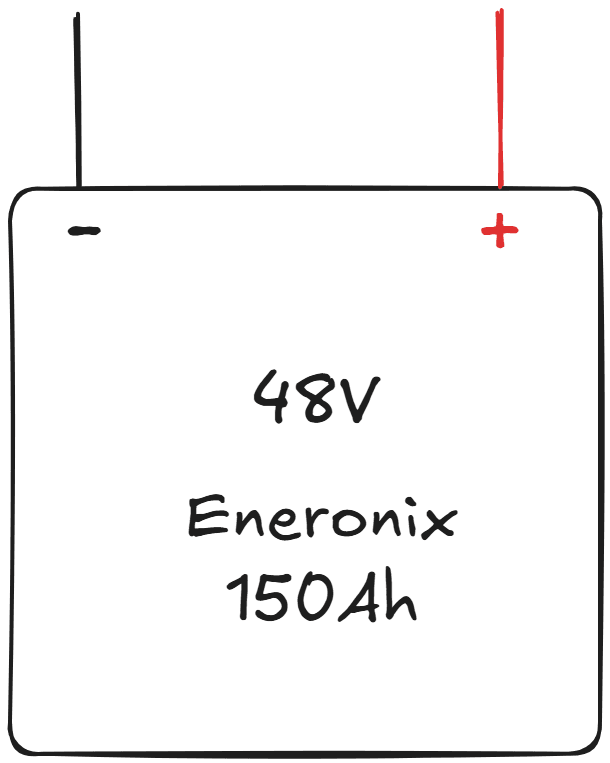
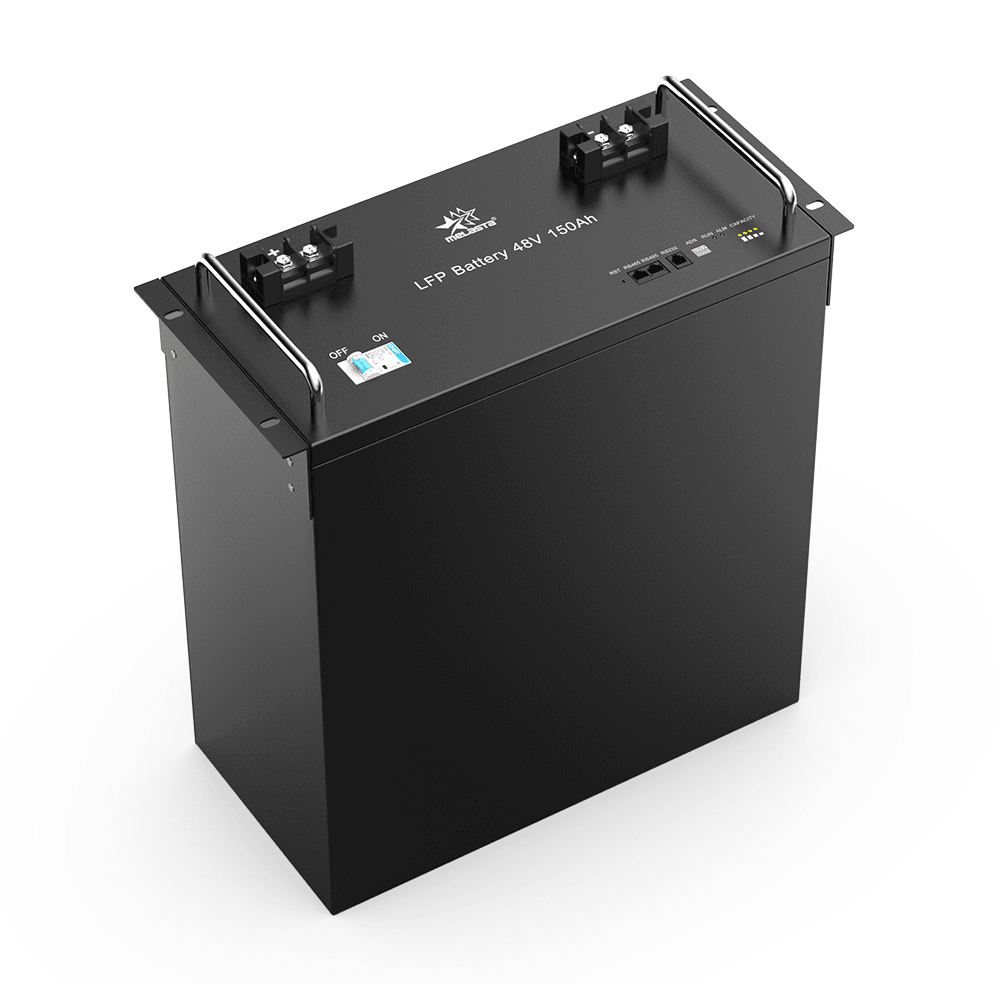
A 48V 150Ah LiFePO4 battery holds 7,200 Wh. At a 500W load it lasts roughly 10.4 hours. At 300W it stretches to about 17.3 hours. Runtime depends on your system voltage, chemistry, depth of discharge, and inverter efficiency. Keep reading for the full formula and real-world tables.
Nobody talks about the 150Ah battery. Online forums argue 100Ah vs 200Ah. Electrical shops push one or the other. But the 150Ah sits quietly in the middle, and for a large number of Nigerian homes and small offices, it is actually the better fit.
The 100Ah is not quite enough to carry a fridge through the night alongside other loads. The 200Ah is more capacity than a single-room apartment or small office genuinely needs. The 150Ah hits the gap, and yet most buyers skip it because the conversation never gets that specific.
This article gives you the exact numbers for a 150Ah battery at every common load level, in an honest format that does not confuse voltage differences with chemistry advantages. By the end you will know whether 150Ah is the right size for your situation, and precisely how long it will last if it is.
How Much Energy Does a 150Ah Battery Actually Hold?
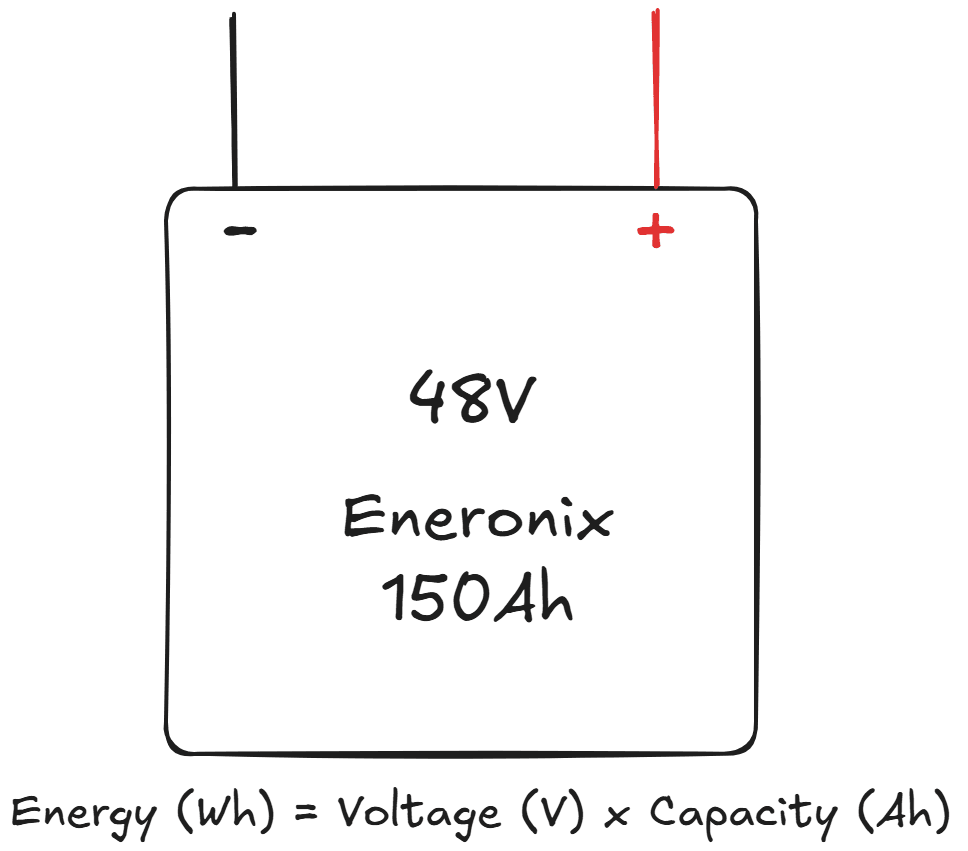
The Ah rating alone tells you nothing useful until you pair it with voltage. Energy is what drives appliances, and energy is measured in watt-hours (Wh), not amp-hours.
Energy (Wh) = Voltage (V) x Capacity (Ah)
For a 150Ah battery across common system voltages:
| System Voltage | Capacity | Total Energy | Typical Application |
| 12V | 150Ah | 1,800 Wh (1.8 kWh) | Small legacy setups |
| 24V | 150Ah | 3,600 Wh (3.6 kWh) | Mid-size off-grid |
| 48V | 150Ah | 7,200 Wh (7.2 kWh) | Modern solar installations |
A 48V 150Ah system stores four times the energy of a 12V 150Ah system. This is the number that should anchor every runtime estimate you read, including the ones in this article. Any comparison between systems at different voltages is a comparison of different energy quantities, not just chemistry. We cover this distinction fully in our article on lithium vs tubular battery in Nigeria.
The Runtime Formula
Runtime (hrs) = (Total Wh x Usable % x Inverter Efficiency) / Load (W)
Breaking down each variable for a 48V 150Ah LiFePO4 system:
- Total Wh: 48 x 150 = 7,200 Wh
- Usable % (DoD): 80% for LiFePO4 lithium. 50% for lead-acid to protect cycle life. Discharging lead-acid below 50% consistently shortens its lifespan dramatically. See our guide on how charge and discharge cycles affect lithium battery lifespan.
- Inverter efficiency: 90% is a reliable figure for quality inverters. Budget units can drop to 80 to 85%. This factor alone can cost you 45 to 90 minutes of runtime on a 500W load.
- Load (W): Every watt counts. Include standby loads, chargers, and background devices. Our phantom loads guide helps you find the loads you are probably not counting.
Worked Example: 48V 150Ah LiFePO4 in a Nigerian Home
A realistic evening load for a medium Nigerian home or small office:
| Appliance | Watts | Qty | Total |
| LED lights | 10W | 5 | 50W |
| Ceiling fans | 55W | 2 | 110W |
| 32-inch TV | 50W | 1 | 50W |
| Decoder/satellite | 15W | 1 | 15W |
| Phone and laptop charging | 30W | 3 | 90W |
| WiFi router | 10W | 1 | 10W |
| Small refrigerator (100L) | 80W avg | 1 | 80W |
| Total | 405W |
Applying the formula:
- Total energy: 48V x 150Ah = 7,200 Wh
- Usable energy (80% DoD): 7,200 x 0.80 = 5,760 Wh
- After inverter losses (90%): 5,760 x 0.90 = 5,184 Wh
- Runtime: 5,184 / 405W = approximately 12.8 hours
At a realistic medium-home load of 405W including a small fridge, a 48V 150Ah LiFePO4 battery runs for nearly 13 hours. That comfortably covers an overnight NEPA outage from 9 PM to 9 AM with margin to spare. This is the scenario where the 150Ah earns its position between the 100Ah and 200Ah options.
Runtime Tables: Fair and Real-World Comparisons
Note on these tables: Table A compares same-voltage systems to isolate chemistry differences. Table B shows the typical real-world upgrade scenario where voltage changes alongside chemistry. Both tables are necessary because they answer different questions. Reading only one gives you an incomplete picture.
Table A: 48V 150Ah Lithium vs 48V 150Ah Lead-Acid (Same Energy, Chemistry Only)
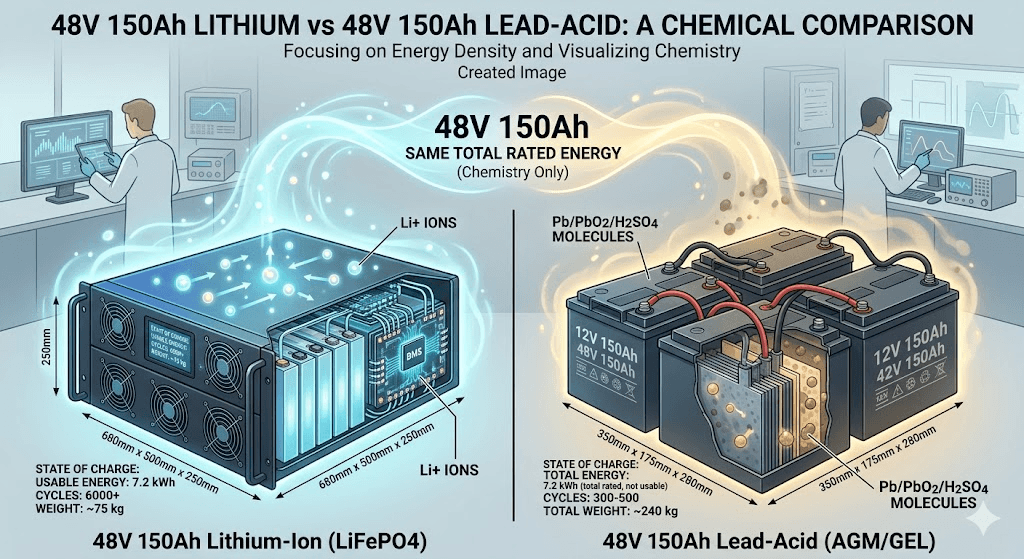
Both systems store 7,200 Wh. The only differences are usable depth of discharge and efficiency:
| Load | 48V 150Ah LiFePO4 (80% DoD, 90% eff.) | 48V 150Ah Lead-Acid (50% DoD, 85% eff.) |
| 200W | ~20.7 hrs | ~12.8 hrs |
| 400W | ~10.4 hrs | ~6.4 hrs |
| 600W | ~6.9 hrs | ~4.3 hrs |
| 1,000W | ~4.1 hrs | ~2.6 hrs |
| 1,500W | ~2.8 hrs | ~1.7 hrs |
| 2,000W | ~2.1 hrs | ~1.3 hrs |
The chemistry advantage is real and consistent: LiFePO4 lasts 60 to 65% longer than lead-acid at the same voltage and Ah rating. This gap does not come from marketing. It comes from the higher safe depth of discharge and lower internal losses of lithium iron phosphate cells.
Table B: 48V 150Ah LiFePO4 vs 12V 150Ah Lead-Acid (Upgrade Comparison)
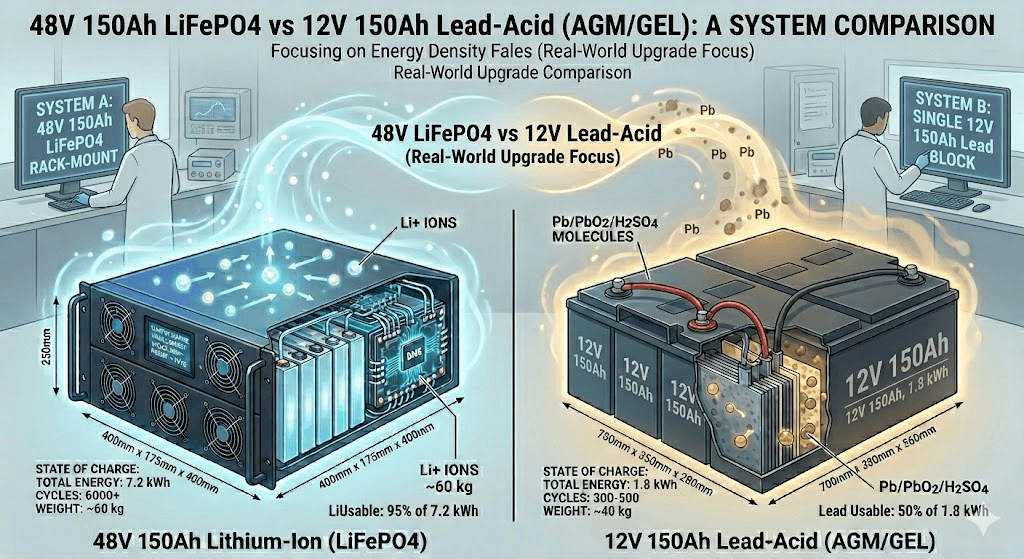
This is the comparison most people are actually making. A 48V 150Ah system stores 7,200 Wh. A 12V 150Ah system stores only 1,800 Wh. The fourfold energy difference accounts for most of the runtime gap:
| Load | 48V 150Ah LiFePO4 (7,200 Wh, 80% DoD) | 12V 150Ah Lead-Acid (1,800 Wh, 50% DoD) |
| 200W | ~20.7 hrs | ~3.8 hrs |
| 400W | ~10.4 hrs | ~1.9 hrs |
| 600W | ~6.9 hrs | ~1.3 hrs |
| 1,000W | ~4.1 hrs | ~0.8 hrs |
| 1,500W | ~2.8 hrs | ~0.5 hrs |
If you upgraded from a 12V system to a 48V system and your backup time jumped dramatically, the voltage change is responsible for 75 to 80% of that improvement. The lithium chemistry accounts for the remaining 20 to 25%. Both are real advantages. Neither should be misattributed.
150Ah Battery Runtime for Common Nigerian Appliances
Reference table: 48V 150Ah LiFePO4 (80% DoD, 90% inverter efficiency), running appliances individually:
| Appliance | Avg. Wattage | Est. Runtime (alone) |
| LED bulb (10W) | 10W | ~415 hrs |
| Ceiling fan | 55W | ~75 hrs |
| Standing fan | 65W | ~64 hrs |
| 32-inch LED TV | 50W | ~83 hrs |
| Laptop | 60W | ~69 hrs |
| Small fridge (100L) | 80W avg | ~52 hrs |
| Medium fridge (200L) | 150W avg | ~27.6 hrs |
| Large fridge (300L) | 220W avg | ~18.9 hrs |
| Water pump (0.5HP) | 370W | ~11.3 hrs |
| 1HP water pump | 750W | ~5.5 hrs |
| 1.5HP air conditioner | 1,200W | ~3.5 hrs |
| 2HP air conditioner | 1,800W | ~2.3 hrs |
These are single-appliance estimates. For combined loads, sum the wattages and divide into the usable energy figure (5,184 Wh after DoD and inverter losses for 48V 150Ah lithium). To build a full system load audit, use our off-grid system load audit guide.
Is 150Ah the Right Size for You?
The 150Ah is genuinely the right answer for a specific type of user. Here is how to know if that is you:
| Situation | 150Ah Good Fit? | Reasoning |
| 1-bedroom apartment with fridge, 2 fans, TV, lights (300 to 400W) | Yes | Runs 10 to 13 hours comfortably |
| 2-bedroom home, no AC, moderate load (400 to 550W) | Yes, with margin | 8 to 10 hours overnight, adequate |
| 3-bedroom home with fridge and AC (1,000W+) | No | Use 200Ah or multiple batteries |
| Small shop or office, lights + laptops + router (200 to 350W) | Yes | Excellent fit, 12 to 17 hours |
| Generator backup top-up (3 to 4 hrs gap) | Yes, easily | 7,200 Wh is far more than needed for short gaps |
| Full off-grid farm or clinic | No | Need larger capacity or battery bank |
Not sure whether to stretch to 200Ah? Read our post on how long a 200Ah battery lasts and compare the numbers directly against your load. If you are torn between 100Ah and 150Ah, how long a 100Ah battery lasts gives you the same breakdown for the smaller size.
What Reduces Your 150Ah Runtime Without You Realising It
The formula gives maximum theoretical runtime. Real-world figures are always a little lower. These are the most common silent drain factors in Nigerian installations:
High ambient temperatures
Nigeria’s climate is not kind to batteries. In cities like Kano, Maiduguri, or even Lagos during the dry season, ambient temperatures regularly exceed 35 degrees Celsius. Lead-acid batteries lose 10 to 20% of rated capacity in these conditions. LiFePO4 handles heat significantly better but still sees reduced performance above 45 degrees Celsius. Keep your battery bank in a shaded, ventilated space, never in a sealed room or under a metal roof without airflow.
Inverter no-load consumption
Even with no appliances running, your inverter draws power just to stay active. This can be 30 to 80W depending on the model and size. Over an 8-hour night, that is 240 to 640 Wh silently consumed. On a 150Ah battery, that represents 5 to 12% of your total usable energy. Our guide on how to select an off-grid inverter includes no-load consumption figures to look for when choosing a model.
Battery age and state of health
A 150Ah battery rated for 2,000 cycles that has been deep-discharged repeatedly over two years may only be delivering 120 to 130Ah of real capacity. The label does not update itself. If your backup time has been shrinking month by month, this is the most likely cause. Our article on how to increase lithium battery lifespan covers the usage habits that preserve rated capacity over time.
Incorrect BMS cutoff settings
A BMS set to cut off at 20% state of charge instead of 10% means you are leaving 10% of your battery unused every cycle. On a 7,200 Wh battery, that is 720 Wh of capacity you are paying for but never using. Getting your BMS thresholds right is not a minor detail. Our BMS protection explained guide shows the correct voltage thresholds for LiFePO4 and lead-acid at 12V, 24V, and 48V.
How to Charge a 150Ah Battery Correctly
Runtime is only half the story. How fast you can recharge your 150Ah battery determines how quickly you recover after a deep discharge or a cloudy day.
For a 48V 150Ah LiFePO4, the recommended maximum charge current is 0.5C, which is 75A. At this rate, charging from 20% to 100% takes approximately 1.5 to 2 hours. Most MPPT charge controllers are sized between 40A and 100A for this battery size. Our MPPT charge controller selection guide explains how to match controller size to battery capacity correctly.
For solar charging, the number of panels you need to fully recharge a 150Ah battery in a single day depends on your location and panel wattage. In Nigeria, with an average of 5.5 peak sun hours, a 48V 150Ah battery needs roughly 1,400 to 1,600W of panels to recover from a 50% discharge in one day. Our solar array sizing guide for off-grid systems walks through the full calculation.
Frequently Asked Questions
How long will a 150Ah battery last on a 1000W load?
At 1,000W, a 48V 150Ah LiFePO4 (80% DoD, 90% inverter efficiency) lasts approximately 4.1 hours. A 12V 150Ah lead-acid at 50% DoD lasts roughly 45 minutes at the same load. The voltage difference accounts for most of that gap, as explained in the tables above.
Can a 150Ah battery power an air conditioner?
A 1.5HP inverter air conditioner draws roughly 1,100 to 1,300W on average. A 48V 150Ah LiFePO4 will run it for about 3 to 3.5 hours alone. That is enough for a few hours of cooling during the hottest part of the day, but not a full overnight run. For AC-heavy homes, a 200Ah or larger battery bank is a more practical choice. See our guide on how long a 200Ah battery lasts for the 200Ah AC runtime figures.
How many solar panels do I need to charge a 150Ah battery?
In Nigeria with 5.5 peak sun hours per day, a 48V 150Ah LiFePO4 depleted to 20% needs to recover about 5,760 Wh. Accounting for system losses, you need roughly 1,400 to 1,600W of solar panels to accomplish that in a single day. That is typically 4 x 400W panels. Our solar array sizing guide gives you the full calculation method.
Is a 150Ah lithium battery better than a 200Ah tubular battery?
At 48V, a 150Ah LiFePO4 delivers about 5,760 Wh of usable energy (80% DoD). A 48V 200Ah tubular lead-acid delivers about 4,800 Wh (50% DoD). So a 150Ah lithium actually gives you more usable energy than a 200Ah tubular, while being lighter and lasting more charge cycles. In terms of real-world performance in Nigerian conditions, the 150Ah lithium wins on almost every metric except upfront cost.
What is the difference between a 150Ah and 200Ah battery?
At 48V, a 200Ah battery stores 9,600 Wh versus 7,200 Wh for the 150Ah. That is 33% more energy, which translates directly to 33% more runtime at the same load. If your typical load is 400W and the 150Ah gives you about 10.4 hours, the 200Ah gives you about 13.8 hours. For a full comparison, read our article on how long a 200Ah battery lasts.
How long will a 150Ah battery last with a 500W inverter?
A 500W load on a 48V 150Ah LiFePO4 (80% DoD, 90% efficiency) gives approximately 10.4 hours. On a 12V 150Ah lead-acid (50% DoD), the same 500W load lasts roughly 1.5 hours. The difference is almost entirely the fourfold energy gap between 12V and 48V systems, not chemistry alone.
The Bottom Line
The 150Ah battery does not get the attention it deserves. At 48V with LiFePO4 chemistry, it holds 7,200 Wh of energy and handles a medium Nigerian home through an entire overnight outage with room to spare. It is the right size for anyone whose load sits between 300 and 600W and who finds the 100Ah slightly tight but the 200Ah slightly excessive.
Know your voltage. Know your load. The numbers in this article are your guide. If you want to build a complete picture of your system from the ground up, start with our complete off-grid system design checklist. And if you are still deciding between 150Ah and 200Ah, the answer is in the load calculation, not the spec sheet.

I am Engr. Ubokobong Ekpenyong, a solar specialist and lithium battery systems engineer with over five years of hands-on experience designing, assembling, and commissioning off-grid solar and energy storage systems. My work focuses on lithium battery pack architecture, BMS configuration, and system reliability in off-grid and high-demand environments.