
You have probably heard that lithium batteries are better than tubular batteries. You may have even paid a premium to upgrade your solar system to one. But if you have never fully understood how a lithium battery actually works, what the voltage numbers mean, why lifespan varies so much, and what happens inside during charging, then you are making decisions about a system you do not fully understand.
That is a problem. Not because lithium batteries are complicated, but because the basics are genuinely simple once someone explains them clearly.
This post is that explanation. We are going to walk through everything: how lithium batteries store energy, what voltage tells you and what it does not, how charging actually works in two stages, what kills battery lifespan faster than anything else, and what real-world performance looks like in a solar or backup power system in a place like Nigeria where electricity is not reliable and the battery is the backbone of everything.
By the end, you will understand your battery the way an engineer does. And that changes how you manage it.
What Is a Lithium Battery, Really?

A lithium battery is not one thing. It is a family of battery chemistries, all of which use lithium ions moving between electrodes to store and release energy. The most common types you will encounter in solar and off-grid energy systems are:
Lithium Iron Phosphate (LiFePO4), This is the one almost every serious solar installer recommends. It is thermally stable, meaning it does not overheat or catch fire easily. It has a long cycle life. And it performs consistently in hot climates. If someone sells you a “lithium battery” for your solar system without specifying the chemistry, ask. If it is not LiFePO4, that is a conversation worth having.
Lithium NMC (Nickel Manganese Cobalt), Higher energy density, which means you get more capacity in a smaller package. Often found in EVs and some portable power stations. But it is less thermally stable than LiFePO4, which matters a lot when your battery sits in a hot room in Port Harcourt or Lagos.
For everything in this post, we will use LiFePO4 as the reference chemistry, because that is what is most relevant to off-grid solar systems.
How a Lithium Battery Stores Energy
Here is the basic idea: inside a lithium battery, there are two electrodes separated by a material called an electrolyte. When you charge the battery, lithium ions move from the positive electrode (the cathode) to the negative electrode (the anode). When you discharge it, that is, when you power your appliances, those ions move back.
That movement of ions is what generates electrical current. The battery does not store electrons the way a water tank stores water. It stores potential energy in the form of chemical separation, and the electricity is released when the ions return to equilibrium.
The important thing to understand here is that this process is reversible, deliberately so. In theory, you could do this indefinitely. In practice, every cycle causes tiny physical and chemical changes that accumulate over time. That is why batteries eventually wear out.
If you want to see how this knowledge applies to an actual off-grid system design, Designing an Off-Grid Power System Using Lithium Batteries covers the full build, battery sizing, BMS setup, and MPPT configuration using LiFePO4.
Voltage: What It Means and Why It Matters
Voltage is one of the most misunderstood things in battery management. People see numbers on their inverter display and do not always know what they are looking at.
Here is a practical breakdown for a single LiFePO4 cell:
1. Fully charged voltage: approximately 3.60 to 3.65V per cell

2. Nominal voltage (the number used for labelling): 3.2V per cell

3. Resting voltage at 50% state of charge: approximately 3.2 to 3.25V per cell

4. Minimum safe discharge voltage: 2.5V per cell (most BMS systems cut off at 2.8V to protect the cells)
Now, most batteries you buy are not single cells. They are packs of cells connected in series. A 12V LiFePO4 battery typically contains four cells in series (4 × 3.2V = 12.8V nominal). A 24V pack has eight cells. A 48V pack has sixteen.
So when your 48V battery reads 54.4V, that is a fully charged battery (16 cells × 3.4V). When it reads 44.8V, that is close to empty (16 cells × 2.8V).
Why does voltage matter in practice?
Because your inverter uses voltage to estimate battery percentage. It sees 54V and says 100%. It sees 48V and says 40%. The problem is that LiFePO4 has an extremely flat discharge curve, meaning the voltage barely changes between about 80% and 20% state of charge. A battery at 80% full and a battery at 30% full might show almost the same voltage. This makes percentage estimates unreliable without a proper battery monitor.
Related read: Why Your Battery Dies Faster Than Expected (Even When It Says 100%) — this post explains exactly how inverter percentage estimates work, why they go wrong, and what you can actually do about it.
Lifespan: What the Numbers Actually Mean
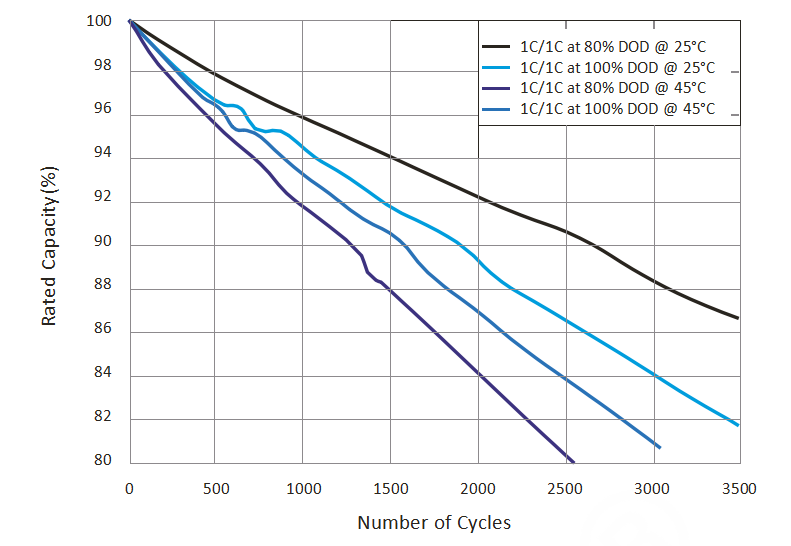
Battery manufacturers will quote you a cycle life number. You might see 2,000 cycles, 3,000 cycles, or even 6,000 cycles on a product spec sheet. But what does that actually mean in real life?
A cycle is one full discharge and recharge of the battery. If your battery goes from 100% to 0% and back to 100%, that is one cycle. If it goes from 100% to 50% and back, that is roughly half a cycle.
Here is where it gets important: depth of discharge (DoD) has a massive impact on how many cycles you get.
A good LiFePO4 battery rated at 3,000 cycles assumes you are cycling it to 80% depth of discharge. If you only ever discharge to 50%, you could get significantly more than 3,000 cycles. If you routinely drain it to 100% depth of discharge, you will get fewer.
This is the 80/20 principle in battery management: the bottom 20% of your battery’s capacity is where the most damage happens. Discharging deep regularly accelerates cell degradation.
Beyond cycle depth, the other major factor in lifespan is temperature. A lithium battery operated consistently above 35°C ages faster than one kept in a cooler environment. In Nigerian conditions, this is not theoretical, it is real. If your battery is in an enclosed room with no ventilation during the dry season, it is aging faster than the spec sheet assumes.
Calendar aging is also real. Even a battery that you never use loses capacity over time just from sitting. The rate is slow, but it happens.
In practical terms, a well-managed LiFePO4 battery in an off-grid solar system should last 8 to 12 years before it drops below 80% of its original capacity. A poorly managed one can fail in 3 to 5 years.
For a complete, numbers-first approach to battery bank sizing — including how cycle life affects your design decisions, read: Battery Bank Sizing for Off-Grid Systems: Capacity, BMS Selection, and Cycle Life
The Lithium Two-Stage Charging Process

Image Source: Battery charger basics
Understanding how your battery actually charges will change how you interpret what your inverter is doing.
Charging a lithium battery happens in two distinct stages:
Stage 1: Constant Current (CC)
In this stage, the charger pushes a fixed amount of current into the battery. The battery voltage rises gradually as the cells fill up. This is the fast part of charging — most batteries go from empty to about 80–90% full during this stage.
Stage 2: Constant Voltage (CV)
Once the battery reaches its target voltage (about 3.45 to 3.65V per cell for LiFePO4), the charger holds that voltage steady. The current now tapers down, from whatever the charge rate was, down to a trickle, and eventually near zero. This top-off stage fills the remaining 10–20% and gives the BMS time to balance the cells.
This two-stage process is why fast charging gets you to 80% quickly but the last 20% takes longer. The physics of electrochemistry require a gentler approach at the top.
Why does this matter for you?
If you set your inverter to stop charging at 90% instead of 100%, you are skipping most of the CV phase. This is actually fine for daily use, it reduces stress on the cells and extends lifespan. Many experienced solar system operators do exactly this, only allowing a full 100% charge once a week or when the system has been sitting unused.
The Biggest Problem with Lithium Batteries
If you ask most engineers what kills lithium batteries, the answers cluster around a few things. But the single biggest problem, the one that causes more premature failures than anything else, is heat combined with a high state of charge.
When a lithium battery sits fully charged at high temperature, it undergoes what is called calendar aging at an accelerated rate. The electrolyte degrades. The cathode material breaks down. The battery loses capacity permanently.
This is why the advice to keep lithium batteries between 20% and 80% for long-term storage exists. It is not arbitrary. A battery stored at 50% in a cool environment will outlast a battery kept at 100% in a hot room by years.
The second major problem is cell imbalance. Over time, individual cells inside the battery pack drift apart in capacity and voltage. When one cell reaches its minimum voltage before the others, the BMS cuts off the whole pack, even if the other cells still have energy. This is why you see systems shutting down at 30% or 40% SOC. The pack is not empty. One weak cell is pulling everything down.
This is exactly the scenario covered in Why Your Battery Dies Faster Than Expected (Even When It Says 100%), the cell imbalance section goes deep into why the pack cuts off early and what warning signs to watch for.
A third problem worth mentioning is cost relative to alternatives. Lithium batteries cost significantly more upfront than tubular batteries. Whether that premium is justified depends entirely on how long the system runs, how many cycles you actually use, and whether you manage the battery correctly to get the full lifespan.
If you are weighing the cost of going solar vs. staying on a generator, the numbers will surprise you: Off-Grid Solar vs Generator in Nigeria: Why Generator Power Costs Over ₦5 Million Per Year
Real-World Performance: What to Expect
Spec sheets are written under ideal conditions. Real-world performance is messier. Here is what you should actually expect from a lithium battery in a solar system:
Usable capacity is less than rated capacity. A 200Ah battery at 48V has a theoretical capacity of 9.6kWh. But if you follow the 80/20 rule and only use 80% of it (to protect the cells), your usable capacity is about 7.7kWh. Plan your system around usable capacity, not rated capacity.
Performance degrades in the cold. LiFePO4 batteries perform well in heat but lose capacity in cold temperatures. Below 0°C, many batteries will not accept a charge at all, the BMS will block it to prevent lithium plating. In most of Nigeria this is not a concern, but if you are in a highland area or the harmattan brings unusually cold nights, it is worth knowing.
The BMS adds protection but also adds complexity. A good Battery Management System protects your cells from overcharge, over-discharge, overcurrent, and temperature extremes. It also does cell balancing during and after each charge cycle. But a poorly configured BMS, or one that does not communicate properly with your inverter, can cause confusing behaviour: your inverter says 60% and your BMS says 40%. These mismatches have real causes and real solutions.
Discharge rate affects available capacity. If you are pulling a large load from your battery, say a 3kW inverter running at full power, you will get slightly less usable capacity than if you are running a lighter load. This is called the Peukert effect, and while LiFePO4 handles high discharge rates better than most other battery chemistries, it still applies.
For a worked example of how inverter size and battery capacity interact in a real off-grid system, see: Off-Grid Inverter Sizing: 3kVA vs 5kVA Victron Multiplus-II Complete Worked Example
How to Increase Lithium Battery Lifespan
Everything in this post points toward the same set of behaviors if you want your battery to last as long as possible:
- Keep the state of charge in the middle range for daily use. Charging to 90% and discharging to 20% puts far less stress on the cells than full cycles every day. Your inverter almost certainly has settings to control charge cutoff and discharge cutoff, use them.
- Control the temperature. If your battery room gets very hot, install a fan or ventilate the space. Heat is silent and accumulative. You will not see the damage until years later when the capacity is noticeably lower.
- Do occasional full charges. While you should not charge to 100% every day, letting the battery reach 100% once a week or so helps the BMS balance the cells. Passive balancing only works at the top of the charge cycle. Without occasional full charges, cell imbalance accumulates.
- Match your charger settings to the battery’s specifications. Charging at a rate higher than the battery is rated for generates excess heat and accelerates degradation. Always check the battery manufacturer’s recommended charge current.
- Do not let it sit fully discharged. If the battery drains to the BMS cutoff and sits there for days or weeks, some cells can drop into what is called deep discharge, a state that causes permanent damage. This is especially relevant for backup systems that do not run every day.
The Biggest Disadvantage of Lithium Batteries
No honest battery guide ends without addressing this: lithium batteries have real disadvantages that most salespeople will not volunteer.
Upfront cost. A lithium battery system costs two to four times more than an equivalent lead-acid or tubular battery system. For many households and businesses in Nigeria, this is not a minor consideration.
Sensitivity to incorrect configuration. A tubular battery connected to the wrong settings on an inverter will usually survive it. A lithium battery connected to an inverter configured for lead-acid will likely be damaged, and may trip its BMS in ways that are confusing to diagnose. Lithium batteries require the installer to understand what they are doing.
BMS dependency. The battery’s safety and performance depend entirely on the quality of the BMS. A cheap BMS with poor balancing or inaccurate protection thresholds will reduce the lifespan of an otherwise good battery.
Cannot be easily recovered when fully dead. A tubular battery that has been deep-discharged can sometimes be recovered with a slow charge. A lithium battery whose BMS has tripped into protection mode needs specific recovery procedures. Some cells, once deeply discharged, cannot be recovered at all.
Why Lithium Still Wins for Most Solar Systems
Despite those disadvantages, the case for lithium in a properly designed off-grid solar system is strong, especially if you are comparing the total cost over 10 years, not just the purchase price.
A quality LiFePO4 battery bank will outlast two or three sets of tubular batteries over the same period. It requires less maintenance, tolerates partial states of charge without damage (something tubular batteries hate), charges faster from solar panels, and has a higher round-trip efficiency, meaning less of your solar energy is wasted as heat during charge and discharge.
For a full walkthrough of sizing a battery bank for an off-grid system — from load audit all the way to BMS selection — read: Battery Bank Sizing for Off-Grid Systems: Capacity, BMS Selection, and Cycle Life
The Bottom Line
A lithium battery is not magic. It is chemistry. And like all chemistry, it has rules.
Understand voltage, and you know when your battery is actually full or actually empty. Understand the two-stage charging process, and you know why the last 10% takes so long. Understand depth of discharge and temperature, and you know exactly what you are trading every time you push the battery to its limits.
The people who get the best performance out of lithium batteries are not the ones who bought the most expensive unit. They are the ones who learned how the system works and managed it accordingly.
You now have the foundation. The cluster posts linked throughout this guide take each of these topics to the next level. Work through them and you will have a level of understanding that most battery owners, and even some installers, simply do not have.
Have questions about anything covered here? Drop them in the comments below. We read every one.
What to Read Next: The Complete Cluster
This is the pillar post for a full topic cluster on lithium batteries. The following posts are planned or coming soon on Eneronix:
- What is the 80/20 rule for lithium batteries?
- What is the biggest problem with lithium batteries?
- Which country is number 1 in lithium?
- What voltage is 50% for a lithium battery?
- How to increase the lifespan of a lithium-ion battery?
- What is the maximum charging current for a 100Ah lithium battery?
- What is the biggest disadvantage of a lithium-ion battery?
- How many tubular batteries make a 10kWh lithium battery?
- Best lithium battery for inverter in Nigeria
- Lithium vs tubular battery cost Nigeria
- How many batteries for 5kVA inverter
- 48V lithium battery sizing guide

I am Engr. Ubokobong Ekpenyong, a solar specialist and lithium battery systems engineer with over five years of hands-on experience designing, assembling, and commissioning off-grid solar and energy storage systems. My work focuses on lithium battery pack architecture, BMS configuration, and system reliability in off-grid and high-demand environments.