A complete engineering guide to hybrid solar systems, how they work, DC vs AC coupling, system sizing, component selection, and design rules for Nigerian conditions.
Most hybrid solar systems in Nigeria fail before their third year.
Not because of bad solar panels. Not because of poor weather. They fail because the system was designed in the wrong order, with the wrong assumptions, by someone who treated a hybrid system like a bigger off-grid system.
It is not.
A hybrid solar system is a fundamentally different architecture. It manages three power sources simultaneously. It makes real-time decisions about where power comes from and where it goes. It communicates with your battery at the protocol level. When it is designed correctly, it runs for 10–15 years with minimal intervention. When it is designed wrong, it destroys a battery bank in 18 months and trips an overload alarm every afternoon.
This guide covers everything. How the system works. The two architectures and which one belongs in a Nigerian installation. The correct eight-step design sequence. Nigeria-specific sizing rules. The three numbers that tell you whether your system is properly designed. And the most common failures with their exact root causes.
If you are planning a hybrid system, commissioning one, or trying to fix one that is not performing, this is the only guide you need.
What Is a Hybrid Solar System The Precise Definition
Here is how most blogs define a hybrid solar system: solar panels plus a battery plus a grid connection.
That definition is useless. It describes a shopping list, not a system.
A hybrid solar system is a grid-interactive energy storage system in which a single hybrid inverter simultaneously manages three power sources a PV array, a battery bank, and the utility grid using programmable priority logic to decide, in real time, which source powers your loads and when.
The word simultaneously is doing the heavy lifting in that definition. An off-grid inverter manages one source at a time. A hybrid inverter manages all three at once every few milliseconds.
An off-grid inverter manages one source at a time. A generator charges the battery. Solar charges the battery. The battery powers the loads. These are sequential operations.
A hybrid inverter manages all three sources at the same time. Solar is producing. The grid is available. The battery is at 60% SOC. The inverter decides based on your configured priority whether to charge the battery from solar, top it up from the grid, export excess solar to the grid, or do a combination of all three. That decision happens every few milliseconds.
That is what makes it hybrid.
What Is NOT a Hybrid Solar System
This matters in Nigeria because the market uses the word loosely.
An off-grid system with a generator is not a hybrid system. The generator connects to an AC input port on the inverter and charges the battery. There is no grid connection, no export capability, no TOU logic. It is an off-grid system with a backup charging source.
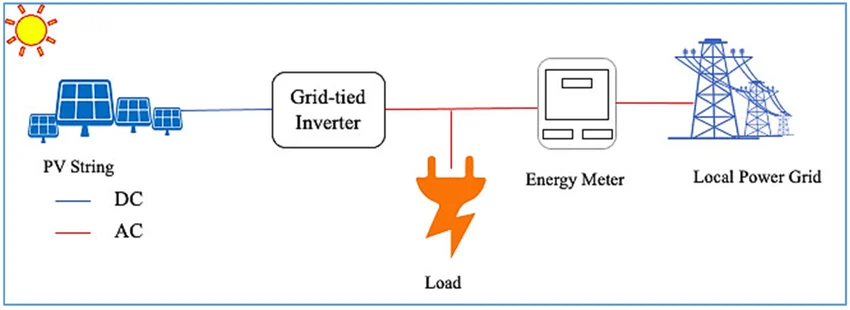
A grid-tied system without a battery is not a hybrid system. When NEPA takes light, it shuts down completely because of anti-islanding protection.
A system where the inverter switches between solar and grid manually is not a hybrid system. That is an automatic transfer switch with solar input.
A true hybrid system has four things: a hybrid inverter with built-in MPPT, a battery bank with BMS communication, a grid connection with bidirectional metering capability, and programmable priority logic. If any of those four are missing, it is not a hybrid system.
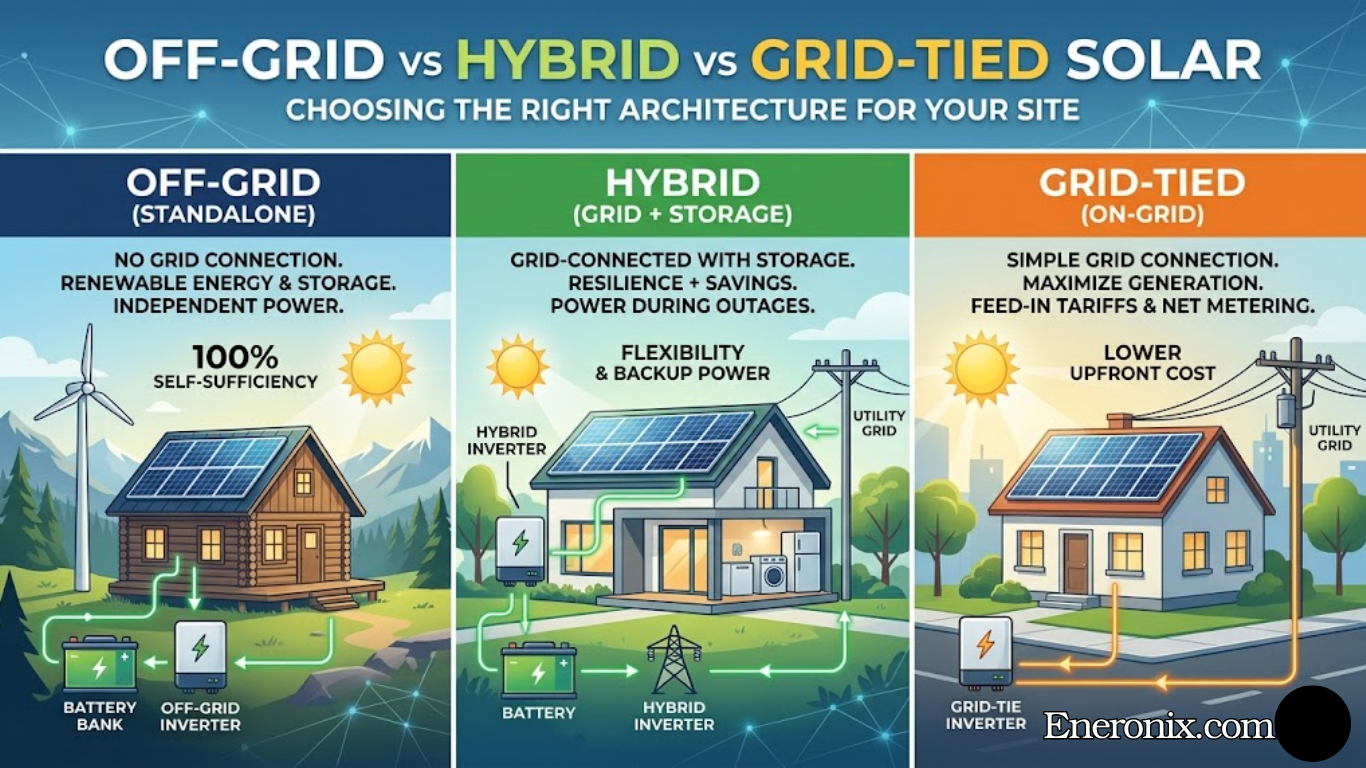
How Hybrid Compares to Off-Grid and Grid-Tied
Feature
Grid-Tied
Off-Grid
Hybrid
Works during blackout
No
Yes
Yes
Exports to grid
Yes
No
Yes (if metering allows)
Needs battery
No
Yes
Yes
Needs large battery bank
No
Yes (3–5 days)
No (1–2 days)
Generator dependency
None
High
Low
Best for Nigeria
Poor fit
Good fit
Best fit
Grid-tied systems are designed for countries with 22–24 hours of stable grid supply. Nigeria does not qualify. Off-grid systems work but demand large, expensive battery banks. A hybrid system sits in the sweet spot it uses the grid as a backup so you need less battery, but keeps your loads running when the grid fails.
The Two Hybrid solar system design Architectures DC-Coupled vs AC-Coupled
This is the decision that comes before every other design decision. Your coupling architecture determines your inverter choice, your efficiency, your wiring layout, and your total system cost.
Most Nigerian installers never have this conversation with their clients. They buy a hybrid inverter, connect it, and move on. That is a mistake.
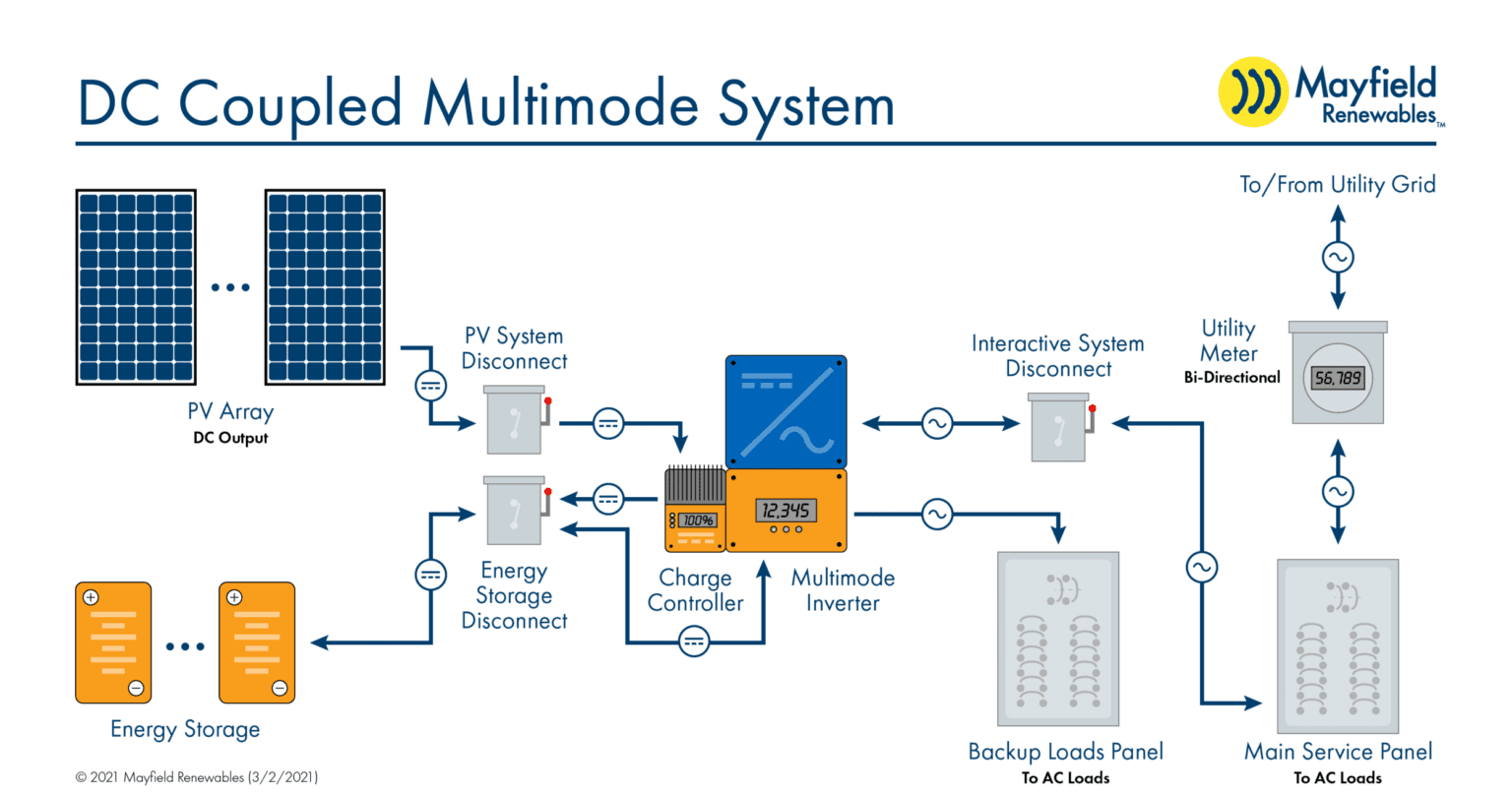
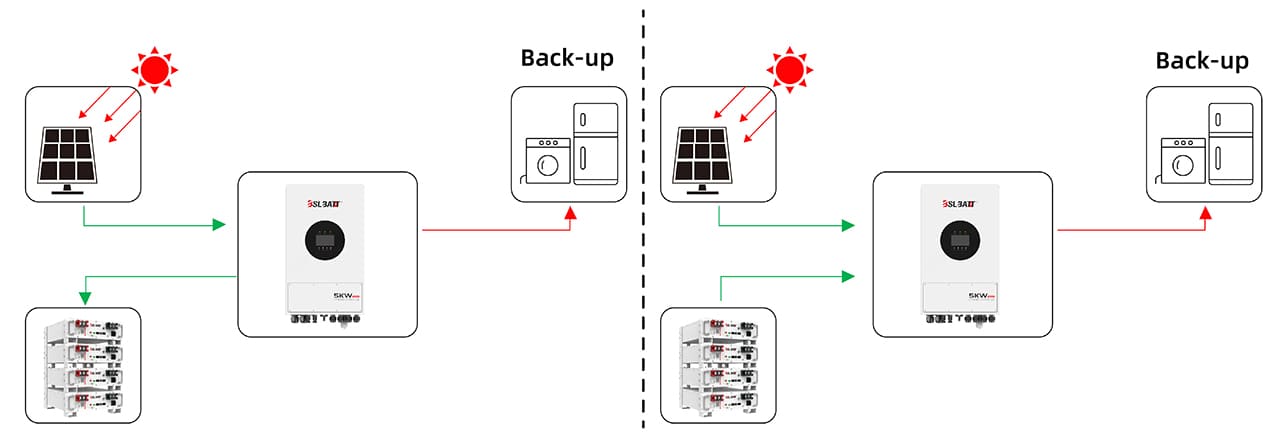
DC coupled hybrid system
Image source: Mayfield Renewables
In a DC-coupled system, the solar array connects directly to the hybrid inverter’s built-in MPPT input. The MPPT charges the battery in DC form. The hybrid inverter converts DC to AC only once when power is needed by your loads or being exported to the grid.
Energy flow: Solar array → Hybrid inverter MPPT → Battery (DC) → Hybrid inverter → Loads (AC) One conversion. DC to AC. That is it.
This is why DC-coupled systems achieve round-trip efficiency of 96–98%. Very little energy is lost between generation and use.
DC coupling is the correct architecture for every new hybrid installation in Nigeria. You are building from scratch. You buy one hybrid inverter that manages everything. It is simpler, cheaper in hardware, and more efficient.
AC-Coupled Architecture
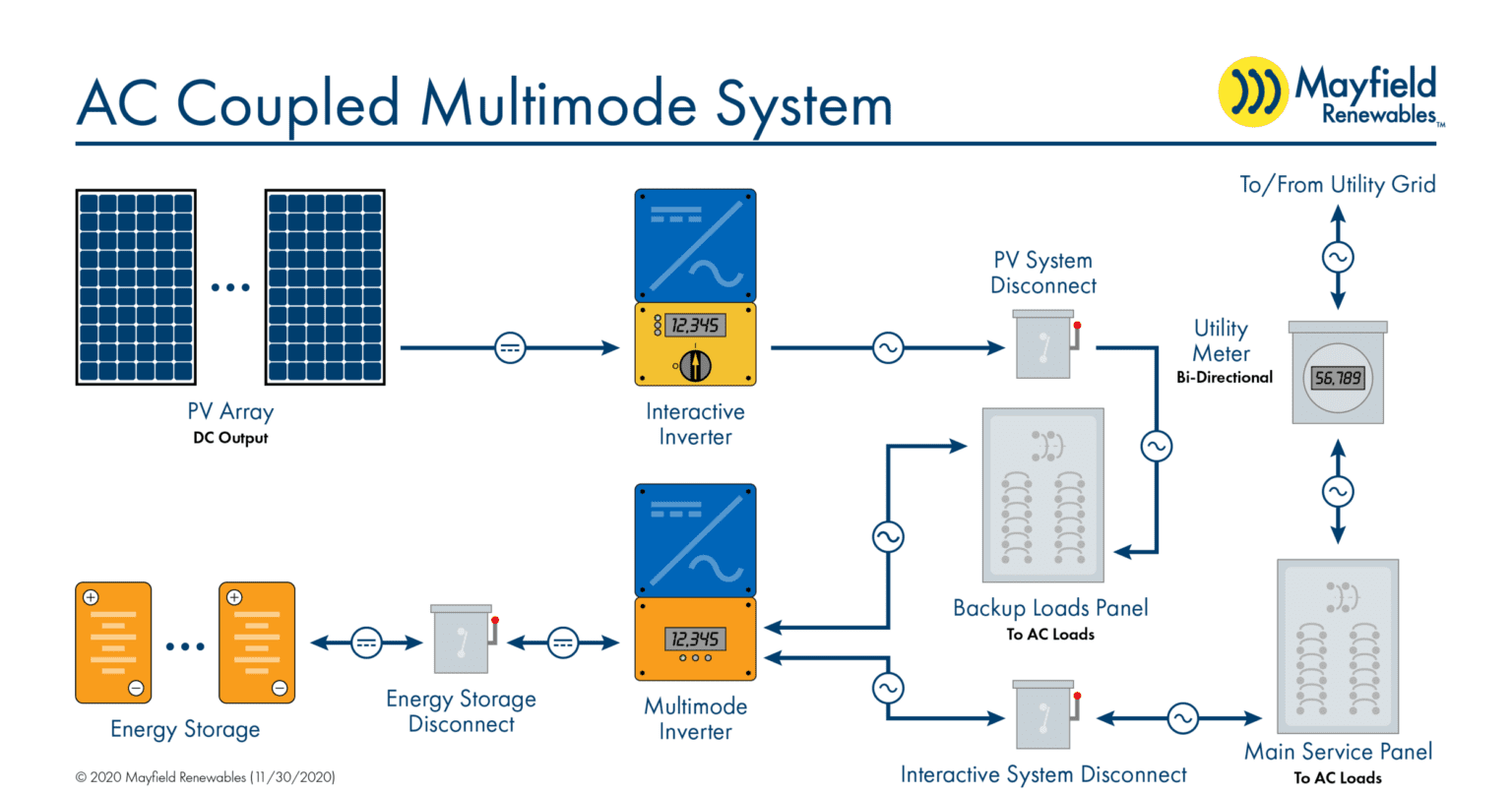
Image source: Mayfield Renewables
In an AC-coupled system, the solar array connects to a separate string inverter that converts DC to AC. That AC power flows to a battery inverter that converts it back to DC to charge the battery. When the battery discharges, the battery inverter converts DC back to AC for your loads.
Energy flow: Solar array → String inverter (DC→AC) → Battery inverter (AC→DC) → Battery → Battery inverter (DC→AC) → Loads Three conversions. Each conversion loses energy.
This is why AC-coupled systems achieve round-trip efficiency of only 90–94%.
In real numbers: if your solar array generates 20kWh in a day and you store 10kWh in the battery, a DC-coupled system gives you back 9.6–9.8kWh. An AC-coupled system gives you back 9.0–9.4kWh. Over a year, that 0.4–0.8kWh daily difference is 150–300kWh of lost energy.
AC coupling has one legitimate use case: retrofitting battery storage onto an existing grid-tied system. For a new installation the majority of Nigerian projects DC coupling is the answer every time.
The Efficiency Difference in Plain Numbers
DC-Coupled
AC-Coupled
Conversions
1
3
Round-trip efficiency
96–98%
90–94%
Hardware cost
Lower (1 inverter)
Higher (2 inverters)
Best use case
New installation
Retrofit
Single point of failure
Yes (hybrid inverter)
No (two inverters)
The one advantage AC-coupled systems have is redundancy. If one inverter fails, the other may still function. This does not change the recommendation for new Nigerian installations.
A quality hybrid inverter with a proper warranty is a better investment than two separate inverters with higher losses.
How a Hybrid System Actually Works The Three Operating Modes
Every hybrid system operates in three distinct modes depending on what the grid is doing, what the solar array is producing, and what the battery SOC is. Understanding these modes is what separates an engineer from someone who just connected components.
Mode 1: Solar Priority Mode (Daytime, Grid Available)
This is the default daytime mode when solar is producing and the grid is connected.
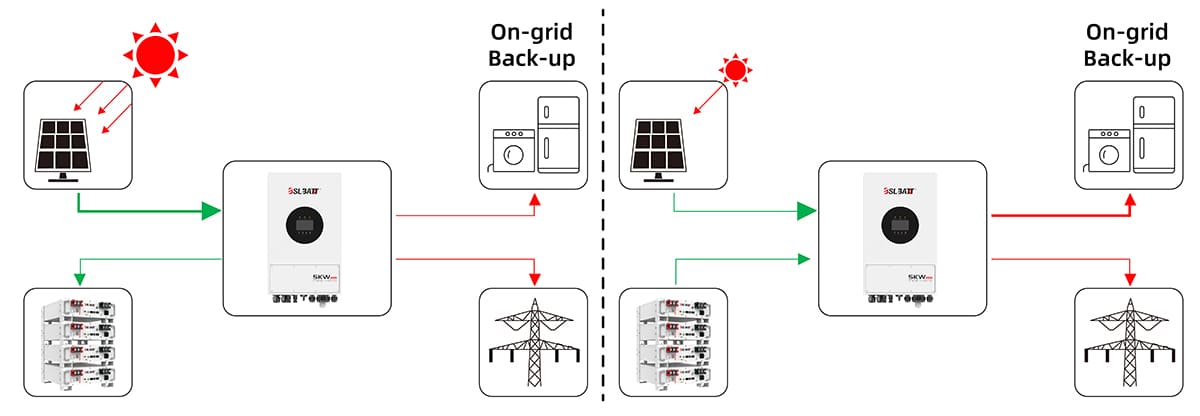
Solar powers your loads first. If solar production exceeds load demand, the excess charges the battery. If solar production exceeds both load demand and battery charge rate, the remaining excess can export to the grid if your utility allows net metering.
In Nigeria, most DISCOs do not currently offer net metering for residential customers. Once the battery is full and solar still exceeds load, the MPPT throttles the array. This is called clipping. It is not a system fault. It is the MPPT protecting the battery from overcharge.
This is why array sizing matters. An oversized array relative to battery capacity clips frequently and wastes potential generation. An undersized array leaves the battery chronically undercharged.
When solar production falls, the battery takes over powering your loads. The grid is available but standing by.
The battery discharges until it hits your configured low SOC threshold typically 20% for LiFePO4, which corresponds to 80% depth of discharge. At that point, the hybrid inverter switches to grid supply and may begin charging the battery from the grid if you have configured a grid-charge schedule.
For LiFePO4 in a Nigerian hybrid system, the correct low SOC threshold is 15–20%. Not 0%. Not 50%.
This is the mode most Nigerians buy a hybrid system for.
When the grid fails, the hybrid inverter detects the loss of grid voltage within milliseconds. It opens the grid relay physically disconnecting the system from the NEPA line and switches to island mode. The battery powers your loads. Solar continues producing and charging the battery simultaneously.
This transition takes 10–20 milliseconds on most quality hybrid inverters. Your LED lights may flicker briefly. Sensitive electronics continue running without interruption because the UPS function built into the hybrid inverter bridges the gap.
When the grid returns, the hybrid inverter verifies that the grid voltage and frequency are stable typically for 30–60 seconds before reconnecting. This prevents reconnecting to a dirty grid during a brownout.
The Five Core Components of a Hybrid Solar System
1. The Hybrid Inverter
The hybrid inverter is the brain of the system. It is not just an inverter. It is a bidirectional inverter-charger with a built-in MPPT charge controller, grid management logic, battery communication interface, and programmable priority settings all in one enclosure.
When selecting a hybrid inverter, four numbers matter:
Continuous output rating (kVA/kW): This is the load it can sustain indefinitely. At 40°C ambient common in a Nigerian plant room it dereates by approximately 15%. Always size for the temperature-derated output, not the nameplate rating.
Surge rating: Motor loads draw 3–6x their running current at startup. Verify the surge rating against your highest inrush load before buying.
MPPT input window: Your solar array’s open-circuit voltage (Voc) must never exceed the MPPT maximum. Your array’s minimum operating voltage at peak temperature must stay above the MPPT minimum.
AC input current limit: This setting tells the hybrid inverter how much current to draw from the grid or generator when charging the battery and powering loads simultaneously.
Use our solar and MPPT calculator to verify your string voltage against the inverter’s MPPT window before purchasing.
2. The Battery Bank
For hybrid systems in Nigeria, the battery choice is straightforward: LiFePO4 (lithium iron phosphate).
Lead-acid batteries are fundamentally incompatible with hybrid system operation. Hybrid inverters with BMS communication manage the battery through CVL, CCL, and DCL signals from the BMS. Lead-acid batteries have no BMS. The inverter manages them blind, relying only on voltage curves which are notoriously unreliable under load.
Additionally, lead-acid batteries require a float charge stage to prevent sulphation. LiFePO4 batteries are actively damaged by float charging. LiFePO4 is not optional for a properly designed hybrid system. It is a technical requirement.
In a hybrid system, the solar array has two jobs: power your loads and recharge your battery. Most Nigerian installers size the array only for loads. This leaves the battery chronically undercharged, especially during the wet season.
The BMS actively communicates with the hybrid inverter to optimise charging and discharging in real time. This communication happens over two protocols: CAN bus and RS485.
CAN bus is faster (1 Mbit/s vs 115 kbit/s for RS485), more noise-resistant, and is used by most premium hybrid inverters and batteries (Victron, BYD, Pylontech). RS485 is more widely supported and is used by most mid-range brands (Growatt, some Deye models).
The critical point: your battery BMS and your hybrid inverter must speak the same protocol. Verify protocol compatibility before purchasing any component.
The protection layer of a hybrid system has four elements, and most Nigerian installations are missing at least one.
DC isolator: Allows the solar array to be safely disconnected from the hybrid inverter for maintenance.
AC circuit breakers and RCBOs: Protect the output circuits from overcurrent and earth faults.
DC surge protection device (SPD): Protects the hybrid inverter’s MPPT input from voltage transients caused by lightning. A ₦15,000 SPD prevents a ₦450,000 inverter replacement.
AC SPD on the grid input: Protects the inverter from voltage spikes coming in from the NEPA line.
Most Nigerian installers start with the inverter. They pick a 5kVA Deye or a Victron Multiplus-II, then figure out the rest. This is the wrong order.
The inverter is Step 5. Not Step 1.
Step 1: Load Audit
Everything starts here. You cannot size any component correctly without knowing your actual daily energy demand in watt-hours. List every appliance. Record its wattage. Record how many hours per day it runs. Multiply wattage by hours. Add them all up. Do not guess. Measure where you can.
Autonomy is how many hours your battery must power your loads without solar input or grid supply. For a Nigerian hybrid system, the target is 8–12 hours of autonomy for essential loads. This covers a typical overnight period when solar is not producing and NEPA is unreliable.
Do not size for 100% of your load. Size for your essential load lights, fans, refrigerator, router, select power sockets. Not air conditioners, not electric kettles, not electric irons.
Step 3: Battery Bank Sizing
With your essential load and autonomy target confirmed, battery sizing follows a direct calculation.
Required usable energy = Essential load (W) × Autonomy hours (h) Required battery capacity (kWh) = Required usable energy (Wh) ÷ 0.8 ÷ 1000 Example: 800W essential load × 10h = 8,000Wh. At 80% DoD: 8,000 ÷ 0.8 = 10,000Wh = 10kWh. For 48V system: 10,000Wh ÷ 48V = 208Ah → select a 200Ah bank minimum.
Always verify that your battery bank’s maximum continuous discharge current (DCL from BMS) can supply your peak load. A 10kWh battery at 48V with a 100A DCL limit delivers a maximum of 4,800W.
Cable sizing covers three segments: DC cables from solar array to inverter, DC cables from battery to inverter, and AC cables from inverter to distribution board. On a 48V system with a 5kVA inverter, battery cables carry up to 115A continuous. Undersized battery cables are the leading cause of resistive heating and fire risk in Nigerian hybrid installations.
Every protection device must be sized so that a fault causes the nearest upstream device to operate, not a device three levels up. Individual RCBO for each output circuit. AC SPD on grid input. DC SPD on MPPT input. Correctly rated DC fuse between battery and inverter within 300mm of battery terminals.
Step 8: BMS Communication Setup and Parameter Configuration
This step determines whether a correctly-sized and correctly-wired system actually performs as designed or degrades quietly over the next 18 months.
Battery type: Set to Lithium/LiFePO4 not AGM, not sealed lead-acid.
Charge voltage limit (CVL): Must match BMS maximum charge voltage. For 48V LiFePO4: typically 56.8–58.4V.
Discharge cut-off voltage: Must match BMS minimum discharge voltage. For 48V LiFePO4: typically 44.0–46.4V.
BMS communication protocol: Select CAN or RS485 to match your battery BMS.
AC input current limit: Set to the lower of your NEPA meter rating and your generator’s maximum output current.
Grid charge schedule: Configure grid charge window if using off-peak tariff charging.
Nigeria-Specific Design Rules
A hybrid system designed using generic international guidelines will underperform in Nigeria. These are the local factors that change the calculations.
Grid Supply Hours
Lagos averages 8–14 hours of DISCO supply per day. Port Harcourt, Abuja, and Kano are broadly similar. Enugu and some parts of the Southeast receive as little as 4–6 hours per day.
Rule: Design for a minimum of 10 hours of essential load autonomy. Increase to 14 hours for locations with poor DISCO supply.
Peak Sun Hours by Region
Location
Dry Season PSH
Wet Season PSH
Design PSH
Kano
6.0–6.5h
4.5–5.0h
4.5h
Abuja
5.5–6.0h
4.0–4.5h
4.0h
Lagos
5.0–5.5h
3.5–4.0h
3.5h
Port Harcourt
4.5–5.0h
3.0–3.5h
3.0h
Always use the wet season PSH as your design figure. A system sized for dry season performance will fail to fully recharge the battery during the wet season, leading to chronic partial charging.
Generator Integration
The critical setting is the AC input current limit. When the inverter is charging the battery while powering loads from the generator, the total current draw can exceed the generator’s rated output.
AC input limit (A) = (Generator rated kVA × 1000 × 0.8) ÷ AC voltage Example: 3.5kVA generator at 230V: (3,500 × 0.8) ÷ 230 = 12.2A → set AC input limit to 12A.
Read our complete generator sizing and integration guide for the full AC input limit methodology including PowerAssist configuration for Victron systems.
Temperature Derating in Nigerian Plant Rooms
A typical Nigerian plant room reaches 35–45°C ambient during dry season. Most hybrid inverters are rated at 25°C.
Rule: Either size up one inverter rating for hot installations, or improve plant room ventilation to keep ambient below 35°C.
The Three Numbers That Tell You If Your System Is Properly Sized
These three metrics are used by professional energy system designers to validate a hybrid system design. You will not find them in most Nigerian solar guides.
1. Self-Consumption Ratio
Self-consumption ratio = Solar energy used directly ÷ Total solar energy generated Target: above 70% If below 50%: your array is oversized relative to your load and battery capacity.
2. Self-Sufficiency Ratio
Self-sufficiency ratio = (Solar energy used + Battery energy used) ÷ Total energy consumed Target: above 60% for a well-sized Nigerian hybrid system with 8–10 hours of DISCO supply. If below 40%: your system is undersized.
3. Battery Cycle Utilisation
Daily cycle utilisation = Daily energy throughput ÷ Usable battery capacity Target: 0.8–1.2 cycles per day Below 0.8: battery oversized. Above 1.5: battery undersized and degrading faster. Example: 10kWh battery delivering 8kWh/day = 0.8 cycles/day. Right at the lower boundary.
Why Hybrid Beats Off-Grid for Most Nigerian Homes
Lower Battery Cost
An off-grid system must carry enough battery to survive 2–3 consecutive days without solar. In a hybrid system, the grid covers those cloudy days. You need 1–2 days of autonomy, not 3–5. For a 5kWh daily essential load, an off-grid system needs 15–25kWh of battery. A hybrid system needs 10–12kWh. At ₦200,000–₦250,000 per kWh for LiFePO4, that is a ₦1,000,000–₦3,250,000 saving on battery cost alone.
No Generator Dependency
In an off-grid system, prolonged cloudy weather forces you to run the generator to recharge the battery. In a hybrid system, the grid does that job. You keep the generator as a tertiary backup rather than a routine recharge source. This reduces generator running hours, fuel cost, and maintenance expense significantly.
TOU Charging Opportunity
Nigerian DISCOs charge different tariffs at different times of day under the MYTO framework. A hybrid system can be programmed to charge the battery from the grid during off-peak hours typically midnight to 6am and discharge during peak hours. This is time-of-use arbitrage. It is not yet widely exploited in Nigeria but represents a real cost saving as tariff structures mature.
Common Hybrid System Failures in Nigeria and Root Causes
Failure 1: Battery Dies Within 18 Months
Symptoms: Battery capacity drops dramatically. System autonomy shrinks from 10 hours to 3 hours within the first two years.
Root causes: Float charging enabled on LiFePO4. BMS communication not configured. DoD set to 100%.
Fix: Set battery type to LiFePO4. Enable BMS communication. Set discharge cut-off to 20% SOC minimum. Disable float or set float voltage to equal absorption voltage.
Symptoms: Inverter trips to fault every afternoon, usually between 1pm and 4pm when loads are highest.
Root causes: Temperature derating not accounted for. Surge loads not verified.
Fix: Improve plant room ventilation, upsize the inverter, or stagger motor load startups.
Failure 3: System Ignores Full Battery and Defaults to Grid
Symptoms: Battery shows 95–100% SOC but the system is pulling from the grid instead of discharging.
Root causes: Low voltage disconnect set too high. Battery type mismatch in inverter settings.
Fix: Reset battery type to LiFePO4. Reset discharge cut-off voltage to 44–46V for a 48V system.
Failure 4: Generator Damages Inverter
Symptoms: Inverter shows AC input fault when generator is connected. Or inverter trips repeatedly during generator-powered charging.
Root causes: AC input current limit not configured. Generator frequency instability under variable load.
Fix: Set AC input current limit per the formula in Section 6. Use a generator rated at minimum 1.5x the inverter’s maximum AC input charging power.
Brand Guide Victron, Deye, Growatt, Solis
Brand
Best For
Key Strength
Key Limitation
Victron Multiplus-II
Large residential, commercial
Deepest config, VRM monitoring, PowerAssist
Higher cost vs equivalents
Deye
Mid-to-large residential
Wide MPPT window, strong BMS support, good value
Thinner support network in Nigeria
Growatt
Budget residential 3–5kVA
Most common, wide availability, good app monitoring
RS485 only, narrower MPPT window
Solis
Mid-range residential
Good build quality, strong battery compatibility
Less rich monitoring platform
Frequently Asked Questions
What is the difference between a hybrid solar system and an off-grid system?
An off-grid system has no grid connection. It relies entirely on solar and battery, with a generator as backup. A hybrid system stays connected to the grid and uses it as a backup source. This means a hybrid system needs a smaller battery bank and has no risk of complete power loss during extended cloudy periods. For most Nigerian homes with partial DISCO supply, hybrid is the better engineering and financial choice.
Can a hybrid solar system work without a battery?
Some hybrid inverters support a batteryless mode where solar powers loads directly without storage. But without a battery, the system loses its backup capability entirely it shuts down when the grid fails, exactly like a grid-tied system. A hybrid system without a battery is just an expensive grid-tied inverter. The battery is what makes it hybrid in any meaningful sense.
How many solar panels do I need for a hybrid system?
It depends on your daily energy demand, your backup autonomy target, and your location’s peak sun hours. Use the array sizing formula in Section 5 of this guide. A typical Nigerian 3-bedroom home with essential load backup needs 8–12 panels of 400–550Wp each.
What happens to a hybrid system when NEPA takes light?
The hybrid inverter detects grid loss within milliseconds, opens the grid relay, and switches to island mode. The battery powers your loads. Solar continues charging the battery and powering loads simultaneously. The transition takes 10–20ms fast enough that most equipment does not notice. When NEPA returns and the inverter verifies stable grid voltage and frequency, it reconnects automatically.
How long does a hybrid system battery last in Nigeria?
A LiFePO4 battery in a correctly configured hybrid system lasts 8–12 years at 80% DoD cycling. The key variables are DoD, temperature, and charging configuration. Batteries in systems with float charging enabled, DoD at 100%, or BMS communication not configured typically fail within 18–36 months.
Is a hybrid solar system worth it in Nigeria?
Yes for any home or business that experiences more than 6 hours of daily power outage. The combination of lower battery cost versus off-grid, elimination of generator running costs, and protection from DISCO tariff increases makes the 5–7 year payback period achievable for most Nigerian residential installations.
What is the best hybrid inverter brand in Nigeria?
For engineering precision and long-term reliability: Victron Multiplus-II. For the best balance of cost and capability: Deye. For budget residential installations: Growatt. The best brand is the one that is correctly sized, correctly configured, and supported by an installer who understands the parameter set.
Conclusion
A hybrid solar system is the right energy architecture for most Nigerian homes and small commercial buildings. The grid supply situation partial, unreliable, and increasingly expensive is precisely the environment hybrid systems are designed for.
But the system only performs as designed if it is designed correctly. That means starting with the load audit, not the inverter. It means sizing the battery for Nigerian autonomy requirements, not European ones. It means using wet season PSH, not dry season. It means configuring BMS communication, not just wiring the cables.
The eight-step design sequence in this guide gives you the framework. The Nigeria-specific rules give you the numbers. The failure analysis gives you the pitfalls to avoid.
I am Engr. Ubokobong Ekpenyong, a solar specialist and lithium battery systems engineer with over five years of hands-on experience designing, assembling, and commissioning off-grid solar and energy storage systems. My work focuses on lithium battery pack architecture, BMS configuration, and system reliability in off-grid and high-demand environments.
Used to determine whether a user is included in an A / B or Multivariate test.
18 months
_ga
ID used to identify users
2 years
_gali
Used by Google Analytics to determine which links on a page are being clicked
30 seconds
_ga_
ID used to identify users
2 years
_gid
ID used to identify users for 24 hours after last activity
24 hours
_gat
Used to monitor number of Google Analytics server requests when using Google Tag Manager
1 minute
_gac_
Contains information related to marketing campaigns of the user. These are shared with Google AdWords / Google Ads when the Google Ads and Google Analytics accounts are linked together.
90 days
__utma
ID used to identify users and sessions
2 years after last activity
__utmt
Used to monitor number of Google Analytics server requests
10 minutes
__utmb
Used to distinguish new sessions and visits. This cookie is set when the GA.js javascript library is loaded and there is no existing __utmb cookie. The cookie is updated every time data is sent to the Google Analytics server.
30 minutes after last activity
__utmc
Used only with old Urchin versions of Google Analytics and not with GA.js. Was used to distinguish between new sessions and visits at the end of a session.
End of session (browser)
__utmz
Contains information about the traffic source or campaign that directed user to the website. The cookie is set when the GA.js javascript is loaded and updated when data is sent to the Google Anaytics server
6 months after last activity
__utmv
Contains custom information set by the web developer via the _setCustomVar method in Google Analytics. This cookie is updated every time new data is sent to the Google Analytics server.
2 years after last activity
You can find more information in our Cookie Policy and .