
Introduction: The $18,000 Communication Failure
Two identical 50 kWh commercial installations commissioned the same week. Same battery brand, same inverter model, same installer. Site A received $800 monitoring system with communication health tracking. Site B got basic installation with no monitoring beyond standard inverter display. Both commissioned perfectly with customers satisfied initially.
Eighteen months later, outcomes diverged dramatically. Site A monitoring alerted installer to 8% communication uptime degradation at month three. Installer visited, found loose CAN connector, re-torqued connections in one hour for $200 service cost. Communication restored to 99.9% uptime. Month eighteen showed battery capacity at 98%, normal aging rate. Total additional cost: $800 monitoring plus $200 service equals $1,000. Customer satisfaction remained high with zero downtime incidents.
Site B experienced communication degradation at month three that nobody noticed. System operated at 92% communication uptime, losing communication 2 hours daily. Inverter defaulted to 57.6V CVL during loss periods instead of BMS-intended 56.0V.
Daily overcharge by 0.1V per cell accumulated invisible damage. Month six customer noticed reduced runtime and called installer. Installer found nothing obviously wrong and left without resolution. Month twelve capacity measured 88%, showing 10% loss versus expected 2%. Month eighteen capacity reached 78%, representing 20% premature fade.
Customer demanded warranty replacement costing $15,000 for new battery. Warranty denied citing communication issues not covered, blaming installation error. Installer absorbed $15,000 cost maintaining reputation to avoid negative online reviews. Customer satisfaction dropped to low with threats of bad reviews. Total Site B cost: $15,000 replacement plus $3,000 reputation damage equals $18,000.
The $18,000 difference between sites: Site A spent $1,000 on monitoring and prevention. Site B spent $18,000 on reactive replacement. ROI of monitoring: 18:1 return on investment. Yet 70% of installers skip monitoring to save $800 upfront cost, not understanding the long-term economic consequences.
Communication reliability exists on a spectrum, not binary working versus broken. Systems operate in middle state at 85% to 95% uptime, appearing functional enough that nobody investigates but poor enough that batteries degrade faster than expected. Damage accumulates invisibly over months, appearing as premature failure rather than communication problem years later. The economic question becomes: what does communication reliability cost, what does failure cost, and where should money be invested for optimal outcomes?
Direct Costs of inverter battery Communication Failures
Capacity fade from communication failures has measurable economic value. Systems operating at 92% communication uptime spend 2 hours daily at wrong limits. Default CVL of 57.6V replaces BMS-intended 56.0V during communication loss. The 0.1V per cell overcharge during loss periods accelerates aging 30% to 50% during those cycles. With 10% of charge cycles at elevated voltage, result is 2% to 3% additional capacity fade annually beyond normal aging.
Economic impact calculation for 50 kWh battery: installed cost $15,000, expected 15-year life with 2% annual normal degradation. Communication-induced extra 3% annual fade means battery reaches 80% capacity replacement threshold at year 10 instead of year 15. Five years lost lifespan equals $5,000 economic loss. Alternative calculation: 20% premature capacity fade equals $3,000 lost battery value. For different sizes: 10 kWh residential shows $500 to $1,000 lost value, 50 kWh small commercial shows $3,000 to $5,000, 200 kWh commercial shows $12,000 to $20,000.
Warranty claim economics split between approved and denied scenarios. Approved claims are rare, costing customer $0 out of pocket, manufacturer $8,000 to $15,000 replacement battery, installer $500 to $1,000 labor for removal and installation. Total system cost reaches $8,500 to $16,000. Denied claims occur more commonly. Manufacturer investigates logs finding communication faults and denies claim citing improper installation, communication errors, or environmental factors. Customer refuses payment for replacement. Installer faces choice: pay $15,000 maintaining customer relationship or lose customer plus reputation damage. Most installers pay to avoid bad reviews, totaling $16,000 with labor.
Industry estimates show 60% to 70% warranty claim denial rate for communication-related failures. Manufacturers position installer as responsible for communication reliability. Installers claim batteries should handle communication transients robustly. Customers expect working systems regardless of technical details.
Service call economics compound costs. Customer complaint triggers truck roll at $200 to $300, diagnostic time of 2 to 4 hours at $100 per hour equals $200 to $400, parts if needed cost $50 to $200. Total per incident: $450 to $900. Systems with 90% communication uptime generate customer calls every 2 to 3 months, creating 4 to 6 annual calls at $600 average equals $2,400 to $3,600 annual service cost. Over 5 years: $12,000 to $18,000 in service calls, most not billable to customers under warranty or goodwill. Systems with 99% uptime generate calls every 2 to 3 years, costing $0 to $600 annually. Difference: $2,400 to $3,000 saved per year.
Hidden Costs: Lost Production and Downtime
Battery communication failures stop PV conversion in some inverter topologies requiring battery voltage to operate. System goes offline 5 to 30 minutes during communication recovery. With marginal communication at 92% uptime, this happens 2 to 3 times weekly. Annual accumulated downtime reaches 8 to 24 hours.
Economic impact for 10 kW residential solar: 20 hours annual downtime during peak solar averaging 8 kW output equals 160 kWh lost production yearly. At $0.12 per kWh retail electricity value: $19.20 annually. At $0.30 per kWh peak rate from time-of-use or backup value: $48 annually. Over 10 years: $190 to $480 lost production value. This appears small for residential but scales significantly for commercial. A 100-kW commercial system with same 20 hours downtime loses 1,600 kWh annually. At $0.20 per kWh commercial rate: $320 yearly. Over 10 years: $3,200 lost value, plus demand charge impacts if backup fails during peak periods.
Mission-critical applications face severe costs. Medical refrigeration medication spoilage: $5,000 to $20,000 per incident. Data center downtime: $5,000 to $10,000 per hour. Telecom service level agreement penalties: $1,000 to $5,000 per incident. Industrial process lost production: $10,000 to $100,000 per hour. Backup power failure during grid outage creates catastrophic scenarios. Communication fault prevents battery discharge despite 80% SOC available. Grid outage occurs as independent event. Critical loads go offline with available battery capacity unusable. Single incident cost exceeds entire battery system investment.
Opportunity cost of capital trapped in underperforming assets adds hidden expense. A $30,000 battery investment expects 8% to 12% annual ROI from energy arbitrage and backup value. System operating at 70% effectiveness due to communication issues delivers actual 5% to 8% ROI. Opportunity cost: 3% to 4% annually on $30,000 equals $900 to $1,200 yearly. Over 10 years: $9,000 to $12,000 lost returns. Alternative investment comparison shows $30,000 in functioning battery returns $2,400 to $3,600 annually, underperforming battery returns $1,500 to $2,400, while S&P 500 index returns $2,400 to $3,000 historically. Underperforming battery performs worse than stock market with more risk and less liquidity.
ROI of Monitoring and Proper Configuration

Monitoring system investment starts with hardware costs. Basic CAN analyzer for commissioning: $200 one-time purchase. Cloud-based monitoring service: $10 to $30 monthly equals $120 to $360 annually. Advanced monitoring with alerts: $500 to $1,500 upfront plus $20 to $50 monthly. Five-year total cost: $1,700 to $4,500 depending on sophistication level.
Monitoring provides communication uptime percentage tracking, automatic alerts when uptime drops below 95%, historical logs for warranty claims and diagnostics, early warning of degradation before customers notice, and remote diagnostic capability reducing truck rolls.
ROI calculation for 50 kWh commercial system shows monitoring investment of $2,000 upfront plus $1,200 over 5 years totaling $3,200. Prevented costs include one premature battery replacement saving $15,000, four service calls saving $2,400, and reputation damage from one bad review saving $5,000. Total prevented costs: $22,400. Net ROI: $22,400 divided by $3,200 equals 7:1 return. Break-even occurs by preventing just one service call at $600 paying for 2 years monitoring.
Proper initial configuration requires time investment. Thorough commissioning with verification takes 4 hours versus 1-hour basic approach. Additional labor cost: 3 hours at $100 equals $300. CAN analyzer for verification: $200. Documentation and labeling: 1 hour at $100 equals $100. Total upfront additional cost: $600.
Configuration prevents ID conflicts causing invisible overcharge worth $15,000 battery replacement avoided, termination errors causing intermittent faults worth $2,400 annual service calls avoided, and dual compensation conflicts causing thermal stress worth $5,000 premature aging avoided. ROI calculation: $600 additional configuration cost prevents single failure worth $15,000, delivering 25:1 return on first prevented failure.
Premium component selection shows $2,000 delta between $10,000 budget battery with basic BMS and $12,000 premium battery with advanced BMS. Premium provides better temperature compensation preventing SOC drift, more robust communication with better EMI immunity, advanced diagnostics enabling faster troubleshooting, and configurable parameters matching inverters better. Economic justification: prevents 10% premature capacity fade saving $1,200 value, reduces service calls 75% saving $1,800 over 5 years, and increases warranty claim approval reducing $15,000 risk. Total value: $18,000 risk-adjusted savings justifying $2,000 premium investment.
Annual preventive maintenance costs $300 for communication verification, log review, and firmware updates. Five-year investment: $1,500 total. Catches 1 to 2 major issues early worth $5,000 to $15,000 each. ROI: 3:1 to 10:1 depending on problems caught.
Total Cost of Ownership Modeling
Budget installation with no monitoring starts at $17,000: $15,000 battery system, $2,000 basic installation, $0 monitoring. Ten-year operational costs accumulate from year 3 loose connector causing 90% uptime requiring $600 service call, year 5 communication-induced 15% capacity fade prompting customer demand for resolution with $12,000 battery replacement, year 8 connector corrosion requiring another $600 service call, and year 10 capacity at 70% from accumulated damage. Total operational: $13,200. Ten-year total cost of ownership: $17,000 initial plus $13,200 operational equals $30,200 total, or $3,020 effective annual cost. Customer satisfaction shows reduced capacity complaints, 2 to 3 unexpected failures, overall, 2 of 5 stars rating, and would not refer installer.
Premium installation with monitoring costs $19,100 upfront: $15,000 battery, $2,600 thorough installation with verification adding $600 extra, $1,500 monitoring system. Ten-year operational costs include $300 yearly monitoring service totaling $3,000, year 2 preventive service from monitoring alert at $300, year 7 firmware update recommended by monitoring at $200, and year 10 capacity at 96% showing normal aging only. Total operational: $3,500. Ten-year total cost of ownership: $19,100 initial plus $3,500 operational equals $22,600 total, or $2,260 effective annual cost.
TCO comparison shows budget approach at $30,200 over 10 years versus premium approach at $22,600, with premium saving $7,600 representing 25% lower total cost. Customer satisfaction reaches 5 of 5 stars with multiple referrals generated.
Break-even analysis by system size reveals monitoring becomes mandatory at different thresholds. For 10 kWh residential, monitoring costs $1,500 plus $300 yearly for 10 years totaling $4,500 while battery replacement costs $3,000 to $5,000, showing marginal benefit at break-even to slightly positive. Recommendation: optional based on application criticality.
For 50 kWh commercial, monitoring costs $2,000 plus $400 yearly for 10 years totaling $6,000 while battery replacement reaches $12,000 to $18,000 and service calls avoided save $3,000 to $6,000. Clear positive ROI: 3:1 to 4:1. Recommendation: strongly recommended.
For 200 kWh commercial, monitoring costs $5,000 plus $600 yearly for 10 years totaling $11,000 while battery replacement costs $50,000 to $80,000 and downtime costs $10,000 to $50,000. Overwhelming positive ROI: 6:1 to 12:1. Recommendation: mandatory, negligence to omit.
Warranty Economics and Risk Allocation
Manufacturers approve warranty claims based on specific documentation. They look for detailed commissioning documentation with photos, communication uptime logs showing above 99% reliability, proof of proper installation including termination and IDs and cable quality, no evidence of environmental abuse in temperature logs, firmware update history showing maintenance, and evidence of following manufacturer installation guide exactly.
Claim denials result from communication uptime below 95% in logs, improper termination where 60Ω was not measured or documented, temperature extremes in logs showing below 0°C or above 50°C charging, CAN ID conflicts visible in captured traffic, missing commissioning documentation, and third-party modifications or non-approved components.
Documentation ROI calculation shows 2 hours to properly document commissioning at $100 per hour equals $200 cost. Value if warranty claim needed: $15,000 battery replacement approved versus denied. Probability of needing warranty claim: 10% to 20% over 10 years. Expected value: 15% probability times $15,000 equals $2,250. ROI: $2,250 divided by $200 equals 11:1 return on documentation time investment.
Contract language determines risk allocation between installer and customer. Poor installer contracts state system will provide specific kWh capacity for specific years with no qualifications about communication reliability requirements. Customer expectation becomes guaranteed performance regardless of circumstances. Installer risk: unlimited, must fix any capacity issues. When communication causes failure, installer pays $15,000.
Better installer contracts state system designed for specific capacity with proper operation and maintenance, customer responsible for environment within specifications, and communication monitoring subscription recommended at customer option. Customer pays for monitoring while installer not liable for declined monitoring. When failure occurs, installer demonstrates proper installation and customer bears risk of declined monitoring.
Economic impact of contract language shows poor contract creates installer expected warranty cost of 15% probability times $15,000 equals $2,250 per installation. Better contract reduces installer expected cost to 5% probability times $5,000 equals $250 per installation. Difference: $2,000 risk reduction per job through proper contract terms.
Liability insurance for solar installers costs $3,000 to $8,000 annually as base premium. Claims history impact: each claim increases premium 10% to 25%. Communication-related warranty claim with $15,000 payout increases premium $500 to $1,500 annually for 3 to 5 years. Total cost from single claim: $1,500 to $7,500. Monitoring preventing one claim pays for itself 5 to 20 times over through avoided insurance premium increases.
Value Segmentation by Application Type
Residential backup-only systems show low economic value from communication monitoring. System characteristics include 10 to 15 kWh capacity, rare cycling for backup only instead of daily use, non-critical loads providing convenience not necessity, and price-sensitive customers. Communication failure impact remains low because system rarely operates making failure during outage unlikely, capacity fade matters less without daily cycling, and downtime is acceptable since backup provides bonus value not critical function. Optimal investment requires basic installation as adequate, monitoring optional and hard to justify ROI, mid-tier quality components acceptable. Total incremental spend beyond basic: $0 to $500.
Residential daily cycling systems demonstrate medium economic value. System characteristics show 15 to 30 kWh capacity, daily time-of-use arbitrage or self-consumption cycling, moderate criticality saving money and providing lifestyle benefit, customers expecting ROI in 7 to 10 years. Communication failure impact reaches medium level because daily cycling means failures happen frequently, capacity fade directly reduces economic returns, and downtime reduces savings but remains non-critical. Optimal investment includes good installation with verification adding $500 extra, basic monitoring costing $1,000 to $2,000 over 10 years, quality components worth 10% to 15% premium. Total incremental spend: $1,500 to $3,000 delivering 3:1 to 5:1 ROI through prevented degradation.
Commercial critical load systems show high economic value. System characteristics include 50 to 200 kWh capacity, daily cycling plus backup function, critical loads where business operation depends on reliability, downtime costing $1,000 to $10,000 per hour. Communication failure impact is high with any failure during business hours extremely costly, reputation damage from failed backup during outage, warranty claims more complex for commercial applications. Optimal investment requires premium installation with full documentation adding $2,000 to $5,000 extra, advanced monitoring with 24/7 alerts costing $5,000 to $10,000 over 10 years, premium components mandatory. Total incremental spend: $7,000 to $15,000 delivering 5:1 to 15:1 ROI through prevented downtime and failures.
Industrial and utility scale systems demonstrate very high economic value. System characteristics show 500 kWh to multi-MWh capacity, continuous operation, revenue-generating asset status, downtime costing $50,000 to $500,000 daily. Communication failure impact is extreme with any reliability issue unacceptable, service level agreements carrying financial penalties, regulatory reporting requirements. Optimal investment includes maximum reliability design requiring $50,000 to $200,000 monitoring infrastructure, redundant communication paths, 24/7 monitoring with guaranteed response. Total: 5% to 10% of system cost on monitoring and reliability delivering 10:1 to 50:1 ROI through prevented downtime.
Comparative Analysis: Prevention vs Reaction
A direct comparison between proactive investment and reactive failure response shows how communication reliability shifts total cost of ownership over a 10-year horizon.
The proactive approach concentrates costs upfront and spreads predictable, low annual expenses over the system lifetime. These include thorough commissioning, verification tooling, monitoring infrastructure, and routine health checks. The goal is to prevent communication degradation from ever reaching a damage-inducing state.
The reactive approach minimizes upfront cost but accepts a significantly higher probability of latent communication failures that manifest later as premature battery degradation, service calls, warranty disputes, and reputational damage. These costs appear sporadic but compound heavily over time.
10-Year Cost Comparison: Proactive vs Reactive Approach
| Cost Component | Proactive Approach | Reactive Approach |
|---|---|---|
| Commissioning & verification | $600 | $0 |
| CAN analyzer (one-time) | $200 | $0 |
| Monitoring system (upfront) | $1,500 | $0 |
| Documentation time | $200 | $0 |
| Total upfront cost | $2,500 | $0 |
| Annual monitoring & health checks | $600 / year | $0 |
| 10-year routine operational cost | $6,000 | $0 |
| Probability of major communication failure (10 yrs) | <10% | 60% |
| Cost per major failure | $0 (prevented) | $25,000 |
| Expected major failure cost | $0 | $15,000 |
| Expected minor service calls (10 yrs) | $0 | $1,200 |
| Total 10-year cost | $8,500 | $16,200 |
Economic Outcome
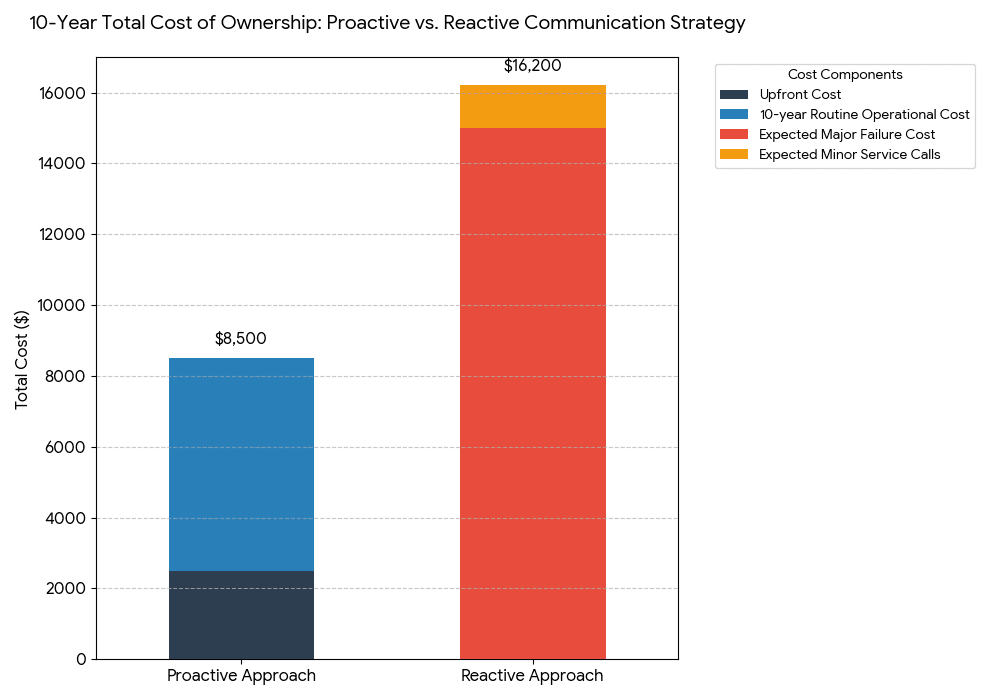
The proactive approach results in a total 10-year cost of $8,500, while the reactive approach produces an expected cost of $16,200.
This yields:
- Net savings: $7,700
- Return on investment: 91%
- Lower risk exposure: predictable costs instead of stochastic failures
Break-even occurs if proactive measures prevent either:
- One $600 service call per year over 10 years ($6,000), or
- A 10% reduction in major failure probability (10% × $25,000 = $2,500)
The proactive strategy exceeds both thresholds comfortably.
Risk-Adjusted Interpretation
- Risk-averse operators find proactive investment optimal regardless of system size.
- Risk-neutral operators see proactive economics dominate for systems above ~20 kWh.
- Risk-seeking operators may accept reactive risk only for sub-10 kWh, non-critical backup systems.
In larger or mission-critical systems, reactive operation is not a cost-saving strategy, it is a deferred liability. Communication failures accumulate invisible damage that surfaces years later as premature capacity fade, denied warranty claims, and costs incorrectly attributed to “battery quality” rather than preventable communication degradation.
Industry Best Practices and Recommendations
Installers should implement three investment tiers. Tier, one applies to all installations regardless of size requiring basic CAN analyzer for commissioning at $200 one-time, termination verification with multimeter at $50, photo documentation of all connections at zero cost using camera phone, commissioning checklist completion taking 30 minutes. Cost per installation: $250 to $300 labor. Prevents 90% of basic configuration errors.
Tier two applies to systems above 20 kWh including everything in tier one plus 24 hours of CAN traffic capture and analysis requiring $200 labor, basic cloud monitoring where customer pays subscription costing installer zero, annual health check offering generating $300 annual revenue. Cost: $500 additional upfront. Prevents 95% of communication-related failures.
Tier three applies to commercial systems above 50 kWh including everything in tier two plus advanced monitoring with custom alerts costing $1,500 to $3,000, quarterly preventive maintenance contract generating ongoing revenue, spare parts inventory including terminators and cables at $500, documented escalation procedures included in service. Cost: $2,000 to $4,000 additional. Prevents 99% of failures while generating ongoing service revenue stream.
System owners should demand monitoring if system exceeds 50 kWh, critical loads depend on battery, remote location exceeds 1 hour from service, extreme climate shows below 0°C or above 40°C regularly, daily cycling for economic return, or business and commercial application. Consider monitoring if system ranges 20 to 50 kWh, daily use but not critical, moderate climate, accessible location. Monitoring optional if system below 20 kWh, backup only with rare cycling, non-critical application, very accessible location.
Manufacturers should provide free diagnostic software for installers, standard CAN message logging capability, clear documentation of expected communication behavior, built-in communication health metrics, remote diagnostic access with customer permission. Economic justification for manufacturers shows reducing support call volume 40% to 60%, improving warranty claim accuracy, building installer loyalty, reducing denied claims disputes. Cost: $50 to $200 per unit in firmware development. Savings: $500 to $2,000 per unit in reduced support costs over product lifetime making investment highly profitable for manufacturers while simultaneously improving installer and customer satisfaction.
Conclusion
Communication reliability has measurable economic value. Spending $1,000-3,000 on monitoring prevents $15,000-25,000 in failure costs over 10 years. ROI: 5:1 residential to 15:1 commercial. Systems above 20 kWh always justify monitoring.
Proactive approach costs $8,500 over 10 years preventing $16,200 reactive costs, saving $7,700 net. Premium installation TCO $22,600 versus budget $30,200 shows 25% savings despite higher upfront.
Poor reliability causes invisible damage. Systems at 92% uptime accumulate stress appearing years later as premature fade. Costs appear as manufacturing defects, not communication problems, without monitoring establishing causation.
Investment priority: quality installation and monitoring first, premium components second, reactive service last. For complete technical context, see Understanding Inverter Battery Communication Protocols in Modern Solar Systems.

Hi, i am Engr. Ubokobong a solar specialist and lithium battery systems engineer, with over five years of practical experience designing, assembling, and analyzing lithium battery packs for solar and energy storage applications, and installation. His interests center on cell architecture, BMS behavior, system reliability, of lithium batteries in off-grid and high-demand environments.