
Architecture Selection at a Glance
| Dimension | Grid-Tied | Hybrid | Off-Grid |
| Grid reliability required | 20+ hours/day reliable | 2 to 16 hours/day | 0 to 2 hours/day |
| Battery bank size | Minimal (backup only) | 0.5 to 1 autonomy day | 2 to 3 autonomy days |
| Generator dependency | None | Low to none | Mandatory backup |
| Capital cost | Lowest | Middle | Highest |
| Best fit: Port Harcourt | Rare most sites unreliable grid | Most residential and commercial sites | Sites with zero or near-zero grid supply |
Introduction
Two identical houses on the same street in Port Harcourt. Same daily energy demand of approximately 5kWh. Same roof space. Same budget of ₦5.5 million. Two different installers. Two different architecture recommendations.
The first installer recommends a grid-tied system the lowest capital cost option, the fastest theoretical payback period, and the architecture he installs most frequently. The second installer recommends an off-grid system with a battery bank and an MPPT charge controller, priced at the same budget with a smaller array to stay within the cost envelope.
Six months later the grid-tied system has produced almost no useful output. The inverter has been shutting down twenty hours a day because the grid its mandatory voltage and frequency reference is absent twenty hours a day. The system is generating solar power during the six hours of grid availability and producing nothing during the twenty hours when the household needs it most. The off-grid system is running every load without interruption, every hour of every day.
The two clients spent the same money and got completely different outcomes because one architecture matched the site conditions and the other did not. Architecture selection is the most important decision in any solar project. Choosing between off-grid vs hybrid vs grid-tied solar systems determines whether your system actually works in real-world conditions.
The Four Inputs That Determine Architecture
Architecture selection is not a matter of preference and it is not determined by budget alone. It is the output of a four-input assessment that, when applied correctly, produces a deterministic recommendation for any site. The four inputs are grid availability, daily energy demand, capital budget, and generator tolerance.
Grid availability is the single most important input and the one most frequently assessed incorrectly. The correct measurement is not whether a grid connection exists it is the number of hours per day the grid delivers power reliably, measured over a minimum 30-day period. A site with a grid connection that delivers 2 hours of power per day is functionally a zero-grid site for architecture selection purposes. Measuring grid availability requires a 30-day log of grid on and off times using a smart plug with logging capability. A client’s verbal estimate is not a reliable input clients consistently overestimate grid hours because they notice when the grid is on and do not systematically record when it is off.
Daily energy demand determines the battery bank size and array capacity. It comes directly from the load audit completed using the methodology in how to do a proper load audit before sizing an off-grid system. The daily energy demand figure is the same regardless of architecture it is a property of the site’s loads, not the system that serves them.
Capital budget constrains which architectures are financially feasible. Budget constraint does not make off-grid wrong for the site. It makes it financially infeasible at the client’s current budget a different problem with different solutions including phased installation, financing, or hybrid architecture with a smaller battery bank.
Generator tolerance is the least technical input and the one most likely to be omitted. A client who lives in a dense residential neighbourhood where generator noise affects neighbours, or who cannot reliably manage generator maintenance, is a client for whom pure off-grid architecture is operationally unsuitable regardless of grid availability. For these clients, hybrid architecture with sufficient battery bank to ride through the typical grid outage period without generator intervention is the correct specification.
| Input | Measurement Method | Typical Port Harcourt Range |
| Grid availability | 30-day on/off log with smart plug | 1 to 6 hours/day for most residential sites |
| Daily energy demand | Load audit with clamp meter | 3,000 to 8,000Wh/day residential |
| Capital budget | Client-stated with financing options explored | ₦3M to ₦10M residential |
| Generator tolerance | Direct client conversation | Highly variable noise, maintenance, fuel access |
Types of Solar Systems Architecture
1. Grid-Tied Architecture
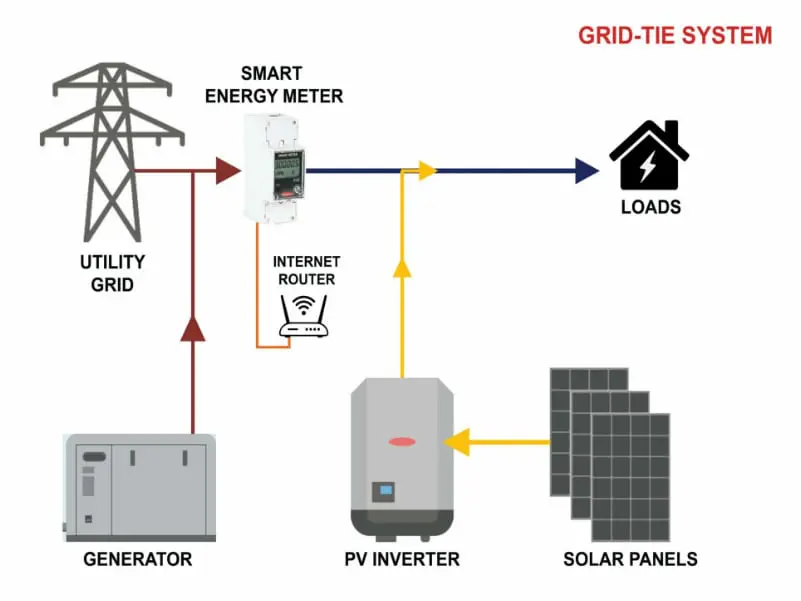
A grid-tied solar system connects the solar array to the utility grid through a grid-tie inverter that converts the array’s DC output to AC power at the grid’s voltage and frequency. The grid-tie inverter uses the grid’s voltage and frequency as its reference signal it synchronises its output to the grid and injects current into the AC circuit, reducing the net current drawn from the utility meter.
The defining characteristic of grid-tied architecture is that the grid-tie inverter has no islanding capability. It cannot operate without the grid’s voltage and frequency reference. When grid power is lost, the inverter shuts down automatically within milliseconds. This is not a design flaw it is a mandatory safety requirement called anti-islanding protection, which prevents the inverter from continuing to energise a section of the distribution network that utility workers may be working on under the assumption that it is de-energised. Anti-islanding is non-negotiable and means that a grid-tied solar system produces zero useful output during a grid outage, regardless of how much solar irradiance is available.
In a market with reliable grid supply 20 or more hours per day with stable voltage and frequency grid-tied architecture produces the most financially efficient solar investment. It requires no battery bank, which is the most expensive component in any solar system, and it requires a simpler and cheaper inverter. The capital cost is typically 40 to 60 percent of an equivalent off-grid system for the same array size.
In Port Harcourt and across most of southern Nigeria, grid-tied architecture is the wrong specification for the vast majority of sites. The grid delivers 1 to 6 hours of power per day for most residential and small commercial customers. A grid-tied inverter that is offline for 18 to 23 hours per day is not a solar investment it is an expensive array of panels feeding an inverter that is switched off. The scenario where grid-tied architecture is the correct specification in the Nigerian market is the minority case: a site on a dedicated feeder or in an area with demonstrably reliable grid supply of 20 or more hours per day, with a net metering agreement in place.
Grid-Tied Architecture When It Is Right and When It Is Wrong
Correct when: grid ≥ 20 hours/day reliably; net metering available; primary objective is bill reduction

Correct when: site on dedicated feeder or private distribution network

Wrong when: grid < 10 hours/day (most Port Harcourt residential sites)

Wrong when: no net metering exported surplus earns nothing

Wrong when: client requires backup power during grid outages

Wrong when: load criticality requires continuous supply
2. Off-Grid Architecture

An off-grid solar system operates entirely independently of the utility grid. The solar array charges the battery bank through the MPPT charge controller during daylight hours. The battery bank supplies the connected loads through the inverter-charger around the clock. The generator provides backup charging when the solar harvest is insufficient. There is no grid connection, no dependency on utility voltage or frequency, and no exposure to grid outages because the grid does not exist in the system’s energy supply chain.
The battery bank must be large enough to carry the site through the worst-case period of low solar harvest without the state of charge falling below the BMS low voltage protection threshold. For coastal West Africa where overcast periods of two to three consecutive days occur several times per year, this means a battery bank sized for two to three autonomy days at the full daily demand. At the cluster system’s 4,916Wh daily demand, this requires four Pylontech US3000C units at minimum a 14.2kWh bank with a daily DoD of 38.5 percent, as established in battery bank sizing for off-grid systems: capacity, BMS selection, and cycle life.
The generator is not optional in an off-grid system. An off-grid system without a generator is a system that sheds load or shuts down whenever the battery bank is depleted during an extended low-solar period. The generator’s sizing and integration must be specified and commissioned as part of the original installation, as covered in generator integration, sizing, and hybrid operation for off-grid solar systems.
Off-grid architecture has the highest capital cost of the three architectures. Against the Port Harcourt generator running cost of ₦5.68 million per year established in off-grid solar vs generator in Nigeria: why generator power costs over ₦5 million per year, the cluster system’s capital cost of ₦5,665,000 has a payback period of approximately one year. Over 15 years, the off-grid system costs approximately ₦10.5 million total against a generator-only TCO of over ₦264 million at 15 percent annual fuel price escalation.
Off-Grid Architecture When It Is Right and When It Is Wrong:
Correct when: grid < 2 hours/day or zero (most Port Harcourt residential and commercial sites)

Correct when: site is remote with no viable grid connection

Correct when: grid connection infrastructure cost exceeds system cost

Correct when: client accepts generator as backup and can manage its maintenance

Wrong when: reliable grid available and client unwilling to pay for battery bank

Wrong when: client cannot or will not manage generator backup
For the complete off-grid system sizing methodology, refer to designing an off-grid power system using lithium batteries and how to do a proper load audit before sizing an off-grid system.
For the complete Off-Grid Solar System Sizing Calculator refer to Off-Grid Solar System Sizing Calculator
3. Hybrid Architecture
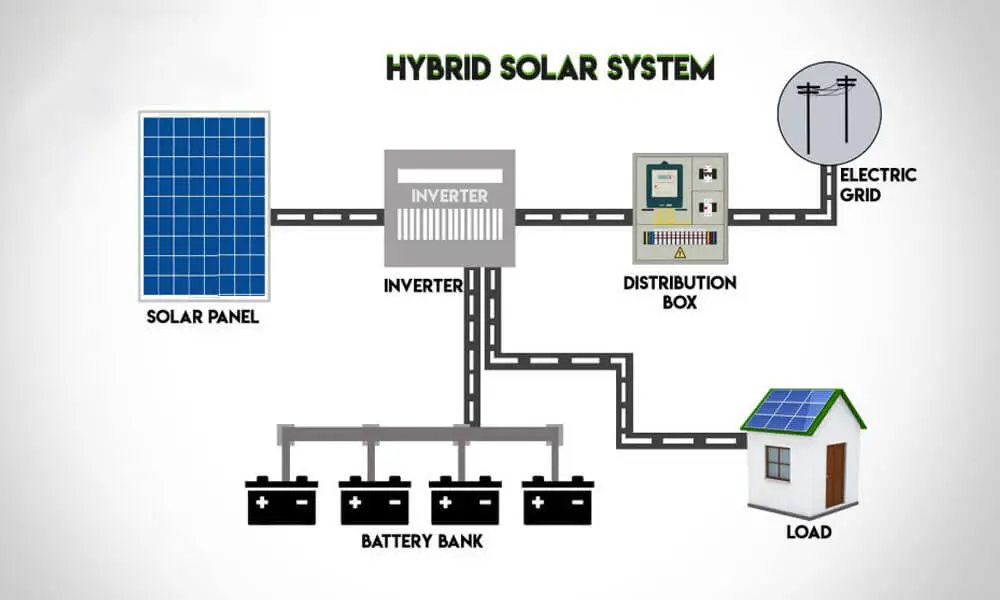
A hybrid solar system combines the energy independence of off-grid architecture with the supplementary charging capability of a grid connection. The solar array charges the battery bank through the MPPT controller during daylight hours. The bidirectional inverter-charger serves the connected loads from the battery bank when grid power is absent, and charges the battery from the grid when grid power is available.
The battery bank sizing advantage is the primary financial argument for hybrid over pure off-grid on a site with intermittent grid supply. In a pure off-grid system the battery bank must carry the site through the worst-case extended low-solar period without any grid supplementation. In a hybrid system the grid provides supplementary charging during its available hours, allowing the bank to be sized for a shorter autonomy period:
Grid supplementary charge contribution (4 hours daily grid supply):

Grid available hours: 4h/day

Battery charge power at AC input limit 8A: 8A x 230V = 1,840W

Daily grid charge energy: 1,840W x 4h = 7,360Wh/day

This exceeds the full daily demand of 4,916Wh.

A 4-hour daily grid supply can fully recharge the battery from 0% SoC in one grid session.

Battery bank can be reduced from 2-day to 0.5-day autonomy specification.

Minimum bank: 4,916Wh x 0.5 / 0.90 = 2,731Wh -> 2 x Pylontech US3000C for redundancy

Capital saving: 2 fewer battery units = ₦1,400,000 reduction in battery cost
The Victron Multiplus-II in ESS mode is the hardware implementation of hybrid architecture on the Victron platform. The hardware is identical to the off-grid Multiplus-II the same unit, the same firmware, the same physical installation. The difference is the operating mode selected in VEConfigure. Switching between the two modes requires a VEConfigure reconfiguration and a grid connection no hardware changes.
The generator elimination potential of hybrid architecture resonates strongly with Port Harcourt clients who cite generator noise, fuel procurement difficulty, and maintenance cost as their primary pain points. On a site with four to six hours of reliable daily grid supply, the grid provides sufficient supplementary charging to keep the battery above the auto-start threshold on most days without the generator starting. At four hours of daily grid supply delivering 7,360Wh of supplementary charge against a 4,916Wh daily demand, the battery bank gains 2,444Wh per day from the grid in addition to whatever the solar array delivers. On all but the most overcast days, this combination eliminates the generator start condition entirely.
Hybrid Architecture When It Is Right and When It Is Wrong:
Correct when: grid 2 to 16 hours/day, reliable during those hours

Correct when: client wants to reduce or eliminate generator dependency

Correct when: budget cannot support full off-grid bank but can support smaller hybrid bank

Correct when: net metering may become available hybrid can be reconfigured to export

Wrong when: grid too unreliable to count on for supplementary charging

Wrong when: zero grid supply off-grid is the correct specification
For the inverter-charger configuration and battery bank sizing that applies to hybrid systems, refer to how to select off-grid inverter: continuous rating, surge, voltage architecture, and BMS communication and battery bank sizing for off-grid systems: capacity, BMS selection, and cycle life.
The Financial Comparison

The financial comparison applies the same TCO methodology from off-grid solar vs generator in Nigeria: why generator power costs over ₦5 million per year to the three site scenarios using the same 4,916Wh daily demand and 15-year assessment period.
Capital Cost Comparison Same Daily Demand, Three Architectures:
Site A: Zero grid -> Pure off-grid

Array (6 x 400W): ₦840,000  |  MPPT 150/60: ₦320,000  |  Multiplus-II 48/3000: ₦680,000

Battery (4 x US3000C): ₦2,800,000  |  Cerbo GX + acc.: ₦370,000  |  Wiring/labour: ₦655,000

  Total: ₦5,665,000
Site B: 4hr grid -> Hybrid

Array (6 x 400W): ₦840,000  |  MPPT 150/60: ₦320,000  |  Multiplus-II 48/3000 ESS: ₦680,000

Battery (2 x US3000C): ₦1,400,000  |  Cerbo GX + acc.: ₦370,000  |  Wiring/labour: ₦655,000

  Total: ₦4,265,000
Site C: 20hr grid -> Grid-tied with battery backup

  Array (6 x 400W): ₦840,000  |  Grid-tie inverter: ₦420,000

  Battery backup (1 x US3000C): ₦700,000  |  Wiring/labour: ₦450,000

  Total: ₦2,410,000
| 15-Year TCO Comparison | Amount |
| Site A (zero grid): Off-grid 15-year TCO | ₦10,515,000 |
| Site A: Generator-only 15-year TCO | ₦264,332,670 |
| Site A: Off-grid advantage over 15 years | ₦253,817,670 |
| Site B (4hr grid): Hybrid 15-year TCO | ₦8,265,000 |
| Site B: Generator-only 15-year TCO | ₦264,332,670 |
| Site B: Hybrid advantage over 15 years | ₦256,067,670 |
| Site C (20hr grid): Grid-tied 15-year TCO | ₦6,410,000 |
| Site C: Utility bill 15-year TCO (15% escalation) | ₦4,500,000 |
| Site C: Net metering credit determines viability | Modest advantage site-specific |
The TCO reversal between capital cost and long-term cost is most dramatic for off-grid and hybrid systems, where the generator running cost being avoided is so large that even the highest-capital-cost architecture pays back within two years. Grid-tied produces the smallest TCO advantage in the Port Harcourt market because the utility electricity tariff being offset is small compared to the generator running cost being avoided by the other two architectures.
The Site Assessment Framework
The four inputs established in Section 1 produce a deterministic architecture recommendation when applied through the following assessment sequence. The sequence is designed to be completed before any component is specified and before any price is quoted.
Step 1: Measure Grid Availability
Install a smart plug with energy logging at the site for a minimum of 30 days. Record the hours per day the grid delivers power. Calculate the average daily grid hours and the worst-case day in the 30-day period. The worst-case day is more important than the average for architecture selection because the battery bank must handle the worst case, not the typical case.
Step 2: Complete the Load Audit
Follow the methodology in how to do a proper load audit before sizing an off-grid system to produce the daily energy demand, peak simultaneous load, and worst-case surge demand. These three figures are required regardless of which architecture is selected.
Step 3: Establish Budget and Generator Tolerance
Confirm the client’s available capital budget and financing options. Confirm the client’s position on generator operation whether they currently run one, whether they are willing to continue, and what constraints exist on generator operation at the site.
Step 4: Apply the Decision Framework
Architecture Decision Framework:
If daily grid hours < 2:-> Pure off-grid; battery 2-3 days; generator mandatory

If daily grid hours 2 to 16:-> Hybrid; battery 0.5-1.5 days; generator optional

If daily grid hours > 16:-> Grid-tied with battery backup; battery 0.3-0.5 days
Budget constraint override:
 If off-grid bank exceeds budget -> specify hybrid with smaller bank

  If hybrid bank still exceeds budget -> phase: array and inverter first, battery in phase 2
Generator tolerance override:
If client cannot manage generator -> specify hybrid regardless of grid hours

Ensure battery covers typical grid outage duration without generator
The upgrade path between architectures on the Victron platform is straightforward. An off-grid system can be upgraded to hybrid by adding a grid connection and reconfiguring the Multiplus-II from off-grid mode to ESS mode in VEConfigure. No hardware changes are required. A hybrid system can be converted to pure off-grid by disconnecting the grid and reconfiguring the operating mode.
Site Assessment Decision Framework:
Step 1 -> measure grid availability: 30-day log, worst-case day identified

Step 2 -> complete load audit: E_daily, P_peak, P_surge documented

Step 3 -> establish budget and generator tolerance: confirmed with client

Step 4 -> apply decision framework: grid hours -> architecture -> battery bank size

Step 5 -> present recommendation with financial comparison

Step 6 -> document site assessment inputs as part of commissioning documentation
Three Worked Scenarios
The site assessment framework applied to three scenarios, all using the same 4,916Wh daily demand.
Site A: Zero Grid Supply Pure Off-Grid
Grid availability: 0 hours/day (confirmed over 30-day measurement)
Decision: grid hours < 2 -> pure off-grid
Specification:

  Array: 6 x 400W (2,400W), 3S2P configuration

  MPPT: Victron SmartSolar MPPT 150/60

  Inverter: Victron Multiplus-II 48/3000 (off-grid mode)

  Battery: 4 x Pylontech US3000C (14.2kWh, 2-day autonomy at 38.5% DoD)

  Communication:Victron Cerbo GX + VE.Can-to-CAN adapter

  Generator: 5kVA petrol, AC input limit 8A, auto-start at 30% SoC

  Capital cost: ₦5,665,000

  Payback: 1.0 year vs generator running cost

  15-year TCO: ₦10,515,000 vs ₦264,332,670 generator TCO
Site B: 4 Hours Daily Grid Hybrid
Grid availability: 4 hours/day average, 2 hours worst-case (30-day measurement)
Generator tolerance: client wants to eliminate generator entirely
Decision: grid hours 2-16 -> hybrid; generator tolerance override -> size for worst-case
Battery sizing for worst-case day without generator:

Grid charge on worst-case day: 1,840W x 2h = 3,680Wh

Solar on worst-case overcast: 1,724W x 0.25 x 5.5h = 2,371Wh

Total supply: 6,051Wh > 4,916Wh daily demand -> no generator start required

Battery: 2 x Pylontech US3000C (7.1kWh, 1-day autonomy)

Specification:

  Array: 6 x 400W (2,400W), 3S2P

  Inverter: Victron Multiplus-II 48/3000 (ESS mode)

  Battery: 2 x Pylontech US3000C (7.1kWh)

  Generator: None eliminated by grid supplementation

  Capital cost: ₦4,265,000

  Saving vs off-grid: ₦1,400,000 (smaller battery bank)

  Payback: 0.75 years vs generator running cost
Site C: 20 Hours Daily Grid Grid-Tied with Battery Backup
Grid availability: 20 hours/day average, 16 hours worst-case
Generator tolerance: client does not want a generator
Decision: grid hours > 16 -> grid-tied with battery backup for outage window
Battery sizing for 4-hour outage window:

Average load during outage: 4,916Wh / 24h = 205W average

Energy during worst-case outage: 205W x 8h (16hr grid = 8hr outage) = 1,640Wh

  Battery: 1 x Pylontech US3000C (3.55kWh) -> 3,195Wh usable -> PASS with margin

Use the Free LiFePO4 Battery Bank Calculator to size your system correctly before installing: LiFePO4 Battery Bank Calculator
Specification:
Array:  6 x 400W (2,400W)

Inverter: 3kW grid-tie + Victron Multiplus-II 48/3000 for backup

Battery: 1 x Pylontech US3000C (3.55kWh, backup for outage window)

Generator: None

Capital cost: ₦2,410,000

  Payback: 2.5 years vs utility bill offset plus export credit

  Note: Viability depends on net metering arrangement with utility
Common Architecture Mistakes
The five architecture mistakes that produce the most expensive field outcomes in the Port Harcourt market are prevented by completing the four-input site assessment in Section 6 before specifying any component.
Mistake 1: Installing Grid-Tied on an Unreliable Grid Site
This is the most expensive architecture mistake in the Nigerian market and the scenario described in the introduction. A grid-tied system on a site with 2 hours of daily grid supply produces approximately 2 hours of useful solar output per day. The corrective action is to add battery storage and a bidirectional inverter-charger which costs more than specifying the correct hybrid architecture from the outset.
Mistake 2: Installing Pure Off-Grid When Hybrid Would Reduce Battery Cost by 50 Percent
A client with 4 hours of reliable daily grid supply who installs a pure off-grid system with a four-unit Pylontech bank has spent ₦1.4 million more on battery capacity than a correctly specified hybrid system requires. The assessment that would have identified this saving takes one additional question: how many hours of grid supply does the site receive?
Mistake 3: Undersizing the Battery Bank in Hybrid Mode
A hybrid system specified with a battery bank sized for the average grid outage duration rather than the worst-case outage duration will reach its BMS low voltage cutoff during the extended outage events that occur several times per year. The battery bank must be sized for the worst-case grid outage at the peak daily load, not the average outage at the average load.
Mistake 4: Specifying Hybrid Without Verifying Grid Stability
A hybrid system on a site where the grid supply is nominally 4 hours per day but the voltage and frequency during those hours are outside the Multiplus-II’s acceptance window produces a system where the grid is present but unusable. The site assessment must include a voltage and frequency measurement during grid-available hours to confirm the supply meets the inverter’s acceptance criteria.
Mistake 5: Omitting the Generator from Off-Grid Specification
An off-grid system without a generator sheds load or shuts down whenever the battery bank is depleted during an extended low-solar period. The generator is a mandatory component of the off-grid architecture whose sizing and integration must be specified and commissioned as part of the original installation.
| Mistake | Cost Impact | Prevention |
| Grid-tied on unreliable grid | Full system cost wasted | Measure grid hours before specifying |
| Off-grid when hybrid sufficient | ₦1.4M+ battery overspend | Check grid hours; specify hybrid if > 2hr/day |
| Hybrid battery undersized for worst-case | System fails on worst outage days | Size for worst-case day, not average |
| Hybrid without grid stability check | Grid present but unusable | Measure V and f during grid hours before specifying |
| Off-grid without generator | Load shedding during low-solar periods | Generator is mandatory; specify and commission it |
Frequently Asked Questions
What is the difference between hybrid and off-grid solar?
An off-grid system operates with no grid connection all energy comes from the solar array, battery bank, and generator backup. A hybrid system has both a battery bank and a grid connection, using the grid as a supplementary charge source during the hours when it is available while maintaining the ability to operate in island mode when the grid is absent. On the Victron platform the hardware is identical the Multiplus-II inverter-charger serves both architectures. The difference is the operating mode configured in VEConfigure and the presence or absence of a grid connection at the AC input terminal.
Can I convert my off-grid system to hybrid later?
Yes, on the Victron platform. Converting an off-grid Multiplus-II system to hybrid ESS mode requires a grid connection at the AC input terminal and a VEConfigure reconfiguration no hardware changes. The battery bank may require assessment to confirm it is adequate for the hybrid operating mode’s autonomy requirement, and if the existing bank was sized for two autonomy days of pure off-grid operation it will be more than adequate for hybrid operation with grid supplementation.
Does grid-tied solar work during a power cut?
No. A standard grid-tied inverter shuts down automatically when grid power is lost. This is the anti-islanding protection requirement mandatory on every grid-tie inverter in every market. A grid-tied system produces zero useful output during a grid outage regardless of solar irradiance. Adding a battery bank and a bidirectional inverter-charger converts the system to hybrid architecture, which can operate in island mode during grid outages.
Which solar system is best for Port Harcourt?
For the majority of Port Harcourt residential and small commercial sites, which receive 1 to 6 hours of grid supply per day, hybrid architecture is the optimal specification. It reduces the battery bank cost compared to pure off-grid, eliminates or significantly reduces generator dependency by using the available grid hours for supplementary charging, and maintains full energy independence during grid outages. Pure off-grid is the correct specification for sites with zero or near-zero grid supply. Grid-tied with battery backup is the correct specification for the minority of Port Harcourt sites with 16 or more hours of reliable daily grid supply typically on dedicated feeders or private distribution networks.
Conclusion
The two clients in the introduction spent the same money and got completely different outcomes. The difference was not the quality of the components, the size of the array, or the experience of the installer. It was the architecture selection the single decision that determines whether a solar investment delivers energy independence or an expensive and underperforming installation.
Architecture selection is a site-specific engineering decision that requires four measured inputs: grid availability, daily energy demand, capital budget, and generator tolerance. The decision framework in Section 6 converts those four inputs into a deterministic architecture recommendation. In Port Harcourt, that recommendation is hybrid for most sites with measurable grid supply, pure off-grid for sites with zero or near-zero grid supply, and grid-tied with battery backup for the minority of sites with genuinely reliable grid supply of 16 or more hours per day.
The financial comparison in Section 5 confirms that all three architectures produce a compelling TCO advantage over continued generator dependence in this market, but the advantage is maximised when the architecture matches the site. A correctly specified hybrid system on a 4-hour grid supply site costs ₦1.4 million less than a pure off-grid system and eliminates the generator entirely. An incorrectly specified grid-tied system on the same site produces no meaningful benefit at any capital cost.
In the final post of this cluster we present the complete cluster index a reading guide for different practitioner types and a summary of every post in the series with its core methodology and key equations.
For the system economics and TCO analysis underpinning the financial comparisons in this post, refer to off-grid solar vs generator in Nigeria: why generator power costs over ₦5 million per year. For the complete off-grid system sizing methodology, refer to designing an off-grid power system using lithium batteries.

I am Engr. Ubokobong Ekpenyong, a solar specialist and lithium battery systems engineer with over five years of hands-on experience designing, assembling, and commissioning off-grid solar and energy storage systems. My work focuses on lithium battery pack architecture, BMS configuration, and system reliability in off-grid and high-demand environments.