How Many Tubular Batteries Equal a 10kWh Lithium Battery?
How many tubular batteries equal a 10kWh lithium battery? This engineering breakdown reveals the real answer using depth of discharge, C-rate, and usable energy not misleading nameplate numbers.
There is a number that has been circulating in Nigerian solar communities for the past few years, repeated in WhatsApp groups, typed into Facebook comment sections, and cited in vendor comparisons as if it were settled engineering fact for this question: How Many Tubular Batteries Equal a 10kWh Lithium Battery
"Four units of 200Ah tubular batteries equals a 10kWh lithium battery."
I understand why it spreads. The nameplate arithmetic is clean: four 12V 200Ah batteries wired in series give you a 48V 200Ah bank, and 48V x 200Ah = 9,600Wh, close enough to 10kWh. It looks right. The problem is that nameplate arithmetic has almost nothing to do with what a battery bank actually delivers to your inverter when Lagos is on hour six of a load-shedding cycle and your critical loads are running.
The comparison fails on two separate engineering grounds: the C-rate derating of tubular batteries under real discharge conditions, and the depth-of-discharge constraint required to get any meaningful service life out of a tubular bank in Nigeria’s climate. When you apply both corrections, the number that emerges is not four batteries. It is not even close to four.
This post walks through the calculation properly, in full. If you are sizing a new system, comparing upgrade options, or trying to understand what your existing battery bank is actually delivering, this is the analysis you need before you commit to a purchase decision.
You need 6–8 units of 200Ah tubular batteries to match a 10kWh lithium battery in usable energy.
What a 10kWh LiFePO4 Battery Actually Delivers: Nameplate vs Usable Energy
Before any comparison is made, the reference point has to be defined correctly. Most people who cite the “4 battery” figure never do this step, and that is where the error begins.
A standard 10kWh LiFePO4 battery is typically a 48V 200Ah pack. The nameplate energy is calculated as 48V multiplied by 200Ah, which gives 9,600Wh or 9.6kWh. Manufacturers round this to 10kWh for marketing purposes. That is the number on the spec sheet. It is not the number that reaches your loads.
What actually reaches your loads is the usable capacity, and that is determined by the depth of discharge the battery is designed to operate at. LiFePO4 chemistry is engineered for deep cycling. A quality LiFePO4 pack rated at 80% depth of discharge delivers 7,680Wh of usable energy per cycle. At 90% depth of discharge, which many premium packs support without meaningful cycle life penalty, that figure rises to 8,640Wh. For the purposes of this analysis, we will use 8,000Wh as a conservative working figure for usable energy from a 10kWh LiFePO4 battery. That is the benchmark every tubular bank in this comparison must match.
This distinction between nameplate and usable capacity is not a minor technical footnote. It is the entire foundation of a correct sizing calculation. A battery bank that cannot deliver 8,000Wh of usable energy per cycle to your inverter is not equivalent to a 10kWh LiFePO4 battery, regardless of what the nameplate says.
The question this post answers is simple: how many 200Ah tubular batteries does it take to reliably deliver 8,000Wh of usable energy per cycle, under real discharge conditions, with a service life that makes the investment rational? For a deeper look at the full battery bank sizing framework including autonomy days and BMS selection, that guide covers the complete three-variable method.
The answer requires two corrections that the “4 battery” comparison never applies. We will take them one at a time.
How Tubular Battery Capacity Actually Works
Every tubular battery you see on the Nigerian market is rated at C20. That single specification is responsible for more oversized quotes, undersized systems, and disappointed customers than almost any other number in the solar industry.
C20 means the battery’s rated capacity is measured by discharging it completely over 20 hours at a low, steady current. A 200Ah tubular battery discharged at the C20 rate draws 10 amps continuously for 20 hours before it is fully depleted. Under those controlled laboratory conditions, it delivers its full 200Ah. That is the number printed on the label.
Your inverter does not discharge your battery at C20.
A typical Nigerian household running an inverter system in the evening has a mix of lights, fans, a television, and possibly a refrigerator. That load profile draws the battery down in 6 to 10 hours, not 20. That is a C10 or C5 discharge rate, and at those rates, a tubular battery does not deliver its nameplate capacity. The electrochemical processes inside a flooded lead-acid cell cannot keep pace with a faster demand. Capacity that exists on paper simply does not make it out of the battery.
The numbers are not theoretical. At C10, a 200Ah tubular battery delivers approximately 176Ah. At C5, which is common in systems with heavier evening loads, that figure drops to approximately 150Ah or below. You have paid for 200Ah. You are getting 150Ah. The remaining 50Ah exists on the spec sheet and nowhere else.
LiFePO4 chemistry does not have this problem to any meaningful degree. A 200Ah LiFePO4 pack delivers close to its rated 200Ah whether you discharge it over 20 hours or 5 hours. The capacity on the label is the capacity available to your system across a wide range of real-world discharge rates. For a full breakdown of how LiFePO4 voltage, capacity, and chemistry behave in service, the lithium battery basics guide covers this in detail.
This C-rate gap alone is enough to invalidate a nameplate-to-nameplate comparison. But it is not the only problem with the tubular bank. The second issue cuts even deeper into the available energy, and it has nothing to do with how fast you discharge the battery. It has to do with how far you are allowed to discharge it at all.
The Depth of Discharge Constraint
If the C-rate problem reduces what a tubular battery can deliver in a single discharge, the depth of discharge constraint determines how much of what remains you are actually permitted to use without destroying the battery prematurely.
Tubular batteries are flooded lead-acid cells. The cycle life of a flooded lead-acid battery is directly and severely affected by how deeply it is discharged on each cycle. Manufacturers publish cycle life figures at various discharge depths, and the relationship is not linear. Discharge a quality tubular battery to 50% depth of discharge consistently, and you can expect somewhere between 1,200 and 1,500 cycles under reasonable conditions.
Push that same battery to 80% depth of discharge regularly, and the cycle count collapses. In Nigeria’s climate, where ambient temperatures routinely exceed 35 degrees Celsius and battery rooms are often poorly ventilated, the degradation at deep discharge is faster still. Heat accelerates the plate corrosion and electrolyte stratification that end a tubular battery’s useful life.
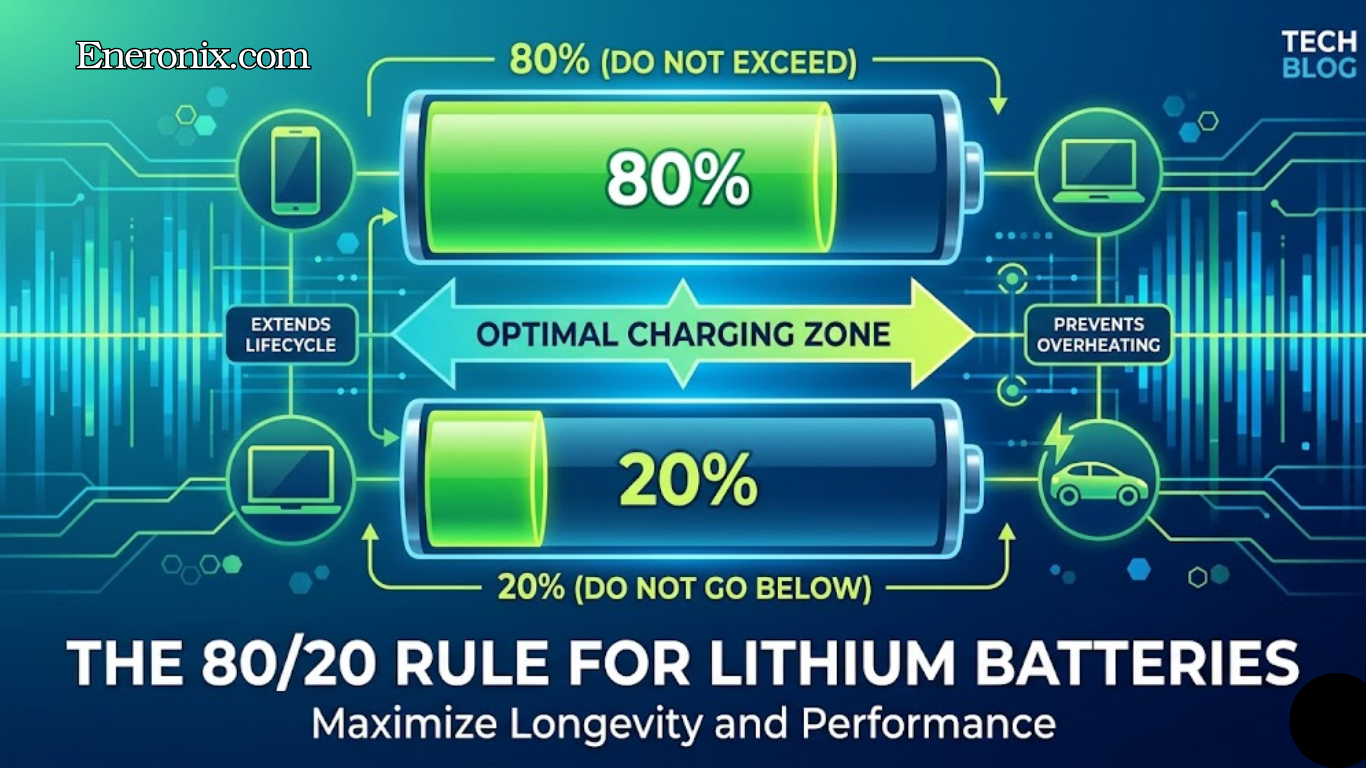
The practical implication is straightforward. To get a service life that makes a tubular battery bank a rational investment, you do not discharge it below 50% of its nameplate capacity. That is the industry-standard recommendation and it is the figure any competent system designer works with. For guidance on how to actively manage depth of discharge to extend battery lifespan, see how to increase lithium battery lifespan, and for the specific 80/20 charging rule that applies to LiFePO4 chemistry, the 80/20 rule for lithium batteries post covers it in full.
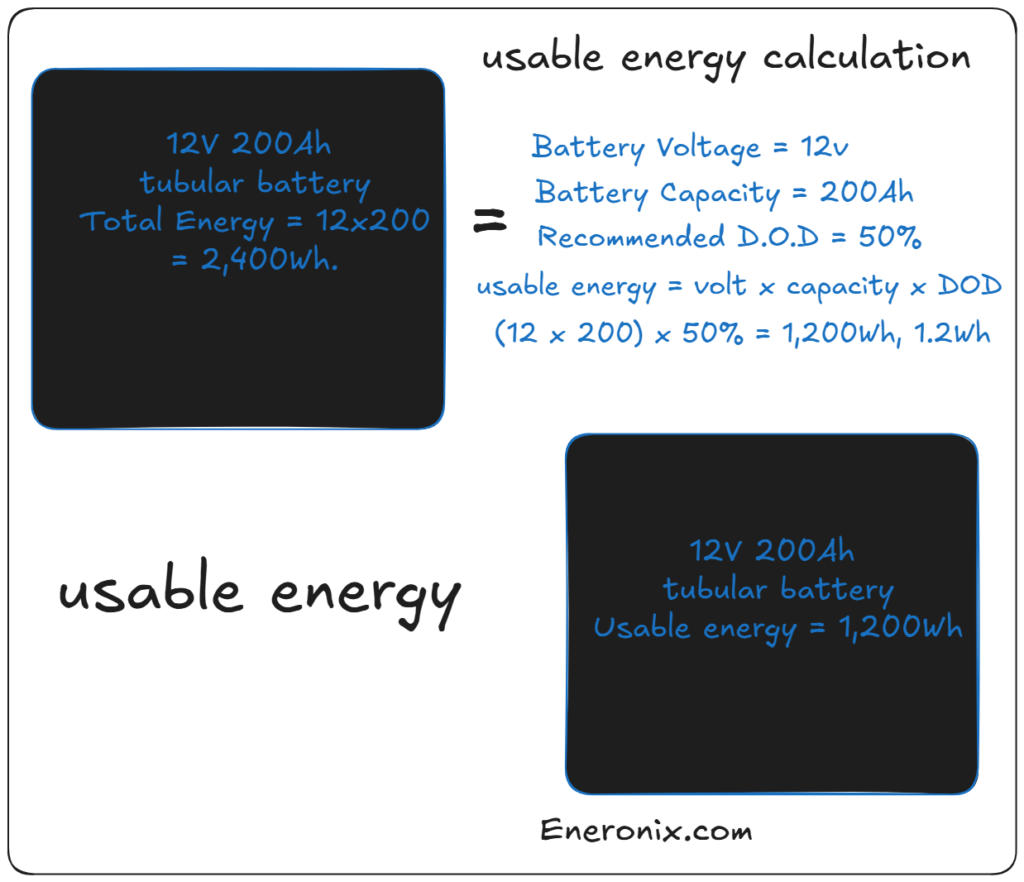
Apply that constraint to a single 12V 200Ah tubular battery and the usable energy calculation becomes: 12V multiplied by 200Ah multiplied by 50%, which gives 1,200Wh or 1.2kWh per battery per cycle.
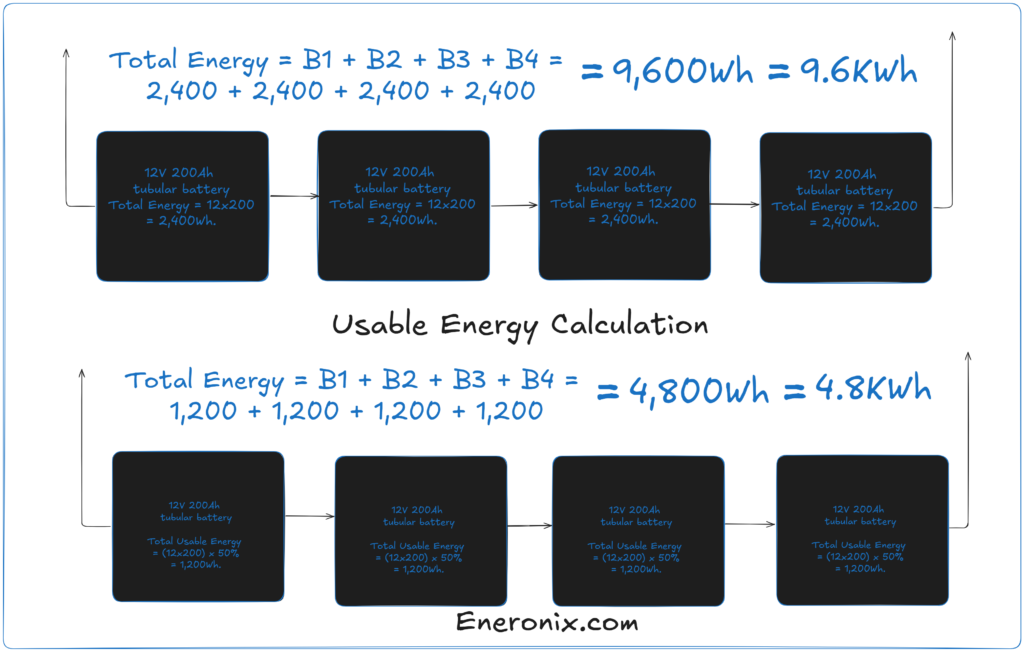
Now scale that to a standard 48V bank, which requires four batteries wired in series. Four batteries at 1.2kWh usable each gives a total usable energy of 4.8kWh per cycle from a bank with a nameplate capacity of 9.6kWh.
Read that again slowly. A four-battery 48V tubular bank with 9.6kWh on the nameplate delivers 4.8kWh of usable energy per cycle when managed correctly. The 10kWh LiFePO4 battery it is being compared to delivers 8,000Wh of usable energy per cycle. Those two things are not equivalent. They are not even in the same category of performance.
This is where the “4 battery” comparison completely falls apart. It takes the nameplate figure of the tubular bank, compares it to the nameplate figure of the lithium pack, and calls it a match. It ignores the fact that you can only safely extract half the nameplate energy from the tubular bank, while the lithium pack delivers 80 to 90 percent of its nameplate as usable energy every single cycle.
The person who buys four tubular batteries expecting 10kWh of storage is not getting 10kWh. They are getting 4.8kWh. They have paid for a system that on paper looks equivalent, and in practice delivers less than 60 percent of what they thought they were buying.
How Many Tubular Batteries You Actually Need
We now have everything required to answer the question properly. The target is 8,000Wh of usable energy per cycle, which is what a 10kWh LiFePO4 battery delivers at 80% depth of discharge. The tubular bank must match that figure under real discharge conditions, managed at 50% depth of discharge to preserve service life.
The formula is straightforward.
Required tubular nameplate capacity equals target usable energy divided by voltage multiplied by allowable depth of discharge.
8,000Wh/(12V x 0.50) = 1,333Ah of total tubular capacity required.
At 200Ah per battery: 1,333Ah divided by 200Ah = 6.67 batteries.
You cannot buy two-thirds of a battery. You round up. The correct answer is a minimum of 7 units of 200Ah tubular batteries to match the usable energy output of a single 10kWh LiFePO4 battery, when both are operated at their recommended discharge limits.
If you are willing to push the tubular bank to 60% depth of discharge and accept a shorter service life in exchange, the calculation shifts. At 60% depth of discharge: 8,000Wh divided by (12V x 0.60) equals 1,111Ah required, which divided by 200Ah gives 5.56 batteries. You round up to 6 units. That is still 50% more batteries than the popular claim suggests, and you are paying for it with accelerated plate degradation in a hot climate.
The honest answer, stated plainly, is this: to match the usable energy of a 10kWh LiFePO4 battery, you need between 6 and 8 units of 200Ah tubular batteries depending on the depth of discharge you apply to the tubular bank. The lower end of that range compromises service life. The upper end protects it.
Four batteries is the answer you get when you compare nameplate to nameplate and apply no engineering corrections whatsoever. It is not a sizing calculation. It is a marketing talking point that happens to use accurate arithmetic to arrive at a misleading conclusion.
To be precise about what four tubular batteries actually gives you: a 48V 200Ah tubular bank at 50% depth of discharge delivers 4.8kWh of usable energy per cycle. That is 3,200Wh short of the 8,000Wh the lithium pack delivers. In a household consuming 8kWh of stored energy per day, that shortfall means your generator is starting hours earlier than you planned, every single evening, for the entire life of the battery bank. At current petrol prices in Nigeria, that gap has a very real naira cost that compounds daily for the next three to five years.
The calculation is not complicated. It just requires that you apply it. Use the LiFePO4 Battery Bank Calculator to run the numbers for your specific load and configuration.
Three More Differences That Matter: Weight, Cycle Life, and Efficiency
The usable energy calculation in Section 5 is the primary argument. But it is not the only one. A buyer comparing four tubular batteries to a single 10kWh LiFePO4 pack is also implicitly comparing two different physical installations, two different maintenance commitments, and two different total costs of ownership over the life of the system. All three of those comparisons run against the tubular bank in ways the nameplate figure does not reveal.
Weight and Physical Footprint
A single 12V 200Ah tubular battery fully loaded with electrolyte weighs approximately 62 kilograms. Four of them weigh approximately 248 kilograms. Seven of them, the minimum number required to match the usable energy of a 10kWh LiFePO4 pack, weigh approximately 434 kilograms. That is nearly half a tonne of battery bank sitting on your floor, on your shelves, or in your battery room, before you add the weight of the rack, the interconnect cables, or the electrolyte topping-up water.
A 48V 200Ah LiFePO4 battery from a quality manufacturer weighs between 50 and 70 kilograms depending on the cell grade and enclosure design. The entire battery sits in a single unit, mounts on a wall bracket or a small floor stand, and occupies a fraction of the space that a seven-battery tubular bank demands.
This is not a trivial distinction in Nigerian installations. Most residential solar setups in Lagos, Port Harcourt, or Abuja do not have dedicated battery rooms. They are installed in store rooms, under staircases, in generator enclosures, or in purpose-built outdoor cabinets. A 434-kilogram battery bank requires structural consideration. It generates significant heat in confined spaces. It needs ventilation for hydrogen off-gassing during charging. The floor load must be evaluated. The lithium pack requires none of those accommodations at the same scale.
Cycle Life and the True Replacement Cost
A quality tubular battery managed correctly at 50% depth of discharge in Nigeria typically delivers between 3 and 5 years of useful service before capacity degradation becomes significant enough to affect system performance. That is the realistic service life figure for daily cycling in our climate. Ambient temperatures between 30 and 40 degrees Celsius year-round, combined with the thermal cycling that comes from being charged by solar and discharged overnight every single day, accelerate lead-acid plate degradation faster than the manufacturers’ datasheets suggest. Those datasheets are tested at 25 degrees Celsius in European or Chinese laboratories, not in a Lagos generator room in March.
A quality LiFePO4 battery properly configured and managed delivers 8 to 12 years of useful service under the same daily cycling conditions. LiFePO4 chemistry is significantly less sensitive to elevated ambient temperatures than lead-acid, and the cycle life degradation curve is flatter. The battery does not suddenly collapse in performance the way a tubular bank does when its plates begin to sulfate.
Over a 10-year ownership period, the arithmetic is straightforward. A tubular bank needs replacing at least once, and more likely twice, within the same period that a single LiFePO4 installation runs to completion. You are not comparing the upfront cost of one option against the other. You are comparing the upfront cost of the lithium pack against the upfront cost plus one or two full replacement cycles for the tubular bank. When you add the labour cost of draining, disposing, transporting, and reinstalling a seven-battery tubular bank in a Nigerian traffic reality, the gap widens further.
Round-Trip Efficiency and the Hidden Solar Loss
Tubular batteries operate at a round-trip energy efficiency of between 75 and 85 percent. What this means in practice is that for every 100Wh your solar array pushes into the battery bank during the day, you recover between 75 and 85Wh when you discharge it at night. The remaining 15 to 25Wh is lost as heat during the charge and discharge process.
LiFePO4 operates at a round-trip efficiency of 95 to 98 percent. For every 100Wh charged, 95 to 98Wh is recovered.
In a system sized for 8kWh of daily consumption, this efficiency gap has a direct consequence for your solar array. To deliver 8kWh of usable energy through a tubular bank operating at 80% round-trip efficiency, your solar array must generate approximately 10kWh per day after all other system losses are accounted for. To deliver the same 8kWh through a LiFePO4 bank at 96% efficiency, your array needs to generate approximately 8.3kWh per day. That difference in required array output must be met by additional solar panels, or by accepting that your tubular system delivers less energy to your loads on days when solar generation is marginal.
In Nigeria, where a cloudy harmattan morning or a late rainy season day already reduces your available solar harvest, that efficiency buffer matters. The tubular bank penalises you twice: once for delivering less usable energy per cycle, and again for wasting more of the solar energy you do capture.
What This Means If You Are Upgrading or Sizing a New System
Everything covered in Sections 2 through 6 converges on a practical decision that people in Nigeria are making right now. Some are sizing a system from scratch and trying to understand what their budget actually buys them. Others are sitting on an existing tubular bank that is three or four years old, performing below expectations, and trying to decide whether to replace it in kind or upgrade to lithium. Both groups are vulnerable to the same mistake: using the “4 battery equals 10kWh lithium” comparison as the basis for their decision.
This section is about what to do with the correct information.
If You Are Sizing a New System
The starting point for any battery sizing decision is your verified daily load in watt-hours. Not an estimate. Not a guess based on what your neighbour said. A proper load audit that lists every appliance, its wattage, and the number of hours per day it runs. If you have not done this yet, the load audit guide on the Eneronix resources page will walk you through the process before you touch any battery calculation.
Once you have your daily load figure, the sizing rule is straightforward. If you are going with LiFePO4, divide your daily load by 0.8 to get the minimum nameplate capacity you need at 80% depth of discharge, then add a system efficiency factor of approximately 1.05 to account for inverter and wiring losses. If you are going with tubular batteries for budget reasons, divide your daily load by 0.5 to get the minimum nameplate capacity at 50% depth of discharge, then apply the same efficiency factor. The difference in nameplate capacity required between the two options is where your money goes, and where your available space goes, and where your replacement budget will go in three to five years.
A quick example using a 5kWh daily load makes the gap concrete. For LiFePO4 at 80% depth of discharge: 5,000Wh divided by 0.8 equals 6,250Wh of nameplate capacity required, which rounds to a 48V 130Ah pack or a 48V 200Ah pack with headroom. For tubular at 50% depth of discharge: 5,000Wh divided by 0.5 equals 10,000Wh of nameplate capacity required, which is approximately four to five 12V 200Ah batteries in a 48V configuration. Same daily load. Significantly different physical and financial commitment, before cycle life and efficiency losses are factored in.
Use the LiFePO4 Battery Bank Calculator to run your specific numbers. It handles the series and parallel configuration, usable kWh output, runtime at different load levels, and charge time from solar, grid, or generator. It will give you a complete bank specification rather than a single number.
If You Are Upgrading From a Tubular Bank
The first thing to understand when upgrading is what your existing tubular bank was actually delivering versus what you thought you were getting. If you installed four 12V 200Ah tubular batteries two or three years ago and your system has been performing below your expectations, the capacity calculations in this post explain why. You were getting approximately 4.8kWh of usable energy on a good day, not 9.6kWh. If your batteries have aged and capacity has degraded further, you may be running on 3kWh or less without realising it.
When you upgrade to a 10kWh LiFePO4 pack, you are not simply replacing like for like. You are increasing your actual usable storage by a factor of roughly 1.6 to 1.7 compared to what the tubular bank was delivering when it was new, and by a larger factor still compared to what it is delivering now. That means your existing solar array, which was sized to charge the tubular bank, may now be undersized for the lithium pack. Before you buy the battery, verify that your array can fully recharge the LiFePO4 bank within a single day of good solar generation.
The calculation is straightforward. A 10kWh LiFePO4 pack depleted to 20% state of charge needs approximately 8kWh of energy input to reach full charge, plus losses. At 96% round-trip efficiency, your array needs to deliver approximately 8.3kWh to the charge controller input on a typical day. In most parts of Nigeria with 4.5 to 5 peak sun hours, that requires a minimum array size of approximately 1,800 to 1,900 watts of installed panel capacity, assuming an 85% MPPT and cable efficiency factor.
If your existing array is smaller than this, you will be chronically undercharging the lithium pack, which is not harmful to LiFePO4 chemistry in the short term but means you are not getting the full benefit of the upgrade.
Use the Off-Grid Solar System Sizing Calculator to verify array adequacy before committing to the upgrade. It takes your location, daily load, battery chemistry, and autonomy days as inputs and outputs a complete system specification including the minimum panel wattage required to fully recharge the bank.
One more point that is specific to Nigerian upgrade scenarios. Many existing tubular installations use inverters that were configured for lead-acid battery profiles, with charge voltage setpoints, absorption timers, and low-voltage cutoffs calibrated for flooded batteries. When you swap in a LiFePO4 pack, those settings must be reconfigured for lithium chemistry. A LiFePO4 battery charged with lead-acid voltage settings will either be chronically undercharged or, in some configurations, pushed beyond its safe upper voltage limit depending on which direction the mismatch runs.
This is one of the most common and most damaging installation errors in Nigerian lithium upgrades. For a full list of the errors that follow people into lithium installations, the top 10 costly off-grid solar mistakes post covers this and the other failure modes in detail. Confirm that your inverter supports LiFePO4 profiles and that the settings are correctly adjusted before the new battery goes online.
Frequently Asked Questions
How many tubular batteries equal a 10kWh lithium battery?
You need 6 to 8 units of 200Ah tubular batteries to match the usable energy of a 10kWh LiFePO4 battery. Four batteries matches the nameplate figure only after applying the 50% depth of discharge limit required for reasonable tubular service life, four batteries delivers only 4.8kWh of usable energy per cycle, not 10kWh.
Why can’t I use the nameplate capacity of tubular batteries for sizing?
Tubular battery nameplate capacity is rated at C20 a 20-hour slow discharge. In real solar systems, discharge happens over 6–10 hours (C5 to C10), at which rate a 200Ah tubular battery delivers only 150–176Ah. Additionally, you should only discharge a tubular battery to 50% depth of discharge to preserve service life, which halves the usable energy further.
What is the usable energy of a 10kWh LiFePO4 battery?
A 10kWh LiFePO4 battery operating at 80% depth of discharge delivers approximately 8,000Wh of usable energy per cycle. At 90% depth of discharge, that rises to around 8,640Wh. LiFePO4 capacity is also largely consistent across discharge rates from C20 down to C5, unlike tubular batteries.
How long do tubular batteries last compared to lithium in Nigeria?
A tubular battery managed at 50% depth of discharge in Nigeria’s tropical climate typically lasts 3–5 years in daily cycling service. A quality LiFePO4 battery in the same application lasts 8–12 years. Over a 10-year period, a tubular bank will likely need replacing once or twice, making the total cost of ownership higher than lithium despite the lower upfront price.
Is it ever better to buy tubular batteries instead of lithium in Nigeria? Yes
in two specific cases. First, if the system cycles infrequently (grid backup only, not daily solar cycling), the lithium cycle life advantage is not fully realised and tubular may make financial sense. Second, if the upfront capital for lithium is not available and a functional system today is more important than optimal long-term cost. Budget constraints are real. The argument here is against using incorrect nameplate comparisons, not against tubular batteries as a category.
Conclusion
This post has covered a lot of ground, but the core argument can be stated in two sentences. To match the usable energy output of a single 10kWh LiFePO4 battery operating at 80% depth of discharge, you need between 6 and 8 units of 200Ah tubular batteries depending on the depth of discharge you are willing to apply to the tubular bank. Four batteries gives you a nameplate match and a real-world shortfall of more than 3,000Wh per cycle.
The “4 battery” answer is not a lie in the arithmetic sense. The nameplate numbers do balance. What it is, is an incomplete calculation presented as a complete one, and in the context of a purchasing decision involving significant money, that incompleteness is not harmless. The person who buys four tubular batteries expecting 10kWh of storage, runs them in a Nigerian climate for three years, and finds themselves replacing a degraded bank while also running their generator more hours per day than they planned, has paid for that incompleteness twice.
The correct comparison between tubular and lithium storage in Nigeria has to account for four variables: usable energy after depth of discharge correction, real delivered capacity after C-rate derating under actual load conditions, cycle life in a tropical operating environment, and round-trip efficiency and its effect on array sizing. When all four are applied, the comparison does not favour four tubular batteries. It does not favour seven of them either, once replacement costs and efficiency losses are compounded over a 10-year ownership period.
This post is not an argument against tubular batteries as a category. There are budget scenarios where a tubular bank is the correct decision, sized honestly and managed correctly. The argument here is against a specific claim that has been repeated so often in Nigerian solar communities that it has started to function as received wisdom rather than engineering. Received wisdom does not keep your loads running at 2am. Correct calculations do.
If this post corrected a comparison you had seen before and accepted, share it in the WhatsApp groups and Facebook communities where the “4 battery” claim circulates. The best way to raise the quality of solar decisions in Nigeria is to raise the quality of the information people are making those decisions with.
I am Engr. Ubokobong Ekpenyong, a solar specialist and lithium battery systems engineer with over five years of hands-on experience designing, assembling, and commissioning off-grid solar and energy storage systems. My work focuses on lithium battery pack architecture, BMS configuration, and system reliability in off-grid and high-demand environments.
ID used to identify users for 24 hours after last activity
24 hours
_gat
Used to monitor number of Google Analytics server requests when using Google Tag Manager
1 minute
_gac_
Contains information related to marketing campaigns of the user. These are shared with Google AdWords / Google Ads when the Google Ads and Google Analytics accounts are linked together.
90 days
__utma
ID used to identify users and sessions
2 years after last activity
__utmt
Used to monitor number of Google Analytics server requests
10 minutes
__utmb
Used to distinguish new sessions and visits. This cookie is set when the GA.js javascript library is loaded and there is no existing __utmb cookie. The cookie is updated every time data is sent to the Google Analytics server.
30 minutes after last activity
__utmc
Used only with old Urchin versions of Google Analytics and not with GA.js. Was used to distinguish between new sessions and visits at the end of a session.
End of session (browser)
__utmz
Contains information about the traffic source or campaign that directed user to the website. The cookie is set when the GA.js javascript is loaded and updated when data is sent to the Google Anaytics server
6 months after last activity
__utmv
Contains custom information set by the web developer via the _setCustomVar method in Google Analytics. This cookie is updated every time new data is sent to the Google Analytics server.
2 years after last activity
__utmx
Used to determine whether a user is included in an A / B or Multivariate test.
18 months
_ga
ID used to identify users
2 years
_gali
Used by Google Analytics to determine which links on a page are being clicked
30 seconds
_ga_
ID used to identify users
2 years
You can find more information in our Cookie Policy and .