
Monocrystalline vs Polycrystalline Solar Panels? Walk into any solar shop in Nigeria and ask the difference between monocrystalline and polycrystalline panels. Most sellers will point at the colour “this black one is mono, this blue one is poly” and leave it there.
That answer is incomplete. And if you buy based on it, you will likely make the wrong decision.
The difference between the two technologies starts at the silicon cell level, and it has direct consequences for how much electricity your panels will actually produce on a Nigerian rooftop.
| What this article covers Crystal structure and why it matters → Why STC ratings are misleading in Nigeria → The temperature coefficient calculation with real Abuja numbers → The harmattan argument settled → 25-year energy yield comparison with naira values → When polycrystalline is still defensible → How to verify what you are actually buying in the Nigerian market |
What Actually Separates Monocrystalline from Polycrystalline
How Crystal Structure Affects Electrical Performance
Both panel types are made from silicon the same base material. What differs is how that silicon is processed before it becomes a solar cell.
Monocrystalline cells are cut from a single, continuous silicon crystal grown through a process called the Czochralski method. The result is a highly uniform crystal lattice atoms arranged in a near-perfect repeating pattern with almost no interruptions.
Polycrystalline cells are made differently. Multiple silicon fragments are melted together and allowed to cool into a solid block. As they cool, different crystal regions form and solidify at slightly different angles. The boundaries where these regions meet are called grain boundaries.
Those grain boundaries are the problem.
When sunlight excites electrons in a solar cell, those electrons need to flow through the silicon to reach the electrical contacts and become usable current. In a monocrystalline cell, they move through a clean, uniform crystal with minimal resistance. In a polycrystalline cell, every time a moving electron reaches a grain boundary, some of it recombines it gets absorbed back into the crystal and is lost as heat rather than electricity.
More grain boundaries means more recombination losses. More recombination losses means lower efficiency. This is why monocrystalline panels consistently achieve module efficiencies of 20–23%, while polycrystalline panels sit at 15–17%.
What You Actually See When Comparing Datasheets

The grain boundary physics shows up clearly when you put two datasheets side by side. Here is a representative comparison of two 400Wp panels in the Nigerian market today:
| Parameter | Mono PERC (400Wp) | Polycrystalline (400Wp) |
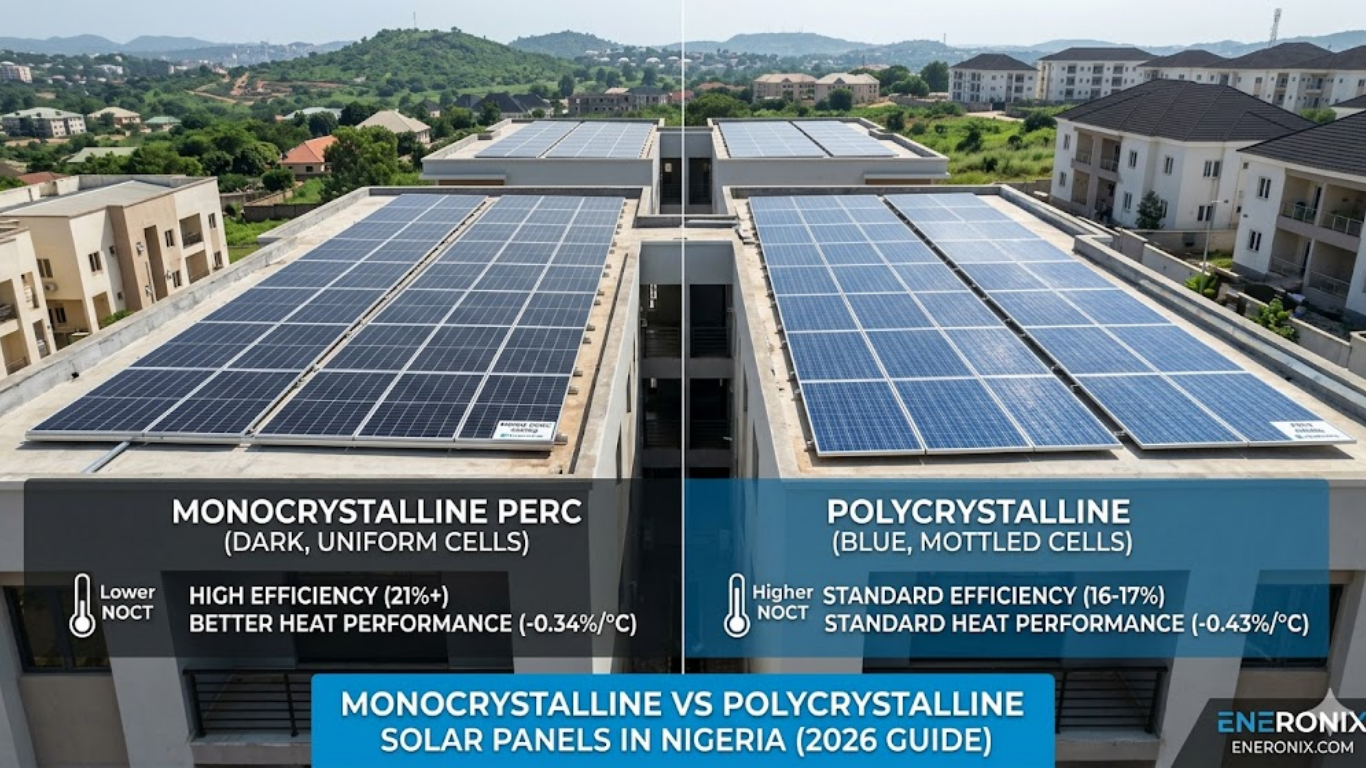
| Module efficiency | 21.3% | 16.8% |
| Temperature coefficient (Pmax) | -0.34%/°C | -0.43%/°C |
| NOCT | 43°C | 46°C |
| Degradation year 1 (LID) | ~0.8% | ~1.5–2.5% |
| Annual degradation (yr 2–25) | ~0.45%/yr | ~0.65%/yr |
| Performance warranty | 86% at 25 years | 80% at 25 years |
| IEC certifications | IEC 61215, IEC 61730 | IEC 61215, IEC 61730 |
Both panels are rated at 400Wp. Both carry the same wattage label. But five of the six key performance parameters favour the monocrystalline panel and in Nigeria’s operating environment, every one of those parameters matters.
For a full explanation of every datasheet parameter and what it means for system sizing, see the Solar Panels in Nigeria: Complete Buyer’s Guide.
Why Standard Test Conditions Are Irrelevant to Nigerian Buyers
Every solar panel sold anywhere in the world is rated under Standard Test Conditions STC. That 400Wp number on the label was measured in a laboratory at exactly 25°C cell temperature, with exactly 1,000 W/m² of irradiance, under a simulated solar spectrum called AM1.5.
Those conditions are precise, repeatable, and almost entirely fictional for a Nigerian installation.
What STC Actually Means and Why It Does Not Apply Here
25°C cell temperature does not mean 25°C ambient air temperature. It means the silicon inside the panel is at 25°C. To achieve that, the air around the panel would need to be well below 20°C cooler than any Nigerian city experiences at any point in the year.
The industry introduced a second test standard called NOCT Nominal Operating Cell Temperature to produce a more realistic benchmark. NOCT is measured at 20°C ambient temperature, 800 W/m² irradiance, and 1 m/s wind speed. Even NOCT is optimistic for Nigerian rooftop conditions, where panels mounted flush on concrete or iron sheet rooftops have restricted airflow underneath.
The practical result: Nigerian panels routinely operate at cell temperatures between 55°C and 75°C during peak sun hours. Not occasionally. Routinely.
How Hot Do Solar Panels Actually Get in Nigeria?
Cell temperature formula: Tcell = Tambient + [(NOCT − 20) / 800] × Irradiance
Worked example Abuja, March (consistently the hottest month in the FCT):
- Ambient temperature: 38°C
- Solar irradiance: 950 W/m²
- Mono PERC NOCT: 43°C
- Poly NOCT: 46°C
| Panel Type | NOCT | Cell Temperature Formula | Result |
| Mono PERC | 43°C | 38 + [(43−20)/800] × 950 | 65.3°C |
| Polycrystalline | 46°C | 38 + [(46−20)/800] × 950 | 68.9°C |
The monocrystalline panel is running at 65°C. The polycrystalline panel is running at nearly 69°C. Both are operating 40–44°C above the STC baseline. That gap above 25°C is where the temperature coefficient does its damage.
For accurate solar array sizing that accounts for real Nigerian operating temperatures, use the Eneronix Off-Grid Solar Sizing Calculator.
The Temperature Coefficient
Most Nigerian solar buyers compare panels by wattage and price. A small number compare efficiency ratings. Almost none look at the temperature coefficient of power. That is the wrong order of priority especially in Nigeria.
The temperature coefficient of power (Pmax) expresses the percentage of rated power the panel loses for every degree Celsius the cell temperature rises above 25°C.
| Panel Type | Typical Pmax Range |
| Monocrystalline PERC | -0.30% to -0.38%/°C |
| Standard polycrystalline | -0.40% to -0.45%/°C |
| Budget / unbranded (any type) | -0.45% to -0.50%/°C |
Worked Example Two 400Wp Panels at Real Nigerian Operating Temperature

Using cell temperatures from the Abuja April scenario above:
| Panel | Cell Temp | Rise Above STC | Pmax Coeff. | Power Loss % | Actual Output |
| Mono PERC | 65.3°C | 40.3°C | -0.34%/°C | 13.7% | 345W |
| Polycrystalline | 68.9°C | 43.9°C | -0.43%/°C | 18.9% | 324W |
Both panels are rated at 400Wp. On the same Abuja rooftop, the mono panel produces 345W and the poly panel produces 324W a 21W gap per panel, every peak sun hour.
| Time Period | Energy Gap (6-panel array) |
| Per peak sun day (5.5 hrs, Abuja) | 693 Wh nearly 0.7 kWh |
| Per year | ~253 kWh |
| Over 10 years | ~2,530 kWh |
| Naira value at ₦1,200/kWh | ~₦3,036,000 over 10 years |
What This Means for Your Battery Charging
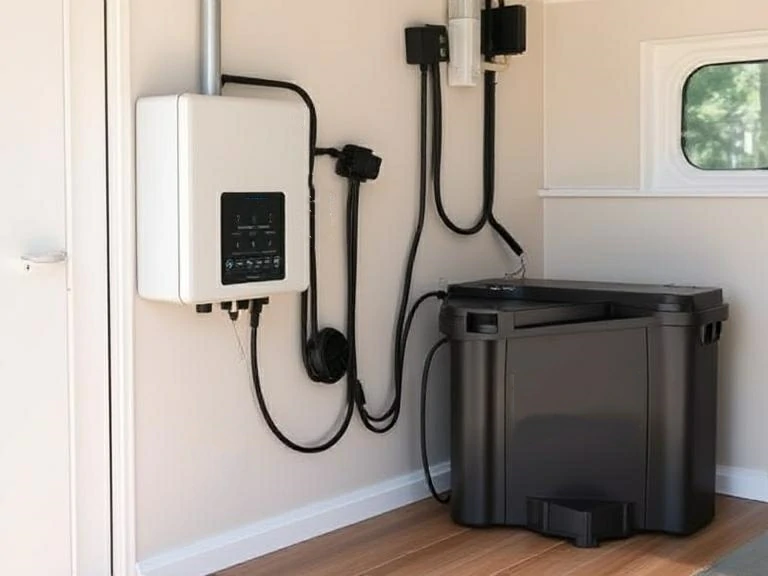
A solar system is sized to charge a specific battery bank within the available peak sun window. When panels consistently underperform their rated output as polycrystalline panels do in Nigerian heat your battery bank receives less energy per day than your system design assumed.
The practical result: your battery runs at a lower average state of charge, cycles deeper, and ages faster. See
How to Increase Lithium Battery Lifespan and Lithium Battery Basics for a detailed treatment of how solar underperformance compounds into battery degradation.
Low-Light Performance Settling the Harmattan Argument
There is a claim that circulates persistently in Nigerian solar circles: “Polycrystalline performs better in low light. So for harmattan season, poly is the smarter choice.” This claim has a historical basis. It is no longer accurate.
The Origin of the Poly-Is-Better-in-Low-Light Claim
Standard monocrystalline cells through the 1990s and 2000s had higher surface reflectance than polycrystalline cells. Under diffuse, low-intensity light, that reflectance meant more photons bounced off the cell surface instead of being absorbed. Polycrystalline cells, with their irregular crystal surface texture, scattered and absorbed diffuse light slightly more effectively in those conditions. That observation was real. The technology that invalidated it has been mainstream for years.
How Modern Mono PERC Panels Actually Perform in Harmattan
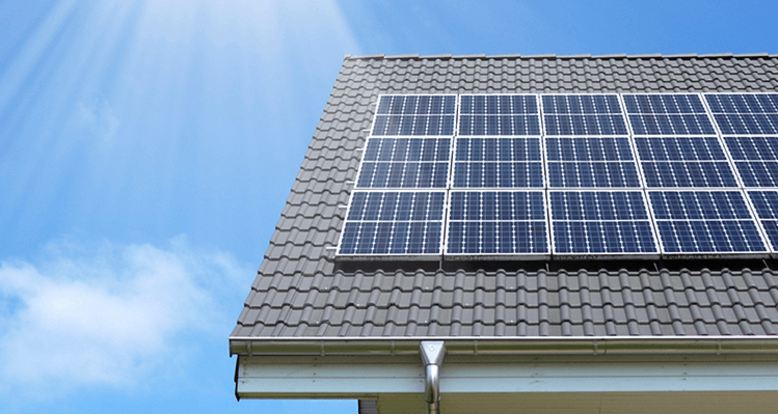
Modern monocrystalline panels virtually every tier-1 and mid-range mono panel available in Nigeria today use PERC technology: Passivated Emitter and Rear Cell. The key innovation is a reflective passivation layer added to the rear of the solar cell.
In a standard solar cell, photons that pass through the silicon without being absorbed exit through the back and are lost as heat. In a PERC cell, the rear passivation layer reflects those unabsorbed photons back through the silicon for a second absorption opportunity. This dramatically improves response at low irradiance levels exactly the diffuse light conditions that characterise harmattan season.
The conclusion is clear: there is no season in Nigeria where polycrystalline panels outperform modern monocrystalline PERC panels. The old argument no longer holds.
For string configuration under harmattan conditions, see Series vs Parallel vs Series-Parallel Solar Array Wiring.
Degradation Over Time The 25-Year Calculation Nobody Does
Most buyers think about the purchase price. Almost none think about what their energy yield looks like in year 15 or year 20. This is the calculation that reframes the entire debate.
Annual Degradation Rates Mono vs Poly
| Panel Type | Annual Degradation | Output at Year 10 | Output at Year 25 |
| Tier-1 mono PERC | ~0.45%/yr | ~95.5% of rated | ~86.6% of rated |
| Standard polycrystalline | ~0.65%/yr | ~93.5% of rated | ~83.8% of rated |
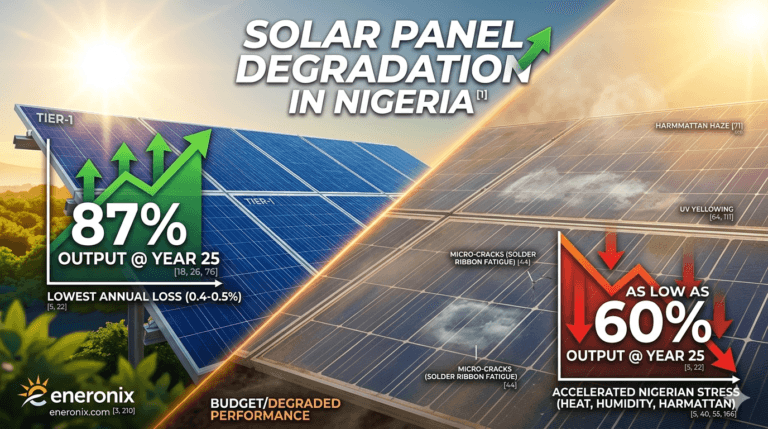
| Budget / unbranded | ~1.0–2.0%/yr | ~80–90% of rated | ~60–75% of rated |
Light Induced Degradation (LID) The First-Week Power Loss
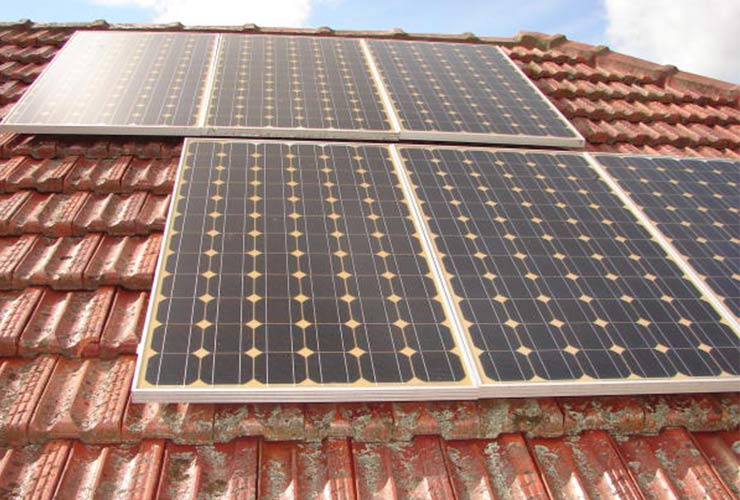
Before annual degradation begins, there is a one-time power loss that occurs in the first hours and days of sun exposure called Light Induced Degradation (LID). Standard polycrystalline panels lose 1.5–2.5% of rated output immediately on first exposure. Modern monocrystalline PERC panels with LID mitigation lose less than 1%.
A budget polycrystalline panel rated at 400Wp may be producing 390W or less by the end of its first week before a single grain of dust has settled on it.
The 25-Year Energy Yield Comparison
Starting conditions: 6-panel array, 400Wp rated output, Lagos (4.5 peak sun hours), temperature derating applied, LID applied in year 1, annual degradation from year 2 onward.
| Period | Mono PERC Array (kWh) | Poly Array (kWh) | Annual Gap (kWh) |
| Year 1 | 3,377 | 3,133 | 244 |
| Year 5 | 3,225 | 2,928 | 297 |
| Year 10 | 3,073 | 2,725 | 348 |
| Year 15 | 2,932 | 2,535 | 397 |
| Year 20 | 2,796 | 2,358 | 438 |
| Year 25 | 2,666 | 2,193 | 473 |
| 25-year TOTAL | ~72,800 kWh | ~65,200 kWh | ~7,600 kWh |
| The naira value of the 25-year gap 7,600 kWh × ₦1,200/kWh = ₦9,120,000 in additional energy value from the monocrystalline array over 25 years. The typical mono vs poly price premium for a 2,400Wp array is ₦480,000–₦960,000. You pay that premium once. You collect the benefit every day for 25 years. |
When Does Polycrystalline Still Make Sense in Nigeria?
An honest engineering assessment does not pretend that one answer fits every situation. There are specific scenarios where polycrystalline remains a defensible choice.
Scenario 1 Short-Term or Temporary Installations
Construction sites, temporary field offices, event infrastructure, or any system designed to operate for five years or less. In these cases, the 25-year yield calculation is irrelevant. If verified poly panels are available at a meaningful cost saving for a short-term application, the economics can support that choice.
Scenario 2 Genuine Budget Constraint Where System Viability Is at Stake
This is the specific situation where the cost difference is the deciding factor between having a functional solar system and having none at all. Even here, the right first step is to verify your load calculation using the Eneronix Off-Grid Solar Sizing Calculator. Many buyers overestimate their load. A correctly sized 4-panel monocrystalline system that covers the actual load beats a 6-panel polycrystalline system sized to an inflated estimate.
Scenario 3 Expanding an Existing Polycrystalline String
Adding monocrystalline panels to an existing poly series string causes technology mismatch different Vmp, different current characteristics, reduced yield from both panel types. The cleanest solution is a dedicated MPPT input for the new panels. If that is not available, match the existing poly technology. See Series vs Parallel vs Series-Parallel Solar Array Wiring and the MPPT Charge Controller Selection Guide for the full technical treatment.
Scenario 4 Verified Tier-1 Mono Supply Is Unavailable
If the only monocrystalline panels available cannot be verified no genuine datasheet, no IEC certification, no traceable serial number then a verified, certified polycrystalline panel from a known brand is the better purchase. A genuine poly panel with real certifications will outperform an unverified mono panel that may be counterfeit or overstated.
How to Verify What You Are Actually Buying in the Nigerian Market
Nigeria’s solar supply chain has a well-documented counterfeiting and misrepresentation problem. Panels are sold as 400Wp that measure 320Wp. Polycrystalline cells are repackaged in black frames to resemble monocrystalline. Certifications are fabricated. Verification is possible and it requires about ten minutes.
Reading the Datasheet Before You Buy

Request the model-specific datasheet not a brand brochure. It must contain all of the following:
- Module efficiency for mono PERC, 19% or above. Any ‘monocrystalline’ panel with efficiency below 18% is almost certainly misclassified.
- Temperature coefficient (Pmax) listed in %/°C. If absent, walk away.
- NOCT 42–45°C for mono PERC, 44–47°C for standard poly.
- Voc, Isc, Vmp, Imp all four electrical parameters must be present.
- IEC 61215 and IEC 61730 both certifications, with the issuing body named (TÜV Rheinland, Bureau Veritas, UL).
Physical Inspection What to Look for on the Panel Itself
- Cell colour and uniformity: Genuine monocrystalline cells are uniformly dark with chamfered (octagonal) corners. Any visible colour mottling means it is not monocrystalline.
- Junction box: Should be firmly attached with an IP67 or IP68 rating stamped on it. A glued junction box with no IP rating is a red flag.
- Serial number verification: Jinko, Longi, and Canadian Solar all operate online portals. Enter the serial number before installation. No result or a mismatched result means counterfeit.
- Pre-installation output test: Measure Voc and Isc with a DC clamp meter before mounting. Compare against datasheet values. Any installer who resists this test is not working in your interest.
For a complete installation quality framework, see the Complete Off-Grid Solar System Design Series and Top 10 Costly Off-Grid Solar Mistakes.
The Verdict Monocrystalline vs Polycrystalline Solar Panels for Nigeria

On temperature performance:
Monocrystalline PERC runs cooler (lower NOCT) and loses less power per degree of heat (lower Pmax). On a Nigerian rooftop at 65–70°C cell temperature, a 400Wp mono panel produces 20–25W more than a 400Wp poly panel. Every day. Every peak sun hour.
On low-light performance:
The claim that polycrystalline outperforms monocrystalline in diffuse light is no longer valid. Modern PERC technology matches or outperforms standard poly at all irradiance levels relevant to Nigerian conditions.
On degradation:
Monocrystalline PERC degrades more slowly (0.45%/yr vs 0.65%/yr), loses less to LID in the first week, and carries stronger performance warranties. Over 25 years, a 6-panel mono array produces ~7,600 kWh more than an equivalent poly array in Lagos conditions worth over ₦9 million at current generator displacement costs.
On cost:
The price premium for mid-range mono over standard poly in Nigeria today is approximately ₦150–250/Wp a one-time additional cost of ₦360,000–₦600,000 for a 2,400Wp array, against a 25-year energy yield advantage worth multiples of that figure.
| Your Situation | Recommended Choice |
| New residential or commercial system, 10+ year lifespan | Monocrystalline PERC tier-1 or verified mid-range |
| Constrained roof space | Monocrystalline PERC higher efficiency per m² |
| Hot location (Abuja, Kano, northern cities) | Monocrystalline PERC temperature advantage is greatest here |
| Coastal/high humidity (Lagos, Port Harcourt) | Mono PERC with IP67+ junction box and verified PID resistance |
| Expanding an existing poly string | Match existing poly OR add mono on a dedicated MPPT input |
| Short-term installation (under 5 years) | Verified poly is acceptable if cost difference is significant |
| Verified mono unavailable | Always choose verified poly over unverified anything |
For the complete framework on sizing your system around verified panel output not STC labels start with the Solar Panels in Nigeria: Complete Buyer’s Guide and use the Eneronix Off-Grid Solar Sizing Calculator to build your system specification from real numbers.
Frequently Asked Questions
1. Is monocrystalline better than polycrystalline in Nigeria?
Yes, for most Nigerian installations. Monocrystalline PERC panels handle heat better due to a lower temperature coefficient, degrade more slowly, and produce more energy per watt over a 25-year system life. The price premium is recoverable within a few years of operation.
2. What is the temperature coefficient and why does it matter in Nigeria?
The temperature coefficient of power (Pmax) tells you how much output a panel loses for every degree Celsius above 25°C. Nigerian rooftop cell temperatures routinely reach 65–70°C. A monocrystalline panel losing 0.34%/°C handles this far better than a polycrystalline panel losing 0.43%/°C a difference that translates to 20–25W less output per panel, every peak sun hour.
3. Do polycrystalline panels really perform better in harmattan?
No. This claim was partially valid for early-generation monocrystalline panels but is no longer accurate. Modern monocrystalline PERC technology matches or outperforms standard polycrystalline at all irradiance levels including diffuse light conditions during harmattan season.
4. How much more energy does monocrystalline produce over 25 years?
For a 6-panel, 400Wp array in Lagos conditions, monocrystalline produces approximately 7,600 kWh more than an equivalent polycrystalline array over 25 years. At current generator displacement costs of ₦1,200/kWh, that gap is worth over ₦9 million.
5. What is NOCT and why does it matter more than STC in Nigeria?
NOCT (Nominal Operating Cell Temperature) is the panel’s cell temperature under more realistic field conditions. It is more relevant than STC for Nigerian buyers because STC assumes 25°C cell temperature, which never occurs on a Nigerian rooftop. A lower NOCT means the panel runs cooler and loses less power to heat.
6. What is LID and how does it affect my panels?
Light Induced Degradation (LID) is a one-time power loss that occurs in the first hours and days of sun exposure. Standard polycrystalline panels lose 1.5–2.5% of rated output immediately. Modern monocrystalline PERC panels with LID mitigation lose less than 1%. This loss is permanent and occurs before any dust, heat cycling, or weather exposure.
7. Can I mix monocrystalline and polycrystalline panels in the same system?
Not in the same series string. Mono and poly panels have different voltage and current characteristics. Mixing them in a series string causes mismatch losses that reduce output from both panel types. If expanding a system with different technology, run the new panels on a separate MPPT input.
8. How do I know if a solar panel sold in Nigeria is genuine?
Request the model-specific datasheet and verify the model number on the manufacturer’s official website. Check that IEC 61215 and IEC 61730 certifications are listed with a named testing body. Enter the panel serial number into the manufacturer’s online verification portal Jinko, Longi, and Canadian Solar all have these. Test Voc and Isc with a clamp meter before installation.
9. Is a cheaper polycrystalline panel worth it if my budget is tight?
Only in specific situations short-term installations under 5 years, or where the cost difference determines whether you can build a functional system at all. For any system intended to run 10 years or more, the 25-year energy yield difference makes monocrystalline the more economical choice despite the higher upfront cost.
10. Which monocrystalline brands are available and trustworthy in Nigeria?
Tier-1 brands with verified Nigerian market presence include Jinko Solar, Longi Green Energy, Canadian Solar, JA Solar, and Risen Energy. All are Chinese-manufactured tier-1 classification is about manufacturing quality and bankability, not country of origin. Verify serial numbers before purchase regardless of brand.
11. Does roof orientation affect whether I should choose mono or poly?
Roof orientation affects total energy yield for both panel types equally. What it does not change is the temperature coefficient advantage of monocrystalline. Even on a perfectly oriented roof, a poly panel in Nigerian heat will produce less per watt of rated capacity than a mono panel in the same position.
12. How does panel choice affect my battery lifespan?
A polycrystalline array that consistently underperforms its rated output means your battery bank receives less charge per day than your system was designed to deliver. Chronic undercharging causes lithium batteries to cycle at lower average states of charge, which accelerates capacity fade over time. Choosing monocrystalline and sizing the array correctly for real operating temperatures protects your battery investment as much as it protects your energy yield.

I am Engr. Ubokobong Ekpenyong, a solar specialist and lithium battery systems engineer with over five years of hands-on experience designing, assembling, and commissioning off-grid solar and energy storage systems. My work focuses on lithium battery pack architecture, BMS configuration, and system reliability in off-grid and high-demand environments.