
Introduction
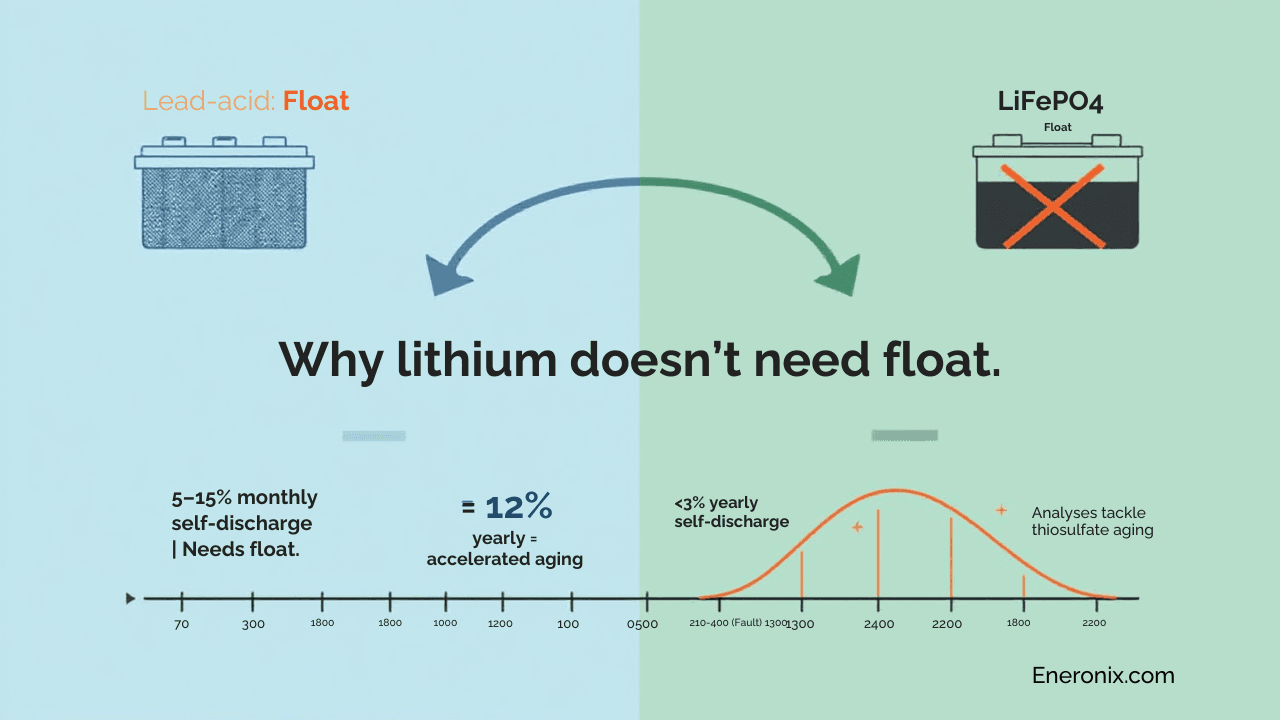
Float charging, is the third stage in the traditional charge controller framework. Installers generally believe its purpose is to maintain battery charge by compensating for self discharge, as required by lead acid batteries. This assumption is correct for lead acid. Lead acid batteries self discharge at a rate of roughly 5 to 15 percent per month due to grid corrosion and other parasitic chemical reactions that continuously consume stored charge. Float provides a small, continuous current that offsets these losses and keeps standby batteries ready for use.
Post 3 explained the absorption stage in lithium charging. Lithium charging reaches approximately 95 percent state of charge within the first ten minutes of the constant voltage phase. The remaining time is not the battery chemistry completing its charge. It is passive balancing circuitry operating at roughly 30 to 100 milliamps to equalize individual cell voltages.
Lithium batteries behave very differently. Typical lithium self discharge is less than 3 percent per year, which is roughly 0.25 percent per month compared to lead acid’s 5 to 15 percent. There is no meaningful loss of charge that requires maintenance.
In a lithium system, float does not maintain the battery. Instead, it holds the cells at elevated voltage for extended periods, typically 13.4 to 13.8 volts for a 12 volt system, or about 3.35 to 3.45 volts per cell. Current flow during float is extremely low, usually only a few milliamps to a few tens of milliamps, and is largely consumed by the BMS quiescent load. The cells themselves are already at equilibrium and are not accepting significant charge. They are simply being held at high voltage and high state of charge, usually between 85 and 95 percent, without any functional benefit.
The consequence is accelerated calendar aging. Prolonged exposure to elevated voltage and high state of charge increases SEI layer growth on the anode, places sustained mechanical stress on cathode particles, and results in gradual lithium inventory loss. This is not immediate damage, but slow and cumulative degradation that builds over years. The practical outcome is a system that reaches end of life in eight to ten years instead of twelve to fifteen years using identical hardware. This represents a 20 to 30 percent reduction in lifespan for no operational gain.
This article explains what float charging was originally designed to do in lead acid standby systems, why lithium batteries do not require it due to negligible self discharge, the calendar aging mechanisms that make float harmful, the charge cycling bounce problem caused by float settings too close to absorption voltage, the limited cases where float may still be justified, such as grid tied backup or critical systems, and practical configuration options to reduce damage when float cannot be disabled.
Part1: Lead-Acid vs Lithium Charging: Key Differences
Part 2: What’s Really Happening During Bulk Charging in Lithium Battery
Part 3: 5 Critical Truths About Absorption Stage in Lithium Batteries
TL; DR
Float charging accelerates lithium battery aging by 20-30% for zero benefit.
Lithium self-discharge: <3% annually (lead-acid: 5-15% monthly). Nothing to maintain. Float holds cells at elevated voltage (13.6V+) and high SOC (85-95%) for hours daily, accelerating calendar aging through SEI layer growth and cathode particle stress.
Calendar aging impact: Systems with float enabled lose 12-18% capacity by year 5 vs. 5-8% without float. Same cells, same cycling, only difference is float configuration.
Charge cycling bounce: Float set too close to absorption (<0.6V separation) causes 10-20 charge restarts daily from small loads. BMS relay wear, voltage stress, 2-3× higher failure rate.
Configuration priority:
- Best: Disable float, re-bulk trigger 13.0-13.2V
- Acceptable: Low float 13.2-13.4V (not 13.6-13.8V default)
- Special case: Float = absorption only if bounce confirmed AND loads discharge battery within 2 hours
Float rarely justified: Grid-tied backup (weeks between cycles), critical systems (instant availability required). NOT for off-grid daily cycling, RV/mobile, regularly-cycled systems.
Result: Disabling or minimizing float extends pack life 20-30%. System lasting 12-15 years instead of 8-10 years from same hardware.
What Float Was Designed to Do for Lead-Acid
The Lead-Acid Self-Discharge Problem
Lead-acid batteries lose 5-15% charge monthly sitting idle. Grid corrosion: lead grids supporting active material slowly corrode in sulfuric acid electrolyte. Creates parasitic electrochemical reactions consuming stored charge continuously. Not from powering loads, just internal chemical degradation.
Standby applications (UPS systems, emergency lighting, backup power): battery must be ready when needed. Leave fully charged lead-acid disconnected for 3 months, returns at 50-60% SOC. Six months: 30-40% SOC, possibly sulfated beyond recovery. Battery wasn’t used, just sat corroding internally.
This makes lead-acid unsuitable for long-term standby without maintenance. Emergency power system checked annually finds dead battery when actually needed. Unacceptable for critical applications.
How Float Charging Solves This
Float provides continuous trickle current at reduced voltage. Typical: 13.2-13.8V for 12V batteries (2.23-2.30V/cell). Current exactly balances self-discharge rate. Battery stays at full charge indefinitely.
Voltage calibration critical. Too high: continuous overcharge, water electrolysis, grid corrosion acceleration, thermal runaway risk in sealed batteries. Too low: self-discharge exceeds float current, battery slowly depletes despite being on float.
Optimal float voltage depends on temperature, battery age, electrolyte specific gravity. Manufacturers specify narrow range (±0.1V) for reason. Operating outside this accelerates degradation or fails to maintain charge.
This is genuine maintenance. Float actively fights ongoing chemical process (grid corrosion) that would otherwise discharge battery. Without float, standby lead-acid batteries require manual charging every 4-6 weeks. Float eliminates this, keeps battery ready continuously.
Why Lithium Doesn’t Need Float
1. Negligible Self-Discharge Rate
LiFePO₄ self-discharge: <3% annually (0.25% monthly). Compare to lead-acid’s 5-15% monthly. Mechanism completely different. Lead-acid loses charge from grid corrosion, ongoing electrochemical reaction. Lithium loses trace amounts from side reactions at SEI (Solid Electrolyte Interphase) layer on anode surface.
SEI layer forms during initial cycles from electrolyte decomposition. Passive film that prevents continuous electrolyte breakdown. Once formed, remains relatively stable. Consumes tiny amount of lithium over time through parasitic reactions, but rate negligible for practical purposes.
Example: Fully charged LiFePO₄ pack, disconnected, left 6 months. Returns at 97-99% SOC. Lead-acid same conditions: 50-60% SOC. Field observation: seasonal off-grid cabins, batteries sit unused 4-6 months winter. Return in spring at essentially full charge, no maintenance charging required.
Nothing to maintain. No parasitic drain requiring compensation. No ongoing corrosion consuming charge.
What Float Actually Does to Lithium
Float voltage (13.4-13.8V typical for 12V systems) holds cells at 3.35-3.45V/cell. Battery at 85-95% SOC continuously. Current flow: milliamps to tens of milliamps total.
Most current: BMS quiescent draw. Microcontroller, voltage monitoring circuits, FET drivers consume 10-50mA continuously just to keep BMS operational. Cells themselves at equilibrium. Minimal lithium ion movement. Not accepting meaningful charge, not compensating for self-discharge (essentially zero).
Not providing useful function. Just holding cells at elevated voltage and high SOC for hours daily.
Off-grid solar system example: Charges to full by 10am on sunny days. Sits at float 13.6V from 10am-6pm. 8 hours daily at elevated voltage = 2,920 hours annually. Multiply by system lifespan: 15,000-30,000+ hours at unnecessary elevated voltage and high SOC.
This prolonged high-voltage, high-SOC exposure accelerates calendar aging through SEI layer growth and cathode particle stress. Not chemistry requiring maintenance current. Chemistry being stressed unnecessarily.
Why Float Is Harmful
1.Calendar Aging
What Is Calendar Aging?
Calendar aging, is the capacity loss from time at voltage/temperature, independent of cycling. Distinct from cycle aging (capacity loss from charge/discharge cycles). Both occur simultaneously in operating systems, but mechanisms different.
Calendar aging mechanisms: SEI layer growth, cathode particle cracking, lithium inventory loss, electrolyte decomposition. Rate depends on voltage level, SOC level, temperature, time duration.
Research data: cells at 3.60V age 20-30% faster than cells at 3.30V. Cells at 90% SOC age faster than cells at 50% SOC. Temperature accelerates exponentially: 10°C increase roughly doubles aging rate (Arrhenius relationship).
Float keeps cells at elevated voltage (3.35-3.45V) + high SOC (85-95%) + ambient temperature continuously. Maximizes calendar aging rate for no operational benefit.
2. SEI Layer Growth at Elevated Voltage
SEI (Solid Electrolyte Interphase) is the passive film on anode surface, it forms during initial cycles from electrolyte decomposition. Necessary for cell function, prevents continuous electrolyte breakdown. Ionically conductive, electronically insulating. Allows lithium ions through, blocks electrons.
Layer continues growing slowly at elevated voltage. Growth consumes lithium and electrolyte irreversibly. Each molecule incorporated into SEI permanently lost from active cycling. Thicker SEI = higher ionic impedance = capacity loss and power fade.
Growth rate increases exponentially with voltage. Holding at 3.40V (typical float) grows SEI significantly faster than cycling between 3.20-3.35V (typical operational range). Hours daily at float voltage compounds this. 2,920 hours annually at elevated voltage accelerates SEI thickening.
After 2-3 years: measurable capacity loss (3-5%) attributable to SEI growth. After 5 years: 10-15% capacity loss from calendar aging alone, separate from cycle degradation. This is on top of normal cycle aging.
3. High-SOC Stress on Cathode
LiFePO₄ cathode particles undergo volume changes during lithium extraction/insertion. At high SOC (>90%): lithium depleted from cathode structure, particle lattice contracts. Creates mechanical stress in crystalline structure.
Prolonged time at high SOC maintains this contracted, stressed state. Float at 85-95% SOC keeps cathode particles under tension for hours daily. Microcracking develops in particles over time from sustained stress. Cracks propagate along grain boundaries, eventually isolating portions of active material.
Isolated material electrically disconnected from current collector. Still present, no longer accessible. Appears as capacity loss. Irreversible damage.
Cycling between 20-80% SOC minimizes time at stress extremes (both high and low SOC create stress, middle range optimal). Float holds cells at upper stress extreme continuously.
Cumulative stress over years: particle degradation, capacity fade. Not dramatic rate, 1-2% annually, but adds to SEI aging. Combined effect: float-enabled system might lose 12-18% capacity by year 5. System without float (or low float voltage): 5-8% loss same timeframe.
Same cells, same cycling pattern, only difference is float configuration. 10% additional capacity loss over 5 years from elevated voltage exposure during standby.
The Charge Cycling Bounce Problem
What Is Charge Cycling Bounce?
Occurs when float voltage set too close to bulk/absorption voltage. Example: absorption 14.4V, float 13.8V (only 0.6V separation).
Scenario: Charging completes, controller drops to float 13.8V. Small load starts (refrigerator compressor, water pump, inverter load spike): pulls pack voltage to 13.7V momentarily. Controller sees voltage below float target, interprets as battery needing recharge, restarts bulk phase.
Current slams in (30-50A depending on available power), voltage rises rapidly to 14.4V. Controller transitions to absorption. Absorption completes quickly (current already low, battery nearly full). Drops back to float 13.8V.
10 minutes later, another load event. Cycle repeats.
Instead of one charge session per day: 10-20 bulk/float/bulk transitions. Battery monitor shows repeated charging despite being full. Customer sees “battery charging all afternoon even though it’s 100%.”
Why This Is Problematic
Each transition creates current surge when bulk restarts. 0A to 50A instantaneous step. Voltage spike when absorption reached. 13.7V to 14.4V in seconds.
BMS relay cycling: charge FETs opening/closing repeatedly. Electromechanical relays: mechanical wear on contacts, contact erosion from arcing during switching under load. Solid-state FETs: thermal cycling from on/off transitions, junction temperature swings.
Repeated voltage swings stress cells more than steady float. Voltage cycling between 13.7V and 14.4V (0.7V range) creates ion concentration gradients that relax and rebuild repeatedly. More disruptive to equilibrium than holding steady voltage.
Customer sees erratic charging behavior. Battery monitor shows charge/discharge cycles despite no net energy movement. Confusing, looks like equipment malfunction.
Over months: relay contact wear or FET degradation from cycling. BMS may develop intermittent connection issues. Contacts weld partially, resistance increases, heat generation accelerates wear. Or FETs develop increased on-resistance from thermal stress, eventually fail shorted or open.
Not immediate failure. Wear accumulation over 1-2 years. Then sudden BMS failure requiring replacement. Appears random to customer, actually predictable from charge cycling bounce configuration.
Field observation: Systems with 0.4-0.6V float/absorption separation show BMS relay failures 2-3× more frequently than systems with proper separation (1.0V+) or float disabled. Failure mode: intermittent charging (relay contacts degraded), or complete charge path failure (FET failure). Replacing BMS without fixing configuration: same failure repeats in 12-18 months.
When Does Float Actually Make Sense for Lithium?
1. Grid-tied backup systems (rarely cycle):
Battery sits weeks or months between power outages. Even 3% annual self-discharge means 0.75% loss over 3 months. For critical backup, finding battery at 97% instead of 100% might matter. Float at low voltage (13.2-13.4V) ensures readiness without manual intervention checks. Accept aging trade-off for operational convenience. Better than finding battery at 92-95% SOC during multi-day outage.
2. Critical backup requiring instant availability:
Medical equipment backup, communications systems, emergency lighting where milliseconds matter. Cannot tolerate even 0.1V voltage sag on connection. Float keeps battery at high SOC for instant full-power response without voltage recovery delay. Calendar aging accepted as cost of mission-critical readiness.
These systems typically replaced on scheduled intervals (5-7 years) regardless of remaining capacity. Calendar aging from float doesn’t matter when replacement triggered by compliance/warranty schedules, not capacity degradation.
NOT legitimate for:
- Off-grid daily cycling: Battery cycles daily, doesn’t sit idle for weeks. No need for maintenance current between daily charge cycles.
- RV/mobile: Battery cycles regularly during use, disconnects when vehicle/system not in use. Self-discharge during storage negligible.
- Any system where battery cycles weekly or more frequently: Regular cycling maintains charge, float provides no benefit.
When Float Is Just Bad Configuration
Most lithium installations:
Float charging provides no functional benefit in lithium systems and introduces measurable long term harm. It is commonly enabled because installers apply lead acid charging assumptions to lithium batteries, because charge controllers default to float mode, or because the installer is unaware that float can be disabled and leaves factory settings unchanged.
The result is thousands of hours per year with the battery held at elevated voltage. In a typical off grid solar system, the battery reaches full charge by mid morning and then remains on float until late afternoon. Eight hours per day at float corresponds to approximately 2,920 hours of elevated voltage exposure per year. Over a five year period, this accumulates to more than 14,600 hours of unnecessary high voltage operation.
The impact is accelerated calendar aging and a measurable reduction in usable service life. Systems that could reasonably operate for twelve to fifteen years often reach end of life in eight to ten years under otherwise identical conditions. This represents a 20 to 30 percent reduction in lifespan attributable solely to float configuration, not to increased cycling or higher energy throughput.
This is not a debatable optimization or a marginal tuning choice. It is a clear trade off with a known cost in calendar aging and no compensating benefit, as lithium self discharge is already negligible. Disabling float, where the controller allows it, directly extends battery life without changing system performance or availability.
Float Configuration Options
Option 1: Disable Float Entirely (Best for Longevity)
If controller supports, disable float completely. Set re-bulk trigger voltage: 13.0-13.2V (pack voltage where charging restarts).
Battery charges to absorption voltage, controller exits absorption (timer or tail current), then stops charging entirely. Voltage settles to open-circuit equilibrium, typically 13.3-13.4V at high SOC. No continuous voltage applied. Battery rests at natural equilibrium between charge cycles.
When loads pull voltage down to 13.0-13.2V re-bulk threshold, charging restarts. Might be hours later, might be next day, depends on load pattern.
Minimizes time at elevated voltage. Battery spends most time at lower resting voltage (13.3V) rather than sustained float voltage (13.6V+). Maximizes calendar life.
This requires controller with float disable option + adjustable re-bulk voltage threshold. Not all controllers support this. Check specifications before purchasing. Common limitation on lower-cost controllers.
Option 2: Low Float Voltage (Compromise)
If float must be enabled, set as low as controller allows. Target: 13.2-13.4V (3.30-3.35V/cell). Much lower than typical 13.6-13.8V default settings.
Holds cells at lower voltage than standard float, reduces calendar aging rate. Not as good as no float (cells at equilibrium), but significantly better than high float.
Battery settles at 80-85% SOC instead of 90-95%. For oversized banks (common in off-grid design, 20-30% oversizing typical): this capacity reduction acceptable. Bank sized for 100% DOD capability rarely sees below 40-50% SOC in practice.
And this will require controllers with adjustable float voltage. Verify minimum settable float voltage before selecting controller. Some allow 13.0V minimum, others 13.4V minimum, some fixed at 13.6V with no adjustment.
Option 3: Float Equals Absorption (Prevents Bounce)
Set float = absorption voltage (14.2-14.4V). Eliminates voltage drop between stages. Once absorption completes, controller “stays” at absorption voltage as float voltage. No transition, no voltage change to trigger bulk restart.
Advantage:
Prevents charge cycling bounce completely. No voltage drop means small loads can’t pull voltage below float threshold. Eliminates relay cycling and repeated charge/discharge events.
Disadvantage:
Holds cells at high voltage (3.55-3.60V) continuously after charging completes. Worst option for calendar aging unless loads discharge battery within 1-2 hours of charge completion.
Only use when: Charge cycling bounce confirmed (monitor showing 10+ charge cycles daily) AND significant afternoon loads reliably discharge battery soon after charging. Not for systems where battery sits full 4-6 hours daily at absorption voltage. Calendar aging acceleration too severe.
Recommended Float Configurations
Decision Tree by Application
1. Off-grid daily cycling:
- First choice: Disable float, re-bulk trigger 13.0-13.2V
- Second choice: Low float 13.2-13.4V
- Never: High float (13.6-13.8V) or float = absorption
- Reasoning: Battery cycles daily, no need for maintenance current between cycles. Minimize voltage exposure.
2. RV/Mobile:
- First choice: Float = absorption (prevents bounce during travel vibration/varying loads)
- Acceptable: Low float 13.2-13.4V
- Reasoning: Road vibration and intermittent loads during travel create charge cycling conditions. Float = absorption prevents relay cycling. Battery discharges regularly during use, not sitting at high SOC continuously.
3. Grid-tied backup:
- Acceptable: Low float 13.2-13.4V (maintains readiness)
- Reasoning: Rare cycling, operational convenience of guaranteed readiness justifies minor aging trade-off. Alternative requires manual quarterly charging checks.
4. Systems with confirmed charge cycling bounce:
- Float = absorption (14.2-14.4V) if loads discharge battery within 2 hours post-charge
- Otherwise: Increase float/absorption separation to 1.0V+ by lowering float to 13.2-13.4V
- Reasoning: Prevents relay wear and voltage cycling stress. Choose lesser of two evils based on load pattern.
Configuration Steps
- Check if float can be disabled:
- Controller manual: search for “float disable,” “maintenance-free mode,” “lithium mode with float off”
- If yes: disable, set re-bulk trigger 13.0-13.2V, done
- If no: proceed to step 2
- Determine lowest settable float voltage:
- Check controller specifications or settings menu
- Some allow 13.0V minimum, others 13.4V minimum, some fixed at 13.6V
- Set to lowest available value
- If fixed above 13.4V: consider different controller for lithium applications
- Verify separation from absorption voltage:
- Calculate: Absorption voltage – Float voltage
- Should be ≥1.0V for reliable operation without bounce
- If <0.6V: expect charge cycling bounce within weeks
- Either lower float (preferred) or accept bounce risk
- Monitor behavior first 48 hours post-configuration:
- Watch for repeated charge restarts (indicates cycling bounce)
- Check cell temperatures during float period (should be ambient ±2°C, not elevated)
- Listen for BMS relay clicking (audible indication of cycling)
- If bounce observed: adjust float/absorption separation immediately
Conclusion
The float stage exists because lead acid batteries self discharge rapidly, typically losing 5 to 15 percent of their charge each month due to grid corrosion and ongoing parasitic chemical reactions. Continuous trickle current offsets this loss and keeps standby lead acid batteries ready for use. For that chemistry, float is a genuine and necessary maintenance function.
Lithium batteries behave fundamentally differently. Typical lithium self discharge is less than 3 percent per year, leaving no meaningful charge loss that requires compensation. When float is applied to lithium systems, it does not maintain the battery. Instead, it holds the cells at elevated voltage, usually 13.4 to 13.8 volts in a 12 volt system, and at high state of charge for hours each day. Current flow during this period is minimal and largely limited to the BMS quiescent load, while the cells themselves remain at equilibrium and accept no significant charge.
This operating condition accelerates calendar aging through two dominant mechanisms. Elevated voltage promotes continued growth of the solid electrolyte interphase layer on the anode, irreversibly consuming lithium and increasing internal resistance. Prolonged high state of charge places sustained mechanical stress on the cathode structure, leading to particle microcracking and loss of active material. Both published research trends and consistent field observations show that lithium systems left on float experience approximately 20 to 30 percent faster capacity fade than comparable systems configured without float. Over a five year period, this often translates to roughly 85 percent remaining capacity with float enabled versus 92 to 95 percent without it.
Float configuration also introduces a secondary and often overlooked failure mode: charge cycling bounce. When float voltage is set too close to absorption, typically with less than 0.6 volts of separation, small load events repeatedly trigger bulk restarts. Instead of one charge cycle per day, the system may initiate ten to twenty cycles. This results in unnecessary voltage cycling, increased stress on the cells, accelerated wear of BMS relays or switching devices, and higher failure rates. Field experience consistently shows BMS failures occurring two to three times more frequently in systems with inadequate separation between absorption and float.
For lithium systems, float is rarely justified. Limited exceptions include grid tied backup installations that may sit unused for extended periods and mission critical systems where guaranteed instant readiness outweighs long term degradation. Float is not justified for off grid systems that cycle daily, RV and mobile applications, or any regularly cycled battery system.
The configuration priority is therefore clear. The preferred approach is to disable float entirely where the charge controller allows it and use a re bulk trigger around 13.0 to 13.2 volts. If float cannot be disabled, it should be set as low as the controller permits, typically in the range of 13.2 to 13.4 volts. Using float equal to absorption should only be considered when charge cycling bounce is confirmed and the battery reliably discharges within a short period after reaching full charge, as this configuration minimizes cycling at the cost of increased calendar aging.
This conclusion completes a four part series examining why lithium batteries are routinely misconfigured using charging logic developed for lead acid chemistry. The series showed that lithium follows a two stage constant current and constant voltage charging profile, that bulk charging delivers most usable capacity rapidly, that absorption time is primarily balancing time rather than additional charging, and that float charging solves a problem lithium batteries do not have.
Taken together, these stages are best understood as a translation layer imposed by legacy charge controllers rather than an ideal representation of lithium chemistry. Configuring them based on lithium behavior rather than lead acid assumptions is the difference between systems that reach end of life in eight to ten years and systems that operate reliably for twelve to fifteen years using the same hardware.

I am Engr. Ubokobong Ekpenyong, a solar specialist and lithium battery systems engineer with over five years of hands-on experience designing, assembling, and commissioning off-grid solar and energy storage systems. My work focuses on lithium battery pack architecture, BMS configuration, and system reliability in off-grid and high-demand environments.